
By Marc S. Sanders
I’m a sucker for a good caper. Capers play like strategy games. An object (Hitchcock called them MacGuffins) needs to be acquired. It doesn’t matter so much what the object is. The importance falls within the pursuit.
William Goldman wrote The Hot Rock, adapted from a novel by Donald E Westlake who penned a series of books focusing on the ex-convict John Dortmunder and his further adventures. In the film, he’s played by Robert Redford.
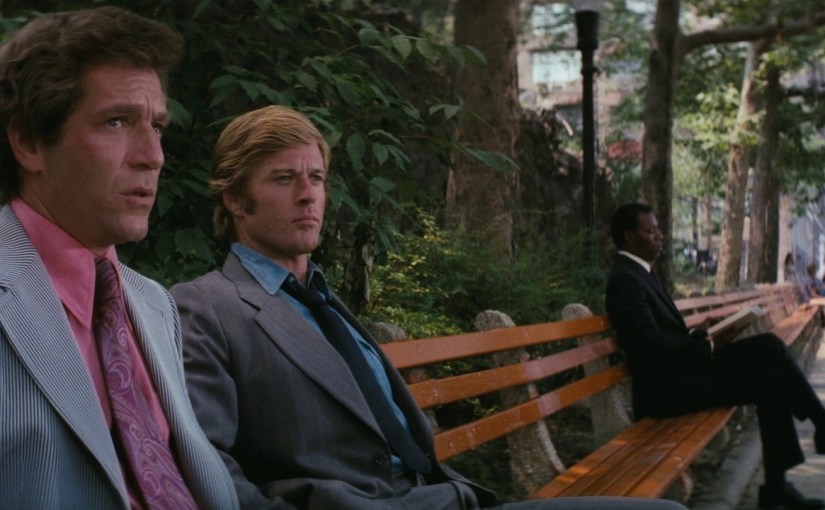
On the day that John is released from a New York state prison he’s picked up by his inept brother-in-law Kelp (George Seagel) who escorts him to Central Park. Kelp wants John to be the fourth member of a team and steal a priceless diamond. A man by the name of Dr. Amusa (Moses Gunn) sits about five feet away from them on a park bench. Amusa breaks it down for the men, but they get interrupted by an elderly woman who sits between them to feed the pigeons. This is what you can expect from The Hot Rock, a film structured under one pesky inconvenience after another.
This rock is currently on display at the Brooklyn Museum, on loan by an African country who has no business having possession of the valuable. The stone belongs with Amusa’s country and he’s ready to pay Kelp and his crew $25,000 each to pull of the heist. He’ll also, reluctantly, front some funding monies ahead of the theft for preparations.
Like in all of these kinds of movies, John is ready to do one last job. Then he’s out for good. However, one last job turns into four last jobs. Without spoiling too much, the rock gets relocated from one place to another. So, a late-night heist at the museum turns into a break in a prison, and then it’s somewhere else and somewhere else after that.
As Hitchcock describes, you never care about the MacGuffin. For movie purposes, you see it on display in its majestic glory, encased in a glass box right in the center of the museum, but so what. The question is to uncover how the guys are going to get it out of there. The Hot Rock doesn’t work nice and neatly like Ocean’s 11 or The Score. In those movies, there are things that don’t go according to plan. In The Hot Rock, nothing goes the way it should. Honestly though, it should be funnier than it really is.
I recall there was a movie called Quick Change with Bill Murray doing his best to get out of New York City following a bank robbery. It was comedic all the way through and maybe that’s because it was Bill Murray of Caddyshack and Ghostbusters fame, not to mention Saturday Night Live. Robert Redford is the rugged actor of the time in 1972, though. Not a comic and he plays Dortmunder like a serious kind of thief, even with his famous blond locks and toothy grin. George Segal along with Ron Leibman and Paul Sand are bumbling chatter mouths, but are they funny? Segal’s character steals a car to pick up John and we see him trying to figure out how to drive the dang thing, nearly running over Redford. I never believed he did not know how to not drive the car.
BY THE WAY: Ever notice in movies that they’ll show someone does not know how to drive a car by having them accidentally turn on the windshield wipers? That’s all that is done. That and having the car drive in S shape patterns as if the steering wheel suddenly took on a life of its own. Then the scene comes to a halt with a startling slam on the brakes. Never fails. This happens over and over again in the movies.
Zero Mostel appears as the father/attorney for Paul Sand’s character. It’s Zero Mostel, but Goldman’s script doesn’t give him much material to play with. It’s not a silly caper flick because suddenly Zero Mostel of The Producers makes an appearance. Look at Ocean’s 11, and see what Carl Reiner is doing. There’s an organic affection for Reiner’s character that Mostel never achieves here.
Peter Yates directed The Hot Rock a couple of years after the car chase thriller, Bullitt with Steve McQueen. He impressed audiences with what two cars pursuing one another across the hilly streets of San Francisco could accomplish. In this film from the early 1970s, Yates attempts to dazzle the audience with a few more speeding car stunts but they just don’t cut the corners. Everything on screen looks like Yates and his crew are trying too hard. There’s a helicopter sequence and much time is devoted to seeing how the chopper flies low over the Hudson River and then soars above the Twin Towers, still under construction at the time. Look everyone! Ron Leibman is flying a helicopter and Robert Redford and the rest look woozy about it all. Thing is that James Bond movies were already doing this kind of schtick (with special effects) year after year by this time. Peter Yates just doesn’t offer up anything that looks like a new sensation.
I’m actually surprised The Hot Rock has not been remade like Ocean’s 11 or The Italian Job. In this film, the tools and skills are left to the guys and their cons. There’s no computer overrides or laser sensors to assist them. Today, all of the techno stuff would be there with lots of closeups of fingers tapping away on a keyboard and then data entries appearing on a monitor. In between, would be the comedy and would you believe of all people, I thought Will Farrell would be the guy to play the straight man and lead the charge. The comedy of the situations would remain, but the thieves would be nerdy geniuses, each having their unique abilities and quirks.
The set up is there for a remake. Who you cast and what is done with it is up to the filmmakers.

 2 UNPAID MOVIE CRITICS!!!!