THE COLOR OF MONEY

By Marc S. Sanders

The Color Of Money is the first and only time that director Martin Scorsese tackled a sequel of sorts.  Paul Newman returned to the screen as Fast Eddie Felson, the hustling pool shark from thirty years prior in The Hustler.  That movie established his career on a bigger scale going forward.

Fast Eddie is older now, and wiser.  He’s much more humbled as a bar owner with a conservative amount of cash on the table to stake younger pool players for small time wagers.  A young John Turturro is who he relies on and quickly loses faith in when a brash, cocky kid named Vincent Lauria (a perfectly cast Tom Cruise) easily undoes his opponent. 

Eddie sees the talent in the kid.  He’s got a helluva break and clears a game of nine ball with as much speed as he has conceit.  What he lacks for in brains and instinct is made up in Vincent’s cool and mature girlfriend Carmen (Mary Elizabeth Mastrantonio in an Oscar nominated role).  It does not take long for Eddie to coach her into realizing that together they can make a lot of money off of what Vincent can do in pool halls across the country.  If only he’d listen to them and do what they tell him to do. Vincent can’t comprehend how sometimes you win a whole lot more, when you lose first.

Scorsese works his camera like a swinging Steadicam.  When he gets close ups of this trio of actors, it’s never just a close up.  He’ll position his lens in a northward direction and then swing around east.  Newman, Cruise and Mastrantonio trust the eye of the camera to follow their performances.  There’s an energy to this kind of shooting.  It makes for a great style.  Scorsese was doing this novel kind of filmmaking, going all the way back to 1971 with Alice Doesn’t Live Here Anymore.  The director is so favored because as typical as a script might seem by its title or its prose, he’s going to find an exhilaration to its narrative.

Along with the director’s resident editor Thelma Schoonmaker, there’s a crackle and quickness to the many variations of pool play – much more playing than I believe was featured in The Hustler.  Schoonmaker makes sure to cut in the cracks of the pool balls as they collide with one another.  The blue cue chalk snows off the tip of the cue sticks.  Reflections of the players appear in the shine of the balls.  Close up profiles of Cruise and Newman lower down into frame just before they take their shots.  Before the kinetic energy found in later films like Goodfellas and The Departed, Scorsese and Schoonmaker were already putting their tag team best at play in The Color Of Money.

Yet, all of this is style with not so much substance.  What kind of story does this next installment in the legacy of Fast Eddie Felson have to say?  Not much really.  While the three actors are doing top notch work, the conversations run very repetitive and do not build toward higher stakes or developments.  Time and again they argue over Vincent’s refusal or naivety to understand the hustling strategies that Eddie has in mind.  Carmen gets it but she goes her own way more often than cooperating with Eddie.  Simply, this is a story of the protégé not grasping what the mentor is trying to teach, and it never evolves from that problem.  It gets stagnant.

What changes within the second half of the film is the introduction of a championship pool tournament in Atlantic City.  Therefore, it’s easy to expect a showdown between Vincent and Eddie.  It happens and there is a twist of a dagger included, but then when the real competition is about to begin, Scorsese concludes his film.  Does it matter who is the better player?  I don’t know, but as the film is wrapping itself up, one character gets short changed.  When that’s discovered, the film opts to also shortchange the audience.  I didn’t think that was very fair.

I think about the notorious ending to the HBO series The Sopranos.  Sure, it’s an ending no one will ever forget but for all the wrong reasons, and I defiantly believe it is because the storyteller ran out of imagination or lost his confidence in upholding an ending that he really wanted.  I feel the same way with The Color Of Money.  The film establishes the skills, intelligence and capabilities of these characters.  Yet, when you take the tool kits away from them, the building never gets completed; only left abandoned.

I’m drawn to watch The Color Of Money.  Michael Ballhaus’ photography is smokey and colorful. I can’t get enough of Paul Newman’s gravelly vocal inflections or even how he unfolds hundred dollar bills from the roll in his pocket.  Tom Cruise humbles himself to look like an idiotic jerk and it works well against the maturity of his scene partners.  Mary Elizabeth Mastrantonio oozes sexual appeal with a lot of brains to uphold the cons.  She has sensational scenes with Paul Newman.  There’s a coolness to the picture because of the cast, the settings, the sounds, the visuals, the editing and the direction. 

This film arrived in 1986 with rock music from the likes of Eric Clapton and Phil Collins.  Beyond Miami Vice and an assortment of John Hughes teen flicks, these artists were making for effective needle drops of atmosphere in films from the 1980s.  Scorsese’s use of the camera keeps me engaged, but when I look at what the characters are anchored to only do, and never rise above, the film does not hold the weight of other character studies that several of Newman’s and Scorsese’s pictures were so astute at achieving.

One scene transcends the arc of Newman’s character and it works beautifully within or out of the context of the picture.  A relatively unknown Forest Whittaker portrays an unlikely kid who goes up against Fast Eddie. As the long scene evolves over their pool competition, the writing hearkens back to the weaknesses and torment that defined Eddie Felson’s character in The Hustler.  If you watch the first film and then jump over to this scene, you recognize a connection for the protagonist of both pictures.  Beyond that The Hustler and The Color Of Money stand a long distance apart from each other.  This scene though is always a favorite of mine for the eventual Oscar winner, Forest Whittaker.  Watch how Whitaker holds his cue stick when he exits the scene.  Think about how he picks the cash up from the table after Newman drops it.  Consider, what his character Amos really means when he asks Eddie: “Do you think I need to lose some weight?”

Had The Color Of Money used more of Whitaker’s character in the film along with the other three, there might have been something more solid to say and introduce within the world of pool hustling with a 1980s barroom vibe.  Same could be said if John Turturro’s character was utilized more.

Paul Newman received the Oscar for this picture.  The actor was nominated seven times before, having never won and the irony is by the time this nomination arrived, Newman opted not to attend the ceremony.  Roles in films like The Verdict (for which he should have won the award) and Cool Hand Luke were much more memorable and fleshed out.  I’d argue Newman likely knew this was not his best performance because it was not the best written of his long-established career, and so he genuinely did not expect to win.  Because he won, it became a celebration of his legendary status as an actor who should have been taken much more seriously, much sooner.   (Two more nominations would follow in Newman’s career.)

THE BREAKFAST CLUB

By Marc S. Sanders

The outcry of teen angst in the 1980s comes through predominantly in the dramatic talking piece called The Breakfast Club.  I look at the film as a mature interpretation of Charles Schultz’ Peanuts Gang actually, and maybe an extension of some of the themes found in Steven Spielberg’s E.T. The Extra-Terrestrial.  The children are heard.  The adults are present but are mostly muffled and out of consideration.  Writer/Director John Hughes wanted the five teenagers destined to occupy a Saturday in the school library for detention to completely undo their armor.  With adults in the way, kids can never truly be themselves.  Lies, exaggerations and attempts at acceptable image come first but as his script progresses, the teens are reduced to expressing how they value themselves and each other. 

Having grown up watching The Breakfast Club by myself on many Friday nights after some challenging weeks of school, I was always looking to sit on the floor with this pack and share my own demons and fears.  Sometimes it worked.  Sometimes I felt as if the brain (Anthony Michael Hall, as Brian), the athlete (Emilio Estevez as Andrew), the basket case (Ally Sheedy as Allison), the princess (Molly Ringwald as Claire) and the criminal (Judd Nelson as John) spoke back to me and told me when I was wrong or when I was justified for having felt like I did. 

Nearly forty years later, some of the thought processes the five endure of themselves seems outdated and inappropriate, however.  For example, in Hughes’ film the female characters are sexually harassed, harshly criticized and/or they succumb to stepping outside their comfort zone and changing their appearance to please a male character.  Had this film been released in a post Me Too era, I think both sides of the political aisle would protest its content.  The Breakfast Club is certainly a movie of its day where it’s treated as comedic escapism to have Nelson’s character commit a fellatio act upon Ringwald’s panty covered crotch.  Do not mistake me.  I am not crying foul and demanding censorship or calling for torches and pitchforks.  The contents of The Breakfast Club should certainly remain preserved and viewed upon as what was a mindset of films in the 1980s, and perhaps how the opposite sexes treated one another then.  Sadly, it is still happening all too often.

The success of the film relies upon the differences in the characters.  None of them have the same interests.  Yet, if you allow them to live among themselves without any outside influences, they will open up to one another.  Hughes’ film begins where the characters hardly speak.  John gets the ball rolling as the troublemaker looking for shock value as he attempts to urinate on the floor in front of the others and then succeeds in unifying the students when he causes the library door to remain shut keeping Mr. Vernon (Paul Gleason), the teacher/antagonist, out of reach of them.  Why should the five work together against Mr. Vernon?  They don’t know or have respect for each other.  Why?  Because one generation will stand arm and arm against another generation, specifically a domineering entity. 

Now that they are isolated, Hughes writes in set ups allowing the five to shed their skin.  In one scene, the ladies empty the contents of their purses while the men’s wallets are exposed.  John sleeps around.  Allison may be mentally ill.  Claire lives off the vanity that comes with makeup and perfumes.  Brian’s middle name is revealed.  (“Ralph, as in puke.”)  The kids lie about their sexual conquests only to be cornered into telling how little experience some of them actually have.  Maybe the most common plane they share are their home lives.  Each uncovers how they relate to their parents and none of them have an ideal upbringing.  Rather, they are disregarded or abused or forced into an appearance they really are not passionate about.  Before the film ends, the five will have their battle cry of dancing individually first, and then lined up together, unified, to a song titled, We Are Not Alone

Hughes even allows enough time and subtlety to demonstrate how Mr. Vernon seems to suffer.  There’s a quick moment, where Vernon commits John to two months of detention.  As Vernon storms out of the room, John screams out “Fuck You!” and Hughes keeps a closeup on Vernon letting out a weary sigh.  His exhaustion of being the authoritative adult is wearing on him.  Yet, after twenty-two years of teaching it is also the only pedestal he has left to stand on; to rule over five misfits on a boring isolated Saturday.  Later, he’ll only feel his most powerful when he has John imprisoned away from the others and he can antagonize and threaten him with the intent of elevating his stature over a punk kid.  (Ironically, this moment also reveals how weak John is and not the intimidating bully he holds himself to be in front of the others.)  Later, Vernon tells the janitor how he’ll have to worry about these kids growing up to look after him when he is elderly.  He’s been so occupied with being sadistically cruel, he has not allowed time to carve out a balanced future.

The Breakfast Club is an important piece to watch for uncovering teenage mentality and the subconsciousness.  How do teenagers function by themselves, with outsiders, with their peers, and with their parents?  What’s best celebrated in many of John Hughes’ films are when he allows his characters not to hinder how they truly regard one another.  While I won’t spoil how these five consider each other by the end of this particular Saturday, as an adult and one who analyzes story more carefully than I did at age fourteen, I am disappointed with how Hughes concludes his film.  At least for four of the characters, it doesn’t seem right.  While I’m let down though, that doesn’t mean the movie is wrong. 

Teenagers will not always act upon what is right or more precisely what they know to be right or just.  Our teenage years are an opportunity to commit and then learn from our mistakes.  In our adolescent years, we explore what is forbidden with misbehavior and risk whether it be rebelling against authority, daring to drink and do drugs, acting upon sexual impulse or exacting bullying and peer pressure.  Even sneaking through the hallways around school is a game of cat and mouse where the goal is not to get caught by the teacher.

I’m inclined to recommend that parents watch The Breakfast Club with their kids when they are mature enough for the material.  Yet, I really don’t want to.  The whole point of the film is to cut off these kids from the outside world of parents and teachers and peers who expect something different of them than how they truly see themselves.  If my daughter were to watch this movie with mom and dad sitting right next to her, then she might not unequivocally respond to what Andrew, Claire, Allison, Brian and John really have to say.  To get in their minds, my daughter would have to watch without any outside influence where the conversation she has with the film is private between The Breakfast Club and her.  Perhaps, then she’ll see another teenager’s honest point of view.

CODE OF SILENCE

By Marc S. Sanders

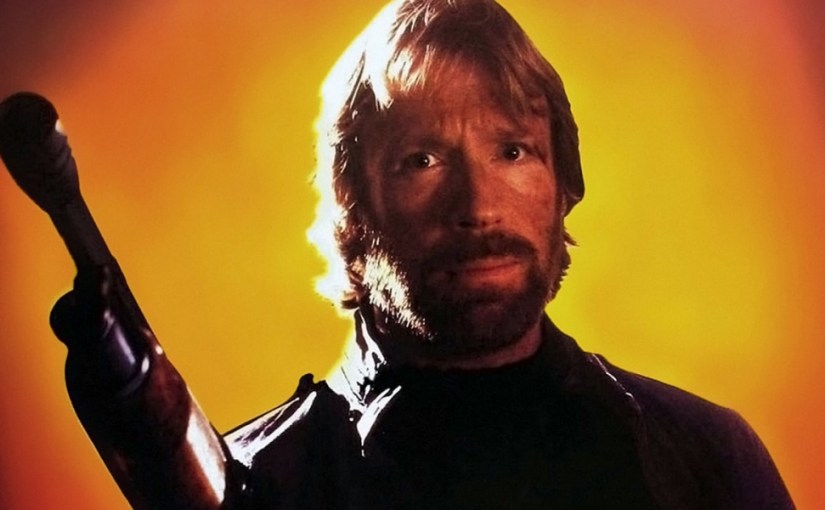
I must admit I have not watched many Chuck Norris movies. Just a handful here or there like The Delta Force, but on my radar to catch was always the cop thriller from 1985, Code Of Silence. I always intended to watch it someday as the film is highly endorsed by Siskel & Ebert. As well, it’s directed by Andrew Davis, the skilled filmmaker who would go on to direct The Fugitive and Under Siege.

Code Of Silence works in two ways; two stories that live up to the title. Norris is a Chicago cop named Eddie Cusack who heads a squad of under covers within the city. The film opens with what is supposed to be a well-planned drug bust that goes wrong when the one mob faction is overrun by another mob. Cusack’s informant as well as others turn up dead just before his band were to move in with arrests. Nearby, two of Cusack’s men come upon a young, unarmed man. The rookie officer witnesses the elder officer accidentally shoot the kid, and afterwards he plants a pistol in his hand to make it look like self-defense.

Now Cusack has to contend with a mob war in the streets where a boss’ daughter (Molly Kagan) is the only survivor of an attack and he must protect her. While at the same time he has to deal with his squad turning on him because he knows what the elder cop really did. The code of silence motif is expected to be honored in both camps. Personal vendettas and violations of police policy need to remain quieted.

The film belongs to Norris exclusively. Andrew Davis allows some of the action star’s kickboxing skills to work their way into the movie, and it all becomes a sidestep dance routine really. It always amuses me in these action pictures where the star will take on twenty guys at once yet he fights one or only two of them at a time. The other eighteen or nineteen thugs wait their turn. Why not just have all of them tackle Norris all together? No. Then we wouldn’t get his outstretched 360-degree roundhouse kicks in the air.

There’s also an unnecessary cop robot contraption that Norris pilots for the climactic action packed ending. This thing looks a rejected auditioner for the role of Johnny 5 in Short Circuit. The robot must have been too tall for the part and rather clunky. It has no relevance to either storyline and was obviously inserted for fun, campy violence of fireballs and explosions in the necessary old, abandoned warehouse where all of these actioners have to take place.

Fortunately, Code Of Silence has good story material to work with, and some thrilling stunt work including Chuck Norris pursuing a bad guy on top of a moving elevated train that makes its way with an eventual leap into the river. From what I could tell, that was really Mr. Norris himself in that whole scene. Good footage here.

Andrew Davis relies on what would become regular side characters that appear in many of his other films including Ron Dean and Joseph Kosala. They always make for good cop antagonists within the Chicago settings of his films. Norris is also good in a quiet Clint Eastwood kind of manner as he holds his own beliefs against the rest of his department who support the elder cop.

I like the conflicts that happen on both sides of the law in Code Of Silence. Sure, it’s got some silliness to it with the kickboxing and the gigantic, cop robot that shamelessly waddles along, but the two stories hold up by keeping me engaged of their outcomes.

Code Of Silence is a pretty effective thriller.

THE FUGITIVE

By Marc S. Sanders

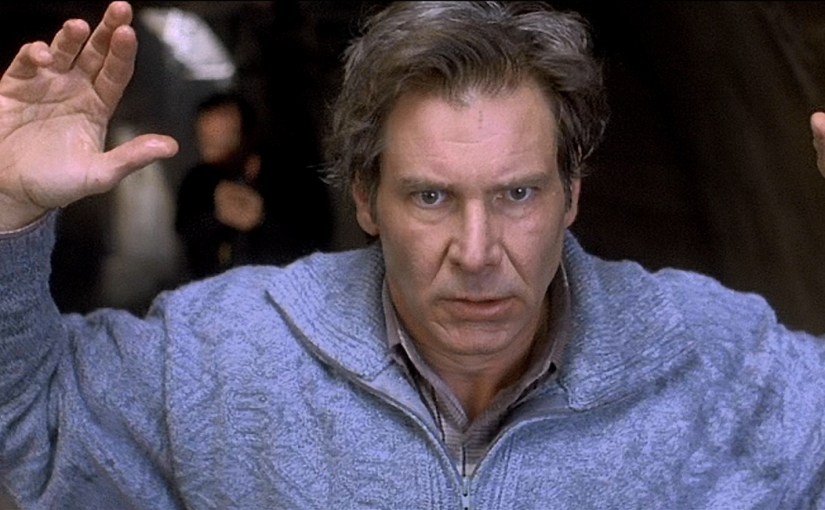
In 1993, Andrew Davis directed the best Alfred Hitchcock film that was not directed by Alfred Hitchcock. The Fugitive with Harrison Ford being pursued by Tommy Lee Jones was a runaway smash. As we now live in an age of cell phones and the World Wide Web, you’d think this film might be somewhat dated but it is the last thing on your mind while watching. This is a tense, taut thriller that never, ever lets up. Another favorite picture of mine.

The opening credits serve as a prologue, showing Dr. Richard Kimble struggle with a one armed man in his home after his wife (Sela Ward) has been assaulted and killed. Kimble becomes the accused and eventual guilty party who is sentenced to death.

Davis is now ready to show his first of many wonderful set pieces. As Kimble’s prison bus careens off the road landing on railroad tracks, an oncoming train collides with the bus. Kimble and another prison inmate now have the opportunity to escape and go on the run. Enter Tommy Lee Jones as Deputy Sam Gerard and his team of smart, intuitive misfits to catch up to Kimble who has made a mad dash into the dense Illinois woods. Because Kimble and Gerard are depicted to be incredibly smart, Kimble only remains a few steps ahead throughout the picture. Later in the film, Kimble makes his way back to Chicago to search for the one armed man and uncover exactly why his wife was murdered.

Location shots are masterfully done in The Fugitive. From the woods to a sewer system (a manufactured set I believe), to the streets of Chicago and Cook County Hospital.

The train crash is one of the all time best moments in film. No miniatures. No CGI. This is a fully loaded train crashing into a bus, and this is where you can not deny the craftsmanship of great filmmaking. Cameras were positioned at multiple angles to capture the mayhem in one take.

The other great set piece occurs during the actual St Patrick’s Day parade in Chicago. Gerard once again gets Kimble in his sights and Kimble manages to blend in with the parade marchers. The quick editing of improvisational camera work is spectacular here. Kimble and Gerard are literally in the same frame and yet Gerard can’t see what’s under his nose. Moments like these can’t be storyboarded. Andrew Davis’ production could not stop the actual parade for another take. It all had to be done on a now or never basis.

I watch The Fugitive and I always think back to Alfred Hitchcock’s best work like The Man Who Knew Too Much and North By Northwest. An innocent man is unexpectedly swept up in a conspiracy where he becomes the target and his adrenaline and instincts must kick in to save himself. The only thing he’s armed with is his mind. There’s also an unusually creepy antagonist, The One-Armed Man. This makes the film incredibly foreboding. I know the film stems from the legendary television series, but Davis treats this villain as if he’s among the ranks of Hitchcock’s use of Martin Landau or James Mason.

Harrison Ford is great at never glamorizing his role. He doesn’t suddenly become Rambo. He becomes a man of convincing desperation. Ford shines in roles like these such as his other films like Witness, Air Force One, and Frantic.

Tommy Lee Jones gives one of my most favorite performances on film. He plays Gerard with non stop adrenaline. He has exquisite chemistry with his team, including Joe Pantoliano. As well, Gerard is only interested in fetching what has escaped. He has no interest in guilt or innocence, until he realizes that Kimble has no interest in the consequences of escape. Kimble is interested in his innocence. Even Gerard becomes attuned to Kimble’s drive. Here is where the script is wise. There is no dialogue to imply what Gerard is thinking. Tommy Lee Jones has a way of giving a great close up to show what he’s thinking. He trusts the audience will presume what’s driving his intuition.

Davis pulls out all the stops with this film. There’s magnificent action shots of Gerard’s helicopter quickly flying over the ambulance that Kimble is racing away in. A great cat and mouse maze sequence happens within a sewer system. Lighting is perfect, there. Nothing is overly dark. There’s also incredible overhead shots of the dam and ravine that Kimble makes for a getaway with an absolutely surprising dive from an enormous height.

The Fugitive is smart and action packed to the teeth. You are in full focus while watching the ongoing pursuit. This film was nominated for Best Picture. Rare for an action film, but also a testament to its greatness. Tommy Lee Jones deservedly won the Oscar for Supporting Actor.

No doubt for me that The Fugitive is a must-see film for any kind of moviegoer. There are moments to feel scared, to laugh, and to cheer. When it is finally over and the story arrives at its satisfying conclusion, you cannot help but let out a deep breath. You feel like you’ve run a hundred miles, or at least as long as Richard Kimble ran towards his innocence. Your time will be well spent investing in the The Fugitive. An absolutely fascinating picture of great, mounting suspense.