
INSOMNIA

By Marc S. Sanders

Insomnia is an unusual kind of crazed killer pursuit because the hero is initially implied to be compromised, and before the first act of the picture ends, we see that he truly is not as noble as he is described.  This Christopher Nolan film, one of the few that neither he nor his brother Jonathan wrote, is headlined by three Oscar winners and they beautifully absorb this insightful script from writer Hillary Seitz.

Al Pacino is a celebrated Los Angeles Detective named Will Dormer.  When we see him arriving aboard a propeller plane into the foggy town of Night Mute, Alaska with his partner Hap Eckart (Martin Donovan), he looks weary and worn out.  Greeted with warm welcomes by a fan of his is Ellie Burr (Hilary Swank) and his old friend Chief Nyback (Paul Dooley).  Will has been special requested to investigate the murder of a young girl found in a trash heap, strangled to death.  Happenings like this do not occur often in Night Mute.  So, it is best to use the assistance of an expert.

Right away, Will is ready to get to work by visiting the girl’s boyfriend at school.  What he doesn’t realize is that it is ten o’clock at night. At this time of year, a midnight sun lasts twenty-four hours over this little getaway.  After he’s had a chance to investigate the victim’s body and go over the autopsy notes, the discovery of her bookbag leads to the prime suspect, mystery writer Walter Finch (Robin Williams).  A raid on his home near the beach is initiated and it does not go as planned.  Will screws up while chasing down the guy who gets away. 

While it seems that with some cover up, Will can keep his terrible error in judgment to himself, Walter knows everything. Now, with taunting phone calls in the middle of broad sunlit evenings, Will’s insomnia is becoming a hinderance as he tries to do his job while suppressing his own personal guilt and egregious acts.

The duality of Pacino versus Williams is reminiscent of Eastwood against Malkovich in In The Line Of Fire.  It works very well especially because of the departure that Robin Williams takes from his usual fare.  Ironically, he portrayed another creepy guy in the year of this release with a movie called One Hour Photo.  Williams is just a different kind of cut from Al Pacino and that’s why their conflict works well.  Pacino’s gruff tone, which is all too familiar within the second half of his career, has a roughness against the smooth and calm demeanor that Robin Williams relies on with his dialogue.  Walter Finch appears relaxed, rested and neat.  Will Dormer is wrinkled, tired, and lonely with guilt.  This killer has an inescapable edge over the cop, and thus Insomnia stands apart from the other fare of its time from the likes of Fincher, Demme or the Scott brothers’ respective films.

Christopher Nolan captures a creepy and uncomfortable setting for an environment bright with daylight amid a corner of the world that still embraces the nature of Earth.  He is thorough explorer with his go-to director of photography, Wally Pfister.  Clouds and the blurs of fogs keep moments unclear.  The sun blaring through windows is disorienting.  You can also feel the chill of Alaska, even if you are like me and have never visited the state. 

Though the film was primarily shot in Canada, there are amazing bluish/white overhead shots of snow-capped mountains and expansive rocky lakes surrounded by green woods.  A foot chase midway through the picture uses this unusual environment as Dormer chases after Finch across an expanse of floating logs that trap him underwater.  As Pacino desperately looks for an opening to the surface, Nolan really makes you feel like you are drowning amid this unexpected trap.  (Try to watch Insomnia on with at least a 5.0 surround sound.)

Hilary Swank’s role appears like a forgettable partner early on, but her significance opens up later in the story as more is revealed.  I look at her character of Ellie and it occurs to me that a theme of mentorship builds the backdrop of Insomnia.  Ellie has studied Will’s most famous cases and he’s much like a celebrity in her presence.  Finch is a well-known author that built a connection with the murder victim who avidly read his novels.  This film is a good reference to the adage that perhaps it is best to never meet your heroes.

I was very surprised by the directions that Insomnia takes, and quite early on.  There are unexpected moments that occur very quickly after the exposition is covered.  Nolan’s film is not a carbon copy of the tough cop working to nab the intelligent killer that’s on the loose.  Bodies do not just turn up before the final showdown, and the office Captain does not unleash on the detective threatening to pull him from this case.  What you observe in Insomnia is not what you have seen a thousand times before. 

Will Dormer is in an unsolvable conundrum of doing the right thing, but can he afford to surrender to his own misgivings after a decorated thirty-year career?  I could not predict how he would get himself out of this situation where Walter Finch, his antagonist, has got the clear advantage. 

Insomnia is a well thought out script superbly brought to vision by Christopher Nolan.  A thinker’s thriller.

NOTE: It’s a nice touch to call Pacino’s character “Dormer” which in French and Latin means “to sleep.”
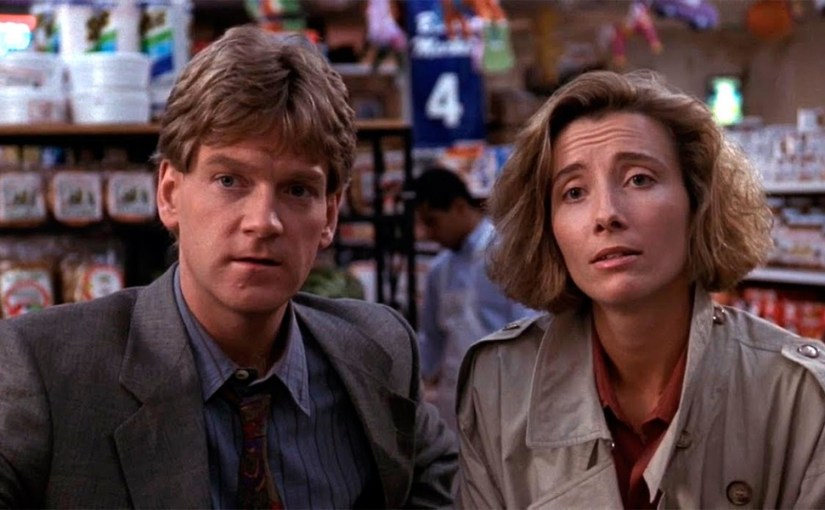
DEAD AGAIN

By Marc S. Sanders

Kenneth Branagh is inventive director.  Arguably, his most uncelebrated film is the noir inspired mystery, Dead Again, which features himself and his wife at the time, Emma Thompson, in the leading roles. 

Branagh and Thompson do double duty, playing multiple parts in two different time periods.  In a 1940s post war Los Angeles, they are Roman and Margaret Strauss.  Roman is a composer.  Margaret is a musician in his company.  They quickly fall in love and live in the limelight of glitz and glamour amid the gossip magazines of the time.  Their life together only becomes juicier when Roman is sentenced to death for the murder of Margaret.  The weapon of choice, a pair of scissors.

In present day 1991, Branagh portrays a private detective named Mike Church who ends up being responsible for an amnesiac, Thompson, who can’t even speak when she’s found.  The woman has unexplainable dreams that recall moments of Roman and Margaret’s life together only to end up as terrible nightmares.  A curious hypnotist (Derek Jacobi) enters the story to lend aid to Mr. Church and the woman.  He serves as a guide, bringing her back to the times of the celebrity couple, helping her to find clues that perhaps could lead to her true identity and uncover exactly why she is haunted by these dreams.

Additional characters enter the storyline as well.  There’s Wayne Knight as a humorous sidekick for Church.  In the flashback 1940s, there’s Andy Garcia as a handsome Pulitzer winning journalist who follows the escapades of Roman and Margaret.

Dead Again is not a long movie, and that lends to how good a film it is.  It’s a lean picture that sets up its clues the moment it starts.  Branagh gives you a background tutorial with newspaper headlines that flash up within the opening credits.  The two time periods are separated with the 1940s shown in gorgeous black and white, while the modern scenes are presented in color.  Branagh puts on a German accent for Roman.  Thompson is English for Margaret.  In the present day, they are Americans.  Of course, it is acknowledged that the respective characters look alike and that allows for possibilities of reincarnation, karma and past lives to enter the frame. 

The screenplay from Scott Frank gets you curious.  What connection could these two wildly different couples have with one another?  What don’t we know about the murder of Margaret at the hands of her husband, Roman?  Who really is the woman that Thompson is portraying in modern times?  How is it possible that a private dick like Mike would coincidentally end up with this “Margaret lookalike” amnesiac?

The cast is having a lot of fun with the puzzle, particularly Derek Jacobi.  His old English mannerisms offer a relaxing storyteller’s narrative to the film.  It feels as if his hypnotist carried over from an Alfred Hitchcock film.  I also appreciate how far apart the respective characters that Branagh and Thompson play.  Not only am I watching a thrilling mystery, but I’m looking at skilled, well-trained actors demonstrating a wide range of performance work.  At times, it’s as if I’m watching two different movies.  How exactly are they going to intersect, though?

I originally saw Dead Again in theatres and was taken with it immediately.  I did not see the end coming and when the veil was lifted, my eyes went wide open.  It has a terrific plot twist.  Branagh, known at the time as a celebrated Shakespearean actor/director, introduced a sweeping, mystery yarn that relishes in fun escapism like Hitchcock or Orson Wells would apply to film noir.  It only makes sense, looking back over thirty years later, why the director opted to turn his craft towards rejuvenating the classic Agatha Christie stories (Murder On The Orient Express, Death On The Nile) for film.  We are better for his contributions.

Now, Dead Again is a film that deserves the attention from a new generation of movie lovers.

AWAKENINGS

By Marc S. Sanders

The title of Penny Marshall’s film Awakenings has at least two meanings.  The most obvious focuses on Robert DeNiro’s character, Leonard Lowe, who comes out of a near thirty-year catatonic state one day.  As well, Robin Williams plays Dr. Malcolm Sayer, the doctor who uncovers the experimental drug that awakens Leonard, along with other patients who reside in the caretaker ward located in the Bronx.  Many of the patients share the same abnormality as Leonard, due to all suffering from a wave of encephalitis that swept through the area in the 1920s. 

DeNiro and Williams are a top of their game pair together.  Both of them go against type that many audiences were accustomed to by the time this film released in 1990; DeNiro – the tough, short tempered, unhinged guy; Williams – the manic, fast talking, quick on his feet comic.  Both actors bring it down many notches to bring this story to light that was inspired by the documented experiences of Dr. Oliver Sacks.

Still, Penny Marshall has a way a bringing gentleness with touches of comedy to this film just like she did with Big and A League Of Their Own.  Okay, maybe those films were more energetic at first and then quieted down, thereafter.  Awakenings performs in the opposite direction, but Marshall’s recipe of drama mixed with humor is so appreciated.

Dr. Sayer is a shy individual with limited social skills.  He relates more to plant life than actual humans.  When he’s recruited by the hospital administration, led by the intentionally obnoxious and objectionable John Heard, to oversee the patients at the ward, he does so without any intent to make a difference.  The hospital staff is just fine with that.  Soon though, Dr. Sayer is recognizing a behavior in some of the patients.  They seem to be staring into space, open mouthed with no emotion or change in expression, but they respond to a variety of unusual stimuli.  A woman will walk across the social hall on the black squares of a checkered floor.  Leonard, and a few other patients, will catch and toss a tennis ball around.  Yet, they won’t blink or wince or smile.  Through further research, Dr. Sayer takes a pharmaceutical risk and increases the dosage of an untested prescription over time.  One night, his patient zero, Leonard, is sitting up in bed and awake.  Shortly thereafter, he’s speaking, walking, and functioning like a regular forty something man.  Thereafter, the drug is administered to the other patients who demonstrate the same outcome. 

The challenge comes first from the hospital, though.  They are not prepared to take Dr. Sayer’s methods or assessments seriously and they are stubborn to recognize some exceptional progress.  Like any standard drama, this leads to conflicted debate.  The debates Dr. Sayer has with the hospital board never took me out of the picture, but I do question if the antagonism needed to be so close minded.  After all, should such unexpected and miraculous development be so dismissed?  The challenge seems so forced at times that a scene is offered where the doctor’s support from nursing and janitorial staff gladly gives up their hard-earned paychecks to help alleviate the expense of the experimental drugs.  It puts a lump in your throat for sure, but would this really happen? 

A hint at a romantic angle presents itself when the lovely Penelope Ann Miller arrives at the ward to tend to her ill father.  Leonard becomes smitten with her.  He is not free to go about as he pleases.  Miller’s character can.  Eventually, Leonard becomes rebellious of his “incarceration” within the ward while the hospital exercises its mandated caution.  While this is occurring, Leonard’s condition is deteriorating. 

Robert DeNiro received an Oscar nomination for this role and its easy to see why.  His physical performance comes so naturally, at first in the catatonic state, later as a man witnessing daily life in the hippie of age of the 1960s and then again as his body dwindles into uncontrollable spasms, when the drugs’ positive effective doesn’t hold.  His enunciation falters, his body violently twitches and he can’t even grasp anything.  It’s a sorrowful and marvelous performance to see.

Awakenings is a picture that performs with real heart and tenderness.  Marshall’s film offers a glimpse into a short period of time when adults who hadn’t gotten the opportunity to live active lives were suddenly offered an opening.  Leonard gets to see a jet liner fly overhead and take a walk in the ocean.  He can taste ice cream for the first time in years and get a glimpse of young hippie’s derriere.  The other patients get a chance to go to dance at a swing club.  As well, Dr. Sayer’s guarded exterior gradually sheds as he persists to act beyond the administrators’ objections and also consider a little romance for himself with a nursing assistant.  (Point of fact: Oliver Sacks was actually gay in real life.  So, some liberties are taken with the film.)

It’s important to point out a forgotten performance from Ruth Nelson as Leonard’s elderly mother.  She visits Leonard every day by reading to him, dressing him, and changing his diapers like any loving mother would.  Yet, as Leonard gets more independent, Nelson is terrific as the kindly elderly woman who has to become a different kind of mother to her son.  She is an quickly awakened from being the mother of a helpless child to the elderly mother who is not as capable of controlling her son’s choices.  Mrs. Lowe is rightly uncomfortable with Leonard’s affection for Miller’s character.  She’s just not used to this dynamic that’s come about so quickly.  What an amazing character arc and Nelson pulls off the portrayal beautifully.

Tear jerking films work best when they operate like Awakenings.  You’re given many opportunities to laugh and enjoy the pleasures and quirkiness of the characters.  Later, it becomes a welcome and satisfactory cry fest when what was once celebrated is at a risk of loss.  Penny Marshall worked best with this formula on these kinds of pictures.  It’s why a simple, seemingly silly story like Big worked.  It’s also why a female baseball movie worked as well beyond the diamond.  There was more dimension than just the basic summary.  Marshall always delved deeper and she allowed her actors to go that far as well.

Awakenings is a terrific film, blessed with a gamut of emotions.