THERE’S SOMETHING ABOUT MARY

By Marc S. Sanders

Love never dies.  Sometimes it just gets jammed in your zipper.

Ted (Ben Stiller) can’t put his finger on it.  Neither can Pat (Matt Dillon) or a couple of other obsessed, stalking paramours.  There’s Just Something About Mary.

In 1985, brace faced, insecure Ted gets the opportunity to go to prom with the prettiest girl in school, Mary (Cameron Diaz).  He’s a good guy, but disaster strikes in truly one of the most unimaginable ways and prom never works out for these kids.

Jump thirteen years later to 1998 and Ted gets the idea to hire Pat, a private investigator, to track down Mary in hopes of rekindling a new romance.  She’s in Miami, Florida now, working as a chiropractic surgeon and even more beautiful than ever.  Problem is that Pat has lied to Ted about what has come of Mary and wants to pounce on her all for himself.  Ted eventually gets up the gumption to trek from Rhode Island to Florida anyway.  Along the way complications ensue.  Let me change topics for one second and remind you to be mindful of rest stops when you are road tripping.

There’s Something About Mary is one of the all-time great comedies and my favorite of the Farrelly Brothers’ collection (Kingpin, Dumb & Dumber, Me, Myself & Irene).  I’ve described the spine of this film, but it’s the guts of endless sight gags within that uphold this picture.  Everything from a dog that gets drugged, electrified, drugged a lot more, and body casted to a handicapped friend of Mary’s who simply cannot pick up his keys without instigating terribly guilt-ridden chuckles. (I’m laughing as I write this.)  Special needs adults lend to the comedy as well.  The Farrellys are proudly nowhere near politically correct. Yet the material manages to not be horribly offensive either.  You need not worry, you will still get into heaven even if you laughed at There’s Something About Mary.  Still, that’s what comedy is.  Somebody always needs to be the victim of the stooges who lend to the mayhem.

This comedy is also perfectly cast from the three headliners all the way down to the extras.  A South Carolina jail cell setting draws big laughs at poor Ted’s demise. 

Cameron Diaz is such a sport though, always looking beautiful while willing to be the fool.  It was great to watch this with my seventeen-year-old daughter since she had no idea of that hair gel scene.  If you don’t know, don’t read about it.  Just watch and look at how well Diaz holds the moment together.  I remember SCREAMING in the movie theatre next to Miguel.

Stiller and Dillon are two dumbasses you likely never would have envisioned in a film together.  Nevertheless, they are perfect foils of stupidity against one another.  Matt Dillon is often recognized for his tough guy dramatic roles.  Yet, he puts it all on the line.  Stiller is primarily known for comedy, and this film is the first of a series where he becomes the unfortunate victim of circumstances (Along Came Polly, Meet The Parents).  I wouldn’t want anyone else in these scenarios though.  You laugh at what Ben Stiller ends up in but also feel sorry for the poor guy.  I would have no objection if Matt Dillon and Ben Stiller paired up again for another comedy, even all these years later.

Other cast members also lend their level of comedy from Chris Elliott to Lin Shaye to Sarah Silverman, Jeffrey Tambor, Markie Post and especially Keith David, who knows he belongs nowhere in this movie, but that’s exactly why he should be part of the cast.  He’s utterly hilarious.

A nice touch to the movie are the series of outtakes during the end credits while the cast lip sync to The Foundations celebratory number “Build Me Up Buttercup.”  This had to have been such a party to film and finally the audience is assured that they can laugh along in front or behind the camera as well. 

There’s Something About Mary is the movie so many of us need right now.  Turn off the news and turn on what went on between Ted and Pat and their pursuit of Mary. 
ABSOLUTE POWER

By Marc S. Sanders

As Clint Eastwood’s Absolute Power was unfolding I started to think this plays like one of those hardcover bestseller political thrillers from the 90s that my dad would scoop up off of the neatly designed stack at the front of Barnes & Noble.  You know with the glossy book jacket that has the blood stain and a dead girl’s nail polished hand next to a bloody letter opener.  The graphics are elevated to feel the crime scene with your fingertips.  The intrigue is summed up on the inside tab.  You turn to the back of the book to see the picture of the author.  Then you buy it with your membership card.  Go figure!  William Goldman adapted the screenplay from a novel by renowned author David Baldacci. Absolute Power has an engaging set up, a who’s who of a cast, it’s directed, produced and starring Eastwood. Still, it evolves into utter eye-rolling preposterousness.

Eastwood directs his own portrayal Luther Whitney, an expert jewel thief.  He might be getting up there in age but he scopes out the mansion of a billionaire tycoon (E.G Marshall, in his final on-screen role) and locates the vault hidden behind a large two-way mirror.  Everything is going to plan as Luther bags up the valuables and a lot of cash but then a drunken couple enter with Luther hidden behind the mirror to watch their tryst turn deadly.  The President of the United States (Gene Hackman) avoids being stabbed to death by the young lady (Melora Hardin) when his secret service detail (Scott Gleen and Dennis Haysbert) enter to shoot the girl dead.  The President’s Chief of Staff (Judy Davis) arrives soon after.  Luther observes the four as they rush the Commander In Chief out of the house and alter the crime scene.  They get careless and just as Luther makes a quick exit, he retrieves evidence that will hopefully work to his advantage.  Now he’s in danger of the President and the other three as they work to permanently contain the situation.

Elsewhere is Ed Harris as the detective out to solve the murder and uncover everything we already know.  When he realizes a thief must have been at the scene of the crime, he actually approaches Luther for some guidance as to who could have been there.  Later, he will use Laura Linney, playing Luther’s daughter, for assistance as her father seems to be the prime suspect. 

The tycoon, the President’s biggest supporter, also wants to resolve his personal vendetta by hiring his own sniper (Richard Jenkins) to take out Luther. 

Absolute Power has all of these players, with recognizable actors in the roles, and yet cannot work the magic necessary to fix this outrageous conundrum.  I can believe that a President could get in more trouble than he needs with a one-night stand and a dead girl on the floor.  I can believe members of his staff will work to tie off all the loose ends, even if it means more murder and mayhem must occur. 

What is hard to swallow is how neatly the story wraps up literally within one afternoon leading into an evening.  It’s fortunate that window washers are present to throw off a couple of snipers with an inconvenient glare at the most inopportune time.  Otherwise, there will be no more movie.  It helps that a character with remorse happens to take his own life, thus exposing the conspiracy, just as Eastwood’s character is steering his own way to exoneration.  All in the same night!!!!

To ramp up the suspense, the bad guys go after Linney’s character, the one person Luther cares for the most.  She ends up in a hospital.  Message has been sent.  Luther better surrender himself along with what he knows to the President’s squad.  Yet, they try one more time to permanently eliminate her and I asked why.  What purpose does that serve to kill her now?  If you kill her, then Luther has nothing to protect or care about anymore.  He can just reveal the entire breakdown of what really happened complete with evidence and so on.

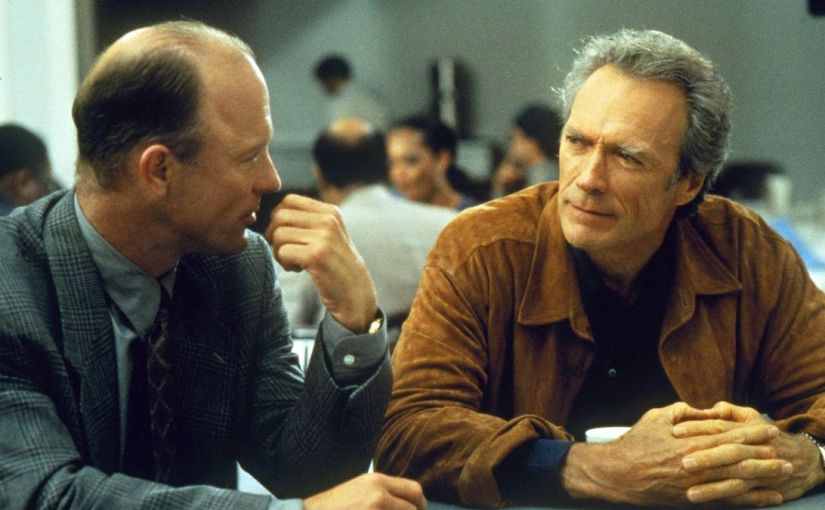
A few years earlier, Eastwood starred in In The Line Of Fire where John Malkovich played a master of disguise assassin.  Luther is also a craftsman at hiding in plain sight.  However, there’s no way I can believe that.  We are looking at Clint Eastwood here.  He’s got his own unique and very tall and square stature.  Put a white mustache and a pair of glasses on the guy, and it is still Clint Eastwood.  Put a hat and beard on him and it is still Clint Eastwood.  Wrap him up in a trench coat and have him walk the city streets in broad daylight where fifty cops are awaiting his arrival and you’ll be able to see the one and only Clint Eastwood.  It just can’t work.  James Bond can hide in disguise.  John Malkovich can hide in disguise.  Go anywhere in the world and Shaquille O’Neal and Clint Eastwood would never be hidden in plain sight. 

William Goldman (The Princess Bride, Butch Cassidy And The Sundance Kid) is one of Hollywood’s most celebrated screenwriters.  He did not think this story all the way through.  You may believe Gene Hackman (second billing behind Eastwood) would have had more of a presence in this picture but oddly enough he’s hardly there. The real bad guy roles belong to Judy Davis and Scott Glenn who are not nearly as exciting as what Hackman could have delivered.

There was a potential for a good conspiracy thriller. The problem is the audience knows too much following the first fifteen minutes of the film.  We know everything that happened and therefore I could care less about the progress that Ed Harris’ detective makes.  Absolute Power likely would have performed better had it opened after the crime had occurred.  Run the opening credits over the dead girl in the room and open the two-way mirror for Luther to enter the frame.  He makes a run for it and then the film can gradually reveal what precisely happened.  A mystery for the characters and the audiences who are watching them only works if the questions are offered before the answers are revealed.

Absolute Power offered a lot of promise with a lot of talent but it’s devoid of both.

SEA OF LOVE

By Marc S. Sanders

Al Pacino is a twenty-year veteran New York City cop, working out of Manhattan, on the trail of a serial killer in Sea Of Love.  The profession is nothing new to Pacino’s repertoire of roles, but the portrayal is unique thanks to a smart and suspenseful script from Richard Price and intense directing from Harold Becker.

The killer leaves a calling card.  A 45 LP record of Phil Phillips ’50s classic crooner, “Sea Of Love,” spinning on the turntable.  The victims are naked men lying face down in bed with a bullet to the head.  Turns out that a cop from another precinct played by John Goodman has uncovered a similar crime scene in Queens.  So, the two team up.  They believe the murderer is a woman.

All the victims have posted a Lonely-Hearts Club blurb in a magazine. The invitation for a date stands out because the text rhymes.  The detectives decide to post their own ad in the same kind of format, meet the women who respond and hope to nab the killer.  It gets complicated when Pacino encounters a breathtaking and sultry woman played by Ellen Barkin. 

Pacino’s cop is a smart guy.  He’s got instincts.  Yet, perhaps due to his constant drinking, insomnia, and the bitterness he carries now that his partner (Richard Jenkins) has hooked up with his ex-wife, he’s also quite vulnerable.

The mystery is strong, and the tension builds as Sea Of Love moves on.  Barkin has Pacino and the audience convinced that she’s the prime suspect.  Still, he lets his defenses down because he’s easily getting seduced by her advances.

Whether you’re watching Al Pacino share scenes with John Goodman or Ellen Barkin, the execution is fantastic.  Great performances from the three.  Pacino and Goodman have a natural exchange with one another. Often humorous, but the guys always talk like cops.  When Pacino admits to tossing away a fingerprinted glass from Barkin, Goodman suggests lifting the prints from something- ahem – more personal of his.  A cute wink and nod exchange.

More important to the film is the erotic chemistry between Barkin and Pacino.  Harold Becker uses a late-night supermarket visit in the vegetable aisle to evoke the risky and irresistible nature the two characters develop for one another.  Other scenes build well on the relationship between these two lonely strangers who’ve only recently met. 

Moments of isolation and drunken stupors also work towards fleshing out Pacino’s burned out cop.  He’s got a schleppy posture to him and an exhausted expression with his sullen eyes and shaggy black hair.  At the same time, his character’s twenty years of experience seem to uphold his alertness.  This cop knows he’s letting his guard down. Without any dialogue, you see the internal struggle Pacino has with what should be done against what he is deliberately neglecting.

This film was Ellen Barkin’s breakthrough role.  She received rave reviews as someone who takes care to uphold a New York City trendy appearance by day as a shoe salesperson in contrast to a woman looking for some carefree lust in the evening.  For Pacino, Sea Of Love reinvigorated a career slump following a series of poorly reviewed films.  Together, they make for a sexy yet untrusting pair.

Circumventing this relationship is the mystery.  Is Barkin the culprit? She seems to have a dark way about her that may not surprise you.  Price, Barkin and Becker designed the character quite well for her to at least have the potential to be a killer of men.  Is she setting Pacino up to be the next victim?

New York City from the late 1980s looks great, even though interiors were shot in Toronto.  Trevor Jones offers a nail-biting soundtrack to keep the suspense heightened at just the right beats of the picture with Becker’s camera pointing down dark hallways or when new clues are discovered.

I’ve seen Sea Of Love a few times and even with knowing the surprise ending, the film still holds up thanks to the performances from its three stars, along with its taut editing, well-paced writing, and smart direction. 

This is a good erotic murder mystery.

KILLING THEM SOFTLY

By Marc S. Sanders

What did I just watch? A mob movie, or a 2008 Presidential debate where the candidates are no shows, and their respective commercials are aired in their place? Andrew Dominik directs Killing Them Softly, with Brad Pitt who also produces.

Reader, I don’t get the appeal. Maybe it’s the outstanding cast which includes Pitt, as well as James Gandolfini, Ben Mehndelson, Richard Jenkins, Scoot McNairy and Ray Liotta. Sadly, these guys are given next to nothing do of any consequence.

After it is revealed that Liotta’s character, Marky, ripped off his own mob poker game a few years back, an idea is presented to two street addicts played McNairy & Mendehelson to do the same thing because, heck, they’d never be suspected and logic dictates that Liotta must have done it again. So, he’ll be the one to blame and get whacked. The game is robbed and now Brad Pitt’s hitman character is on the job. Simple enough story, almost like a Guy Ritchie picture.

Killing Them Softly is an adaptation of a 1974 novel by George V Higgins. I never read the book, but I’m curious if it contains any kind of relation to Andrew Dominik’s idea of editing recurring speeches and ads, compliments of Obama, McCain and Bush 45. Truly, what was the point of this recurring theme? A two-sentence piece of dialogue finally acknowledges this in the final minute of the film, but I’m still lost on the significance. Somehow Dominik made a dirty, cold, rain-soaked picture that has an omnipotent viewpoint from our most prominent politicians, and I don’t know what one thing has to do with another.

As well, Gandolfini arrives in the story and I never could gather what was his purpose. I think he is a hitman who is washed up, never getting his ass up to carry out the job and just monologues about nothing like the hooker he pays off; topics that Quentin Tarantino might’ve thrown in the editing trash bin.

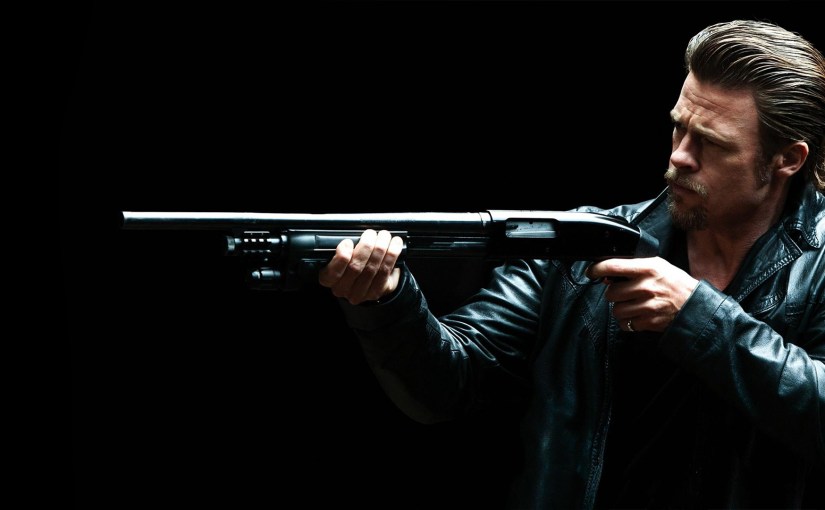
Mendelsohn looks incredibly convincing as an addict living off the streets, yet his storyline has no end. He’s arrested. Then what happens? What does that mean for everyone else? Liotta has a long drawn out sequence of getting the shit kicked out of him by two mob foot soldiers. The scene goes on and on and on. His face cracks and bleeds, and bleeds some more. Brad Pitt? Well, he’s the hitman who just looks cool. Yeah, the black leather jacket he wears looks very cool on him. That’s about it.

There’s no development to Killing Them Softly. No surprise or twist. The guys you expect to get killed, get killed, and there’s no good dialogue.

This film is just an empty void of poorly, uninteresting violence.

NIGHTMARE ALLEY (2021)

By Marc S. Sanders

Guillermo del Toro’s Nightmare Alley is a visual feast of the macabre set in a Depression era western America.  Every caption caught on film is unbelievable to look at, and while I know del Toro released his picture in black and white to enhance its film noir theme, I was truly delighted with the color version of the film.  With del Toro’s direction and photography designed by Dan Lausten, every dimension and sparkle of color from a sunset to a dreary cloud in the sky to the lights on a Ferris wheel spinning in an open field from the distance is absolutely jaw dropping.  Nightmare Alley is a modern technical masterpiece.  It makes me want to go back and watch the original 1947 version, as well as explore other productions in the film noir category.

Bradley Cooper portrays Stanton Carlisle, a murderous drifter who ends up accompanying a traveling carnival of garish figures who entertain their quirky qualities for townsfolk to be marveled and amazed.  There’s the flexible snakeman, the world’s strongest man (del Toro regular, Ron Perlman), the smallest man alive, the electrical woman, the psychic and the terrorizing, caged “geek” who will eat the head off a live chicken in front of your very eyes.  At first Stanton serves as a heavy meant to carry loads and set up and strike the tents and stages as the show moves from town to town.  He connects though with the psychic (Toni Collette) and the architect behind her façade (David Strathairn).  Soon, Stanton is adopting their techniques of using code words and hand gestures to “read the minds” of the various audience participants. 

He goes even further by redesigning the electrical woman’s presentation. Before she was using teslas to demonstrate her will to generate electrical currents.  Now she can be zapped in an electric chair.  The woman is Molly (Rooney Mara), and a relationship begins that sends her and Stanton on a successful tour away from the carnival where they entertain more sophisticated and wealthier nightclub guests with his psychic abilities.  One attendee, however, is on to Stanton’s devices, a beautifully alluring psychiatrist named Lilith (Cate Blanchett).  She maneuvers Stanton into using his manipulative talents into conning her clients.  She has recorded her sessions and will share confidential information with Stanton. Then, he will use that towards his ongoing psychic advantage as a means to swindle them of their fortunes.  Lilith and Stanton will split the rewards.  The play seems convincing enough for the likes of a wealthy industrialist named Ezra, played by Richard Jenkins yearning to reconnect with his deceased wife at a cost of thousands of dollars for Stanton’s services.

The narrative of Nightmare Alley is so absorbing.  Everything is beautifully staged.  A fun house hall of mirrors has a décor of disturbing imagery.  Stanton enters this place symbolically at the beginning of the film in search of the runaway “geek.”  The surroundings display the seven deadly sins around a large skull and other haunted house imagery.  del Toro demonstrates what Stanton is about to enter, which occupies the remainder of the film.  Stanton performs on the motivations of greed and lust and vanity.  Maybe, pride as well.  At least those are the first couple of sins that come to my mind.  How will his actions reflect back on him later on, though?

The film is also performed by a magnificent cast.  Cooper is doing some of his best work here.  While I feel like I’ve seen Blanchett’s deceitful character before, I don’t mind.  I can’t think of anyone else to play the role.  Curiously, del Toro has Mara, with her snow-white complexion, dressed in red quite often amid a cast of characters and extras wearing blacks and dark greys.  She’s meant to stand out as the innocent.  Molly questions Stanton’s decisions while also trying to convince him to end his charades.  Yet, she only serves as a disturbing pawn in the shyster’s tricks.  Will Stanton corrupt Molly though?  It’s one thing to put on a magic show for a couple of hours each night.  It’s another when you are swindling the massive fortunes of others and toying with their despair. 

Other surprise performers that appear include Willem Dafoe as the showman for the “geek,” and a late appearance by Tim Blake Nelson to close out the film and deliver what’s to come of Stanton. 

Nightmare Alley deliberately moves at a slow pace, but that only allows you to take in its various environments.  From the carnival tents to the nightclubs to the alleyways, to Ezra’s snow covered never-ending garden, and even Lillith’s gold embossed office of cabinetry and furniture are so hypnotic and dark in its intended film noir way.  Again, while I’m sure there’s some striking qualities to the black and white interpretation of the film, I really fell in love with the colors provided by Lausten’s photography.

I won’t call this a favorite film of mine, but I loved the journey of it all.  I appreciated the script by del Toro and Kim Morgan, adapted from the novel by Lindsay Gresham, that depicts a sinful man like Stanton devolve into more sin, until he’s only undone by a smarter sinner than he; a sinner masked within beauty and wealth with a noble and educated profession.  Bradley Cooper and Cate Blanchett perform beautifully with one another.  They make a terrific pair.  I only hope they’ll do another film together.