By Marc S. Sanders
Alfred Hitchcock’s beloved classic Rear Window remains absolutely relatable today. Before the age of the internet and reality TV, people already had a voyeuristic instinct about them. Heck, movies are voyeuristic! The audience watches the behaviors and actions of people on a large screen. Snooping into the activities within your neighbor’s private apartments is not much different. Though likely less ethical.
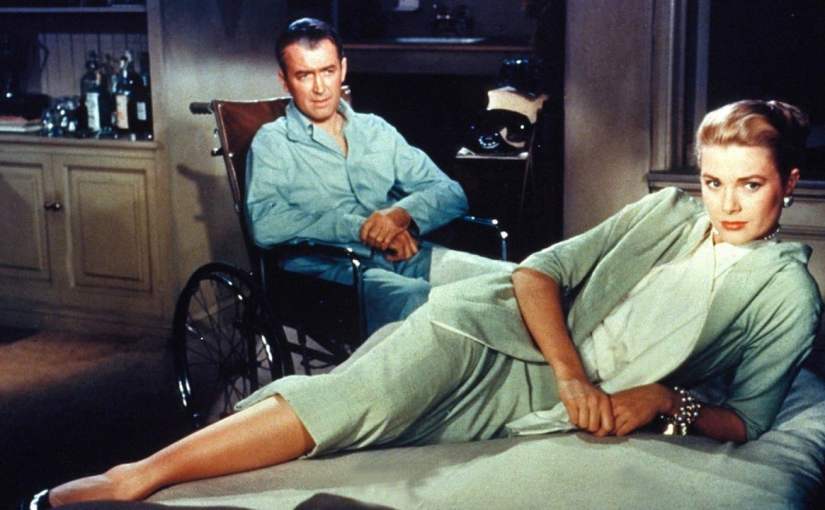
When photographer L.B. Jeffries, aka “Jeff,” (James Stewart, in one of his most famous roles) is bound up in a wheelchair with his broken leg wrapped in a waist high cast, there’s not much adventure like his traveling career demands. So, he gets caught up in looking at the goings on of his Greenwich Village apartment neighbors like a beautiful hourglass figure dancer he dubs “Miss Torso,” or the newlywed couple and their never-ending sexual escapades. There’s also an elderly couple who find comfort in sleeping at night on their outdoor balcony next to one another. He can also take pleasure in a struggling musician trying to write his next piano tune while also entertaining a collection black tie guests. Another woman he dubs “Miss Lonely Hearts,” for her desperate attempts at entertaining herself with imaginary escorts she’s “invited” for dinner, also leaves him curious to keep up with.
The most inquisitive occupants in this building are a husband (Raymond Burr) and his seemingly ill and often irritating and nagging wife. Over one rainy night, Jeff takes notice of the husband leaving his apartment with a suitcase at three different times and the wife is nowhere in sight ever again thereafter. Later glimpses of the husband handling a carving knife, a saw and some rope tied around a storage trunk are also eye opening. Jeff recounts this sequence of events to his desperate love interest, Lisa (Grace Kelly, with a gorgeous on-screen entrance in one of costumer Edith Head’s legendary dresses) and his nurse caretaker Stella (a smart allecky and perfectly cast Thelma Ritter). When the likelihood of murder has probably occurred, Jeff also lets his detective friend Tom Doyle in on what’s seen. All seem skeptical at first.
Now the action of murder is never seen by Jeff, nor by the audience, mind you. For the most part, Hitchcock limits the viewer only to what Jeff sees with his own eyes or with the help of his binoculars and his long lens camera. Midway through the film, the director allows Jeff to doze and gives us a glimpse of something the husband does. Now, we the audience, have a slight edge of knowledge that our hero doesn’t. This plays with Hitchcock’s approach to suspense. We know there’s a “bomb” under the table. The people sitting there don’t however. It pains us to wonder if our protagonists will discover the bomb before it goes off.
I’m a big fan of Alfred Hitchcock movies because they never get too complex. The stories he chose to direct normally place an everyman in a scenario he/she never expected to find themselves in, much less be invited to. With a screenplay from John Michael Hayes, Hitchcock puts out only a few pieces of a puzzle. Then, it’s up to his handicapped hero and the audience to solve it.
The voyeurism for Jeff seems like a harmless vice while his time at home slowly passes painstakingly by. Hitchcock and Stewart do very well in assembling this film. A close up of Stewart will have him turn his eyes to his right and then we will see what the newlywed couple are doing. Then we will cut back to Stewart and see his reaction with a smirk. A look down will cut to the dog, curiously digging away in a flower bed. Then once again back to Stewart for a close up that maybe has him wondering if the dog is getting at something pertaining to this husband and his now missing wife. The smirk leaves Stewart’s face. Now, it’s an expression of puzzlement.
I noted earlier that Rear Window can easily be related to what drives people’s obsessions today. We are people driven by internet surfing and television streaming and social media. The known statistic that half of marriages end in divorce is still prominent. (Maybe that percentage is even higher by now.) Stewart’s character of Jeff becomes so obsessed with keeping up with these people’s stories, that he hardly finds time or enthusiasm to accept the romantic gestures of Lisa. It’d be fair to argue that technological devices of today serve as an equal distraction in relationships.
Grace Kelly is well cast here. Arguably one of the most beautiful women to ever appear on screen, dressed in some of the most artistic and fascinating costumes provided by Edith Head, and even she can not divert Stewart’s attention away from the activities of others that Jeff doesn’t even have an intimate knowledge of. Kelly begins her performance in the film with an approaching close up followed by a sensual kiss upon a sleeping Jeff. She arranges a catered dinner, delivered by the renowned New York restaurant, Twenty-One. It just doesn’t completely sway Jeff away from what he becomes obsessed with. Much like people are with social media, Jeff has been addicted to his vice. When Lisa tries to implore with Jeff to take their relationship further, James Stewart raises his voice to tell her to shut up and insists that her beautiful hairstyles, wardrobes and high heel shoes could never keep up with him on his travels to far off deserts, jungles and war-torn areas that he photographs. Yes, Jimmy Stewart tells Grace Kelly to shut up. It’s shocking. However, maybe the film will eventually demonstrate that Jeff really doesn’t know anything about Lisa. The everyman of cinema at that time has been corrupted by what he’s focused on, and in an Alfred Hitchcock film, it is bound to get him into more trouble than he ever expected. More importantly, the one who cares for him may open his eyes to what he really can’t see as this mystery proceeds. Broken leg or not, Jeff has never truly seen the real Lisa.
I recall visiting Universal Studios in Orlando, Florida when there was an Alfred Hitchcock attraction there. I miss it. It was taken over by a Shrek ride and soon it will be another Minions adventure. Before ever having seen Rear Window, the attraction featured a look at the Greenwich Village courtyard setting of the film. It was fascinating. It was four floors of apartments directly across a courtyard that had a flower bed, folding chairs and the like. There was also an alley that presumably led to a bustling New York City street. Naturally, you couldn’t see much of the street. Just a sliver. Hitchcock arranged with Paramount Pictures to build the set this way. Audiences would have wide open views of activities within the window frames of these apartments, the hallways beyond the front door of each dwelling and that one slim alleyway. The viewer is as limited in what can be seen as Jeff. This mysterious husband may be going somewhere at odd hours of the night, but once he passes that alleyway, there’s no way of knowing where he went. Today, we might call something like this one of those “Escape Rooms.” Solve the mystery, but only with what you can see and only from your one stationary position. If something takes an unexpected direction, you could find yourself in danger without any means of escape. That’s how Hitchcock sets up the limitations for Jeff.
As the film progresses, Lisa proves that she can be adventurous like Jeff claims that she isn’t. In her beautiful gown, heeled shoes and coifed hairdo, she climbs into the apartment of the likely murder suspect looking for clues. Jeff, however, can’t do anything but watch. There’s not much he can do either even when the suspect returns while Lisa is still there. He’s helpless to help her or even himself. This assembly of direction again falls in line with the “bomb under the table” idea. It’s one of many devices Hitchcock uses to keep Rear Window as suspensefully entertaining as it was for audiences in the 1950s.
Few directors still can’t keep audiences on the edge of their seat like Alfred Hitchcock. He had such an intuition for knowing what would keep viewers engaged and wanting to know more. Unlike other films from him, there’s not much of a twist to Rear Window. The resolution falls in lifting the veils. Jeff must reveal himself to this mysterious husband. (When they come face to face finally, Hitch is smart to position Jeff as a silhouette in darkness.) Lisa must show Jeff a side to her that he refuses to acknowledge in order to save their relationship. Most importantly, a mystery has to be confirmed. You find yourself more and more breathless as the film moves on, and then more facts are revealed implying that Jeff is truly on to something. When the picture finally ends, if you got caught in Hitchcock’s web of suspense, you’ll likely let out a satisfying sigh of relief.

 2 UNPAID MOVIE CRITICS!!!!