COP LAND

By Marc S. Sanders

You need look no further than the HBO series The Sopranos to see that the state of New Jersey is often regarded as a red headed stepchild in comparison to the empires of crime found in New York.  In fact, two years before that series debuted, many of the varied cast members (Edie Falco, Frank Vincent, Robert Patrick, Annabella Sciorra, and Arthur J Nascarella) appeared in writer/director James Mangold’s second film Cop Land, which carried the same kind of regards for the two thirds of the known Tri State area.  Tony Soprano always had to surrender to Johnny Sack and his crew if you know what I mean.  There’s Jersey…but then there is New York!

A whose who of staple actors for New York crime and corruption films take center stage including Harvey Keitel, Ray Liotta, and Robert DeNiro.  Yet, the spotlight belongs to Sylvester Stallone in what is arguably the most unsung and best role, next to Rocky Balboa, of his entire career. 

Stallone portrays the pot-bellied schlub Freddy Heflin.  He is the Sherrif of small-town Garrison, NJ where the cops who work within the city, across the bridge, reside comfortably here.  Freddy aspired to be one of those celebrated officers dressed in pressed blue uniforms, but he could not get past the physical due to a loss of hearing in his right ear.  He got that when he was kid and rescued someone from a sinking car that crashed in the river.  Perhaps Freddy wished that never happened.  Maybe his life would have been much more colorful like these New Yorkers.  I can understand the poor guy’s self-reflection.    

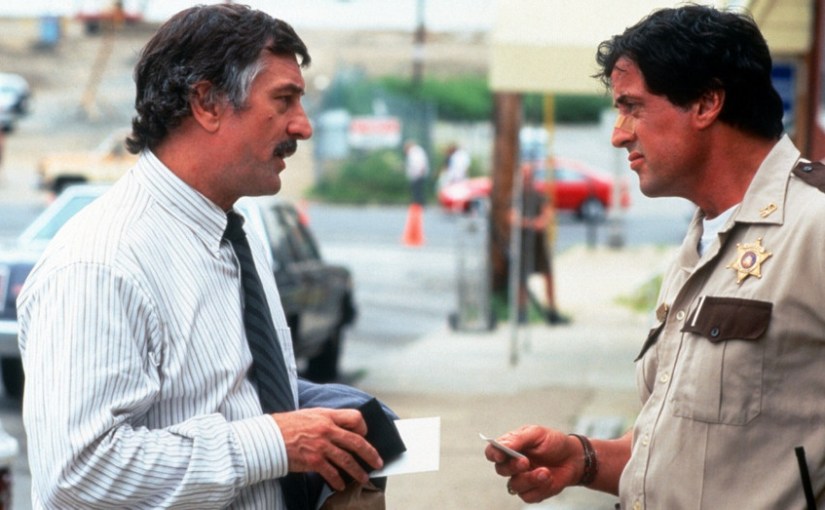
An internal affairs investigator named Moe Tilden (another of many convincing New York variations for Robert DeNiro) brings reasonable suspicions of corruption to Freddy’s attention.  How do these guys live so well based on the salary they earn on the police force?  Too often they have been connected with reputed mobsters, and incidents are quickly swept under the rug and kept quiet.  It stands to reason that the cover ups they commit happen in the home state of Jersey, outside of Moe’s jurisdiction.  Moe needs Freddy to quickly offer up anything he knows or witnesses. 

In particular, the leader of these guys, Ray Donlan (Harvey Keitel), might have something to do with the disappearance of his nephew Murray (Michael Rapaport) who was regarded as a young hero cop but is now at the center of a shooting incident gone wrong while driving across the bridge.  Donlan and gang fake a suicide for the kid, but with no body turning up in the river, it’s not so far-fetched to believe that perhaps he’s still alive and hiding out somewhere.

Cop Land works like an Us vs Them observation.  Freddy is the pawn for these guys to keep up appearances while this friendly town operates on other levels.  He’s the guy they can rely on to look the other way and mind his own business.  What I like about Mangold’s script is the dilemma with Stallone’s character.  Who could ever intimidate Sylvester Stallone after Rocky II?  He’s one of the biggest muscle men in film history. Yet here he is the weakling.  Most importantly, he’s utterly believable in this role that’s nowhere in the same league as Rambo or Rocky. 

The cast is as magnificent as you would expect.  Harvey Keitel looks like the family man but he’s got other nefarious ideas bubbling under his exterior.  Robert Patrick fills a role as Keitel’s heavy in a frazzled departure from his anal-retentive evilness that premiered in Terminator 2.  Ray Liotta is the second star of this picture sharing some good scenes with Stallone.  You’d think Liotta was the more seasoned actor even though Stallone came on the scene a few decades before.  Liotta is playing a guy who maybe once lived with a good soul but is now checkered and weary.  How I wish Ray Liotta had more significant screen time during his film career.

The setting works like an intimidating character here. The other supporting players flesh out the environment of Stallone’s sheep herding through a bed of wolves.  Those actors consist of Cathy Moriarty, Annabella Schiorra, Peter Berg, John Spencer and of course Frank Vincent who is a regular in these kinds of pictures.

Cop Land teeters on what Martin Scorsese or Sidney Lumet might have done with this picture.  It only falls short due to a wrap up ending with an unsurprising shootout.  What works so well as a pressure cooker crime drama devolves into blood and bullets and that is a letdown because it’s an easy way out.  In Lumet’s hands for example, the film would have taken advantage of at least an additional half hour to drive the piece into the arena of the public court system (a welcome opportunity for another all-star cameo from the likes of Al Pacino or Sean Penn.   I think the film would have been even smarter for doing so.  The avenue that James Mangold takes with his film is not terrible.  It just feels a little unrewarding or worthy of everything that was wisely executed before.

Cop Land should be seen for the dilemmas it hinges on and then for the various acting scenes among this terrific all-star cast.  Usually, actors will boast that they got to share screen time with Robert DeNiro.  I’m sure guys like Robert Patrick and Michael Rapaport place those experiences high on their mantles.  However, I bet all of these guys said what an honor it was to share the screen with Sylvester Stallone in a performance uncharacteristic of his usual criteria. 

James Mangold’s Cop Land is a terrific crime drama.

FIELD OF DREAMS

By Marc S. Sanders

Fantasy can be a real challenge.  The audience must convincingly accept what could never possibly be real.  The Wizard Of Oz from 1939 will always be the best of all fantasy films.  The most visually significant element was bookending the film in black and white, with illuminating color in the center for the Land of Oz to come to life.  You feel transported.

Phil Alden Robinson’s screen adaptation of W.P. Kinsella’s novel, Shoeless Joe, had a big challenge.  The film became known as Field Of Dreams.  How would any of us believe that an Iowa corn crop farmer hears voices and gets the inspiration to throw all common sense out the window and build a baseball field in the middle of his property?  It’s absurd.  Maybe only Kevin Costner, a modern-day innocent Jimmy Stewart of the time in the late 1980s, would convince any of us that this is something that needs to be accomplished.  Robinson’s script offers no logic that any of this should be done.  Re-watching the film, I was still skeptical of accepting the outrageousness.  Then again this is Kevin Costner in his mid-thirties with a toothy grin on his face, chestnut hair, beat up jeans, and an adorable 8-year-old Gaby Hoffman for a daughter and a spitfire Amy Madigan for a wife.  I can’t explain it any more than Ray can explain to his wife why he needs to tear down acres and acres of valuable crops for a baseball field that’ll run him into enormous debt. You just gotta roll with it, I guess, even if your suspension of disbelief isn’t there. 

Thankfully, the authenticity of the fantasy welcomes itself as Field Of Dreams moves on. 

Costner plays Ray Kinsella who had a very estranged relationship with his father who only briefly played in the minor leagues before aging quickly and working himself towards a premature death.  Ray went on to Berkeley in the ‘60s and got caught up in the hippie movement leaving his father’s baseball heroes of Ty Cobb, Rusty Miller and “Shoeless” Joe Jackson behind. 

After Ray builds the beautiful field and waits months and months for something, anything, to happen, the ghost of “Shoeless” Joe Jackson, (Ray Liotta) donned in his White Sox uniform, appears.  Jackson was part of the infamous Black Sox scandal and was denied of ever playing professional baseball again, following being caught accepting bribes to fix games with seven other teammates.  Ray spends the evening with Joe pitching and fielding together.  Now, whatever hasn’t made sense to the viewer suddenly presents some light on this outrageous feat we’ve been witnessing.  Dorothy has met the Scarecrow.

Ray has dreams to find a recluse author named Terance Mann (a superb James Earl Jones who should’ve gotten an Oscar nomination; just an astonishing actor).  Later, he meets a ball player who only played one inning in the major leagues, Archie “Moonlight” Graham – portrayed charmingly by an elderly Burt Lancaster and a spry Frank Whaley.  How they both play the role is a surprise I’ll withhold from this write up.

I share this summary because Field Of Dreams improves itself as it progresses.  The ghosts, the fantasy, and the sheer nerve that Robinson (director and writer) grants to Costner and the cast send you into the imaginary.  You’ll be twenty minutes into the picture and ready to give up.  Thankfully, the storyteller who made the film introduces something unworldly that encourages us to learn more and more.  That’s what happens every time you watch The Wizard Of Oz.  Not just the color, but the décor and strangely adorable munchkins draw you in with curiosity and you want to discover more about this place you’ve never visited before. 

With Field Of Dreams, you don’t have to know anything about baseball.  What you need to understand is that people of a past enter Ray’s life when he never expected them. Now, he’s destined to aid them in fulfilling what they were denied of during a time gone by. 

We all wish to take advantage of our dreams gone by.  Fantasy makes that possible.

Perhaps Ray Kinsella was denied an experience, as well.  You’ll have to watch Field Of Dreams to find out.

KILLING THEM SOFTLY

By Marc S. Sanders

What did I just watch? A mob movie, or a 2008 Presidential debate where the candidates are no shows, and their respective commercials are aired in their place? Andrew Dominik directs Killing Them Softly, with Brad Pitt who also produces.

Reader, I don’t get the appeal. Maybe it’s the outstanding cast which includes Pitt, as well as James Gandolfini, Ben Mehndelson, Richard Jenkins, Scoot McNairy and Ray Liotta. Sadly, these guys are given next to nothing do of any consequence.

After it is revealed that Liotta’s character, Marky, ripped off his own mob poker game a few years back, an idea is presented to two street addicts played McNairy & Mendehelson to do the same thing because, heck, they’d never be suspected and logic dictates that Liotta must have done it again. So, he’ll be the one to blame and get whacked. The game is robbed and now Brad Pitt’s hitman character is on the job. Simple enough story, almost like a Guy Ritchie picture.

Killing Them Softly is an adaptation of a 1974 novel by George V Higgins. I never read the book, but I’m curious if it contains any kind of relation to Andrew Dominik’s idea of editing recurring speeches and ads, compliments of Obama, McCain and Bush 45. Truly, what was the point of this recurring theme? A two-sentence piece of dialogue finally acknowledges this in the final minute of the film, but I’m still lost on the significance. Somehow Dominik made a dirty, cold, rain-soaked picture that has an omnipotent viewpoint from our most prominent politicians, and I don’t know what one thing has to do with another.

As well, Gandolfini arrives in the story and I never could gather what was his purpose. I think he is a hitman who is washed up, never getting his ass up to carry out the job and just monologues about nothing like the hooker he pays off; topics that Quentin Tarantino might’ve thrown in the editing trash bin.

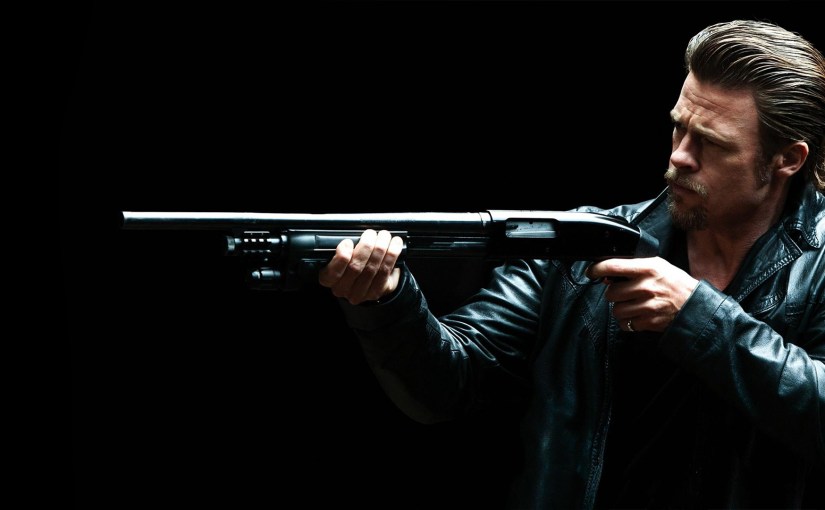
Mendelsohn looks incredibly convincing as an addict living off the streets, yet his storyline has no end. He’s arrested. Then what happens? What does that mean for everyone else? Liotta has a long drawn out sequence of getting the shit kicked out of him by two mob foot soldiers. The scene goes on and on and on. His face cracks and bleeds, and bleeds some more. Brad Pitt? Well, he’s the hitman who just looks cool. Yeah, the black leather jacket he wears looks very cool on him. That’s about it.

There’s no development to Killing Them Softly. No surprise or twist. The guys you expect to get killed, get killed, and there’s no good dialogue.

This film is just an empty void of poorly, uninteresting violence.

UNLAWFUL ENTRY

By Marc S. Sanders

The boogeyman is dressed as a police officer!

In 1992’s Unlawful Entry, Jonathan Kaplan (The Accused) directs a well-played Ray Liotta as a psychotic cop named Pete Davis who is terrorizing a yuppie couple named Michael & Karen Carr (Kurt Russell, Madeleine Stowe). The Carrs experience a home intruder who puts a knife to Karen’s throat. Officer Davis offers comfort to the pair and happily volunteers the arrangements for a high-tech alarm system. The first mistake that Michael makes is sharing the password with trusty Pete. You’ll expect that to come into play later on. Maybe what inspired the password will work itself into the film as well. Hmmmmmm?????

It’s difficult for Pete to resist the obsession he has for Karen and so he begins a campaign to get Michael out of the way. First, he demonstrates his brutality by offering Michael the opportunity to senselessly beat up the home intruder for no other purpose than personal satisfaction. When Mike refuses, Pete finishes the job. Later, Mike makes efforts to keep Pete out of their lives. It’s hard to do that when a highly decorated cop is involved. Karen, his own loving spouse, won’t even truly believe Mike; neither will the police chief.

As Pete continues with his intentions, Mike’s credit cards are maxed out, he loses a high priced client that Pete has been talking to, parking tickets add up, and so on. Pete also appears at the house at inopportune times like when Karen is taking in a swim or creepily stepping into their bedroom while the married couple is having sex. Eventually, Mike is put out of the way when he’s imprisoned after being framed as a drug dealer. Now Karen is all alone for a terrifying third act that you’ve likely seen hundreds of times before.

Unlawful Entry is engaging while you’re watching, but it does not convey much. The happenings all appear probable if a deranged cop wanted to go through all this trouble. Therefore, Ray Liotta owns the picture. Yet, what did I learn here? Don’t call the police?

For Kurt Russell, this is the first of two “husband is being terrorized” roles for him. Later, Russell would headline the cast of a better film to fall in this genre called Breakdown. Still, I like Russell here. He starts out as a guy who is not capable of fighting for the sake of his wife. He regrettably admits that shame to Pete early on. Pete pounces on that advantage to win Karen. Later, the strength of Mike’s short temper followed by his fear push him to do what he must to protect himself and his wife.

Madeleine Stowe is a good actress. There’s just not much for her to do with this part. She’s the spouse who opts not to believe her husband’s concerns. If she did, there wouldn’t be much of a movie. The third act is all action and blood and falling down the stairs and running back up the stairs. It’s no surprise really. Though it is convenient that Michael is finally able to post bail and get home in time for a final confrontation with Pete.

One thing that kept echoing in my head though was that as good as Ray Liotta is (he’s very, very good actually; very primal and deceiving), he is terrorizing a woman named “Karen.” Every time he says the name Karen, all that comes back to me is the film Goodfellas where he more or less tormented and disrespected Lorraine Bracco known as, you guessed it, Karen. A rule should be put in place, Liotta can no longer be cast with other characters named Karen. His Karen quota is maxed out.

GOODFELLAS

By Marc S. Sanders

Goodfellas is my favorite film by Martin Scorsese. It’s a fast-paced roller coaster narrative of Irish street kid Henry Hill’s experience in the mob, dramatized from his real life as part of the Gambino crime family of New York.

“How am I funny?,” the Lufthansa heist, Spider takes it in the foot and then in the chest, Morrie’s Wigs, the piano montage from Derrick And The Dominos, Billy Batt’s demise followed by an early morning breakfast stopover at mom’s, and Henry’s helicopter paranoia. All of these elements are assembled to depict the perceived glamour and undoing of street level hoods, proud to steal and dress in the finest threads while bedding dames behind their wives’ backs.

Scorsese along with Nicholas Pileggi uncovered something special when they adapted Wiseguy (Pileggi’s book) for the screen. I think they struck a nerve because they showed these guys as men doing a routine living. There was a process to their deeds. Give a cut of your theft to the man above and keep the rest for yourself. Above all else, stay off the fucking phone. Get out of line and get whacked, unless you’re a “made guy.” This is all code, normal to Henry and his cohorts (Robert DeNiro as Jimmy Conway; Joe Pesci as Tommy DiSimone).

Moreover, the wives understood this behavior as well. Henry’s wife Karen (Lorraine Bracco) knew these guys were not 9 to 5 husbands and the more it occurred, the more normal it all seemed. Including when the FBI presented a warrant to search the premises. Just let them in and go back to rocking the baby to sleep while watching Al Jolson on the box.

Scorsese took the best approach by not judging the actions of these raw criminals. They dressed well, but they weren’t reluctant to draw blood if an insult was tossed their way. Pesci, in an Oscar winning best performance, represents that philosophy. Scorsese, with his regular editor, Thelma Schoonmaker, are not shy about the violence. Watch how Jimmy and Tommy beat up a “made guy.” DeNiro just stomps his dress shoes into the guy’s face over and over. Pesci pistol whips him, but before he can shoot him, he breaks the gun…on the guy’s face. The romance of gangster life quickly undoes itself in moments like this. As Henry notes, your friends come at you with smiles before they whack you.

Ray Liotta is Henry, the primary narrator and centerpiece of the film. Most of the story is from his perspective. I’m sorry that Liotta didn’t get much award recognition. He really deserved it. His voiceover narration is superb. It gives a feeling like I’m talking to Henry in a bar with his tales of Mafia code and life in the criminal underworld. His voiceover is conversational. He’s also got great expressions of disregard, anger, and intense, raging fear on screen. When Henry is at his worst, his eyes are dry red, and his skin is pale and craggily. None of that is just makeup at work. That’s Ray Liotta performing with an exhausted energy in character. Watch the scene following his 3rd act incarceration where he argues with Karen over the last of their drug supply being flushed down the toilet. It’s not so much a party anymore. The manic response couldn’t feel more real as he slams his hand against the wall and then crouches up into a weeping ball of helplessness in the corner, on the floor.

Liotta and Bracco have sensational chemistry together in scenes of their courting nature when they first meet, followed by the ongoing, bickering abuse that enters their married life. There’s a great hysteria to them. Bracco got a nomination for her role. She deserved it.

Scorsese is a master at filming basic gestures as well to show the nature of these mob guys and their crimes. A key folded in a paper is then inserted into a knob and a stash is walked off with. A blood-soaked revolver is placed in a tin box and then Schoonmaker cuts over to the customary stomping of a glass at a Jewish wedding. Every prop and detail are connected.

Even better is Martin Scorsese depicting the wise guys’ incarceration midway through the film. Watch how the head mob boss Pauly (Paul Sorvino) slices onion with a razor for dinner complete with steaks broiling, pork sauce bubbling and even lobster ready to be boiled. Scorsese and Pileggi found it important to depict how attractive this life could be, despite a stretch in the joint or the violence that might come. Pay off the right guys and you could live like kings.

The master director doesn’t stop there. His selection of doo wop and rock period music paints the historical palette of the 50s through 80s. Music was being played and life was happening all the while an underhanded way of crime and violence occurred.

One of the best blends of film and song occurs during the classic one-shot steady cam where Henry escorts Karen through the back way of the famed nightclub, Copacabana. It’s one of the greatest scenes ever in movies. The walk journeys downstairs, through the kitchen, past wait staff, cooks, bouncers, people necking and to a front and center table to see Henny Youngman’s stand-up routine. The sequence is accompanied by the song “And Then He Kissed Me.” It’s a great character description to display a young guy, proud of his gangster image, with a whole world ahead of him and everyone offering their respects while he hands out twenty-dollar bills like gift coupons. This young guy had power, and the girl holding his hand couldn’t be more impressed.

Goodfellas is one of the greatest mob movies ever made. It’s one of my favorite films. It’s genuine in its grit and language. Every F-word uttered is necessary to translate the regard for code, or the blatant disregard for the law, loyalty within a crew, or even the ethics of marriage. It astounds me that it didn’t win Best Picture in 1990, losing to Dances With Wolves. Perhaps it got cancelled out with fellow mob nominee The Godfather Part III.

Regardless, the film struck a chord and pioneered a new way of showing criminals in celebration of themselves while sometimes encountering the inconvenience of the law or the women in their lives or worse, the betrayals among themselves. At any given moment you might rat on your friend and not keep your mouth shut.

Without Goodfellas, The Sopranos might not have been as welcomed into the pop culture lexicon. Maybe even the films of Quentin Tarantino or Guy Ritchie or Paul Thomas Anderson, or even other Scorsese projects yet to come.

Goodfellas is an electrifying film of unabashed humor, realistic and shocking violence, and authentic culture within a well established crime syndicate.

Goodfellas is a must see film.