CONCLAVE

By Marc S. Sanders

conflict

noun

  • 1.
    a serious disagreement or argument,

conclave

noun

con· clave ˈkän-ˌklāv 

Synonyms of conclave

1

a private meeting or secret assembly

especially  a meeting of Roman Catholic cardinals secluded continuously while choosing a pope 

2

a gathering of a group or association

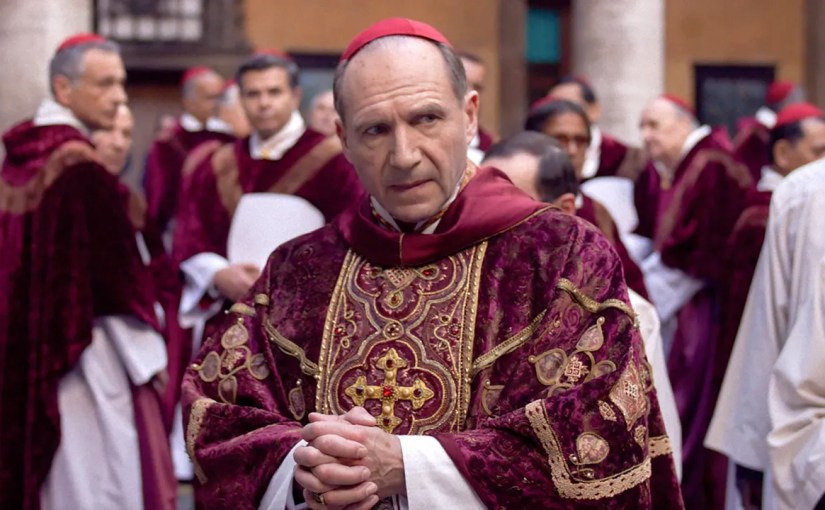
As I watched Edward Berger’s new film, Conclave, the word “conflict” came to mind based simply off of the same prefix the two terms share.  This picture does not just depict a sequestered assembly to elect a new Pope for the Roman Catholic Church.  It goes further because nothing goes as expected for the Dean of the Conclave, Cardinal Lawrence (Ralph Fiennes, doing Oscar caliber work).  

Now that the Pope has passed away, the various cardinals assemble, and all seem to have their own impressions of who should take the reins.  Cardinal Bellini (Stanley Tucci, man I love this guy) is the liberal candidate, tolerant and supportive of the gay population and accepting of women in authoritative positions.  Cardinal Tedesco (Sergio Castellitto) is on the conservative side believing the position should rightly return to an Italian with restrictions and containments of liberal ideals that have diminished what the church used to stand for.  There is also Bishop Tremblay (John Lithgow) who has an abundance of support to no one’s surprise. A few others earned some votes during the initial balloting, but it’s seemingly of no big consequence. Still, over the course of the film, multiple votes will have to be counted until the minimum majority necessary for a new Pope is collected.

The men of God convene in a formality of faith, swearing their handwritten votes before the Almighty.  Yet, Lawrence, as a dean of ethics and morality, is becoming apprised of some questionable irregularities among his peers.  While some of these men are earning more and more support with each passing tally, new developments present themselves forcing Lawrence to question if there should be some investigations to determine if some of these men are qualified to acquire the Papacy beyond an election.  Hence, the conclave is getting gravely interrupted by an overwhelming number of conflicts for Lawrence to consider.

I must stop there with my summary of Berger’s film, based on the novel by Robert Harris.  This is a top notch drama helmed by an outstanding cast.  At the very least the adapted screenplay by Peter Straughan will win the Oscar.  The dialogue is aggressive and forthright when it needs to be.  An institution like the Roman Catholic Church operates on secrecy.  However, it’s so interesting to see these devout men of God challenge one another. Just because they are the highest priests does not constitute them beyond sin or even corruption.  As Stanley Tucci’s character demonstrates, they might not be polite either.  Simply honest when their personal stance is challenged.  

The script is also quietly ponderous.  Ralph Fiennes shows an internal conflict between his duties to the church and how he truly characterizes some of his peers.  He even begins to wonder if he should continue as a priest. Has his faith remained uncompromised? Frankly, how can a priest of the highest order live satisfyingly knowing that no person is of an upmost perfection even if they swear by their faith? Still, the strict expectations of a widespread religion will demand contexts of that notion.

Constructively, Conclave has a gripping energy.  The performances from especially Fiennes, Tucci and Lithgow are magnetic as soon as they enter the piece.  Isabella Rossellini delivers an under-radar performance as a nun who works with a necessary audaciousness to her character.  She knows things that should never have occurred.  Yet, how will she confront these intimidating, stark, red-robed figureheads?  Does she even have a right or authority to speak?

The music from Volker Bertelmann could belong in Hitchcock thriller if Bernard Hermann wasn’t available.  It keeps you alert and never anchors your feelings as new developments come to light.  The composition only enhances the weight of the drama.  

Edward Berger is an observant director.  Ahead of the conclave he reminds you that even telephones are not permitted inside and tossed in a heap outdoors.  The priests are smokers. Personally, I find that surprising as cigarettes almost seem like a mild narcotic and a contradiction of how I envision a Catholic priest should behave.  Nevertheless, Berger also gives you a close up of a pile of cigarette butts tossed on the ground just ahead of being sequestered. These men turn off the world outside to focus on this important election. It’s as if they live in a submarine below the surface.

Conclave wil be a very divisive film.  Politically, it’s apparent that it favors one side (liberal vs conservative) over another.  In addition, it is not shy about showing its characters with their assortments of fault.  I am not educated in Catholicism.  Though I am well aware of the value it holds across its worshippers.   For many, their faith is held above all else and those people will find a discomfort with this picture.  I might even be understating that assessment.  Some folks of the Catholic order, and maybe other denominations of Christianity, will even take grave offense to this fictionalized depiction.

Conclave is truly conflicting.

Because I do not hold any value in Catholicism, much less any religion anymore (just a shred for the Judaic customs I was raised on), I did not hold any bias or objections to Edward Berger’s film. Rather I was engaged in how difficult it is to balance yourself as a Catholic priest.  For Cardinal Lawrence, Ralph Fiennes is neither likable nor unlikable but I certainly felt his character’s frustrations and the challenges he is obliged to navigate.  

Who is judging these Cardinals? 

God?  

Or is it each one of them?  

Conclave is built on one believable, yet shocking, surprise after another.  Still, when the big twist at the end arrives, it is completely blind siding and Straughan’s script leaves his audiences with a new question that’s practically impossible to contend or compromise.  

Again, Conclave is very, very conflicting.

Nevertheless, this is one of the best films I have seen in a very long time.  So much so, that I cannot wait to see it again.

Conclave is one of the best films of the year.

QUIZ SHOW (1994)

by Miguel E. Rodriguez

DIRECTOR: Robert Redford
CAST: John Turturro, Rob Morrow, Ralph Fiennes, Paul Scofield, David Paymer, Hank Azaria, Christopher McDonald, Mira Sorvino
MY RATING: 7/10
ROTTEN TOMATOMETER: 97% Certified Fresh

PLOT: In the late 1950s, a popular TV quiz show, along with its current champion, falls under federal investigation following allegations of rigging.


I imagine there will be no shortage of people more than willing to tell me how wrong I am, but while Robert Redford’s Quiz Show was well-directed, well-written, and well-acted, I never fell completely under its spell.  For that matter, it never felt like it had the director’s stamp on the material; a lot of it felt like a Ron Howard film.  No doubt the story captured a lot of attention when it happened in the late ‘50s, but it failed to grab mine, at least to that same degree.  It’s too well-made for me to skewer it mercilessly, but neither do I consider it a masterpiece.  It’s…okay.

It’s 1957, and Sputnik captures the world’s attention at (or at least near) the height of the Cold War.  To distract themselves from Sputnik’s implications, Americans tune their TV sets to the most popular game show on the air: Twenty-One, in which competing contestants are asked random trivia questions while isolated from each other.  These questions are something else.  One multi-part question includes: “Who rode with Paul Revere?  Who lent him his horse?  Was it a mare or a stallion?  And what was the horse’s name?”  I mean, really?  The current champion, Herbie Stempel (John Turturro), knows these answers and many others and has become something of a local hero, but he’s not terribly photogenic, with his oversized shoulders, those nerd goggles, and that one rotten bicuspid that you can’t take your eyes off.

Twenty-One’s showrunners decide Stempel’s run has come to an end and hatch a plan to throw the next episode to handsome young Charles van Doren (Ralph Fiennes), a Harvard professor who in real life did not look quite as handsome as Ralph Fiennes, but whatever, this isn’t a documentary.  Both Van Doren and Stempel comply with this plan, but the scenes in which they make their decisions felt contrived, or false, or something.  I was never convinced of their motivations.  Stempel needed the money but was supposedly swayed by the possibility of being awarded his own “panel show.”  Van Doren clearly didn’t need the money and even turns the offer down at first, but then he changes his mind because…I guess he needed a way to live up to his Pulitzer-Prize-winning father?  All the pieces are there, but it’s never fully explained until his final speech in front of a Congressional committee.

The story engine involves a young DC lawyer named Dick Goodwin (Rob Morrow) who gets a whiff of potential scandal and, eager to make a name for himself – as a possible parallel to Van Doren himself – does some independent investigating.  His digging leads inevitably to Stempel, who is more than happy to name names, but whose irascible personality makes him a less than ideal witness.  Things get interesting when he interviews Van Doren.  He is clearly suspicious, but no hard evidence appears…until he watches an old clip of a previous Twenty-One contestant who appears to give an answer the host was not expecting…

I don’t know how relevant this is, but I feel compelled to observe that director Redford seems to have phoned in a lot of favors when it came to casting Quiz Show.  In addition to the fine performances from the leads (Rob Morrow is outgunned by Turturro and Fiennes, but he holds his own), the supporting cast reads like a Woody Allen picture: David Paymer, Hank Azaria, Christopher McDonald (perfectly cast as the smarmy, superficial host of Twenty-One), Mira Sorvino, Martin freaking Scorsese, and walk-ons by Timothy Busfield, Ernie Sabella, Barry Levinson, Mario Cantone, Illeana Douglas, Calista Flockhart, and a blink-and-you’ll-miss-him Ethan Hawke.  Redford clearly wanted to make sure his canvas was deep and well-drawn, and not just with the impeccable period production design.

But to what end?  I went into Quiz Show thinking it would involve a much deeper conspiracy than just two showrunners who, following orders from corporate, simply bribed several contestants to follow a scripted playbook.  About halfway through the movie, I realized there was not going to be much more to that part of the story, and we were going to follow the lawyer on his quest to uncover the truth, and I was like, “…that’s it?”  Does that make me guilty of criticizing the movie that I wanted it to be, instead of criticizing the movie itself?  I’m not sure.  Rightly or wrongly, I felt the movie wanted me to empathize or sympathize, or one of the -izes, with Van Doren.  But I was not moved to goosebumps by Van Doren’s final speech at the end of the film.  I found myself siding more with the committee member who says, “I don’t think an adult of your intelligence ought to be commended for simply, at long last, telling the truth.”

(I suppose a case could be made that the whole film is a parable for Watergate, still several years in the future; Nixon is name-dropped a few times.  The end credits inform us that NBC and Twenty-One’s sponsor, Geritol, were never indicted because their underlings claimed full responsibility for their actions, much like Haldeman, Ehrlichman, and the rest.  Does the buried subtext of America’s lost innocence make Quiz Show a better film?  Maybe a little, but only when you stand back from it, not while you’re watching it.)

HAIL, CAESAR! (2016)

by Miguel E. Rodriguez

DIRECTORS: Ethan Coen & Joel Coen
CAST: Josh Brolin, George Clooney, Alden Ehrenreich, Ralph Fiennes, Scarlett Johansson, Tilda Swinton, Channing Tatum
MY RATING: 7/10
ROTTEN TOMATOMETER: 86% Certified Fresh

PLOT: A movie studio “fixer” in 1950s Hollywood faces his biggest challenge yet when the star of the studio’s most prestigious film in production is kidnapped by a shadowy organization calling itself, “The Future.”


The word “idiosyncratic” feels like it was invented for the Coen Brothers…or maybe vice versa.  Their 2016 film Hail, Caesar! is yet another case in point.  Packed with the kind of early Hollywood detail we wouldn’t see again until 2022’s Babylon, this film is a love letter to the 1950s studio system that produced such classics as All About Eve, Stalag 17, The Bridge on the River Kwai, and Ben-Hur.  However, the comic story surrounding this love letter is a bit rambling and disjointed.  About halfway through, I found myself wondering if maybe the movie wouldn’t have been better if the filmmakers had just ditched the comedy and made a straight-up drama.  But then we got to the climax, and I realized, no, comedy is better for serving up the kind of silliness we get at the end.  It’s no Raising Arizona, but it’ll serve.

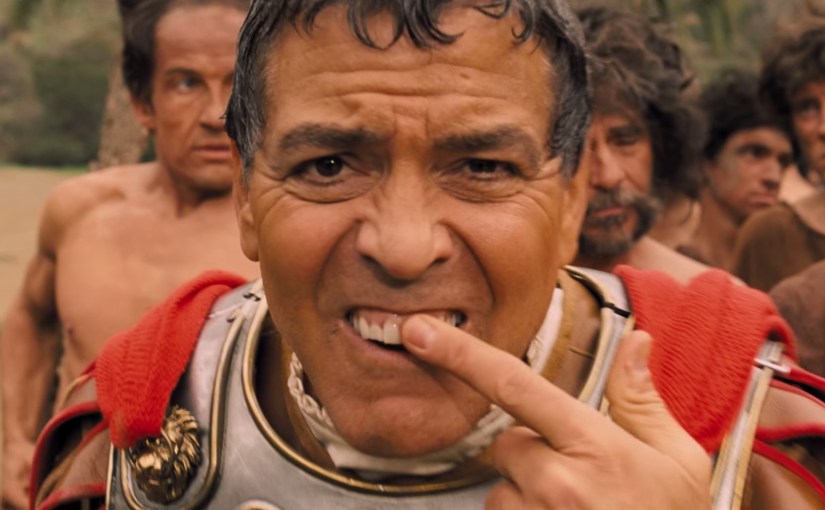
In classic film noir fashion, a narrator (Michael Gambon) informs us that Eddie Mannix (Josh Brolin) is head of production at the fictional Capitol Pictures, which is in the middle of shooting its most ambitious picture ever, an epic Biblical tale called Hail, Caesar!  (Think Ben-Hur with a lower budget and an outright plagiarized screenplay.)  However, their leading man, the improbably handsome and incredibly dumb Baird Whitlock (George Clooney), abruptly goes missing when he is kidnapped by a couple of lurking extras.  Mannix must deal with finding Whitlock while also figuring out what to do about:

  1. DeeAnna Moran’s (Scarlett Johansson) unexpected pregnancy.
  2. Hobie Doyle’s (Alden Ehrenreich) inability to deliver lines without a cowboy accent, which infuriates his director, Laurence Laurentz (Ralph Fiennes).
  3. Two persistent gossip columnists (both played by Tilda Swinton) who are running stories on Whitlock’s disappearance and/or salacious rumors about Whitlock’s past.
  4. A lucrative job offer from Lockheed.
  5. His promise to his wife (Allison Pill in a tiny role) to quit smoking.

Whew!  And I haven’t even mentioned the singer/dancer Burt Gurney (Channing Tatum) or the mysterious group of academics who have apparently kidnapped Whitlock, a group calling itself, “The Future.”  …spooky…

As in many other of the Coen Brothers’ films – not ALL of them, but many of them – the story itself is not really the point.  It just serves as an excuse for Ethan and Joel to present the viewer with scene after scene demonstrating their immense affection for a bygone era of filmmaking.  When Scarlett Johansson’s character, DeeAnna, is introduced, for example, we don’t just get a line or two about what she does (she’s an aquatic star modeled after Esther Williams).  We’re treated to an elaborately choreographed scene with dozens of bathing beauties, ScarJo diving from a great height wearing a mermaid tail, and a mechanical whale complete with a spouting blowhole.

At one point, Mannix visits the chief film editor for the studio, C.C. Calhoun (Frances McDormand), to see how Mr. Laurentz’s film is shaping up.  This scene in particular is lovingly presented, as we get a quick-cut sequence of Calhoun unspooling the film in the dim editing room, re-threading it, punching a button, flipping a switch, click-clack, click-clack, and Mannix watches the opening sequence of “Merrily We Dance” on the tiny Moviola as the projector whirs in the background.  I would bet real money that Martin Scorsese really, REALLY loved this scene.  (Plus there’s a nice little comic button at the end of the scene that is an excellent demonstration of Edna Mode’s immortal dictum in The Incredibles: “No capes!”)

The whole movie is like that.  It’s one of the most nostalgic homages to old Hollywood that I’ve ever seen.  But the movie can’t seem to make up its mind about what it’s about.  George Clooney puts on a clinic of how to play dumb as the clueless Baird Whitlock.  (In fact, this movie serves as the conclusion to the unofficial “Idiots” cycle of films from the Coen Brothers films, which also includes O Brother, Where Art Thou?, Intolerable Cruelty, and Burn After Reading, all of which star Clooney in a lead role…playing an idiot.)  Alden Ehrenreich is pretty convincing as a young star with a pretty boy face and limited acting ability, which I’m sure is far from the truth, but he pulls it off.  His scene where he tries to wrap his Texas accent around the simple line, “Would that it were so simple”, with his director patiently trying to coach him, is hilarious on its own.  But it runs on a little too long, as does the aforementioned scene in the editing room.  The subplot with the gossip columnists feels tacked on, almost as of the Coens were trying to pad the running time.  There’s a magnificently choreographed scene where we watch Channing Tatum’s character do some tap dancing dressed as a sailor for another movie being filmed, but even THAT runs a little too long.

Ultimately, Hail, Caesar! feels more like an intellectual exercise instead of an emotional one.  I hate to keep bringing this movie up by comparison, but Babylon, for example, managed to capture a nostalgia for Old Hollywood AND kept me emotionally involved for its entirety.  There was an energy that kept things moving.  Hail, Caesar! lacks that energy, but I can’t quite bring myself to call it a “bad” movie because I connected with its affection for the monolithic, flawed system that managed to create so many diamonds amid SO many lumps of coal.  (Just like today!)

THE MENU

By Marc S. Sanders

Whether you’re the storyteller or the viewer/reader, you take a chance with satire.  The darker the satire is, the even greater the risk you take. A film like The Menu, from director Mark Mylod, is one such example. You’ll hate it…like my wife did, despite the lively conversation we had afterwards.  On the other hand, you might love its invention to strike back at an upper class that lacks any clue or respect for the talents of others. Then again, you just might only like it.  Well…at least I liked it.

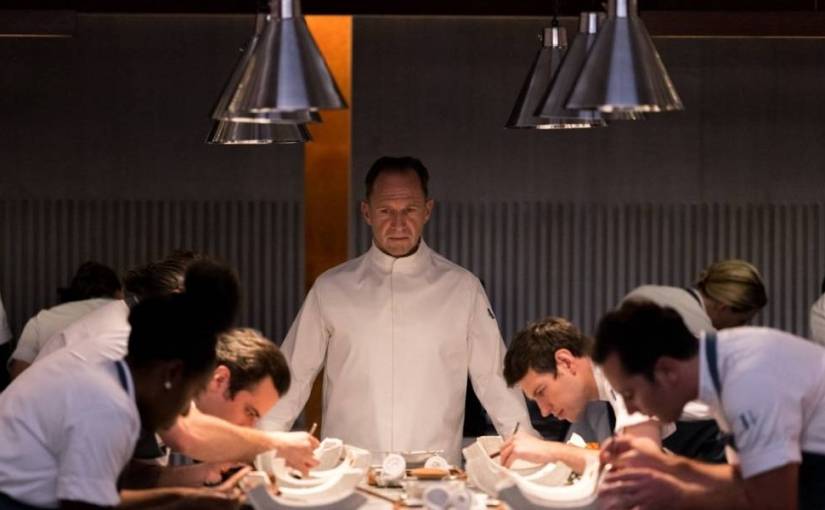
Ralph Fiennes’ résumé has earned a reputation to intimidate an audience. He is a superb actor who can be absolutely frightening as a Nazi in Schindler’s List, or heartbreaking as a torn affiliate of a deceitful plot like in Quiz Show. He can also go toe to toe as a Greek god against Liam Neeson, or he can demand that James Bond “Stand down!” and strike with snake like glee at Harry Potter. He can also teeter along the antics of the devil himself as he portrays the world’s most esteemed chef in The Menu.

A collection of guests is escorted by boat to a remote island where the finest restaurant is located and run by Chef Slowik (Fiennes), with assistance from Elsa (Hong Chau).  There’s Tyler (Nicholas Hoult), a die-hard fan of the chef’s craft with his date Margot (Anya Taylor-Joy), who is nowhere near as impressed.  Tyler has to remind Margot not to smoke, otherwise it’ll destroy her palette for taste.  There’s an older couple who has frequented the Chef’s dining establishments before and are back for another visit.  There are a pair of restaurant critics. There’s a movie star (John Leguizamo) with his young assistant.  Finally, there is a trio of sophomoric, yuppie businessmen who are here because their last monthly commission likely afforded this exclusive opportunity, and their favorite hockey team was out of town.

When the guests arrive on the island, Elsa gives them a tour ahead of the restaurant where they will eventually dine.  A cabin is displayed to show how the meats are aged over a period of 152 days. Quite specific! One of the yuppies has the audacity to ask what happens if you age it to day 153. I don’t recall Elsa’s response.  I do remember her disdain for the question though. They walk through the lodge where Elsa explains that the entire staff reside and sleep in the one room together. One cot for each person. Odd, but okay. Moving on is a quick pass by the cottage where the Chef resides, and no one is permitted to enter. Oooo!!!! I know one thing I expect to happen.

It is important to note that I opted not to read up on anything The Menu was about.  I didn’t know if I was to see a comedy, drama or horror film.  As this tour continued though, I had eerie recollections of the film Midsommar, directed by Ari Aster. That movie still gives me the bejeebees.  So much so that I could not bring myself to write an article about it.  Like that film, our cast has become isolated in a desolate locale, and the guide could not be more unsettling.  When they arrive at the restaurant, a large horizontal door is thunderously closed behind them. Margot gives a quick look back over her shoulder. This cannot be good.

Lending to the structure of the film, courses are presented with a startling clap of the hands from Chef Slowik. Mark Mylod executes a nice pattern of gracefully displaying text across the screen describing what the next featured course is, along with its fine ingredients.  It is elegant but also only partially revealing of some of the guests. Tyler isn’t the kind of fan that Chef would welcome.  After a request has been made not to take pictures of the dishes, he does so anyway.  He is uncouth with his commentary and clumsy as well.  Additionally, bewildering for Chef Slowik is the presence of Margot. He was not expecting her to attend. Yet, here she is and he cannot understand why.

The Menu does not deviate from its intent to be strange. A bread dish is presented without any bread! Only the dips. Tyler is absolutely impressed. Margot thinks it is ridiculous. By the time, the fourth course has arrived, a shocking presentation is exhibited to the guests and that is where the film takes a graphic turn.

It’s best not to reveal much about the movie.  Its features work if you share the perspective of the guests, particularly Margot. What you are left to decide though is if you accept that dark satirical nature of the piece.  You will or you won’t.

I did not find The Menu to be very symbolic, allegorical, or even a reflection of the natures of social classes who partake in exclusive high-end cuisine.  Chef Slowik has prepared a specific plan for this assortment of guests. The execution and outcome cater to his personal satisfaction and no one else’s.  I guess that’s why I only liked the wit behind the message of the film.  I just could not fully embrace its invention.

My experience with satire typically allows me to think about how people behave and what they can learn from outrageous proposals or extreme actions. Network explores how the world responds to what is proposed for satisfying television audiences while generating business profits.  A film like The Menu delves into grandiose, unheard of actions that will satisfy the one puppet master behind everything you are seeing.  Maybe I was looking for the message the Chef delivers to include my own misgivings and sins and temptations in his overall delivery.  Instead, his machinations rely on these specific guests on this particular night, and so I kind of felt left out of the circle. As the guests are specifically affected by the developments of the evening, I can’t say I had any care or sense of suspense for them.  Nor did I care for Chef’s own satisfaction as the evening carries on.

The cast is a terrific eclectic assortment. Anya Taylor-Joy is a smart and forthright hero against Ralph Fiennes’ antagonist. A well written conclusion that made me applaud is included by her character’s deductive reasoning. The other players though are not given much fat to chew on in terms of dialogue or scenes.  Their purpose is specifically explained, and then they are left to watch and wait for the climax of the film. I like the veil that is lifted from Margot’s character.  I would have welcomed a little more subtext on the other characters, however. Again, their purpose is laid out, but I think the film, which clocks in at around an hour and forty-five minutes, could have dug a little deeper into the guests sitting at the other tables. Not to mention those few who also serve on the Chef’s cooking staff.

The Menu is an unusual film, like an episode of Tales From The Darkside or The Twilight Zone.  It is limited like a TV episode. I just think it needed two or three more courses to savor just a little more meat on the bone.

SCHINDLER’S LIST

By Marc S. Sanders

Oskar Schindler was a handsome, well dressed man. A man of wealth, power, and influence. A successful businessman. He was a womanizer. And Oskar Schindler was a Nazi who saved 1100 Jews from the atrocities of the Holocaust.

On a filmmaking measure alone, Schindler’s List is one of the best pictures to ever be made. Steven Spielberg’s production value is incomparable. Nothing I can recall appears as grand (not sure that’s the appropriate word here???) and authentic as Schindler’s List. How did Spielberg pull off this feat? How did he direct hundreds, thousands maybe, of extras to reenact the vilest human suffering that a generation of people could ever encounter? I’m astounded. Positively astounded.

This evening was only my second time seeing the film. I always put off watching it over the last 30 years; reluctant maybe to see a horrifying truth. The first time I saw the film was on Christmas Day, 1993 at the Hyde Park cinemas in Tampa, Florida with my father. I didn’t realize it at the time, but I was in the beginning stages of the flu with a high fever. Midway through the film, I had to leave the theatre as my illness caught up with me. I mustered the strength to return to watching the remainder of the movie, as I recall I could not go without finishing this masterpiece. I was horrified and yet amazed; amazed that this moment in world history could have ever occurred.

To see a man like Amon Goth (brutally and uncompromisingly played by Ralph Fiennes), a high ranking Nazi, excuse himself from his nude mistress’ bed and perch himself on his balcony to sniper random Jewish prisoners as a means of sport was sickening and twisted to me. Twenty five years later, it is this moment that has always stayed with me, as much of the story and scenes left my memory from so long ago. This moment as well as Spielberg’s choice to highlight a young girl in a red coat amidst a most somber black and white picture have stayed with me all these years. The glimpse of red serves as a truth to Schindler’s naivety. Spielberg is a thinking director. He never follows the manual. He chooses to think outside the box. A glimpse of a child dressed in red in a sea of black and white where mutilated corpses and possessions are aimlessly strewn about. It’s a marvelously telling moment.

Liam Neeson plays Schindler. It will likely be the greatest role of his career. Schindler is a man who even fools the audience until the very end when he reveals that the war has ended and his salvation has rescued these 1100 souls. Finally, his humanity no longer hides and he weeps to his accountant and accomplice, Itzhak Stern (played subtly and beautifully by Ben Kingsley). Schindler weeps for he could have saved more. Neeson is superb in this moment. His commanding stature crumbles, his materialism and wealth have disappeared. Neeson translates all of that clearly, and finally my tears arrive. Prior to this moment, I was numb to the Nazi tactics of gas chambers, careless bloodshed and apathetic separation of families and friends; perhaps because I’ve extensively studied it during my years in Yeshiva. Before Schindler’s List, much of the history on the Holocaust seemed like textbook fare to me. Spielberg made its terrifying and tragic reality real.

Ben Kingsley’s performance is so important as well. The architect behind the list, his portrayal of Stern is countered with contained fear and leveled sensibilities amid the senseless intentions of a dominant force of evil. His instincts kept him alive so that only he could help keep his comrades alive.

Schindler’s List won the Best Picture Oscar for 1993, only 50-52 years following the events of the Holocaust. Many survivors thankfully remained to see Spielberg’s epic premiere. People who I share this planet with experienced the most insane and heinous evil ever encountered. They were well to do people living normally until they were violently pulled from their homes, stripped of their possessions, separated from their families, suffered at the threat of murder, witnesses to other murders and hate crimes, humiliated, beaten, forced into slave labor in tightly contained ghettos and eventually thrust into concentration camps. Yet, these few survivors lived to carry on with their lives and deliver new generations, beyond this morally ugly and evil historic episode.

I’m being redundant as I’ve said it many times before, but isn’t that the point? The Holocaust and the Nazi regime only occurred around 85 years ago. This happened before. This can happen again.

Thank you, Steven Spielberg for Schindler’s List.

I don’t consider myself to be very religious anymore. Because of moments like the Holocaust, I question how a God could ever be possible. Still, for the survivors and those that perished, I can only say Baruch Hashem, and L’Chaim. 

Peace.  Progress.  Love.

RED DRAGON

By Marc S. Sanders

So this may be director Brett Ratner’s best film, but that doesn’t make it a great film. Ratner directs Anthony Hopkins as Hannibal “The Cannibal” Lechter in this prequel film to The Silence of The Lambs.

Hopkins does his best with a script that lacks the wit of the original Lambs script. The puns are lacking this time as he plays mind games with Edward Norton’s FBI agent who is trying to apprehend “The Tooth Fairy,” a deranged killer of families played by a disturbing Ralph Fiennes.

Red Dragon boasts a who’s who of a great cast; Hopkins, Norton, Fiennes, Harvey Keitel, Emily Blunt, Mary Louise Parker and Phillip Seymour Hoffman. Yet, every player is incredibly boring. It’s as if they memorized their lines and just recited them at the call of action. There are no nuances. No fear or fascination within their interactions, and thus what’s at stake seems awfully minimal. We get a LOT of Norton just talking to himself or a tape recorder. It’s all very flat.

Ratner’s art director should be commended for effectively duplicating Hannibal’s prison from Lambs. That’s where the eye-popping stops, however. Hannibal’s infamous muzzle mask also makes a return.

I remember loving this book by Thomas Harris. It was so imaginative and descriptive. Very fast reading. Ratner gets all the important scenes in his film as well as some additional fodder for Hopkins but it’s all color by numbers. Nothing is here to carry a swell of emotion. No close ups. No lighting technique.

The best that Ratner comes up with is to chain Hannibal to a steel cable like a wild animal. He lunges for Norton and the chain rattles. Meh. A cat jumping out of nowhere has given me worse nightmares. Ratner forgot to cast the cat, however.

THE PRINCE OF EGYPT (1998)

by Miguel E. Rodriguez

Directors: Brenda Chapman, Steve Hickner, Simon Wells
Cast: Val Kilmer, Ralph Fiennes, Michelle Pfeiffer, Sandra Bullock, Jeff Goldblum, Danny Glover, Patrick Stewart, Helen Mirren, Steve Martin, Martin Short (whew!)
My Rating: 10/10
Rotten Tomatometer: 80% Certified Fresh

PLOT: Egyptian Prince Moses learns of his identity as a Hebrew and, somewhat reluctantly, realizes his destiny to become the chosen deliverer of his people.


I sat down to watch The Prince of Egypt for the umpteenth time today, ostensibly in honor of Passover, but really it’s just an excuse to watch it again.  In the 24 years since its release, it’s become one of my favorite animated films.  I started out thinking it was a gimmicky cash grab.  Then I realized how majestic the score and songs were (by Hans Zimmer and Stephen Schwartz, respectively).  Then I came to appreciate how effectively it humanizes the Exodus story, so it becomes something more than just an excuse for some crazy visual effects.  Then I looked more closely at those visual effects and realized how magnificent they are, too.

So now it’s a treat when I watch it.  But something rare and unexpected happened to me when I watched it today.  Before I get into that, though, for anyone who may still be unfamiliar with this marvelous film…

Moses (Val Kilmer), a prince of Egypt, younger brother to Rameses (Ralph Fiennes) and son to the great Seti (Patrick Stewart), is comfortable with his place in the world.  One day, he comes across Miriam (Sandra Bullock), a Hebrew slave who boldly informs him he is not Egyptian.  He is, in fact, the son of a Hebrew slave woman who set him adrift on the Nile River to spare him from the bloody purges ordered by Seti, the man he calls father.  Disturbed and conflicted, Moses unthinkingly kills an Egyptian slave driver in a heated moment and leaves behind the only family he’s ever known to face his fate in the desert.

There he meets Tzipporah (Michelle Pfeiffer), a Midianite girl on whom he showed mercy earlier, and her family.  Embracing his new Hebrew identity, he marries Tzipporah and becomes a shepherd.  Time passes.  One day, Moses is searching for a lost sheep when he is confronted with a strange sight: a bush that appears to be, not burning, but covered in cold white flames, nevertheless.  To his shock, a voice speaks from the bush.  It is the God of his ancestors, and He is displeased with how His people are being treated in Egypt.  He commands Moses to go to Egypt and tell the pharaoh to let His people go…

Need I go on?  The staff, the plagues, the blood, the angel of death, the pillar of fire…it’s all presented here in spectacular fashion.

When DreamWorks first announced plans to make what basically amounts to a musical version of The Ten Commandments, I was skeptical to say the least.  I even remember what theatre I saw it in: the Ybor Centro movie theater in 1998.  I sat through the movie, and I allowed my skepticism to color my entire viewing experience, right up until the sensational Red Sea parting, which even now is one of the great animated sequences of all time.  But aside from that, I felt The Prince of Egypt was all flash and no substance, a way for an upstart movie studio to get people into theaters with an overabundance of star power and little else going for it.  But after watching it on home video repeatedly…I mean, REPEATEDLY…I started to analyze it a little more.

The first thing that really renewed my interest and appreciation for the film was the humanization of the main characters, particularly the relationship between Moses and Rameses.  Moses is no movie idol in this film.  He’s just a man.  Kind of a scrawny man, too, not classically handsome like his brother, Rameses.  Where Moses looks a little spindly and frail, Rameses looks like he lifts weights, or whatever folks did back then on “arm day.”  I also like how the movie allows these two men to behave and relate to each other like real brothers might.  They race chariots down city streets, needle each other, call each other names, play pranks on the high priests, the whole nine yards.  It’s a dynamic the two men surely must have shared as brothers growing up, but it never gets addressed in other interpretations of the story.  Because we get to see how much they love each other, the scene where Moses reluctantly turns his back on Rameses carries so much more weight than we might be accustomed to seeing.

This dynamic comes full circle when Moses returns to demand freedom for the Hebrew slaves.  Rameses is now pharaoh, and laughs at Moses’ demands, wondering what his “angle” is.  And then, when the plagues are visited upon Egypt and the city has nearly crumbled, the two men share a scene of astonishing power.  Rameses sees his city in ruins, but ruefully remembers how Moses used to get him out of trouble when they were younger.  It’s a wonderfully human moment.

The second element of the film that sparked my renewed interest was the music.  At the end of the opening number, which is itself emotionally powerful on several levels, a solo female voice sings out, “Deliver us!” right at the end of the song.  I can no longer remember a time when that moment didn’t give me goosebumps.  The score by Hans Zimmer is magnificent.  There is one particular motif of a choir of voices that we hear whenever we are in the presence of something holy or mystical, and even that gives me goosebumps.  Another moment that deservers recognition is during the big number, “When You Believe,” as the Hebrews are flowing out of Egypt.  At one point, the song is replaced by a Hebrew folk song, “Ashira L’Adonai,” sung by a little girl.  Her voice is joined by several others, and then a few more, and then a whole choir, and then the whole orchestra comes in for a reprise of the chorus, and if you don’t get goosebumps at that moment, you need a vacation.

The third element that keeps me coming back to this movie is the visuals.  True, the CGI visuals are relatively primitive compared to what was going on at Pixar around the same time.  The chariot race between Moses and Rameses features CG chariots which you may notice have wheels that don’t always turn while the chariot is moving.  This was an aspect of the film that led to my early dismissal of it.  But then came the Angel of Death scene, with a hole literally torn in the sky and sinister tendrils pouring out of it and into the village streets.  And then came the eye-popping Red Sea sequence.  More so than any other version I’ve seen, The Prince of Egypt made me feel in my bones that, yes, THIS is what it would have looked like if uncountable tons of water were parted down the middle, clearing a path large enough for the entire Hebrew nation to walk across.  (Depending on who you ask, that number could have been up to two million people, so we’re talking about a WIDE path.)  As they walk between the two massive walls of water on either side, lightning flashes illuminate sea life swimming alongside them, including some really large fish.  Now THERE’S something you don’t see every day.

So, yeah, the movie is amazing.  People may quibble about its historical inaccuracy, or the liberties it may take with certain religious beliefs.  But that does not diminish its power in the slightest bit.

Which brings me back to what I mentioned in the opening paragraph:

I sat down to watch the movie today, and for reasons I can’t explain, the opening scenes were bringing a lump to my throat.  That solo female voice singing “Deliver us!” nearly brought a tear to my eye.  And it nearly happened again after a wedding song.  And again, when Moses is leading the Hebrews out of Egypt to the strains of “When You Believe.”  And when Moses slams his staff into the shallow waters on the banks of the Red Sea, and those waters shot up into the air and kept going and going…my God, man, I nearly lost it.  I was one thread of self-control away from going full-on blubber-fest.  I mean, I grabbed my chest like a Victorian lady reading a Jane Austen novel.  In the middle of my emotional experience, I kept asking myself, “What is WRONG with me?!”

The answer is, of course, nothing is wrong with me.  I was just in exactly the right frame of mind to have a borderline religious experience while watching a movie.  It’s the same when I watch the finale of Fantasia 2000, when the sprite erupts from the ground in a gesture of pure joy.  Or when Riley learns the importance of experiencing sadness at the end of Inside Out.  Or any number of other transcendent films that can put me right in the middle of the story emotionally.  The Prince of Egypt does exactly that through a well-managed mixture of story, visuals, and music.  It may not be perfect from a technical standpoint, but it gets me where it counts, and that’s all that matters.

SPECTRE

By Marc S. Sanders

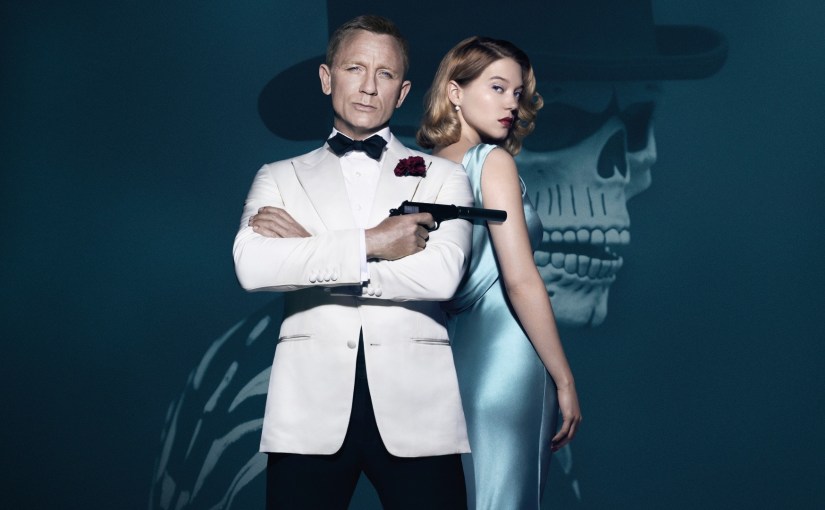
It’s fortunate that the success of Mike Myers’ Austin Powers franchise did not wash out the best features of the James Bond series. Had it done so, we wouldn’t have been treated to the outstanding production of Daniel Craig’s film, Spectre, with an opportunity to face off against a reinvented Ernst Stavro Blofeld played perfectly by Christoph Waltz. One of my few complaints however, is that we didn’t get enough material for the two-time Oscar winner.

Director Sam Mendes returns following Skyfall to reinvigorate the original traditions and blueprints that attracted audiences to 007 in 1962 with Dr. No. Blofeld lays in wait in his secret fortress of a lair housed within a desert crater (an upgrade from the volcano in You Only Live Twice), ready to offer exquisite hospitality to Bond and his love interest before providing an unrequested guided tour of his technology and hideous plots. No, he never had to show Bond anything. Yet Blofeld was never bashful, with or without his cat. Waltz is the right choice for this 21st century iteration of the staple villain. Gone is most of the camp presented in the character during the later Connery films. Most of the camp actually. He does still have the white cat after all.

Craig remains a great 007. The role is not a mimic of past Bonds. Craig is everything of the “blunt instrument” that author Ian Fleming described. Thanks to his physique and some great fight choreography, a marvelous fisticuffs scene occurs between him and brutish Dave Bautista aboard a moving train. Craig always looking great in the white dinner jacket tux, even while he’s getting pushed around.

Lea Seydoux is serviceable as the Bond girl, Madeline Swann, daughter of an old enemy of Bond with information necessary in the pursuit. Seydoux is not the best Bond girl. Others have offered more intellect beyond the beauty. Still, that might only be due to the limits of the script. She’s a good actor nonetheless.

Ben Whishaw and Naomie Harris are great as Q and Moneypenny. The roles have stepped up in frankness and skills that stretch out more than a traditional one scene cameo. Whishaw as Q is more of a know it all and Harris as Moneypenny reminds the audience that she has a life outside the office.

Ralph Fiennes is good too as M. Though I do wish his storyline was better here where he is dealing with an over abundant policy in complete government surveillance. The antagonist against Fiennes is nothing special and as quick as this storyline started, you knew how it was going to end. Still, I like watching Fiennes in the role.

Spectre has great scenes, most especially the signature opening taking place on the Day of the Dead in Mexico City that culminates in the destruction of a city block before Bond disables two bad guys aboard a spiraling helicopter. Steady cam and very clear edits make this a knockout.

I also appreciate the gag that not all things work accordingly for Bond. He orders his signature Vodka Martini, shaken not stirred, and is denied as he is at a bar located in an isolated strict health retreat. As well, his Aston Martin is not as reliable thanks to empty hidden machine guns hidden behind the logo in the trunk. Not everything comes as easy for Craig’s Bond, and that allows for some tongue in cheek humor.

I liked Spectre more on a repeat viewing. Mendes shot a gorgeous looking globetrotting picture of Mexico City, Rome, Austria, Tangiers and clear evening London.

Considering the next installment is likely to be Craig’s last film is disheartening. With Spectre, a summation of all the prior Craig films is assembled leading to what has been a great miniseries within the storied franchise. I’ve liked following this James Bond. There are revelations about the character including his orphan history, his faults and his coldness that only serves to protect the Queen’s country. The Daniel Craig Bond is the best following the very different albeit wry interpretation of Sean Connery.

Still, I’ll take what I can get, and once again happily look down the target scope aimed right for 007 before the blood comes pouring down.

SKYFALL

By Marc S. Sanders

Skyfall is a great James Bond film. One of the best. However, …it has one major shortcoming that always gnaws at me. Regrettably, it has a contrived middle section that steals some of the magic away from the film. Yes, for a moment, my suspension of disbelief is robbed from me.

Daniel Craig’s third outing as 007 has become a favorite among fans and movie goers. Craig is magnificent in a primarily dramatic turn in the part. Following a fantastic action packed opening where Bond pursues an assassin through the streets of Istanbul, Turkey (widely known as a favorite locale of Ian Fleming), the chase involves cars, motorcycles, rooftops, fruit stands and trains for well edited shootouts and fist fights. Alas, the assassin gets away and Bond is left for dead.

Following an attempt on the life of M (Judi Dench in her absolute best portrayal in the role), Bond returns for active duty. However, he’s not what he used to be. His aim is off and his body is worn. The question remains if Bond is ready to be back in the field.

The plot centers on a bitter former MI6 agent named Silva (Javier Bardem in a potentially Oscar worthy performance) out to seek revenge on M for the sins he believes she’s committed.

It’s funny. The Austin Powers films, and even film critic Roger Ebert, would always draw attention to the fact the villain would just longingly speechify when they have all the time in the world to just shoot Bond dead and move on with their devious plot. Silva is a response to that issue. He has a mutual respect for Bond, and you can see he’d rather keep him alive for the time being to allow the game to keep running. It’s not said outright, mind you. Yet that’s what I took away from the character. A superbly written monologue to introduce Silva at the midway point of the film compares him and Bond to the last of two rats surviving a trap. Which rat will win out?

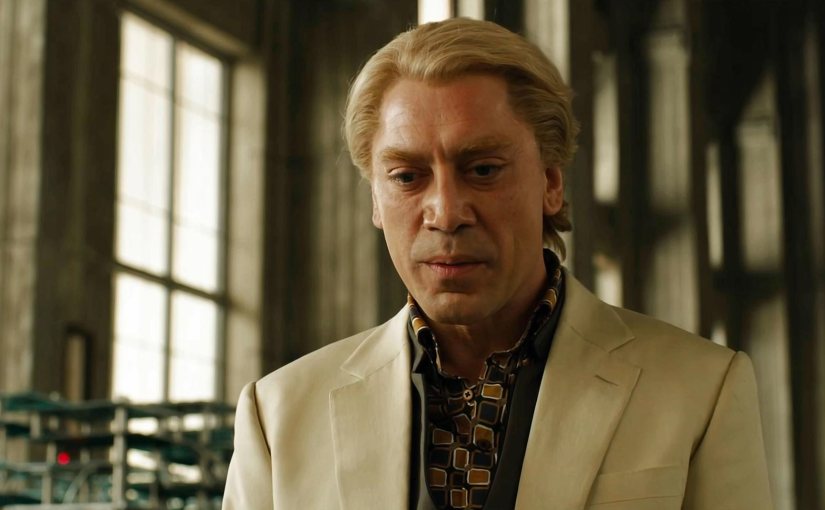
It’s also quite special that Bardem shapes his villainous role with a homosexual tendency. Silva is fashionable and proudly dons a bleach blonde hairstyle. He gleefully rubs Bond’s legs and opens his shirt to examine his scarred chest, pronouncing that Bond must ponder his “training” at the moment. Silva is beyond the typical femme fatale. It’s different and it’s time the Bond franchise acknowledges the differences in people. A welcome trait for a major character.

The plot set up of Skyfall‘s devices are ingenious in simplicity with a basic revenge tale but also with broadening the legacy and responsibilities of the M character. What Casino Royale did for a story arc for James Bond, Skyfall does for M, and with Dench in the role it works beautifully. She must answer to superiors, like a very welcome Ralph Fiennes, for the death of several agents and a bombing of MI6 headquarters. She must resist the pressure of early retirement. This is the most that M has ever had to contend with personally, and it’s here at last.

My one reservation with the film occurs just after the midway point. Silva somehow arranged to get apprehended and then managed to escape, don a police uniform, travel through London’s tube, and time an explosion on a runaway train ready to crash into James Bond who is on his trail. Thereafter, he’s able to locate the interrogation session where M is making a public statement in her defense and try to kill her. There are way too many factors at play that work too conveniently to Silva’s advantage. It’s a tension filled sequence. It looks great. It has great action and effects, but it’s overly contrived. I wish the script from Neal Purvis, Robert Wade and John Logan made this middle section a little more believable.

Sam Mendes (American Beauty) directs a terrific, action-packed film filled with more drama and minimal tongue in cheek that the series is primarily known for. I was grateful for the more serious Bond. Like the other Craig installments as well as the Dalton films, Skyfall offers a different and fresher approach.

Granted the ending plays more like an Arnold Schwarzenegger action piece from the 1980/90s, but it’s highly entertaining, well edited and well shot, nonetheless.

I highly recommend Skyfall for its outstanding cast that also includes Ben Whishaw as a nerdy variation of Q, the gadget man, and Naomie Harris in a secret role that has a satisfying payoff. As well, the standard revenge story works quite well here when you have Bardem, Fiennes, Craig and most especially Dench doing some really top notch acting with terrific dialogue. Mendes is a stage director first, and it shows quite admirably here.

Again, Skyfall is not the best Bond film but it’s at least one of the best.

QUIZ SHOW

By Marc S. Sanders

Robert Redford’s 1994 masterpiece deserves much more recognition than it ever got.

Here, he produced and directed a stellar cast that showed how America was always in it for the competition and for the glory and for the fame and naturally for the money.

Redford opens his film with a car salesman describing the regal elegance and perfection of a 1957 Chrysler convertible. It’s a gorgeous car. Then the potential buyer turns on the radio. The car isn’t so fascinating anymore as a news announcement reveals that Russia beat the United States into space with its launch of Sputnik. All America has now is just a car.

Opening credits roll and the next American sensation is presented, “21,” the most popular show displayed on the greatest invention, a home television set. However, the show is all a lie, and yet by the end it’ll survive along with its network, NBC, and its wealthy sponsors.

Quiz Show foreshadows the cost of fame and attention. It’s a wonderful sensation until it’s stripped away in personal disgrace. John Turturro (how did he not get an Oscar nomination?) is Herb Stemple, the champion, nerdy schlub who is growing tiresome among producers and audiences. He is forced to take a dive and be replaced by the handsome Charles Van Doren played Ralph Fiennes, a member of one of the country’s most intellectually gifted families. The difference in appearance is obvious. So is the desire for a change in programming. What’s obvious is how the two men are exploited as pawns for gain in corporate America. Cheat, but if you call it television, what harm is there really?

The harm falls in public perception. Disgrace comes to these men, and worse, to their families. It mirrors modern stories like Harvey Weinstein, Joe Paterno, Bill Cosby, Kevin Spacey and Matt Lauer.

It’s a very calm film that debates the ethics of these men and necessities to uncover the truths and reveal the falsehoods.

Redford only gets aggressive in his period settings and I’m thankful for it. Nothing looks out of place, including the large enthusiastic grins of a 1950s American viewing audience dressed elegantly and innocent. Even nuns and pajama clad children are invested in “21.” This clean cut appearance will soon fade , however, after the quiz show scandal dies down.

Ugly lies and denials were committed against Redford’s beautiful backdrops. Therein lies the necessary conflict of another fascinating story.

Was this country ever innocent?