SEPTEMBER 5 (Germany, 2024)

by Miguel E. Rodriguez

DIRECTOR: Tim Fehlbaum
CAST: Peter Sarsgaard, John Magaro, Ben Chaplin, Leonie Benesch
MY RATING: 10/10
ROTTEN TOMATOMETER: 93% Certified Fresh

PLOT: During the 1972 Summer Olympics in Munich, Germany, the ABC Sports broadcasting team must adapt to providing live coverage of Israeli athletes being held hostage by a terrorist group.


Two of my absolute favorite true-life movies (United 93 [2006], Bloody Sunday [2002]) happen to be from the same director, Paul Greengrass.  Watching Tim Fehlbaum’s film September 5 felt at times like I was watching a Paul Greengrass film, and I can offer no higher compliment than that.  From the moment the first gunshots are heard coming from the Olympic village in Munich in the wee morning hours of September 5, 1972, this movie never lets up on the tension.  Over the next 24 hours, we will follow the ABC Sports broadcasting team as the managers and crew work through a tangle of journalistic ethics and operational logistics to report on the biggest news story of their lives while maintaining objectivity and their obligation to the truth, and ALSO keeping the safety of the victims and their families in mind.

The four major characters are legendary ABC Sports executive Roone Arledge (Peter Sarsgaard); a then-unknown control-room functionary, Geoffrey Mason (John Magaro), who was in the right place at the wrong time; ABC Sports producer Marvin Bader (Ben Chaplin); and German-to-English translator Marianne Gebhardt (Leonie Benesch), who is probably an amalgam of several different people who were most likely present during the actual events of the film.

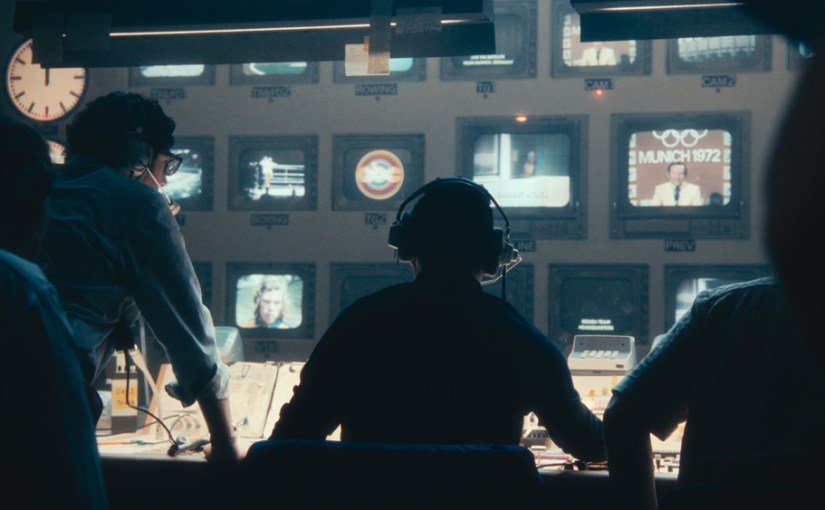
One of the masterstrokes of September 5 is how it rachets up the tension by staying inside the claustrophobic control room and connected offices for the entire film, minus the opening and closing shots showing Geoff arriving for work and leaving the next morning.  Anything showing us the outside world is only visible on the banks of television monitors in front of them, which leads to much confusion towards the end of the film as reports of the Israeli hostages being freed begin circulating, but no one can actually see what the hell is going on.  This is one of the ways the film reminded me of some of the best scenes in United 93 when the people responsible for making the most crucial decisions of their lives were limited by what they could see and hear on the news.

I have never worked in a TV studio, but this movie carries a palpable authenticity that made me believe everything I was seeing.  I never knew, for example, that chyrons (those small captions on the bottom of a TV screen during the news) were analog back in 1972.  Whenever a new development occurs, the control room has to call up a woman in a completely separate room/mini-studio so she can manually place individual letters onto a physical message board, then get behind a camera and shoot the image so it can be superimposed back in the main control room.  Exhausting!

Peter Jennings is reporting remotely across the street from the Israeli apartments, but he cannot be heard live from his radio into the audio feed for the TV signal.  So, some random dude takes a phone handset, unscrews it, solders some wires, clamps it all together in front of a microphone, and presto, now Jennings is live.  The whole operation is put together with spit and baling wire.  It feels like it’s a miracle that anything was televised at all.

The other conflicts presented to us are no less important.  Marianne, a German woman, is drafted into helping with the translation, but first she must endure some brief accusations from Marvin.  The fact these Olympics are being held in Munich less than thirty years after the end of World War II is something many people are still coming to terms with.  He asks her if her parents knew about the concentration camps.  She stares for a second and gives the best answer possible: “But I am not them.”  After that, she earns the complete trust of the entire staff.

The subtext of the German guilt over World War II is bubbling just beneath the surface for the entire film.  A German maintenance worker won’t release replacement cables to a French tech until Marianne talks him into it.  It is theorized at one point that German military forces could possibly end the hostage situation within minutes, but the German military is constitutionally forbidden to operate within the Olympic village, for obvious reasons.  Roone Arledge watches Mark Spitz win yet another gold medal, and instead of going to a closeup of Spitz, he instructs the cameraman to cut to the face of the German swimmer who lost.  Someone asks him, “Do you really want to bring politics into this?”  And he replies, “It’s not about politics, it’s about emotions.”

Which brings in the other major point of retelling this story in this way.  There is a point where ABC’s cameras have great shots of the building, the balcony, and the entire complex, and they are broadcasting live (the first time the Olympics had been broadcast live, by the way).  Someone spots German policemen – non-military – getting into position with sniper rifles.  Marianne hears chatter on the police band about an operation getting the green light.  The press is ordered out of the area, but ABC’s cameras continue to broadcast live.  Someone notices that a TV appears to be on inside the apartment where the hostages are being held.  Geoff suddenly asks a reasonable question: “Are the terrorists seeing this?”  Minutes later, German police storm the ABC control room and demand the cameras be turned off, pointing a gun at the crew at one point.  The cameras get turned off and a furious Arledge kicks the Germans out of the building, but the point is made.  Minutes later, the operation is called off. 

“They should’ve cut the electricity to the apartment, it’s not up to us to double-check on them,” says Marv.  But Geoff makes a point: “Marv, it’s not okay if we made it worse.”  The fine line between the freedom of the press and general public safety could not be more elegantly portrayed than it is here.  Earlier in the film, just as the cameras have been set up with shots of the balcony of the apartment, someone asks, “Black September [the terrorist group responsible], they know the whole world is watching, right? …if they shoot someone on live television, whose story is that?  Is it ours, or is it theirs?”

It seems like an easy question to answer: “Public safety comes first.”  But who gets to decide what’s in the public’s best interest?  Those policemen who burst into the control room and shut the cameras off at gunpoint?  Perhaps it should be left to each newsperson’s individual conscience, but can that always be trusted?  These are questions I am not qualified to answer, but I appreciate films like September 5 because they have enough faith in the viewer to pose those questions and then refrain from providing a tidy answer.  It’s one of those rare thrillers that tells a crackling good story and also asks some big, relevant questions that you may not even think about until you’re driving to work the next day.

One of the last things we hear is Marianne talking to Geoff, who had sent her to the German airport where the hostages were supposed to have been flown out of Germany.  “I was there with hundreds of people, we stared into the night.  We were waiting for something to happen because we wanted to take a picture of it.”  While that’s a rather bleak way of describing a profession that has given us some compelling images that have swayed the world’s opinion on vitally important matters, perhaps it’s also a way to caution those who would exploit situations, like the paparazzi who chased Princess Di into that tunnel.
SEPTEMBER 5

By Marc S. Sanders

September 5 is a sweeping account of how breaking news used to be assembled.  You had to be in the right place at the right time.  If you weren’t, then perhaps the sports department of your media conglomerate is, and they will get the story. 

The very first televised terrorist attack was broadcast at a sadly appropriate time.  The 1972 Olympics were being covered by the ABC television network.  For the first time, homes all across the world would be able to watch the games in color, from a satellite feed shared among the big three networks.  ABC had the broadcasting rights to the games though.  The setting is especially interesting to this story.  The Olympics are being hosted by Germany, primarily out of Munich.  This is an opportunity for the country to finally redeem itself, only twenty-seven years after World War II had come to an end and their country’s Nazi regime had been overthrown.  Germany had a lot to make up for.

The Sports Division of ABC news turn over in the wee hours of the morning of September 5.  Geoffrey Mason (John Magaro) slumps into the studio and relieves Roone Arlege (Peter Sarsgaard) following long hours of editing and covering competitions in swimming, volleyball, boxing, track and so on.  There’s minimal staff on shift as the athletes and coaches are asleep for the night, but then Geoffrey and crew believe they hear machine gun fire out of the direction of Olympic Park, and suddenly everyone is awakened and scrambling to put together the story fast. 

No other broadcasts are reporting on this alarming incident.  This is a story that comes at ABC Sports in their own time.  Had this happened today, amid an age of worldwide shrinkage with the existence of the internet, these guys would have been way behind.  In 1972 however, they can rely on Mariane Gebhardt (Leonie Benesch) a female German flunky of the sports division to translate the various radio communications between the terrorists and the German negotiators, and what plans are being put in place.  Nine Israeli athletes have been taken hostage in their hotel rooms with two believed to have already been killed.  The terrorists (believed to be a Palestinian militia group called Black September) demand that Israel release two hundred of their prisoners or they will kill a hostage every hour beginning at noon.

Forgive the cliché terminology, but September 5 is a taut, nail biting, documentary style thriller told only through the perspective of the ABC Sports division.  While the developments of the hostage situation feel urgent, for these unshaven guys in glasses and wrinkled shirts who are operating on little sleep and a lot of coffee, it is about getting the news out quickly and accurately, and just as importantly, first.  Geoffrey and Roone are constantly on the phones trying to learn whatever they can from Peter Jennings, the eventual famed ABC reporter, who is nearby the incident and at times hiding from the German police who are desperately trying to clear the area of the press.  The guys even send in a staff member with a smuggled camera and reels of film taped to his belly while he poses as an Olympic weightlifter.  The Germans forbid the press from trespassing but insist the games carry on.  So, the athletes and coaches are the only ones who can enter the area to prepare for competitions of the day.  Even Howard Cosell happens to be in a hotel staircase nearby and can provide feedback. 

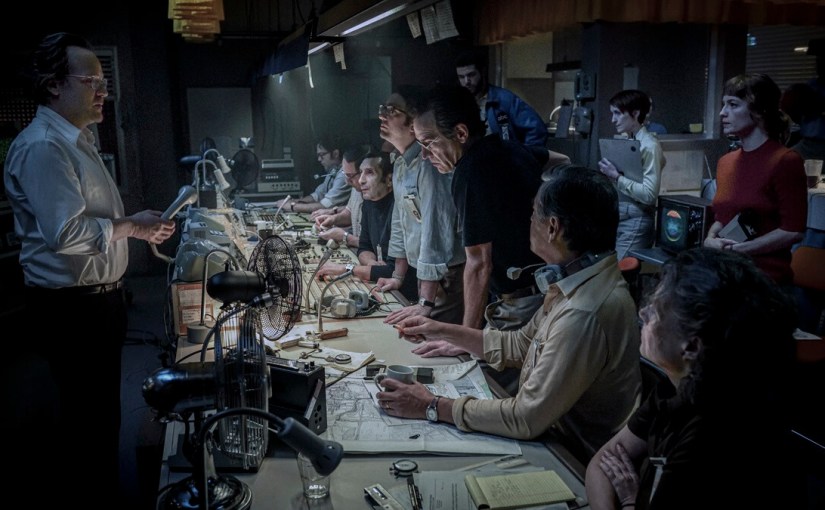
In the news control room, the guys are literally putting walkie talkies next to microphones that broadcast live on air with Jim McKay who is behind the desk, talking to the world.  This is bare bones news broadcasting with unsophisticated technology to aid them in this short window of time.  The director of this film, Tim Fehlbaum, brilliantly captures the desperate inconveniences of reporting this way. 

Roone and Geoffrey also have to contend within their own ranks.  This is not a sports story.  This is a news story and so Roone must insist on keeping the story.  They are the only ones there.  How much more effective would a news division located on the other side of the world fare?  Therefore, Roone’s team are the only ones qualified to cover this developing story.  ABC News will not have access to this. 

Roone also has to improvise how the satellite feed is shared with their competitor, CBS Sports.  It’s a pain in the ass inconvenience and yet the resourcefulness and quick thinking of the control room staff find a way to uphold their claim on this story.

While watching this account, it matters little if we know the outcome of the September 5, 1972, Munich attack.  This film’s purpose is covering how the first few who knew about the situation responded. By the time the ninety-five-minute film is over a lot has been shared.  Tim Fehlbaum, with an Oscar nominated screenplay written by him along with Moritz Binder cover quite a bit.  The pace moves as fast as these people in the control had to move on that terrible day.  So, the information comes quick.  With real life archived ABC footage spliced within the film, you feel as if you are standing in the corner of this dark room with various tv screens, microphones, and telephones. 

You watch John Magaro feed information to Jim McKay, and then the picture cuts to real life footage of McKay at the desk.  It’s quite inventive how the script is accommodated to work in line with what Jennings, Cosell, McKay and others literally said as the crisis was being reported.

Having seen all ten Best Picture nominees for 2024, it is disappointing that September 5 did not make the cut.  Tim Fehlbaum’s picture certainly deserves more recognition and a slot over other contenders this year.  Still, the screenplay is a well-deserved accolade.  To interweave a fresh script that hinges on what was literally said on television screens around the world at that time is a marvelous strategy. 

September 5 is a crackling thriller of a terribly sad day.

BLACK MASS

By Marc S. Sanders

Black Mass tells the story of an FBI agent, and his two childhood friends who are brothers.  One brother is Billy Bulger, a Massachusetts state senator.  The other is notorious Boston gangster James “Whitey” Bulger.  The script has a lot of elements to make for a great crime drama, but I wonder what Johnny Depp is doing here made up to perform like a crazed ghoul.

The FBI agent is John Connolly (Joel Edgerton) who turns to Whitey (Depp), a fearful leader of the Irish mob in South Boston during the nineteen seventies through eighties to work as an informant, providing intel on the competing Italian Mafia.  It’s no secret about Whitey Bulger’s dealings or what territory he covers.  Agent Connolly does his best to protect his friend, so long as he collects pertinent information that leads to arrests.  However, what’s the limit to Bulger’s activities, and how does this reflect on a public figure like Whitey’s politician brother, Billy (Benedict Cumberbatch)?

Much of Black Mass reenacts recorded testimonies after everything has shaken out.  Guys who survived Whitey’s violent crew (Jesse Plemmons, Rory Cochrane) offer information on the gangster’s activities and what he compelled his captains to carry out.  Mixed in with these voiceovers are how Connolly responds to the progress of his operations.  Time and again, his superiors (first played by Kevin Bacon and later by Corey Stoll) question Connolly about how beneficial Bulger can be if the crook always has his finger on the trigger, killing those that might rat him out.  Black Mass is told from an assortment of different perspectives and sometimes that muddies the water.

The most interesting storyline is how Connolly uses and protects his criminal friend, while also stepping away from getting blood on his hands.  Joel Edgerton gives the best performance of the film as an FBI guy who turns a blind eye to Whitey’s crimes. Connolly thinks he can continue his own corruption while Whitey cooperates and leads him to big, heroic indictments of the Italian mob.  As long as the arrangement upholds, the corrupt agent will always have an answer for his actions and stay ahead of the ethical lines he knows he’s crossing.  More importantly, even if his wife protests, Connolly is getting prestigious promotions and collecting substantial paychecks for his progress.  Scott Cooper directs Edgerton with conflicts of overwhelming complications.

One problem is that Whitey Bulger is a loose cannon who is never intimidated, not even by the Feds, especially not by his childhood friend.  His brother Billy looks away to maintain a clean political image.  Therefore, it is quite easy for Whitey to gun down a rat associate in broad daylight in the middle of a wide-open parking lot, shotgun and all.  The killer doesn’t even need to run away from the scene of the crime.  This is Whitey Bulger.

Johnny Depp is great in the role, but does his portrayal belong in this film?  Depp’s career is widely celebrated for the quirky, makeup clad parts he plays such as Jack Sparrow and Edward Scissorhands.  Even Ed Wood is delightfully weird.  In Black Mass, the actor dons steel grey eye contacts, white slicked back hair making him appear almost bald, and skeletal teeth beneath a near albino complexion.  He looks like Skeletor without the hood.  Throw in a brooding, deep Bostonian accent and you have the ghoul I referred to earlier.  Is this Whitey Bulger?  Online photos of the real guy do not seem consistent with the film’s appearance.  Depp’s delivery of dialogue and even his wicked Freddy Krueger laugh seem too far beyond the realm of this crime drama.  The actor is working on another plane than everyone else in the cast who wear hairpieces, three-piece cotton suits and cheesy off-the-rack polyesters and denims to populate this time period from forty years ago. 

A scene showing Bulger dining on steaks with Connolly and his FBI partner (David Harbor) was famously used in preview showings ahead of the film’s release.  Take this scene out of context like the trailer did and Depp looks scary good as he terrifies Harbor for doing something as simple as revealing a long-time secret family recipe.  Afterwards, Whitey goes upstairs to harass Connolly’s wife (Julianne Nicholson) at the bedroom door.  The dinner scene sold me on getting a ticket for the movie as soon as it was released.  However, put it back into the framework of the script and I feel like Black Mass is diverting itself from a complex crime drama to a vampire in a Member’s Only jacket.  As good as Depp is with his makeup and his vocal inflections and pace, it just doesn’t seem to belong in this particular film.  Marlon Brando as Don Corleone with the shoe polish in the hair and the cotton in the mouth? That works.  Johnny Depp as Count Dracula in Sergio Valente skinny jeans is not as effective.

Because the script changes hands from one perspective to another and then another, I found the reenactments of Connolly and Bulger’s reign of crimes to be a little inconsistent.  I found much potential for Benedict Cumberbatch’s purpose as Whitey’s brother, but there is too much diverted away from that character because the picture is trafficked with what everyone else is doing and seeing on top of giving Johnny Depp a lot of scenery to chew.

Black Mass pursued the potential for a very interesting gangster picture like Goodfellas or Donnie Brasco, but it wants to capitalize too much on the latest Johnny Depp routine.  I think James “Whitey” Bulger is an interesting twentieth century bad guy with a violently daring and checkered background.  He had associates within his family and gang to color in a movie that’ll grab you.  The tainted lawmen who were involved are also intriguing.  Scott Cooper and the screenwriters knew this, but often they opt to go in different directions.  

Now that a loose interpretation of Bulger has been played by Jack Nicholson in Martin Scorsese’s Oscar winning The Departed and again here, it’s time to tell the cold-blooded killer’s story once more.  Just go simpler without all the clownish theatrics.

GARDEN STATE

By Marc S. Sanders

The irony of Zach Braff’s Garden State is that the protagonist he portrays is heavily medicated to subdue any variation of depression or anger induced mood swings.  Yet, it seems like everyone else in the picture should be off the drugs, and those that aren’t taking any, should revert to some appropriate pharmaceuticals.  STAT!

Braff wrote and directed this quirky comedy-drama loosely inspired by his upbringing in northern New Jersey.  He plays Andrew “Large” Largeman.  He’s an actor living in Los Angeles when his father calls him to let him know that his quadriplegic mother has drowned in the bathtub.  Andrew seems like what Cameron from Ferris Bueller’s Day Off might have become a few years after he kicked his dad’s prized Ferrari out the glass garage.  This guy is sullen, sedate and when speaks or responds to a question, you might think he’s catatonic as well.  He’s just so numb from the medicinal products he takes.  They were prescribed by his psychiatrist, who also happens to be his father, Gideon, played with quiet tension by Ian Holm.

At the graveside funeral, Andrew comes upon some childhood friends who never left Jersey behind.  Peter Sarsgaard is Mark who vaguely remembers Andrew and invites him to a party later that night which is likely just like last weekend’s party and the weekend before that.  Mushrooms, weed, coke, alcohol.  It’s all there.

The next day Andrew meets a precocious young lady named Sam (Natalie Portman) who recommends he fend off a humping seeing eye dog by kicking him in the balls.  This unexpected introduction is what will meaningfully break Andrew of his stupor. The bond between Sam and Andrew will carve out the rest of Garden State following a meanderingly weird exposition.  I’m grateful for that because just when you think this film is going nowhere fast, even if it is told at a slow pace, the story absorbs a sweet narrative shared between two very likable characters.

There’s a lot of eccentricities in Zach Braff’s film which he admirably wrote and directed as well.  Living in New Jersey for fourteen years of my childhood, I don’t recall anything within my nearby Jewish suburban neighborhoods being this oddball.  Then again, Braff is maybe a little too ambitious to have one strange character turn up after another.  A woman at the funeral makes him a shirt that matches the wallpaper of the hallway.  A dim-witted cop asks how he did when he procedurally pulls Andrew over.  Another guy shoots flaming arrows into the air in the backyard of his mansion for Sam and Andrew to haphazardly dodge their descent. 

Mark is not only a grave digger in the cemetery, but a robber as well, stealing the jewelry from the remains in the coffins.  Sam lives with her mom and adopted Nigerian brother amid Dobermans and a hamster jungle gym that stretches the entire course of the house and serves as a hazard for one poor rodent after another.  Sam has a well populated little pet cemetery out back.

Amid all these strange visuals and discoveries, there is a background to Andrew’s need to be drugged by his father.  He was the cause of his mother’s disability when he was age nine and pushed her down, causing permanent paralysis. 

There are colorful backgrounds to Andrew and Sam and a curiosity to learn more about them.  Still, the film seems to stretch its running time with too much unusual, oddball material.  I responded to most of it with a smirk or chuckle, but I ask myself why.  Why is so much of this here?  It builds up a setting, perhaps.  I’m just not sure.  There’s an overt weirdness to every single character seen in this film.  Nevertheless, I don’t believe Braff’s intentions were to duplicate a Wes Anderson formula.

Fortunately, Zach Braff offers a wonderful character arc where Andrew becomes more and more awakened as the film moves on, while clinging to Sam’s company and abandoning his father’s prescriptions.  Natalie Portman seems to mature over the course of the picture. Sam’s quirk is that she tells tall tale lies in rapid succession.  That façade nicely breaks down to show the genuine person Sam truly is later.  When her mother boasts a video recording of an ice-skating routine that Sam did while dressed as an alligator, the embarrassment on Natalie Portman’s face is so naturally telling.

Ian Holm should also be recognized as he portrays the opposite of whatever dialogue Braff wrote for the father character.  That’s a great challenge.  A scene in the kitchen has Gideon dressed in a bland, beige sweater and tie and he seems to hide within the pale walls of the room.  There’s no life to the guy.  Nothing stimulating, despite how educated the man may appear.  So, it seems unjustified for Gideon to tell his son later that he wants them to be happy like they used to be.  Braff’s character wisely responds by being unable to recall any time when they were ever happy.  Moments like these are the strength and intelligence immersed in Garden State.  The assortment of side quirks does not have this kind of staying power, though.

I like Garden State but there’s no way I could love it or embrace it.  There’s just too much moroseness within the strange residents amid their sleepy conversations to make me want to stay with any of these characters.  The benefit of watching the film is to see what Zach Braff, Natalie Portman and Ian Holm lend to the picture – three wonderful performances.

AN EDUCATION (2009, Great Britain)

by Miguel E. Rodriguez

Director: Lone Scherfig
Cast: Peter Sarsgaard, Alfred Molina, Rosamund Pike, Dominic Cooper, Olivia Williams, Emma Thompson, Carey Mulligan
My Rating: 9/10
Rotten Tomatometer: 93% Certified Fresh

PLOT: A coming-of-age story about a teenage girl in 1960s suburban London, and how her life changes with the arrival of a playboy nearly twice her age.


Lone Scherfig’s An Education, written by famed British author/screenwriter Nick Hornby, is yet another example of how my preconceived notions of a film are often very wrong.  Based on the plot description above, I assumed I was in for what I call a “spinach movie”: something that’s good for you, but not a lot of fun to eat.  I thought the film would be dark and deep, delving into unsavory territory involving a predatory older man putting the make on an underage girl.  Lessons would be learned, but it would be an uncomfortable watch.

For about the first half of the film, I felt I was mostly right.  It’s 1962 in England, and Jenny (Carey Mulligan in her first major role) is a sixteen-year-old student who is studying hard to pass her A-levels – I think I got that right – with flying colors, which she hopes will give a favorable impression to the admissions board at Oxford.  Her father (Alfred Molina) supports her plans…or rather, he supports HIS plans for her.  He gives several impassioned speeches about the importance of getting a higher education, making sacrifices, dropping her cello hobby, etcetera, all in the service of getting those Oxford-level grades.

One day, Jenny gets caught in the rain and is rescued by David (Peter Sarsgaard), a charming older man driving an irresistible maroon sportscar.  He isn’t just charming, he’s effortlessly charming, turning the exact right phrases to put Jenny at ease.  The morning after he drives her home, he leaves a bouquet of flowers at her doorstep.  He bumps into her again quite by accident, or “accident”, and asks her on a date for dinner and a concert.  For this, he must convince Jenny’s very suspicious father…which he does with silver-tongued ease.

Jenny is caught up in this whirlwind of attention from a much older man who is clearly well off with sophisticated friends, Danny and Helen (Dominic Cooper and Rosamund Pike).  Jenny’s father, Jack (Alfred Molina), is torn between his protective instincts and the idea that Jenny might have met a man who could make her dreams of Oxford…moot.  Why worry about the expense of university when a rich husband can keep his daughter well cared for?

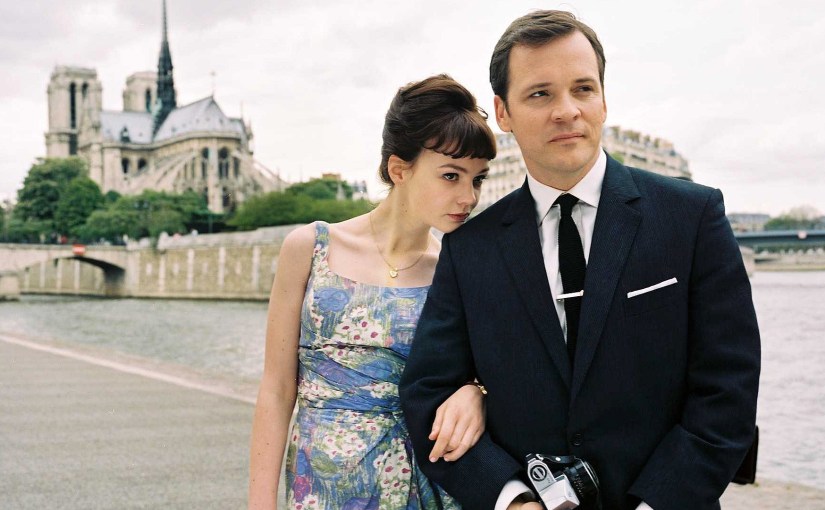
Despite the father’s (and my own) forebodings, Jenny is genuinely enjoying herself.  She loves music, so David takes her to a concert.  She loves art, so David takes her to an art auction.  She loves learning and speaking French, so David takes her to Paris.  His method of getting Jenny’s father to agree to this overnight trip is simultaneously simple and diabolical.  Jenny is having fun for what seems to be the first time in her life.

She’s having so much fun that, for a while, I wasn’t quite sure what the movie was advocating.  Is it supporting this relationship?  She has a very frank conversation with David regarding her wish to remain a virgin until her seventeenth birthday.  David agrees…then, in one of the ballsiest (and creepiest) moves I’ve ever seen from a guy in a movie, he asks her to give him a “peek.”  What is going on?!?  This guy is clearly a cad.  But he’s so nice to her…and she’s having fun…!

Put it this way: I was prepared to throw something at the television by this point.

Around the midway point, though, the movie finally makes its true purpose known.  It’s not about judging Jenny, which is too easy to do, or even judging David, which is ridiculously easy to do.  The film is based on a memoir by a British journalist named Lynn Barber, which made some of the revelations about David’s past and how he makes a living easier to swallow, knowing that it’s based at least partially on fact.  It also made all the “icky” parts in the first half of the film a little more palatable.  When you realize that someone really went through this, it puts everything in a different light.  I had the same epiphany during Schindler’s List; the concept that this all actually happened brought a deeper level to the viewing experience that I hadn’t expected.  (It’s also what made Fargo so much more entertaining than your average crime film, but that’s another story…)

Anyway, this happens and that happens, and before you know it, Jenny has made the kinds of decisions that would make grown men and women tremble with anxiety. The movie’s title takes on a whole new meaning.  It’s not just about Oxford anymore.  It’s about studying at the University of Life, where the only way to know if you passed your test is if you’re still willing to take the next one, and the next, and the next.  Even David learns a thing or two.  Maybe.  It’s a little inconclusive when it comes to that guy.  What a jackass.

So…is it any good?  Yes, it is.  It’s got brilliant performances working from a Nick Hornby script that switches easily among pathos and embarrassment humor (witness the predicament of Jenny’s other suitor at her 17th birthday party) and even a little suspense.  I tend to think of Hornby as Britain’s answer to Cameron Crowe.  Hornby’s books and screenplays walk that same tightrope time after time (About a Boy, High Fidelity, the original Fever Pitch – soccer, not baseball), just like Crowe’s best work (Jerry Maguire, Say Anything, Almost Famous, which I don’t particularly love, but I do acknowledge its craftsmanship).  By the time I got to the end of An Education, the double- or triple-meaning of the title is fully realized.  Everyone has learned something.  Not all of it has been good.  It doesn’t all tickle.  But, except possibly for David, everyone has taken what they’ve learned, good or bad, and put it to good use.  That’s a satisfying ending.

[Side note: after this movie was over, I found myself thinking of Licorice Pizza and its plot regarding an underage boy and an adult woman. I can imagine my friend and partner-in-crime reading my favorable review above and asking me, “If you like this movie, how can you not like Licorice Pizza?” (He really loved Licorice Pizza.) The difference is that, by the time An Education is over, the characters have EVOLVED. Discuss.]

FLIGHTPLAN (2005)

by Miguel E. Rodriguez

Director: Robert Schwentke
Cast: Jodie Foster, Peter Sarsgaard, Sean Bean (who, miraculously, does NOT die in this film)
My Rating: 8/10
Rotten Tomatometer: 37%

PLOT: A bereaved woman (Foster) and her daughter are flying home from Berlin to America. At 30,000 feet, the child vanishes, and nobody will admit she was ever on the plane.


I get it. Flightplan strains at the leash of credibility. A lot. In order for the plot to work, the audience has to believe that a number of people would have to be involved in a massive conspiracy, a cacophony of coincidences that screams “CONTRIVED” to any sane moviegoer.

But, as ridiculous as it seems, the movie still works incredibly well, even upon repeat viewings. Director Robert Schwentke has not exactly distinguished himself since this film (credits include R.I.P.D., Red, and the last two Divergent movies), but Flightplan displays a surefire command of tone, creating a claustrophobic atmosphere while keeping the camera free to move around the plane along seemingly impossible paths.

This film is a classic example of what Roger Ebert called a “locked room” puzzle. A girl is missing on an airplane – admittedly a very LARGE airplane, but still. There are only so many places she can be. The plane is searched, but she’s nowhere to be found, leaving only two possibilities: she was never there to begin with, or someone’s lying. But who? And why? She thinks she recognizes an Arab passenger on the plane…was he staring in her apartment window the previous night? Is she going crazy, or has there been an actual kidnapping? That’s the central mystery, and it carries the movie for most of its brief running time.

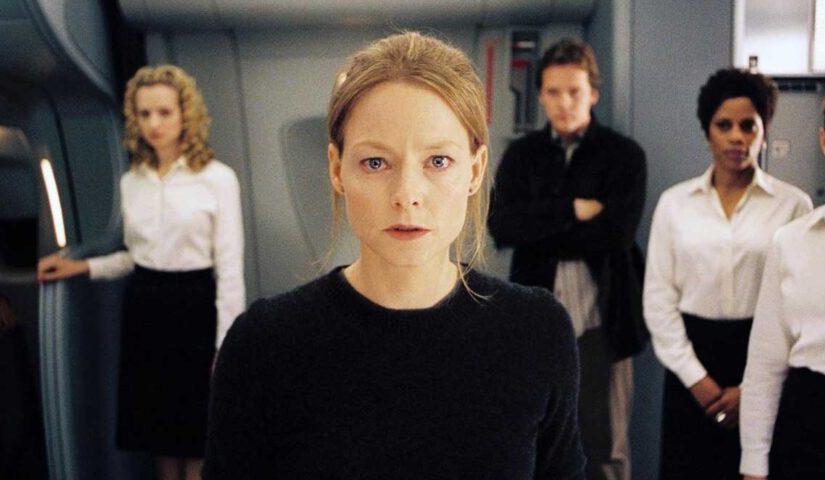
(There’s a neat section where Foster’s character (who, coincidentally, helped design the plane they’re on), monkeys around with the plane’s electronics and gets the oxygen masks to fall, to create a diversion for herself. Tell you what, that would get MY attention.)

The final resolution is…well, let’s say it answers all the questions of what happened without addressing HOW it happened. A lot of folks found that unsatisfactory (thus the 37% on Rotten Tomatoes), but the movie is so well-made and executed that, by the time the credits rolled, I didn’t mind it so much. But, you know…that’s just me.