
WALL STREET

By Marc S. Sanders

Oliver Stone is a very good director at providing the evidence of cynicism within the worlds he films.  JFK covered a clandestine, conspiring environment oozing out of the columns of government.  Platoon not only depicted the horrors of war, but also the cancer that poisons the mentality of soldiers expected to protect one another.  Wall Street explores the temptations to cheat the stock market for grand prizes in wealth.  Gordon Gekko is the 1980s tycoon who never knows the meaning of enough.

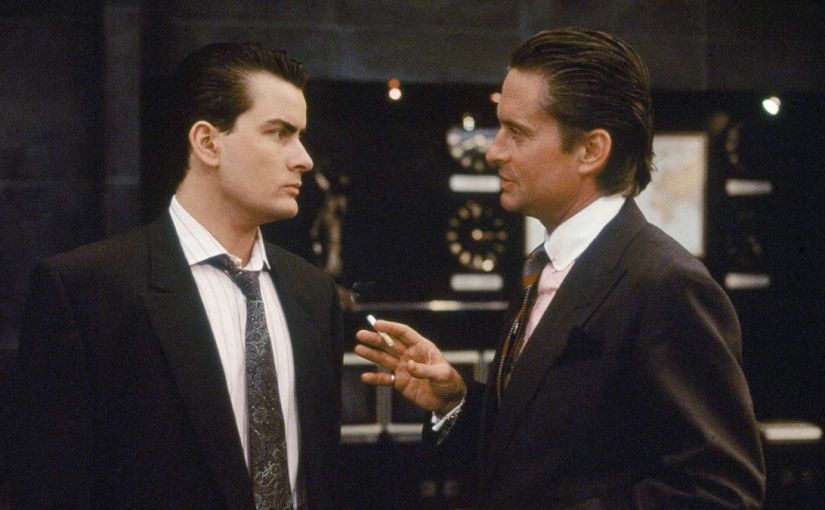
The well-dressed yuppie lizard, Gordon Gekko, is memorably played by Michael Douglas in his only Oscar winning role; regarded as one of the most villainous characters of the last fifty years.  It’s not a modest part, and Douglas’ performance is therefore electrifying.  With slicked back hair, the signature crackle of a voice inherited by his father Kirk, and the newest 80s innovation, a brick size cellular phone, the power to earn money and crush corporate enemies is done with ease.  Gekko relies on obtaining inside information (a federal crime) to find the next chest of treasures.  It might be an illegal practice but the best of the best at making mountains of money do it, and if you keep your process on the down low, nobody will catch wind of what you’re up to.  Gordon Gekko is an absolute genius, and he’s awarded a script of fast talking, slick monologues that justify his sins.

Bud Fox (Charlie Sheen) is the kid on the ground, way below Gordon’s high-rise office, desperately trying to get five minutes with the guy.  A whole day’s wait in the lobby and a birthday gift of Cuban cigars does the trick.  Now the lizard has the fox ensnared in his money-making schemes of deception and pursuits for unlimited greed.

Oliver Stone writes Sheen’s character as virginal when it comes to stock trading.  The kid is dying to get laid with the big boys while getting away from the cold calling hang ups of promising uncertain futures in stocks and bonds.  A subtle and effective angle is to give Bud a mentor.  Hal Holbrook enters the screen from left or right on many occasions to put his hand on Bud’s shoulder and give him his own twist of Confucius philosophy.  Then he exits out of frame towards the opposite direction he enters, leaving Bud to follow the questionable paths that Gordon paves.  Holbrook’s contribution to Wall Street has never been celebrated enough over the years.

Michael Douglas and Charlie Sheen are an outstanding pair of devilish mentorship against innocence lost.  Gekko preaches his passion for wealth on top of more wealth and why nothing should stand in his way, especially the law or the cost of others’ livelihoods.  Bud Fox emulates him as a master of the universe.  Charlie Sheen is great at being the biggest fan in Michael Douglas’ concerts of monologues. Watch how Sheen listens when Douglas has the floor. 

Martin Sheen extends his paternal role to Charlie within Stone’s film.  As Gordon sets designs on taking stock ownership of the small airline company that the father works for, the father/son relationship is tested, and Bud becomes blurred between what is right and wrong.  The Sheens have good debates and heightened dramatic moments.  I wish they were given more to do together though.  Perhaps even showing the wedge of the mother role within this family.

Additionally, Oliver Stone writes dynamics for Bud in a worker relationship with a fellow trader colleague (John C McGinley). There’s a former college pal/now lawyer (James Spader) that Bud tries to squeeze at the behest of Gordon’s demands.  Bud is also covered doing his own tricks of the trade such as dressing as a janitor to dig for what’s forbidden.

Why bring up all of these storylines?  Well, there’s a wealth of great material in Wall Street that’s relevant to the practice of insider trading and corporate overhaul.  Somehow though, Oliver Stone is responsible for writing one of the most unnecessary characters in film history.

Daryl Hannah just had to be cast as the buxom blond love interest for Bud Fox.  She’s never believable as a New York City interior designer and the chemistry between Hannah and Sheen is as thin as water.  Her name is Darien (a 1980s name) and one scene between Michael Douglas and her bustling the streets of Manhattan goes nowhere.  Wall Street is simply not the superb film it could have been because of the amount of time devoted to Daryl Hannah’s character.  Every moment she occupies is cutting room floor material.  When Darien exits the picture she’s never mentioned again.  The history she has with Gordon is never revealed to Bud.  Regrettably, it’s all meaningless.

What’s frustrating with Wall Street is its promise is never fully committed.  The roles awarded to Spader, McGinley, Holbrook and even Saul Rubinek in an early role as Gordon’s nerdy lawyer could have been even more fleshed out in lieu of what is covered with Daryl Hannah’s part.  More moments with Martin and Charlie Sheen would have better served the film.  A competitor tycoon played by Terence Stamp is very interesting and worthy of a larger presence.  Sadly, I imagine a studio producer or even Stone insisted on having a love interest that serves no purpose here except to put a glamorous actress above the title in the credits.  

Nonetheless, Oliver Stone built an authenticity to the hysteria of stock trading and corporate underhandedness.  When he shoots the scenes occupied by Bud and Gordon, he does handheld shaky camera work to emulate that nothing feels sturdy and balanced.  In moments that Bud’s father is at the center, the director shoots with a locked in position, bearing the character’s assured apprehension to trust his son or this prophet of greed.

I especially like the scene where Michael Douglas delivers his famous “Greed…is good!” speech at a shareholders’ annual meeting.  Stone glosses over all the company vice presidents and officers as well as the fat cat suits who carry stakes in the company.  Yet, the filmmaker also takes the time to show that little old lady with the pocketbook who finds her entitled seat to see how the value of her small ownership share is being treated.  Remember, if you own stock like Disney or IBM, you get that invitation in the mail to attend these meetings, and you have just as much a right to attend as all the Gordon Gekkos of the world.

Wall Street serves an important reflection of 1980s capitalism, while taking place in 1985, two years ahead of the infamous market crash of 1987 (the year the film was released).  Guys like Bud Fox had the Charlie Sheen image. Boyish men who got rich quick with little imagination to create and build.  They stood next to tall wealth and learned, but they never gained the knowledge to prepare for quick falls and disheartening sacrifice.  Most importantly, they took their own sense of morale for granted.  These are the best parts of Wall Street.

AIR FORCE ONE

By Marc S. Sanders

On the day I write this article, July 12, 2024, the new trailer for Captain America: New World Order premiered and Harrison Ford (whose birthday is tomorrow; Happy Tiding Dr. Kimble, Dr. Jones, Captain Solo, Mr. President, Dr. Ryan) is back in the Oval Office playing the President of the United States.  Don’t know what kind of Commander In Chief he’ll be this time around.  He might be as heroic as James Marshall from Air Force One. Then again he could be a challenge of hulk like proportions.  However, let’s at least fantasize that we have Mr. Marshall running for the top job this year against both the criminal buffoonery and geriatric disqualifications we are left to choose from.  Just look at James Marshall’s qualifications. 

Following an American Special Ops capture of a Russian radical, Marshall is bestowed an honor from the Soviet government. His acceptance speech insists his administration will never negotiate with terrorists.  Now that the line has been drawn, away he goes with his staff, his wife (Wendy Crewson) and pre-teen daughter aboard the most protected and safest plane in the world, Air Force One.  Yet, an element of careful process does not go according to plan and Gary Oldman’s team of Russian radicals hijack the plane with demands to free their leader from captivity.  Oldman’s screaming hysterical character, Ivan Korshunov, won’t have it so easy though because his team of men failed to capture the President.  As well, it requires the Vice President (Glenn Close) and Secretary of Defense (Dean Stockwell) who are on the ground to coordinate with Russia to free the prisoner.  Oldman’s response is to kill a hostage every half hour and if that does not work, then just blow up the plane.

This is not good.  BUT WAIT!!!!!  Is that…?  Could it be???  Is the President alive, sneaking around the bowels of the plane while taking out one terrorist at a time?  Raise your fist for Harrison Ford!!!!

‘Murica!!!!!!

There are two narratives going on with Air Force One.  One is the standard Die Hard formula action onboard the plane.  Then there is the endless debates of authority between the Vice President, the Secretary of Defense and the military leaders about if the President is in a proper state of mind to lead and act upon his aggression with a high level of threat to the country at stake, and more personally his wife and daughter in harm’s way?   None of this is nothing new.  It’s all familiar from the likes of many late 80’s and 90’s action pictures.  The politics are much more simplified than what you’d find in a Tom Clancy novel.  There’s even time for a which color wire to cut scene.  Yet, the movie is entertaining.

Director Wolfgang Peterson is best at showing the real star of the picture and that is Air Force One itself.  He’s got long shots down endless corridors and aisles. Within the underbelly, as well as the hollowed-out cockpit, there’s more for us to explore amidst the gunfire.  We see where the weapons are stored as well as the luggage and food supply.  We get to watch the football game in the President’s office too.  Heck, before the terrorists reveal themselves they are given a tour of the massive plane as their guide boasts that it is even impervious to a nuclear blast.  Color me impressed in Patriotic Red, White and Blue.

I think some of the acting is a little overdone at times. Not by Ford, but by almost everyone else.  Watching the debates within the government conference room, I’m seeing a little too much melodrama around the table.  A little too much hand clasping, pacing around the room, whispering,  and deep sighing.  On the plane, Oldman goes over the top but he’s one of our best character actors and its expected from him.  He’s the evil villain after all.  On the ground though, Dean Stockwell has done better work elsewhere, with much more complicated material. 

I like the idea of including political debates and a response to an unfathomable crisis like this, but a lot of the dialogue from guys like Stockwell, Phillip Baker Hall and Bill Smitrovitch comes off as textbook boring.  Same goes for Close, but she fits the role perfectly.  Let her be Ford’s running mate and they got my vote.  The only thing that upholds these scenes are due to Peterson’s hyper Steadicam.  So, when one more person in a suit makes a mad dash into the room, the director sweeps his camera right over there to get the latest news. 

Harrison Ford is doing his standard everyman/tough guy routine, always knowing how to stay one step ahead of the bad guys. President Marshall is much more capable than his entire trained Secret Service Squad and it’s fortunate that he gets the convenient shard of broken glass to cut the tape that binds his hands.  How often do we see that in movies?  The film definitely belongs to Ford, but it’s also nice to see some familiar faces participating like Xander Berkley, William H Macy and Paul Guilfoyle. 

The most unforgiving moment of the film occurs in the final minutes.  I don’t spoil everything by saying the plane nosedives into the sea, but this crash has to land at the top of some of the worst CGI ever assembled.  Yes, I know this was back in 1997, two years before what George Lucas accomplished with, at the time, pioneering effects on his return to Star Wars.  However, the final climax to Air Force One looks so obscurely animated and unfinished, it begs for the screenplay to find another way to wrap up its simplistic story.  It is downright terrible.  I recall it looking terrible on the big screen.  It looks just as bad on a 65” flat screen.  A toy plane crashing into a bathtub would look more convincing.

Air Force One is solid action.  Nothing more.  It’s not a thinking picture or one needing deep concentration and analysis. It does make you yearn for Harrison Ford to at least consider a run for the Oval Office, though.  He’d still be better than what will be on the ballot this year.

ARTHUR THE KING

By Marc S. Sanders

I cannot stand to watch dogs in peril.  It guts me right in the feels and stays with me long after.  I only saw the movie Single White Female once, when it was in theaters, and I still remember that puppy’s horrifying demise.  Terrible. Just awful.

On the other hand, when a dog is the companion or the factor of good fortune needed for the cast of human characters, I’m going to be won over.  Arthur The King has a shaggy mutt that you absolutely fall in love with, but I don’t think its all schmaltz, because the dog who portrays the title character is not the only storyline to follow.

Mark Wahlberg is Michael, who leads a team of four endurance adventurer racers.  He has the odds stacked against him.  He’s a well-known racer within the circuit but not for the right reasons.  The teams he’s led usually place in the top ten at the finish line, but Michael has never made it to first place.  Not once.  On social media, he’s mocked as the guy who comes up short.  His father (Paul Guilfoyle) is not very encouraging either.  As well, the window of opportunity to show himself as a champion is dwindling as he’s getting up in years.  Still, Michael is confident he has one more race left in him, but he’s granted very little sponsorship money and given a lot less time to train and prepare than he and his team are accustomed to.

Joining Michael in the competition is Olivia (Nathalie Emmanuel) who is an expert climber on any terrain.  She is reluctantly joining the team at the urging of her terminally ill father.  There’s also Chik (Ali Suliman) who serves as the navigator during the race looking for alternative routes and detours off the path that will put the team ahead of others.  Lastly, there is Leo (Simu Liu).  He is the vain Instagram celebrity with thousands of followers and a huge chip on his shoulder that tests Michael’s instincts because Leo has usually been right in the past.  Michael always made the foolhardy option to ignore Leo’s concerns and thus got stuck in the mud, missing another first-place opportunity.

The homeless, neglected dog in the picture initially follows a parallel story within the streets of the Dominican Republic.  Living off scraps with damp, dirty fur, he roams from place to place, being chased and bullied by other alley dogs.

Director Simon Cellan Jones goes for a documentary approach to the endurance racing.  Bylines and GPS maps cut into the picture showing the team’s progress and where they stand in the rankings.  Sometimes there are voiceover commentaries.  It’s efficient information that allows the audience to keep up with the team’s progress as the flow of the film moves at a brisk pace.

We see the team of four run, bike, kayak, climb, stop for breaks, and debate their next options.  Challenges arrive where a large rock must be climbed.  Heavy rain weighs upon their progress.  Snakes are encountered.  Swamp conditions must be overcome.  A thrilling zip line sequence will have you sitting up in your chair.  The footage in this scene is amazing to look at from the enormous height over a bottomless jungle chasm.  It’s certainly dramatic.  Because the film does not rely on the standard suspense music you might find in other sports films, it performs like a documentary with the director’s well positioned camera work and the unexpected reactions of the cast.

At a rest stop the dog captures Michael’s attention.  Some scritches and scratches along with a few meatball treats and then the team must move on.  However, the dog seemingly turns up within the dense jungle terrain having followed their trajectory.  Michael can’t help but be fascinated by the stamina of this animal, and thus a connection is made.  Shortly thereafter, Olivia, Chik and even Leo warms up to the fifth team member.

The race goes on.  Michael’s wife and daughter follow the team’s progress from home.  Dehydration sets in.  A twisted knee interferes.  It’s all standard.  Yet, it’s hard not to get caught up in this film.

If you have never been a pet owner, it might be hard to truly relate how an animal can change a person.  It might sound cliché but there’s really no way to describe how unconditional a dog’s love can be, and Arthur The King certainly demonstrates that kind of affection. If that is still not enough for you to swallow, then consider that this film is based on a true story. 

There was a dog named Arthur The King who defied the odds to keep up with an endurance racer named Mikael Lindnord, thereby inspiring the team to push forward and strive to win.  The inspiration of the real-life Arthur established The Arthur Foundation whose ongoing mission is to raise funds to provide resources to help dogs around the world receive better care.

Arthur The King might have mapped out its story as soon as the movie began, but that does not mean it is devoid of genuine emotion.  This film possesses a yearning for adventure and a need to defy doubt and reach for victory while never losing sight of what could be more valuable than a championship.  The main character starts out as a confident endurance racer.  Yet, he’s a new kind of racer with an eye-opening perspective when he meets Arthur The King.