
MEET THE PARENTS

By Marc S. Sanders

Am I the only one who used to get tired of feeling sorry for Ben Stiller?  The go to formulas of his earlier comedies made him the unfortunate stooge.  The best of that batch was The Farrelly Brothers’ hilarious There’s Something About Mary.  Every gag, every cast member, every storyline was straight up side splitting.  Late last year, during the hurricane chaos in Florida I got around to watching Along Came Polly.  Poor Ben had to play basketball defense against a bare chested wookie hairball of a guy and his close up of misfortune carried the advertising campaign for that movie. 

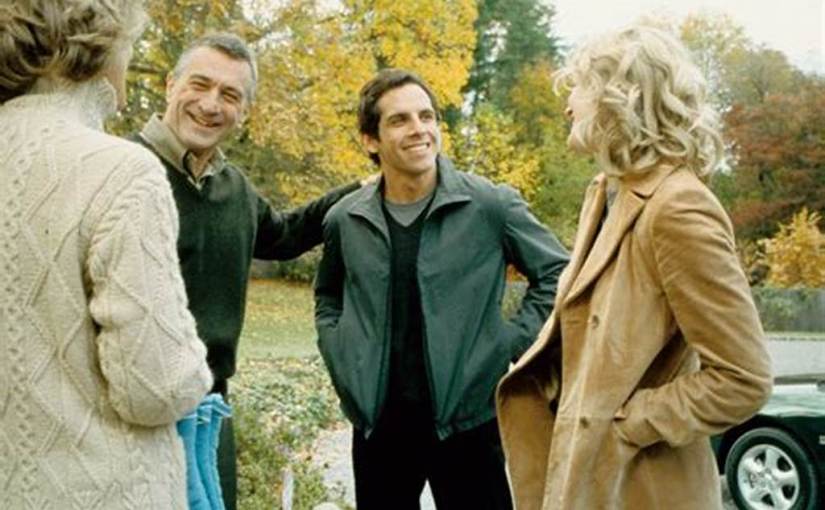
Back in the year 2000, Stiller suffered through a terrible weekend with an intimidating Robert DeNiro frowning on his every move in Meet The Parents, also known as the first of a “Fockers Trilogy.”  Yeah, Meet The Parents is funny.  You shake your head at the absurd comedy that befalls Stiller’s character, Greg Focker. Though that isn’t even his real name at birthright.  Still, I can’t recall feeling so guilty for one guy’s misfortune that he can hardly ever help to avoid.  This guy is destined to never win, to never overcome, to never live without self-consciousness.

Greg Focker is ready to propose to his loving girlfriend Pam Burns (Teri Polo). First, he has to survive a weekend at her parents’ house where the other daughter is getting married.  Not so easy because first the airline loses his luggage and poor Greg has no clothes to wear, other than what Pam’s pot head brother can provide. Baggy jeans and baggy sweatshirt on a short and svelte Ben Stiller is one sight gag of many.  The guy also has to nonchalantly dismiss his uninviting surname and the fact that Pam’s father Jack (DeNiro) is unimpressed with his occupation.  Greg is not a nurse.  Greg is “a male nurse,” who opted not to go all the way for the MD, even after taking the exams. 

Jack and his wife Dina (Blythe Danner) are less than impressed with Greg’s housewarming gift.  Jack’s precious cat Mr. Jinx is a bit of a problem because Pam can’t keep her mouth shut that Greg is not fond of cats.  Doesn’t make him a bad guy, but does her cat loving father need to know this interesting tid bit, right away?  Pam’s ex-boyfriend Kevin (a hilarious Owen Wilson against Stiller’s pitiful expressions) can do absolutely no wrong – like nothing at all.  The biggest challenge for Greg though is Jack.  Whether it’s Taxi Driver or Meet The Parents or Rocky & Bullwinkle, Robert DeNiro is the embodiment of intimidation. 

Meet The Parents is funny, and it serves no purpose to surrender the many sight gags or one liners that are offered in the film.  I laugh.  I laugh hard when I watch this movie, but I hardly ever feel good about myself.  Poor Greg never catches a break.  He’s in a no-win situation and I’m just uneasy about the whole thing.  The guy chooses not to go swimming because he has no swimsuit. Then Kevin offers one and well…yeah…I’m on Greg’s side and it’s not funny for Greg.  If I was a guest in someone’s home only to wake up late when the whole family is dressed and finishing breakfast, and I’m wearing my girlfriend’s dad’s PJs, of course I’m going to feel insecure.  For the sake of the comedy in Meet The Parents, the set ups are simply awkward situations to laugh at that one guy in the room.  Poor Greg.  Poor, poor Greg. 

In fact, the real villain of Meet The Parents is not even DeNiro’s Jack Burns who has some secrets to hide.  Actually, the unsympathizing bad guy is Teri Polo’s character.  Pam never makes it easy for her boyfriend.  Greg rightfully asks why didn’t she wake him up or why didn’t she tell him her dad is not a florist, or why this and why that, and Pam is naïve to Greg’s justified concern, never empathizing with his position.  In fact, when he tries to explain his feelings, she’s nothing but insensitively dismissive. 

Yes.  It’s a comedy, but I was begging and begging and BEGGING Greg to just leave.  Leave this place.  LEAVE PAM FOR GOOD AND GET OUT OF THIS HOUSE.  You know, like we would tell the counselors in a Friday The 13th flick?  It’s not so much the father as it is his girlfriend who quickly nosedives Greg’s comfort into an inescapable hell.  You know how people love to say Jenny is the villain of Forrest Gump?  Well, I got one better.  Pam Burns is an unthoughtful, uncaring, spoiled brat of a daddy’s girl with nary a shred of consideration for others. 

I despise you Pam Burns – daughter of Jack and Dina Burns, rotten and heartless girlfriend to Greg Focker!!!!! 

HAUNTED MANSION (2023)

by Miguel E. Rodriguez

DIRECTOR: Justin Simien
CAST: LaKeith Stanfield, Rosario Dawson, Owen Wilson, Tiffany Haddish, Danny DeVito, Jamie Lee Curtis, Jared Leto
MY RATING: 6/10
ROTTEN TOMATOMETER: 40%

PLOT: A single mom in New Orleans hires a grieving tour guide, a dubious psychic, a shady priest, and an unhinged historian to help exorcise her newly bought mansion after discovering it is inhabited by ghosts.


Writing even a mildly negative review of Disney’s Haunted Mansion feels a little like hitting “dislike” on a picture of a 3-legged puppy.  The puppy is just being a puppy.  It doesn’t know or care that it’s missing a leg.  It just is what it is.

So it goes with this new attempt at a movie based on a popular Disney ride.  It’s chock-a-block full of inside jokes and references to the ride, some in plain sight, some tucked away in the corners of the screen.  As a fan of the ride at the Magic Kingdom in Orlando (I’ve never been to the Disney parks in Anaheim), I enjoyed these little Easter eggs.  Truthfully…I enjoyed them a lot.  I especially liked the chair shaped like a Doom Buggy, and the room that stretches, and the hitchhiking ghosts, and on and on.  This movie is basically Ready Player One revolving around just one IP instead of hundreds of them.  (That’s “Intellectual Property” for all you non-nerds out there.)

But aside from all the cool references, there’s not much else to recommend, especially not for those few poor souls who are not as thoroughly familiar with the Disney ride as I and many others are.  For those people, I would imagine Haunted Mansion plays a little bit like a de-fanged version of the original Jumanji [1995] or Jon Favreau’s criminally under-appreciated Zathura [2005].  There’s a heart-tugging sub-plot about the grieving tour guide, Ben, played by LaKeith Stanfield.  (Stanfield deserves recognition for playing the absurd material absolutely straight, even pulling out the emotional stops for a touching moment as he describes his late wife, in a scene that features an absolute scene-stealing button from Danny DeVito.)  Travis, son of single mom Gabbie (Rosario Dawson), has problems with bullies at school, even when he isn’t troubled by the ghosts who have latched onto him like lice.  Then there’s the issue of who all the resident ghosts are REALLY afraid of, a big-bad known only as the hatbox ghost (Jared Leto).

(I was reminded here of Peter Jackson’s The Frighteners [1996] in which a host of ghosts were terrified of a being that can actually kill a ghost.)

The movie has all the requisite creepy hallways and creaking doors and one or two jump-scares, but everything is done so tongue-and-cheek that it’s never truly horrifying…which was, I’m sure, the aim of the filmmakers.  Certainly you don’t want to make a film, based on a theme park ride, as scary as The Exorcist.  So, to that end, the filmmakers succeeded.  The movie is harmless, even a little fun at times, Owen Wilson gets to deliver some of his trademark dry observations, and DeVito gets to play some notes that I haven’t seen him play in a very long time.  If pressed, I would be forced to conclude that, for non-fans of the ride, this movie would most likely be a bit of a slog.

…but it is cute, despite missing that one leg.

WEDDING CRASHERS

By Marc S. Sanders

Owen Wilson and Vince Vaughn make a perfect comedy pair close to the same vein as Bill Murray and Harold Ramis. Close, but not as legendary, and nowhere near the statures of Newman and Redford.

Wedding Crashers was the the first of their two collaborations to date. The movie works as it charges forth in its raunchiness and unabashed thrust to not hold back. Fortunately, a guy named David Dobkin directed a script from Steve Faber and Bob Fisher long before the age of “Me Too.” What a denial of a great idea we would have, had this film been made later. Reader, Wedding Crashers was never intended to be politically correct. If it even thought about it for a second, the entire production would have failed.

Just go with this. Wilson and Vaughn are John and Jeremy, practicing marital law mediators (I said go with it!), who relish in debauchery by crashing weddings as an opportunity to score one babe after another. Dobkin and crew assemble a fantastic early montage of various nuptials to show how well John and Jeremy play this field of formality. We get to see them in action in all of the different methods. At one time they are charming the parents. They are telling sob stories and crying false tears. They are making balloon animals for the youngsters as a means to catch the attention of a beautiful bridesmaid caught up in the sanctum of love. One after the other a braless gal pal is tossed onto a bed ready for John and/or Jeremy. Call it refreshing, but at least these players are equal opportunists; Jewish, Irish, Italian, Indian. Every kind of wedding ceremony imaginable is given attention. These guys are so fine-tuned at what they do that there is even a rule book, which you can reference on IMDB, or on the Blu Ray extra.

When Secretary Cleary’s (Christopher Walken with not nearly enough to do) daughter is getting married, one last hurrah before wedding season closes is upon them. John immediately becomes attracted to the bride’s sister, played spiritually by Rachel McAdams, while Jeremy oversteps himself with the youngest and overly clingy sister who makes sadomasochism seem G rated. She is played by Isla Fisher. To my surprise, following the success of this film, Fisher never really became more mainstream. She’s the scene stealer. When she begs Walken to let the men stay for the weekend at their New England island home, I lost it. I was dying at her antics. Fisher is so good. She had to have invented some of this material herself. An amazing comedienne. The stomping feet. The poutiness. This is comedy. Fisher never holds back in every scene she’s in and because of her, Vaughn as her lustful prey is all the better in his tormented state.

Another scene stealer is Bradley Cooper, playing McAdams bullying boyfriend. Cooper probably made this character bigger than the script intended. Again, I lost it as the family and guests warm up for a friendly game of flag football. Cooper is in his own element apart from the others as he goes through regiment drills of what equates to an unhinged Marine. He’s cruelly brutal but he’s terribly funny. Later in the film his part might get too sadistic though as he punches Wilson bare knuckled which truly sounds like a crack of his skull. There’s nothing really funny there. This is beyond a Three Stooges slap or eye poke. Sometimes less is more. Blame that on Dobkin.

Other parts are wasted though they start out promising like Jane Seymour as Walken’s wife and Fisher & McAdams mother, who serves as a sex craved Mrs. Robinson. She’s given a presence, though her story never really delivers. As well, there’s a resentful gay brother (Kier O’Donnell) who dresses in black and bears a striking resemblance to Gru from Despicable Me. The character makes a good entrance but is primarily there to further torment Vaughn in a quick bed hop scene. Then there’s not much else.

McAdams plays meet cute just fine with Wilson. Though with much interference from the rest of the characters during the course of the weekend you really don’t get a sense of how McAdams falls for Wilson as well as why Wilson goes against his Crasher Code and obsessively falls for her. Not much beyond dream like gazes at each other across the room. For the romance to really work, these characters have to talk with each other a whole lot more than just a token wave crashing beach scene.

The 3rd act is expected. The boy loses the girl. He takes lonely walks down the street, he becomes a slob and he makes one failed effort after another to win the girl back. For a raunchy comedy that was moving with lightning hilarity, this 3rd act really slows the movie down. It ran way too long.

Still, Wedding Crashers is a great comedy most especially thanks to the concept of taking advantage of what can typically happen at any wedding reception, and the uncompromising comedy of both Isla Fisher and most of Bradley Cooper’s material.

Put your morals aside and RSVP to the event.

THE DARJEELING LIMITED (2007)

by Miguel E. Rodriguez

Director: Wes Anderson
Cast: Owen Wilson, Adrien Brody, Jason Schwartzman, Amara Karan
My Rating: 8/10
Rotten Tomatometer: 69%

PLOT: A year after their father’s funeral, three brothers travel across India by train in an attempt to bond with each other.


In one of the bonus features on the Criterion Blu-ray for Wes Anderson’s charming The Darjeeling Limited, film critic Matt Zoller Seitz compares it to Stanley Kubrick’s 2001: A Space Odyssey because (I’m paraphrasing here) it is the perfect distillation of the director’s method, mood, and style.  I would reserve that distinction for either The Royal Tenenbaums or The Grand Budapest Hotel, myself, but The Darjeeling Limited certainly does capture everything that is typical of a Wes Anderson film: charm, whimsy, troubled souls, a quest of some kind, attention-grabbing camera moves, frequent slo-mo (but not too much), cameos, light and dark material jockeying for position, and a denouement that may signal the end of the film but certainly not the final arc of the main characters.

Meet the Whitman brothers: Francis (Owen Wilson), Peter (Adrien Brody), and Jack (Jason Schwartzman).  A year ago, their father died, and for the first time since that day, they’re about to meet each other and speak to other on board The Darjeeling Limited, a train that will take them across India on a spiritual journey.  Francis, the eldest, is the eager organizer of this little pilgrimage, providing everyone with laminated daily itineraries that are produced by Brendan, his personal assistant who is also travelling in a separate train car.  Francis will spend much of the film wearing bandages on his head and face that make him look as if he lost a fight with a honey badger.  What caused these injuries is not for me to say.

The ostensible reason for this journey is spiritual awakening and reconnecting with each other.  “I want us to become brothers again like we used to be and for us to find ourselves and bond with each other,” says Francis.  Peter and Jack are skeptical and not exactly psyched for this little trip, each for their own reasons.  Peter has a wife back home, 7-and-a-half months pregnant, who has no idea he’s in India.  Jack, a writer, has broken up with his girlfriend, but he obsessively checks her voicemails remotely because he still has the code to her answering machine.  (Hey, this was made in 2007 when you could still do that.)  He has his own return ticket in case he wants to leave the trip early.  Of course, he’ll find that difficult without his passport, which Francis has confiscated.  “For safety,” he argues.  Yeah, right.

There is an ulterior motive for the trip, having to do with who did and didn’t attend their father’s funeral, but ultimately the ins and outs of the characters, while engaging, kind of take a back seat to the trademark Wes Anderson visual style.  This is not a bad thing.  I am not a fan of Anderson’s first film, Bottle Rocket, because I felt it was all posturing with no meat to the story.  However, with each successive film of his, I become more and more endeared and captivated with his trademarks, especially when he uses it to tell stories that I would never have thought would “mesh” with his style.

For example, near the halfway point of the film, an extremely unexpected crisis occurs.  Because the movie has been happy and bouncy and witty up to now, it comes completely out of left field.  But remarkably, in the middle of this action, Anderson’s camera remains as “Anderson-esque” as ever, still performing quick pans and push-ins and keeping me involved in the story.  This crisis might have felt contrived in another film, a plot device to inject some needed drama into the story.  Not here.  Anderson’s storytelling methods made the event feel as random as anything life might throw at us on any given day: the death of a parent, the birth of a child, a snake getting loose in your train compartment, etcetera.

With one or two obvious exceptions (I think), the entire film was shot in India.  The trusty IMDb trivia page informs me the train scenes themselves were filmed inside a moving train travelling from Jodhpur to Jaisalmer.  The beautiful Indian locations are a major feature of the film.  They visit temples, marketplaces, a monastery, and hilltops overlooking vast Indian vistas.

And all the while, Francis, Jack, and Peter struggle to come to grips with their differences and their brotherhood.  “I wonder if the three of us would’ve been friends in real life,” Jack asks at one point.  Great question.  Given what we see in the film, it’s sometimes hard to believe they ever loved each other.  At one point, Francis and Peter get into a wrestling match and Jack has to step in: “I love you, but I’m gonna mace you in the face!”  That’s real love right there.  Right?  I guess…

I’ve heard that if you’re ever not sure what a book or a movie is about, just look at how a character has changed at the end of the story as opposed to what they were like at the beginning.  In The Darjeeling Limited, that’s not so easy to pin down.  I can see that Francis has grown a bit (he eventually relinquishes his brothers’ passports).  But when it comes to Jack and Peter…I’m not sure much has changed with them at all.  Does that make this Francis’s movie through and through?

I’m not sure it matters.  I mean, yes, the story is fun to watch, and I wanted to see where this journey would lead each one of the three brothers.  But for me, the element, or factor, or whatever, that makes The Darjeeling Limited so fun to watch is the directorial style of Wes Anderson.  In this film, as in so many of his films, it’s not about the destination.  It’s about the journey.

[Trivia note: the Criterion Blu-ray also contains a short film called Hotel Chevalier which is intended as a kind of prologue to The Darjeeling Limited.  Don’t make the mistake I did…if you get the Blu-ray, be sure to watch the movie with the prologue.  Don’t wait until after watching the main feature.]

[Super-nerdy trivia note: every musical cue in the film was cribbed from the early films of James Ivory and Satyajit Ray; Wes Anderson wanted to pay tribute to the filmmakers who influenced so much of his style.]

MIDNIGHT IN PARIS (2011)

by Miguel E. Rodriguez

Director: Woody Allen
Cast: Owen Wilson, Rachel McAdams, Marion Cotillard, Kathy Bates, Adrien Brody, Tom Hiddleston, Alison Pill, Léa Seydoux, Michael Sheen
My Rating: 10/10
Rotten Tomatometer: 93% Certified Fresh

PLOT: A nostalgic screenwriter travels with his fiancée’s family to Paris where, every night at midnight, he inexplicably finds himself going back in time to the 1920s.


The best of times is now / As for tomorrow, well, who knows?
La Cage Aux Folles

It’s currently 11:05 at night on a Sunday evening.  I’m getting older, so if I’m smart, I should get off to bed, owing to the fact I have to get up early tomorrow to get ready for work.

But I can’t.  I have just re-watched Woody Allen’s Midnight in Paris for only the second time in my life, and I have revised my original rating of 9 up to a 10.  And I am just bursting to write about how wonderful this movie is.  I’m hoping that I can reach someone who has not seen it before, so I can convince them that, even if they’ve never seen a Woody Allen movie before, this is the one they should start with.  Yes, even over Annie Hall or Manhattan or even Match Point.  In my mind, Midnight in Paris captures the voice of the artist as he is reaching a certain age and has something important to say about nostalgia, and how sometimes it’s not always what it’s cracked up to be.

Gil Pender (Owen Wilson) is a Hollywood screenwriter trying to complete his first novel.  He and his fiancée, Inez (Rachel McAdams), travel to Paris with her family so he can perhaps get inspired by one of the all-time great cities of the world.  He is immediately smitten with the atmosphere of the place; the movie opens with a wordless montage of static shots of Parisian cafés, streets, museums, statues, apartment buildings, and, of course, the Eiffel Tower.  The sequence sounds simple on paper, but the effect is – I don’t know how to describe it.  It captures the ineffable romance of the place.  More so than any other movie set in Paris, Midnight in Paris really, REALLY makes me want to go there.

Gil and Inez seem happy enough, but he is a little more antisocial than she is.  He is star-struck by Paris, but Inez is not incredibly fond of it.  They bump into an old friend of Inez’s, a pleasant enough man who turns out to be a bit pedantic; during a museum tour, he presumptuously corrects the tour guide on details of the life of Auguste Rodin.  This is not the kind of guy I would want to be stuck with on an elevator.

One night, Gil goes walking by himself on the Paris streets and gets a little lost.  Long story short, he inexplicably finds himself transported back to Paris of the 1920s, when the cafés were full of American expats and frequent visitors like Ernest Hemingway, F. Scott and Zelda Fitzgerald, Cole Porter, Gertrude Stein, T.S. Eliot, Pablo Picasso, Salvador Dalí, etcetera.  As a writer, Gil is over the moon; it just so happens his unfinished novel is about a man who runs a “nostalgia shop”, so this pleasant turn of events is a welcome tonic to his vaguely unhappy days back in the present.

Watching the scenes of Gil rapturously conversing with Hemingway, or goggling at Cole Porter playing the piano, I was swept away by the audaciousness of this movie.  It’s illogical and steeped in fantasy and seems to be begging not to be taken too seriously.  But it is a pure joy to watch.  I immediately identified with Gil.  I found myself imagining how I would respond if I were somehow transported back to a time and place when some of my own idols walked the Earth: Hollywood, the 1940s, walking around and conversing with Orson Welles, Alfred Hitchcock, Jimmy Stewart, Katharine Hepburn.  Or even not so far back: the 1970s, having lunch with young Spielberg and Coppola and Lucas, and Pacino and Streep and DeNiro, discussing film and life and getting insight into their inner workings.

From our perch in the present, it’s easy for us to look back at the past and say, well, those were the days.  Just earlier today, I was having an online discussion about the difference between CGI and practical effects in movies like Star Wars or The Lord of the Rings and even Honey, I Shrunk the Kids.  We tell each other that older movies felt more real because the effects were made with real props occupying real space, whether they were miniatures or matte paintings or what have you.  And we say, “Man, they just don’t make them like that anymore.  They knew what they were doing back then.”

That’s Gil.  He looks around at the shimmering jewel of Paris in the 1920s and he’s convinced that this is “where it’s at.”  What can today’s world offer in comparison to sitting in a café and discussing art with Salvador Dalí and Luis Buñuel?  Or the pleasure at hearing Ernest Hemingway tell you he’ll hate your book, even if it’s good, because that would make you a better author than him?  Or getting constructive notes on your novel from Gertrude Stein?

The story progresses.  Gil becomes infatuated with a beautiful woman from the past, Adriana (a luminous Marion Cotillard), and it becomes harder and harder for him to go back to his own present each night.  Inez’s father gets suspicious and hires a private detective to follow Gil during his midnight strolls.  You may ask how a private detective can follow someone who is traveling back in time.  Well, my friend, that is an EXCELLENT question, one which the movie answers in satisfying and gut-busting fashion in the final reel.

But the heart of the movie lies in the touching, revealing segment when Gil and Adriana go even further back in time, this time in a horse-and-carriage, back to the Belle Époque, the “Beautiful Age” of Paris, which lasted from about the 1870s to the 1910s.  Adriana, who lives — lived — in the ‘20s, is entranced with this even more bygone era.  She feels about the Belle Époque the way Gil feels about the ‘20s.  To her, the ‘20s are slow-paced, a drudge.  But, oh, to be back in the 1890s!  Dinner at Maxim’s, the Moulin Rouge, meeting Toulouse-Latrec and Gauguin and Degas!  How wonderful those days must have been compared to the Boring Twenties!

And there’s the message of the movie.  We can grouse and grumble about the modern world all we want.  The movies are dime-a-dozen.  The books even more so.  The music is crap.  Cell phones have turned us into tiny-screen junkies.  But, oh, to be back in the good old days of the 1980s, when the music was gnarly, and the movies were iconic, and the books were amazing, and everything was just better.

But we forget that, in the ‘80s, people were grousing and grumbling about THAT era, and they longed for the more sedate and rosy era of the 1950’s.  And in the ‘50s, people said the ‘30s were the BEST.  DECADE.  EVER.  And so on and so on.

It’s human nature for us not to realize what we’ve got going for us until it’s gone.  We are living in glorious times.  (Coronavirus and politics notwithstanding…gimme a break, I’m trying to make a point here.)  Look around.  Really SEE it.  Embrace it.  We don’t need a time machine to go back to our glory days.  We’re IN our glory days.  Just wait.  In 20 years, you’ll look back on the 2010s and say, “Man, wasn’t that a time?”

If you take nothing else away from the above review, remember this: Midnight in Paris is pure charm, is laugh-out-loud funny, and is the best Woody Allen film since Match Point.  So if you haven’t seen it, you really, really, REALLY need to make a point to do so.