SUPERMAN (2025)

By Marc S. Sanders

Once again the man in blue, red and yellow has returned to the big screen by means of director James Gunn who is intent on starting a whole new universe of DC comics characters.  The 2025 interpretation of Superman is zippy and fun even if it is a little too shallow of character development and dimension.  That’s regrettably ironic actually.  A man who dons two different personalities, Superman and mild-mannered reporter Clark Kent. Yet, neither has much to say or stand for in this two hour picture.

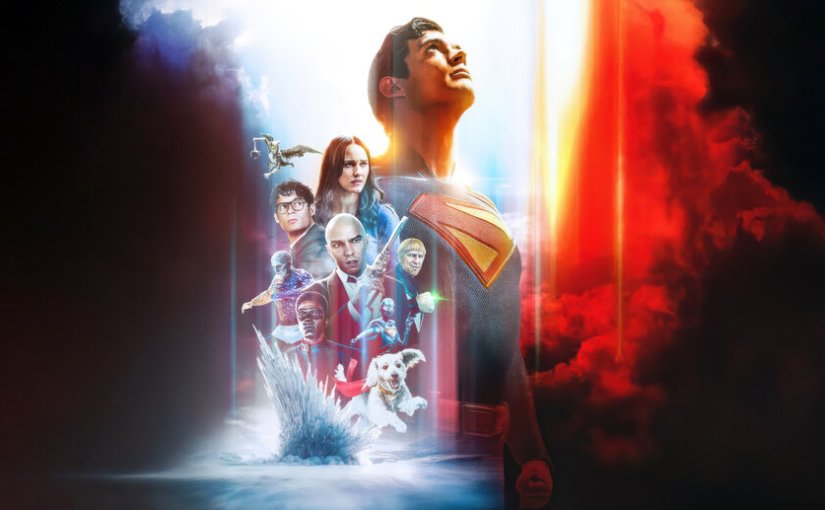
Gunn’s film is defiant to avoid any heavy exposition as this film begins.  There’s a slim foreword as the picture begins to describe this new universe that contains metahumans who arrived on Earth centuries ago, along with a little bit of Kal-el’s origin that many of us are familiar with.  Then we see the Man Of Steel crater into the Antarctic wounded from battle and aided by his feisty canine friend, Krypto, who drags him to his ice palace, the Fortress of Solitude.

Action commences thereafter back in Metropolis.  Lex Luthor (Nicholas Hoult) is pulling the puppet strings.  Lois Lane (Rachel Brosnahan) and the rest of the Daily Planet staff witness the mayhem over the city.

Then we get a bit of Clark looking a little goofy as he rushes into work, followed by some romantic interlude between Clark and Lois back at her apartment.  The two toe the line of their relationship when finally, the Superman persona allows his girlfriend to test his purpose for serving planet Earth along with his limits of authority and decisive action.  They go back and forth but none of the dialogue lands and the argument has no impact.  A missed opportunity to set up the Lois and Clark relationship.

The rest of the picture focuses on comic book episodes of endangering Superman while other metahumans make appearances – an obnoxious Green Lantern (Nathan Fillion), Hawkgirl, the shape shifting Metamorpho, and the surprisingly entertaining Mr. Terrific (Edi Gathegi) who seems to operate like Mr. Spock from Star Trek.  Of the four, the guy with the dumbest name actually serves the picture the best.

James Gunn’s film takes a huge departure from the recent films of Zach Snyder’s universe.  Nothing is dark and hardly anything is morose.  Some subplots seem to be ripped from the headlines of current events that’ll have you thinking about the Russian-Ukraine war.  None of it is overly heavy though because this picture is designed for families to watch together. 

Superman is pure escape with a red cape.

What I miss though is what both the Snyder and the Christopher Reeve pictures offered.  What does Superman mean to himself and the planet Earth?  The one conversation between Lois and Clark/Superman goes on long and while it feels like there is a purpose in that exchange, I cannot recall one kind of conclusion that stemmed from it.  For the rest of the film, Lois flies a spaceship and helps a weakened Superman find aid. When the two share any more scenes together it is for the action of the piece followed by a kissing scene.  I just didn’t respond to the puppy love or risks of their relationship that other iterations offered.  Their connection is just written a little too thin.  That’s a problem, because the Superman mythos always hinged on their relationship in the face of danger or true love or even journalistic integrity.

Am I being too serious and hardheaded?  Yes.  Nevertheless, even with a comic book/Saturday morning cartoon gloss, I wanted to see more weight to the relationship between the two characters.

The best attraction is Nicholas Hoult as a connivingly evil Lex Luthor.  He’s a raging madman bent on destroying Superman like everyone knows and the actor chews the scenery while primarily hiding in his glass headquartered command center for most of the film.  Anytime the movie diverts to Luthor, the picture just felt more alive.  This is a great Lex Luthor!!!!!!

Like he did with a smart aleck racoon in his other films, James Gunn introduces a toy line merchandise with the flying white terrier dog known as Krypto.  His intent is for audiences to cheer for him like other precocious creatures from past films such as any Disney movie or E.T. or Baby Yoda or Rocket Raccoon.  He’s cute and spirited.  When he’s in danger, the kids will be worried.  When he flies into the center of the screen with a bark or a yelp, everyone will applaud. 

David Corenswet is Superman.  He’s fine.  He definitely looks like the part.  He’s a happy go lucky Kryptonian.  He’ll never be as memorable as Christopher Reeve.  I also have more to appreciate in Henry Cavill’s performance.  I just didn’t see Corenswet do enough with this role.  I’ve yet to really see the dramatic chops he could offer.  Simply lying on the floor of a cell while falling ill to Krytonite is not urgent or frightening enough.  I hardly got to know this guy to care enough if he lives or dies.  I hope he’ll blossom some more within future installments of Gunn’s superhero universe.  That’s up to the writers though.  David Corenswet is pleasingly relaxed in a role that demands almost a hundred years of acceptance for a modern age.  I’m confident he can do it and that Gunn cast the right guy for the part.  While he’s acceptable, both Corenswet and Brosnahan would best be served better material for them to work together. 

As for Rachel Brosnahan, I guess she’s okay.  I don’t see her do much beside fly a spaceship.  Lois Lane is such an immense character of brains and gusto striving to always be the number one reporter.  Her only weakness is her love for Superman.  There’s not much I remember about her from this film.  I did notice that she primarily wears purple like the character did in 1990’s animated series.  Nice salute.  Come on James Gunn.  Rachel Brosnahan is good actress.  Give her something more to do.  Let her act a little.  (Let David Corenswet act a little too.)

It’s wonderful that an optimistic interpretation of Superman has arrived.  We need it.  It’s colorful and fun.  It could be more exciting, though, with higher stakes that just didn’t arrive quite right.  This film is not my ideal picture of the hero, but the universe to come, especially with a quick appearance from another character at the conclusion, offers promise. 

Despite my reservations, the new DC Cinematic Universe seems to be in the right hands once again, and James Gunn’s team will deliver something entertaining for the next few years to come.
NOSFERATU (2024)

by Miguel E. Rodriguez

DIRECTOR: Robert Eggers
CAST: Lily-Rose Depp, Nicholas Hoult, Bill Skarsgård, Aaron Taylor-Johnson, Willem Dafoe
MY RATING: 8/10
ROTTEN TOMATOMETER: 85% Certified Fresh

PLOT: The true OG vampire movie gets a fresh coat of paint in this gothic tale of obsession between a haunted young woman and the terrifying vampire infatuated with her.


Allow me to begin, as so many great films do, with a couple of flashbacks.

2018: The indie band Weezer records and releases their polarizing cover of Toto’s stone-cold classic “Africa.”  While recorded and produced with all the modern techniques at their disposal, fans of both bands say, correctly, that this new version is virtually identical to the original…so what was the point?  Couldn’t they have put some kind of new spin on it, like (for better or worse) UB40 and their cover of “Can’t Help Falling in Love”?  Why bother?

1991: Orion Pictures releases The Silence of the Lambs, an adaptation of Thomas Harris’s terrifying psychological thriller.  It goes on to win the coveted “Big Five” at the Oscars: Best Picture, Director, Actor, Actress, and Screenplay (Adapted).  Having devoured the book during one summer vacation, I go to a screening expecting to be wowed.  But…because the filmmakers stuck SO closely to the book (with some minor exceptions), there is little to no suspense for me.  While I am genuinely floored by how well-made and well-acted the film is, I do not experience any of the thrills and chills felt by those viewers who had NOT read the book.  I knew ahead of time what they would find in the corpse’s throat in the funeral parlor, how Lecter would escape from the courthouse, and how Starling would stumble upon Buffalo Bill’s house.  Don’t get me wrong, it’s a stellar movie.  But it was never truly scary for me.

Which brings me to Robert Eggers’s long-gestating remake of THE original vampire movie, Nosferatu.  Based on the immortal silent classic of the same name from 1922, directed by F.W. Murnau, the story will be familiar to any serious film/horror buffs, especially since Murnau “borrowed” liberally from Bram Stoker’s novel, Dracula, without first obtaining legal permission from Stoker’s estate.  How liberally?  Here’s a quote from IMDb: “All known prints and negatives were destroyed under the terms of settlement of a lawsuit by Bram Stoker’s widow.”  The only way the film survived was via 2nd-generation copies from other countries around the world.  Plagiarism?  Or homage?  I would normally say here, “You be the judge,” but the courts seem to have answered that question pretty definitively.

I mention this because every version of the Dracula mythology, starting with Nosferatu all the way through the semi-campy Hammer films to Coppola’s famous “low-tech” version and beyond – all of them tell the same story with only minor changes.  Consequently, the thing I look for in those films is not WHAT they’re telling me, but HOW they’re telling it.  Any student of pop culture knows Bruce Wayne’s origin story, so Batman Begins [2005] holds no surprises there, but the story is told extremely well, and so you roll with it, you know what I mean?

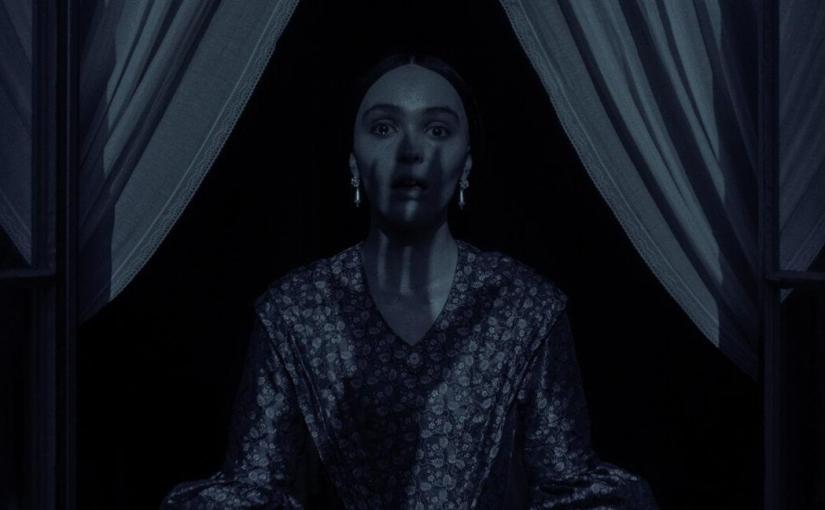
With Eggers’s Nosferatu, the production values on display are magnificent.  Eggers gets the mood and tone of a genuinely gothic horror story exactly right, as I knew he would, based on his previous films, especially The VVitch [2015].  The colors are muted to recreate the vibe of a black-and-white film, which paradoxically makes some of the scarier scenes even scarier.  The performances all around are top notch.  Poor Nicholas Hoult is saddled with the thankless Thomas Hutter role, stuck in straight-man mode the entire film; but Lily-Rose Depp had me thunderstruck with her performance as Ellen, Thomas’s wife, and the dependable Bill Skarsgård delivers the goods as Count Orlok, with a proper Transylvanian moustache (right out of the history books, haters) and an accent thick enough to tar ten miles of a country road with.

But let’s think about this for a second.  Those of you unfamiliar with the story of Nosferatu might be thinking to yourselves, “Who’s Thomas Hutter?  Who’s Ellen?  Don’t you mean Jonathan Harker and Mina?”  Well, naturally, those are the names the vast majority of filmgoers are going to be familiar with, not Thomas and Ellen and Count Orlok (which for my money is a much creepier name than “Dracula,” but I digress).

And therein lies part of the problem with this film.  I was so thoroughly familiar with the Dracula story that, even though this new film is a wonder to behold, it held very little suspense for me, since I knew exactly what was going to happen next, beat for beat.  There are, of course, cosmetic differences here and there: Thomas’s visit to a Romani village before he arrives at Orlok’s castle…Orlok’s straight-up possessions of Ellen…the highly effective jump-scares with the dogs here and there.  But I’ve seen it all before, MANY times.

(By contrast, I just recently watched one of the greatest slasher movies I’ve ever seen, X [2022], and it has virtually every slasher-movie-trope imaginable, and yet it somehow managed to transcend its own genre and become some kind of crazy masterpiece.)

In fact, in a very unexpected twist, there actually were two genuinely scary/creepy moments for me, and neither of them featured Count Orlok himself, at least not in the flesh.  They both involved Ellen, Thomas’s new wife, who becomes literally possessed by Orlok’s influence in scenes that legitimately give The Exorcist [1973] a run for its money.  Ellen thrashes about, rolls her eyes into the back of her head, speaks in an unnaturally guttural croak, bends backwards impossibly far – is Lily-Rose Depp a contortionist on the side? – and generally scares the bejeezus out of her husband and the audience.  On the strength of these two scenes alone, in addition to the general excellence of filmmaking craft on display, I would have no hesitation in recommending Nosferatu to moviegoers.

So, yes, despite my disappointments at the story level, given there were virtually no surprises plot-wise, I still give the movie a favorable rating just because it’s so well made.  If it had been created in a vacuum, if there had never been a vampire movie before this one, I believe I would have been creeped out to a much greater degree than I was, and this would have been hailed as an instant masterpiece.  But it is darkly beautiful to look at and wonderfully moody; there are many shots that are very nearly duplicates of shots from the original, which I enjoyed on a film-geek level.  I look forward to Robert Eggers tackling purely original material again.  He knows what he’s doing.

JUROR #2

By Marc S. Sanders

Since Unforgiven, director Clint Eastwood has sought out projects that have an intrinsic message or a question of morality.  That film seemed to channel the second half of his career that has spanned over a half a century.  Before, many of his films sensationalized the quiet killer or the silent tough guy with the six shooter gunplay and cracking fists. After the movie won Best Picture in 1992, movies like A Perfect World, Letters From Iwo Jima and Mystic River were not developed for simply the sake of escapist entertainment.  There was something to ponder after the stories wrapped up. 

Eastwood’s latest film, and supposedly his last, is Juror #2 and to the best of my recollection, I believe it is the first time the actor/director brings his experience to a courtroom.  Some of his more recent efforts have been questionable and not up to his best standards (Cry Macho), but Juror #2 is one of the best films he’s directed, and perhaps the best picture I’ve seen this year so far. 

Nicholas Hoult plays Justin Kemp, an expectant father with his wife Allison (Zoey Deutch).  He has just been selected for jury duty in a Savannah, Georgia courthouse.  Justin is Juror #2.  The case centers on trying a man for the murder of his girlfriend who was found bloodied and bruised in a rocky, wooded canal beneath a bridge.  Earlier that night, the couple were witnessed at a local watering hole having a drunken argument.  She walked off in the dead of night in the pouring rain.  The man was seen going after her.

Coincidentally, Justin was at this same bar.  He drove off in his car around the same time, but he accidentally hit what he thought was a deer.  The incident was hardly considered again until the opening statements were heard in court a year later.  Suddenly, the young man is putting two and two together and questioning if in fact he hit a deer.  Now Juror #2 embarks on a test of morality while sometimes adopting a Twelve Angry Men narrative.  Justin might appear as noble as Henry Fonda, but is he the culpable one?

Juror #2 assembles a good cast of characters.  Toni Collette is the prosecuting attorney, Faith Killebrew, who is also campaigning for an important election.  Collette has that deep southern twang, but the earth tone suits she wears along with her firm body language exude a tough exterior.  You believe Collete’s character is compartmentalizing this trial away from her chances of election.  The opposing attorney, Eric Resnick (Chris Messina, who I’d like to see in more films), is apt to imply the true motive behind Faith’s pursuit of trying his client.  Is it for personal gain, because Eric truly believes his client is innocent.  The evidence and facts add up to reasonable doubt.

Eastwood, with a script by Jonathan A Abrams, places his film in a variety of on set locations around Savannah.  Personally, it was fun recognizing certain areas following a recent weekend getaway my wife and I took to the storied town.  There are flashback pieces to the night in question at the bar and the crime scene.  Beautiful locales within the historic squares of Savannah are also covered in addition to the river boats near the docks.  Much of the picture occurs in the jury room where the group of twelve deliberate.  Leslie Bibb is charming as the Jury Foreperson.  However, Justin tries to find ways to allow his peers to consider other possibilities.  The only one on his side is a well-cast J.K. Simmons.  Simmons has the deep crackling voice that absorbs you into what he’s believes versus everyone else in the room.  Against him are jurors played by Cedric Yarbough and Chikako Fukuyama, also well cast.  What seems like an easy wrap up case of declaring a guilty verdict turns into a dead heat of 10 to 2, and eventually even Faith the prosecutor is personally questioning what occurred.

Juror #2 is very well cast film.  None of the actors are stand out marquee names, which works as an advantage.  They all appear common.  They don’t look like movie stars and thus it is easier to buy them in their roles.  After seeing the film at the 2024 AFI Film Festival, the gentleman sitting next to me had to surrender to a friendly debate we had.  He tried to point out plot holes in the film but I had an answer for each element he questioned.  Juror #2 is solid in its storytelling.  The motives that characters like Justin and Faith and even the respective jurors stand by all have a validity to their lines of thinking.  Therefore, Abrams’ script works well at arguing two sides of the same coin and the picture concludes with an opportunity to think about it long after it’s over.  Hanging threads to solid conundrums are a favorite factor of mine.

A story currently circulating in the trade papers is that Juror #2 is only being released in fifty theatres nationwide.  This is Warner Brothers’ decision and it’s a terrible shame.  When the debate of streaming versus exclusive theatrical releases is continuously being put into question, this is a sure sign of movie theatres eventually becoming obsolete. What a pleasure it was to watch Clint Eastwood’s film among crowd at the famed Grauman’s Chinese Theater (aka TCL Theatre) in Hollywood, California.  The audience was completely engaged, applauding as names appeared in the credits and laughing at the intended cues provided by the director and screenwriter.  To see a film, any film in a theatre, is a unique experience when it can be embraced among a crowd of movie lovers. 

If Robert Zemeckis’ Here can be released nationwide in thousands of venues, there is no reason why a well-made Clint Eastwood picture can not have the same treatment.  Movie houses were never designed to offer only the latest Marvel or Transformers film.

My hope is that the ongoing, widespread positive reception that Eastwood’s final film is receiving is noticed thereby building some traction for Warner Brothers to consider going wider with exposure.  At the very least, the famed studio owes it to arguably its most prized filmmaker and actor.  Time after time, the WB logo appears just ahead of Eastwood’s own Malpaso studio credit.  There is no Warner Brothers without Clint Eastwood and to close out his legendary career commands a bigger recognition. 

At the very least, Warner Brothers needs to recollect what occurred with a film like The Shawshank Redemption.  No one saw it in theatres and it had a terrible initial box office.  Some argue it was the title that turned people off.  Maybe.  Yet, think about the admiration that movie continues to garner thirty years later.  Warner Brothers needs to pay more attention to the quality they possess in their library.

At any rate, my hat off to Mr. Clint Eastwood – a pioneer filmmaker and one of the last survivors of a filmmaking yesteryear.  He began directing in 1971 with the thriller Play Misty For Me, and at age 94, he has only enhanced his meticulous dedication to drawing a crowd in while directing sensational casts.  Along with Harrison Ford and Steven Spielberg, I have followed Clint Eastwood’s career all my life.  Beginning with seeing Dirty Harry at age 8, I grew up on his imposing stature and his reliance on silent performances.  The first R rated film I saw in theatres was Sudden Impact.  Beyond being a Producer, Director and Actor, he is also a film composer.  Clint Eastwood is one of the few multi-talented people within the history of Hollywood, but no one compares to him.  You’re likely never to hear someone say that guy reminds me of Clint Eastwood, because there is only one Clint Eastwood. 

I am only blessed because I still have yet to see every one of his films.  If Juror #2 is his last effort, it’s a noble and solid ending to his run.  Yet, I’m glad I know I still have more to uncover in Clint Eastwood’s celebrated career.

NOTE: The murder victim is portrayed by Francesca Eastwood, Clint’s daughter.  As well, look for a blink and miss it moment where the director makes his way down a staircase while JK Simmons and Toni Collette share a scene together.  Eastwood is full bearded but there is no doubt that’s the guy.

PERSONAL NOTE: On the closing night of the 2024 AFI Film Festival, I had the pleasure to meet actors Cedric Yarbaugh, Amy Aquino and Zele Avradopoulos following the film and it was such a treat to hear how much they appreciated Mr. Eastwood as a director. All three were consistent in their admiration for the filmmaker describing him as patient, quiet, and a master of his craft who continuously worked with the same crew on one film after another. It was a real treat to chat with them. I also saw Nicholas Hoult walk by me three times and because I simply didn’t recognize him, I regret not asking him for a quick chat and photo as well. Yet, he and Toni Collette introduced the film which included a quick impersonation of Clint on the phone offering the role to him. Everyone was positively charming. This was such a memorable moviegoing experience. I’ll treasure the memory always.

MAD MAX: FURY ROAD

By Marc S. Sanders

After watching Mad Max: Fury Road, you will feel like you need a shower.  Strike that, you will need a shower in aloe first, then a traditional shower and then a weeklong bath in aloe.  It’s a baked in environment that gives you the feel of grainy sands and burning sunbeams.

George Miller’s return to the gonzo, apocalyptic diesel future franchise is exciting from the moment the Warner Bros logo appears with the vroom vroom blaring through your sound system’s speakers.  Miller hardly surrenders the breakneck speed of his two-hour picture to let an audience catch a breath, and because the director is so unforgiving it makes this a tour de force of action entertainment that other adventure films can only strive to at least match.  Still, the movie has next to no story, and that’s fine.

Up until this 2015 reinvention, Mel Gibson was the Aussie Road Warrior donned in leather fighting to survive against lawless bandits coming from any direction in the sand swept plains of an earth afterlife.  Now Tom Hardy takes over the role.  Frankly, it could have been anyone who got recast in the part.  Hardy has few lines and for half the film his face is caged in a grotesque, steel bar mask while he is strapped to the front of a hot rod, gear grinding, amalgamation of a vehicle, simply to be a kind of three-dimensional hood ornament.  This Max is suffering through high-speed chases with his head trapped in animalistic headgear and his arms and legs bound behind his back while he’s tethered to this four-wheeler.  It’s brutal and we can feel how tortuous it is for Hardy’s character.  Yet, we love it!!!!  Keep it going, George!

The real star of Fury Road is Charlize Theron as a one arm rebel caked in black grease with a shaven head.  Her name? Imperatour Furiosa.  What a name!!!!!  Furiosa attaches a steering wheel to the driving hilt of an 18 – no 20, maybe 24-wheeler (it could even be 36) big rig with a big ball of fuel hitched to the back. She detours away from a band of outlaw drivers ruled over by Immortan Joe (Hugh Keays-Burn).  Yes!  His name is Immortan Joe. 

In tow with Furiosa are Joe’s pregnant concubines whose fetuses are declared his property.  These lovely lasses dressed only in bed sheets have names like Capable, Cheedo The Fragile, The Dag, Toast The Knowing and The Splendid Angharad (Riley Keogh, Courtney Eaton, Abby Lee, Zoë Kravitz and Rosie Huntington-Whitley).  What is the point of listing off these ladies’ identities? Well, the script for the film doesn’t do so. Yet, the end credits do in a heavy metal kind of font, and it is clear that George Miller is proud of every name, every piece of junk that flies through the air in one crash and bash after another, and every flame that exhausts out of a pipe or even a death metal rock guitar orchestrated by a guy simply known as The Doof Warrior (played by a musician named Iota).  Incidentally, The Doof Warrior is garbed in red long johns and tethered by chains to a big rig with the biggest, blastiest speakers known to man.  The Doof Warrior serves no purpose except to scratch on the guitar while flames shoot out of the stem.  I’m laughing as I type this all out.  This whole display is thankfully ridiculous while all of these figures have the most outlandish and greatest names of all time!!!!

When Furiosa diverts away in the mighty big rig with the pregnant women, Joe follows suit with his endless band of albino crazies in one tricked out vehicle after another.  One car has the chassis of a Mercedes wedged on to the fattest wheels ever conceived.  Another is a Chrysler (I think) resting atop a pair armored tank tracks.  Joe’s automobile looks like it got disqualified from a monster truck rally because it was caught taking diesel steroids. 

Anyway, Mad Max eventually catches up with Furiosa and the ladies.  His last name is not something simple like Jones, Smith, Sanders or Rodriguez.  It’s ROCKATANSKY!!!!!  BOOM! That is awesome!!! A one-time underling of Joe’s, named Nux (Nicholas Hoult), eventually sways over to the heroes’ side as well, and the pursuit carries on.  Furiosa’s destination is a location of green, beyond the desert wasteland.

It’s a wonder that Mad Max: Fury Road was applauded so much in 2015.  However, take a moment to consider the construction of this two-hour operatic noise fest and you cannot help but salute all the merits that went into the final product.  First the nominated visual effects are primarily practical with little to no CGI.  If George Miller is going to make another Mad Max film, he’s going all the way.  The cinematography is gorgeous in a tan, orange, and yellow sun burning desert, while the night scenes are unhidden due to a pure, bright blue.  The interior of the truck seems cramped and uncomfortable, and yet Miller leaves enough room for the viewer to sit inside and uncover every hidden firearm plus get up close with the driver and the lady passengers.  There’s even a cool weapon found in the stick shift.  Wait until you see that!  The editing is relentless with perfectly captured close ups of so many character drivers and passengers all in a matter of seconds.  Plus, wide overhead shots and extended ground captions make it easy to understand just how many vehicles are included in this endless demolition derby.  I’m talking hundreds of monster machines ready for weaponized destructions. The choreographed action scenes of gun shots firing and vehicular collisions is like a ballet of a perfect derby show.  Monster razor blades are given their due, along with an assortment flame throwers. Also, kamikaze suicidal albinos are ready to act like destructive grenades.  Not one scene or shot in a Transformers CGI picture of metal vomit comes close to a millisecond of George Miller’s craft.

No other film could be as deserving of Academy Awards for sound, cinematography and editing as well as nominations for Best Picture and Best Director.  Even the warped-out S&M costume designs and make up are eye popping; merits that also earned Oscars.  You might have a fondness for art house cinema like Fellini or perhaps a Daniel Day-Lewis piece that invests in the method of caliber acting performances, but you cannot deny the artistic efforts vested by George Miller, his editor wife Margaret Sixel, and the rest of the crew. Mad Max: Fury Road was placed on so many top ten lists in the year 2015, and its because the film succeeds in the best of technical achievements. 

George Miller operates like that nasty kid named Sid from the Toy Story pictures.  He assembles his set pieces in the most tricked out, ugly and grotesque combinations of auto body parts, gives them engines that breathe fire and roar like vicious beasts that smell like diesel and then collides them altogether in a wide open plain.  Try to imagine Miller as a young child with his Matchbox cars on his bedroom floor.  His parents might have had some concern while observing his play activity.  What’s appreciated though is that this director never settled for simple with his Mad Max films and he never repeated what he’s already demonstrated.  No car crash looks the same.  No single shot is  repetitive.  This is how a director of any film genre should operate.  When they take attentive care to every frame they capture with their camera, then they get a Mad Max: Fury Road

One of the best films of the twenty-first century!

NOTE: I originally saw this film in 3-D in the theaters.  Wanna know my sentiments towards 3-D? Well, I hated this film after I saw it.  I gave up five minutes into the piece because the 3-D was unforgiving in distraction and dark beyond comprehension and measure.  Watching Mad Max: Fury Road again, a number of years later in a standard 4K on my 65-inch flat screen, you can likely tell by my write up that my sentiments have drastically changed for the picture.  It’s also telling to note that the new prequel film Furiosa is not being presented in 3-D.  Unless it is a James Cameron film or a special exception like Ridley Scott’s Prometheus, modern 3-D is as big a failure as the new formula Coke was back in the 1980s. 

THE MENU

By Marc S. Sanders

Whether you’re the storyteller or the viewer/reader, you take a chance with satire.  The darker the satire is, the even greater the risk you take. A film like The Menu, from director Mark Mylod, is one such example. You’ll hate it…like my wife did, despite the lively conversation we had afterwards.  On the other hand, you might love its invention to strike back at an upper class that lacks any clue or respect for the talents of others. Then again, you just might only like it.  Well…at least I liked it.

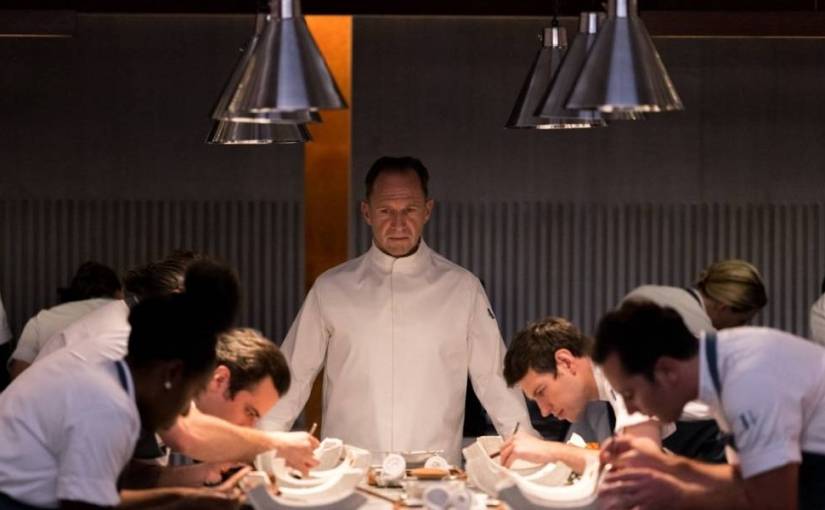
Ralph Fiennes’ résumé has earned a reputation to intimidate an audience. He is a superb actor who can be absolutely frightening as a Nazi in Schindler’s List, or heartbreaking as a torn affiliate of a deceitful plot like in Quiz Show. He can also go toe to toe as a Greek god against Liam Neeson, or he can demand that James Bond “Stand down!” and strike with snake like glee at Harry Potter. He can also teeter along the antics of the devil himself as he portrays the world’s most esteemed chef in The Menu.

A collection of guests is escorted by boat to a remote island where the finest restaurant is located and run by Chef Slowik (Fiennes), with assistance from Elsa (Hong Chau).  There’s Tyler (Nicholas Hoult), a die-hard fan of the chef’s craft with his date Margot (Anya Taylor-Joy), who is nowhere near as impressed.  Tyler has to remind Margot not to smoke, otherwise it’ll destroy her palette for taste.  There’s an older couple who has frequented the Chef’s dining establishments before and are back for another visit.  There are a pair of restaurant critics. There’s a movie star (John Leguizamo) with his young assistant.  Finally, there is a trio of sophomoric, yuppie businessmen who are here because their last monthly commission likely afforded this exclusive opportunity, and their favorite hockey team was out of town.

When the guests arrive on the island, Elsa gives them a tour ahead of the restaurant where they will eventually dine.  A cabin is displayed to show how the meats are aged over a period of 152 days. Quite specific! One of the yuppies has the audacity to ask what happens if you age it to day 153. I don’t recall Elsa’s response.  I do remember her disdain for the question though. They walk through the lodge where Elsa explains that the entire staff reside and sleep in the one room together. One cot for each person. Odd, but okay. Moving on is a quick pass by the cottage where the Chef resides, and no one is permitted to enter. Oooo!!!! I know one thing I expect to happen.

It is important to note that I opted not to read up on anything The Menu was about.  I didn’t know if I was to see a comedy, drama or horror film.  As this tour continued though, I had eerie recollections of the film Midsommar, directed by Ari Aster. That movie still gives me the bejeebees.  So much so that I could not bring myself to write an article about it.  Like that film, our cast has become isolated in a desolate locale, and the guide could not be more unsettling.  When they arrive at the restaurant, a large horizontal door is thunderously closed behind them. Margot gives a quick look back over her shoulder. This cannot be good.

Lending to the structure of the film, courses are presented with a startling clap of the hands from Chef Slowik. Mark Mylod executes a nice pattern of gracefully displaying text across the screen describing what the next featured course is, along with its fine ingredients.  It is elegant but also only partially revealing of some of the guests. Tyler isn’t the kind of fan that Chef would welcome.  After a request has been made not to take pictures of the dishes, he does so anyway.  He is uncouth with his commentary and clumsy as well.  Additionally, bewildering for Chef Slowik is the presence of Margot. He was not expecting her to attend. Yet, here she is and he cannot understand why.

The Menu does not deviate from its intent to be strange. A bread dish is presented without any bread! Only the dips. Tyler is absolutely impressed. Margot thinks it is ridiculous. By the time, the fourth course has arrived, a shocking presentation is exhibited to the guests and that is where the film takes a graphic turn.

It’s best not to reveal much about the movie.  Its features work if you share the perspective of the guests, particularly Margot. What you are left to decide though is if you accept that dark satirical nature of the piece.  You will or you won’t.

I did not find The Menu to be very symbolic, allegorical, or even a reflection of the natures of social classes who partake in exclusive high-end cuisine.  Chef Slowik has prepared a specific plan for this assortment of guests. The execution and outcome cater to his personal satisfaction and no one else’s.  I guess that’s why I only liked the wit behind the message of the film.  I just could not fully embrace its invention.

My experience with satire typically allows me to think about how people behave and what they can learn from outrageous proposals or extreme actions. Network explores how the world responds to what is proposed for satisfying television audiences while generating business profits.  A film like The Menu delves into grandiose, unheard of actions that will satisfy the one puppet master behind everything you are seeing.  Maybe I was looking for the message the Chef delivers to include my own misgivings and sins and temptations in his overall delivery.  Instead, his machinations rely on these specific guests on this particular night, and so I kind of felt left out of the circle. As the guests are specifically affected by the developments of the evening, I can’t say I had any care or sense of suspense for them.  Nor did I care for Chef’s own satisfaction as the evening carries on.

The cast is a terrific eclectic assortment. Anya Taylor-Joy is a smart and forthright hero against Ralph Fiennes’ antagonist. A well written conclusion that made me applaud is included by her character’s deductive reasoning. The other players though are not given much fat to chew on in terms of dialogue or scenes.  Their purpose is specifically explained, and then they are left to watch and wait for the climax of the film. I like the veil that is lifted from Margot’s character.  I would have welcomed a little more subtext on the other characters, however. Again, their purpose is laid out, but I think the film, which clocks in at around an hour and forty-five minutes, could have dug a little deeper into the guests sitting at the other tables. Not to mention those few who also serve on the Chef’s cooking staff.

The Menu is an unusual film, like an episode of Tales From The Darkside or The Twilight Zone.  It is limited like a TV episode. I just think it needed two or three more courses to savor just a little more meat on the bone.

THE FAVOURITE (2018)

By Miguel E. Rodriguez

Director: Yorgos Lanthimos
Cast: Olivia Colman, Rachel Weisz, Emma Stone, Nicholas Hoult
My Rating: 10/10
Rotten Tomatometer: 94% Certified Fresh

PLOT: In early 18th century England, a frail Queen Anne (Colman) enjoys the attentions of her close friend, Lady Sarah (Weisz), but when Sarah’s cousin (Stone) arrives at court, a subtle power struggle ensues.


This movie is a TRIP.  Imagine that someone crossed the sex-driven antics in Dangerous Liaisons with the cat-fighting in All About Eve, directed by someone who idolizes Stanley Kubrick and David Fincher.  It’s that good.

Where to begin?

I loved the story.  It’s a basic power struggle/love triangle, but told with immense wit and originality.  Queen Anne indulges in sexual dalliances with her closest confidante, Lady Sarah.  Then Abigail appears, a distant cousin to Lady Sarah; she’s hired as a scullery maid and slowly works her way into Lady Sarah’s confidence as her handmaiden.  When the Queen starts to show a preference for Abigail over Lady Sarah, oh, the fur doth fly.

Rarely has it been so much fun to see such bad people behaving so badly.  At first, I was rooting for Abigail, who is only doing what seems necessary to survive, but then it becomes obvious that there ARE no good guys in this movie.  Abigail proves herself just as capable of social atrocities as Lady Sarah or Queen Anne herself.  Normally, I HATE movies with no clear heroes, but the screenplay and camerawork kept me constantly engaged and entertained.  I think I had a smile on my face continuously after the 30-minute mark.

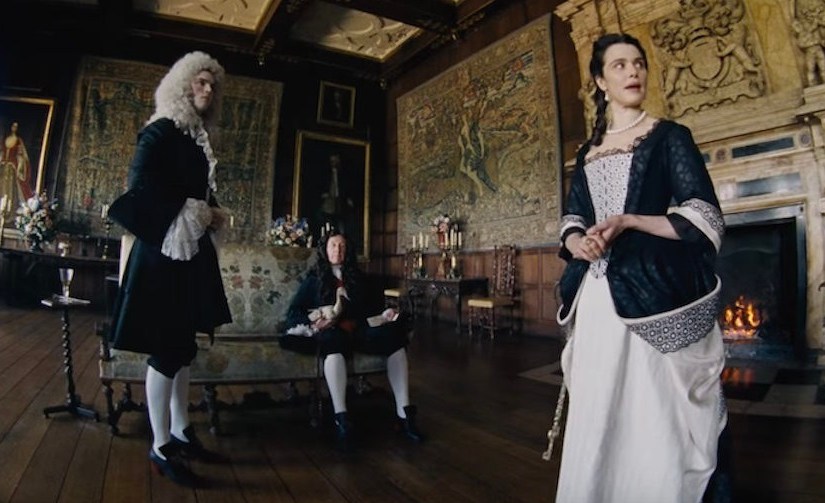
And let’s talk about that camerawork.  I’ve never seen one of this director Yorgos Lanthimos’s films before, but if they share the same visual inventiveness as THIS movie, I am going to seek them out.  The list of directors working today with visual styles unique to them is relatively short, so to find this fresh take on moving pictures was a delightful surprise.  There are a couple of places where extremely-wide-angle “fish-eye” lenses are used, distorting the picture on the edges so it looks like you’re looking at the scene through the bottom of a Coke bottle.  I found that particular device odd, calling attention to itself, but it worked.  It sort of created this idea that we’re looking at a staged performance rather than attempting to mimic or capture strict reality, which makes some of the behavior of the main characters more palatable than they might be in another film.

There are one or two moments that are so over the top, they might have derailed another film.  At one point, two characters dance during a formal party, as the Queen looks on.  It starts out daintily enough, like you’ve seen in countless other 18th-century films, the mincing steps back and forth, a little bow here, a curtsy there.  Then, as the music continues…something happens.  The man lifts the woman and swings her around on his hips like a swing dance.  They start to move their hands like in the “Vogue” video.  At one point, I’d swear the man started a rudimentary breakdancing move.  What’s going on here?  Why is this jarringly anachronistic dance intruding on the proceedings?

My first reaction while watching the movie was to just laugh in disbelief, while asking, “What IS this?”  Looking back on it now, I’d guess the purpose was to put ourselves into the mind of the Queen, whose perception of the dance starts to degrade the angrier she gets.  Regardless of its true purpose, it’s thoroughly weird but hilarious.

(Also, the screenplay contains some of the greatest zingers I’ve heard in a very long time, although I doubt some of them are historically accurate.  Not that I’m a historian, of course, but I remain unconvinced that British royals in the 1700s ever used the term “vajoojoo.”)

I’ll be honest, I was not previously aware of the actress Olivia Colman, who portrays the fragile, temperamental Queen Anne, before this movie, but I’ll be looking out for her from now on.  She more than holds her own with two Oscar winners (Emma Stone and Rachel Weisz).  Colman’s Queen Anne is a spoiled brat whose petulance is tolerated because, you know, she’s the Queen.  I loved a moment when she walks past an unsuspecting footman and yells at him, “Look at me!  Look at me!!!”  He turns and looks, and she immediately yells: “HOW DARE YOU LOOK AT ME!!!”  Right there, early on, her character is indelibly defined.

The depths to which all three women sink to exact their own particular brands of revenge upon each other will astonish you.  While the ending is not the one I quite hoped for, it’s extremely satisfying in a “be careful what you wish for” kind of way.  This movie was a delicious romp, and is definitely worth your time.