

A PLACE IN THE SUN (1951)

by Miguel E. Rodriguez

DIRECTOR: George Stevens
CAST: Montgomery Clift, Elizabeth Taylor, Shelley Winters, Raymond Burr
MY RATING: 9/10
ROTTEN TOMATOMETER: 82% Fresh

PLOT: A struggling young man gets a job working for his rich uncle and ends up falling in love with two women, one rich and one poor.


I first saw A Place in the Sun many moons ago at a friend’s house.  I remember enjoying it but thinking it was too soapy for my taste.  Years went by.  I finally got around to watching Woody Allen’s Match Point and was stunned at how much Allen’s film borrowed from George Stevens’ celebrated melodrama.  Having just re-watched A Place in the Sun, my opinion of it has warmed considerably, without diminishing my admiration for Match Point, which remains one of my favorite films of all time.

A Place in the Sun tells the story of young George Eastman, played by Montgomery Clift at or near the height of his powers.  He’s a bit of a layabout who wrangles a job at his rich uncle’s swimsuit factory.  When George meets his rich relatives, I was reminded of a George Gobel quip: “Did you ever get the feeling that the world was a tuxedo and you were a pair of brown shoes?”  That’s George Eastman to a T, a ne’er-do-well in a sea of the well-to-do.

Against company policy, George falls in love (or at least in lust) with a rather plain girl, Alice, played by Shelley Winters in a de-glamorized role that went completely against type at that point in her career, winning her a Best Actress nomination.  Alice and George flirt and hold hands and occasionally neck (mildly scandalous for a 1951 film), but George can’t help but stare at another girl who pops up occasionally: Angela Vickers.  Angela is played by a ravishing Elizabeth Taylor, who was only 17 at the time of filming and empirically one of the most beautiful women in Hollywood, if not the world.  It’s not too hard to imagine any man, let alone poor George Eastman, falling in love with her instantly.

But George is still connected to Alice, especially because he’s already slept with her.  When George learns Alice is pregnant, he despairs because he had been planning to end things with Alice to pursue Angela.  Alice even visits a doctor who might possibly provide an abortion.  Of course, this being 1951, “abortion” is never mentioned out loud, nor is the word “pregnant.”  But Alice’s visit to the doctor is handled with incredible intelligence and brilliant screenwriting that manages to say everything it needs to say without ever uttering those forbidden words.

The rest of the film examines what George may or may not be willing to do for the sake of his love for Angela, who loves him back, it turns out…but she doesn’t know about Alice.  Since this is based on a then-famous novel called An American Tragedy (by Theodore Dreiser), it may not be too hard to divine what is in store for George before the final credits roll, but getting there is the fun part.  By casting heartthrobs as the hero/anti-hero and the rich girl he loves, the film cleverly gets us to root for them a little bit, even when George is considering murder.

While Elizabeth Taylor dominates every scene she’s in just by standing there, the Academy made sure Shelley Winters was recognized for her incredibly difficult performance as Alice.  There are some movies where, if a character is an emotional yo-yo, it can be frustrating.  With Alice, Winters never crossed a line into unlikability, even when she calls George at a fancy dinner party demanding he marry her tomorrow, “or else.”  It’s clear she has no options left to her if she wants to have any semblance of a life in polite society (by 1950s standards, anyway).  I felt bad for her.  But I also felt bad for George – to a degree – when he demonstrates how sincerely he has fallen head over heels for Angela.  Not just because she’s stunningly beautiful, but also because she really seems to have fallen for him, too.

Lately, my movie-watching itinerary of classic films has involved a fair share of outstanding melodramas (Leave Her to Heaven, 1945; The Heiress, 1949; Dodsworth, 1936).  A Place in the Sun fits right into that mold.  It doesn’t quite achieve the perfection of The Heiress, but it is a fantastic example of its genre, good enough for Woody Allen to “reimagine” its basic story for Match Point, so it’s definitely worth a look if you’re into that kind of thing.
THE HEIRESS (1949)

by Miguel E. Rodriguez

DIRECTOR: William Wyler
CAST: Olivia de Havilland, Montgomery Clift, Ralph Richardson, Miriam Hopkins
MY RATING: 10/10
ROTTEN TOMATOMETER: 100% Fresh

PLOT: In the mid-1800s, a naïve young woman falls for a handsome young rogue whom her emotionally abusive father suspects is the male version of a gold-digger.


[Author’s note: If you have not seen this film, but intend to do so, I urge you not to seek out spoilers.  The final resolution of this movie deserves to be seen in a vacuum, if you know what I mean.]

The AFI’s list of the 50 Greatest Villains in American film does not include Dr. Austin Sloper, played with indifferent cruelty by the great Ralph Richardson in William Wyler’s The Heiress.  This is a miscarriage of justice, as Dr. Sloper is one of the most ruthlessly harsh characters I’ve seen in a movie in many years.  The fact that he is successfully upstaged by Olivia de Havilland as his daughter, Catherine, is a triumph of screenwriting, directing, and pitch-perfect acting from both performers.  The fact that both performances nearly overshadow a charismatic young Montgomery Clift is something that must be seen to be believed.

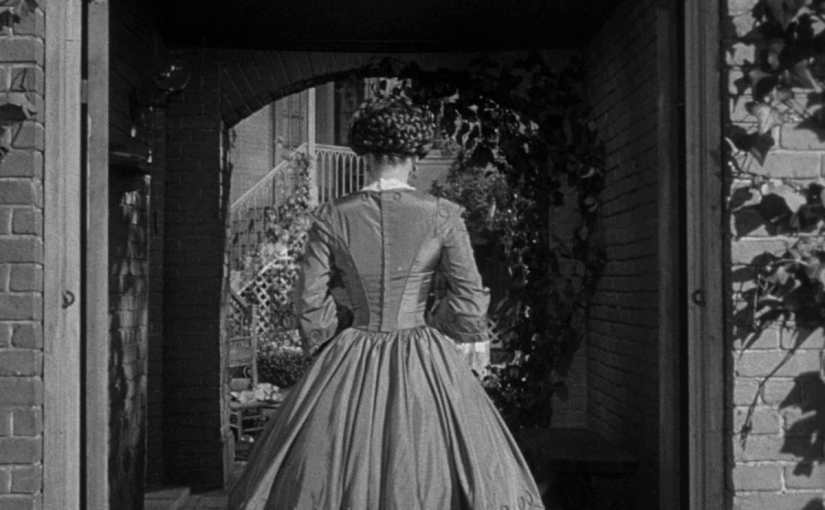
The film starts in the mid-1800s in the Washington Square area of New York City.  It’s a time of horse-drawn carriages, corsets, and garden parties.  Catherine Sloper is a very plain, very shy, single woman who lives in a three-story brownstone with her widowed aunt, Lavinia (Miriam Hopkins), and her father, a financially successful doctor who will bequeath a $30,000-a-year inheritance to Catherine upon his death.  In addition to the $10,000-a-year she already receives from her mother’s inheritance, Catherine will be financially comfortable for the rest of her life.  Alas, her social graces are virtually nonexistent, and she is quite plain when compared to her late mother…as Dr. Sloper casually mentions from time to time, utterly oblivious to the effect this has on Catherine.

At a garden party, during which Catherine is socially humiliated by a thoughtless gentleman, she meets the well-dressed, well-behaved, and nearly penniless Morris Townsend (Clift), who makes it clear that he is utterly taken with her and would like nothing more than to spend the rest of the evening talking or dancing with her and no one else.  Her aunt Lavinia is ecstatic the next day, but Dr. Sloper is skeptical.  In his mind, no gentleman in his right mind would express romantic intentions towards his socially unsuitable daughter unless he simply wanted the money that comes with her, and he says as much to Mr. Townsend AND to Catherine.  The callousness of Dr. Sloper’s behavior is abhorrent, and I found myself thinking, “If this guy were drawn and quartered by the end of the movie, that would still be too good for him.”

The brilliance of the screenplay becomes apparent when Morris boldly announces his love for Catherine, to her complete stupefaction.  And when he actually proposes, that pushes her over the edge, and she falls head over heels in love with him, because he’s the first man who has ever shown anything more than polite tolerance towards her…including her father.  Dr. Sloper lays out his case for what he believes Townsend’s true intentions are: to take control of or squander her inheritance after they marry.

Dr. Sloper’s brutality knows no bounds…but you find yourself thinking: what if he’s right?  Certainly, Townsend is completely genuine in his love for Catherine, or at least seems to be.  He knows exactly what to say, and when and how to say it.  Is it an act?  He’s handsome enough to be an eligible catch for any number of society women in the city, so why waste his time on such a plain-Jane girl as Catherine?

This conflict occupies the main thrust of at least the first half of the film.  What transpires and how and when, I will not say.  I will say that the story led me in one well-traveled direction, took a left turn, then took another unexpected turn that left me kind of breathless at its audacity.  The movie as a whole has been compared in some circles to Scorsese’s The Age of Innocence (1993), and deservedly so.

Olivia de Havilland’s performance as Catherine is one of the greatest performances I’ve seen in any film of that era.  It trumps even her powerful turn in The Snake Pit a year earlier.  Clearly, de Havilland was anything but plain and awkward in real life, but careful makeup and performance nuances helped her bring off one of the most commanding roles of her career.  There is an emotional transformation that occurs at one point where she is able to affect a complete one-eighty in her character, and it never once feels histrionic or gimmicky.  She shares a scene with her father in which she has “found [her] tongue at last,” as he puts it, that I would rank as one of the greatest two-handed scenes I’ve ever watched.  The surgical application of language to inflict harm on another person is breathtaking.  Neil LaBute or David Mamet couldn’t have written it any better.

The Heiress left me feeling a little wrung out at the final credits.  I remember watching this movie many years ago, but nothing stuck with me except that ending.  Despite this foreknowledge, the movie still worked its spell on me, leaving me with a dropped jaw and a blown mind.  The ending is somehow definite and ambiguous at the same time, a screenwriting miracle.  (And I don’t mean in a Sopranos kind of way, either.)  The Heiress is officially one of my new favorite films.

I CONFESS

By Marc S. Sanders

Alfred Hitchcock’s 1953 film noir I Confess is an absolute must see. An underrated film that held my attention all the way to the end. Perhaps because of its subject matter and setting within the Catholic Church it didn’t hold the reputation of Hitch’s other more well known classics like Psycho, The Birds and North By Northwest. Those films played with their suspense. They had fun with humor and special effects to carry their adventures and horror. I Confess has a little more serious weight to its story, as it examines the scruples of its characters within a murder yarn.

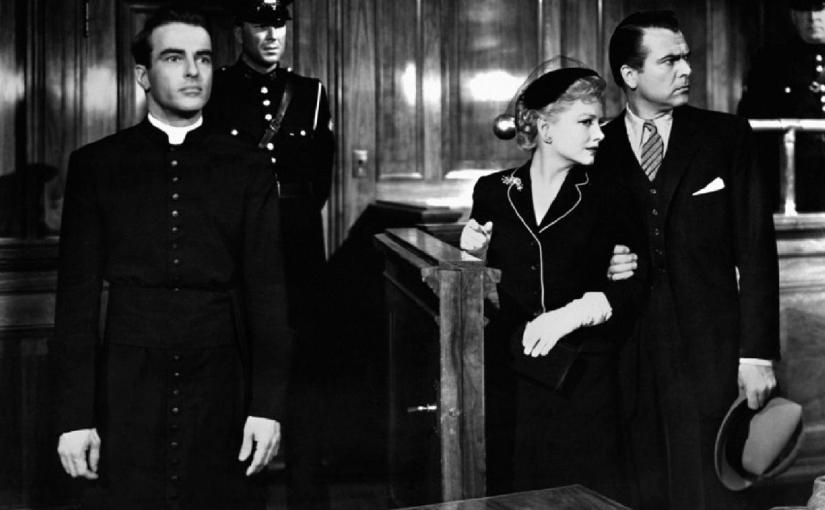
Montgomery Clift portrays Michael Logan, a Catholic Priest, who hears the confession of a murder from the church’s maintenance man (O.E. Hasse), late one night. Only now, sworn to his oath of confidence, he must keep it undisclosed. That might be a little challenging when it is gradually revealed that Fr. Logan might have a connection to the victim, a well known attorney.

Anne Baxter plays Ruth Grandefort, the wife of a politician, caught speaking with Logan just outside of the scene of the crime the next morning. Inspector LaRue (Karl Malden) has reason to follow up on these people. Immediately, your mind will likely go somewhere. When a man and a woman are caught whispering to one another in any murder mystery, well, what are you gonna think? Still, could it be something else entirely? Alibis are not quite solid and unlikely suspects are caught together. Why? What do they know? What’s the connection?

Hitchcock shoots a mystery turned inside out. You know who the killer is in the first five minutes. From there he pursues the red herring until it’s conclusion. The mystery isn’t really the issue here. The question is whether Logan and Grandefort will avoid a frame up. Can Fr. Logan maintain his oath while maintaining his innocence? Det. LaRue has every reason to believe he’s got his culprit, and yet he doesn’t.

Film noir set in Quebec sidles up to questions of morality beautifully here. I was truly wondering whether Logan was going to get exonerated. Hitchcock applies the suspense in that perspective. It’s a great twist on the traditional Agatha Christie motif. He’s got a great tracking shot (actually he was probably carrying the camera and walking on his own two feet) of the maintenance man walking at a fast pace alongside Logan down a hallway, reminding him of his commitment of confidentiality. “As long as you’re a priest…”. Hitch got my pulse racing at this moment.

The three principal players (Clift, Baxter and Malden) are very good here. None of the performances feel dated. As well, Hasse as the murderous German caretaker makes for a good, creepy foil, always looking in from the outside to make certain the investigation never sways away from Logan.

The set up is really well executed from Hitchcock using a script by George Tabori & William Archibald, adapted from an early 20th century play by Paul Anthelme. It’s a little surprising to see a priest caught up in a murder and perhaps some other sinful acts in a film from 1953. There were actually aspects of the original script that Warner Brothers insisted be excised.

However, had this film been made today, there’d likely be an uproar over a Catholic Priest being considered for murder or even participating in a possible affair.

The shock of it all still works in I Confess. A priest is a prime murder suspect? Never! How could it be? Yet, that’s what engaged me. We all are capable of carrying out the worst acts imaginable. The same could be said that we are all capable of holding true to our moral character. Our capabilities are embedded in our human mindset. The question is what is everyone willing to believe.