HIGH PLAINS DRIFTER

By Marc S. Sanders

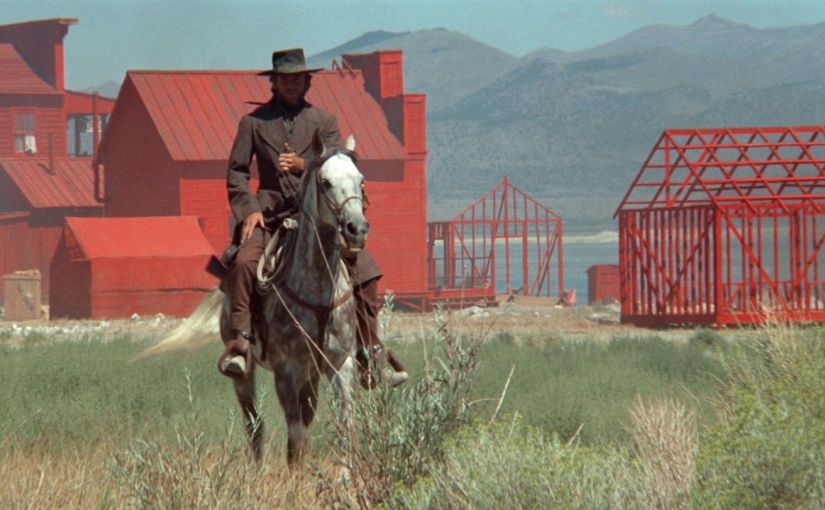
Because Clint Eastwood’s career of acting roles is thematically the strong, silent type, it’s easy to appreciate that in one film he may be The Man With No Name, while in another picture he’s simply The Stranger.  In the second film he directed, High Plains Drifter, he’s an intimidating force riding on horseback into the lakeside town of Lago.  

He may enter the saloon for a beer and a bottle and then cross the street to the barber for a shave and a bath, but you likely do not want to ever involve yourself with him.  He is also horrifically unkind to one of the few women in these parts.  Let’s just say it ain’t no roll in the hay.  This Stranger is a scary dude in a black hat.

The townsmen recognize a convenience in this man’s arrival though.  He’s demonstrated what he is capable of and therefore he appears to be the one qualified to kill three outlaws who were just released from prison with vengeance on their minds as they make a return to Lago.

There’s a hint of supernatural play in High Plains Drifter.  The Stranger recalls a harsh night when the local Marshall had been whipped to death by the townsfolk.  Could the Marshall be the Stranger?  Perhaps.  The victimized Marshall is portrayed by Eastwood’s long time stunt double and occasional director Buddy Van Horn (Pink Cadillac, The Dead Pool).  While that bloody slaughter occurred, the townsfolk simply watched with no offer to help.  For a while, High Plains Drifter was rumored to have been inspired by a real-life rape from the mid-1960s which ultimately led to the need for calling 911 in the event of an emergency.  Art imitates life even in the Old West.

The Stranger agrees to help the town prepare for the outlaws’ violent return, but like a fantasy character he makes special requests of his own including reassigning the sheriff’s badge to the town dwarf, plus taking whatever merchandise he wants from the mercantile and occupying the two best rooms in the hotel.  Also, he gives instructions to load up on a large supply of red paint.  Is the town of Lago getting what they bargained for or are they dwindling into a worse fate? Could be a deal with the devil or as Jewish mysticism might imply, the town of Lago might be inheriting a gollum.

Clint Eastwood salutes his prior directors that prepped him to become an esteemed filmmaker.  Don Siegel’s (Dirty Harry) and Sergio Leone’s (The Dollars spaghetti westerns) names are engraved on tombstones within the nearby cemetery built for the set.  Eastwood adopts some of their famed techniques while not setting himself apart from what those influencers accomplished.  He was still finding his footing behind the camera. High Plains Drifter is just a tale of revenge with recognizable set ups found within typical Hollywood westerns.  

Visually, the film starts out mysteriously with The Stranger’s arrival out of a sun soaked desert boil.  The photography looks deliberately grainy before the modern twenty-first century film restoration appears. Not a word of dialogue is uttered until after the picture has run for over seven minutes.  

Lago becomes a town with a new kind of identity later in the film as mandated by the script.  This is where Eastwood finds opportunity to do things with his western that his earlier pictures had not offered yet.  A bloody, hellish war is expected.

High Plains Drifter traverses in different directions while primarily staying in this one small town and you may wonder what this storyline has to do with that storyline.  Well, the commonality of its various parts is The Stranger’s arrival.  

You’ll may question who this unnamed man truly was by the time film ends.  Maybe it was not a man at all.  There are moments included by Eastwood’s direction to question what precisely occurred.  

Is High Plains Drifter a western or is it a ghost story? Like me, perhaps you’ll uncover moments that support either argument.

MONTE WALSH (1970)

by Miguel E. Rodriguez

DIRECTOR: William A. Fraker
CAST: Lee Marvin, Jeanne Moreau, Jack Palance, Mitchell Ryan
MY RATING: 7/10
ROTTEN TOMATOMETER: 89% Fresh

PLOT: An aging cowboy realizes that the West he knew and loved will soon be no more – and that there will be no room for him, either.


Based on this film, Monte Walsh, and the other two films he directed, A Reflection of Fear [1972] and The Legend of the Lone Ranger [1981], I think it would be charitable to say that William A. Fraker’s best films are the ones where he served instead as director of photography, such as Bullitt [1968], WarGames [1983], and Tombstone [1993], among many other notable movies.  Am I saying Monte Walsh is a bad film?  No, but it’s certainly not as bad as Gene Siskel’s 1-star rating, nor is it as stellar as Roger Ebert’s 4-star rating.  I give it a 7-out-of-10 on my scale because of the way the second half of the film builds and builds so that the outbursts of violence feel earned and motivated instead of cliched.

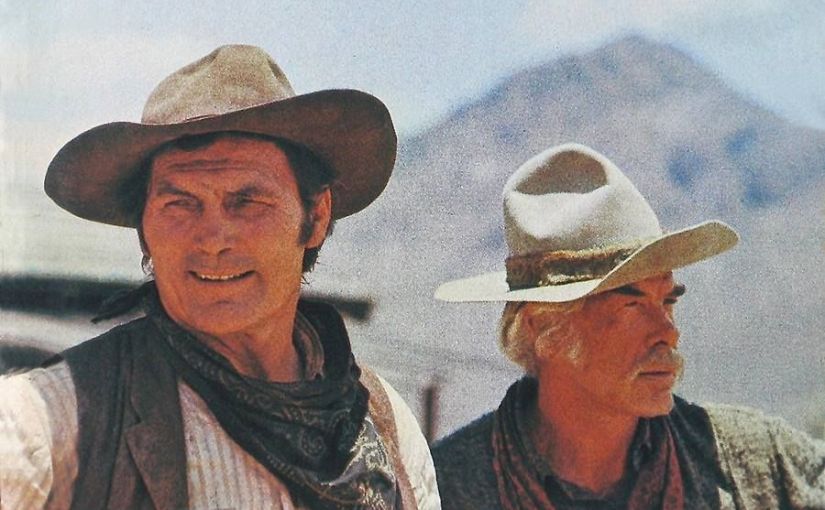
Monte Walsh (Lee Marvin, grizzled as ever, even with a handlebar moustache) and his friend and partner, Chet (Jack Palance in a rare non-villainous role), come down off a mountainside after a rough winter keeping watch on Mr. Brennan’s herd of cattle, only to get news that Brennan’s ranch has been purchased by a corporate entity, Consolidated Cattle.  Brennan offers them a steady job, which they reluctantly take, but deep inside they know this means their prairie-roaming way of life is coming to an end.  Chet is prepared to accept this, but Monte chafes at the idea.  “I ain’t doing nothing I can’t do from a horse,” he warns Brennan.

We get entertaining glimpses of the ranch hand life, complete with the saloon fights and the stinky cook.  Monte dallies with a French madame, Martine (played by the exotic Jeanne Moreau).  At one point, Monte and Chet ride out and meet a weathered old ranch hand who is “riding fence,” or inspecting every foot of fence around the ranch for repairs…the only work he’s cut out for anymore.  “Looks like his life is over with,” they say, and you can tell they’re looking into their own future.

The thrust of the film is one I’ve seen in many other westerns before this one: “The old West is changing, and there’s no place in it for people like us anymore, so we’d better evolve or die.”  This theme is present in Once Upon a Time in the West [1968], Butch Cassidy and the Sundance Kid [1969], and especially The Wild Bunch [also 1969]…seemed to be a trend for westerns at the turn of the decade, for some reason.  Monte Walsh handles it in an episodic format, kind of like another Lee Marvin film, The Big Red One [1980].  It doesn’t quite tell a straightforward plot with a pre-determined story arc.  It skips around a little bit, painting a picture without telling a conventional story.

There can be a sense of freedom in this kind of storytelling.  Unshackled by traditional story beats – at least for the first half – the movie is laid back, asking the viewer for a little patience as it slowly lays down building blocks for the finale.  However, I must report that I found this section of the movie a little slow.  I grew impatient.  I felt I was being set up for something, but pretty soon I just wanted the movie to get on with it.  Butch Cassidy sort of works that way, but you had two of the most photogenic stars who ever lived as the two leads.  I struggled to care the same way for Jack Palance as I did for Paul Newman.

But then an unexpected scene of violence occurs, setting into motion a series of events that culminate in a tragic series of deaths that, I must admit, had me glued to the screen as they unfolded.  Because of the gangbusters nature of this section, I am inclined to forgive the film’s shortcomings in its first half.  Here, we see, yes, Monte must evolve or die, and even if it’s never in any real doubt what he will choose, it’s entertaining to watch him make that choice.

If not for the second half of the picture, I might not even be writing about Monte Walsh.  I didn’t care for the opening song (even if it WAS sung by Mama Cass), some of the movie felt ripped off from several other westerns, and I was borderline bored for the first half.  But if you stick with Monte Walsh until the end, I think you’ll agree it’s worth a look.

MAGNUM FORCE

By Marc S. Sanders

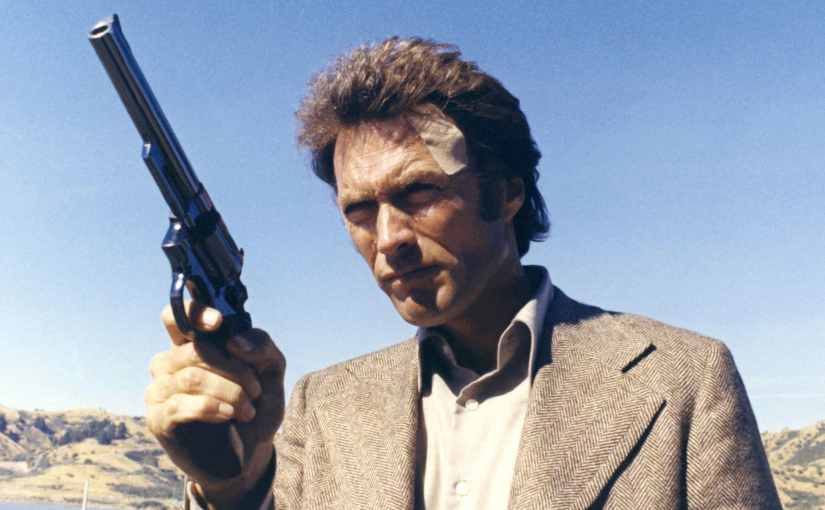
If you don’t know by now, I’m a huge admirer of Clint Eastwood’s work. His talents broach so many facets.  He acts.  He produces. He’s likely even better when he’s in the director’s chair.  He actually sings and he has even orchestrated his own music for some of his films.  Ever since I was first introduced to him at a young age when he played Dirty Harry Callahan and Fido Beddo, partnered with Clyde the orangutan, I was fascinated by his coolness and confidence in his stature on screen.  Whether he’s raising a fist, donning a scowl, giving a smirk or a squint of his narrow eyes or using his most famous prop, a .44 Magnum handgun, as an extension of his right arm, I’ve always been magnetically drawn to what he does on screen.

Online, a common question is asked: What is your favorite Clint Eastwood movie?  If I have to choose one, I guess it would have to be Magnum Force, the follow up to Dirty Harry.  Yet, I always believed Magnum Force could not operate without hitching on to the impact and message from Dirty Harry.  I can’t just like The Godfather Part II without liking the first film.  I can’t just love The Empire Strikes Back without liking its box office predecessor.  Same goes for The Lord Of The Rings pictures.

Magnum Force works so well because it questions what celebrated the Harry Callahan character that Eastwood portrayed two years prior.  This is a San Fransisco cop who defies authority when he knows that a danger must be suppressed without the inconvenience of bureaucratic red tape and police procedurals that ultimately will work in the criminals’ favor if not taken care of immediately.  As the first film demonstrated, it is easy for us to side with Harry’s desperation because we know the crazed killer is on the loose and he is only going to kill again and again while never surrendering or negotiating.  This second follow up film (in a series of five) tests the ideology of Eastwood’s character. 

A series of grisly murders are occurring within the city and it appears that a traffic cop is committing the acts.  The victims are the worst mobsters and pimps within San Fransisco who time and again have been overlooked for their crimes and/or have been released from trial or prisons based on technicalities.  A handful of characters within Magnum Force remind us that someone is saving the taxpayers a lot of money each time the body count increases. 

There’s a slight mystery to this film.  Harry encounters four rookie cops (David Soul, Robert Urich, Kip Niven and Tim Matheson) who seem very likable.  They are admirable of Harry’s reputation.  Harry is impressed by their shooting skills in particular.  Another traffic cop is an old friend of Harry’s, a guy named Charlie McCoy (Mitchell Ryan) who is on the edge and might pose a threat if he continues working the streets.  Any of these men could be suspects to these vigilante murders as it is soon realized that the scene of some of these crimes are similar. Often, cars are pulled over for traffic violations.  As well, ballistics indicate that the weapons of choice are normally a .357 Magnum, the standard issued firearm for a police officer.

The debate with Harry’s philosophy, firmly established in the prior film, is staged against that of his superior, Lt. Briggs.  He’s played by Hal Holbrook who is one of the best antagonists in all of Eastwood’s films.  They play so well against one another.  Early on, Briggs declares he’s never once had to pull his gun out of his holster.  Callahan sarcastically salutes the lieutenant by reminding him that men have got to know their limitations and that’s where the measure of asking what is ultimately necessary in fighting crime.  Where does it begin and when does it end?

Harry Callahan is that unusual cop who is frowned upon for the actions he takes in his own hands.  Other cops in movies played by Stallone or Gibson go to extreme measures simply for the cinematic action of it all.  Callahan is never thanked or given any serious commendations for what he executes with his .44 Magnum, a weapon that is as outside the lines as Harry himself. 

The difference between Harry and whoever this vigilante is must be deciphered and much of Magnum Force’s grey area is all that is seen.  Eventually, the black vs white clarity reveals itself and a telling lesson presents itself between what Harry Callahan stands for and what guise a vigilante operates under.  At the risk of revealing too much, the best scene of the picture occurs between Holbrook and Eastwood’s characters as they sum up the entirety of the film before the climax.  This film is over fifty years old and still the assortment of mindsets found within Magnum Force are worth pondering. Callahan is put to the test one time before in a haunting parking garage.

Beyond what’s worth considering among these many dangerous philosophies, this is a solid action picture with thrilling and well edited shoot outs among the cops and robbers.  A hilarious plane hijacking is derailed by Harry when he poses as a pilot.  Later there’s a store robbery that is undone and then there is a warehouse port exchange of gunfire that puts Harry and his partner in unexpected danger. 

There is an interesting target competition between the cops that implies what Harry suspects.  I like this scene in particular because it gives an inside look into how police officers interact and admire one another when not on the streets.  Yet, when one particular cop cannot get a thought out of his mind, it carries over into the action of the moment.  At the combat range, Harry fires his gun at one particular target that may cause you to sit up in your chair a little.  Often, Eastwood performs with little to no dialogue in his films and this is one very informative moment.

As much as I’m a big fan of Magnum Force, the penultimate scene always sticks in my craw a little.  Callahan is pursued on foot within the bulk of a freighter.  There is very little light provided in this sequence as Harry moves down one corridor or around a corner elsewhere.  It’s hard to see what is happening and who is where or who I am looking at.  For such a thrilling movie, this is a bit of a letdown as overall much of the action of this movie is driven by the plot.  Nothing feels random in Magnum Force.  Everything moves towards more story development or realizations.  Yet, I have to be somewhat forgiving only because this darkened scene occurs after all of the cards are put on the table and all the hero has to do is survive.

Just before the foot chase, there is a thrilling car chase with Eastwood actually doing the driving that takes us through the well-known twists of Lombard Street.  Director Ted Post wisely covers this from an overhead shot.   The car careens up and down the steep slopes of San Fransisco’s avenues and there are plenty of intense close ups of Eastwood behind the wheel accompanied by the screeching tires, bullets bouncing off the windshield and motors humming.  I have declared it before, the best place to have a car chase is in San Fransisco.  Surprisingly, this pursuit hardly ever gets categorized with the great ones like Bullitt, The French Connection, Ronin or The Seven Ups.

If you have never seen Magnum Force, check it out.  It is off color at times, but the exploits of Harry Callahan and the scum he’s forced to associate with were never about political correctness.  Still, there is much to debate, argue, and lend some serious thought to, especially in a newly unsteady climate of police acceptance and procedure.  My one recommendation though is to watch it as a double feature with the original Dirty Harry to truly see the two sides of Harry Callahan’s coin. 

NOTE: An interesting fact I just realized at the end of Dirty Harry, the cop shoots the bad guy with his right hand.  Later, he tosses his badge, but with his left hand.  Especially with Magnum Force as a follow up film, I see the internal struggle of Harry Callahan pitting his gun up against the mindsets that come with his badge.

LETHAL WEAPON

By Marc S. Sanders

The opening scene to Richard Donner’s 1987 film, Lethal Weapon, always intrigues me. Following an opening credit flyover of Los Angeles at night played to the tune of “Jingle Bell Rock,” a beautiful young, topless woman snorts some cocaine, steps out on a balcony and leaps to her death. It was a great hook for the beginning of a script written by Shane Black. How does a random suicide jump connect to heavily armed mercenaries with an interest in heroin shipments? Two cops at odds with one another will find out.

Mel Gibson and Danny Glover hit the payload of a new and long lasting cinematic franchise playing suicidal cop Martin Riggs and by the book family man Roger Murtaugh; one of the very best on screen pairings since Neil Simon’s “The Odd Couple.” Riggs is ready to die at any given moment following the loss of his loving wife. There’s an effective dramatic moment where Gibson plays a very drunk Riggs, and loads a bullet into the chamber of his Baretta. Donner gets one unsettling take of a man in despair biting down on the weapon, holding it to his forehead and under his chin. It’s pretty frightening. Gibson is great in this moment, red faced and uncontrollably tearful.

The first of the four films remains the best as Black’s story is continuously pealing back layer after layer. There’s something new to the main plot in nearly every scene. A banker is involved. A nightclub as well, and a prostitute’s house is detonated and of course there’s the girl who dove off her balcony. Shane Black seamlessly connects all the dots.

More so, there’s something to the cops relationship in nearly every scene. We see Riggs & Murtaugh begin with a major divide in working together. Riggs has a cavalier attitude of nothing to lose. Murtaugh is content with turning 50, but might not get to enjoy his new year at the expense of his new partner’s reckless behavior. How does Riggs rescue a suicide jumper? Not the way you’d expect I imagine. Efficiently, a trust is built among the two men with Donner doing a fine job of escaping the main storyline for a nice family meal. It’s humorous and charming but necessary to really appreciate these characters. Then the ribbing among the two guys happens. Jokes about Roger’s wife’s cooking and a contest of target practice at the shooting range allow the audience to feel like they just made two new best friends.

On the other side are two worthy villains played by Mitchell Ryan, and more prominently Gary Busey. They play ruthless shadow company soldiers from the Vietnam era ready to eliminate anyone who interferes with their drug dealing venture. Busey is especially good and ruthless. It’s a shame that gossip magazines and a crazy lifestyle have mostly dominated his public life over the years. He’s so good in this role. He had already been an Oscar nominee by the time this film was released. You have to wonder why did it all go so wrong for him. Gary Busey might have been a top billing movie star.

Richard Donner had already been a well established director with Superman The Movie, The Goonies, and The Omen. His action film was even more a testament to his skills. Action scenes are so well filmed in “Lethal Weapon” whether they take place in a Christmas tree lot, a desert outskirt, a nightclub or on Hollywood Boulevard. Credit should also go to Michael Kamen’s music, adventurously dramatic with an air of mystery at times. He works in accompaniment with Eric Clapton too.

I take one issue with Lethal Weapon. The final scene, a jiu jitsu fight between Gibson and Busey in front of the entire police force abandons the story. Nothing new is left to happen. Ever since I saw the film in theaters I asked myself why is this here. Two tough guys just punching the hell out of each other. There’s no development here. There’s no way a moment like this would ever occur. In addition, the editing is choppy at times and I can’t tell who is hitting who. It’s not a terrible violation, but it’s not all that interesting either.

Barring this ending scene, Lethal Weapon is just a well assembled film of action, humor, drama, suspense, and story. At the time, Shane Black was paid a record sum for his script. I still believe it was worth every penny.