
By Marc S. Sanders
It’s impossible to find absolute perfection. I don’t care if it’s in the field of medicine, law, mathematics, art or even music. No one is THE ONE. Yet, if you are determined to partake in that hunt, it’s likely you’ll scream with frustration. You might think you’re on to something but still it’s not quite the one. Maybe, however, you will force your search for the one if you throw a chair at your gifted student, scream some of the ugliest obscenities, impose threats, slap him, allow the tears to run, force a literal blood draw, or sweat them into numbing exhaustion.
Whiplash is the name of a piece of jazz music originally composed by Hank Levy. It is also the title of Damien Chazelle’s brilliant first film, and the best to come out of 2014. Allegorically speaking, the term takes on a harsher connotation. The word whiplash gives me an image of torn skin and hot, dripping blood.
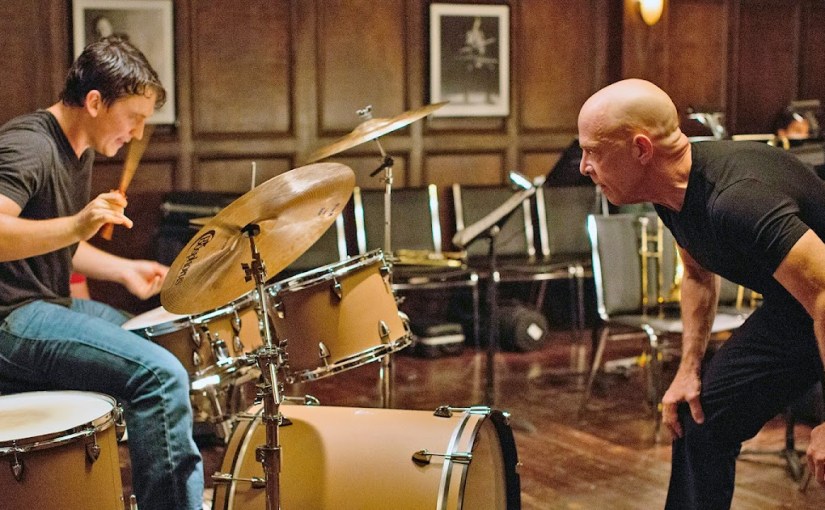
Andrew (Miles Teller) attends the Shafer Conservatory in New York. He’s a jazz drummer who gets hand picked by the esteemed conductor Terence Fletcher (J.K. Simmons, in a well deserved Oscar winning role) to join his elite class. Mr. Fletcher is cordial at first and a little instinctive as he’ll stop his musicians short of getting past one note before asking them to start again. A hand gesture with a headshake and a wince. Now go again. Another gesture. Go again. One more gesture. Again. Now an outburst of violent rage.
Individually, Andrew and Terence are determined with unhealthy mindsets to obtain levels of achievement that appear impossible to grasp. The boy wants to get to where his drummer idol Buddy Rich plateaued. The teacher wants to find the next Charlie “Bird” Parker. These men of different generations are terribly talented. Terribly I say because their passion for music is their self-imposed and cruel undoing.
Chazelle has much respect for the field of contemporary jazz. I like jazz but I know nothing about how a piece is assembled so rhythmically among an assortment of instruments from the drums to the harp to the cello to the 88 keys and the various horns. Put them all together, and there’s an atmospheric magic to what’s churned out. It’s beautiful and bewildering. Complicated, yet mesmerizing. In Whiplash though, the music may be the worst antagonist because the frustrations that arrive with trying to become a master are unforgiving.
A late scene in the film shows Terence Fletcher, an altogether tyrant of a teacher, playing melodic nightclub piano in a bar. He’s applauded and appreciatied as he presses down on the final key. He thanks his audience with a nod. Nevertheless, J.K. Simmons shows a different level of frustration. Up to this point, the actor’s character has been a series of screaming eruptions. In this moment, the man looks like he wants to cry. No matter what he plays or how well loved he is, Terence Fletcher knows it could have been better. So, if he lives with his suffering, then he will teach his best students to suffer through music as well.
Andrew is on the cusp of living his own life. With a mother no longer in the picture, he still shares movie times with his father (Paul Reiser) perhaps so his father can still be a father, or maybe it is to remain a child to someone. He’s starting a what could be a promising relationship with a girl named Nicole (Melissa Benoist), but his need to be a better drummer interfere and the only way he’ll know he’s at least as good as Buddy Rich is if he satisfies his teacher. That’s the only sure sign.
Does Terence turn Andrew into a monster, or is it the music?
This will always be one of Miles Teller’s best roles. He’s got that innocent, quiet way about him, but as he gets “mentored” by this new composer, he changes. He becomes devoid of care for Nicole and rebellious towards the lack of respect he receives from family and fellow students. Like a chess champion, the art of drumming turns the drummer into an unloving creature soaked in blood and sweat. This ongoing trajectory might make him a better musician but it will also bring him to an end result that matches his teacher.
Beyond the energy of the music, Damien Chazelle steers a thrilling duo. Simmons is an outstanding villain as a guy you can only hate until you see the motivations he’s only trapped himself into. Only then you might just sympathize. Teller is circling the waters of a dangerous relationship with music. Chazelle allows his picture to swim towards defiance with bloody and painful persistence. The epilogue of the film demonstrates precisely what these two men are searching for. It’s only when you arrive at the end of Whiplash do you realize and empathize with the internal and physical pains these people choose to weigh on themselves.
To my ears, music is a beautiful, universal language.
For the scribes, it’s an agony they choose to bear.

 2 UNPAID MOVIE CRITICS!!!!