
By Marc S. Sanders
If you are going to rewrite history then go crazy. Go big and bloody. Go for broke. Don’t hold back. Quentin Tarantino didn’t hold back when he penned and directed Inglourious Basterds, my personal favorite of his films.
To date of when this review is published, Tarantino has directed nine films and if ever the maturity of a director is so evident, it really shows with Basterds where three quarters of the picture is performed in either French or German. English is secondary here, and Italian is limited to only a couple of “Bonjournos!” and “Gorlamis!”
Tarantino presents early 1940s France when Germany occupied most of the country and practically rounded up all of the Jews. In 1941, a cunning detective of a Nazi Colonel, Hans Landa (Christoph Waltz performing as one of the greatest villains of all time) visits a French dairy farmer to ensure there are no unaccounted-for Jews scurrying around; scurrying around like their beastly equivalent, the rat. Landa is the hawk that will most assuredly find them. This scene is the best written moment within Tarantino’s catalog of various scripts and dialogue exchanges. The Landa character offers justification as to why a Jew needs to be exterminated to the point that he nearly had me (a conservative practicing Jewish man) believing in his hateful philosophy. The lines crackle here with Waltz doing most of the talking while the sad dairy farmer can do no more than respond with certifying Landa’s interesting points. Tarantino closes the peaceful discussion with horrifying violence though. Hans Landa may be complimentary of a farmer’s milk and his three beautiful daughters. He may be eloquent in his dialogue albeit French, German or English, but he is a ruthless enforcer of law …of Nazi law at least. I also would like to note Tarantino’s tactful way of using props like the pipes the characters smoke, the glass of milk that is consumed by Landa and the ink pen and spreadsheet he uses for accounting of the Jews in the area. There’s an uncomfortable intimidation in all of these items as they are handled by Waltz, the actor. Later in the film, Waltz will send a chill down your spine as he happily enjoys a delicious strudel with whipped cream. Inglourious Basterds is a great combination of directing, editing, cinematography and acting.
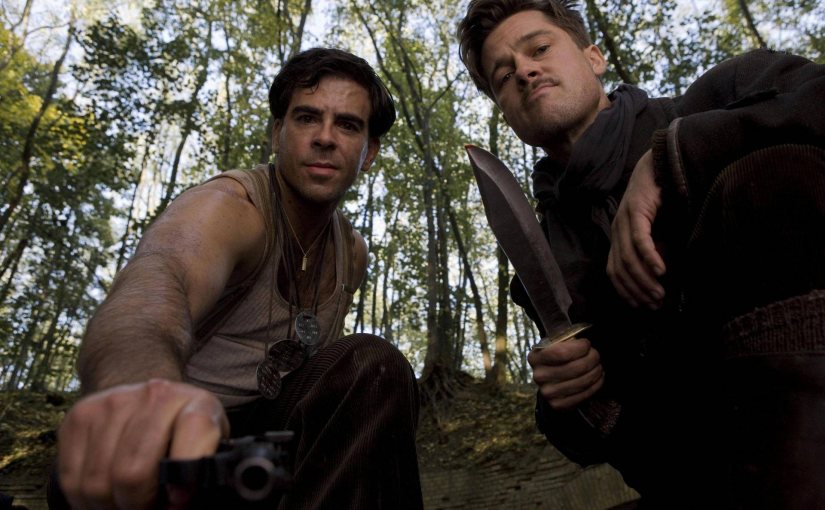
The film diverts into a few separate stories, namely the title characters led by Aldo “The Apache” Raines, played with Tennessee redneck glee by Brad Pitt. The Basterds consist of mostly Jewish American soldiers tasked with going deep into enemy territory and literally killing and scalping one hundred Nazi soldiers, each. However, keep at least one alive during each encounter with a carved souvenir on their forehead, to spread the word of the Basterds intent. This is deliberate B movie Dirty Dozen material and it works because it doesn’t take itself seriously. Tarantino maintains that pulpy fiction narrative. A cut to an over-the-top crybaby Adolph Hitler asks, “What is a Hugo Stiglitz?” and then we get a quick pause with big black block letters across the screen spelling out HUGO STIGLITZ. This guy is a bad ass; a German turncoat who only wants to kill fellow German Nazis. He’ll shoot them up until they are dead three times over. He’ll stab them in the face twenty times through a pillow. He’s not a suave killer. He likes it violent and bloody messy. The Basterds are fans.
The heroine of the film is Shoshanna (Melanie Laurent), a Jewish girl who is living undercover as a cinema owner in France. By implied force she is tasked with presenting Himmler’s proud film of Nazi Germany’s finest war hero, Fredrick Zoller (Daniel Bruhl), recreating his bird’s nest three day sniper battle against an army of three hundred men. This is where Tarantino does best at writing what he knows, and what he knows best is anything about cinematic film. He literally uses his knowledge of film and film reels to bridge his story while setting Shoshanna on a mission to actually end World War II in one swift motion.
In addition, he captures the adoration of film lovers and celebrity status. Zoller is as heroic a celebrity as John Wayne or Zorro. When he is recognized in the coffee houses or on the street, he humbly stops his ongoing flirtation with an uninterested Shoshanna, to give an autograph or pose for a picture.
Furthermore, Tarantino applies the scientific knowledge of how 35mm film is more flammable than paper as well as how to edit a film reel to an unexpected moment for Shoshanna’s Nazi audience. He knows the architecture of a European cinema with its lobby and balconies and seating capacities. He allows his characters to speak on an intellectual level by discussing great film artists of the time – filmmakers not as well-known as Chaplin here in the United States, but just as great or even artistically better. The art direction of the cinema both inside and out is adorned with washed out, distressed classic noir films. Shoshanna changes out the lettering of the curved marquee top of the theater as well. It might sound mundane, but to me it’s all atmospheric.
Beyond the subject of cinematic art, a bad guy will weed out a spy disguised in Nazi garb by recognizing how he signals for three drinks with his hand. There’s a right way and a wrong way to place an order with a bartender. Inglourious Basterds may be a fictional historical piece, but it also will give you an education. All of this reminds me that Quentin Tarantino has graduated from the simplicity of Reservoir Dogs to something bigger and grander and glossier. Production money with a large budget will lend to that status of course, but Tarantino still had to learn to truly know what he was doing.
I will not spoil the ending here. It’s a bloody blast for sure. Moreover, it’s shocking. If anything, Inglourious Basterds introduces an exclusive universe that resides in the mind of Quentin Tarantino where the textbook is thrown away, burned, riddled with bullets and blown up; it is where something else altogether happened, and you know what? I really wish it did actually happen this way.
 2 UNPAID MOVIE CRITICS!!!!