
ON THE WATERFRONT

By Marc S. Sanders

Terry Malloy innocently calls up to his friend Joe’s window and tells him to go to the roof of his apartment building to check on the pigeons.  Only what happens to Joe when he gets there is not what Terry expected setting off a complex dilemma of morality and preservation of life.

In one of Marlon Brando’s most famous roles, Terry Malloy is an ex-prize fighter who now carries out menial tasks for the New Jersey mob bosses that have a foothold over the longshoremen and their union contracts.  Terry listens to what his mobster brother Charley (Rod Steiger) tells him to do.  As long as he keeps his mouth shut, he’ll be selected each day on the dock for work and he’ll never have to lift a finger.  Just let things be and keep quiet.

Charley’s boss is Johnny Friendly (Lee J Cobb), who is ruthless with his control over the area. The guys have to surrender to the demands of Johnny and his toughies because it is no secret what really happened to Joe and who was responsible.  The cops can investigate and ask questions, but they’ll get nowhere.  It’s up to Father Barry (Karl Malden) to talk some sense into the fellas, and considering Terry was one of the last guys to see Joe alive, he’s the best option to overthrow Johnny’s reign.  If Terry shows up for a subpoena, it could put Johnny and his goons out of business.

Another conflict of interest for Terry is that he has taken to Joe’s sister Edie (Eva Marie Saint) who also knows of Johnny’s corruption.  She just has not realized that Terry might have been indirectly responsible.

Marlon Brando looks everything like a movie star should.  His slicked back hair and dark eyes shadowed by his thin eyebrows and the way he carries himself in a plaid winter coat is held in a permanent memory just as James Dean and later pop culture figures like Fonzie, or Tom Cruise and Brad Pitt evolved.  It sounds silly but there’s a reason Madonna lends recognition to the classic actor in her club song Vogue, and this is one of many films in his early career to reference for the honor. 

Eva Marie Saint is wonderful as the young woman in pain and confusion following the death of her brother.  Edie is as least as conflicted as Terry due to her immediate attraction to the tough guy’s charms while still bent on discovering who had her kind brother killed and why.  Brando and Saint have a magnificent scene together when the truth comes out and Leonard Bernstein’s music comes to a halt of silence.

On The Waterfront has an irony of life imitating art.  Mind you, I’m not here to provide a history lesson and wallow in political divisions.  I find it interesting that Terry Malloy’s dilemma is whistle blowing the corruption that occurs, while also being intimidated to keep quiet.  Patterned similarly is what director Elia Kazan infamously became known for when he testified during the Joseph McCarthy hearings against people in Hollywood suspected of having communist ties.  A Union community is designed to protect its members, but sometimes the dynamics lead to just one who is singled out to expose what is not cooperating legally and accordingly.  (Some of the actors were against working on this film because of what Kazan committed but they were bound by studio contracts.)

I am aware of how much On The Waterfront is hailed as a perennial classic.  The cast is an outstanding collection of actors beginning of course with Brando, Malden, Steiger and Cobb.  Following television appearances, this was Eva Marie Saint’s first film, and there are other uncredited actors who had not made their mark yet including Martin Balsam, Michael V Gazzo, and Fred Gwynne.  The film boasts Oscar nominations for five actors (two wins, for Brando and Saint respectively) as well as wins for Best Picture, Director and Screenplay.  All that being said and yet I cannot say I felt invested in the film. 

The characters’ plights and pains simply did not connect with me.  Actually, while I believe I’m expected to yearn for Terry Malloy’s pain and regret where he declares he “…coulda been a contender…,” I felt sorrier for his brother Charley. 

In that well-known scene between the two brothers in the back of the cab, it is Charley who is really torn.  Charley is tied to his mob boss, Johnny Friendly, but he has to convince his brother to do what is best to protect the mob he’s committed to, or it could get both of them killed.  That famous scene is owned more by Steiger than Brando.  An interesting fact is that Rod Steiger had to perform most of that scene without Marlon Brando there.  The lead actor would leave the set at 4pm sharp each day, leaving Steiger to do his half of the scene with a stand in reading Brando’s lines.  It caused a bitter rift between the two actors.  Yet, the next time you catch the film, have a look at who is really doing the heavy lifting.

I might have gotten trapped trying to understand the way the union operates and how the mob manipulates everything to their advantage.  I’m lost in some of the early dialogue and how people go about doing what they do.  Maybe what I should have done is relax my train of thought and take in how the protagonist is pulled in many different ways, none of which seem like a winning solution. 

Out of context there is a selection of great scenes on display.  Karl Malden is magnificent when he urges the longshoremen to stand up to the brutality and intimidation they are under.  His concentration is amazing as he is pelted with trash while holding his composure.  This scene won him his Oscar nomination.

Lee J Cobb is a memorable antagonist. The concluding scene between his Johnny Friendly and Terry stands as a final battle between hero and villain and the residual effects of what was shot of that bout have been honorably repeated in many films thereafter. 

There’s an obvious influence that stemmed from On The Waterfront.  Clearly, much of the material had an enormous influence on future filmmakers like Lumet, Scorsese and Coppola.  Perhaps that’s the reason it did not grab me.  Those future directors turned the motifs that Kazan provided into flashier segments of color and trick camera work.  Even the inclusion of harsh language in those grittier, later films left me with a more convincing authenticity.  Then again, I was shocked to see Terry Malloy tell Father Barry to go to hell.  Pretty bold for 1954, and still somewhat shocking within the context of the piece.

On The Waterfront is actually based on fact from happenings at the docks off of Hoboken, NJ where most of the film was shot.  To watch it today is to look back at what high stakes dramatization and dilemmas of ethics surrounded by death and crime must have looked like.  It does feel outdated to me, showing a period that is long past, but it paints its truth very, very well. 
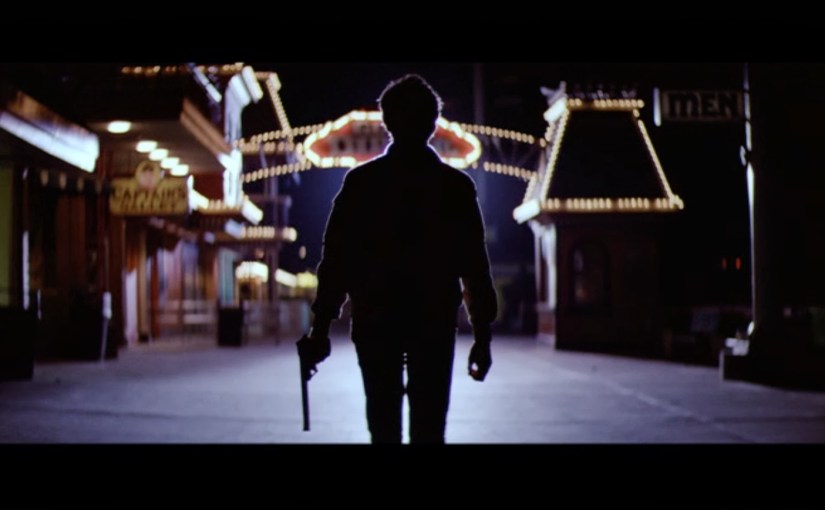
SUDDEN IMPACT

By Marc S. Sanders

The very first R rated picture I ever saw in theaters was the fourth installment of Clint Eastwood’s Dirty Harry franchise, entitled Sudden Impact.  I was eleven years old and I loved it.  My brother Brian took me with his best friend Nick.  Age 11 and I’m in a crowded theater on a Saturday night watching a brutally violent and sometimes funny crime drama with the cop who carries the .44 Magnum.  Looking back, it felt like a rite of passage.  It felt rebellious.  I’d now be the coolest kid in school as I recount for them everything I was allowed to see that their parents refused to even consider.

Brian introduced me to many of what remain my favorites this very day.  He introduced me to Jackie Gleason in The Honeymooners,and then at age 8 or 9 I must have watched the first of Eastwood’s series, Dirty Harry, on video tape.  At that age, you just want to get to the next shootout where Harry allows his bloodletting revolver do the talking while he finishes his hot dog.  I watched those first three films (Dirty Harry, Magnum Force and The Enforcer) over and over again.  As an adult, I more so appreciate the themes of the San Francisco cop, Harry Callahan.  He always had a low tolerance for the bureaucratic BS of court procedure and legal precedent.  He was always smart enough to know who the real bad guys were and that was enough to bring them in. If they didn’t cooperate, well then there were other means. 

The first two films in the series question Harry’s procedures and philosophies.  The third film, although entertaining to a degree, deviated from that.  The fourth film returns to test Harry’s beliefs in police enforcement and justice.  Only this time, it’s actually from the perspective of a gang rape victim, played by Sondra Locke.

Much of the first hour of Sudden Impact is episodic.  Scene after scene shows Harry’s encounters with various hoods that he has a connection too.  Harry disrupts a wedding to undo a vicious mobster.  Later, those guys try to take him down.  Some punk kids get off on a technicality in court.  They’ll have something to say to Harry as well, and just in case you need a little more action, there is that very memorable coffee shop robbery where Harry tempts all of us to “Go ahead.  Make my day.”  There’s also good laughs as Harry is gifted a bulldog he calls Meathead. 

Weaved within these various moments is a separate story focusing on a beautiful painter who has a knack for killing men with one bullet to the genitals and another to the head.  She has revenge on her mind following a gang rape of her and her sister ten years prior.  Eventually, Harry is assigned to investigate and he is on his way to a fictional neighborhood known as San Paulo (filmed in Santa Cruz).  Harry has to navigate around a difficult police captain (Pat Hingle) as the killings continue to happen out here.

I’ve always been fascinated with the Dirty Harry series.  Surprisingly, when I do internet searches on the films and character, I don’t find much that explores the measure of rights and law.  Yet, beyond the sometimes-comic book violence of the pictures there’s much to question and think about.  Is Harry right with his chosen actions?  After all, the films make clear that the bad guys are the bad guys.  The writing however, makes it a challenge when legality interferes and the rights of men and women are tested.  Sudden Impact does the same thing.  With Eastwood directing, he makes the viewers witnesses to what the Locke character is subjected too.  That should be enough, right?  Real life is not that clean cut though.  However, in an age of internet surfing and headline breezing, people are endlessly tried in the court of public opinion and not a court of law.

The first film in the series had Harry declare that the law is crazy.  The second film tested the protagonist when he uncovers that people supposedly on his own team were carrying out vigilante murders against the worst mobsters and pimps in the city, as a means to clean up the streets.  Now, another and more personal vigilante appears.  What makes Harry right and these others wrong?  I don’t think any of the five films in the series ever give a clear-cut answer.  That’s okay.  I’d be frightened if there were a direct response, because it remains a complex issue.  When the courts fail us, what is there left to do?

Do not mistake me.  I am not calling for violence.  I’m just questioning a system that is sometimes broken.    

Recently, a local trial wrapped up where a retired police officer shot a man in a movie theatre who became argumentative and belligerent when he wouldn’t turn off his cell phone.  Popcorn was thrown, a gun was drawn and a man was instantly killed.  The retired police officer was found not guilty by a jury of his peers.  The court of public opinion by and large have been outraged with this verdict.  The grieving widow felt as if justice was not served.  Followers of the story didn’t either.  Another story focused on a beloved teacher who was hit by a car in a school parking lot.  I actually got into a public Facebook debate with someone who said the driver should be punished to the full extent of the law.  I questioned if the driver is truly guilty of murder or manslaughter.  It could have just been an accident.  We are humans to a fault.  How do we know the teacher didn’t just step in front of the car without looking?  The opposing view insisted the driver had to be speeding.  Maybe.  Yet, at the time neither of us knew that.  A car going at 5 mph can just as easily crush a human to death as a car going at 30 mph.  I insisted to the person I was sparring with that she was riding a slippery slope of presumption without all of the facts disclosed.  A police report has yet to be publicly disclosed.  Circumstances always come into play.

I know I’m digressing.  With a Dirty Harry picture like Sudden Impact, it’s laid all out for you.  Harry will request that four robbers put down their guns before introducing his friends Smith & Wesson.  He’ll also consider the circumstances after a woman’s life has been permanently scarred with no one to side with her.  A police officer should not be judge and jury.  Yet, it’s reassuring those films like Sudden Impact or Dirty Harry will allow a comeuppance for the wrongdoers in the world. During the closing minutes of the film, Sondra Locke delivers a monologue that at least is worth consideration even if it’s not agreeable.  I don’t believe our society should turn into a wild west circus where you can get gunned down in a movie theater over thrown popcorn.  I do believe however, that evidence must be taken more seriously in many circumstances.  Suspicion must be valued more often. 

Sudden Impact might have a right-wing attraction to it.  It glorifies gun violence, for the sake of action entertainment.  Harry doesn’t just have a .44 Magnum.  Now, he also has a .44 Magnum Auto Mag!!!!  (Whatever that is!)  Ironically, this picture is primarily told from a woman’s point of view where she wants to be believed and she wants justice, much like many of the messages of the Me-Too movement that gained major traction in 2019.  It’s insisted that when a victim says they have been raped or assaulted, no matter how far back the incident occurred, it should be believed.  The argument is where’s the proof?  Like Harry Callahan though, proof is not always the end all be all.  Instinct and common sense sometimes have to prevail.  Again, it’s a slippery slope, but it’s also always worth questioning.  Harry Callahan is always worth questioning.

THE GODFATHER PART II

By Marc S. Sanders

The first film to use the number 2 (or Roman numeral II, in this case), in its title and the first sequel to win Best Picture is Francis Ford Coppola’s continuous adaptation of Mario Puzo’s Corleone family legacy in The Godfather Part II. It is worthy of all of the accolades it collected as an individual film. Yet, it does not best the first film.

Unlike the 1972 classic, Part II does not provide much character arc for anyone. We’ve already seen Michael (Al Pacino, silently ferocious here) change from good college boy and war hero to the evil puppet master Mafioso he eventually became. This film shows him exercising his threateningly murderous deeds as he works in conjunction with a sly Nevada Senator, a Jewish Miami mob boss (an excellent performance from Lee Strasberg) from the time of his father’s reign, and another mob guy from New York (Michael V Gazzo). We get a whiff of all these guys early on during a commencement celebration for Michael’s son. Coppola keeps this a running theme of grand openings in all three films. It’s a great method of introductions each time.

Following the party, an assassination attempt is brought against Michael. But who did it? Problem is this is where the foundation of the film is not so strong. It’s never really made clear who betrayed Michael. That’s a little bothersome.

Coppola depicts another storyline altogether with the early 20th century origin of Vito Corleone flawlessly played by Robert DeNiro who hardly speaks any English while communicating in a Sicilian variant of Italian. Young Vito immigrates to America following an escape from the Sicilian Don that murdered his family. In New York we witness his rise to power. Famed Cinematographer Gordon Willis washes out these flashback images to enhance a pictorial history accompanied by Angelo P. Graham’s art direction of early brick and mortar architecture and the muddy streets of early Little Italy, New York. It’s a time travel back to a historical age. It’s magnificent.

Back in the 1950s, Puzo and Coppola bring authentic fiction to real life history as Michael considers a go at a business enterprise in Cuba. However, will the rebellion uprising interfere with his plans, and what will it cost him? As well, there’s a great sequence where he has to testify before a congressional hearing in response to suspicion of criminal activities. Coppola used the infamous McCarthy hearing footage as inspiration for this predecessor to what C-Span would eventually look like.

Yet, there’s another story to become involved with as Michael must contend with his dim witted older brother Fredo. John Cazale is superb as the guy who wanted more but was limited by the influence of competing factions and his loyalty to his brother. Pacino and Cazale always had great chemistry together. A great conversation moment occurs in the third act following a terribly surprising twist. One of the best scenes in the film occurs on the porch of the Corleone compound.

More story elements come into play as Michael attempts to balance his married life with Kay (Diane Keaton). She’s pregnant again. Yet, what will that mean for the future of the family?

The sequel to The Godfather assembles another stellar cast. So good, that the film garnered three Oscar nominations in the Supporting Actor category alone (DeNiro, Gazzo, Strasberg) as well as a nomination for Pacino as Best Actor and Talia Shire (Supporting Actress) as Connie, Michael’s sister. That nom left me a little dubious only because there’s not much material for Shire to play with here.

Coppola’s detail is at the top of his game again. The film, like the first, feels like a true life biography.

Puzo offers heartbreaking moments, most especially in the film’s shocking end which leads to a flashback assembly of characters from the first film. That scene alone plays as a great reminder of what Michael once was before becoming the hideous monster that closes the story. Puzo’s whole Godfather franchise hinges on well defined, crushing tragedy.

The Godfather Part II is nothing short of mesmerizing and wholly engaging. You can watch it over and over again. It’s layered in rich storytelling and narratives that provide endless amounts of material for a family meant to be mired in secrets, deliberately hidden in the dimly lit rooms that Willis photographed.

It’s a treat to be the fly on the wall wherever Michael and his family move to next.