SUPERMAN (2025)

By Marc S. Sanders

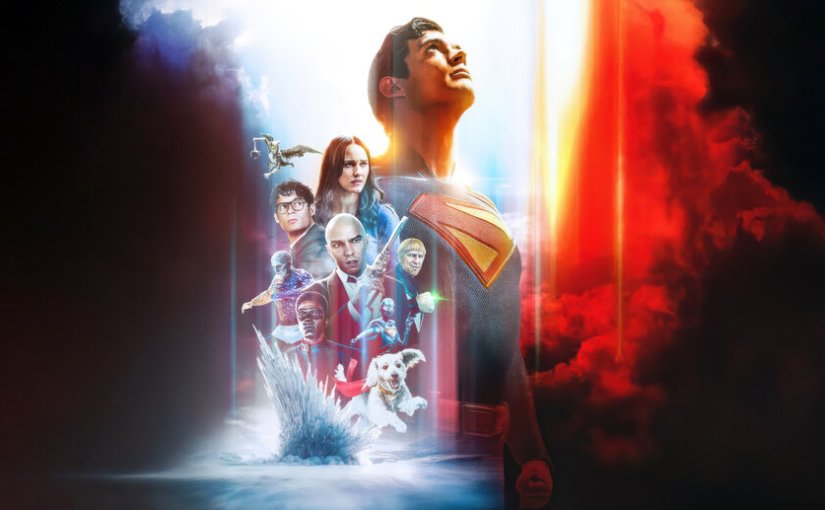
Once again the man in blue, red and yellow has returned to the big screen by means of director James Gunn who is intent on starting a whole new universe of DC comics characters.  The 2025 interpretation of Superman is zippy and fun even if it is a little too shallow of character development and dimension.  That’s regrettably ironic actually.  A man who dons two different personalities, Superman and mild-mannered reporter Clark Kent. Yet, neither has much to say or stand for in this two hour picture.

Gunn’s film is defiant to avoid any heavy exposition as this film begins.  There’s a slim foreword as the picture begins to describe this new universe that contains metahumans who arrived on Earth centuries ago, along with a little bit of Kal-el’s origin that many of us are familiar with.  Then we see the Man Of Steel crater into the Antarctic wounded from battle and aided by his feisty canine friend, Krypto, who drags him to his ice palace, the Fortress of Solitude.

Action commences thereafter back in Metropolis.  Lex Luthor (Nicholas Hoult) is pulling the puppet strings.  Lois Lane (Rachel Brosnahan) and the rest of the Daily Planet staff witness the mayhem over the city.

Then we get a bit of Clark looking a little goofy as he rushes into work, followed by some romantic interlude between Clark and Lois back at her apartment.  The two toe the line of their relationship when finally, the Superman persona allows his girlfriend to test his purpose for serving planet Earth along with his limits of authority and decisive action.  They go back and forth but none of the dialogue lands and the argument has no impact.  A missed opportunity to set up the Lois and Clark relationship.

The rest of the picture focuses on comic book episodes of endangering Superman while other metahumans make appearances – an obnoxious Green Lantern (Nathan Fillion), Hawkgirl, the shape shifting Metamorpho, and the surprisingly entertaining Mr. Terrific (Edi Gathegi) who seems to operate like Mr. Spock from Star Trek.  Of the four, the guy with the dumbest name actually serves the picture the best.

James Gunn’s film takes a huge departure from the recent films of Zach Snyder’s universe.  Nothing is dark and hardly anything is morose.  Some subplots seem to be ripped from the headlines of current events that’ll have you thinking about the Russian-Ukraine war.  None of it is overly heavy though because this picture is designed for families to watch together. 

Superman is pure escape with a red cape.

What I miss though is what both the Snyder and the Christopher Reeve pictures offered.  What does Superman mean to himself and the planet Earth?  The one conversation between Lois and Clark/Superman goes on long and while it feels like there is a purpose in that exchange, I cannot recall one kind of conclusion that stemmed from it.  For the rest of the film, Lois flies a spaceship and helps a weakened Superman find aid. When the two share any more scenes together it is for the action of the piece followed by a kissing scene.  I just didn’t respond to the puppy love or risks of their relationship that other iterations offered.  Their connection is just written a little too thin.  That’s a problem, because the Superman mythos always hinged on their relationship in the face of danger or true love or even journalistic integrity.

Am I being too serious and hardheaded?  Yes.  Nevertheless, even with a comic book/Saturday morning cartoon gloss, I wanted to see more weight to the relationship between the two characters.

The best attraction is Nicholas Hoult as a connivingly evil Lex Luthor.  He’s a raging madman bent on destroying Superman like everyone knows and the actor chews the scenery while primarily hiding in his glass headquartered command center for most of the film.  Anytime the movie diverts to Luthor, the picture just felt more alive.  This is a great Lex Luthor!!!!!!

Like he did with a smart aleck racoon in his other films, James Gunn introduces a toy line merchandise with the flying white terrier dog known as Krypto.  His intent is for audiences to cheer for him like other precocious creatures from past films such as any Disney movie or E.T. or Baby Yoda or Rocket Raccoon.  He’s cute and spirited.  When he’s in danger, the kids will be worried.  When he flies into the center of the screen with a bark or a yelp, everyone will applaud. 

David Corenswet is Superman.  He’s fine.  He definitely looks like the part.  He’s a happy go lucky Kryptonian.  He’ll never be as memorable as Christopher Reeve.  I also have more to appreciate in Henry Cavill’s performance.  I just didn’t see Corenswet do enough with this role.  I’ve yet to really see the dramatic chops he could offer.  Simply lying on the floor of a cell while falling ill to Krytonite is not urgent or frightening enough.  I hardly got to know this guy to care enough if he lives or dies.  I hope he’ll blossom some more within future installments of Gunn’s superhero universe.  That’s up to the writers though.  David Corenswet is pleasingly relaxed in a role that demands almost a hundred years of acceptance for a modern age.  I’m confident he can do it and that Gunn cast the right guy for the part.  While he’s acceptable, both Corenswet and Brosnahan would best be served better material for them to work together. 

As for Rachel Brosnahan, I guess she’s okay.  I don’t see her do much beside fly a spaceship.  Lois Lane is such an immense character of brains and gusto striving to always be the number one reporter.  Her only weakness is her love for Superman.  There’s not much I remember about her from this film.  I did notice that she primarily wears purple like the character did in 1990’s animated series.  Nice salute.  Come on James Gunn.  Rachel Brosnahan is good actress.  Give her something more to do.  Let her act a little.  (Let David Corenswet act a little too.)

It’s wonderful that an optimistic interpretation of Superman has arrived.  We need it.  It’s colorful and fun.  It could be more exciting, though, with higher stakes that just didn’t arrive quite right.  This film is not my ideal picture of the hero, but the universe to come, especially with a quick appearance from another character at the conclusion, offers promise. 

Despite my reservations, the new DC Cinematic Universe seems to be in the right hands once again, and James Gunn’s team will deliver something entertaining for the next few years to come.
JFK – DIRECTOR’S CUT

By Marc S. Sanders

Oliver Stone’s JFK is told through perspective, not necessarily history.  It’s not a biography and I do not believe Stone would ever claim it to be so.  It’s a thinking person’s picture that gives viewers entitlement to question what occurred, how it occurred and why it occurred.  It might guide you not to trust what anyone says, sees or hears, but let’s face it.  Probably the day Kennedy was shot, November 22, 1963, could we ever completely trust anyone ever again? 

(Forgive my cynicism.  I must backtrack a little.  I still trust my wife and daughter.)

Oliver Stone works through the eyes of New Orleans Prosecutor Jim Garrison (Kevin Costner, in what may have been his most challenging role to date at the time).  Garrison sees a little too easily that there are circumstances out of place, or maybe too neatly in place to satisfy the ultimate resolution that a known American defector to the Soviet Union, like Lee Harvey Oswald (Gary Oldman), acted alone in the assassination of the President.  Stone wrote the script for JFK with Jim Marrs and used Garrison’s input from his own novel. Nearly every scene builds into another possibility of how that fateful day came to be.  Stone even questions if a famous photo of Oswald on the cover of Life Magazine is real.   Too many cover ups with a building list of body count witnesses and too many coincidences keep Garrison up at night.  So, he assembles a crack team of investigators and fellow attorneys to reopen the case and question the official Earl Warren Commission.

Firstly, JFK is magnificent entertainment with a hair raising and unusual original score from famed film composer John Williams.  His notes on percussion with dings and harpsichord strings cue in at just the right moments when Stone introduces another one of many scenes that point out what seems cagy and suspect. The music of JFK works as a narrator.  This narrative keeps you alert.  Maybe you should look in each corner of the screen at times for some subtle clues.

It was also wise of Stone to go with a well-known cast of actors.  The Oscar winning editing from Joe Hutshing and Pietro Scalia moves at a breakneck pace.  Yet, because I recognize fine performers like Ed Asner, Jack Lemmon, Kevin Bacon, Tommy Lee Jones, Brian Doyle-Murray (Bill’s brother), John Candy and Joe Pesci it is easy to piece together who is playing who and what significance they lend to the many theories Garrison and Stone question next.  

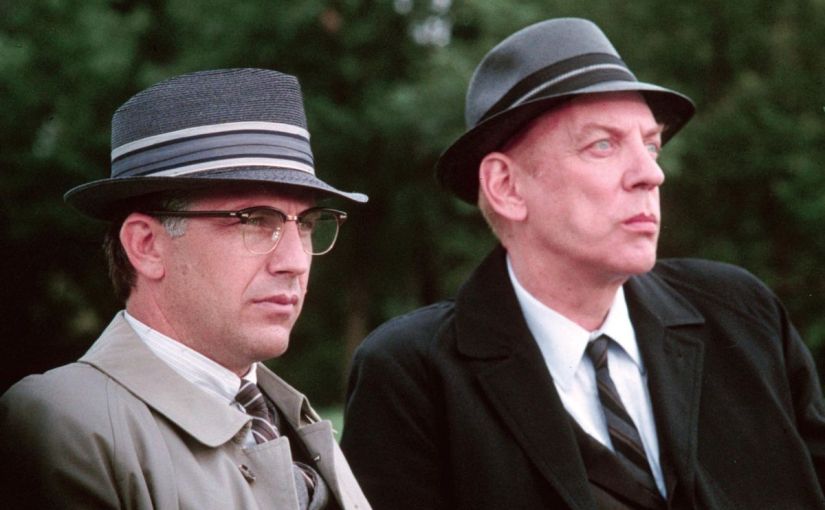
My admiration for the casting continues with the Garrison team that performs with Costner – Michael Rooker, Laurie Metcalf (especially impressive), Wayne Knight, and Jay O. Sanders.  There’s also a clandestine trench coat guy named X portrayed by Donald Sutherland.  Who even knows if this guy ever existed?  He’s more secretive than Deep Throat, but Mr. X has a hell of a lot of information to justify Jim Garrison’s suspicions.  That is an especially marvelous sequence between two men strolling through Washington D.C., eventually concluding a disturbing realization on a park bench.

Sissy Spacek brings out another dimension to the Jim Garrison character.  She’s his wife and the mother of five who suffers the loss of her husband’s attention which is entirely focused on this compounding investigation.  I like Costner’s take on the Garrison character.  Early on he politely asks one of his associates to stop cursing.  He does not like that kind of talk.  Later, it is Garrison who is dropping a number of eff bombs in front of his wife and young children.  This conundrum of a case, a very puzzling detective story, is unraveling the investigator. 

JFK was instrumental for further Congressional consideration following its release.  Files were reopened.  Additional research was executed, and soon many of those secret documents pertaining to the assassination will be revealed in 2029.  Back in 1991, of course that appeared to be a lifetime away.  It’s time we know everything, though.  Arguably, most of who were involved in this incident are dead by now.  Let us know our history.  Still, Garrison was bold enough to point skepticism at not just the adversarial relationship Kennedy may have had with Castro, the Cubans and their Communist allies, but also the people within the CIA and the FBI.  Lyndon Johnson is not even free from scrutiny after he’s sworn in.  Some on Garrison’s team went so far as to factor in culpability from the mafia.  Garrison was not so keen on that theory, actually. 

The construction of Oliver Stone’s film is unparalleled.  I think it’s his best film to date and I can find few others that even compare to how he assembled the picture.  It begins with the voiceover of Martin Sheen laying out many news cycles that were occurring ahead of Kennedy’s murder such as the Bay Of Pigs and the President’s supposed efforts to withdraw from Vietnam.  Sheen’s narrative comes at you very fast with Stone incorporating real life home movies of Kennedy along with his brother Bobby, as well as Castro, and television news footage from Vietnam and anywhere else events were happening.  By the end of the roughly five-minute opening, your head might be spinning. 

Thereafter, though, Stone goes through Garrison’s day on November 22, 1963, watching the outcome following the momentous event and the writer/director works his way into the drama beginning with Asner and Lemmon as two drunk old guys walking through the rain and getting into an argument. 

Three years pass by and so begins Jim Garrison’s motivations to follow multiple trails of breadcrumbs that lead to a lot of different places, all unlike what Earl Warren surmised. 

The scenes work quickly from that point on, and cuts of theoretical reenactments occur.  Who knows if any of these scenes are factual?  Stone and Garrison want you to at least consider their reasonable likelihood.  Moments happen where Joe Pesci and Tommy Lee Jones’ characters appear to be lying about even knowing one another while Stone will depict a sexual role play encounter between them which also includes Kevin Bacon as someone with no more reason to lie. 

Episodes are deeply focused on Lee Harvey Oswald depicted as an infamous and suspected patsy in association with others who may have a reason to want Kennedy dead.  Gary Oldman hides so well in the role.  Oliver Stone even lends focus to how different witnesses describe Oswald.  In some scenes it is Oldman, but then there are other times where a shorter, more overweight man may have been the real Oswald. Later, there’s an Oswald who is taller and more slender. 

A few years ago, I was visiting Dallas, and I was able to spend a some time walking around the crossroads where Kennedy was shot in the convertible while seated next to his wife Jackie.  Watching JFK again lent more clarity to all of the locales such as where Oswald was supposedly shooting from the top floor of the corner book depository.  Kevin Costner and Jay O. Sanders go through the motions of Oswald firing the three shots from his rifle in the short amount of time span.  The script also questions why Kennedy was taken out by Oswald after the turn off the corner of Elm and Houston. There appears to be a better wide-open clear shot long before the turn with the car only going ten miles per hour.  The men question if it was Oswald, then why didn’t he take advantage of the clearer shot.

I know.  I could go on and on.  I have to stop myself.  There’s a ton – A TON – of information in JFK.  It becomes addicting to watch.  You don’t even want to pause the long film for a bathroom break.  I watched the extended Director’s Cut by the way. 

Many common critiques of JFK lean towards how many of these scenes did not even happen.  People are happy to point out there’s no evidence to truly say any of Oliver Stone’s enactments occurred.  I agree, but that’s not the point of this director’s piece.  This is primarily told through the eyes of Jim Garrison.  Kevin Costner is great as the listener, the observer and especially at the conclusion, the describer.  Watch him physically respond to anyone he shares a scene with.  There’s a memorable twitch he offers while at the scene of the assassination that works perfectly with a jarring echo of a gunshot edited into the film.  He’s also great at turning his head down as the thinker while Mr. X lays out an enormous amount of information that comes from several different directions.  Because the film comes from Garrison’s perspective, it does not have to be true.  It only has to be what the investigating prosecutor reasonably believes, and what he absorbs from suspects, witnesses, and his devoted team. 

A final speech of Garrison’s is told at the trial of suspect Clay Bertram, aka Clay Shaw (Tommy Lee Jones), who was the only man tried by Garrison for Kennedy’s murder.  First, it’s important to note that during this fifteen-minute sequence, when Stone cuts back to Garrison in the courtroom, Costner is wearing different suits.  So, while it is assembled as an ongoing rundown, it is not meant to all be in one instance.  Garrison lays claim to an endless amount of possibilities and circumstances that at times have no correlation with each other but could possibly all merge together towards November 22, 1963.  Critics argued this speech of Garrison’s never took place.  That’s correct.  However, this is a movie and for the efficiency of information to come out, a funnel must be opened up to learn what is being pursued and what has been uncovered.  This is the strategy that the script for JFK adopts and it works, leaving you thinking and rightfully doubting what our governing bodies and history books have told us.  Most famous of all of these nonsensical happenings delivered by Garrison is the “Magic Bullet Theory” made extra famous by Jerry Seinfeld with Wayne Knight on the comedian’s sitcom.  It’s silly but it is also a response to the impact that came from JFK.

JFK has a very glossy appearance from the Oscar winning cinematography.  Reflections and natural glares come off of Jim Garrison’s glasses.  The exasperation, along with the shiny persperation of John Candy’s sleazy lawyer character is undeniably noticed as his integrity is being questioned.  Staged reenactments are shown in black and white, clear color or grainy distressed output (such as recreations of the known Zapruder Film).  Nothing is clear about what led to Kennedy’s murder.  So, Oliver Stone’s filmmaking team will ensure that nothing should look consistent.  There are no straight answers; only endless amounts of reasons to ask another question after another.

Oliver Stone does not make JFK as complex as some will have you believe.  It’s quite easy to piece together who represents what in this story.  Many theories are offered at lightning speed, but they hardly ever intersect with each other until a probability is completely laid out on the table and then the film moves on to the next one.

JFK may have a long running time and a large cast with a lot to say and ask, but it’s an exhilarating thrill to behold.  Who knows what is true?  The importance of Oliver Stone’s masterpiece demonstrates that much of what we were told as truth may not consist of the entirety of facts. 

Again, question your governing bodies and ask the hows and whys and whos.  Oliver Stone reminds us that we have that right as the citizens of America. 

What really happened to our President, and who was really responsible?

SEA OF LOVE

By Marc S. Sanders

Al Pacino is a twenty-year veteran New York City cop, working out of Manhattan, on the trail of a serial killer in Sea Of Love.  The profession is nothing new to Pacino’s repertoire of roles, but the portrayal is unique thanks to a smart and suspenseful script from Richard Price and intense directing from Harold Becker.

The killer leaves a calling card.  A 45 LP record of Phil Phillips ’50s classic crooner, “Sea Of Love,” spinning on the turntable.  The victims are naked men lying face down in bed with a bullet to the head.  Turns out that a cop from another precinct played by John Goodman has uncovered a similar crime scene in Queens.  So, the two team up.  They believe the murderer is a woman.

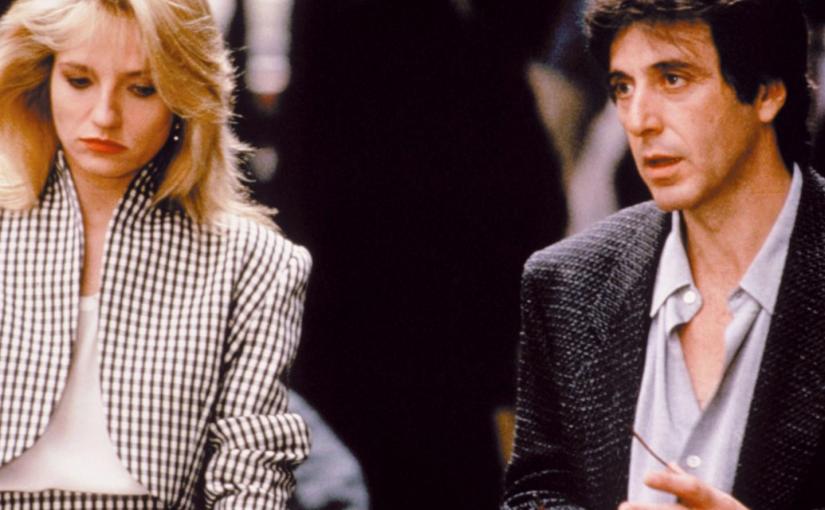
All the victims have posted a Lonely-Hearts Club blurb in a magazine. The invitation for a date stands out because the text rhymes.  The detectives decide to post their own ad in the same kind of format, meet the women who respond and hope to nab the killer.  It gets complicated when Pacino encounters a breathtaking and sultry woman played by Ellen Barkin. 

Pacino’s cop is a smart guy.  He’s got instincts.  Yet, perhaps due to his constant drinking, insomnia, and the bitterness he carries now that his partner (Richard Jenkins) has hooked up with his ex-wife, he’s also quite vulnerable.

The mystery is strong, and the tension builds as Sea Of Love moves on.  Barkin has Pacino and the audience convinced that she’s the prime suspect.  Still, he lets his defenses down because he’s easily getting seduced by her advances.

Whether you’re watching Al Pacino share scenes with John Goodman or Ellen Barkin, the execution is fantastic.  Great performances from the three.  Pacino and Goodman have a natural exchange with one another. Often humorous, but the guys always talk like cops.  When Pacino admits to tossing away a fingerprinted glass from Barkin, Goodman suggests lifting the prints from something- ahem – more personal of his.  A cute wink and nod exchange.

More important to the film is the erotic chemistry between Barkin and Pacino.  Harold Becker uses a late-night supermarket visit in the vegetable aisle to evoke the risky and irresistible nature the two characters develop for one another.  Other scenes build well on the relationship between these two lonely strangers who’ve only recently met. 

Moments of isolation and drunken stupors also work towards fleshing out Pacino’s burned out cop.  He’s got a schleppy posture to him and an exhausted expression with his sullen eyes and shaggy black hair.  At the same time, his character’s twenty years of experience seem to uphold his alertness.  This cop knows he’s letting his guard down. Without any dialogue, you see the internal struggle Pacino has with what should be done against what he is deliberately neglecting.

This film was Ellen Barkin’s breakthrough role.  She received rave reviews as someone who takes care to uphold a New York City trendy appearance by day as a shoe salesperson in contrast to a woman looking for some carefree lust in the evening.  For Pacino, Sea Of Love reinvigorated a career slump following a series of poorly reviewed films.  Together, they make for a sexy yet untrusting pair.

Circumventing this relationship is the mystery.  Is Barkin the culprit? She seems to have a dark way about her that may not surprise you.  Price, Barkin and Becker designed the character quite well for her to at least have the potential to be a killer of men.  Is she setting Pacino up to be the next victim?

New York City from the late 1980s looks great, even though interiors were shot in Toronto.  Trevor Jones offers a nail-biting soundtrack to keep the suspense heightened at just the right beats of the picture with Becker’s camera pointing down dark hallways or when new clues are discovered.

I’ve seen Sea Of Love a few times and even with knowing the surprise ending, the film still holds up thanks to the performances from its three stars, along with its taut editing, well-paced writing, and smart direction. 

This is a good erotic murder mystery.

CLIFFHANGER

By Marc S. Sanders

It’s an action picture.  What’s common?  Sylvester Stallone, the MacGuffin is money, and the villain has a European accent.  What’s uncommon?  The setting is a Colorado snow covered mountain. 

The movie is Cliffhanger directed by Renny Harlin.

This film deserves much praise for the photography it offers of Stallone and his sidekicks (Michael Rooker, Janine Turner) scaling steep rock formations while trying to evade brutal, but moronic, thieves who have foolishly lost their booty in midair. Now the bad guys must recover the stolen Federal Reserve bills which are scattered in three different locations within the mountain range.  When their plane crashes they force the heroes into leading them on an expedition to locate the money before they will surely kill them.  John Lithgow leads the villains.  Thanks to his slithery English dialect, he’s not bad in the part.

For a pinch of character depth, Gabe (Stallone) is haunted by the opening scene of the film where he failed to rescue the girlfriend of his buddy, Hal (Rooker).  Gabe and Hal will be awarded the opportunity to make amends thanks to this unexpected adventure.  Cliffhanger is not just a thriller.  It’s also a chick flick for guys. 

On a modern flat screen TV, it is quite discernable to recognize the CGI and handcrafted sets that make up much of the scenes.  However, the thrill of it all still holds up and as noted before, the overhead shots really look spectacular.  Stallone really is hanging from these bottomless heights with just one hand; at least that’s what it looks like.  If there is an illusion at play, then there are moments where I can’t tell if I’m being deceived.

The opening scene is the highlight of the picture as Gabe must zip line himself upside down over a wide crevice while attempting to save a hapless climber whose harness has given out.  It’s impossible not to sit still during a well edited and directed moment like this.  This is a masterful scene of terror and suspense.  Renny Harlin is certainly an undervalued director in the action genre.  (I wonder what he’s been up to these days.)

The bad guys are quite hapless though, as they freely bicker among themselves and give away how they’ll happily kill the heroes quickly, allowing one to warn the others.  They are dumb right from the start by killing the pilot of the plane they’re on before fully completing their mission and idiotically losing the money at play.  Then again, as my Unpaid Critic colleague would say, “Then there’d be no movie.”  True Mig!  Very true.

Still, the atmosphere of Cliffhanger is what works.  Blustery snow and wind come off convincingly as Gabe is forced to freeze and shiver with no layers to keep him warm while executing some daring escapes.  Rescue helicopter stunts and collisions are sensational.  There are obligatory shootouts and bloody slashes of skin from climbing tools.  There’s even a bat cave, with no superhero in sight, but it will give you the willies.

I’m hot and cold on many of Sylvester Stallone’s films.  Don’t get me started on Assassins with Antonio Banderas or The Specialist with Sharon Stone.  Those movies required some nuanced acting that the action star just wasn’t offering.  However, here the adventure makes the piece thanks to the director, and Stallone fits right into this environment where the role demands strength, stamina, and outdoor intuition.  Renny Harlin is the top hero here, allowing the marquee actor to look really good on screen.

GUARDIANS OF THE GALAXY VOL. 2

By Marc S. Sanders

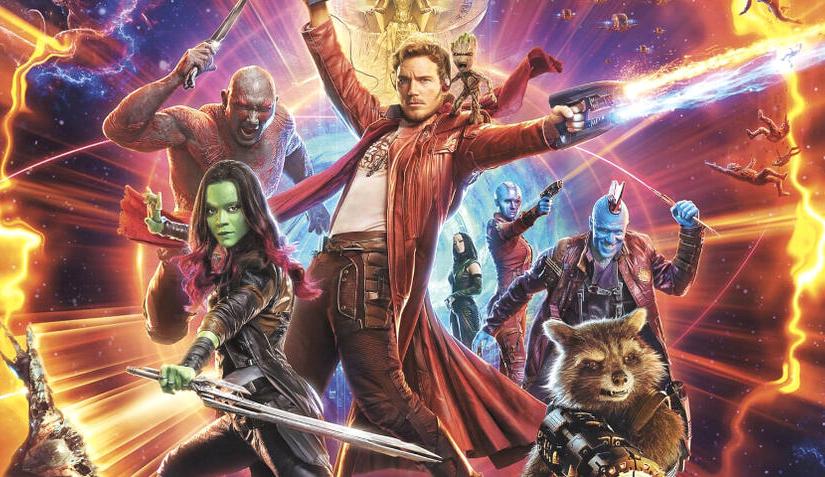
James Gunn continues his Looney Tunes odyssey helming Guardians Of The Galaxy Vol. 2. The silliness is grander, the story is weirder and the characters are now comfortably fleshed out.

Vol 2 is probably not better than the first installment. However, it is more inventive as Gunn takes his film along the hanging thread left over from before. Peter “Star Lord” Quill (Chris Pratt) meets his father at last in the persona of Kurt Russell who goes by the moniker Ego. This is all enthralling to Quill, though his love interest, Gamora (Zoe Saldana) sees beyond the facade.

Ego has invited them to his planet that he created. It pops with colors, serenity and cheer. This plays for a good story; maybe as a better and more developed Star Trek episode.

What differentiates this film from other Marvel films comes out in the third act. This does not consist of just space battles, laser swords and shootouts. The end is something else, something new, entirely. Thus, you are given the film’s greatest strength. I found it to be very imaginative.

Gunn however falls a little bit into his own trap along the way. There are too many relationships and characters that work as filler for side stories. Gamora vs her bitter sister Nebula. Drax (Dave Bautista) with a new, weird antenna on the head character named Mantis and Rocket Racoon and his big mouth with Yondu (Michael Rooker, in a bigger more significant role this time). Oh yeah! There’s also Yondu vs Sylvester Stallone (huh? why? how?) and Yondu vs his mutinous army, The Ravagers. It’s all a little too much for an already busy looking film.

I found it funny that The Ravagers reminded me of the motorcycle gang, The Black Widows, from Clint Eastwood’s Every Which Way… bare knuckle comedies. Those guys were much funnier than these Ravagers. Gunn overstays their welcome as they randomly cackle and heckle poor Baby Groot, the toddler tree thing. That gets old quickly.

Gunn approaches a special kind of humor here. Repeatedly, because these are outer space characters, it’s apparently funny to lend them explaining the punchline of a gag. So if Drax realizes that Peter has the hots for Gamora, he’ll belly laugh and explain literally how Peter feels and do it bigger and louder. Variations of that gag occur quite often among most of the characters. Sometimes it works. Sometimes it gets old.

GOTG Vol 2 is a fun watch. I don’t foresee this installment carrying the legendary status the first one did or even standing out among the best of the Marvel series, but I will give props to the outcome of what Ego truly is and what his intent depends on. (I won’t spoil that here, of course.)

The cast is great. Saldana is one of the stronger female characters in the MCU. She captures a background to Gamora that is blatantly absent from other Marvel ladies. Bautista has become a great character actor as well. He’s a smart guy with good timing. With his extensive child and adult film resume Kurt Russell is perfectly cast as Pratt’s father. Their personalities lend to some good chemistry.

James Gunn owns the Guardians films. No one else can capture his blend of humor and pop culture salutes. Yet, he overreaches a little trying to incorporate so much story and so many gags into one film. His vision is well defined, though.

Plus, Gunn stages another dance scene for Pratt and Saldana, and it’s great. As I noted in my Vol 1 review, that’s how you get to a viewer’s heart. Everyone loves to dance.

As well, Gunn accompanied his sequences with some tunes both fresh and familiar from Fleetwood Mac, Electric Light Orchestra and George Harrison to name a few.

James Gunn was always going to make sure never to take his films seriously. So, when you see a baby tree groove along while trying to detonate a bomb, I defy you to be so serious as well.

GUARDIANS OF THE GALAXY

By Marc S. Sanders

Forgive me! I’m going into the woods or, rather, outer space a little on this review.

Director James Gunn brings new perspective to Marvel Studios’ Guardians Of The Galaxy, by recognizing the one instinct that every person possesses but is not acted upon often enough…the instinct to dance.

I love to watch characters (not part of a standard song and dance musical) break out into dance. It comes out of nowhere while it humanizes the person. I write my own plays that way, and I award my characters the opportunity to dance as well. I love it when I see it because it’s always a surprise and always welcomed with a smile. Think of that great moment in John Hughes The Breakfast Club, when the five kids let it all out after they’ve let it all out among themselves in confidence. Look at Eddie Murphy boogie in a night club in 48 hrs and Beverly Hills Cop, and look past the crappy script of Footloose for one of the silliest and most fun dance soundtracks to bop your head to. That last bit offered some inspiration for James Gunn especially. Dancing is needed in life. Dancing brings a surge of security as we shed our inhibitions for a fleeting moment. James Gunn reminds his audience of that. If you can’t smile and tap your toe to at least one fresh minute of GOTG then I worry for your soul.

Try not to smile when you first see lead hero Peter Quill aka Star Lord shake, slide and lip sync out by himself on a marooned, wasted planet to the melody of Come And Get Your Love by Redbone. Yes. Don’t deny it! Your head was shifting and your foot was shaking when you first saw this moment.

Gunn hit on all the right notes with a film that could have torpedoed straight to B class junk in another director/writer’s hands.

GOTG focuses more on the humor than any of the zippy outer space special effects. Everyone is having a good time, even the bad guys.

The story more or less focuses on the pursuit and take away/get back of a MacGuffin. Because that’s so simple, Gunn doesn’t have to concern his script with logic and over plotting. Instead, he can offer time for great naive one liners from brutish Dave Bautista as lovable Drax The Destroyer (do I really need to explain this character? ) and Rocket Raccoon (do I really need to explain this character as well?). There’s a giant tree named Groot who will happily tell you “I am Groot” in case that wasn’t clear to you, and a tough as nails, green skinned Gamora played by Zoe Saldana. She, along with Chris Pratt as Quill, have great chemistry together as they develop a caring friendship amid their competitiveness and wacky action. A pause in the play to allow a sway and flow dance for Saldana and Pratt to Elvin Bishop’s Fooled Around And Fell In Love is hypnotic as Gunn stages it against a gorgeous purple galaxy sky with random yellow sparkles raining down. I could stay in that scene forever.

Main focus goes to Quill who pirates the galaxy while not knowing much about his father and keeps the memory of his Earth mother alive with her “Awesome Mix Tape Vol 1.” He’s a lone pirate with no allegiance, and happily scavenges items for pay from the highest bidder. Pratt has fun with his breakout cinematic role. He laughs, he teases and yup, he dances.

On a first viewing, GOTG can leave you a little bewildered as you try to comprehend what weird name belongs with what weird character and what is everyone talking about. Your next viewing will feel like an invitation to a night club because you’ll realize whatever exposition Gunn’s script offers is really not significant.

James Gunn offers a pleasure piece of sights and musical sounds. One motif I like about his fictional galaxy is that no two characters look the same. It reminded me of George Lucas’ first Star Wars film. The famous cantina scene never shows two of the same species of alien. That’s all that’s needed to imply the vastness of the population. Unlike the Aquaman, James Gunn doesn’t feel the need to show you every inch of this universe to prove just how big it all is. He adopts the means of many extras all with their unique look.

The villain is Lee Pace, a guy who’d make a great Bond villain actually. He’s hidden behind a lot of costume and makeup as Ronan, and maybe he could’ve been given more to do. There’s not much one on team time between him and the Guardians.

Other fun moments abound though, including a ridiculous daylight chase through a busy planetary downtown, and a ridiculous prison break led by Rocket and Groot that reminded me of a lot of the Zucker brothers humor from their Airplane! and Naked Gun films.

James Gunn manages the biggest and bravest departure from the Marvel Cinematic Universe and it’s oh so right and necessary to keep the franchise alive and fresh.

Guardians Of The Galaxy is Marvel Studios’ answer to Looney Tunes and The Muppets. The great Mel Blanc and Jim Henson would have applauded a ridiculous film like this for years on end.