UNSTOPPABLE (2024)

By Marc S. Sanders

The Oscar winning film editor of Argo, William Goldenberg, finally directs his first film and it’s a winner.  The true story of Anthony Robles, the one-legged NCAA world champion wrestler is brought to the screen in Unstoppable.  While the story is paint by numbers for a typical sports movie, because it is adapted from his real-life experiences during his time at Arizona State University, it cannot help but be embraced.  The cast is sensational as well, with not one weak link.

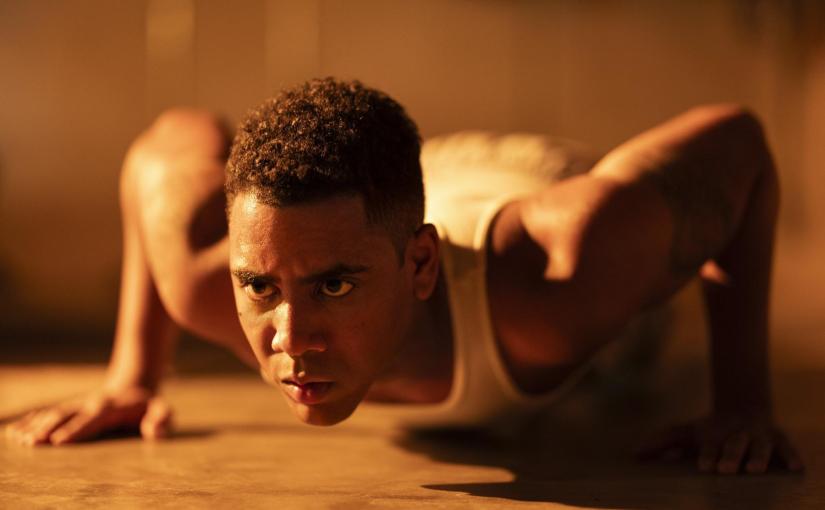
Anthony Robles (Jharrel Jerome, the Emmy winner of the HBO miniseries When They See Us) is a good kid.  Anthony is loved by his brothers and sisters, and his mother.  They cheer him on to persist and win.  He’s a hero to his younger siblings.  Anthony also gets much encouragement from his high school wrestling coach, Michael Peña, and his co-worker that he cleans airplanes with, played by Mykelti Williamson.  Still, he has a troubled domestic life.  His stepfather is an intimidating tyrant.  Bobby Cannavale plays one of the harshest villains in recent memory.  A towering monster with a voice that’ll make you wince.  He’s verbally abusive and eventually we learn physically as well to Anthony’s mother Judy (Jennifer Lopez). 

As the film begins, following a winning match, Anthony receives an all expenses paid ride to a Pennsylvania college.  However, that school does not contend in the NCAA and despite everyone telling him to take the free ride, he has his eyes set on Arizona State.  Even ASU’s Coach Shawn Charles (Don Cheadle, and dang is he ever good) is not confident in Anthony making the final cut for the team.  Yet, Anthony defies what everyone else thinks and scrounges up the monies with his family’s support to attend the local university.  Now the challenge is to make the team against all odds with his crutches to support him through rocky terrain hikes and laps around the track while carrying heavy weights.  How does a man with one leg stand upright and manage to climb mountainous terrains in the desert heat while staying in pace with the rest of the candidates?  How does he even hold a thirty-pound weight while running the track on crutches?  Anthony Robles will show you.

Unstoppable does not offer anything new or inventive.  Anthony even reflects on the fictional character Rocky Balboa a few times.  There are challenges to overcome, not just for Anthony, but for Judy as well.  The bank wants to foreclose on their home and her husband is monster of a jerk.  Plus, there’s Anthony’s handicap which can never serve as an excuse for falling behind with the rest of his squad. 

Some matches are lost.  There are scary episodes at home.  There’s the imposing undefeated champion that Anthony will eventually have to face.  There are the loving moments between mother and son.  It’s all textbook, and the ending is predicted as soon as the film begins.  Still, had I known Anthony Robles personally while growing up, I’d be saying this story is prime for a movie or a book and that is what became of it. 

At the 2024 AFI Film Festival, there was a Q&A following the film’s presentation.  Jennifer Lopez, Jharell Jerome, William Goldenberg, and Judy and Anthony Robles were in attendance.  To watch the film and then hear of these people’s real-life experiences afterwards is astonishing.  Both mother and son came from rock bottom scenarios mired in debt and abuse.  Now, long after Anthony has finished his career as a champion wrestler, we see that the two continue their crusades.  I won’t spoil what they went on to next.  The film provides a footnote ahead of the end credits, but it is nothing short of inspiring.  The Robles demonstrate that anything is possible and nothing works as an excuse.

Jennifer Lopez and Jharrel Jerome share a lot of beautiful scenes together.  Lopez might be easy fodder for gossip columns, but she is truly a wonderful actress.  Jerome reminds me of when I first saw Cuba Gooding Jr in Boyz In The Hood, which was an astonishing debut of a promising career.  This guy needs to be cast in a lot of beefy roles going forward.  He’s a sensation. 

William Goldenberg has made an under the radar film, but it has box office success written all over it like The Karate Kid or Rocky.  His vast experience in editing allows for a well-paced two hours so that even if you know what is coming next, you remain enthralled and wanting to cheer on the protagonists. 

The film will be streaming on Amazon Prime soon, and that is perhaps it’s only disappointment.  Again, as I have written in other recent columns, a movie like Unstoppable belongs in the theatres first and seen with well attended audiences who will clap and cheer at both Judy and Anthony’s triumphs.  Some of my fondest memories are watching the heroes I grew up with played by Ralph Macchio and Sylvester Stallone finally achieving that hard-to-reach gold crown, and suddenly there’s an overwhelming cheer from the audience within the darkness of the theatre.  Remember when Rocky sprinted up the 72 steps of the Philadelphia Museum Of Art?  A cued response almost seems edited into the context of the film.  That kind of experience is absent from the private confines of a living room.

Unstoppable has joined the lexicon of amazing sports stories.  You can’t help but cry while you are cheering.

MILLION DOLLAR BABY

By Marc S. Sanders

Clint Eastwood has one of the most remarkable careers in Hollywood history.  As his appearance has aged, so have the roles he’s occupied. He’s got these long lines that run down his cheekbones and across his forehead that compliment his signature scowl and white hair.  These facial features lend to a background in many of the characters he’s portrayed over the last thirty years ranging from a “Frank” in In The Line Of Fire to a “Frank” in Million Dollar Baby, his second film to be a recipient Oscars for Best Picture, Best Director, and Best Supporting Actor.  A Best Actress Oscar was also garnered for Hilary Swank. 

Swank won her second Oscar as Maggie Fitzgerald, a backwoods product of a hillbilly upbringing, who only lives for one dream and that is to be a championship boxer.  When she’s not waitressing to collect coins and singles for tips, she is spending every waking moment at Frank’s boxing gym, The Hit Pit.  Maggie keeps to herself by punching a bag, but she is persistent at convincing a closed off Frank to become her trainer.  Frank has no interest in training a girl, but maybe there’s more to why he’s reluctant to take her on.  The lines on Eastwood’s face seem to metaphorically hint at a challenging past.

Frank’s best friend is Eddie, or otherwise known as “Scrap Iron,” played by Morgan Freeman in a very long overdue Oscar winning role.  Some may argue that Freeman was bestowed with an award for such an illustrious career.  That’s fine.  I still believe that this performance is just as worthy as his other celebrated works (Driving Miss Daisy, The Shawshank Redemption).  Eddie lives in a small room in the gym and manages the place by day.  Frank is a crank towards Eddie, but they’re the best of pals. Frank carries the responsibility for Eddie losing an eye in the ring while under his coaching. 

Frank also suffers from the loss of a relationship with a daughter.  He writes her but the letters come back “return to sender.”

Million Dollar Baby is a boxing movie but the film, written by Paul Haggis, serves a much deeper and intimate purpose.  Eastwood, as director, gives beautiful and sensitive focus towards a relationship between Maggie and Frank.  Maggie has an ungrateful family with a mother (Margo Martindale) who spits the gift of a purchased home back in Maggie’s face.  Hilary Swank offers silent, yet agonizing hurt at the rejection and Haggis writes a simple line for her to share with her coach by asserting “You’re all I have, Boss.”  In turn, without his daughter, Maggie is all Frank has.  Their commonality is “Scrap Iron” who is there to offer insight into what Maggie needs from Frank, and what Frank needs from Maggie.  As well, Scrap even suggests that Maggie seeks out another manager to salvage both of their souls.

Haggis and Eastwood go even further with the setting of The Hit Pit.  A mentally disabled kid who proudly identifies himself as Danger (Jay Baruchel) relies on the gym for his own personal glorification.  Danger is a kid with no experience and no business being a boxer, but he glorifies himself as the next all-time great champion while the other boxers (Anthony Mackie, Michael Pena) tease and jeer him.  Frank hems and haws at Scrap Iron to get rid of him.  Danger doesn’t belong here.  Scrap Iron just lets the kid come and go.  The two old guys are both protecting Danger.  One doesn’t want to see another kid get permanently injured, but the other is well aware this kid has nowhere to go.

Million Dollar Baby is a film of acceptance when every other direction leads to rejection for its characters.  Every main character is destined to serve a purpose for another character.  The surprisingly heartbreaking third act is an ultimate test for a dare-to-dream fighter and her coach, however. 

A grizzled old trainer like Frank will laugh in the face of one of God’s ministers with his daily visits to Mass to hide the guilt he feels responsible for, while a girl boxer who wasn’t even much of a fighter until Frank reluctantly accepted her is forced to question how useful she is for herself or Frank or Scrap Iron after she’s been trained to be an elite.

There is so much to appreciate of the sins and curses that weigh on Frank, Scrap Iron and Maggie.  Accompanied with their anguish is a quiet, tearful piano soundtrack composed by Clint Eastwood, himself.  To complete the picture is the dark shadowed cinematography from Tom Stern.  So often, Eastwood with Stern shoots the cast in silhouette. A narrow beam of white light points down on Maggie punching the bag with earnest, but no rhythm.  It could also be Scrap Iron looking from a window upon his friends who accept the pain they live with.  The characters show only a small portion of profile while they are involved in their character.  You’ll catch a glimpse of Frank’s chiseled lines, or Maggie’s black eye and broken nose, or the rough texture of Scrap Iron’s dark complexion.  Other moments, Eastwood follows himself walking through the front door of Frank’s home to find another letter on the floor coming back to him, unopened, returned to sender.  The pain never gets numb.  The darkness of Stern’s photography is haunting, and yet it’s blanketed as comfort for these lonely souls.

Morgan Freeman as Scrap Iron narrates this bedtime story, and we eventually learn who he’s actually speaking to.  It’s the last element of the picture needed to complete Million Dollar Baby.  Freeman is the best candidate for any kind of voiceover.  He only draws attention to these people, in this beat-up old boxing gym, who never acquired acceptance from who they once thought should matter most in their lives. 

This film takes place in and out of a boxing ring.  However, it’s not so much about the sport as it is about surviving through personal battles that’ll never be won. 

Million Dollar Baby is one of the best films Clint Eastwood directed as well as performed in, and it belongs at the top of Freeman and Swank’s career best as well.  It’s just a beautiful piece.

THE MULE

By Marc S. Sanders

Earl Stone (Clint Eastwood) was once considered one of the best horticulturalists in the country.  In fact, he devoted more of his time to raising the most unique flowers and plants that anyone could find than he ever did to his wife, Mary (Dianne Weist) or his daughter, Iris (Alison Eastwood).  He even missed Iris’ wedding, to attend an award reception in his honor.  At age 90, though, Earl is quickly forgotten by his ardent fans thanks to the ease of ordering horticultural specimens off the internet.  There’s no longer value in meeting the maker.  Just as Earl never took account for his family like he did with his beloved occupation.

Clint Eastwood portrays Earl Stone in The Mule, which he also produced and directed.  Written by the Nick Schenk, this film is one of Eastwood’s best directing efforts.  It is inspired by a real life story where the forced to retire horticulturalist finds himself working as a drug mule for the Mexican cartel.  Earl is corralled into making easy money by driving a duffel bag across country.   At the destination, he leaves his truck and returns shortly thereafter to find large amounts of cash in his glove compartment for his trek.  

Earl is so naive to all this activity though that he doesn’t even know how to use the various cell phones the dealers give him for each new journey.  It’s only on the third drive that he opens the bag to find kilos of cocaine.  

Earl is a perfect front for the cartel.  The Don (Andy Garcia) sees the value of this camouflage.  Who’d ever suspect a frail ninety year old Korean War veteran, who’s never gotten a traffic ticket, of doing their bidding? Certainly, the sharp witted FBI agents (Bradley Cooper, Michael Peña) could only get as close as determining this mule is driving a black pickup truck.  Beyond that they are at a loss, despite the leeway and patience awarded to them by their superior (Laurence Fishburn).

This film boasts an outstanding cast from all four corners of its various stories.

The Mule works so well because of Eastwood, the filmmaker.  He offers thrilling overhead highway shots (with no car chases) of Earl’s pickup truck running parallel to a helicopter as well as how the cartel escorts follow behind.  There’s humor in how impatient they get with the old codger by how slow he drives and the old time music he listens and sings along to.  Wait until you see two tough armed Mexican cartel members relent to singing along to Dean Martin.  Eastwood cuts and stages these hilarious moments that are most welcome, even if they had no business being in a story like this.

Clint Eastwood’s performance is really shining through.  You recognize his signature scowl and his heightened walk despite his frail physicality.  The Earl Stone character is so well drawn and Eastwood, as director and especially actor, answers every demand of the script sharing celebrated scenes with Andy Garcia who treasures his prize mule and gifts him a couple of women to make him feel comfortable.  Other moments allow wonderful exchanges between him and Dianne Weist as Mary, Earl’s estranged and very ill ex-wife.

The Mule is a crime picture, sometimes lighthearted and on occasion heavily serious.  Yet, it’s also a well-drawn out family drama.  Earl is grateful for the rewards that come with being a drug mule.  He’s generous to his friends.  He modestly treats himself.  He lends attention to his adult and loving granddaughter (Taissa Farmiga).  He accepts Iris’ disregard for him.  Yet, none of these gestures buy back or exchange any time he’s lost with the family he never got to know.

The film plays like two different movies until finally a sacrifice must be made to appease one part of Earl’s life versus the other.  I almost wished for everything new that came upon Earl in his late life to remain on that trajectory.  Yet, like the best stories, interference will eventually get in the way.  It’s that much more crushing when Earl’s new pattern is upended.  Still, that’s what makes for good drama.

I highly recommend seeking out Clint Eastwood’s The Mule. It surprised me in the best ways possible.  I did not expect to be so impressed.  Eastwood continues to be an inspiration with the persistent longevity of his talents as an actor, a screen legend, and a gifted filmmaker.  The Mule shows he’s as sharp as he ever was before in some of the best films of his decades long career. 

ANT-MAN

By Marc S. Sanders

Peyton Reed not only capitalizes on Edgar Wright’s interpretation of Marvel’s Ant-Man, but also on the first chapter of the MCU, Iron Man. The similarities in the two films are so familiar that Ant-Man seems a little boring and redundant. You’ll turn to your seat mate midway through and say “We’ve seen this.”

Nevertheless, Reed’s film is saved thanks to a likable Paul Rudd, a welcome Michael Douglas and a scene stealing Michael Pena. Evangeline Lilly is here but she’s as useful as Gwenyth Paltrow has been. Corey Stoll is the bald villain, like Jeff Bridges before him, and well… LOOK!!! You just needed to find someone to be the villain; the guy interested in stealing technology to use for making a lot of money and other nefarious purposes. You’ve seen it all before.

Pena is given the best stuff to do as Reed takes advantage of visually recounting a “telephone game” story of what he and then what she said and then what he said after that. Michael Pena is a really funny guy who deserves more work. He’ll likely get a lead in an ABC family sitcom one day called Pena or Michael!, let’s say.

Rudd has fun with the stupidity of his superhero name and abilities. Let’s face it. Controlling the minds of ants is not as flashy as Batman and his gadgets or Spider-Man web slinging through the city. Rudd smirks through all of it. So, I felt okay to smirk as well.

The film suffers from a lot of exposition and a few too many characters. In a flashback 80s scene, Douglas’ character (the original Ant-Man) breaks some SHIELD agent’s nose. What’s so special or offensive about this guy? I don’t know. Also, Bobby Cannavale is a pain in the ass cop for Rudd to deal with, but more or less you’d have the same film if he was excised from the final cut.

Reed saves his movie with a really fun ending consisting of a battle involving shrinking and enlarging and shrinking again aboard a Thomas The Train Engine toy playset. It’s Rudd as Ant-Man vs Stoll as Yellowjacket (very cool looking and not used enough). As well, you can’t help but smile when you see a fifty foot high toy train crash through a house.

This is a scrappy little film in the Marvel Cinematic Universe and not much seems original, but you got a cast that’s likable and an ending to be entertained by.

Nothing special, but nothing terrible either.

LIONS FOR LAMBS

By Marc S. Sanders

Robert Redford directed a huge, glossy looking misfire of a political thriller in 2007 with a film called Lions For Lambs, written by Matthew Michael Carnagan.

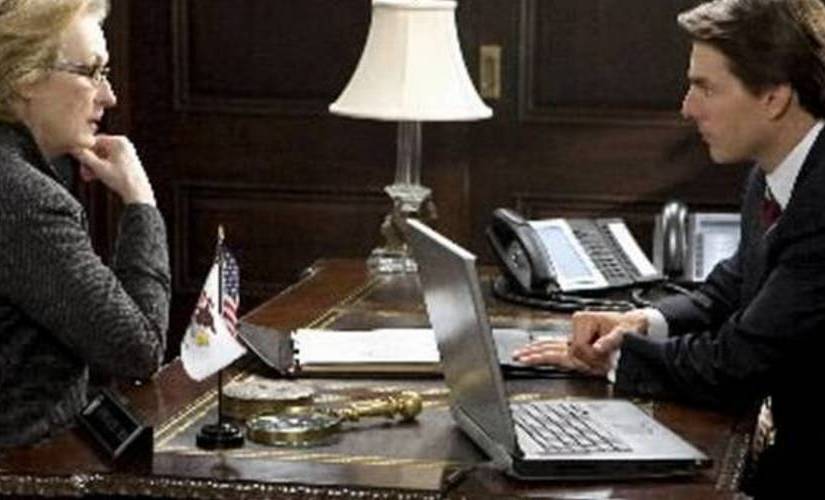
Preachiness is never fun when it labors on for an hour and a half. I don’t care if it’s Tom Cruise or Meryl Streep or even Robert Redford doing the preaching. If these powerhouse celebrities called me up and asked if they could come to my house for coffee and talk, and when they got there, all they did was spew in circles a political platform of “right and wrong” and “why” and “don’t” and “can’t” and “yes and no,” I’d call the police and have them arrested. Time for you to leave, Meryl! Tom, it’s been real.

In 2007, during the late half of Bush 43’s second term, questions of war with the Middle East was at the forefront during a post 9/11 age. Redford, with Cruise producing, thought it’d be interesting to show three different stories (actually two long winded conversations set around desks, and two stranded soldiers) occurring. A political professor (Redford) tries to open the eyes of a student (Andrew Garfield) with great potential but no drive to make a difference. A Republican Senator (Cruise) sets up his own interview with a liberal leaning reporter (Streep) to boast of a new secret mission he’s championing, and two special forces ops are left stranded (Michael Pena & Derek Luke) in the cold of Iraq, the most interesting of three narratives.

Carnagan’s script goes in circles and it’s likely the politics he questions all lean left. Yet the conversations (Redford & Garfield; Cruise & Streep) become just a lot of back talk. A character makes a point, and the other character makes a counter point. I was hoping for a line like “Meryl, you ignorant slut!” Where are we going with all of this?

The soldiers are the mission planned by the Senator that has now gone awry and follows their outcome as they are left wounded and surrounded by Iraqi forces in the snowy darkness. We learn they were students of the professor who wanted to make a difference by enlisting in the Army. See the connection now; the very thin uninspired connection?

Here’s something for ya. In case, you can’t recognize easily enough, Redford dresses his characters in either shades of Red or Blue. Nice touch with Garfield’s frat boy wearing a RED Hawaiian shirt while Redford has the BLUE denim button down. Cruise gets the shiny RED coffee mug for a prop. Does the film have to be THIS transparent? If so, couldn’t the dialogue have been as well?

Lions For Lambs talks A LOT and tells me nothing. Streep’s reporter is a disappointment. Yet Redford portrays her as noble. She loathes the platform of the Senator she just interviewed and is adamant about not writing the quite revealing story he just laid out for her. How can she be that way? She’s a reporter!!!! Tell the truth. Inform the public, even if it’s not pretty, and yet Redford will have a viewer believe it is righteous of Streep to figuratively break her pencil and unplug her computer while she gripes to her editor in chief. No! This is an absolute betrayal of journalistic integrity. What is Robert Redford, the once producer and star of All The President’s Men, thinking here???

You wanna talk about betrayal? The final moments with Streep really had me puzzled. She takes a thought-provoking cab ride that drives past the Capital, Arlington National Cemetery, the Supreme Court, and The White House (right, dab, in front of it no less). Reader, I’ve been to Washington DC a number of times as recent as this past summer. Where the hell is this cabbie driving to, and what route was he taking????

A WRINKLE IN TIME

By Marc S. Sanders

Oprah Winfrey has a big head.

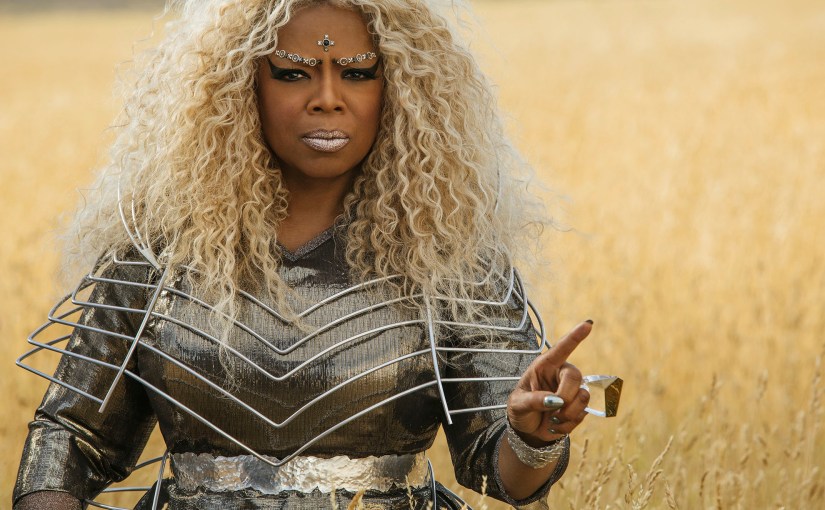
I don’t mean a big head as in a large ego. I mean Oprah Winfrey has a BIG HEAD. So BIG that I caught every sprinkle of glitter in her eyebrows and lipstick that it looked like it came out of the discount basket at Justice For Girls. Why do I focus on this first and foremost? Well…because that is about where the scope of imagination stops in Ava DuVernay’s direction of A Wrinkle In Time.

Remember the first time you saw The Wizard of Oz? Remember when Dorothy walks out of her monochromatic home and into the brightly lit Munchkinland? Judy Garland walked cautiously. Spoke carefully (“Toto, I have a feeling we’re not in Kansas anymore.”) There was a reaction to all of the grandeur and strangeness. Now, over 82 years later, many fantasies on film refuse to take inspiration from that timeless cinematic moment. A Wrinkle In Time definitely doesn’t.

In Duvaraney’s interpretation, Reese Witherspoon, dressed in a white king size bedsheet with hideously bright orange hair can just appear in the living room of a home and no one has nary a response to the unusual. There is neither panic, nor a “wow,” not an eye bulge, not a large swallow of gulp. Nothing. The protagonist, Meg, and her mother just say who are you (actually I’m not sure they even said that), and Reese puts on her over exaggerated smile and cheerful vocal inflection and speaks in some kind limerick dialogue. She walks out the front door, disappears into the night, and no one says anything; no one ponders anything. There is no imagination in the filmmaking here, nor in the scriptwriting. This is a fantasy, right?

Mindy Kaling is another fantasy character in garish makeup and costume. She quotes expressions from various poets and artists from history. Why? I don’t know. What does she lend to Meg’s mission? Yawn!!!! Nothing.

Zach Galifianakis accepted the role of another weird character that Johnny Depp probably turned down, and would have likely been offered to Robin Williams had he still been alive. Zach has nothing to say either.

Meg has a little brother named Charles Wallace. I know this because the script hammers away this kid’s name over and over again. Charles Wallace. Charles Wallace. CHARLES WALLACE!!!!! Not just Charles. This kid is always addressed as CHARLES WALLACE!!!! There’s a drinking game in the making. Give the movie 15 minutes and I promise you, you will be heavily intoxicated after hearing CHARLES WALLACE again and again and AGAIN!!!!

All of these claims go back to my one main, sole issue with this film. A complete lack of imagination and awareness of its fantasy.

DuVernay films Oprah as a towering 20 foot presence (literally) and fills in every void of space on the screen with her head. “CHARLES WALLACE” is about all Meg says to her little brother; there’s no sibling connection. Lastly, the most glaring error, is there is no reaction to the wonder of this fantasy. Were any of the actors informed there would be more to the green screens they were filming in front of?

So, it’s a nay for me. If you are going to do a fantasy make sure everyone in the production gets the memo please.

Oh yeah, Meg is on a mission to find her missing father in the universe of time or something like that. Yeah. That whole thing never mattered much to me. It didn’t really seem to matter much to Meg either.

CRASH (2005)

By Marc S. Sanders

Paul Haggis’ vignette themed script for Crash should not have won Best Screenplay. The film he directed should not have won Best Picture. Could it be that because this picture is masked as that special movie with that especially poignant message that it got the recognition I don’t think it ever deserved? I can appreciate the attempt at bringing hot button social issues like racism and injustice to light, but it does not need to be as immaturely contrived as this picture.

Crash occurs over two days within the city of modern day Los Angeles. A select group of characters of different social classes and ethnicities are covered, and the film circumvents back and forth among their perspectives. For the most part, all of these people have major social hang-ups with people outside their race. The first example shows us that if a white woman who is simply cold on a winter night hugs her husband tightly for some warmth, apparently a couple of black men will automatically believe this woman is fearful of their approach.

Especially today, I know that prejudice exists, but to this extreme and this contrived…I’m not sure. I guess I’m not sure because I have not experienced it enough to be convinced yet. When I read a friend’s testimony of falling victim to racial prejudice I lean towards believing everything they tell me. I guess it’s this movie, Crash, that left me feeling dubious and maybe that’s because the circumstances seem way too forced.

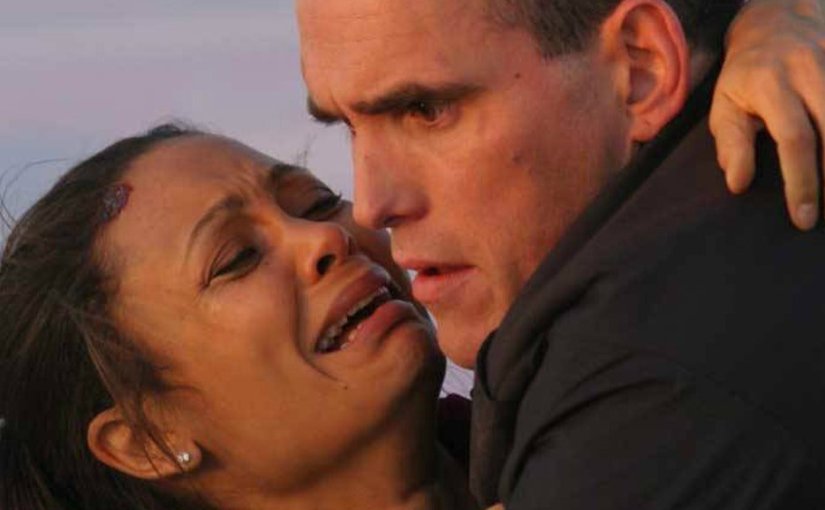
A racist cop (Matt Dillon) will pull over a well to do Muslim man (Terrence Howard) driving a high priced SUV and perform a sobriety test for no reason. Then the cop will deliberately frisk the man’s wife (Thandie Newton) with digital penetration. The next day, it’ll just happen to be that this woman will have no choice but to be rescued from a burning car by this same racist cop. Now I’m supposed to believe that the racist cop is not so bad, and the woman learns to become more tolerant. Well gee, thank heavens for coincidences!

The Muslim man (a television show director) gets car jacked the following day, and in a tense pull over moment he’s mistaken as the criminal. Fortunately, the partner of the racist cop (Ryan Phillipe) is there to subdue the situation. I’m sorry, but life doesn’t work out to be this tidy. Call me cynical, but more often than not we are not given a second chance at first impressions.

One of the real car jackers (Chris “Ludacris” Bridges) gets a moment of clarity and suddenly he’s generously giving out his last forty dollars to a group of Asian people being held in a van for human trafficking. Forgive me. If I want to begin respecting this car jacker who has held multiple people at gun point and even runs over a man, only to toss him out on the drive up to the Emergency Room, I’ll be more apt to do so if the criminal turns himself in.

I dunno. Maybe I’ve got a personal issue with Crash. It could not be more apparently preachy in how it patronizes me to simply understand the seething hate and criminal violations of its characters. I’m supposed to empathize with the racist cop because his ill father can’t get the health care he’s entitled to? I’m supposed to understand the prejudicial anger that the WASP wife (Sandra Bullock) of a District Attorney (Brendan Frasier) expresses because she no longer trusts her dedicated Hispanic housekeeper or the locksmith (Michael Pena) changing the locks on their house following a car jacking?

No. Paul Haggis didn’t earn that response from me in almost all of the short story scenarios his film offers. Maybe it’s because I tend to compartmentalize my episodes. I like to think that I don’t allow one experience with one kind of person cloud my judgement on the next person I encounter. A waiter can totally screw up my order and can even mouth off to me in a heated moment. Yet, I’ll return to the restaurant on another occasion because it’s likely I’ll run into a different waiter.

Haggis depicts people who appear to have a blanket opinion of other people with different backgrounds. These are all extremely prejudiced people with next to no understanding of where each of them stem from. An angry Persian man (Shaun Toub) puts blame on the locksmith after his convenience store is ransacked. The locksmith was only trying to explain that the back door needed to be replaced. The Persian refused to listen because his English is limited. So he just gets angry and curses the locksmith out. Haggis opts to insert a language barrier between the two men to serve up an eventual tense and dramatic moment in a neighborhood driveway with a loaded gun and a little girl. A loaded gun and a little girl! Yup, I think they teach these are the true ingredients for effective drama on the first day of screenwriting class. Again, it all comes about a little too forced.

The conveniences and ironies that bubble up at times are surprising. “Oh that guy is that guy’s brother! I see.” Things like that. However, I don’t think that is necessarily the strength of the picture.

In a film like Magnolia, we are treated to the vignettes of a handful of people too. However, not every single one of those people are sketched by means of their prejudiced natures. They are drawn by a variety of different elements whether it be a traumatic past or an inclination to do good. Then it’s kind of fun to uncover how each player is connected to one another.

In Crash, the players are only connected by the hate they carry within themselves, and Paul Haggis forces a redemption upon most of them with small gestures or a line of dialogue or the purity of a welcome snowfall to close out the film. Sorry, life is lot more messy and complicated than that. I guess I’m saying I may have learned a lot more about human nature from a downpour of frogs than a downpour of snow.

THE LINCOLN LAWYER

By Marc S. Sanders

Michael Connolly authored a series of best seller legal thrillers featuring his famed character Mickey Haller. His most favored book of that series was adapted into a 2011 film called The Lincoln Lawyer with Matthew McConaughey in the role and directed by Brad Furman. I only wish more of Connolly’s books were adapted thereafter, because this movie is at least as good as the novel.

McConaughey is well cast as Haller, a defense attorney who operates out of his Lincoln Town Car working to get low level criminals off on technicalities or by easy settlements with the prosecution. His clients range from prostitutes accused of possession to notorious motorcycle gang members. When these clients can’t pay, Mickey wisely becomes resourceful with favors they can provide later on. One of his former clients drives the car while Mickey works in the back seat making calls out of his mobile office.

Louis Roulet (Ryan Phillippe) has just been arrested for beating up a prostitute at knifepoint. Roulet is a spoiled, preppy thirty something who is protected by the vast wealth of his mother (Frances Fisher) and their successful real estate enterprise. So it’s surprising that Roulet turns to street lawyer Mickey to be his legal counsel. At the same time though, this is a big score in legal fees. So Mickey is enthusiastic to accept the case, and go to trial. Louis doesn’t want it any other way to prove and insist upon his innocence.

It wouldn’t be fair to reveal much more about The Lincoln Lawyer because it’s got a lot of welcome surprises and twists along the way. What I can reiterate is how good an actor Matthew McConaughey is as I’ve written before. He just performs with a relaxed and confident swagger about himself. Mickey Haller is written as a smart and very strategic attorney. He knows the ins and outs of the courtrooms. He not only uses his clients for additional help, but he also sidles up to the bailiffs so he gets his clients cut ahead of the line to quickly face a judge. McConaughey is really good at not glamorizing the intelligence of Mickey Haller, but rather the charming personality of the guy. The character doesn’t come off as having all the answers at his fingertips, even though he likely does. It makes the film that much more dynamic to see McConaughey’s personality ahead of a Sherlock Holmes or Perry Mason kind of lawyer who might telescope everything five steps ahead of what’s eventually going to happen.

The supporting cast of The Lincoln Lawyer is also magnificent with Marisa Tomei, Bryan Cranston, John Leguizamo, Bob Gunton, Michael Pena, Trace Adkins, Josh Lucas and William H Macy. These are just great character actors. Everyone serves a purpose, even if it is just for a few moments.

Again, Mickey Haller is a great, modern day crusader. Like other literary characters such as Alex Cross and Jack Ryan, based on this film, I always hoped McConaughey followed up with at least one or two more additional films. I’d sure as hell be there to watch. Heck, the eventual Oscar winner went on to be a spokesman for Lincoln automobiles. So why couldn’t he have continued to carry the torch on the big screen?