BATMAN BEGINS

By Marc S. Sanders

The merits of a lot of action/adventure films is predicated on how strong the villain is to the story.  Often the hero is the straight character in the heroic garb ready to enter the scene just as the bad guy is on the brink of maniacally destroying the world.  In the early 2000s however, the focus diverted to the hero when big franchises opted to reinvent themselves.  James Bond’s origin was finally offered up in the best film of the series, Casino Royale.  Christopher and Jonathan Nolan served up one of the best cinematic Batman stories on screen.  The title said it all.

Batman Begins gets every note right with the all too familiar back story of Bruce Wayne’s drive to become Gotham City’s Dark Knight vigilante.  The film has its collection of villains but the center of the picture is always circumventing around Bruce Wayne, perfectly played by Christian Bale, with somber truth hidden by handsome playboy disguise.  As a child, he discovers his fear of bats and then attends the theater with his billionaire parents.  Upon their exit through a back alley, he witnesses their death and is left to be raised by his trusty butler, Alfred Pennyworth (Michael Caine, my favorite actor in the role to date).

This film achieves my undivided attention because it paints a full canvas of this character before he ever adopts an alter ego in a black costume.  We explore how he becomes motivated followed by his intense training in the zenith alps, on the Asian continent.  Then we see how he supplies himself with all of the familiar gadgets and costumes when he befriends an ally within his father’s company, Lucius Fox (Morgan Freeman). 

Jonathan Nolan’s script diverts away on occasion to embrace the capable villains of this story with the Scarecrow (Cillian Murphy), Rha’s Al Ghul (Ken Watanabe) and mob boss Carmine Falcone (Tom Wilkinson).  Bruce’s mentor, Ducard (Liam Neeson), is a big factor in the hero’s development as well.  Lastly, there’s Bruce’s childhood friend and legal connection, Assistant D.A. Rachel Dawes (Katie Holmes).  Lt. James Gordon is the uncompromised police detective that Bruce singles out to trust within this dense world of corruption.

Just to read this cast list is impressive as they fall beautifully within the matrix of Nolan’s blueprint.  Everyone is given enough time to make more than one impression as their storylines twist and alter.

Christopher Nolan’s films are always moving like a smooth ride on a never-ending stretch of road with no traffic in the way.  Nothing bears repeating from what was already shown in an earlier scene.  There’s something new to learn as the pace continues.  Nolan is one of the few filmmakers where you do not mind the time jumps he incorporates into his stories.  Bruce will first be seen as a ten-year-old boy, then in his muscular fit thirties in a Chinese prison completely departed from the wealth of Wayne Manor.  A step back before that shows him as a Princeton drop out with a mop top haircut.  Every different appearance of Bruce is interesting and you become intrigued with how he ends up in one place after another. 

Like the first appearance of Daniel Craig in the Bond series, this Batman/Bruce Wayne is repeatedly imperfect.  He’s flawed because he still needs to learn and the characters that enter and exit and reenter his life must teach him.  Alfred will lecture a short-triggered Bruce when he’s on the cusp of risking the reputation of his father’s legacy.  Rachel will slap him when he’s prepared to kill in cold vengeance.  Ducard will teach him the ways of physical survival and will test Bruce’s loyalty and the measures of crime with punishment.  Even the Scarecrow is smarter than Batman when he springs an unexpected trap.

The ongoing education of Bruce Wayne is the theme of Batman Begins, all the way to the end, when he finally learns to mind his surroundings.

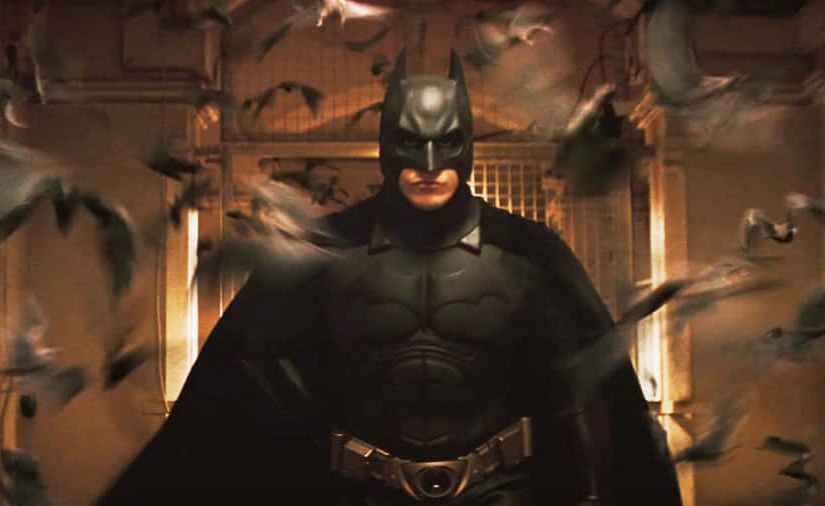
Christopher Nolan made Batman exciting in a new unfamiliar way.  The Batmobile is a not a sporty kind of vehicle.  It’s a tank called The Tumbler and it bears a thunderous series of sound edits as it barrels through Gotham City.  After some slip and falls off rooftops, Batman becomes much more covert than in other interpretations.  You don’t have to physically see Batman to observe him operate.  If a thug gets swallowed into a void of darkness, you know what has ensnared him.  The crusader’s devices which stem from his gold utility belt are demonstrated with explained reason for why he selected them for his fighting advantage.  The Nolans proudly recognize the theatricality of this guy.

Cillian Murphy is unforgettable as he lives up to the name of Scarecrow, also known as Dr. Jonathan Crane, a criminal psychologist.  His choice to put his victims into a hypnotizing sense of fear lend to the back story of Bruce Wayne’s intent to become a frightening figure himself, where his enemies will recognize his dread.  Tom Wilkinson claws his gangster persona straight from a Godfather kind of picture, but he represents an old guard of Gotham City before costumed and makeup identities take over.  Gotham will transition from the sharp dressed mobsters over to the crazed clowns yet to come. 

Gary Oldman invents another unique personality – a strait-laced city guy who might have come from a 1970s ABC cops and robber show like Dragnet.  No two characters of Oldman’s are ever the same.  So much so, you almost wish they would all assemble in a movie for the various personalities to interact.  Morgan Freeman and Michael Caine are like comfort food who are so subtle and relaxed in front of a camera.  Neither one makes big waves with their characters.  Jonathan Nolan wrote their respective purposes for this Bruce Wayne and they execute their techniques of less is more beautifully.

Liam Neeson delivers the second-best performance of his career thus far, after Oskar Schindler.  He adopts the same kind of method that Freeman and Caine work with, but then he sways from that behavior when Ducard has to surprise Bruce as a means for his pupil’s development. Some of what he does comes from nowhere.  Early in the film, his first two scenes could not be more different.  Neeson works like an unpredictable entity.

The next film in this trilogy replaced Katie Holmes with Maggie Gyllenhaal.  I was disappointed because Holmes was maturing as a very formative actor by this time.  She was blessed with a well written character in Rachel Dawes.  When I watch the next film, The Dark Knight, I cannot help but wonder how she would have performed the role for a second and much more developed opportunity. 

There is not one flaw in Batman Begins.  This is the movie that placed Christopher Nolan in the echelon of top blockbuster directors like Spielberg and Hitchcock, along with Lumet and Mann.  Hans Zimmer’s soundtrack is thrilling as it speaks for The Dark Knight who is of few words.  Zimmer’s scores announce the introduction of Bruce Wayne first, and then later Batman. 

Gotham City makes for a sensational character with various rooftops, fire escapes, tunnels, bridges and a gorgeous, elevated train at its center.  The entire city breathes steam amid the distressed decay, wet streets and rusted architecture. 

Wayne Manor has a ghostly effect as Alfred and Bruce climb the large staircases and floors.  Further down under its platforms rests the cave that’ll serve Batman well.  The waterfalls and rocky caverns are immense. 

Batman Begins is not one of the best films of a genre like any other superhero movie.  I refuse to recognize it that way.  Instead, I see a character study where a man accepts a responsibility to fix what scarred him at a young age.  He wants to right a world that once had promise.  I don’t see the costumed protagonist announce himself as a superhero.  I don’t see the costume.  With the cape and the horns on the head and the car and the tools, I see an image, never a superhero.  With Christopher Nolan’s first film in what will become a well-received trilogy, I always see the man underneath the mask. 
GET CARTER (United Kingdom, 1971)

by Miguel E. Rodriguez

DIRECTOR: Mike Hodges
CAST: Michael Caine, Ian Hendry, Britt Ekland, John Osborne
MY RATING: 8/10
ROTTEN TOMATOMETER: 87% Fresh

PLOT: When his brother dies under mysterious circumstances, London gangster Jack Carter travels to Newcastle to investigate.


While watching 1971’s Get Carter (Caine, not Stallone), I was reminded of so many other later films that I began to wonder what gangster/crime films weren’t influenced by Get Carter.  Throughout the picture, I could see hints and whispers of Bugsy, Beverly Hills Cop, Carlito’s Way, and the John Wick franchise, among others.  I probably missed some.  Maybe I’m wrong.  Maybe those films weren’t paying homage to the best British film ever made (according to a 2004 poll), at least not consciously.  But its DNA is there for anyone who knows where to look.

(To be sure, Get Carter was itself influenced by earlier authors and films.  In very broad strokes, the plot of Get Carter resembles The Big Sleep.  In both films, a hard, cynical man tries to get to the bottom of a mystery that no one else is particularly interested in solving.  They both even involve pornography, though to be sure that was more implied in the older film, while in Get Carter we are left in no doubt.)

The tone of Get Carter matches its protagonist: cold, flat, uninflected, violent only when it has to be.  Michael Caine’s performance is a masterpiece of understated, simmering viciousness.  He only gets really angry a few times in the film, and he doesn’t smile, not genuinely, until the very end.  I read on IMDb that Caine’s intention was to show a more realistic, less sensational kind of violence than had been seen in earlier gangster films, “never using thirty punches when one would do.”

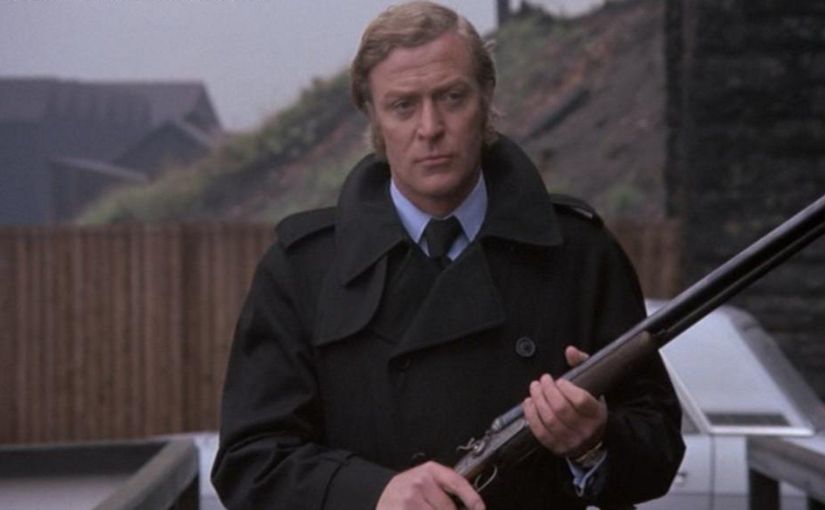
This is also an echo of a French film, Le samouraï, in which a professional killer shows absolutely no expressions the entire film, even with a gun in his face.  Carter is equally cool under pressure, as in the scene when he is surprised in the act of “lovemaking” (love has nothing to do with it) by two gangsters.  He registers surprise and little else, pulling a double-barreled shotgun from under the bed and, while stark naked, marching his would-be attackers out of the flat at gunpoint.  In a movie with little to no humor, there is a welcome double-take from the nosey next-door neighbor, not to mention the children’s parade taking place down the street.  (In this scene, there is something very Bond-like about Carter, mixing deadly danger with borderline slapstick.)

1971 was not a year for shrinking violets at the movies.  It saw the release of Dirty Harry, A Clockwork Orange, and The French Connection, among others.  Into this mix comes Get Carter with its casual violence and frequent female nudity, profanity, and so on.  Even so, there were a couple of moments that got a little shock out of me.  One was when a car is disposed of while Carter knows what precious cargo is in the trunk, but the bad guys do not.  Watch Carter’s utter impassiveness; he could have raised a warning, but he doesn’t.  There’s cold, and then there’s cold.  Another shocking moment is when Carter absentmindedly turns on a film projector and watches the amateur porn film displayed on the wall.  Watch his face again as he slowly realizes the identity of one of the actresses in this tawdry film.  A tear rolls down his face.  Because of what we already know about Carter, that tear doesn’t just mean he’s grieving.  He’s so boiling mad that I feared for the life of the woman in the next room.  It’s a great moment because of how rarely we see emotion on his face.

Get Carter is classic noir, just in color and with more adult situations.  Carter may not be a cop, but he has a code, nonetheless.  He absolutely will not stop digging until he solves the question of his brother’s death.  He defies his own bosses in London, ignores many warnings, survives several attempts on his life, but he just can’t help himself.  His obsession trumps everything else, just like Bogey in The Big Sleep or William Hurt in Body Heat.  There are hints of tragedy at every turn, but Carter presses on, whatever the cost, even if he thinks he might not like what he finds.  These are the qualities of any great noir hero, and Carter exemplifies them all.

***SPOILER ALERT AHEAD, YOU HAVE BEEN WARNED:***

I feel obligated to mention my reaction, at least briefly, to the film’s ending.  At first, I threw my hands in the air, much as I did at the ending of…well, another very different film from the late ‘60s.  But as I thought back to the events of the film leading to this moment, I had to shrug and say to myself, “Well…it’s not like they didn’t warn him.”  At least it’s motivated by something, and not just random fate.  I can accept it.  It’s not something you would see in a conventional Hollywood film today, that’s for sure.  Look at John Wick.

A BRIDGE TOO FAR (1977)

by Miguel E. Rodriguez

DIRECTOR: Richard Attenborough
CAST: Sean Connery, Ryan O’Neal, Gene Hackman, Michael Caine, Anthony Hopkins, James Caan, Maximilian Schell, Elliott Gould, Denholm Elliott, Laurence Olivier, Robert Redford, and MANY others
MY RATING: 7/10
ROTTEN TOMATOMETER: 63% Fresh
Everyone’s a Critic Category: “A Movie Set During an Historic War”

PLOT: A detailed account of an overly ambitious Allied forces operation intended to end the war by Christmas of 1944.


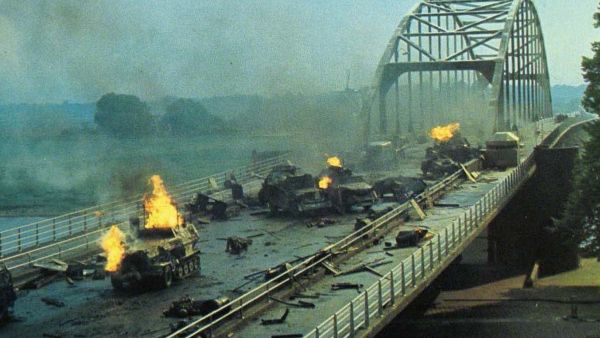
In September of 1944, in an attempt to land a finishing blow to Germany following D-Day, Allied forces launched Operation Market Garden, a bold offensive that would drop over 30,000 soldiers behind enemy lines.  The objective was to capture and hold three strategic bridges in the Netherlands, over which a massive column of British tanks would then roll straight into the Ruhr, the heart of Germany’s industrial complex.  Neutralize the Ruhr, and taking Berlin would be inevitable.  However, as with so many other simple plans in history, multiple factors led to the operation getting bogged down at the third bridge, and after massive Allied casualties, the offensive was abandoned.

Based on a bestselling novel by Cornelius Ryan (who also wrote the novel The Longest Day), the movie of A Bridge Too Far resembles the actual Operation Market Garden, not just in appearances, but also in its ambition, scope, and ultimate failure to achieve its goal.  However, as a pure combat movie, I give it credit where it’s due.

First off, look at this cast.  There had not been an assemblage of so many of Hollywood’s leading men since 1962’s The Longest Day (“42 International Stars”, that movie’s posters proclaimed).  Naturally, most of the actors are pitch perfect in their roles, with one glaring exception.  Whoever thought Gene Hackman was just the right guy to play a Polish general was either desperate or foolhardy, or both.  Hackman is a talented actor, without question, but his attempt at a Polish accent is a MAJOR distraction from whatever he’s saying.  Every once in a while, it even pulls a disappearing act, not that it matters.

ANYHOO.  The all-star cast.  To offset the lengthy running time, the story is told in semi-episodic fashion, which makes me wonder if someone hasn’t thought about rebooting this movie as a Netflix/HBO/streaming miniseries.  I’d watch it.  Within each of these episodes, it helps if we remember right away that Michael Caine is the leader of the tank column, Sean Connery is heading up one of the ground units, Anthony Hopkins is holding the bridge at Arnhem, and Elliot Gould is the cigar-chewing American trying to get a temporary bridge put together, and so on.  It’s a rather brilliant way of using visual shorthand to keep the audience oriented during its nearly three-hour running time (including an intermission at some screenings).

There is one “episode” featuring James Caan that has literally – LITERALLY – nothing to do with the plot.  He plays an Army grunt who has promised his young captain not to let him die.  After a grueling ground battle, Caan finds his captain’s lifeless body and, after improbably running a German blockade, holds an Army medic at gunpoint, forcing him to examine his dead captain for signs of life.  I read that, unlikely thought it may seem, this incident really did happen as presented in the film (more or less).  All well and good.  But what does it have to do with capturing bridges?  I’m sure the story is in the novel, but the movie takes a good 10-to-15-minute detour from the plot to follow this bizarre story.  Did director Richard Attenborough think we needed comic relief or something?  I remember liking that story as a kid, but watching it now…is it necessary?  Discuss amongst yourselves, I’ll expect a summary of your answer at tomorrow’s class.

I want to mention the combat scenes in A Bridge Too Far.  First off, I never served in the armed forces.  Well, never in combat.  I was in the Air Force for about a week.  (Well, Air Force boot camp in Oklahoma for about a week…LONG story.)  So, my observations of the combat scenes are less about historical accuracy and more about how they compare to other films.  While some of the combat portrayed is rightfully horrific in its own way – the river crossing in those ridiculous canvas boats, the slaughter of the paratroopers, the seemingly endless holdout at Arnhem – a lot of the combat, particularly the tank shelling and the skirmishes at Arnhem, is…I have to say, it’s kind of fun to watch.  There’s something, I don’t know, charming about it all.  It reminded me of how I used to play with my army men and Star Wars figures, or how I used to run around with neighborhood friends wearing plastic helmets and pretending we were “good-guys-and-bad-guys” while throwing dirt clods at each other and making fake explosion noises.  It was movies like A Bridge Too Far that shaped my young impressions of what wartime combat was like, and whether it was realistic or not was irrelevant.

Anyway, enough nostalgia.  Here’s the sad truth: A Bridge Too Far, despite its thrilling combat and all-star cast, falls short of delivering a truly meaningful war film.  There are half-hearted attempts to drum up some dramatic impact with scenes in a makeshift field hospital and a speech in Dutch from Liv Ullman wearing her best “isn’t-war-awful” expression, but for some reason those scenes fall flat.  (I did like the “war-is-futile” scene with that one soldier who runs out to retrieve the air-dropped canister, only to discover…well, I won’t spoil it, but it’s a good scene.)

After writing almost 1,000 words, I’m no closer to explaining why A Bridge Too Far falls short.  It’s still an entertaining watch, but I’ve really got to be in the mood for it.  It’s rather like reading a historical novel that isn’t particularly thrilling like a Crichton or a Clancy, but it does deliver some eyebrow-raising information.  It doesn’t hit me in the heart, but it does feed my brain.  Maybe that’s not such a bad thing in the long run, but if movies are about stirring emotions, I must say: A Bridge Too Far is no Saving Private Ryan.

(Sure, I probably could have just said that instead of writing this long-ass review, but where’s the fun in that?)


QUESTIONS FROM EVERYONE’S A CRITIC

Best line or memorable quote:
“Remember what the general said: we’re the cavalry. It would be bad form to arrive in advance of schedule. In the nick of time would do nicely.”

Would you recommend this film?  Why or why not?
Ultimately, I would recommend it to film buffs who have not yet seen it.  If nothing else, it’s an interesting time capsule movie.  This would be the last time for a VERY long time that anyone would attempt to make an epic film with a truly all-star cast.  …come to think of it, I can’t think of a major, epic drama since A Bridge Too Far with an actual A-list cast.  Can you?