THE DEPARTED

By Marc S. Sanders

Martin Scorsese finally won his Best Director Oscar with the 2006 Best Picture The Departed, from a script written by William Monahan. The film is a remake of a Hong Kong crime drama called Infernal Affairs.

Also known as the one film in Scorsese’s library with a linear plot, The Departed depicts the stories of two guys who grew up in the south end of Boston and joined the police academy to serve. Only difference is one is recruited to go undercover within the Irish mob, while the other is recruited by the same mob to become a highly respected police officer and supply an unlimited wealth of information to his criminal boss.

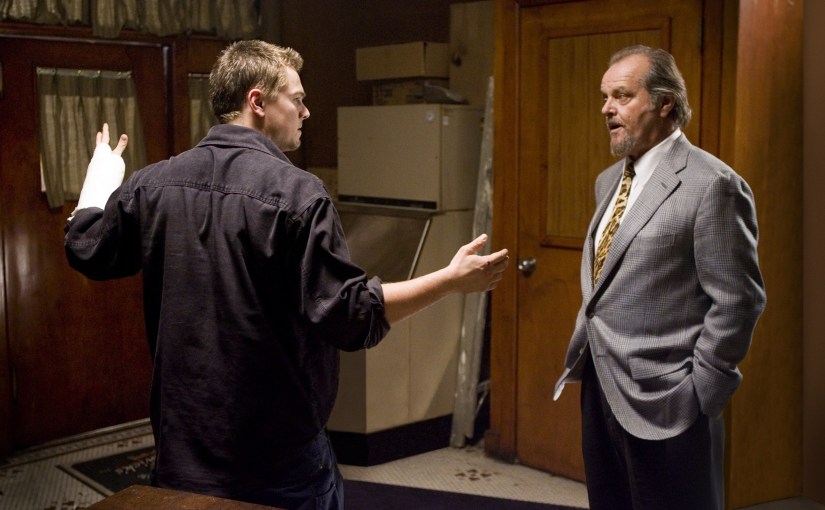
Leonardo DiCaprio is the undercover cop Billy Costigan. Matt Damon is the criminal cop Colin Sullivan. Jack Nicholson is the Irish mob boss in the middle, Frank Costello.

The Departed works because Scorsese and Monahan allow the audience in on every deceit playing against the characters. Pleasantly surprising is that there are even twists to this layered story, and cellular flip phones assist all the players with trying to remain in hiding or hoping to one up and trap the other. However, because everyone is getting tipped from their own respective sources, people are either not ending up dead, or arrested or caught red handed. As Costigan builds his case against Costello, Sullivan is worming his way to protecting his cover in the police force while also tipping off his true boss.

Performances from DiCaprio, Damon and Nicholson are what you’d expect. Nicholson is chewing the scenery again appearing like the devil incarnate while hamming up the facial expressions. Damon is great at playing it like the Boy Scout cop in well-tailored suits, clean shaven and flirtatious within his department and earning respect among his peers, that is until it all seems to unravel. DiCaprio is wired as the cop who needs to show he’s a dangerous hood to be trusted among the mob cohorts. However, he’s getting more paranoid and unwound at the risk of being made.

Thelma Schoonmaker (one of my favorites) does a balanced approach edit to showing a parallel among the cops. She will insert a happening of Costigan for a snippet and then segue to Sullivan appearing to do honest police work, or reaching out to Costello with a warning of what’s coming for him.

Great support also comes from Ray Winstone as Costello’s right hand man, and Alec Baldwin, Anthony Anderson and Martin Sheen, all within the police department.

Ironically, the one Oscar nominated performance was bestowed upon Mark Wahlberg and I grew tired of his presence quickly as the cop who berates Costigan endlessly with yelling and fast one liners that involve someone’s mother. Could we just move on from this please?

I also found Vera Farmiga as a police psychologist to be mostly unnecessary until a contrived ending point needed to arrive. Her character naturally has affairs with both Damon and DiCaprio, who also attend her office for sessions. Of course they do! Whenever the film sidetracks to one of them with Farmiga, The Departed stalls for a moment. Her character carries no stake in the plot line and offers no further dimension to DiCaprio and Damon’s characters.

The film works best as the complications compound on each other. A great moment occurs between the cops when one of them picks up a bloody cell phone to dial back the most recent call. Silence on both ends of the line, and the moment just plays out until someone speaks or hangs up.

Moments like that is suspense similar to when a man is intruding in a dark house. However, this is suspense delivered by Martin Scorsese, and Martin Scorsese will film suspense that is anything but typical. Martin Scorsese’s suspense leaves you breathless.

QUICK TAKE: Syriana (2005)

By Miguel E. Rodriguez

Director: Stephen Gaghan
Cast: George Clooney, Matt Damon, Jeffrey Wright, Christopher Plummer, Chris Cooper, Amanda Peet
My Rating: 8/10
Rotten Tomatometer: 72%

PLOT: A politically charged epic about the state of the oil industry in the hands of those personally involved and affected by it.


Syriana reminds me of one of those puzzles made out of twisted nails, where the challenge is to untangle them, even though it appears to be impossible.  The difference is, with Syriana, I don’t get tired of trying.  At least, not yet.

The movie is a pleasure to watch, but hard to explain.  It’s a convoluted tale that starts with an impending merger between two oil companies, detours into political and legal intrigue, and sprinkles in some religious fanaticism by the time we get to the end.  I’ve watched it five times, and I still have questions about the plot.  I JUST watched it, and I’m still not entirely sure who Christopher Plummer’s character is and why he matters at all to the story.

Normally, a movie this confusing would turn me off.  (Examples: Full Frontal [2002], The Fountain [2006], The Counselor [2013])  But when I watch Syriana, I get the sense that, underneath the twisty plot and maddeningly oblique dialogue, there lurks a great truth.  Maybe the plot is confusing because, really, the situation it’s describing is so confusing in real life.  Maybe any attempt to parse the complexities of U.S. relations with oil-producing countries is a fool’s gambit to begin with.  So the movie just jumps in with both feet and separates the watchers from the listeners.  You’ve really got to ACTIVELY listen for two hours to make ANY sense of the movie.

Maybe that’s not your thing.  Fair enough.  This is the kind of movie that I can’t defend on objective grounds.  You’re either gonna like it or not.  For myself, I get sucked into it every time I watch, even if I don’t understand it all 100%.  So.  There you go.

SCHOOL TIES

By Marc S. Sanders

Robert Mandel’s adaptation of a story from Dick Wolf might be regarded nearly 30 years later as the film with the next generation of up-and-coming brat packers, but School Ties remains an underrated and topically important film nonetheless.  Just as it is still a problem of today, victimized by ignorance and unfounded bigotry, anti-Semitism was an issue that spread like a social disease within the confines of a prep school New England community in the 1950’s.

Brendan Fraser is David Greene, a high school senior awarded a scholarship at the school in order to usher in a championship football season as their quarterback.  David is well aware of his ultimate purpose for his scholarship and he brushes that aside as just one year of attendance will ultimately lead to acceptance at an Ivy League school.  He’s just like any other handsome boy attending the school, and he’s immediately accepted among the masses.  He’s hilarious at mischievous horseplay with the French teacher.  The beautiful girl (Amy Locane) at the nearby girls’ school is taken with him.  His football skills are applauded.  It may be a little surprising that he stems from the blue-collar town of Scranton, Pennsylvania and he buses the tables at dinner time, but David is an all-around okay guy who can knock over a linebacker while passing exceptional touchdown passes.  Amid this environment of different Christian denominations and WASP culture, however, David knows that he will stand apart if he reveals he is Jewish.  Therefore, he tolerates the casual jokes and accepts that it’s best to hide his Star of David necklace. 

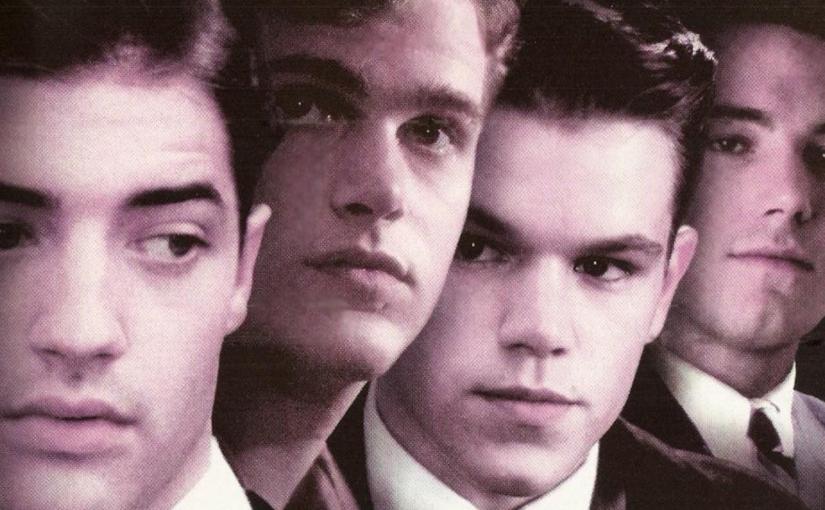
The most important relationship occurs between David and his back up quarterback, Charlie (Matt Damon, before he became a superstar, but already looks like he’ll be a superstar).  Charlie begrudgingly accepts that David got to cut in line to be the star player.  As David becomes more of the celebrity on campus, Charlie is proud to be by his side.  Yet, Charlie has his own pressures to live up to as the fifth in line of his esteemed family who must carry on the legacy at the school followed by attending Harvard the following year. 

The roadmap of School Ties is easy to navigate.  You know when each note of the script is about to be played.  There will be a swastika that will shockingly appear.  Fist fights will happen.  The blue blood parents and faculty will interfere preaching their own “codes of honor” and the school’s storied 193 year history.  Yet, the film works very, very effectively.  The dialogue isn’t hokey and nothing feels like what could have been an after school special. 

No debate among the viewers.  Anti-Semitism is evil and thoughtless without merit or justification.  Questions appear where is it right to ask if David should have hidden his Jewishness or was he even lying about being Jewish, when in fact he just wasn’t even asked.  Is it right that David confronts his problems with his fists first?  Yet, Wolf’s script, apparently based on personal experience, delves further into the mounting pressures of these prep school kids who are primed from birth to be the latest model churned out from the respective family lineage for greatness in academics and athleticism.  Much of the material is devoted to the horror of actually not acing a class, and I appreciate that it’s not diminished to a standard line of “my parents are going to kill me.”  Raw emotion and stress are legitimized among these students.

The third act comes with no foreshadowing as a cheating scandal is suddenly introduced. Collectively the boys must debate who is the guilty party and why are they the guilty party.  Is it because one is Jewish, or is it because one actually cheated?  Good dialogue, good debate, but this also may be where the standard stuff spills over a little too much.  As such, the ending hinges on the third act, when it should have embraced more of the film as a whole.

The cast is made up of, at the time, soon to be superstars like Fraser, Damon, Chris O’Donnell, and Ben Affleck.  School Ties should be regarded as a winning audition for these guys’ careers that were only just on the horizon.  Their respective performances here are just as good as any of their most well-known roles, and they are happy to hide in the background as extras or step up for a camera shot.

ROUNDERS

By Marc S. Sanders

Recently, I watched The Cincinnati Kid with Steve McQueen and it reminded me how much I enjoy a good poker movie, and I don’t even play cards.  Shortly thereafter, I took it upon myself to watch Rounders directed by John Dahl.  A few things occurred to me.  Poker movies do not acknowledge an organization called Gamblers Anonymous.  I guess to do so would be too much of a downer when the real suspense lies in the close ups of these talented players trying to read and outplay one another across the table.  Addictions become all too real and movies are not about reality but rather enhanced reality.

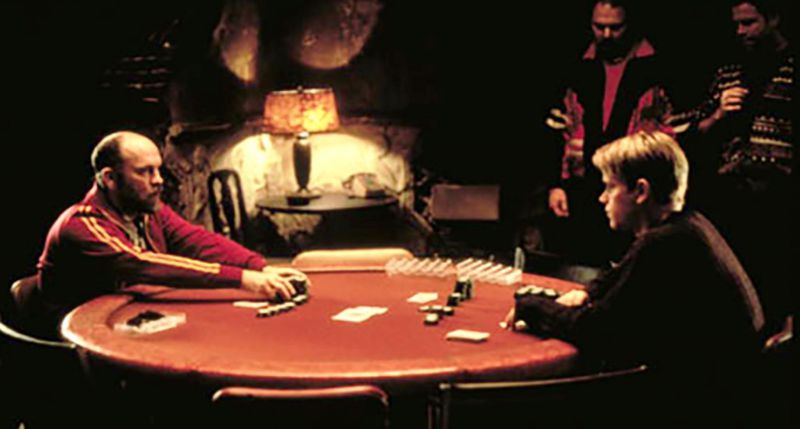
Rounders explores a seedy underground world of poker in modern day New York City.  Its community is made up of guys with names like Teddy KGB (aka The Mad Russian with ties to the mob), Joey “Knish,” and Worm.  There’s also a heavy who conveniently comes in to collect debts, and his affectionate name is Gramma.  These guys are portrayed by an outstanding cast of actors; respectively John Malkovich, John Turturro and Edward Norton.  Gramma is Michael Rispoli looking squat but all muscle under a derby hat while residing in his brothel of hookers who work for him.  All of these characters couldn’t be any more different.  The only thing they have in common is the game.  Gramma is the destiny that follows you after the game.  The other thing they have in common is the storytelling device of mentor, both good and bad. 

Knish maintains a conservative career approach to poker that allows him to pay his bills and alimony, and has groomed a baby faced “rounder” known as Mike McDermott.  He doesn’t look like he belongs with these shadowy figures but maybe that’s why he’s so good at the table.  KGB is the devil that’s not in disguise.  He’s the Oreo chomping Russian psycho with an appropriate, yet overly laid on Bolshevik accent. Worm is Mike’s pal who won’t let up to entice his childhood friend to keep the juice going because poker, honest or more importantly shady, is all that matters. 

Matt Damon is Mike in one of his most underappreciated roles.  Mike looks like a law student with a promising career.  I said he looks like that.  The film however shows that Mike is not a law student at all.  At least he shouldn’t be.  Early on in the film, Mike’s britches get too big for him and he loses everything such as his tuition money and rent and anything else he’d been saving up for.  Knish offers to help him get back in the game, but Mike swears off poker like someone who perhaps would swear off fatty foods.  I guess it’s not an addiction that is taking over his livelihood such as with his devoted law school student  girlfriend Jo, played by Gretchen Mol.  In Rounders, law school and love are the inconvenience.  Not poker.

Nine months go by and Mike picks up his childhood best friend, Worm, played with exceptional sleaze by Edward Norton.  Mike resists Worm’s advances to get back in the neighborhood games where they were masters at the hustle.  Worm is desperate and eager to play because it’s all he wants to do and he has an acknowledged drive to simply self-destruct in endless debt.  Mike’s devotion to Worm is tough for him to compromise and pretty soon his personal vouch for his friend gets them both into trouble where binge gaming is their only option.

The step-by-step play of the story is predictable here.  We know there’ll be one big game at the end with a monster win.  Mike will face set backs along the way.  He’ll have mentor moments and arguments with Jo.  But so what.  Look at the actors this film has to offer, and follow along with a great script of dialogue too. 

Rounders came out in 1998 when Matt Damon was surprising the world with his original script Good Will Hunting.  This movie is one of the first films where he got top billing and his name above the title.  He has so many good scenes because many of them play like duets.  Damon vs Malkovich.  Damon with Turturro.  Damon with, and sometimes against, Norton. 

My favorite pairings are the scenes he shares with Martin Landau who plays Mike’s law professor, Abe Petrovsky.  Landau personally touched me as the son of Jewish immigrants where each generation went on to Rabbinical school.  Petrovsky describes for his law student, Mike, that through his own personal experience that our destiny chooses us.  Often, we don’t choose what we have to become.  The Petrovsky character was raised in the Jewish orthodox community where I also had experience while attending Yeshiva for ten years.  I knew this man that Landau so accurately portrays.   Beyond my review, I have to share that this character spoke to me and reunited me with the Rabbis who taught me in elementary school. Personally, Petrovsky assured me that it was okay that I did not follow in the footsteps of my teachings at Yeshiva.  It wasn’t for me, much like law school is not for Mike.  Mike has a talent for something else.  Still, it’s a very risky talent.  Rounders would like to tell you that everything in life is worth taking risks.

I’m not sure I agree with the philosophy of Rounders.  Gambling can easily turn into a terrible addiction.  My father played all the games at the casinos on occasion, but he never stayed very long and he only went infrequently like when he was on a business trip.  He always told me that he would not be sure he’d be able to stop if he took up the game.  I knew exactly what he was talking about which is why I never even opted to learn.  I know my limitations.  Rounders doesn’t focus on limitations, though.  Limitations are for nerds, I guess.  Rounders is all about searching for strategy to improve your game.  It’s movie money.  So, there’s only pretend risk as Mike aspires to beat the best of the underground, come out alive from the violations of his pal and then move on to Vegas where he’ll give it a shot at the World Series of Poker.

There’s one other aspect I admire about Dahl’s film.  I looked for it on this most recent viewing and I’m telling you I couldn’t see it anywhere.  Dahl never, ever shows you the full hands of the players.  Either you see only a part of the river of a Texas Hold ‘Em game or you see the pair of cards the players hold, but never both in any round of the various card playing.  Dahl’s approach like the Mike’s philosophy is not so much playing the cards as it is to show the players play against each other.  The ticks and expressions they give like how they smoke or drink or even how they eat Oreo cookies out of their poker chip rack.  It’s very effective compared to other poker scenes in films like The Sting or even Casino Royale.  With a fine tuned script by David Levien and Brian Koppelman, it is fair to say that anyone knows what hand beats a flush or two pair or whatever.  More importantly, what matters is what read is ultimately gonna win you the table.  Rounders is all about winning the table, not the hand.