GONE BABY GONE

By Marc S. Sanders

Ben Affleck’s directorial debut, Gone Baby Gone, is crime drama mystery thriller that never offers easy answers and concludes with great debate.  You’ll ask yourself if right decisions were made.  You will argue with your best friend or significant other about the endings.  What’s undeniable though is that the film, adapted from Dennis Lehane’s novel, is full of an array of characters, most operating with the best of intentions, and yet they wind up doing everything wrong or against their sworn principles.  In order to work the problem, these people will have to betray themselves. 

One of Affleck’s many best decisions was casting his brother Casey Affleck in the lead role of private detective Patrick Kenzie.  With his girlfriend, Angie Gennaro (Michelle Monaghan), they specialize in tracking down missing persons in and around the Southeastern Boston area.  The brothers’ pairing is especially effective as Boston, Massachusetts is where they were born and raised.  They know this setting intimately. Unpolished multi-floored tenement neighborhoods near seedy watering holes are where the crimes of Gone Baby Gone occur.  Casey can ensure that his character, Patrick, can speak the slang, use the thick dialect, and feel comfortable amid a crowded and overpopulated area. As director, Ben ensures the setting is captured in great detail from Red Sox caps to beat up cars and dirty unkept apartments and secret hang outs.

In the middle of the night a little girl has gone missing and her deadbeat, drug addicted, careless mother Helene (Amy Ryan) is unmotivated to offer the police much to go on. Helene’s brother and sister-in-law (Titus Weliver, Amy Madigan) take it upon themselves to hire Patrick and Angie to find their niece.  The only leads that Patrick, Angie and the police (Ed Harris, John Ashton and occasionally Morgan Freeman) have to go on are Helene’s contacts within the drug peddling underground.  Someone within that community might have taken the girl or know someone who did.

Gone Baby Gone may feel like a Law & Order episode where red herrings are offered early and then dismissed for the actual truth.  However, Lehane’s story twists much deeper beneath the surface.  Not one character is wasted in this film.  Each serves a purpose to how and why this crime ever occurred.  Mysteries get resolved but the answers are not simple because they are multi-layered with many different people spinning twice as many plates.

Ben Affleck seems nothing like an amateur director here.  He does not always rely on dialogue to describe a scenario because he films quite a bit of a disheveled room or kitchen, or an outdoor area.  A daylight scene will take place in a darkly lit bar where only people need to hide from their troubles on an ordinary workday, or maybe they are in there to suppress something uglier.

The cast is outstanding.  While the characters belonging to Freeman, Harris and Ashton seem familiar from much of their other career films, they look like they lived within this environment of three-story houses bordering the harbor, across town from Fenway.  You believe these guys know every alleyway, street corner or contact among the city’s small-time deadbeats. 

Amy Ryan was nominated, and perhaps should have won, for her trashy Bostonian performance as Helene, the missing girl’s mother.  This actress is buried so deep in this role, from her worn out facial features to her New England dialect that blends so well.  She is completely believable, which is why you would not be able to stand sharing the same space with her.

Titus Welliver dons a thick, wide Irish mustache.  I read he had to keep it because he was shooting his HBO series, Deadwood, at the same time.  Nonetheless, it builds his character into the blue-collar working man whose greatest achievement is getting out of the life of small-time crime in order to put food on the table, while his sister could not.  His wife played by the great Amy Madigan, an actress that does not get enough coverage, is perfect.  Just her facial expressions with a pale, freckled complexion, tight chin and pinched lips show her biting her tongue while in the same room as her loser sister-in-law.  It sickens her that a sweet little girl like her niece is missing.  Everything is read on her face.  I know Madigan best as Kevin Costner’s midwestern cheerful wife in Field Of Dreams.  She played this role almost two decades later and she absolutely hides herself.  You forget you are watching her.  An outstanding character actress.  (I’m glad she’s getting new recognition with 2025’s hit horror movie Weapons.)

Michelle Monaghan as the girlfriend Angie is the sidekick to Casey Affleck’s Patrick.  Yet, she makes the horror of this movie convincingly real.  Early on, Angie is reluctant to accept the case because she doesn’t “want to find a kid in a dumpster.”  Now this isn’t some Dirty Harry or Lethal Weapon cop showcase.  It’s not glamourized with Hannibal Lecter glee.  This has not become much further materialized.  I don’t want to see a horrifying outcome for a child either, but Ben Affleck’s direction does not make any promises.  There are some repulsive, scary people in this world, right outside the front doors where people listen to the game on the radio and kids play stickball in the street.  Monaghan seems like that young woman who came from another place in the country with a fine upbringing and fell in love with Affleck’s character. With her brains, instincts and empathy, Angie took up the cause as a fellow crusader.  None of this is spelled out in the film and I have not read Lehane’s books, but I can see it in Michelle Monaghan’s performance.

Casey Affleck is a perfect surprise.  He dons the appearance of a thin, shrimpy kind of kid (supposedly age 31), and yet no matter who he is coming face to face with he never shows any sort of apprehension.  I truly believe that Patrick is not afraid of his work or the people he has to confront while trying to solve his various mysteries.  If a large gun is introduced into a scene, Patrick’s reaction is an act of “whoa, what’s this?”  Another character in another film would tighten up and hold their breath, or they would knock the weapon out of the way for an action scene.  Patrick has put this kind of act on before to outlast a situation.  Angie has definitely seen it before. 

Casey Affleck is great at just listening.  Shortly after he accepts the case, Patrick and Angie are in one of these darkened bars trying to collect information.  Ben Affleck shoots his camera above Casey sitting in a booth with a beer.  The actor keeps his head tilted as if he is listening to nothing spewing from a possible lead sitting across the table.  When a gun is pulled though, Casey stands three feet taller than his posture implies and controls the scene.  That is Dennis Lehane’s character Patrick Kensie completely defined because Casey Affleck has a full understanding of this guy.  Someone like Patrick knew that if he was going to take this kind occupation on full time, he had better be aware he would not survive on brawn that he cannot show.  It’s a confidence that has to come through. 

Gone Baby Gone is a gripping and engaging thriller shown with varying degrees of light and perfect cinematography to offer genuine on-site locations of Boston and the surrounding areas.  Ben Affleck chose not to compromise any of his set pieces.  With handheld cameras, when a missing person’s search is happening, it feels like a documentary of procedure is being shown. 

The various directions and endings are entirely unexpected and yet very, very plausible.  This is a smart, sensational crime drama that deserves a resurgence of attention nearly twenty years after its release.
ABSOLUTE POWER

By Marc S. Sanders

As Clint Eastwood’s Absolute Power was unfolding I started to think this plays like one of those hardcover bestseller political thrillers from the 90s that my dad would scoop up off of the neatly designed stack at the front of Barnes & Noble.  You know with the glossy book jacket that has the blood stain and a dead girl’s nail polished hand next to a bloody letter opener.  The graphics are elevated to feel the crime scene with your fingertips.  The intrigue is summed up on the inside tab.  You turn to the back of the book to see the picture of the author.  Then you buy it with your membership card.  Go figure!  William Goldman adapted the screenplay from a novel by renowned author David Baldacci. Absolute Power has an engaging set up, a who’s who of a cast, it’s directed, produced and starring Eastwood. Still, it evolves into utter eye-rolling preposterousness.

Eastwood directs his own portrayal Luther Whitney, an expert jewel thief.  He might be getting up there in age but he scopes out the mansion of a billionaire tycoon (E.G Marshall, in his final on-screen role) and locates the vault hidden behind a large two-way mirror.  Everything is going to plan as Luther bags up the valuables and a lot of cash but then a drunken couple enter with Luther hidden behind the mirror to watch their tryst turn deadly.  The President of the United States (Gene Hackman) avoids being stabbed to death by the young lady (Melora Hardin) when his secret service detail (Scott Gleen and Dennis Haysbert) enter to shoot the girl dead.  The President’s Chief of Staff (Judy Davis) arrives soon after.  Luther observes the four as they rush the Commander In Chief out of the house and alter the crime scene.  They get careless and just as Luther makes a quick exit, he retrieves evidence that will hopefully work to his advantage.  Now he’s in danger of the President and the other three as they work to permanently contain the situation.

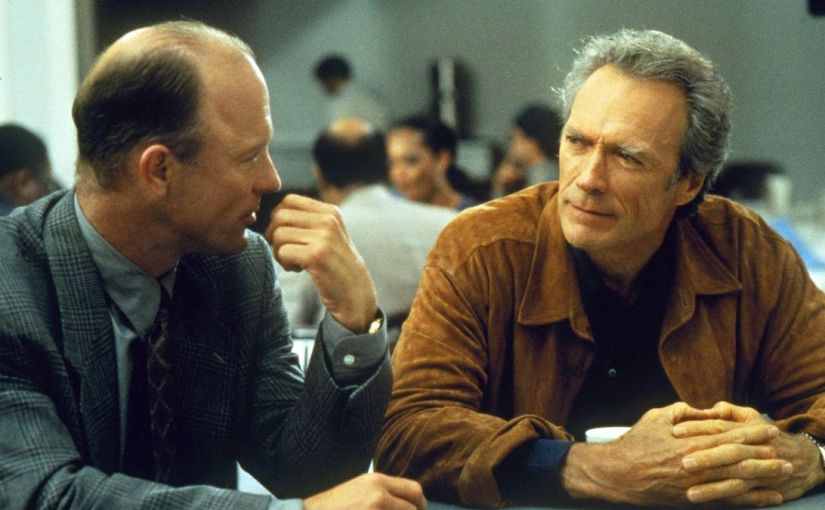
Elsewhere is Ed Harris as the detective out to solve the murder and uncover everything we already know.  When he realizes a thief must have been at the scene of the crime, he actually approaches Luther for some guidance as to who could have been there.  Later, he will use Laura Linney, playing Luther’s daughter, for assistance as her father seems to be the prime suspect. 

The tycoon, the President’s biggest supporter, also wants to resolve his personal vendetta by hiring his own sniper (Richard Jenkins) to take out Luther. 

Absolute Power has all of these players, with recognizable actors in the roles, and yet cannot work the magic necessary to fix this outrageous conundrum.  I can believe that a President could get in more trouble than he needs with a one-night stand and a dead girl on the floor.  I can believe members of his staff will work to tie off all the loose ends, even if it means more murder and mayhem must occur. 

What is hard to swallow is how neatly the story wraps up literally within one afternoon leading into an evening.  It’s fortunate that window washers are present to throw off a couple of snipers with an inconvenient glare at the most inopportune time.  Otherwise, there will be no more movie.  It helps that a character with remorse happens to take his own life, thus exposing the conspiracy, just as Eastwood’s character is steering his own way to exoneration.  All in the same night!!!!

To ramp up the suspense, the bad guys go after Linney’s character, the one person Luther cares for the most.  She ends up in a hospital.  Message has been sent.  Luther better surrender himself along with what he knows to the President’s squad.  Yet, they try one more time to permanently eliminate her and I asked why.  What purpose does that serve to kill her now?  If you kill her, then Luther has nothing to protect or care about anymore.  He can just reveal the entire breakdown of what really happened complete with evidence and so on.

A few years earlier, Eastwood starred in In The Line Of Fire where John Malkovich played a master of disguise assassin.  Luther is also a craftsman at hiding in plain sight.  However, there’s no way I can believe that.  We are looking at Clint Eastwood here.  He’s got his own unique and very tall and square stature.  Put a white mustache and a pair of glasses on the guy, and it is still Clint Eastwood.  Put a hat and beard on him and it is still Clint Eastwood.  Wrap him up in a trench coat and have him walk the city streets in broad daylight where fifty cops are awaiting his arrival and you’ll be able to see the one and only Clint Eastwood.  It just can’t work.  James Bond can hide in disguise.  John Malkovich can hide in disguise.  Go anywhere in the world and Shaquille O’Neal and Clint Eastwood would never be hidden in plain sight. 

William Goldman (The Princess Bride, Butch Cassidy And The Sundance Kid) is one of Hollywood’s most celebrated screenwriters.  He did not think this story all the way through.  You may believe Gene Hackman (second billing behind Eastwood) would have had more of a presence in this picture but oddly enough he’s hardly there. The real bad guy roles belong to Judy Davis and Scott Glenn who are not nearly as exciting as what Hackman could have delivered.

There was a potential for a good conspiracy thriller. The problem is the audience knows too much following the first fifteen minutes of the film.  We know everything that happened and therefore I could care less about the progress that Ed Harris’ detective makes.  Absolute Power likely would have performed better had it opened after the crime had occurred.  Run the opening credits over the dead girl in the room and open the two-way mirror for Luther to enter the frame.  He makes a run for it and then the film can gradually reveal what precisely happened.  A mystery for the characters and the audiences who are watching them only works if the questions are offered before the answers are revealed.

Absolute Power offered a lot of promise with a lot of talent but it’s devoid of both.

SCARFACE (1983)

By Marc S. Sanders

On Thanksgiving Day when we glutton ourselves with an abundance of food, it seemed highly appropriate to watch one of the most self-indulgent pieces ever put on film.  Brian DePalma’s Scarface with a script written by Oliver Stone and featuring Al Pacino.  This is a movie that brags about its boastfulness.  I mean look at everything that is mashed into this thing.  Blood, bullets, lots of cocaine and too much Al Pacino.

Pacino is Cuban refugee Tony Montana.  He is one of a handful of small time criminals who is shipped over to the United States when Castro wanted less people to oversee.  Refugee camps are fenced up under the highways of Southern Florida where no law is enforced among the tented populations.

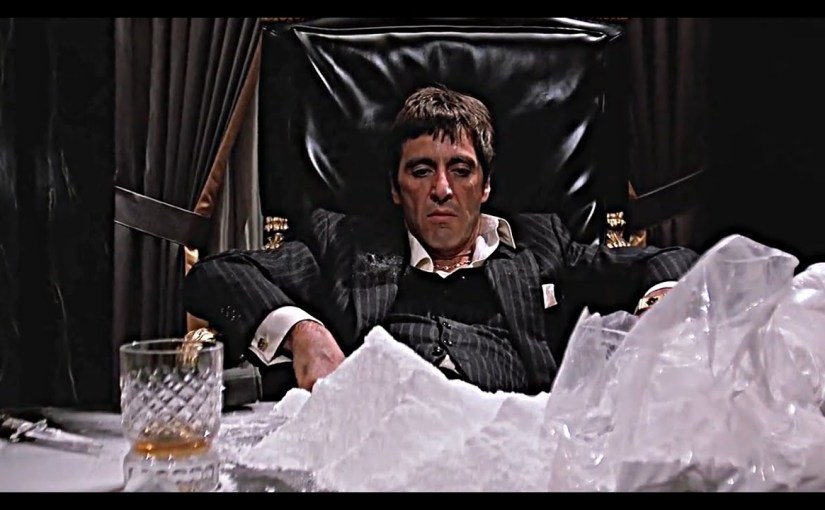
Soon after Tony arrives he’s hot on the scene of pushing the newest underground product through Miami – cocaine.  With his buddy Manny (Steven Bauer) the two men get in good graces with a well dressed sleaze named Omar (F Murray Abraham), who is second in command to an established drug kingpin named Frank (Robert Loggia).  For Tony and Manny it’ll only be a matter of time before they take over as the numbers one and two bad guys.  That’ll include Tony marrying Frank’s blond trophy girlfriend Elvira (Michelle Pfeiffer in her breakout role) and winning a trusting partnership with a South American drug czar named Alejandro (Paul Shenar).  If you ever expect to get killed, you don’t want to be by the orders of Alejandro.  A helicopter serves much more of a purpose once it takes flight.

Scarface is a step-by-step movie or a climb up a three-hour ladder and then a gradual drop down off a balcony into a bloody fountain below.  There’s no depth and it works like a shopping list that you check off as it moves along. Props and houses and suits and jewelry and cars and cocaine and cash have more significance than what anyone has to say. Other than Tony, none of the people in this film matter. What Tony acquires and what he says about himself is all that is important.

This is a big ass movie with bloody graphics and killings, mountains of drugs and money, a lot of fucks, a gaudy estate home, a way over the top Al Pacino and lots and lots and lots of bullets and guns to go with them.  The film only settles for one chainsaw killing, though.  At the time, I recall that scene was up for big debate on the film’s MPAA rating.  Brian DePalma wanted to up the ante on brutality to grab moviegoers’ attention.  The scene remains quite stomach churning.

DePalma’s best work is at the beginning of the Scarface.  Following the establishing real life footage of the Cuban refugees arriving by boats in search of an American dream, Tony is taken into custody and questioned by a batch of immigration agents.  DePalma only keeps one steady camera focused on a very tan Pacino with a faint signature scar on his left cheek, sitting in the middle of the room and putting on a Cuban accent that only he could uniquely own.  Pacino’s concentration in this moment is admirable as he responds to questions from all different directions.  It’s all done in one take with the director’s camera circling around Pacino.  After this introduction is over, the tone of the movie changes for the next two hours and ten minutes into a gritty interpretation of Lifestyles Of The Rich And Famous.

Oliver Stone’s dialogue with Brian DePalma’s set ups don’t require much of the other actors.  It’s like everything caters to an always inebriated, hyperactive Al Pacino doing his Tony Montana with the gold chains and wide collared shirts over the linen suits.  He’s a motor mouth of endless f-bombs, with a slinky Michelle Pfeiffer in a blond bob-cut, dressed glittery evening gowns, at his side.  She has nothing of significance to say.  This is all you learn about Elvira; what you see of her materialism and all the coke she snorts.  She never smiles or exudes any connection to the Pacino character.  It’s all eye candy.  In fact, there’s never a clear answer of what becomes of this character.  That’s a problem because the movie is so much about Tony Montana, nothing else matters.

Other characters not given enough attention are Tony’s sister Gina (Mary Elizabeth Mastrantonio) and their mother (Miriam Colon).  Momma despises Tony for the criminal thug he is while Gina becomes enamored with the wealth and drug night life.  Unfortunately, Momma only has one meaty scene and Gina’s purpose to the script is to lend reason for another character’s eventual demise.  Both of these actresses are very good with what little they have.  Yet so much is devoted to Tony’s indulgence and the mania that Pacino brings that they are sidelined as well.

Brian DePalma seems to be more proud with how excessive he can make this guy than actually turning him into a guy.  Wait until you see the mansion that Tony gets. His office alone is of black, gaudy exuberance. His master bedroom contains a small swimming pool size tub right in the middle of the carpeted floor.  That setting occupies a fifteen-minute-long scene of Tony in a bubble bath, watching his five TV screens while not talking about anything meaningful except himself as he chastises Manny.  Elvira is only there to uphold her dread for her husband as she snorts coke off of her vanity.  When they both leave, an Oliver Stone monologue ends with a now recognizable sound byte of “Well say ‘allo to da bad guy!” Ah! Big deal! Tony never seemed so bad ass as he does feel obnoxious.

Again, Scarface is about not much else except the conceit of sleazy criminal.

When someone has to die it becomes a long drawn-out process as Tony, aka Pacino, puts on a performance or delivers a sermon.  Tony will meet with kingpins from Columbia along with other South Americans and dirty government officials.  There will be 5-7 guys in the room but for the most part it is only Tony talking.

“Say ‘allo to my little fren!” is one of the most memorable lines to come out of the 1980s decade of excess and it arrives during the ongoing and endless bloody shootout that closes the film.  There’s buckets of blood and truckloads of ammunition fired off.  These machine guns seem designed to kill things twice the size of elephants.  Little Al Pacino, with a ginormous cannon gripped in one hand, gets hit in all places and extremities except the head so that he can keep ranting – I mean this guy never shuts up – and going as he fends off the armies of goons coming at him from all directions.  Truly, it’s laughable and nowhere is it ever absorbing.  It’s like I’m watching someone else play a first-person shooter video game during a sleepover.  My friend is entertained while I’m just watching him be entertained.

Scarface comes to an abrupt halt when the final shootout stops.  There’s no footnote to ponder or real news story to follow up on.  The credits roll and the orchestral strings of the soundtrack cut in. You get the idea that DePalma, Stone, and Pacino became exhausted over this monster of a movie and simply declared “Okay! That’s enough!”

Considering the later insightful pieces that Oliver Stone delivered like Platoon and JFK, I wish he explored more of the politics and Cuban dealings affecting the United States.  As this film arrived in 1983, soon after there would be more of an intellectual standpoint to make us aware of a very real drug epidemic in this country.  It may appear to be sending some kind of message, but Scarface doesn’t challenge the brains that flourished this contraband industry.  Forty five minute episodes of Miami Vice tell more than this three-hour opus.

Plenty of gangster films like Chinatown, The Godfather, and Goodfellas offer up the greed and ego of the criminal mind, but the men of those pictures are never as self-indulgent or off putting as Tony Montana.

Besides, what does it say about a movie called Scarface when no one calls the main guy Scarface, and you hardly ever see the scar graced across his profile?  The real Scarface, Al Capone, would be very disappointed in Al Pacino.

THE SECRET OF MY SUCCESS

By Marc S. Sanders

Reader, it has been a hard week.  Hard because my flat screen has been on the fritz.  Finally, today at last, the Best Buy Geek Squad will be paying me a visit and working on a repair. In the meantime, I have had to relegate myself to one of the smaller flat screens within the household.  I feel dirty.  Cheap.  I can’t even look at myself.  Just look away!!!!  Considering the dire circumstances, I could never look at my next big film to review during the absence of my 9.0 sound system and 65 inches of viewing pleasure.  It would be a sin to watch a Christopher Nolan or Steven Spielberg piece anywhere else (unless it’s in the cinema).  Therefore, I settled, and I hit rock bottom.  I opted to for Netflix meh! 

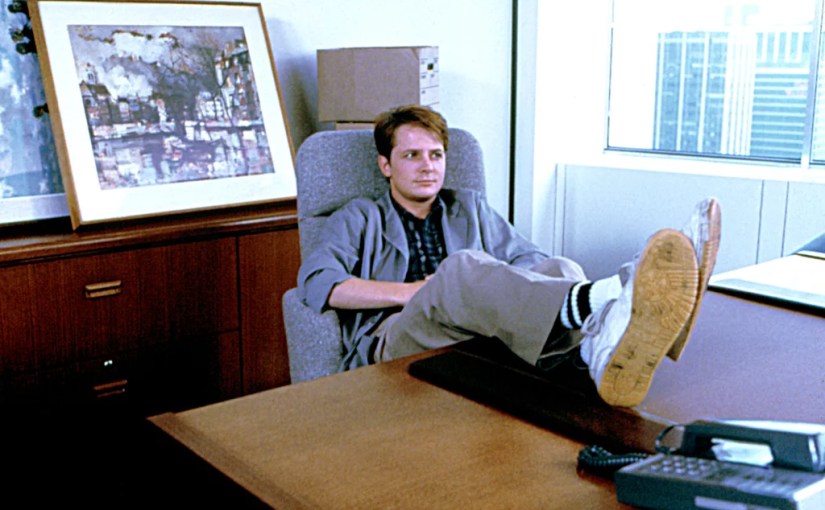
All I have, all I can give you, all I can offer, all I can claim for you during this dark, sad time is Herbert Ross’ attempt at shaping a Michael J Fox thirty second MTV style 1980’s music video into a film.  The “film” is The Secret Of My Success

I recall seeing this movie at age 14 during a field trip to Washington DC with my eighth grade Yeshiva class.  Every time the dimply cute yuppie Canadian sensation from Family Ties and Back To The Future graced the screen, the girls in my class screamed with puppy love glee.  I liked Fox at that time.  I still do.  He was a bright guy and while not an actor like Brando or Olivier, he had a unique charm that defined the clean cut 1980s with knit ties and Benneton sweaters.  His unforgettable Alex P Keaton was the fictional cheerleader for the era of Ronald Reagan, and no one protested.

I recall the promise of The Secret Of My Success as being the vehicle that would elevate his tv persona to the big screen since he already had luck with Marty McFly and a healthy B-movie following with HBO airings of Teen Wolf (a much better movie than it ever deserves to be). Regrettably, this film never landed.  It’s most glaring failure is that it never even lives up to its title.

The assembly of Herbert Ross’ romantic, New York, yuppie comedy occupies itself so much with music montages.  It’s as guilty of its own indulgence as Rocky IV.  How many times must we see a grinning Michael J Fox hustle through the concrete jungle of the city and then through skyscraper cubicle hallways within a white collared business world?  Night Ranger is the ‘80s hair band who provides most of the movie soundtrack and they owe much to Michael J Fox as the face that accompanies their work with trinkling keyboards and electric guitars with the raspy roar of their lead singer.  If Michael J Fox is not walking down streets where apparently supermodels live to turn their heads (I saw you Cindy Crawford), he’s got a pen wedged between his teeth and he’s pulling huge three ring binders off of shelves while doing an all nighter.  This is oh so boring.  In 1987 however, it is all a couple of Teen Beat readers needed in their lives.  I can watch Meryl Streep or Gary Oldman read a three-ring binder.  Michael J Fox just doesn’t have a knack for this skill.

Fox plays Kansas farm boy Brantley Foster.  Now that he has earned a business degree, he has enormous aspirations to climb the top of the New York corporate ladder and make a success of himself with a “beautiful secretary.”  Because, you know, you can’t make it without a secretary, much less a beautiful secretary. 

Upon relocating into a roach infested apartment, Brantley’s plans fall through, and he has to beg his super rich Uncle Howard (Richard Jordan) into giving him a job in the mail room of his building.  Brantley encounters a beautiful blond executive named Christy (Helen Slater) amid a sea of uptight middle-aged men.  The depth of this attraction only goes so far as fantasizing about her walking towards him in a cheesy, glittery pink evening gown with a keyboard and saxophone chiming in.  On the side is Howard’s bored trophy wife Vera (Margaret Whitton) crowding young Brantley in an illicit Mrs. Robinson kind of affair.  Let me clarify.  Vera is married to Brantley’s Uncle Howard.  So, Brantley is being terrorized by Aunt Vera.

For the purposes of ridiculous farce, that might be funny for a moment.  However, The Secret Of My Success takes forever to arrive at the farce it could have hinged on.  Instead, Brantley has to discover a way into the white-collar world when he comes upon an empty office and bears the fictional name of Carlton Whitfield to justify his suits and his motivation to work in the heart of the corporate world.

I noted that the film does not live up to the title.  When Brantley is working the persona of Whitfield, we never get an idea of his brilliant ideas for business success and operations.  We never learn what turned Uncle Howard’s high-rise building into the towering reputation it apparently stands upon.  We never understand the threat of a shareholder’s takeover that Howard and his team fear is imminent.  Where’s the value in anything that Brantley is doing to be that corporate hero and what is he trying to improve or salvage?

Instead, we are left with a very poor chemistry pairing between Helen Slater and Michael J Fox.  Slater is flat out boring with no dynamic to her.  If you want to see how to deliver any variation of a line in a flat, monotone way, then observe what she has to offer.  Fox is on another level of energy that Slater cannot match and Herbert Ross and the script from Jim Cash and Jack Epps Jr (Top Gun, Legal Eagles) chooses to occupy itself more with this romance than the corporate world at play.

The following two years after this film’s release would do better for this hustle and bustle setting with Oliver Stone’s cynical Wall Street and Mike Nichols romantic comedy Working Girl.  The latter film follows a near exact blueprint of The Secret Of My Success.  Yet, it wins because we actually see the main character, portrayed by Melanie Griffith, actually demonstrate her prowess for the cutthroat world of business power and politics.  By comparison, Michael J Fox just wants to play hooky and make out in the back of a limousine.

A last-ditch effort is made though when the big wigs assemble for a weekend getaway. What seems like an attempt at bedroom farce barely gets started with the players climbing staircases and tip toing behind doors and hopping into bed together and blah blah blah.  It doesn’t serve, however, because the idiot plot intrudes where everyone has to act as if they have no idea of who is sleeping with who and who is Brantley and who is Whitfield amid the fast-talking dialogue edited within.  You want to scream at the screen and tell everyone to shut up because this can all be explained in sixty seconds.

Again, as Mike Nichols’ Oscar nominated film eventually proved, there was a better film to be made here for Michael J Fox.  It could have included all of the cynical realities that go with the natures of a corporate American beast.  Instead, The Secret Of My Success relies on music video montages with the teardrop keyboards and the yearning saxophone that seemed like a requisite for the adoring Michael J Fox of the 1980s. 

Enough already!!!!  I need to cleanse my palette.  GEEK SQUAD, WHERE ARE YOU?????