
ASTEROID CITY (2023)

by Miguel E. Rodriguez

DIRECTOR: Wes Anderson
CAST: More Actors Than You Can Shake a Stick At
MY RATING: 5/10
ROTTEN TOMATOMETER: 76% Certified Fresh

PLOT: In the mid-1950s, a roadside motel in a fictional mid-Western flyspeck plays host to a junior stargazing event that unexpectedly escalates, changing everyone’s world view forever.  …sort of.


Asteroid City, Wes Anderson’s latest film, feels like a collector’s edition box of Cracker Jack with no prize inside.  Or a cake that has prize-winning decorations, but it’s hollow inside.  It looks phenomenal; one of my fellow cinephiles, Anthony, predicts it will be nominated for cinematography and production design, and I agree with him.  But where the heart of the film should be is simply a crater like the one around which the fictional town of Asteroid City was built.  This is yet another star-studded cast for Wes Anderson, but Anderson has given them very little to do other than wear colorful costumes, look solemnly into the camera, and speak in very precise phrases.

This strategy has served him very well…no…EXTREMELY well in the past.  Moonrise Kingdom (2012) and Grand Budapest Hotel (2014) spring immediately to mind.  But some crucial piece of machinery is missing from Asteroid City.  The characters are colorful and quirky, but at the end of the day, I simply didn’t care about what they did or said.  (Well…except when actress Midge Campbell [Scarlett Johansson] decides to rehearse her nude scene for her next-door neighbor…I did care about that.)

The film opens with a pillarboxed segment in black-and-white.  Our host (Bryan Cranston) explains that we’re about to watch a staged presentation of the newest play from author Conrad Earp (Edward Norton), who proceeds to lay out the “set” for us.  “Upstage right is the crater…upstage left are the motel cabins”, etc.  Then the screen expands to full letterbox and we are treated to eye-popping Kodachrome desert landscapes as we follow a 165-car freight train as it passes by Asteroid City.  Well, “City” should be in quotes…the population is officially listed at eighty-seven.

This is some wacky city.  It’s as if Wes Anderson watched every Coen Brothers film set in the Midwest, from Raising Arizona to No Country for Old Men, and filtered them through a Looney Tunes cartoon written by Charlie Kaufman.  Vending machines on the porch of the rental office sell everything from snacks and drinks to martinis and parcels of local real estate.  (Cost for the real estate parcels: forty quarters…they’re not big parcels.)  An abandoned highway overpass lurks on the outskirts.  Periodically, a police chase roars down the otherwise empty highway, guns firing and sirens blaring.  The residents say nothing about this phenomenon.  And every now and then, the town shakes from nuclear testing being done hundreds of miles away, but close enough that the mushroom clouds are visible.

Man, I love this kind of thing.  The stage is set for one of the all-time great satires, or maybe just a flat-out fairy tale.  We meet the cast of characters who have congregated here to honor young geniuses who have invented everything from rocket packs to particle guns to a projector strong enough to project an image on the moon.  A full rundown of all these characters would wind up being a novella, but if you’re acquainted with Anderson’s work, they will all be familiar to you in one way or another.  (Not least because many of them have worked on Anderson’s other films.)  They have also gathered to witness a rare astronomical event: a solar ellipse.  Not an eclipse.  An ellipse.  The mechanism required to view an ellipse without damaging your retinas looks like something out of Brazil.

Again, I normally love this kind of stuff, really, I do.  But…okay, look, first of all, the film intermittently takes a break from the movie itself to yank us out of the story and show us an event in the playwright’s life that led to the casting of Augie Steenbeck.  Or to show us a rehearsal where an acting coach (Willem Dafoe) encourages the actors – that we’ve already been watching perform in the movie/play – to improvise what it’s like to wake up by first falling asleep.  There’s even a moment where the host shows up where he really shouldn’t be.  And when one of the actors has a moment of existential crisis concerning the character he’s playing, he simply walks off the set, goes backstage and asks the director (Adrien Brody) why he’s doing what he’s doing.

…I mean…what IS this?  Conceptually, I get it, even if it’s a little heavy-handed.  (“What’s my motivation?”  “You’ll have to figure it out as you go along.”  “That’s too hard!”  “Well, that’s life.”)  But…why is it here?  Anderson worked with non-linear structure before in Grand Budapest Hotel, and it worked marvelously.  Here, it feels indulgent.  In fact, many of the scenes in the movie feel that way.  There’s a moment where an army general (Jeffrey Wright) announces he’s going to deliver a speech he’s prepared for the occasion of the “ellipse.”  But this is no ordinary speech.  It’s practically beat poetry, delivered with the kind of conviction that only Jeffrey Wright’s magnificent voice can provide, but…but…why is it here?  Even in this weird, cotton-candy, retro-fever-dream of a movie, this “speech” felt out of place and just plain goofy.  In fact, quite a lot of the scenes between characters felt less like story and more like the kind of dialogues you find in source books for actors.  (101 Scenes for Two and Three Actors…that kind of thing.)

I will provide full disclosure and say the movie did deliver some decent laughs and chuckles.  There is an event that occurs during the ellipse (I’ll have to tread carefully here) that may not be entirely unexpected, but it’s executed and timed so well that I laughed pretty much through the whole scene.  It’s the kind of thing I imagine Buster Keaton and Charlie Chaplin would have thoroughly enjoyed, if I may be so bold.  There is also the problem of the disposition of a Tupperware container holding a valuable, ah, keepsake.  Oh, and that roadrunner was awesome.

But by the time Asteroid City rolled credits, I didn’t feel like I had seen one of Wes Anderson’s best films.  (The Royal Tenenbaums remains his best film, in my opinion.)  This almost felt like a movie made on a whim, kinda like, “Hell, I don’t know if this’ll work, but if I get enough star power behind it, this may turn out to be something.”  Alas, it did not.
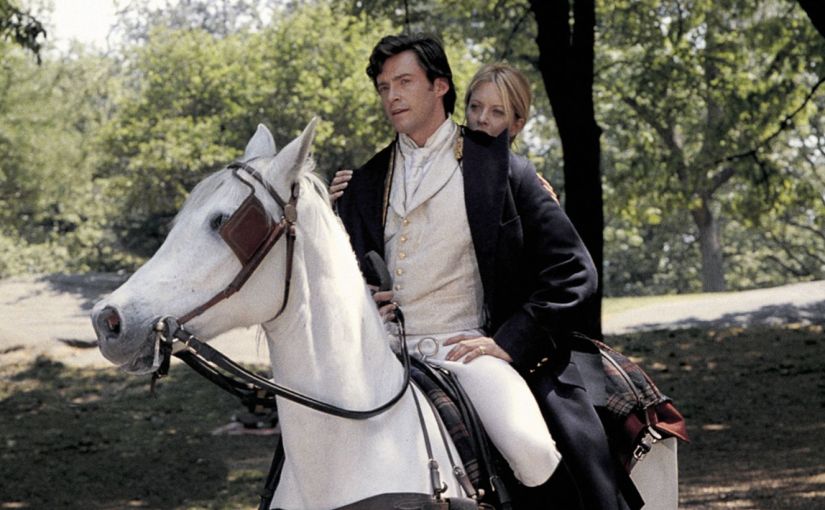
KATE & LEOPOLD

By Marc S. Sanders

Fish out of water stories will always be told. Kate & Leopold directed by James Mangold reminded me of the New York City based romantic comedy Big, which was a better variation on that formula.

In Kate & Leopold, Hugh Jackman portrays the second title character also known as the Duke of Albany in the year 1876, and apparently the eventual inventor of the elevator. One night, he pursues a curious fellow who is attending an evening ball designed to find a bride for Leopold. The man runs and Leopold gives chase into the rain where they find themselves hanging from scaffolding of what will become the Brooklyn Bridge, designed by-you guessed it-Leopold. The moment of suspense ends with Leopold accompanying the fellow named Stuart (a very miscast Liev Schrieber) into present day New York; a New York unfamiliar to Leopold where manners of grace and elegance have gone out the window and you’re expected to pick up your dog’s poop following a walk.

Let’s get this out of the way, quick. Stuart has uncovered time travel. How does it work? Who cares? Move along.

Stuart’s ex-girlfriend and downstairs neighbor is played by the late 20th century staple resident of the Big Apple movies, Meg Ryan. She’s the Kate of the film’s title. Just like other romantic comedies of this nature, Kate is tense and stressed and trying to land a big account where she’s looking for the right spokesperson for a new butter spread commercial. You think Leopold, in his signature 19th century outfit, may fit the bill? I’m thinking you guessed correctly.

What else do you think happens? Yeah. You’re right. Kate and Leopold start to fall in love.

I grew tired of Kate & Leopold for a few reasons. There’s a side story meant for some slapstick kind of humor where Stuart, who is the “Doc Brown” of this picture, falls down an elevator shaft only to be relegated to a mental ward where he struggles to get in touch with the leads to explain what must be done from here. C’mon!!! A patient in a hospital should be able to make a lousy phone call.

Two, as Leopold romances Kate as well as coaches her brother (Breckin Meyer) in the ways of romance, how does he manage to find the financial resources for a violinist or the decor he uses to uphold his manners of refine? Reader, if I’m occupying myself with these trivial questions, then what do you think might be wrong here?

Chemistry!

Most importantly, the chemistry between Ryan and Jackman seems way off. I didn’t believe for a second these two were falling in love with one another. They speak two different variations of English and while Leopold is a man of great chivalry, I never found a moment in the film where he would be captivated by the modern-day Kate. What did Kate do anywhere in this picture that swept him off his feet? For Kate, when did she fall in love with Leopold? She’s hardly giving him the time of day and he’s really only a convenient opportunity to rescue her big account, but that’s not love for me. That’s not romance. That’s, at best, discovery. Like finding the next big talent or gimmick. If this is what love is, then who fell in love with Mr. Clean and how many years is the Jolly Green Giant married now? Did the Kool-Aid Man find his betrothed when he smashed through her kitchen wall?

In Big, director Penny Marshall found opportunities for the Elizabeth Perkins character to stop and look at the 12-year-old character version of Tom Hanks. Because she stopped and looked, she then still felt comfortable in her own skin. Hanks’ kid like character develops a first crush. A first crush may not be love, but to a 12-year-old, nothing is more confusing or self-occupying.

In Mangold’s film which he co-wrote with Steve Rogers, Leopold admits early on that he’s never been in love. Where’s the weight of his emotions here? I never uncovered those moments between the characters of Kate & Leopold, while a film like Big devoted a wealth of attention to it.

As well, like I said earlier, I could not take my mind off figuring out how Leopold is paying for this elegant rooftop dinner. Where did he get the money, in New York City, to pay for all this?

Know what Tom Hanks did in Big? He got a job!

SPIDER-MAN: INTO THE SPIDER-VERSE (2018)

By Miguel E. Rodriguez

Directors: Bob Persichetti, Peter Ramsey, Rodney Rothman
Cast: Shameik Moore, Jake Johnson, Hailee Steinfeld, Mahershala Ali, Lily Tomlin, Kathryn Hahn, Liev Schrieber
My Rating: 10/10
Rotten Tomatometer: 97% Certified Fresh

PLOT: In an alternate New York City, Miles Morales is bitten by a spider that has been strangely affected by scientific experiments being conducted by Kingpin. He soon meets other Spider-People from OTHER alternate realities who were dragged to Miles’ reality by those same experiments…


Right from the opening credits, an intense, fan-boy-level love of the Spider-Man characters (and comic books in general) radiates from the heart of Spider-Man: Into the Spider-Verse like those little squiggly lines of “spider-sense” that instinctively tells the various spider-people that they are in the presence of other spider-people.  It tells the other fan-boys, fan-girls, and fan-adults that here, at last, is a cartoon comic-book movie worthy of standing with the live-action giants of the MCU, both in terms of visual spectacle and in terms of an extremely solid, well-told story.

When I saw the first trailers for this film, I instantly dismissed it as yet another cinematic screening of a forgettable, straight-to-video animated feature.  The style looked like some kind of mish-mash of CG figures and hand-drawn faces, trying way too hard to be different without actually being effective.  The story was ultra-cheese, the kind of thing that even comic-book writers would find old-hat: a trans-dimensional rift allows Spider-People from different alternate universes to interact with each other at the same time.  And one of them is a literal cartoon pig called Spider-Ham.

Right.

So the movie gets released, and one day I take a peek at the ol’ Rotten Tomatometer, and it’s like at 95 or 96 percent.  And I’m STILL skeptical because the Tomatometer is only really accurate about 80% of the time.  But it continues to get buzz, and everyone on Facebook who sees it posts saying, “WOW, was that a good movie!”  It suddenly becomes the must-see movie of the holiday season.

So.  We saw it today, and just got home.  And WOW, was that a good movie!  It is fulfilling in just about every way a movie can be.  It had loads of humor; it was brilliantly original; it was visually stunning; it had real, EARNED dramatic moments; and it has the best credit-cookie since Ralph Breaks the Internet.

A lot of the film’s impact comes from that stunning visual style, which I initially dismissed.  As much as Sin City and Watchmen before it, Into the Spider-Verse takes great pains to recreate the look and feel of a comic book in as many ways as possible.  Speech panels appear occasionally.  Sound effects are manifested as words: “bap!” and “BOOM” and “bagel!”  (Yes, that is one of the sound effects.)  A lot of backgrounds are made to look as if they’re printed off-kilter, much like some comic books used to be printed back in the stone age.  This non-realistic style allows the filmmakers to create a crazy climax that would be virtually impossible with a live-action film; the CG would look too crazy to take seriously.

Aside from the visuals, there’s also the stunning originality with the screenplay.  For example, given the fact of many (infinite, really) alternate universes, the variations the screenwriters use are truly ingenious, particularly when it comes to the villains.  Kingpin makes an early, ENORMOUS appearance (he looks like the Hulk in a business suit), and he has a henchman that I really should have recognized earlier.  And the cleverness of Doc Ock’s arrival had me shaking my head in admiration.

The storytelling takes the time to let us get to know the inner workings of the main characters, a rarity in a non-Pixar film.  Miles Morales (the focal point of the story) is a high-school kid, loves his Latina mom and African-American dad, doesn’t love his new private school, loves bonding with his ne’er-do-well uncle…these connections are solidified in our minds so when the moment comes when a family member’s life is on the line, you feel it, man.  It’s not just drawings going through the motions.

It’s very hard for me to discuss the humor without giving away some of the best jokes.  You just have to trust me on this one, besides being one of the best comic-book movies of the year, it’s also one of the funniest.  (I LOVED the fake movie posters in Times Square.)

In closing, I can only apologize to the movie gods for completely dismissing this movie on the basis of the trailer.  Ever since that happened to me with Fight Club, I’ve tried to avoid making that kind of snap judgement.

SPOTLIGHT

By Marc S. Sanders

It’s tough to be a fair journalist when a higher power carries great influence over the what and how of honest reporting. In Tom McCarthy’s Best Picture Oscar winner, Spotlight, it’s not so much the crimes of child molestation by the hands of priests from the Boston Archdiocese that are so important. Rather, it is how the facts are suppressed and the pressure to contain the truth are so apparent. Maybe it finally took the will of a new editor, a Jewish editor from New York, named Marty Baron (Liev Schrieber), at the esteemed Boston Globe newspaper to get the special section crew known as Spotlight to work on how case after case of reported child molestation incidents were allowed to occur for decades under the eye of the highest powers in the church.

First, it’s important to note how easy it is for a priest to seduce a young boy. He welcomes the boy for special duties within the church. Then the priest and child may share a dirty joke together. Just their little secret. After that, touching occurs which leads to unimaginable and irreversible damage. Yet, the grown man once considered that special attention he received as a direct link to God himself. McCarthy deliberately repeats that viewpoint from more than one victim in the film; it was as if God had selected them for special attention and God was especially speaking to them. None of this could be more patterned.

Marty Baron counts on his team to not only collect the mounting number of cases. He tells them to uncover an even worse truth and that is the systemic response the church upheld where when a new case comes to light, a deal is worked with a pawn for an attorney to give settlement hush money while the priest in question will take sick leave or simply be reassigned to another church location free to do God’s will while also committing his own willing nature.

The Spotlight team consists of Mark Ruffalo and Rachel McAdams as well as Michael Keaton. All of their true to life characters were born and raised in Boston. Some under Catholic influence. So the conflict for them to do their jobs ethically and morally is challenging when faced with literally going up against the one institution that seems to own the city of Boston without it showing on paper necessarily. It also means coming to disheartening terms with their own upbringing.

To convincingly depict the grasp the church has on the politicians and newspapers in the area, McCarthy shoots a lot of his talking scenes outdoors on public benches and sidewalks. Therefore, you get an almost claustrophobic shadow of how close the Catholic Church is to the city’s residents. If a scene is at a dinner party or cocktail hour, a man of the cloth is nearby. A sidewalk stroll between a victim and a reporter seems to tread carefully. You never know if that cathedral on the corner is listening. Spotlight is primarily a journalism film of the highest standard. The pursuit for the truth is ripe with the obstacles of slamming doors when trying to get a statement or dealing with the unfair reveal of no records that legally are meant to be public. There’s a race to get the whole truth before a competing media outlet grabs it and misconstrues it. As well, what happens when a bigger story suddenly takes precedence and this story must be put on hold. I mean how do you not drop everything to report on 9/11?

Spotlight is another important film as it does not compromise in its true to life storytelling. It’s unfathomable to believe that men of God could use their positions to take advantage of the innocence of children and then refuse to accept responsibility for it. Even worse is the egregious actions taken to modify the authority of local law enforcement and judicial objectivity that should be there to protect the rights of these victims.

Tom McCarthy’s piece is excellent with a cast in top form. It would have to be as the screenplay is peppered with conversation after conversation. This is a newspaper film. So therefore it’s a talky piece. You get passionate monologues from Ruffalo who does not hold back his anger and disgust at what he uncovers with an acerbic but crusading attorney played beautifully by Stanley Tucci. This attorney has lost every battle he’s had with the church but he does not give up on his client victims either. He’s their only protector in an arena of powerful criminals who hide behind scripture.

You also have a real go-getter reporter in Rachel McAdams. McCarthy repeatedly shoots her from behind walking the streets of Boston with a pad and pen as she meets a victim or simply knocks on neighboring doors for some facts. Her challenge is seeking the truth while her grandmother holds an undying faith in religion of Catholicism by visiting the church at least three times a week. A crushing, albeit brief, scene occurs near the end of the film when the reporter’s grandmother reads her final story in the Spotlight section.

Michael Keaton is the Irish Bostonian rooted in tradition. He knows all the important people in the city. He knows Cardinal Law who runs the church and he holds on to his journalistic code of fact collecting for as long as he can muster.

The truth and web of lies and deceit could never really shock me in Spotlight. I’ve heard it all before. Instead, it’s the knowing acts of concealing horrifying sin. Ironically, those actions are committed by those that listen to the confessions of its sinful disciples. As I’m of an age where I question the validity and need for religion in our upbringing, I can’t help but wonder how these victims would have turned out had religion never became a factor in their lives. These children, now men, went on to commit suicide, become chemical dependent, and occasionally became child molesters themselves. It’s easy to argue that these conditions were never part of their chemical make up. It’s also easy to argue that the Catholic Church carelessly determined the destinies of these men without any regard for being accountable of the damaging results. Spotlight confidentially reaffirms both of these arguments.