MONTE WALSH (1970)

by Miguel E. Rodriguez

DIRECTOR: William A. Fraker
CAST: Lee Marvin, Jeanne Moreau, Jack Palance, Mitchell Ryan
MY RATING: 7/10
ROTTEN TOMATOMETER: 89% Fresh

PLOT: An aging cowboy realizes that the West he knew and loved will soon be no more – and that there will be no room for him, either.


Based on this film, Monte Walsh, and the other two films he directed, A Reflection of Fear [1972] and The Legend of the Lone Ranger [1981], I think it would be charitable to say that William A. Fraker’s best films are the ones where he served instead as director of photography, such as Bullitt [1968], WarGames [1983], and Tombstone [1993], among many other notable movies.  Am I saying Monte Walsh is a bad film?  No, but it’s certainly not as bad as Gene Siskel’s 1-star rating, nor is it as stellar as Roger Ebert’s 4-star rating.  I give it a 7-out-of-10 on my scale because of the way the second half of the film builds and builds so that the outbursts of violence feel earned and motivated instead of cliched.

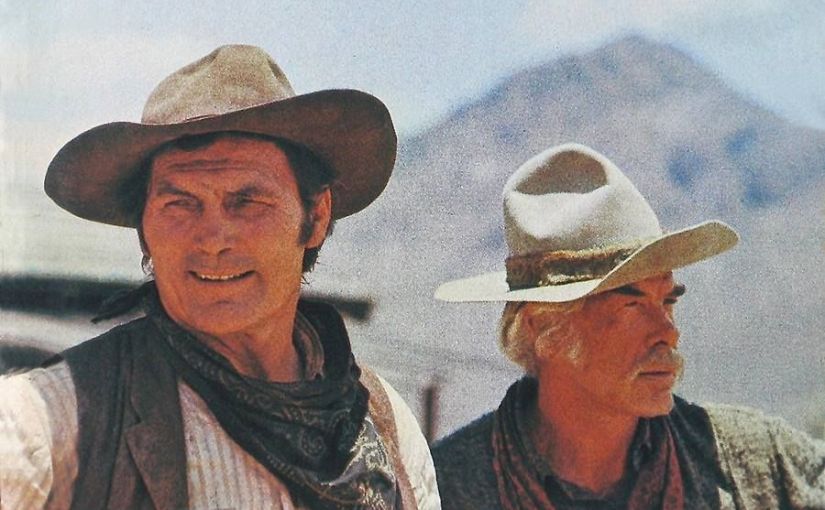
Monte Walsh (Lee Marvin, grizzled as ever, even with a handlebar moustache) and his friend and partner, Chet (Jack Palance in a rare non-villainous role), come down off a mountainside after a rough winter keeping watch on Mr. Brennan’s herd of cattle, only to get news that Brennan’s ranch has been purchased by a corporate entity, Consolidated Cattle.  Brennan offers them a steady job, which they reluctantly take, but deep inside they know this means their prairie-roaming way of life is coming to an end.  Chet is prepared to accept this, but Monte chafes at the idea.  “I ain’t doing nothing I can’t do from a horse,” he warns Brennan.

We get entertaining glimpses of the ranch hand life, complete with the saloon fights and the stinky cook.  Monte dallies with a French madame, Martine (played by the exotic Jeanne Moreau).  At one point, Monte and Chet ride out and meet a weathered old ranch hand who is “riding fence,” or inspecting every foot of fence around the ranch for repairs…the only work he’s cut out for anymore.  “Looks like his life is over with,” they say, and you can tell they’re looking into their own future.

The thrust of the film is one I’ve seen in many other westerns before this one: “The old West is changing, and there’s no place in it for people like us anymore, so we’d better evolve or die.”  This theme is present in Once Upon a Time in the West [1968], Butch Cassidy and the Sundance Kid [1969], and especially The Wild Bunch [also 1969]…seemed to be a trend for westerns at the turn of the decade, for some reason.  Monte Walsh handles it in an episodic format, kind of like another Lee Marvin film, The Big Red One [1980].  It doesn’t quite tell a straightforward plot with a pre-determined story arc.  It skips around a little bit, painting a picture without telling a conventional story.

There can be a sense of freedom in this kind of storytelling.  Unshackled by traditional story beats – at least for the first half – the movie is laid back, asking the viewer for a little patience as it slowly lays down building blocks for the finale.  However, I must report that I found this section of the movie a little slow.  I grew impatient.  I felt I was being set up for something, but pretty soon I just wanted the movie to get on with it.  Butch Cassidy sort of works that way, but you had two of the most photogenic stars who ever lived as the two leads.  I struggled to care the same way for Jack Palance as I did for Paul Newman.

But then an unexpected scene of violence occurs, setting into motion a series of events that culminate in a tragic series of deaths that, I must admit, had me glued to the screen as they unfolded.  Because of the gangbusters nature of this section, I am inclined to forgive the film’s shortcomings in its first half.  Here, we see, yes, Monte must evolve or die, and even if it’s never in any real doubt what he will choose, it’s entertaining to watch him make that choice.

If not for the second half of the picture, I might not even be writing about Monte Walsh.  I didn’t care for the opening song (even if it WAS sung by Mama Cass), some of the movie felt ripped off from several other westerns, and I was borderline bored for the first half.  But if you stick with Monte Walsh until the end, I think you’ll agree it’s worth a look.

THE KILLERS (1964)

by Miguel E. Rodriguez

Director: Don Siegel
Cast: Lee Marvin, Angie Dickinson, John Cassavetes, Clu Gulager, and in his final acting role, Ronald Reagan
My Rating: 5/10
Rotten Tomatometer: 80%

PLOT: A hit man and his sadistic partner try to find out why their latest victim, a former race-car driver, did not try to escape.


…well, THAT was disappointing.

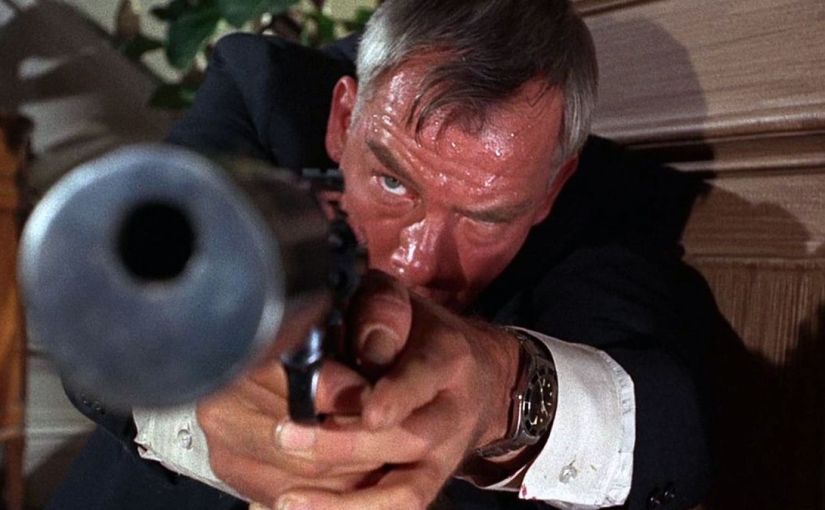
Fresh off watching the original The Killers from 1946, I dove into the 1964 remake.  Originally intended for television – indeed, this was supposed to have been the very first made-for-TV movie – it contained so much casual violence and sexual content that no network would touch it, not even the network that commissioned it, NBC.  It was imported to movie screens, pillarbox framing and all, where it cemented Lee Marvin’s status as one of the all-time great Hollywood tough guys.  (How tough?  He reportedly shot a scene while he was literally falling-down drunk.  That’s the take that’s in the film; you’ll know which scene it is when you see it.)

But while Lee Marvin is indeed tough, and even though his partner (Clu Gulager) plays a sociopathic killer who brings tension to every scene he’s in, I couldn’t get as worked up over this remake as I did over the original version.  Those two performances aside, this movie felt cliched and a little boring to me.

The story is the same as the original, with a couple of minor changes.  Two hitmen stroll into a school for the blind (!) and gun down Johnny North (John Cassavetes) in broad daylight.  Afterwards, Charlie, the veteran hitman (Lee Marvin) latches on to something he can’t figure out: why didn’t the target try to escape?  He does his own digging which leads him to a motley assortment of thugs and one duplicitous dame, Sheila (Angie Dickinson), who isn’t just a gold-digger, she’s a gold-strip-miner.  Turns out North was part of a million-dollar heist along with Sheila and some other thugs, including Jack Browning (Ronald Reagan).  The heist was successful, but after a series of double-crosses, no one seems to know where the money is.  With his seriously psycho partner, Lee (Gulager), Charlie tracks down the witnesses, and we get the same flashback structure as the original.  And the more he digs, the less he likes what he finds…

One major factor that didn’t score many points with me was the production’s obvious roots in television.  As you can well imagine, lighting on a movie set is very different from lighting for television.  And this movie looks like a TV movie through and through.  At the time, because of the relatively smaller screens of most televisions, it was believed that a movie shot FOR television needed bright lights and especially colors, so the pictures would be clearly visible on the tiny screens.  Well, in this remake, everything is so brightly lit and colorful it looks an episode of Star Trek or any other TV series of that era.  The very brightness of the surroundings drains a lot of the tension out of scenes that are meant to be disturbing or violent.  Blood doesn’t look like blood; it looks like Sherwin Williams.  I’m aware of the technical limitations of the time, but the shortcomings are just so obvious that it left me cold.

(By comparison, the original 1946 version is steeped in darkness and shadows and pools of light; it’s not only more beautiful, but it also just works better for the story.)

I also had problems with the casting of some of the big character roles, but my momma always said, if you can’t say nothin’ nice, don’t say nothin’ at all.  So that’s all I’ll say about that.

The editing was also a little distracting.  Again, this might be a factor of the period when it was made, as well as the fact that it was intended for TV, not the movies.  But one scene annoyed the heck out of me.  I don’t normally nit-pick bad editing, but here goes.

There’s a scene where someone has to drive a car down the length of a winding dirt road within two minutes, if not faster.  Zoom, off he goes.  And as we cut back and forth to various shots showing the car’s progress, instead of cutting directly to a different vantage point or camera angle, it’s cut with fades, which are normally used to indicate a passage of time.  But when the fades are used in what is basically a race against time, it has the effect of making the scene feel longer than two minutes, even though only 30-40 seconds of real time have elapsed.  It made the whole scene feel “off”, even amateurish.  Director Siegel had already directed 15 or 16 films by this time.  I think he should have known better.  Or his editor should have.

By the time we get to the end of the film, we’ve seen someone get dangled out of a hotel window from seven stories up, six or seven people get shot dead (one by a sniper rifle), more double-crosses than a Luftwaffe squadron, and a future hardline conservative President of the United States play…a villain.  But it all felt like an exercise in futility.  Sure, you get Lee Marvin playing a tough guy, but in three short years he’d get to play a really tough guy in Point Blank.  THAT’S the movie you wanna see. Or go find Dirty Harry, or even Escape from Alcatraz, both directed by Don Siegel, both superior films.

This one?  This one I only got because it came packaged with the 1946 version on the Criterion Blu-ray.  Do with that information what you will.

THE DELTA FORCE

By Marc S. Sanders

In the 1980s, a small production company named Cannon Films was started by an Israeli named Menachem Golan.  It churned out at least a dozen Charles Bronsan cheapy crime dramas and gave longevity to his Death Wish series of films.  Cannon also provided another franchise called American Ninja with action star Michael Dudikoff.  Dudikoff, nor any of his films won an Oscar, much less a Golden Globe or even an MTV Movie Award.  The poor guy with twenty bottles of mousse in his hair didn’t even get turned into an action figure. 

While I did see Death Wish 3, ahem…five times in the movie theatres (I mean there’s an outstanding final thirty minutes of a wall to wall shootout action in that film, and it was all a 13 year old boy yearned for at the time), Golan’s best product that I have at least seen to date is The Delta Force, featuring Chuck Norris, Lee Marvin and a host of stars most recently having been featured in every disaster film to crank out of the 1970s; Shelly Winters from The Poseidon Adventure, Robert Vaughn from The Towering Inferno and George Kennedy from every Airport movie under the sun.

Golan directed this film that was inspired by the 1985 hijacking of a TWA flight heading for Athens, Greece and he pretty much directed two different kinds of films in one.  The first hour focuses on the Libyan hijackers, led by an unrecognizable and terrifying Robert Forester, and their hostages.  A plane carrying mostly Americans is taken captive in midair and is diverted to Beirut.  Like the real-life event, a German born American stewardess is forced to select the Jewish passengers (Winters, Lanie Kazan, Joey Bishop and Martin Balsam) and separate them for an unknown fate.  An American Navy serviceman is also brutally tormented and later, an airline pilot (Bo Svenson) is interviewed by the media from the open window of the grounded plane’s cockpit, complete with a gun to his head.  All of this happened during that harrowing event.  Golan does a very good job of capturing these moments with heartbreak, fear and genuine terror.  The Jewish selection process is a scene that I take very personally, and it is not overdramatized as it glaringly hearkens back to the atrocities of the Nazis who sent millions of Jews to certain death, torture and concentration camps.  Remember, this film was released only 40 years after those terrible events.  Golan’s filmmaking makes certain the Holocaust is never forgotten.

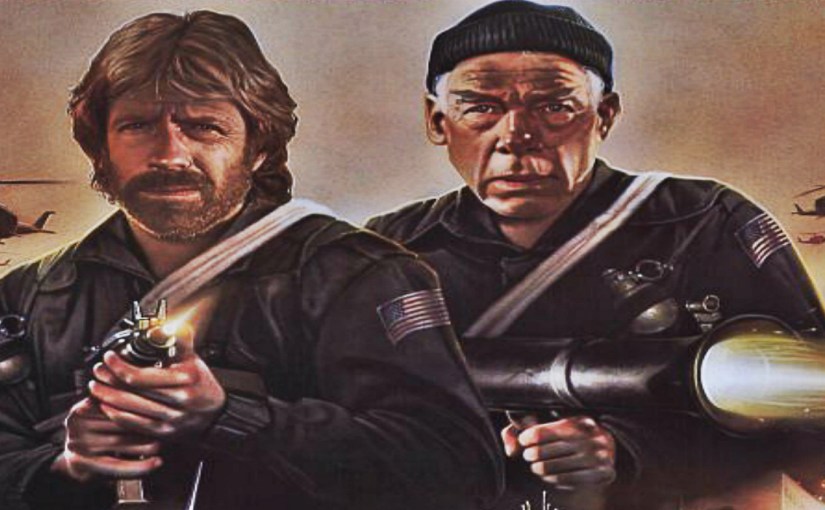
Sprinkled throughout these first hour scenes are bits and pieces of the American strike team known as The Delta Force, led with gruff command by Lee Marvin and silent but deadly Chuck Norris.  These guys gear up, dress in black uniforms, load their aircraft carrier with motorcycles and armed dune buggies, listen to Marvin’s instructions and wait and wait and wait.  There’s something to appreciate in the wait of these skilled snipers and specialists.  Golan doesn’t rush the action.  Material is depicted showing Marvin, Norris and company exploring the options they have for taking out the terrorists and rescuing the hostages.  This is not a typical Rambo movie of destroying the village just to save it.  However, once the action starts, it doesn’t stop and Golan lets Norris do all the things he’s known for while arguably inspiring how POWERFUL Chuck Norris is compared to…well…anything else.  Don’t forget!  Inside Chuck Norris’ chin is ANOTHER FIST!  Also, Superman wears Chuck Norris underoos!  Chuck Norris can unscramble an egg!  Chuck Norris made a snowman out of rain!  It’s hard not to deny these claims when the film boasts a strike team consisting of 20-30 members, but Norris seems to do all the work and heavy lifting. 

It’s hard not to get caught up in The Delta Force.  You wanna see these terrorists get blown up real good.  You also wanna see Chuck Norris ride an agile moped equipped with an endless supply of missiles and ammunition ready to overturn enemy vehicles and bloody up a bad guy until he screams and turns on one foot before dropping dead with his eyes opened.  You also may get a jolt of energy from Alan Silvestri’s rah rah theme music that quickly stays embedded in your subconscious.  I read that his music was used for a time when the Indy 500 would air on TV.  That does not surprise me at all.  Its symphonic themes are as memorable as the Monday Night Football tune.

Unlike, other Norris films this crowd pleaser doesn’t just rely on him and his roundhouse kicks.  There’s a little bit of that schtick for the fans, but I gotta say I was truly touched by the cast as whole.  Lee Marvin (in his final film) echoes George C Scott’s portrayal of Patton.  The collective hostage cast are not overdramatized here.  Golan managed to capture a history to them.  While I thought Shelley Winters was a such joke for fodder in Poseidon, here she is truly sorrowful as she is separated from her husband played by Balsam.  Kazan and Bishop are equally touching.  Reader, this Jewish guy originally from New Jersey, who attended ten years of Yeshiva education, recognizes these folks when they are spirited vacationers early on, and then later tormented prisoners who’ve faced horrors like this before.

I know that Cannon Films also produced another favorite called Runaway Train with an Oscar nominated performance from Jon Voight.  As I write this column, I’ve yet to see that film.  It’s on my radar.  That being said, I have to wonder if Golan and company had stayed on this trajectory of genuine drama like he mustered in portions of The Delta Force, what powerfully impactful films might he also had up his sleeve.  Unfortunately, we were left with too much excess like American Ninja, I’m afraid.

Still, after watching The Delta Force you’ll absolutely believe that Chuck Norris can see things that don’t exist and that he counted to infinity…twice!