JFK – DIRECTOR’S CUT

By Marc S. Sanders

Oliver Stone’s JFK is told through perspective, not necessarily history.  It’s not a biography and I do not believe Stone would ever claim it to be so.  It’s a thinking person’s picture that gives viewers entitlement to question what occurred, how it occurred and why it occurred.  It might guide you not to trust what anyone says, sees or hears, but let’s face it.  Probably the day Kennedy was shot, November 22, 1963, could we ever completely trust anyone ever again? 

(Forgive my cynicism.  I must backtrack a little.  I still trust my wife and daughter.)

Oliver Stone works through the eyes of New Orleans Prosecutor Jim Garrison (Kevin Costner, in what may have been his most challenging role to date at the time).  Garrison sees a little too easily that there are circumstances out of place, or maybe too neatly in place to satisfy the ultimate resolution that a known American defector to the Soviet Union, like Lee Harvey Oswald (Gary Oldman), acted alone in the assassination of the President.  Stone wrote the script for JFK with Jim Marrs and used Garrison’s input from his own novel. Nearly every scene builds into another possibility of how that fateful day came to be.  Stone even questions if a famous photo of Oswald on the cover of Life Magazine is real.   Too many cover ups with a building list of body count witnesses and too many coincidences keep Garrison up at night.  So, he assembles a crack team of investigators and fellow attorneys to reopen the case and question the official Earl Warren Commission.

Firstly, JFK is magnificent entertainment with a hair raising and unusual original score from famed film composer John Williams.  His notes on percussion with dings and harpsichord strings cue in at just the right moments when Stone introduces another one of many scenes that point out what seems cagy and suspect. The music of JFK works as a narrator.  This narrative keeps you alert.  Maybe you should look in each corner of the screen at times for some subtle clues.

It was also wise of Stone to go with a well-known cast of actors.  The Oscar winning editing from Joe Hutshing and Pietro Scalia moves at a breakneck pace.  Yet, because I recognize fine performers like Ed Asner, Jack Lemmon, Kevin Bacon, Tommy Lee Jones, Brian Doyle-Murray (Bill’s brother), John Candy and Joe Pesci it is easy to piece together who is playing who and what significance they lend to the many theories Garrison and Stone question next.  

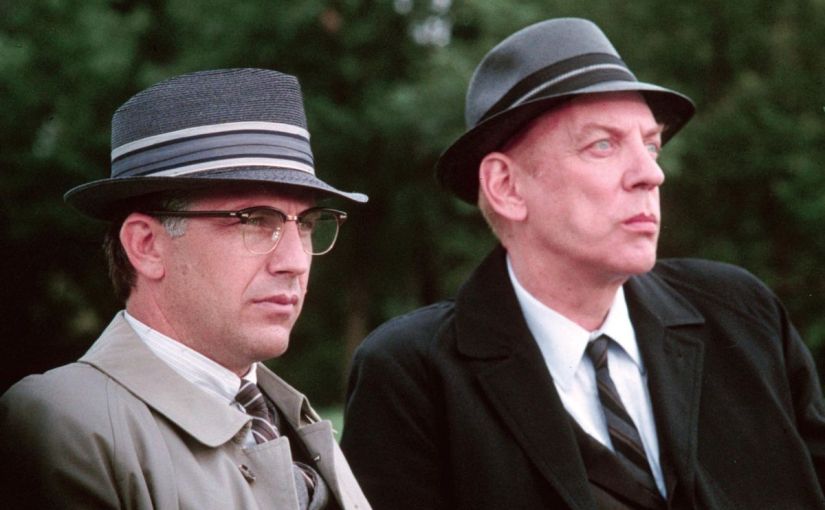
My admiration for the casting continues with the Garrison team that performs with Costner – Michael Rooker, Laurie Metcalf (especially impressive), Wayne Knight, and Jay O. Sanders.  There’s also a clandestine trench coat guy named X portrayed by Donald Sutherland.  Who even knows if this guy ever existed?  He’s more secretive than Deep Throat, but Mr. X has a hell of a lot of information to justify Jim Garrison’s suspicions.  That is an especially marvelous sequence between two men strolling through Washington D.C., eventually concluding a disturbing realization on a park bench.

Sissy Spacek brings out another dimension to the Jim Garrison character.  She’s his wife and the mother of five who suffers the loss of her husband’s attention which is entirely focused on this compounding investigation.  I like Costner’s take on the Garrison character.  Early on he politely asks one of his associates to stop cursing.  He does not like that kind of talk.  Later, it is Garrison who is dropping a number of eff bombs in front of his wife and young children.  This conundrum of a case, a very puzzling detective story, is unraveling the investigator. 

JFK was instrumental for further Congressional consideration following its release.  Files were reopened.  Additional research was executed, and soon many of those secret documents pertaining to the assassination will be revealed in 2029.  Back in 1991, of course that appeared to be a lifetime away.  It’s time we know everything, though.  Arguably, most of who were involved in this incident are dead by now.  Let us know our history.  Still, Garrison was bold enough to point skepticism at not just the adversarial relationship Kennedy may have had with Castro, the Cubans and their Communist allies, but also the people within the CIA and the FBI.  Lyndon Johnson is not even free from scrutiny after he’s sworn in.  Some on Garrison’s team went so far as to factor in culpability from the mafia.  Garrison was not so keen on that theory, actually. 

The construction of Oliver Stone’s film is unparalleled.  I think it’s his best film to date and I can find few others that even compare to how he assembled the picture.  It begins with the voiceover of Martin Sheen laying out many news cycles that were occurring ahead of Kennedy’s murder such as the Bay Of Pigs and the President’s supposed efforts to withdraw from Vietnam.  Sheen’s narrative comes at you very fast with Stone incorporating real life home movies of Kennedy along with his brother Bobby, as well as Castro, and television news footage from Vietnam and anywhere else events were happening.  By the end of the roughly five-minute opening, your head might be spinning. 

Thereafter, though, Stone goes through Garrison’s day on November 22, 1963, watching the outcome following the momentous event and the writer/director works his way into the drama beginning with Asner and Lemmon as two drunk old guys walking through the rain and getting into an argument. 

Three years pass by and so begins Jim Garrison’s motivations to follow multiple trails of breadcrumbs that lead to a lot of different places, all unlike what Earl Warren surmised. 

The scenes work quickly from that point on, and cuts of theoretical reenactments occur.  Who knows if any of these scenes are factual?  Stone and Garrison want you to at least consider their reasonable likelihood.  Moments happen where Joe Pesci and Tommy Lee Jones’ characters appear to be lying about even knowing one another while Stone will depict a sexual role play encounter between them which also includes Kevin Bacon as someone with no more reason to lie. 

Episodes are deeply focused on Lee Harvey Oswald depicted as an infamous and suspected patsy in association with others who may have a reason to want Kennedy dead.  Gary Oldman hides so well in the role.  Oliver Stone even lends focus to how different witnesses describe Oswald.  In some scenes it is Oldman, but then there are other times where a shorter, more overweight man may have been the real Oswald. Later, there’s an Oswald who is taller and more slender. 

A few years ago, I was visiting Dallas, and I was able to spend a some time walking around the crossroads where Kennedy was shot in the convertible while seated next to his wife Jackie.  Watching JFK again lent more clarity to all of the locales such as where Oswald was supposedly shooting from the top floor of the corner book depository.  Kevin Costner and Jay O. Sanders go through the motions of Oswald firing the three shots from his rifle in the short amount of time span.  The script also questions why Kennedy was taken out by Oswald after the turn off the corner of Elm and Houston. There appears to be a better wide-open clear shot long before the turn with the car only going ten miles per hour.  The men question if it was Oswald, then why didn’t he take advantage of the clearer shot.

I know.  I could go on and on.  I have to stop myself.  There’s a ton – A TON – of information in JFK.  It becomes addicting to watch.  You don’t even want to pause the long film for a bathroom break.  I watched the extended Director’s Cut by the way. 

Many common critiques of JFK lean towards how many of these scenes did not even happen.  People are happy to point out there’s no evidence to truly say any of Oliver Stone’s enactments occurred.  I agree, but that’s not the point of this director’s piece.  This is primarily told through the eyes of Jim Garrison.  Kevin Costner is great as the listener, the observer and especially at the conclusion, the describer.  Watch him physically respond to anyone he shares a scene with.  There’s a memorable twitch he offers while at the scene of the assassination that works perfectly with a jarring echo of a gunshot edited into the film.  He’s also great at turning his head down as the thinker while Mr. X lays out an enormous amount of information that comes from several different directions.  Because the film comes from Garrison’s perspective, it does not have to be true.  It only has to be what the investigating prosecutor reasonably believes, and what he absorbs from suspects, witnesses, and his devoted team. 

A final speech of Garrison’s is told at the trial of suspect Clay Bertram, aka Clay Shaw (Tommy Lee Jones), who was the only man tried by Garrison for Kennedy’s murder.  First, it’s important to note that during this fifteen-minute sequence, when Stone cuts back to Garrison in the courtroom, Costner is wearing different suits.  So, while it is assembled as an ongoing rundown, it is not meant to all be in one instance.  Garrison lays claim to an endless amount of possibilities and circumstances that at times have no correlation with each other but could possibly all merge together towards November 22, 1963.  Critics argued this speech of Garrison’s never took place.  That’s correct.  However, this is a movie and for the efficiency of information to come out, a funnel must be opened up to learn what is being pursued and what has been uncovered.  This is the strategy that the script for JFK adopts and it works, leaving you thinking and rightfully doubting what our governing bodies and history books have told us.  Most famous of all of these nonsensical happenings delivered by Garrison is the “Magic Bullet Theory” made extra famous by Jerry Seinfeld with Wayne Knight on the comedian’s sitcom.  It’s silly but it is also a response to the impact that came from JFK.

JFK has a very glossy appearance from the Oscar winning cinematography.  Reflections and natural glares come off of Jim Garrison’s glasses.  The exasperation, along with the shiny persperation of John Candy’s sleazy lawyer character is undeniably noticed as his integrity is being questioned.  Staged reenactments are shown in black and white, clear color or grainy distressed output (such as recreations of the known Zapruder Film).  Nothing is clear about what led to Kennedy’s murder.  So, Oliver Stone’s filmmaking team will ensure that nothing should look consistent.  There are no straight answers; only endless amounts of reasons to ask another question after another.

Oliver Stone does not make JFK as complex as some will have you believe.  It’s quite easy to piece together who represents what in this story.  Many theories are offered at lightning speed, but they hardly ever intersect with each other until a probability is completely laid out on the table and then the film moves on to the next one.

JFK may have a long running time and a large cast with a lot to say and ask, but it’s an exhilarating thrill to behold.  Who knows what is true?  The importance of Oliver Stone’s masterpiece demonstrates that much of what we were told as truth may not consist of the entirety of facts. 

Again, question your governing bodies and ask the hows and whys and whos.  Oliver Stone reminds us that we have that right as the citizens of America. 

What really happened to our President, and who was really responsible?

FIELD OF DREAMS

By Marc S. Sanders

Fantasy can be a real challenge.  The audience must convincingly accept what could never possibly be real.  The Wizard Of Oz from 1939 will always be the best of all fantasy films.  The most visually significant element was bookending the film in black and white, with illuminating color in the center for the Land of Oz to come to life.  You feel transported.

Phil Alden Robinson’s screen adaptation of W.P. Kinsella’s novel, Shoeless Joe, had a big challenge.  The film became known as Field Of Dreams.  How would any of us believe that an Iowa corn crop farmer hears voices and gets the inspiration to throw all common sense out the window and build a baseball field in the middle of his property?  It’s absurd.  Maybe only Kevin Costner, a modern-day innocent Jimmy Stewart of the time in the late 1980s, would convince any of us that this is something that needs to be accomplished.  Robinson’s script offers no logic that any of this should be done.  Re-watching the film, I was still skeptical of accepting the outrageousness.  Then again this is Kevin Costner in his mid-thirties with a toothy grin on his face, chestnut hair, beat up jeans, and an adorable 8-year-old Gaby Hoffman for a daughter and a spitfire Amy Madigan for a wife.  I can’t explain it any more than Ray can explain to his wife why he needs to tear down acres and acres of valuable crops for a baseball field that’ll run him into enormous debt. You just gotta roll with it, I guess, even if your suspension of disbelief isn’t there. 

Thankfully, the authenticity of the fantasy welcomes itself as Field Of Dreams moves on. 

Costner plays Ray Kinsella who had a very estranged relationship with his father who only briefly played in the minor leagues before aging quickly and working himself towards a premature death.  Ray went on to Berkeley in the ‘60s and got caught up in the hippie movement leaving his father’s baseball heroes of Ty Cobb, Rusty Miller and “Shoeless” Joe Jackson behind. 

After Ray builds the beautiful field and waits months and months for something, anything, to happen, the ghost of “Shoeless” Joe Jackson, (Ray Liotta) donned in his White Sox uniform, appears.  Jackson was part of the infamous Black Sox scandal and was denied of ever playing professional baseball again, following being caught accepting bribes to fix games with seven other teammates.  Ray spends the evening with Joe pitching and fielding together.  Now, whatever hasn’t made sense to the viewer suddenly presents some light on this outrageous feat we’ve been witnessing.  Dorothy has met the Scarecrow.

Ray has dreams to find a recluse author named Terance Mann (a superb James Earl Jones who should’ve gotten an Oscar nomination; just an astonishing actor).  Later, he meets a ball player who only played one inning in the major leagues, Archie “Moonlight” Graham – portrayed charmingly by an elderly Burt Lancaster and a spry Frank Whaley.  How they both play the role is a surprise I’ll withhold from this write up.

I share this summary because Field Of Dreams improves itself as it progresses.  The ghosts, the fantasy, and the sheer nerve that Robinson (director and writer) grants to Costner and the cast send you into the imaginary.  You’ll be twenty minutes into the picture and ready to give up.  Thankfully, the storyteller who made the film introduces something unworldly that encourages us to learn more and more.  That’s what happens every time you watch The Wizard Of Oz.  Not just the color, but the décor and strangely adorable munchkins draw you in with curiosity and you want to discover more about this place you’ve never visited before. 

With Field Of Dreams, you don’t have to know anything about baseball.  What you need to understand is that people of a past enter Ray’s life when he never expected them. Now, he’s destined to aid them in fulfilling what they were denied of during a time gone by. 

We all wish to take advantage of our dreams gone by.  Fantasy makes that possible.

Perhaps Ray Kinsella was denied an experience, as well.  You’ll have to watch Field Of Dreams to find out.

MAN OF STEEL (2013)

by Miguel E. Rodriguez

Director: Zack Snyder
Cast: Henry Cavill, Amy Adams, Michael Shannon, Diane Lane, Russell Crowe, Kevin Costner, Laurence Fishburne
My Rating: 9/10
Rotten Tomatometer: 56% (damn…haters gonna hate)

PLOT: The last son of a dead planet finds a home on Earth and, thanks to enhanced senses and powers, becomes its mightiest defender when an ancient enemy attacks.


I never tire of repeating this: the majority of my enjoyment of a movie is derived from how it affects me on an emotional level.  And, brother, in my case, Man of Steel knows exactly which buttons to push to make the hairs on my arm stand on end.

I can still remember the first time I saw the very first teaser trailer, back in 2012.  It fired my imagination almost as much as the first trailers for The Phantom Menace did.  “At last,” I thought, “someone is going to make a SERIOUS Superman movie!  It worked for The Dark Knight, why not Superman?”

And in my humble opinion, it did work.  But before I get into the debate between different Superman versions, let me talk about this movie first.

Man of Steel is ambitious, audacious, and visually spectacular.  Its one major fault lies in the finale, in which a human family is threatened by a heat ray, and it seems all they have to do is just…run the other way.  But a point is being made (a good one, I might add), so I can forgive it after the fact.  On first viewing, though, I will admit the mildly absurd situation took me a little bit out of the moment.

But I’m picking nits.  The rest of Man of Steel is just a great experience at the movies.

Right from the get-go, we know we’re in for something different when, for the first time since Superman II [1980], we get a glimpse of Kal-El’s homeworld, Krypton.  But this is not your father’s Krypton.  This is a lush, red-sky world, with stunning vistas, flying creatures, and hyper-advanced technology.

The familiar story is all there: a dying race and a loving mother and father who send their infant son to the stars for one last chance of survival, for him and for their race.  In flashback, we see Kal-El’s childhood in Kansas, as he struggles to adapt to his enhanced senses.  This is one of the great concepts I’m glad the movie took the time to show.  We see him trying to cope with seeing and hearing EVERYTHING, all at once, and learning to focus his powers so he can function in this new world.  That was a nice touch.  The school bus scene was handled especially well.

We see him as a grown man (played by Henry Cavill) before he dons the familiar suit, a drifter, only reluctantly playing the hero from time to time.  I liked the beats in this section because they echoed some of the good deeds we saw in “Superman” [1978], but everything was done from a standpoint of genuine awe and astonishment.

Then an alien ship is discovered buried under the ice in northern Canada, Clark investigates, and so does ace reporter Lois Lane (Amy Adams), and things start to snowball from there.  But in “Man of Steel”, everything is handled in a way that makes the far-fetched story seem more real and relatable, more so than its predecessors.  And that appeals to some part of me that is hard to quantify or put into words.

Ever since I was a kid, I was drawn to the darker, grittier aspects of comic books.  My favorite Batman comic?  “The Dark Knight Returns,” Frank Miller’s magnum opus in which Bruce Wayne is an old man, the Joker winds up getting killed, and Batman and Superman fight to the death.  My favorite Marvel comic?  “Identity Crisis,” in which a superhero’s wife is murdered and the Justice League bands together to find her killer.  My other favorite comics?  “Preacher”, “Y: The Last Man”, “Saga”, “Watchmen”, “V for Vendetta”, and “Ronin.”  I was always, and still am, a fan of how the medium of comics can be used for telling mature stories that don’t always depend on happy endings, or heroes swooping from the skies to catch falling helicopters.

So when a movie DOES come along that, by default, has swooping heroes and a happy ending, but can ALSO make things a little darker or grittier than usual, I am thrilled, because it means the filmmakers are not confining themselves to ancient stereotypes.  They’re trying to surprise me.  They’re making a movie for ME.  …at least, that’s how I feel, because it’s right up my alley.  For example, one of the heaviest criticisms involves the overblown battle scenes.  But, man, I was TOTALLY okay with it.  No flying sheets of cellophane or creepy identical twins here.  These guys are playing for KEEPS.

Does this mean I am somehow in favor of comic book movies removing all traces of fun?  Of course not.  One of my favorite DC movies is “Shazam!” which was WAY more fun than I anticipated.  It’s pretty much a straight up comedy.  Would I prefer a grittier “Shazam” movie drained of fun, with dark skies and a darker ending?  No.  For “Shazam”, the fun approach worked.

When it comes to Superman, I think it’s a mark of the character’s versatility and endurance that it’s even possible for the “fun” Superman (yes, including “Superman Returns [2006]) to exist alongside the darker Superman.  It’s not like “Man of Steel” or its sequels somehow erased or replaced previously existing versions.  They’re still there.  If the comic book industry has taught us anything, it’s that the market for reboots and “remixes” is almost inexhaustible, as long as you stay true to the core principles of the character you’re working with.  In my opinion, “Man of Steel” does exactly that.  It keeps Clark Kent’s innate principles and values in place while dressing up the story to give us one of the best reboots of a character since “The Dark Knight” [2005].

There is, perhaps, one glaring exception, and it comes at the finale of “Man of Steel”, so SPOILER, SPOILER, SPOILER.

SPOILER ALERT.  You have been warned.

If you’ve seen the movie, you know what I’m talking about: Superman is forced to kill General Zod (Michael Shannon) when it becomes clear that Zod will never stop his war on humanity, when he vows to kill everyone on Earth to avenge his lost civilization.  In the comic book, it’s a given that Superman himself does not kill anyone.  (There may be exceptions, but give me a break, I don’t read comic books religiously.)  So why this egregious contradiction?

Since “Man of Steel” is a reboot, I choose to think of it this way:

This is Kal-El’s first test as a hero, his first battle with an enemy as strong as he is in every physical way possible.  He is faced with an impossible choice: kill Zod, or allow countless more humans to die in who-knows-how-many-more battles.  He may be more powerful than a locomotive, but he is just plain inexperienced when it comes to this kind of decision.  So he does what he feels is necessary to preserve life.  He is definitely NOT okay with it.  Watch the movie, and you’ll see his howl of anguish and regret after the deed is done.

But he makes his choice.  He is the son of two worlds, but he chooses Earth.  “Krypton had its chance,” he yells at one point.  It’s time for him to move on.

I know, movies are subjective, and there are no doubt many excellent arguments against my interpretation.  Maybe that’s what makes “Man of Steel” and the Superman character so durable: the fact that there are so many vastly differing interpretations, and that they all apply equally.  Superman can be many things to many people, but no matter how many years go by, he’ll still be what he’s always been: a symbol of hope.

(Got a little mushy there at the end, hope you don’t mind.)

MOLLY’S GAME

By Marc S. Sanders

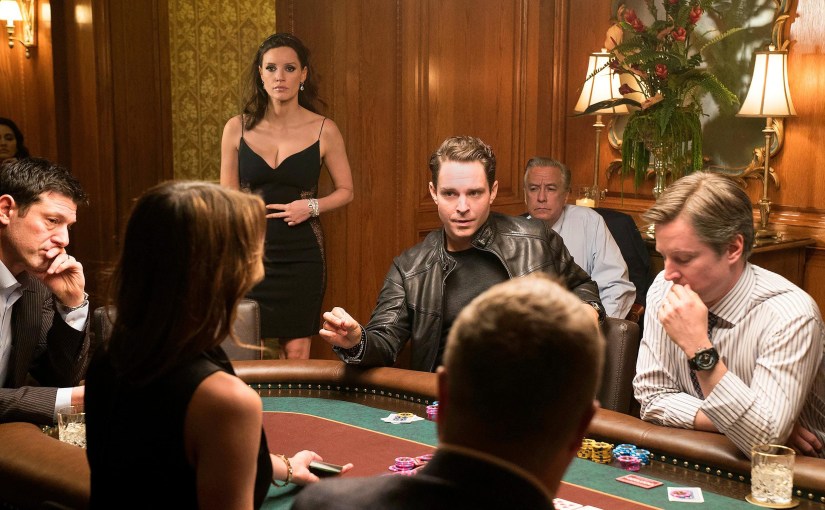
Despite being a little distracted by a drunk patron sitting next to me, I thought Molly’s Game was very good. It doesn’t measure up to The Social Network, and I feel justified in comparing the two because the sharp, fast dialogue follows what appears to be an intentionally similar narrative from writer, and here director, Aaron Sorkin.

Sorkin in his directorial debut uses great techniques for film editing to match the beats of his dialogue.  His opening voiceover of Jessica Chastain as Molly describing the ultimate worst sports experience will get your heartbeat racing.  It draws you into the film right away.

Chastain is good, but maybe a little over the top.  I needed a little more convincing that she was actually this brilliant, inventive and resourceful woman who was also considered one of the world’s greatest skiers.  Can’t put my finger on it but something was missing with her playing the Molly Bloom role.  Was she really holding her own against these high stakes guys who take big risks in her personally constructed poker ring?  I’m just not sure.

Felt the same about Kevin Costner in the role of her father.  He’s supposed to be an incredibly brilliant psychologist and an intimidating patriarch.  Yet Costner doesn’t fit that mold for me here.  Couldn’t feel the pressure from Dad on his daughter.  Someone else might have been stronger.

Michael Cera too.  I think he is playing a combination variation of Tobey Maguire & Leonardo DiCaprio, two of the most famous celebs that participated in the real Molly Bloom’s underground poker games, but Michael Cera?  Really?  He doesn’t carry the weight or looks of guys like that.  There just was not enough power or presence from him.

None of these actors were the worst options for this cast, I just think the film could have used more appropriate performers. There was more appropriate talent out there, I’m sure.

Idris Elba is great, however.  He’s blessed with an awesome Sorkin monologue in the 3rd act of the film, and he hits every note.

A great script.  A great story worthy of being a big screen film and it’s got me interested to learn more about the real Molly Bloom, including reading her novel.

BULL DURHAM

By Marc S. Sanders

How Susan Sarandon did not even get nominated for an Oscar for Ron Shelton’s Bull Durham, I’ll never know. Shelton writes the character of the lustrous, Annie Savoy with grace, wisdom and silky sex appeal. It remains one of the best female characters to ever appear on a screen and no one else could have played the part other than Sarandon.

Shelton’s sensational script opens with Annie’s declaration that she believes in the “church of baseball” and from there it waxes poetic on the sport’s religion and traditions as Annie uses her charm to seduce the Durham Bulls’ newest talent, dim witted pitcher Eppy Calvin “Nuke” Laloosh (Tim Robbins) leaving the team’s experienced catcher Crash Davis (Kevin Costner) wanting more. That is until Annie realizes that she’s the one who wants more.

Davis is recruited to groom Nuke for the big leagues. Nuke has got a million dollar fast ball arm but he “…fucks like he pitches. Sort of all over the place.” Crash is the frustrated player with talent but the sun is setting on his opportunity for the big leagues. Dumb Nuke has a future that just doesn’t seem fair to Crash. Annie is no help when she chooses Nuke over Crash to hook up with for the season.

Shelton explores so many dimensions in his script. It does not solely focus on the three primary characters. The screenplay stirs in a mixture of what it’s like to serve on a minor league team with bats and gloves that are cursed, the urge for a rain out game or what present to get Bobby and Millie for their wedding. A call to the mound might settle some of these things.

Shelton directs his script with a very natural approach. Watch Crash and Annie flirt in a batting cage. Costner and Sarandon don’t even flinch as the balls whiz between them. Baseball is a part of these characters. They live and breathe baseball and they relish sex.

Shelton’s last 15 minutes of film offer a celebration of sexual release that appears pleasant, fun and somewhat religious as the chemistry between Costner and Sarandon remains strong. They rattle the whole house it seems and the kitchen will never be the same.

Robbins is great with his idiocy. He wasn’t as well known when this film was released in 1988. His surprise appearance of stupidity is so lovable and welcome. When he tries to think he gets himself in trouble. When he listens to his coaches, Annie and Crash, he excels. The pains he goes through upon their advice is ridiculously hilarious. Don’t forget to breathe through your eyelids, Nuke.

I also gotta recognize Robert Wuhl and Trey Wilson as the managers of the team. They are hilarious but not overt. Wuhl is great as he bellows out encouraging but incomprehensible cheers from the dugout. Wilson looks on with tired facial expressions.

This cast is invested in the cloth of America’s pastime. They know the batting averages. They read the signs. They play for the crowds. It’s as if Shelton moseyed into the town of Durham, North Carolina, put his camera up and watched how another season all played out. His lens could have been working with a documentary mindset.

Bull Durham is one of the best scripts ever written full of brilliant one liners and philosophies that I might not entirely understand what any of it is referencing. Yet when Annie or Crash carry on, I can’t help but suddenly get interested.

Bull Durham is the best baseball film ever made performed by an outstanding cast led by a director with a clear, wide-open vision.

Play ball!!!

DANCES WITH WOLVES

By Marc S. Sanders

The western motif of filmmaking really comes alive with the 1990 winner for Best Picture, Dances With Wolves starring Kevin Costner in his astounding directorial debut. Until now, this film eluded me. I just never got around to seeing it. Watching it now is to recognize the parallels of current events in the year 2020. A Native American Facebook friend of mine recently lauded the takedown of a statue of Christopher Columbus. At the risk of sounding like I’m taking political side (I insist that I’m not!), I think understand her position a little more. I’m not saying I agree or disagree with this topic. I’m just saying I understand.

After committing what was seemingly an act of suicide, but instead is recognized as heroic in the eyes of the Union army during the Civil War, John Dunbar (Costner) is offered the pick of location for his next post. He opts for Fort Sedgwick because he wants to witness the frontier out west before it will likely be taken over by the white Americans. As Dunbar waits for fellow infantrymen to arrive, he gets the old fort into shape with his trusty horse Sisco. He also encounters companionship in a lone wolf he names Two Socks. The wolf only gradually learns to trust Dunbar, but that’s a project for the infantryman to occupy himself with. That, and keeping his personal journal.

Shortly after he’s settled in, he comes upon a Sioux Indian named Kicking Bird (an excellent Graham Greene). He and Dunbar are the first to develop trust with one another. Eventually, Dunbar’s good nature allows him the opportunity to rescue a white woman who lives with the Sioux tribe known as Stands With A Fist (Mary McDonnell). She has attempted to kill herself following the death of her husband. As the film continues, she becomes the translator between Dunbar and the other Indian leaders, allowing the story and relationships to move along.

The script by Michael Blake is fascinating simply because we are granted plenty of opportunities for the tribespeople to speak in their native tongue. Forgive me, I thought for a little about Hollywood’s most famous Indian, Tonto, and his laughably limited English. Here, language is instead limited for the white man as Costner does his best charade of buffalo to find initial common ground with the tribe’s holy man played by Greene.

Hollywood westerns seem to equate American Indians as savages, the bad guys of the films, complete with tomahawks and bow and arrows and bellowed battle cries for expression. Not here. Dunbar’s loneliness at the fort without another white man in sight does not allow for the ease of prejudice to interfere. Instead, he is a character who must learn to be accepted by the greater populace. When he is, he realizes that his true name is Dances With Wolves and not John Dunbar. That’s a fascinating character arc of change. The setting and the community within that location change the character. I was really moved by it.

As well, there is struggle and disagreements among the Indian population. Perhaps it truly is in the nature of humanity to be that way. The Sioux tribe must contend violently with the Pawnee tribe in a struggle to protect their territory and their food and supplies. Yet, that is wholly different from what drives the war that Dunbar has heroically served in. It’s not until Dunbar fights alongside his Sioux friends that he realizes he’s not an infantryman. This is another example of Costner effectively directing himself to find a new and enriching identity for his character.

A third example of character change stems from the eventual and expected love story that unfolds between Dunbar and Stands With A Fist. It’s something I’ve seen in countless other films. However, Mary McDonnell is quite good as the white woman whose English is close to being entirely replaced by the Native American tongue. She seems so indoctrinated within the Sioux tribe that when she first comes on the screen I questioned if she was a natural born Indian or an actual white woman.

Costner’s film is full of magnificent imagery. Gorgeous landscapes of the filming locations of South Dakota are like perfect paintings of open fields and endless blue sky. The blu ray transfer I watched was eye popping.

One of the greatest moments was a sequence involving a buffalo stampede. Costner with cast all on horseback ride within, as well as parallel to the animals and if ever a widescreen shot should be appreciated, this is a moment to turn to. The score moves beautifully with the pounding of the horses and buffalo stampeding across the open plains.

A personal sidenote is in regards to John Barry, the film’s music composer. I know this is an unfair criticism but at times his score is so strikingly similar to his work on various James Bond films that it was a distraction for me. Other times, Barry’s work lent well in some of the action scenes.

Nonetheless, what an incredible achievement that Costner commanded. He gives a terrific performance, but his direction is what truly stands out. Particularly, with the battle scenes and animal footage, I questioned how he managed to accomplish all of it. It’s just spectacular.

Dances With Wolves is certainly worthy of the accolades it attained and the reputation it still holds. The production value is easy to admire and unforgettable. Beyond that though, is the converse nature the film adheres to as a Hollywood western. The culture of a Native American tribe never seemed so authentic to me as it does here, accompanied with their sense of humor or even their temptation at playful gossip when observing the central love story between Dunbar and Stands With A Fist. We see what the Sioux tribe does to survive, yes. Still, we also see how they interact with one another and converse, as well as how they respond to a new neighbor, for example.

Dances With Wolves is an authentic masterpiece of a modern western. It’s a must-see film.

THE UNTOUCHABLES

By Marc S. Sanders

Brian DePalma directed the very loose cinematic adaptation of Eliot Ness’ squad of treasury agents during the 1930s prohibition era. The movie is The Untouchables, based on the famed TV show starring Robert Stack. It’s a gorgeous picture with incredible set designs, props, and Georgio Armani costume wear. It’s also bloody as hell.

Kevin Costner solidified his leading man status as the righteous Eliot Ness who swears by the law he promises to uphold, while making efforts to topple Al Capone’s (a convincing looking Robert DeNiro) massive Chicago empire that thrives on the buy and sell of illegal alcohol. Capone controls the city on all levels, from government officials down to the police force. His power is unlimited, but he has not filed his tax returns in four years. It’s crazy, but that just might bring him down.

Ness teams up with veteran beat cop Jimmy Malone played by Sean Connery, in one of the most celebrated and winning roles the Academy Awards ever bestowed. Malone knows where the underground liquor operations are located. He knows who accepts the bribes and kickbacks too. The question is how involved does he want to get. He’s the grizzled Irish mentor for Ness, and his timing is perfect for David Mamet’s script.

Memorable additions to the team also include a young and tough Andy Garcia and nerdy Charles Martin Smith as the IRS agent happy to pick up a shotgun for the cause.

DePalma’s film carries the epic look. There’s much splendor in the art direction of the film. It’s a glamorous piece of film, but it’s also just a movie.

Mamet’s script takes lots of liberties against the actual occurrences that came through historically. I do not recall hearing that The Untouchables ever took down a deal while riding horseback alongside the Canadian Mounties, for example. A villainous henchman for Capone is Frank Nitti (a happily slimy Billy Drago), always dressed in bad guy white and putting on the bad guy charm. His demise in the film never happened and most certainly not so adventurous or violently, but DePalma and Mamet clearly don’t care. This is lean entertainment for action sequences set in a gorgeous gangster period. The Untouchables is a slick looking gangster flick and nothing more.

A real star of the film is the Oscar nominated score of the film from The Maestro, himself, Ennio Morricone. His opening piece of drum beats with quick piano keys during the credits will get your pulse going. He also has great horn sections that capture the four heroes in tight shots of shining cinematography from Stephen H Burum. For me personally, this is my favorite soundtrack of Morricone’s massive career.

Costner is well cast. He has the handsome hero look to him. Garcia became a well-known and sharp looking tough guy. Smith did not move on to more celebrated material beyond this. He was remembered comedically here, just as he was in American Graffiti. He also directed since this film. As a team though, Costner, Garcia, Smith and Connery have wonderful chemistry together.

DeNiro actually took a step back from the spotlight here. His Al Capone is not so much a character as he is an every so often antagonizing appearance with a couple of well paced lines from Mamet’s famed dialogue. He’s got a memorable moment with a baseball monologue that convinces you of Capone’s strong arm, but his villain does not get too personal with the hero.

The Untouchables holds a special place in my heart. It was the last film I saw before my life changing move from New Jersey to Florida in 1987. Because the move was hard on me from a teenager’s perspective, I found great escape with this film as I memorized the lines of the enormously colorful characters along with getting absorbed by the violence and emotional variety of tones in the score. Having watched the movie many times since it was released, it’s become a kind of therapeutic experience for me. I take in the gorgeous craftsmanship of the film, the humor and the surprise moments many of the beloved characters face.

The Untouchables is not a perfect film I thought it was at age fourteen. It’s almost proud of its admitted inaccuracies, but it remains a favorite and very personal piece for me. I still love the film, all these years later.

MAN OF STEEL

By Marc S. Sanders

The first time I saw Zack Snyder’s Man Of Steel, I was disappointed.  Very disappointed.  It was only after a second viewing about a year later that I realized I was simply biased and unfair with my perception of the film.  I grew up with the Richards’, Donner and Lester, films that featured Christopher Reeve in the role of Superman/Clark Kent.  Nothing could violate what was done in those films from the ’70s and ’80s. 

My impression of Man Of Steel now is that it is a marvelous film.  It’s an exploration of a stranger in a strange land questioning how to adapt to a living environment that he is not from, nor where anyone around him is genetically built like him either.  Henry Cavill fills the role of the title character.  What’s especially important is that he is not attempting to do what Reeve memorably did before him.  Actually, David S Goyer’s script really doesn’t allow for the hijinks of the prior films.  Clark Kent is not portrayed as a goofy and lovable klutz this time around.  Instead, the boy from Smallville, Kansas is challenged to limit his abilities at the behest of his Earthling father, Jonathan (Kevin Costner).  It’s dangerous for Clark to show all that he is capable of from his super strength to his heat vision.  Clark’s Earth mother, Martha (Diane Lane), is more protective of her son.  A really powerful scene occurs when young Clark is in the classroom and he has a bout with sensory overload of super hearing and super x-ray vision.  He can’t get the encompassing sounds and sights out of his head.  One of many CGI effects in the film come with Snyder showing the skeletal insides of Clark’s classmates and teachers.  It’s frightening; even to an innocent alien boy from another world.  This is good conflict.  Does the world need Clark Kent?  Would Clark Kent be better off someplace else?  Can he manage to live with daily life drowning out his sensibilities?

Another dilemma opens the film on Clark’s home planet of Krypton where he was born with the name Kal-el.  His father, Jor-el (Russell Crowe) has insisted to the governing body that the planet is expected to self destruct soon, and civilization needs to be relocated to another planet.  The politicians refuse to accept his theory.  Jor-el’s friend, the military leader General Zod (Michael Shannon) sides with his opinion.  Though his approach is violent insurrection of the Kryptonians.  Zod is punished for his crimes and sentenced to an eternal prison known as The Phantom Zone before baby Kal-el is shipped away, and the planet implodes with all its inhabitants.

Following this opening, Snyder cuts his film with flashbacks and forwards showing Clark in various different roles as either a fishing boat crewman or a bartender trying his best to remain undercover even when the temptation for use of his powers repeatedly shows itself.  Clark reflects on moments from his childhood when he and his Earth parents questioned how to present himself.  

Superman’s known love interest eventually shows herself, Pulitzer Prize winning reporter for the Daily Planet, Lois Lane (Amy Adams).  She’s following up on an alien ship that has been discovered in the arctic after 20,000 years.  Clark and Lois connect at this moment.  Of all the Superman angles that are familiar to so many of us, this is where Goyer and Snyder perhaps do not focus enough.  Man Of Steel is a satisfyingly long film, but there’s a lot of material and drawn out action to cover as well.  So the Lois and Clark relationship is somewhat sacrificed and not as nuanced as we have experienced in other iterations.

Zod arrives on Earth requesting that Kal-el reveal himself along with the intent to destructively turn Earth into a new Krypton at the sacrifice of the planet’s human population.  Naturally, a city wide battle will ensue. and lemme tell you reader you wanna talk about destroying the village just to save it….well…that’s what happens here.  When New York got destroyed in Marvel’s The Avengers or Ghostbusters, those pictures looked like spilled milk compared to what Superman and Zod do here.

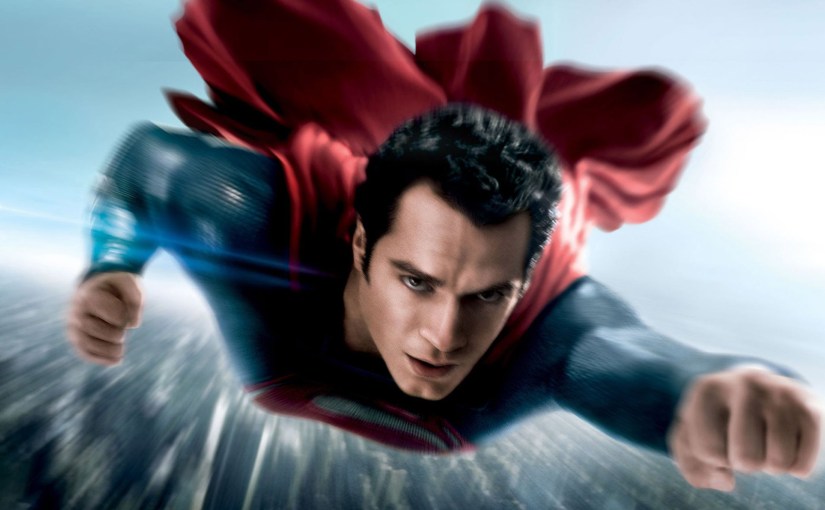
Man Of Steel is the best film of the new Warner Bros/DC universe.  It might be Zack Snyder’s best film as well.  The assembly of the picture is masterful.  Hans Zimmer’s score has these great build ups as Clark discovers more of his capabilities.  It especially lends to when the character dons the cape and costume for the first time ready to leap in the sky and fly.  Snyder shows the efforts needed for Superman to carry out this talent.  The flying doesn’t come easy.  It looks like work on the super hero.  Zimmer’s score starts out quiet and then advances to these powerful notes as Superman soars higher and higher.  The boy from Kansas is making himself into something greater that he has no familiarity with.

Michael Shannon plays another of many kinds of villains and antagonists on his resume.  I’m not sick of this guy’s antics yet.  It’s time he become a James Bond villain.  He plays Zod with an uncompromising determination and disregard for anything else but to rule.  It’s all very sci fi like but I love how unforgiving he is with the role.  Much less Shakespearean than when Terrance Stamp played the part so well with Reeve as the hero.  Shannon is more direct and bloodthirsty.  Michael Shannon just knows how to be scary on film. This kind of personality would work great in a silly comedy from the Farrelly brothers as well.

Amy Adams is fine as Lois, but there’s not much here to work with honestly.  More details of her relationship with Superman come through in later films.  However, this story development soured me on my initial viewing.  The iconic irony of Superman pathos is that as sharp a reporter as Lois Lane is, she can not realize that the guy wearing the glasses who is working right next to her is actually Clark Kent?!?!?! Readers and viewers were always thankfully in on the joke.  On follow up viewings of Man Of Steel, I understand that Goyer and Snyder were never aiming for irony.  Lois knows who Clark really is from the get go. What was once an unforgivable departure for me, no longer is a concern.  There are deeper angles to question in Man Of Steel, like a purpose to others and the freedom to force a change because it can be done.

Snyder and Goyer broach on the well known Christ allegory with Superman.  The film takes place in Clark’s thirty third Earth year.  Jor-el is slain with with a stabbing to his rib.  There’s also the crucifixion  pose on a number of occasions.  I must admit, as a Jew raised conservatively with just the Old Testament, I am not very educated on the texts of Jesus Christ.  However, the basics are explored in Man Of Steel.  Is Superman a savior?  Snyder wisely even has Clark visit with his Smallville priest to question his obligations to Earth and to Zod’s calling, with window artwork of Christ in the background.  

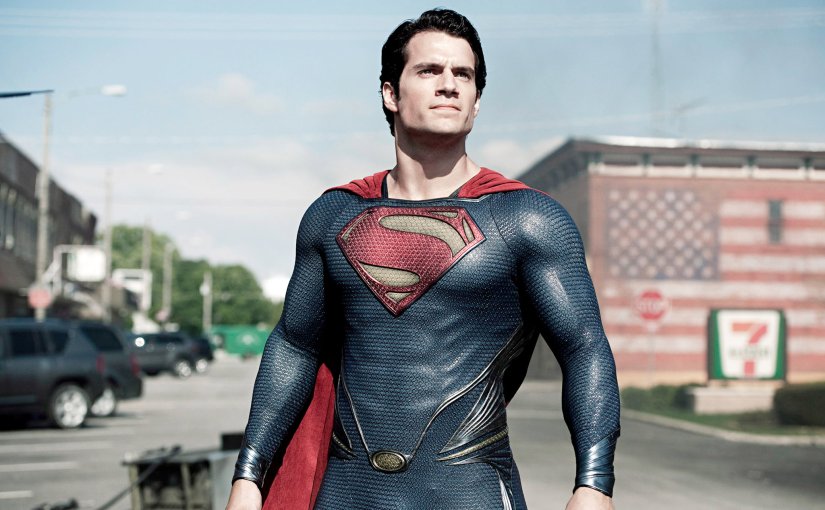
One vice I have with Snyder’s picture is the shameless plugging.  How overt must signage from Sears, U-Haul, 7-Eleven and IHop be?  Granted, all of these summer blockbuster films have the inserts of brand labels going all the way back to the original Superman films.  Here though, the corporate advertising is a true eyesore.  Superman being thrown into the dining area of an IHop is not as memorably funny as when Zod’s underling, Non, crashed into New York’s famed Coca-Cola sign back in 1981.

The seemingly endless battle consuming about forty five minutes of the third act of the film are over the top outrageous.  I might normally be saying I’ve seen enough while casualties are never considered as buildings literally topple over into mushroom clouds of concrete dust.  Still, the cast keeps these moments alive.  Shannon and Cavill, along with Laurence Fishburne as Perry White, the Daily Planet editor, and Amy Adams, actually show risk and fear amid all of this bombastic action.  Still, Snyder is insistent on his freedom to go crazy with CGI effects.  It’s more than a bit much, but the characters up to this point keep me engaged with the film all the way through.  Later DC films in this franchise don’t do it so much for me, but that’s another column altogether.  

Again, what I especially like about Man Of Steel is how Snyder cuts back and forth with the film.  Heroic moments occur and then are reflected back to times in Clark’s childhood with Jonathan and Martha.  With Zimmer’s score, it seems to allow Clark to consider conversations and moments from his past as meaningful to what he is experiencing in the present.  When Zack Snyder stays on this trajectory it makes Man Of Steel more than just another comic book movie for summer box office.  There’s depth from Goyer’s script that Snyder wisely does not disregard.  

Man Of Steel is a new and unfamiliar kind of Superman, but its a very welcome Superman too.

BATMAN V. SUPERMAN: DAWN OF JUSTICE

By Marc S. Sanders

Zack Snyder may have been indulging in too many cookies from the jar when he made Batman v Superman: Dawn Of Justice.  I can not deny how ambitious this film is, but did it ever need to be this ambitious?  There are too many storylines, too many characters, and not enough thought provoking dialogue to really make any sense of the gobblety gook that’s splattered all over the screen.

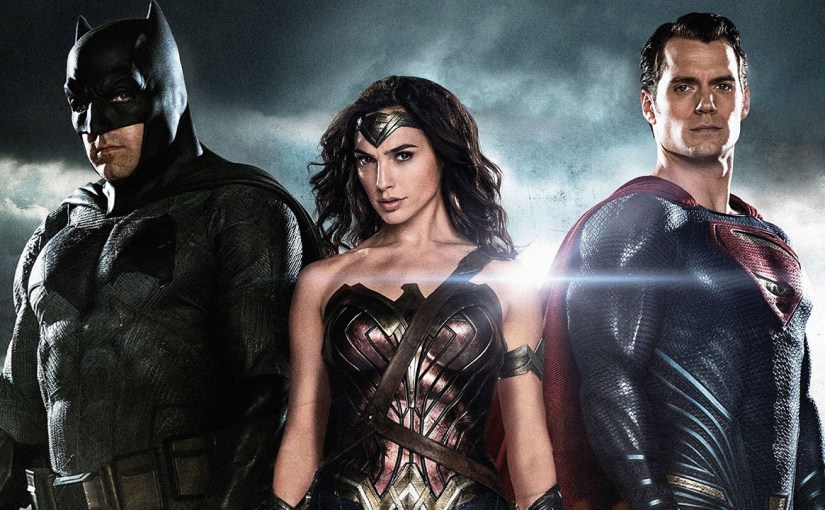
Reader, my favorite super hero of all time is Batman.  Nearly any variation of Batman (including moments from the dreadful Joel Schumacher films) contains an element that I just love about the character.  Ben Affleck is cast as The Dark Knight here.  He’s fine in the role.  I knew since he had done Daredevil, that he could pull off this part.  He might be too long in the tooth, and too busy an actor/director, for a new series of super hero films, but I digress.  That being said, the movies have gone into overkill on the Batman character.  It’s time the Gotham crusader hide in his cave for a little while and let some of the other super heroes out to play.  Snyder’s film proves my theory.  After all, the true highlight is neither title character in this movie.  

Actually Wonder Woman (Gal Godot) making her big screen debut is the draw above anything else here.  Even that is problematic, though.  I’ve seen this film twice now.  Can anyone tell me why Wonder Woman aka Diana Prince even makes an appearance in this film?  From a story perspective, what justifies Diana creeping into this film, other than to plaster her picture on DVD covers and merchandise a new action figure?

Events begin right after Snyder’s stellar Superman film, Man Of Steel.  An older and experienced Bruce Wayne is dubious of the benefits that Superman (Henry Cavill) can serve on Earth.  After all, his bout with the Krypton villain, General Zod, practically leveled Metropolis.  Heaven forbid if one day this powerful alien with the red cape goes out of control.  Bruce, as well as politicians led by Holly Hunter, ask a wise question.  Who on earth could ever stop him?  So Bruce, with assistance from Alfred (Jeremy Irons playing the well known sidekick more as a strategist, than a polite butler) begin preparing for a seemingly inevitable battle to eliminate the Kryptonian. 

Meanwhile, a young, brainy Lex Luthor (Jesse Eisenberg) is planning for his own undoing of both of these super heroes by living up to the film’s title; pitting the Bat of Gotham against the God of Metropolis; mano y mano.  Like most iterations, Luthor plays with defying the odds of nature.  In this case, he is experimenting with a green element sourced from Krypton which we all know is Kryptonite, as well as extracting blood from the corpse of Zod to create his own monster movie.  That last part feels like a side gig for the supposedly genius villain.

In addition, a mysteriously exotic and beautiful woman is turning up on various occasions.  Somehow, only Bruce seems to take notice of her.  Why?  I don’t know.  There’s really no purpose for him to scope out this person amid a sea of other extras attending a Luthor gala. 

There’s also Lois Lane (Amy Adams) and Martha Kent (Diane Lane).  There’s a retread of Bruce Wayne’s origin story that we’ve seen countless times before.  There’s a bitter and disabled former employee of Wayne Enterprises.  There’s a dream sequence showing vague plague like foreshadowing to come.  There’s an arms dealer/terrorist sequence in the desert for Lois to investigate, and another figure for Bruce to track.  There’s the eventual gladiator battle between the two heroes, and then there’s another battle thereafter for the two guys to team up with the the woman who carries a magic lasso to defeat a Doomsday monster; likely rejected sketches from the Harry Potter and Star Wars franchises.  Oh yeah.  There’s also some teaser material for what’s yet to come in the DC cinematic universe.

Do you see where I am going with all of this?  There’s just too much stuff here.  Eventually it all gets tedious.  A laundry list of storylines with little to no connection with one another feels burdensome.  I wish the screenwriters, Chris Terrio and David S Goyer, finished writing a script before starting another script.  As lengthy as all of these stories feel, they also seem unfinished, and, I can’t understand why.  

Forgive me.  It’s easy to compare the DC Comics film adaptations to the Marvel Comics films that Disney now owns.  The latter franchise seems well structured and outlined.  The former franchise helmed by Snyder seems rushed to catch up to everything that Marvel has already accomplished.  If the intent was to have a huge franchise of films, then why smash all of your material together in one sitting?

That gets back to my viewpoint on Batman.  Why Batman, all over again?  Snyder and the producers really aced it with the casting of Gal Godot.  She is Wonder Woman.  Snyder also struck gold on Man Of Steel with Cavill as Superman.  I wanted more exploration of that guy.  So why make this a Superman and Batman film?  We’ve seen enough Batman through the last thirty years.  Let’s give someone else a chance.  Much could have been accomplished had this installment been a Superman and Wonder Woman team up with maybe a teaser ending of a new Batman yet to come.  This Batman shows me nothing I hadn’t already seen.  There’s a new car and gadgets and cables to swing from.  It’s all been done before.  Lemme see some of what this Wonder Woman can do.  As well, if Wonder Woman is here, then tell me why she is here.  Again, she just comes out of nowhere and never explains why she’s there.  My wife and daughter tried to explain it to me.  Apparently, she wants to acquire a photograph of her with her war comrades from the first World War, and Lex Luthor is in possession of it.  Really?  That’s it?  She just needs to get a sentimental photograph back?  By the way, why does Lex have this photo, and how did she know he has it anyway?

Good stories always answer questions with more questions until it’s eventually tied off at the end.  Moments in Batman v Superman: Dawn Of Justice seem to begin in the middle of their stories with questions that did not answer questions that likely came before, and by the end of the picture, there’s no ending or answers in sight.

I had already reviewed Wonder Woman, and in that column I specifically noted that DC films with Warner Bros always seems to come close, but never gets it completely right.  This film boasts an impressive cast, and all are good in their respective roles.  My approach to this Lex Luthor from Eisenberg might have been different if I were in charge; make him more like a Steve Jobs kinda guy rather than a slight variation of the actor’s other famous role as Mark Zuckerberg.  Still, it’s not good enough and it’s hardly forgivable for what the filmmakers churned out with this picture.  The writers have an infinite wealth of source material to select from.  Pick up a comic book, guys!!!!  They have the funds and opportunity to divide up the best moments of these outstanding characters for the next ten years of film installments.  Nevertheless, they don’t take the time to think strategically, and flesh out the environments and the characters that inhabit these settings.  

Batman v Superman: Dawn Of Justice is just a sloppy mountain of peas, carrots, corn and green beans, with lumpy mashed potatoes and covered in lots of over seasoned gravy.