THERE’S SOMETHING ABOUT MARY

By Marc S. Sanders

Love never dies.  Sometimes it just gets jammed in your zipper.

Ted (Ben Stiller) can’t put his finger on it.  Neither can Pat (Matt Dillon) or a couple of other obsessed, stalking paramours.  There’s Just Something About Mary.

In 1985, brace faced, insecure Ted gets the opportunity to go to prom with the prettiest girl in school, Mary (Cameron Diaz).  He’s a good guy, but disaster strikes in truly one of the most unimaginable ways and prom never works out for these kids.

Jump thirteen years later to 1998 and Ted gets the idea to hire Pat, a private investigator, to track down Mary in hopes of rekindling a new romance.  She’s in Miami, Florida now, working as a chiropractic surgeon and even more beautiful than ever.  Problem is that Pat has lied to Ted about what has come of Mary and wants to pounce on her all for himself.  Ted eventually gets up the gumption to trek from Rhode Island to Florida anyway.  Along the way complications ensue.  Let me change topics for one second and remind you to be mindful of rest stops when you are road tripping.

There’s Something About Mary is one of the all-time great comedies and my favorite of the Farrelly Brothers’ collection (Kingpin, Dumb & Dumber, Me, Myself & Irene).  I’ve described the spine of this film, but it’s the guts of endless sight gags within that uphold this picture.  Everything from a dog that gets drugged, electrified, drugged a lot more, and body casted to a handicapped friend of Mary’s who simply cannot pick up his keys without instigating terribly guilt-ridden chuckles. (I’m laughing as I write this.)  Special needs adults lend to the comedy as well.  The Farrellys are proudly nowhere near politically correct. Yet the material manages to not be horribly offensive either.  You need not worry, you will still get into heaven even if you laughed at There’s Something About Mary.  Still, that’s what comedy is.  Somebody always needs to be the victim of the stooges who lend to the mayhem.

This comedy is also perfectly cast from the three headliners all the way down to the extras.  A South Carolina jail cell setting draws big laughs at poor Ted’s demise. 

Cameron Diaz is such a sport though, always looking beautiful while willing to be the fool.  It was great to watch this with my seventeen-year-old daughter since she had no idea of that hair gel scene.  If you don’t know, don’t read about it.  Just watch and look at how well Diaz holds the moment together.  I remember SCREAMING in the movie theatre next to Miguel.

Stiller and Dillon are two dumbasses you likely never would have envisioned in a film together.  Nevertheless, they are perfect foils of stupidity against one another.  Matt Dillon is often recognized for his tough guy dramatic roles.  Yet, he puts it all on the line.  Stiller is primarily known for comedy, and this film is the first of a series where he becomes the unfortunate victim of circumstances (Along Came Polly, Meet The Parents).  I wouldn’t want anyone else in these scenarios though.  You laugh at what Ben Stiller ends up in but also feel sorry for the poor guy.  I would have no objection if Matt Dillon and Ben Stiller paired up again for another comedy, even all these years later.

Other cast members also lend their level of comedy from Chris Elliott to Lin Shaye to Sarah Silverman, Jeffrey Tambor, Markie Post and especially Keith David, who knows he belongs nowhere in this movie, but that’s exactly why he should be part of the cast.  He’s utterly hilarious.

A nice touch to the movie are the series of outtakes during the end credits while the cast lip sync to The Foundations celebratory number “Build Me Up Buttercup.”  This had to have been such a party to film and finally the audience is assured that they can laugh along in front or behind the camera as well. 

There’s Something About Mary is the movie so many of us need right now.  Turn off the news and turn on what went on between Ted and Pat and their pursuit of Mary. 
THE QUICK AND THE DEAD

By Marc S. Sanders

The Quick And The Dead is a gritty, stylish western that boasts a who’s who of great actors.  Some of which went on to magnificent careers.  I wish the story was a strong as the cast list though.  It’s watchable.  It’s intriguing. It’s also too repetitious.

Sharon Stone is Elle.  Otherwise known in these parts as The Lady.  Two minutes into the picture and my suspension of disbelief is withering away.  Not because this gunslinger cowboy is a cowgirl, but because Stone does not look like she fits in the Old West.  Her blond locks are shampooed and conditioned.  Her complexion perfectly made up without a hint of grime or dirt or sunburn.  Stone looks like she took one step off the Oscars red carpet and onto this set. Her costume with a scarf, leather pants, black rimmed hat, and spurred boots looks like its attempting its own kind of Clint Eastwood stranger.  Frankly, it appears to have leaped off the pages of an Old Navy catalogue.

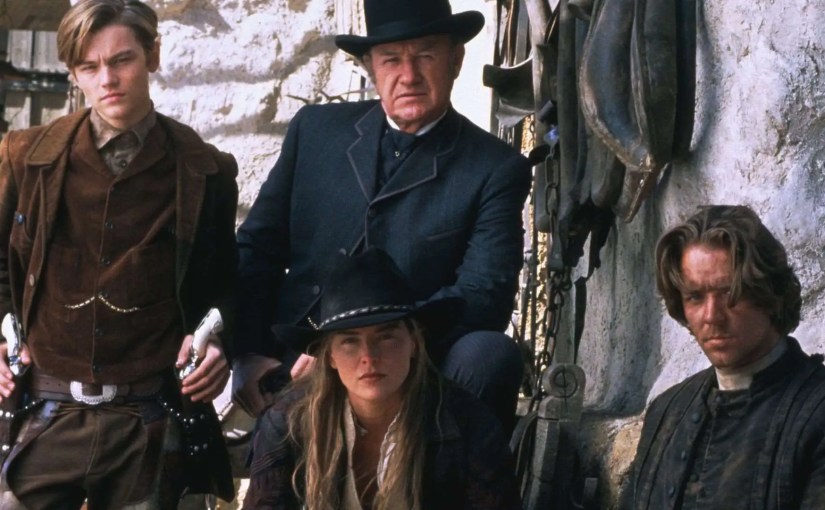
Below Stone on the credit lineup is a much more redeemable list of characters.  Gene Hackman is Mayor Herod who has amped up his level of sinister from his Oscar winning performance in Unforgiven.  There’s also Ace Hanlon played by Lance Henrickson with a rare on-screen giddy grin, whose personal deck of cards consists of aces of spades for every man he’s killed. Sgt Cantrell is the flamboyant personality with the handlebar mustache, deep voice and toothy grin that actor Keith David proudly bears.  A kid named Leonardo DiCaprio plays up the youthful cockiness of an outlaw named The Kid.  All these folks are gunslingers participating in the sport of gunslinging.  Last one left standing is the winner.  Midway through though, Herod will up the ante and deem that the last one left alive is the winner.  Each one challenges another until a final winner is recognized.  One reluctant participant is played by a very youthful looking Russell Crowe.  Cort is a former fast draw, who is now a remorseful preacher for all of the killings he’s committed.  Herod is not entirely convinced and will antagonize Cort to throw his hand in the game.

Sam Raimi directs and Sharon Stone produces this slick small town modern day High Noon.  The problem though is that Raimi and screenwriter Simon Moore choose to only send up the climax of that classic Gary Cooper western over and over.  Time and again, two opponents line up at opposite ends of the street.  The townsfolk observe with close up tension shots.  The hands twitch their fingers next to the holsters and when the clock strikes twelve, the guns go off.  Raimi often gives you the impression that the one expected to live is the one who is going to topple over dead and then an edit shows the match went exactly like you thought it would. 

This whole supporting cast has enough presence and charisma to keep my attention, but the set ups are the same over the course of the film.  Cut in between are discussions within the saloon or the hotel rooms where Herod or the Lady rest.  Cort remains chained in the town square.  When the movie breaks away it goes to flashbacks of Stone’s character as a child when she once crossed paths with the devilish Herod. 

I like the polish that Sam Raimi brought to The Quick And The Dead.  Before Quentin Tarantino was glamourizing his pulp fiction to his own two dimensional westerns and war movies, Raimi was daring enough to let us look through literal bullet holes from the front to the back of his victims.  Holes through the hand, the chest and the head.  It’s fun.  There are also countless closeups of haunting music from Alan Silvestri as a new stranger enters a saloon to click his spurs on the wooden floor.  Quick draw action is how these pistols perform too.  Hangings are a part of any day as well.  All of this is familiar and standard to the B movies brought to us by Sergio Leone’s spaghetti westerns during the mid twentieth century, but now we have a modern day cast and some glossy cinematography.

I was ready for a worthy salute.  It just comes up short due to a lack of any depth in story.  Gunslinging quick draws are not as dynamic as a gunfight at the OK corral.  How much different is one dual draw going to be from the last one we watched five minutes ago?  Raimi’s camera points from behind each challenger.  The music builds louder and louder.  Zoom in shots of townsfolk cut in.  The minute hand on the clock tower moves closer and closer to the roman numeral twelve, and then…BANG BANG!!! (I’ve said this before, haven’t I?  Well, so does the movie.)

The Quick And The Dead is worth seeing especially for another scenery chewing villain from the great Gene Hackman.  I’ll never tire of watching him.  To see the beginnings of Russell Crowe and Leonardo DiCaprio’s potential is a real treat as well.  They all certainly have some acting moments that I loved digging up from this time capsule.  Character actors Keith David and Lance Henrickson break from the standard personas you’ll find on the rest of their resumes.  I just needed more of a variety to this town setting they got play in.  The déjà vu is too overdone.

Sharon Stone usually looks like she’s giving a so so community theatre audition.  It’s hard to take her seriously, the same way I would had Uma Thurman, Susan Sarandon or Geena Davis been cast as The Lady.  Those actresses work for their appearance to be appropriate for the setting of their films.  Look at Sharon Stone here in the dusty Old West.  Then look back to what Sarandon and Davis did in Thelma & Louise.  You’ll see right away, practically anyone else would have been more suitable for the lead of The Quick And The Dead.

AMERICAN FICTION

By Marc S. Sanders

Cord Jefferson directs his first film and it’s a winning combination of Tootsie with the prose of Alexander Payne.  

American Fiction follows author/literature professor Thelonius Ellison, otherwise known as Monk (Jeffrey Wright).  He’s encouraged by his university to take some time off as his patience with the mindset of students and colleagues has reached its tipping point.  Upon his return to visit his mother (Leslie Uggams) and sister Lisa (Tracee Ellis Ross), he realizes that mother is beginning to suffer from Alzheimer’s disease.  An unexpected tragedy also strikes, and now Monk has to figure a way to afford round the clock care for mother.

A side story also gnaws at Monk. His literary agent, Arthur (a hilarious John Ortiz) encourages him to write a book about “black life,” much like the current bestselling novelist Sintara Golden (Issa Rae).  Her book is celebrated, particularly by the middle/upper class white demographic, for its “authenticity” in urban black dialect and situations.  Monk is disgusted by this kind of reception.  He may be black, but he’s simply a novelist. Best to take his hard cover novels out of the African Studies section at the bookstore.

After a drunken binge of adopting Sintara’s approach, Monk writes a book, under a gang like pseudonym, as simply a gag to demonstrate how foolish consumers and the top publishers can truly be.  Arthur submits the manuscript to potential publishers and immediately fortune finds him.  A publisher is so moved by the book’s plight, she wants to gear it as a summertime bestseller and Hollywood wants to adapt the story.  It’s also a serious contender for a literary award, of which Monk is on the judging panel.  To Monk’s reluctance, he must don a persona of a fugitive criminal author, unwilling to disclose his identity or location.  White consumerism eats all of this up.  At best, all of this hoopla is covering the cost of his mother’s care. Otherwise, he despises being a part of this charade in front of his new girlfriend, Coraline (Erica Alexander) and his family which also includes his gay, undependable brother, Cliff (Sterling K Brown, another winning actor in this outstanding cast). 

American Fiction works on several levels, but the balance is between satire and relatable drama.  There’s a past that defines Monk’s character.  It defines what irritates him as a black man who is encouraged to digress from the sophisticated intelligence and formal education he possesses.  No one encourages him to live up to his disposition as simply a good writer.  Because he’s black, he can only be regarded as a black writer.   

Jeffrey Wright breaks free of his well-known character actor performances (James Bond films for example) to lead this stellar script adapted from a novel called Erasure by Percival Everett.  He wears multiple hats in this film, which include tender moments shared with Erica Alexander and Leslie Uggams, as well as more challenging debates with the sibling characters while addressing a common family problem of dealing with an elderly parent’s care.  His siblings sardonically address him as “Detective Dictionary” when engaged in a debate. As well, Wright’s comedy works as he’s the irascible author who is flabbergasted at how seriously his little prank takes him so far.  It disgusts him that this novel, this deliberate smack in the face to what readers embrace as black literature, generates a sensation. The further it’s regarded in hype, the deeper Monk has to hide as that urban gangster fugitive.

Thelonius “Monk” Ellison is one of the best characters to come out of 2023.  Ironically, the first film I saw this year was a dreadful comedy called You People with Eddie Murphy and Jonah Hill.  That film attempted to poke fun at what presumed were the stereotypes of blacks and Jews when in fact it had no discernible concept.  American Fiction explores how black life and culture is perceived by a white populace only to genuinely demonstrate an unfair delusion, and it works perfectly.  It’s a very smart script with intelligent and likable characters, and the dialogue is never pandering but absolutely forthright.  

American Fiction pokes fun at perceptions.  How Hollywood addresses black history and culture and a sad truth of what garners attention for fiction with black characters and storylines.  For black actors and authors, like any of their industry peers regardless of race/demographic, there’s more than just stories focusing on life in the ghetto or on a southern plantation.

Cord Jefferson’s screenplay reveals a midlife crisis for Monk that allows a provocation to consider what is genuine in black and white people.  At the same time, while Monk only wants to reveal a false delusion, he also has to live up to unwanted responsibilities as a son, a brother and a boyfriend.  Jeffrey Wright is worthy of an Oscar nomination for his role.  

Nearly every scene in Jefferson’s film can prompt you to hit pause and think about what was just said or demonstrated.  This movie is also very, very funny in its honest truth of what consumers absorb.  Yes! I do believe Hollywood would likely make a revenge slasher horror picture on a Louisiana cotton plantation, complete with Ryan Reynolds as a slave owner getting beheaded by an Afro blade.  

American Fiction is one of the ten best films of 2023. 

PLATOON

By Marc S. Sanders

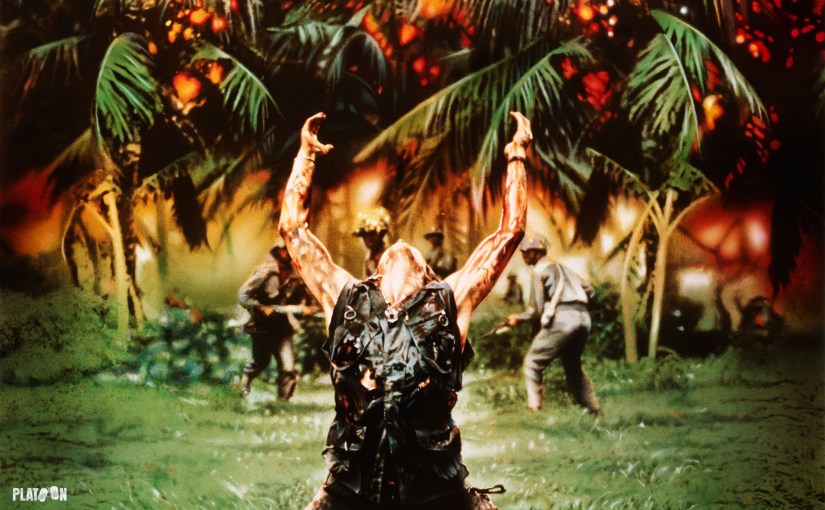
Oliver Stone’s Oscar winning Platoon takes place in the late 1960s, somewhere on the Cambodian border during the Vietnam War.  Many of the chaotic happenings the film presents are based on Stone’s own experiences after he voluntarily enlisted to fight.  However, while there is an unwinnable war occurring for the American troops, there is just as horrifying a battle going on within the ranks of the platoon the film focuses on.

Charlie Sheen echoes a lot of his father’s, Martin Sheen, voiceover narration, and performance in Francis Ford Coppola’s Apocalypse Now.  He portrays Chris Taylor, a college dropout who voluntarily enlisted for a one-year tour of duty to serve.  After only one week within the harsh, humid, and wet jungles, he’s writing his grandmother a letter asking what the hell was he thinking.  Chris is quite virginal to the harshness of war and that won’t work to his advantage when needing mentoring and support from his fellow soldiers.  The newest enlistees are the ones at the front point.  They haven’t devoted enough time to sit in the back and because of their lack of experience with war, they are not as valuable for the ongoing campaign in battle.  Platoon is not the heroics depicted in John Wayne movies.  This was one reason that Oliver Stone wanted to make this picture.  Platoon is a bitter retort to Wayne’s celebrated movie, The Green Berets.

There is an angel and devil flanking Chris in the form of Elias (Willem Dafoe) and Barnes (Tom Berenger).  Berenger is the cruel side of the conflict with his battle-scarred face.  He gives his underlings the impression that because he’s seen so much fighting and endured being shot seven times, that he must be invincible.  Elias is a fighting soldier, but he adheres to the rules of war and when it is time for rest, he joins his fellow troops in a unified vigil of drug-induced relaxation.  Chris warms up to Elias easily despite his initial fears of being a soldier with no experience or knowledge of how to survive, much less fight alongside his fellow men.

What drives the conflict between Barnes and Elias occurs following the first act of the movie.  The infantrymen come upon a Vietnamese village.  Some men, including Chris, get wildly abusive with the unarmed people, burning and pillaging their huts.  Only after Chris gets control of himself does he realize the wrongs he’s capable of by serving in this war.  He prevents a group of men from gang raping a child.  Furthermore, he witnesses Barnes commit the illegal murder of a defenseless village woman, shot at point blank range.  Elias has his bearings though and will file the proper reports when the opportunity permits.  Nothing in Platoon is easy though.  This war rages on and the possibility of an investigation and court martial is held off while the fighting continues. 

An interesting take on Oliver Stone’s direction is that he never really shows any close ups or lends any dialogue to the Viet Cong.  I believe Stone is confident that people know who our battalions were supposed to engage with.  However, as another favorite picture of mine stated (Crimson Tide), the true enemy of war is war itself.  The enemies of Elias, Chris, and Barnes as well as the rest of the platoon permeate within and among themselves and it lends to the chaos of the brutal combat scenes depicted in the film. Stone doesn’t offer much opportunity to see who any of the soldiers are shooting at or who is shooting at them.   There is much screaming and hollering but who are any of the characters shouting at and can they even be heard or understand what is being said amid the gunfire?  Platoon demonstrates that a Vietnam war picture is not one of heroics with grandstanding trumpets and a towering John Wayne who takes a hill.  War is disorganized, messy, and terribly bloody. 

This may be Charlie Sheen’s best film of his career.  As he represents the fictional account of Oliver Stone’s personal experiences, we see the trajectory of his change.  He is supposed to be there for 365 days, and he, along with his buddies, count down to when their tour will be complete.  However, this one short year will be the longest he ever encounters, and it will change him permanently, assuming he survives.  Chris is always tested of his tolerance.  He’s always subject to respond to how Barnes commands or how Elias mentors and leads. 

Oliver Stone is so convincing in his often-documentary approach to Platoon that it is at least understandable to see how the men in this picture behave and carry themselves.  Why do they refer to the Vietnamese as “gooks.”  Why do they bully with intent to commit rape.  Why do they quickly pounce to kill when for even a moment there is no threat.  Moreover, why they are willing to turn on each other.

They were never the decision makers for this conflict.  These soldiers are depleted of sleep and rest.  They are the pawns of a higher power, and they have been left to their own devices in a dense environment infested with bugs, snakes, unbearable humidity, and bodies that infest the waters and land while armed men appear out of nowhere ready to ambush.  Some ensnarements might occur within their own regimen.  None of these men are justified in their actions.  Yet, it is not hard to understand where their motivations stem from.  They are not programmed for heroics.  Keith David portrays a likable soldier who tells Chris that his mission is just to survive until he’s summoned home.  Survive among those you march and sleep with.  Outlast this hellish environment and overcome those that are trying to mow you down in machine gun fire.  Everything else around here is “just gravy.”  When you are an infantryman, you are not making a statement any longer.  You are not fighting for a cause anymore.  You are only trying to stay alive.

Platoon is such a shocking film of unconventional madness and turmoil.  Oliver Stone is relentless in the set ups he stages.  This picture came out in 1986, long before the strategic methods of the modern “shaky camera” approach.  It’s beneficial to watch the film as Stone must be positioning his camera on a track as the platoon hikes through the forest, parallel to his moving lens.  We are walking alongside them.   Early morning overhead shots depict the carnage of battles that occurred in the dark of night. Flares and sparks come from nowhere.  I think you could watch this movie ten times and still not know when to expect gunfire to intersect with the story or when the bombs to go off.  It’s hectic hysteria like I can only imagine these young men experienced before they spilled their blood on the battleground and either died right there or returned home physically and mentally crippled for life.

Platoon is one of the best and most frightening war pictures ever made.

NOPE (2022)

by Miguel E. Rodriguez

DIRECTOR: Jordan Peele
CAST: Daniel Kaluuya, Keke Palmer, Brandon Perea, Michael Wincott, Steven Yeun, Keith David
MY RATING: 7/10
ROTTEN TOMATOMETER: 83% Certified Fresh

PLOT: Residents of a lonely gulch in inland California bear witness to an uncanny and chilling discovery.


After watching Nope, the third feature from Jordan Peele (Get Out, Us), I found myself curiously unable, or unwilling, to sit down and write a review for it.  What more can I add, I thought, to the volumes that have already been written about it?  What insights can I share that aren’t revealed in the making-of documentary on the Blu-ray?  How can I analyze a movie that can literally be boiled down to, “What if Close Encounters turned into Jaws?”  What good would it do to figuratively take this movie apart and critique its individual components?  It’s a roller-coaster, pure and simple, much like Jurassic Park III [2001].  How do you review a roller-coaster ride and try to compare it to other roller-coaster rides in terms of a review?

“I found the first hill of Rip-Ride Rocket much more intense than the slingshot approach of Hulk or Rock-N-Rollercoaster, but each has something to offer in terms of inversions, smoothness, and on and on and on…”

It just feels pointless, for reasons that are proving themselves difficult to pin down.  So, instead of a “normal” review, here are random thoughts, in no particular order:

  • The “true” nature of the UFO – oops, sorry, UAP, I had to look that up – stretched my disbelief suspension to the limit, but I will admit, it’s certainly original.  I can’t think offhand of any other movie or book I’ve watched or read that even considered that explanation for all those unexplained sightings in the books.  Once that was established, every successive appearance of the “spacecraft” became even more ominous and/or menacing.
  • I loved how the movie is littered with clues or easter eggs that either give a hint to the film or sort of comment on what we’ve seen before.  There is an early scene when OJ (Kaluuya) and Em (Palmer) are walking outside with a magnificent setting sun behind them behind the clouds, and hand to God, I remember noticing one particular cloud that looked…off.  Also, there’s another scene when a horse runs off and OJ watches it through the gaps of a wooden shed, and the visual impression is that of a zoetrope, the machine that made the opening images of the running horse possible.  Or even look at the screenshot at the top of this article…quick! What does that lampshade look like to you?
  • There was something about the design of the UAP that bugged me throughout the movie, not necessarily in a bad way, but it just seemed weird.  Why would something that is [SPOILER REDACTED] need what looks like fabric when seen up close?  Is it a sail?  That seems most likely.  In the latter stages of the movie, the “anomaly” doesn’t seem quite as mobile or speedy as it did when its “sail” was intact.  It’s an interesting design concept.
  • One of the scariest moments for me had nothing to do with the UAP itself.  It’s the scene in the exhibition area where the lights seem to be turning on by themselves.  The payoff for the scene seems predictable in hindsight, but as the scene progressed, I was BESIDE myself.  You can ask my best friend, Marc, who watched it with me.  When that shapeless mass by the light switch suddenly started to “unfold”, I echoed OJ: “Nope!  Gotta go, goodbye!”  It is a brilliantly executed scene.
  • I’ll need to watch the movie again to fully understand how that little parachute managed to scare off the UAP.  I assume it has to do with actual horse training, and with some research I could find the answer myself, but the movie does very little to explain it to the viewer.  Or maybe it does.  Like I said, I need to watch it again.
  • I loved how the flashback with the chimpanzee seems utterly incongruous at first.  And I loved how creepy and horrifying it is.  It’s a brilliant framing device (if I’m using that term right) that kept me guessing as to its real purpose right up to the end, or CLOSE to the end.  And did I mention how horrifying it is?  That moment when it’s resting…and then looks RIGHT AT THE CAMERA…chilling.
  • Someone somewhere had said that Keke Palmer was robbed of an Oscar nomination.  With all due respect to Ms. Palmer…she did an admirable job, but I didn’t see anything in the film that would have had me reaching for my Oscar ballot.  But I will give her props for her opening speech to that film crew.  The special features on the Blu-ray reveal that she delivered MANY different variations (fourteen, according to IMDb), much like you see so many other actors do in broad comedies, just to find the exact right version or take.
  • Much like Us, Nope feels like it bit off a little more than it could chew when it comes to the resolution of the film.  Everything leading up to the last 10 minutes or so is gangbusters, honestly, even the silver-helmet guy.  But as everything started to wrap up, I began to feel as if I’d seen all this before, just in different ways, in many different films.  Perhaps I’m being unfair.  Perhaps I’m criticizing the movie for what it isn’t instead of reviewing what it is.  I don’t know.  As it is, also like Us, Nope is one helluva roller-coaster ride that ends, not with a bang, but with a “pop.”
  • Allow me to shamelessly quote Roger Ebert, again: “If you have to ask what something symbolizes, it doesn’t.”

THE THING (1982)

By Marc S. Sanders

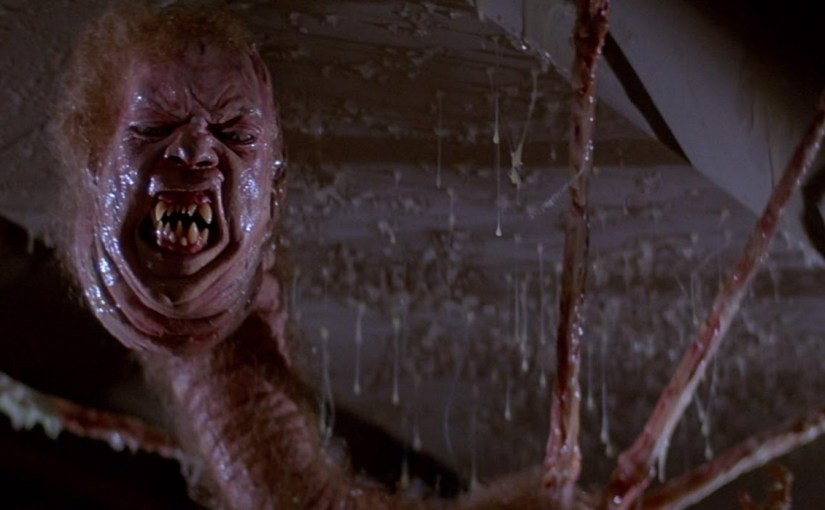
Often, a great beginning to a film offers an intriguing question. So as I finally watched John Carpenter’s 1982 interpretation of The Thing, I was especially curious as to why a sniper aboard a fast moving helicopter was targeting a dog running across the open plains of Antarctica with a pulse pounding beat from legendary film composer Ennio Morricone. The film has me hooked and none of the gory horror to come, compliments of creature effects wizard Rob Bottin, has even presented itself yet.

Gore never did anything for me in horror, and horror has never been my most favorite genre of film. Rather, suspense always held my attention and kept me thinking long after the movie was over. Carpenter’s film is full of Bottin’s imaginative gore but the paranoia and mistrust among a crew of science operatives is the real centerpiece here. Whether it’s the innocence of a dog or the star power of Kurt Russell, I never trusted the narrative of The Thing and that’s the point.

An exceptional scene on the same level as the dinner scene in Ridley Scott’s Alien occurs following a crew man suffering a heart attack. The defibrillator is brought out, “CLEAR” is shouted and the man is zapped. Then something else happens. I won’t spoil the moment. Yet, this is where imagination was put to work; where effects and storytelling work cohesively. Thankfully, moments like these become a running theme throughout The Thing. You never know what to expect from an unmeasurable and incomprehensible enemy. The fact that resources are scarce and escape is impossible traps our characters and the viewer as well.

Convenient, fast learning knowledge only tells you that this entity can duplicate anything it comes in contact with. So, you might just be sidling up to the thing itself and you won’t even know it until it’s too late.

Isolation, lack of trust, fear, paranoia – all of these elements work towards the advantage of superb imagination and storytelling in Carpenter’s piece.

The Thing was always a movie that eluded me. I’m now so grateful to have witnessed it. It makes me yearn for better storytelling in today’s films beyond remakes and superhero exhaustion.

John Carpenter’s The Thing is an absolute must see motion picture. Watch it with friends and watch it with the lights turned off.

21 BRIDGES

By Marc S. Sanders

What a huge loss it is to no longer have Chadwick Boseman after being taken so early in life by cancer.  His heroic role in Black Panther is what is arguably celebrated most.  However, even a small, standard cop film like 21 Bridges is evidence of his magnetism on screen.

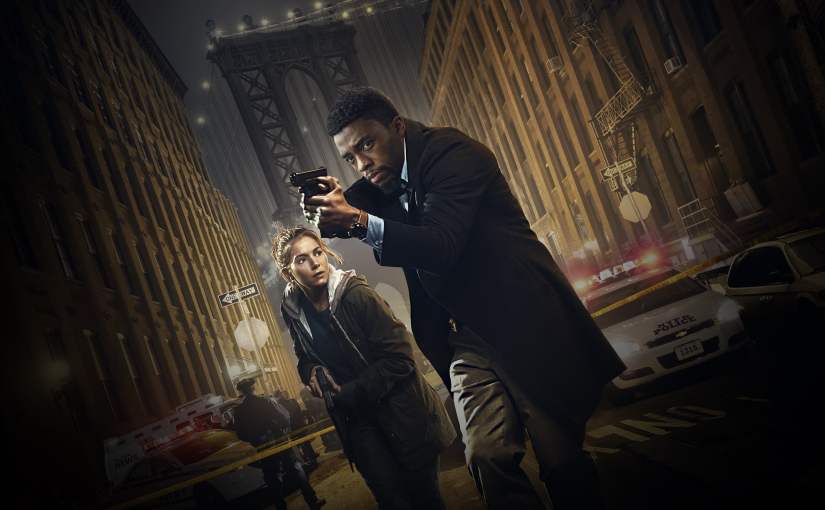
In this movie, Boseman portrays Andre Davis, a New York police detective who is under investigation by Internal Affairs for an abundance of shooting incidents.  Yet he is still on the beat.  When he is summoned to the aftermath of a violent crime scene after midnight in Manhattan, it is up to Andre and his new partner Frankie Burns (Sienna Miller) to track down two killers who ran off with a large supply in cocaine while taking out seven police officers in the getaway.   The best way to catch the bad guys is to shut down the twenty outlets off of Manhattan Island. That means all bridges, tunnels and ferries are closed off until sunrise.  Now it becomes a closed off maze to locate and apprehend the men.  One problem for Andre and Frankie is that the entire police force is looking to taking out the suspects as punishment for killing their comrades.  Andre is actually not the shoot first cop he’s unfairly being characterized as, though.  Sounds simple and familiar, yes.  However, Andre slowly realizes that there may be a complicated conspiracy involved. 

Directed by Brian Kirk, 21 Bridges won’t rank up there with Andrew Davis’ The Fugitive or even the best of the Dirty Harry installments, but the film moves at a brisk pace and the action is spectacular, and at times unexpected.  The early heist of the drugs from an underground wine cellar is fast and shocking when a shootout erupts that goes for a thankfully suspenseful long time.  Kirk doesn’t make it easy for the bad guys (Steven James, Taylor Kitsch) to make their escape.  When they do, the desperation is engaging. 

While this picture didn’t generate much box office success, there’s no question that Boseman would have been a go to leading man in the same vein as Keanu Reeves or Tom Holland has become. My theory: it should not have been released against blockbuster power hitters. Had it come out in January or February, this would have been a sleeper hit for sure. Boseman looks great as the hero and righteous cop, competing with the standard police veterans (JK Simmons) who remind the hero he doesn’t know what he’s talking about, etc.  We, the viewers, know better though.  Boseman looks very cool and athletic in his dark blue overcoat and drawn pistol, running through the streets of Chinatown or within apartment staircases and hallways as he maintains the chase.  Chadwick Boseman is just a solid leading man.  No question about it.

The script by Adam Mervis and Matthew Michael Carnahan is full of surprises that fit in the sense of the picture.  Nothing comes out of left field, but I wasn’t looking for surprises either.  So, when a new development presented itself, I appreciated it.  It kept the movie alive.

So again, Chadwick Boseman is huge loss within the Hollywood ranks.  I read that a sequel was considered.  I would have liked to see that with Boseman reprising his role because it’s a good part for him.   

If you have grown tired of watching the Marvel and Star Wars films and series for the 50th time and you’re looking for something new, seek out 21 Bridges.  It’s a first-rate solid crime thriller.

CLOUD ATLAS (2012)

by Miguel E. Rodriguez

Directors: Lana Wachowski, Lilly Wachowski, Tom Tykwer
Cast: Tom Hanks, Halle Berry, Jim Broadbent, Hugo Weaving, Jim Sturgess, Doona Bae, Ben Whishaw, Keith David, Susan Sarandon, Hugh Grant
My Rating: 10/10
Rotten Tomatometer: 66%

PLOT: An exploration of how individual lives impact one another in the past, present, and future, as one soul is shaped from a killer into a hero, and an act of kindness ripples across centuries to inspire a revolution.


Okay, faithful readers, I hope you’re comfortable.

Cloud Atlas is one of those movies like Baraka that leaves me with the urgent need to tell people how amazing it is.  It’s visually spectacular, thought-provoking, and hopelessly optimistic about love and the good side of human nature, even in the face of the worst humanity has to offer.

Based on a critically acclaimed novel by David Mitchell, the movie tells six separate stories, linked by the fact that a core group of actors plays all the principal roles in each story, and by the fact that at least one actor in each story carries a curious birthmark shaped a bit like a comet or a shooting star.  Each story is separated from the others by decades or centuries, taking place in the years 1849, 1936, 1973, 2012, 2144, and an apparently post-apocalyptic 2321.

I cannot imagine the lengths to which the filmmakers, and the film editor in particular, went to make this movie work.  The film jumps freely from one story to another, forward, back, forward, and back again, somehow maintaining a clean flow and keeping each storyline absolutely clear.  Although the stories are unique, the editing keeps the idea of connection alive for nearly three hours.  Just based on the editing alone, that makes Cloud Atlas kind of exhilarating to watch, especially when things heat up in the 2144 segment.

Let me see if I can quickly summarize each story, without giving too much away:

  • 1849 – An American lawyer visits property holdings overseas and witnesses the brutal whipping of a slave, who stows away on the lawyer’s ship returning to San Francisco; meanwhile, an unscrupulous doctor has plans to steal the lawyer’s gold en route.
  • 1936 – A struggling composer, Robert Frobisher, is hired as an amanuensis (a fancy word for a music stenographer) to another aging composer, which allows Frobisher to compose his own masterpiece, The Cloud Atlas Sextet. The aging composer demands credit for the piece and threatens to expose Frobisher’s bisexuality, including his deep, unconditional love for a gentleman named Rufus Sixsmith.
  • 1973 – An investigative reporter stumbles onto a conspiracy at a nuclear power plant, thanks to a whistle-blowing report written by none other than Rufus Sixsmith, now in his sixties.
  • 2012 – An author on the run from hooligan creditors takes refuge in what he thinks is a hotel, but is in fact a nursing home, to which he has inadvertently committed himself.  He and three other residents plan a daring jailbreak.
  • 2144 – Set in a vastly futuristic New Seoul, a renegade “fabricant” is brought in for questioning by the ruling government known as Unanimity.  The fabricant, known only as Sonmi-451, spins a tale of oppression, liberation, and horrific realization as she becomes the voice of a revolution that will ripple across centuries.
  • 2321 – In a post-apocalyptic Hawaii, peaceful Valleysmen live in constant fear of attacks from vicious cannibals, the Kona tribe.  They also receive periodic visits from Prescients, a highly advanced society that apparently lives offshore.  One day, a Prescient, Meronym, asks a Valleysmen leader to guide her to a remote mountain peak where she hopes to send an SOS signal to off-world colonies.

Confused yet?  Don’t be.  The editing keeps everything crystal clear.

But that’s just the clinical description of the movie.  What catapults Cloud Atlas into the stratosphere is how the fancy editing and visual effects occasionally take a back seat to a really deep philosophical question that leaves me with a sense of awe.  It’s really a what-if question, one of the greatest what-if questions of human existence.

What if…death isn’t the end?

I know that countless other movies have asked this question. We all have our own answers and beliefs.  I am not suggesting that Cloud Atlas has somehow figured out THE answer to this question, or that the answer it provides somehow trumps your own beliefs. But of all the movies I’ve seen on this topic, Cloud Atlas is the only one that really, genuinely, truly left me in awe of the possibilities it proposes.

I mentioned earlier that key roles are played by the same actors over and over again in each of the stories.  While that was initially distracting, I realized that the filmmakers were actually making a genius move.  It was nothing more than a simple way of illustrating the concept that a life in one era is echoed in another, decades or centuries later.  Heavy makeup is used to indicate how one person’s life as an Asian woman could, in theory, be echoed in the life of a Mexican woman in another era.  Or perhaps the life of a British man might be echoed later as a British woman.

And then there’s the question of that recurring birthmark.  One key character from each storyline bears a birthmark that resembles a shooting star.  So many people (including me the first time around) wanted to attach some kind of conventional story-based meaning to that birthmark.  Did it mean these characters were all somehow blood-related?  Was it a prophecy of some kind?  Something mentioned in the book, perhaps, that had to be left out of the film for pacing reasons, or some such thing?  No.  It’s just another visual reinforcement of the idea of recurrence, or reincarnation.

And that’s where I get awestruck by the movie.  Reincarnation is not a new concept in films, but Cloud Atlas really got under my skin.  Imagine.  What if…the person you love, your soulmate, the one you’ll love until the day of your death…what if, centuries hence, you’ll meet each other again?  Maybe you’ve walked down the street, or been eating in a restaurant, and for a fleeting second you lock eyes with a total stranger across the room, and you think, “I KNOW that person,” but the moment passes and life goes on.  What if that happened because you have met in some past life?

Or maybe you go on a date, and it goes phenomenally well, as if you’ve known each other for ages?  Well…maybe you have.  It’s your destiny to meet and love this person because you’ve already done it before.

I know I’m getting a little woo-woo/touchy-feely here.  It’s not a new idea.  It’s just that Cloud Atlas presents the idea so well that my breath gets taken away when I think about its implications.

I just have to bring up the stunning visuals again.  There’s a scene where the composer, Frobisher, is writing to his lover, Rufus Sixsmith, and there’s a passage where, in his mind, he meets Sixsmith in a china shop.  In a wonderfully poetic moment, they start smashing the china in slow motion as Frobisher’s composition plays in the background.  Then, just as the music reaches a crescendo, the two of them stop in place, and hundreds of china vases and plates rain down from the ceiling in slow motion, hanging in space, descending slowly to the ground like gigantic snowflakes.

I’m at a loss.  I’ve come to the end of whatever I can discuss about this movie without repeating myself endlessly.  I want to reiterate that I don’t believe this movie has THE answer to what lies beyond death.  But it has a truly lovely hypothesis, one that leaves me awestruck with its implications.

So let me just end with a line from the movie that makes my heart swell every time I hear it.

“I believe there is another world waiting for us, Sixsmith. A better world…and I’ll be waiting for you there. I believe we do not stay dead long. Find me beneath the Corsican stars, where we first kissed.”