MISERY

By Marc S. Sanders

The worst thing that could have happened to Paul Sheldon is that Annie Wilkes saved his life.

Rob Reiner breaks away from innocent romantic comedy to deliver a violently cruel kind of intimacy. He directs his second Stephen King adaptation, Misery.  (His first was based off King’s novella The Body, which became Stand By Me.)  With next to no prior record with horror or disturbing psychosis, Reiner achieves greatness with this film.  Much like Martin Scorsese, he focuses quite a bit on props that offer no dialogue but say so much.  A cigarette, a match, a champagne flute, a bottle, a beat-up briefcase, a clunky Ford Mustang, along with a gun, a two by four block of wood, a portable grill, a knife, a syringe, a sledgehammer, and a porcelain penguin.  Barry Sonnenfeld is the cinematographer offering brilliant clarities of color for mundane and endless discomfort.

Before leaving his mountainous Colorado cabin, Paul has smoked his cigarette and savored his glass of 1982 Dom Perignon.  He has just completed a new manuscript; a big departure from his best-selling series of novels focusing on his beloved heroine Misery Chastain.  Lady Misery is not how Paul wants to be entirely defined as an author.  

Unfortunately, on his way back down the snowy mountain, he veers off the road and lands upside down in his Mustang, buried within a blizzard.  A hulking figure carries him back to a peaceful, isolated cabin in the woods.  When he awakens two days later, he meets Annie who has already begun to nurse him back to health following two very damaged legs and a popped shoulder blade.  By his grogginess, he might have had a concussion too.  Lucky for Paul because apparently, he cannot reach a hospital or get a call out to his family or literary agent (Lauren Bacall) due to the harsh weather conditions.

It’s also convenient that Annie is quite the fan of Paul’s work, particularly his series of Misery novels.  She has a maternal bedside manner, but oddly enough she becomes irascible at any given moment.  After honoring Annie’s request to read his untitled manuscript, Paul realizes that might have been a mistake.  Annie can easily get unhinged to say the least, and that temper…

Paul Sheldon is portrayed by James Caan, and he was one name on a long list of leading actors considered for the role including Warren Beatty, Robert Redford, Harrison Ford, Robert DeNiro, and Jack Nicholson.  Any one of these guys could have done the part.  However, I can now only see James Caan.  He beautifully plays stationary vulnerability as he’s anchored to a bed for most of the film.  Ironically, for a writing master of words, Caan’s dialogue is not even half of the script that belongs to his counterpart.

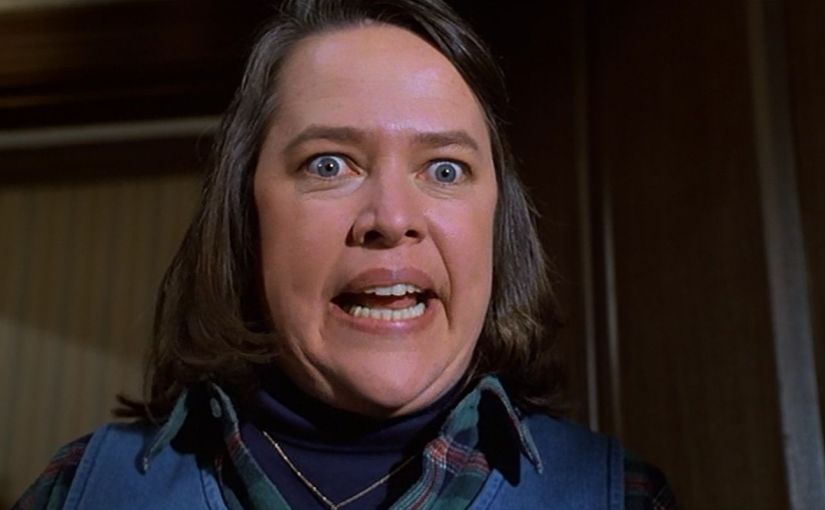
Kathy Bates was deservedly awarded the Oscar and a slew of accolades for her role as Annie Wilkes.  This role put Bates on the map.  Her portrayal is timed so authentically with changes in tempo from childlike enthusiasm to demented rage that she only makes Stephen King seem like that much better of an author than he already was at the time.  Actually, I’d argue that before Misery hit theaters, the Stephen King factory of film adaptations was churning out subpar products like Cujo, Firestarter, Christine, and his own film that he directed Maximum OverdriveMisery elevated the author’s brand back to when it was celebrated with Brian DePalma’s Carrie and Stanley Kubrick’s unforgettable interpretation of The Shining.

I believe what helps is that of all the varieties of horror the author was delivering, Misery did not hinge on the supernatural.  Annie Wilkes is a very real embodiment of capable terror and disturbing psychological handicap.  Kathy Bates effectively demonstrates byproducts of schizophrenia and obsessive, compulsive disorders.  Living alone in the woods with the subconsciousness of an author speaking to her through the pages of his fictional hardcover novels only feeds the beast that she’s become. 

I’m not a big fan of Stephen King’s works.  Often, I find his material of gore stretches too hard for shock value, and hardly ever achieving insightful originality.  To the best of my recollection, I’ve only read Misery, The Stand and It.  That’s enough for me.  I read that as he was writing Misery, he was emoting his alcoholic demons that left him obsessively challenged.  Annie Wilkes developed into that tangible, physical fiend.  This story takes a far step away from the macabre world that built his literary empire.

Rob Reiner does not go for any kind of novel inventions with his film.  He’s simply telling a story with the tools provided by celebrated screenwriter William Goldman (The Princess Bride, Butch Cassidy & The Sundance Kid, All The President’s Men) and his wise adjustments from King’s piece.  Goldman and Reiner wisely cut out a lot of King’s gory schlock.  (That foot scene, for example.  Either way?  YEESH!!!) Smart move, because Annie Wilkes is such force of power personified by the hulking physicality (by choice of Reiner’s lens) and range of Annie Wilkes.  Even though Kathy Bates is short, she is a hulking menace here. Kathy Bates is doing stage work in front of a camera.  I’d argue her performance inspired the idea of eventually converting Misery into a Broadway play that featured Laurie Metcalf and Bruce Willis in the roles.  I wish I could have seen that. 

Goldman wisely allows the picture to move on with another perspective in the form of two characters that were not part of King’s story.  A perfect casting of Richard Farnsworth and Frances Sternhagen as the local sheriff and wife advance the curiosity of Paul’s absence from the world.  They speak for the surrounding areas that don’t reveal what is beneath the blankets of snow where few clues remain, and not even a missing 1965 Ford Mustang can show itself.  They’re funny, quirky, and unusual, almost like a combination of Jessica Fletcher or Miss Marple seeking to resolve the mystery.

Props like a gun and a knife along with visuals like uncontrollable fires and fight scenes are nothing new.  However, it’s when these scenarios are paired with Kathy Bates to victimize a small, weakened James Caan that these items become well filmed properties of Rob Reiner.  So again, I focus on the inanimate objects of Misery because Reiner lends a lot of footage to all of these working pieces.  This revolver suddenly has dialogue of its own through one of Annie’s personalities.  The knife works like a guard dog for Paul.  The aluminum can of lighter fluid sadistically squirts itself to tickle or tease an extreme point for Annie.

The cigarette and champagne flute emote those small, cheating, harmless vice escapes from commitment that awards Paul. 

The sledgehammer puts its foot down.

The match plays both sides of the duality during different points of the film.

Misery is that film that works with a small cast, but with a wide population of environment, in a snug, confined space.  I describe the picture this way because like Annie Wilkes, this exploration in psychological terror operates without fair balance.  When an animal cannot control and subdue its instincts, there’s no telling what to expect, and an unpredictable Annie Wilkes might be one of the scariest personifications any one of us could ever encounter.

THE GRIFTERS (1990)

by Miguel E. Rodriguez

DIRECTOR: Stephen Frears
CAST: Anjelica Huston, John Cusack, Annette Bening, Pat Hingle, Charles Napier, J.T. Walsh
MY RATING: 9/10
ROTTEN TOMATOMETER: 91% Certified Fresh

PLOT: A small-time con man has torn loyalties between his new girlfriend and his estranged mother, a high stakes grifter working for the mob.


Imagine your favorite film noir from the 1940s and ‘50s.  The Big Heat, say, or Double Indemnity.  Now imagine someone remade it, set it in the modern world, retained most, if not all, of the hard-boiled dialogue and characters, threw in some gratuitous nudity, and added some Freudian subtext that would have made Oedipus blush.  Oh, and imagine David Mamet directed it.  Voila…you’ve got 1990’s The Grifters, directed by Stephen Frears and co-produced by none other than Martin Scorsese.  It tends to move just a tad slow at times, but all that simmering pays off in the movie’s phenomenal final reel.  I am going to have to tread carefully indeed to avoid spoiling some of the movie’s best surprises.  Here goes:

As the movie opens, we are introduced to three very different characters, at least on the surface.  Lilly (Anjelica Huston) works for the mob by visiting horse racing tracks across the country and laying pricey bets on long shots to bring the odds down just in case they pay off.  She also skims just enough off the top to stay under the radar.  Roy (John Cusack) is a young man pulling small-time cons of his own, like the one where he flashes a $20 bill at a bartender, then pays with a $10 bill instead, getting $20 worth of change at half the price.  And Myra Langtry (Annette Bening in her breakout role) is first glimpsed attempting a lame con at a jewelry shop that ends with her offering her body to the jeweler instead.  (I like the fact that nearly everyone calls her “Mrs. Langtry” even though no one seems to have laid eyes on her husband.)

Myra is Roy’s vivacious new girlfriend.  Lilly is Roy’s estranged mother; she had him when she was fourteen years old (yikes) and he left home at 17, as he puts it, “with nothing but stuff I bought and paid for myself.”  Roy values his independence above all else, maybe even more than the money he’s “earned” and stashed away behind the ugly clown paintings in his living room.  So, when Lilly unexpectedly drops by his apartment in Los Angeles (which she always pronounces “Los Ann-guh-leez”) on her way to the track at La Jolla, he lies about his livelihood.  The last thing he wants is a concerned grifter mother trying to partner up with him.  He learned that from a mentor years ago, seen in a flashback: “You take a partner, you put an apple on your head and hand the other guy a shotgun.”

Due to an injury sustained from a bartender who caught him in a grift, Roy winds up in the hospital, where Lilly meets Myra for the first time.  They are not impressed with each other; their introductory conversation is brief, but it plays like Bette Davis clashing with Joan Crawford.  We get a little more information about Myra’s situation when we see her go home to her apartment where she is met by her landlord, Joe, who demands payment on her outstanding bill.  Her response is to bat her eyes and launch into a patter of what sounds like a radio or TV commercial.  “You, too, could learn to dance!  All you need is a magic step!”  After some more back and forth, she lies down naked on her bed and offers Joe a choice: “Only one choice to a customer, the lady or the loot.  What’s it gonna be?”

What makes a scene like that sparkle, along with virtually every scene in the film, is the fierce individuality displayed by the characters.  They are each wholly original, not simply placeholders for foregone dialogue or plot developments.  In classic film noir, the lead character is usually a smart guy (or gal) who thinks he’s smarter than everyone else but gets caught off guard by his own desires.  In The Grifters, all the main characters are smart…and they stay that way the whole movie.  There is not one single plot development that evolves because anyone makes a dumb decision.  You can see that they all have a clear view of all the angles, and no one is going to make a stupid choice for the sake of the script.  I can’t tell you how rare that is.  The plot and the story unwind and are wound up like a precision watch.  By the time the credits roll, you can see exactly why each character made the decisions they did, leading them to the shocking finale in the last reel.

I really can’t say more about the plot without simply retelling scenes or giving away spoilers.  Throughout the film, Huston, Cusack, and Bening deliver performances that would be right at home in a Mamet film.  They’re allowed to show more emotion than can usually be found in Mamet (I’m thinking particularly of House of Games), but their pared-down, hard-boiled dialogue cuts to the heart of the matter without being flowery.  There’s a scene involving Lilly’s boss, Bobo, played by Pat Hingle with a flat-eyed menace that would make Sonny Corleone run for cover.  His deadpan dialogue with Lilly about oranges is one of the tensest gangland conversations I’ve ever seen, and he does it without ever raising his voice.  Brilliantly written.

If this review has been vague, it’s because I am trying to preserve the unexpected twists and turns about who’s who, and who’s hiding what, and why.  If you find yourself wondering why things are moving kind of slow in the first 30-45 minutes, just be patient and let your ears bask in the hum of the crisp dialogue; observe how each character behaves according to their character, not according to a script; and marvel how a movie set in modern day can still have dizzy dames and classy broads and world-weary heroes and not feel like a relic from the 1940s, but instead feels as fresh as a movie that was released yesterday.  The Grifters is nearly-buried treasure that deserves to be rediscovered.

EXECUTIVE DECISION

By Marc S. Sanders

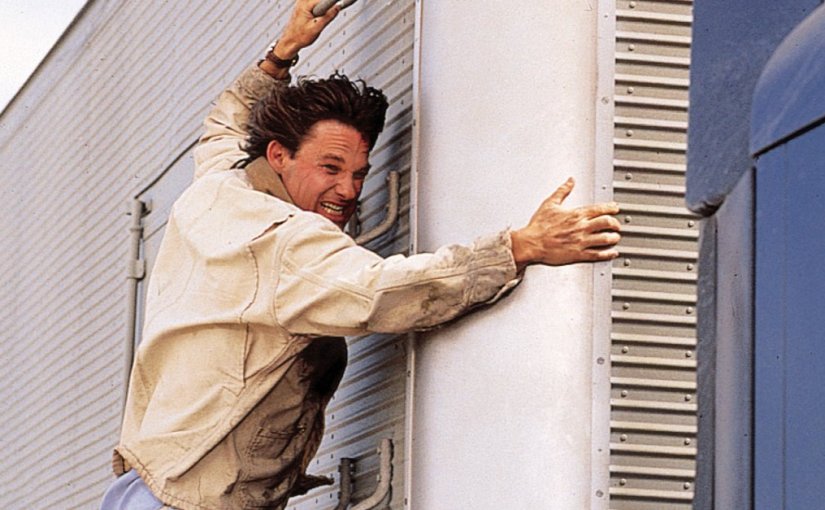
A commercial passenger plane carrying a bomb with enough explosives to wipe out the entire eastern seaboard of the United States has been hijacked.  Fortunately, Steven Seagal has come up with an idea to get his squad of commandos on board and contain the threat.  It’s also a blessing that in the first twenty minutes of Executive Decision, Seagal dies during the midair transfer.  There!  I spoiled it for you.  I’m not big on spoilers, but this is worth it because I believe it’ll entice you even more to watch this scrappy, under the radar action picture directed by Stuart Baird.

Before all of the action gets started, Kurt Russell makes his introduction attempting to land a small plane during a flying lesson.  I wonder if that’ll play into the story later.  Hmmm!!!! Russell plays David Grant, a consulting analyst for the US Army. Dressed in his tuxedo, he’s swept up from a dinner party and informed of the terrorist hijacking at play.  Grant is familiar with the lead terrorist and his ideals.  For whatever reason he’s instructed to board a specialized jet with Seagal’s crew.  This jet carries a tube that will attach to the hull of the captive plane in midflight. The soldiers will climb aboard and go to work.  Complications ensue though, and after that harrowing scene is over, four members of the elite squad (one becomes paralyzed) have made it on board along with Grant and the design engineer (Oliver Platt) of the jet.  Now the fun begins. 

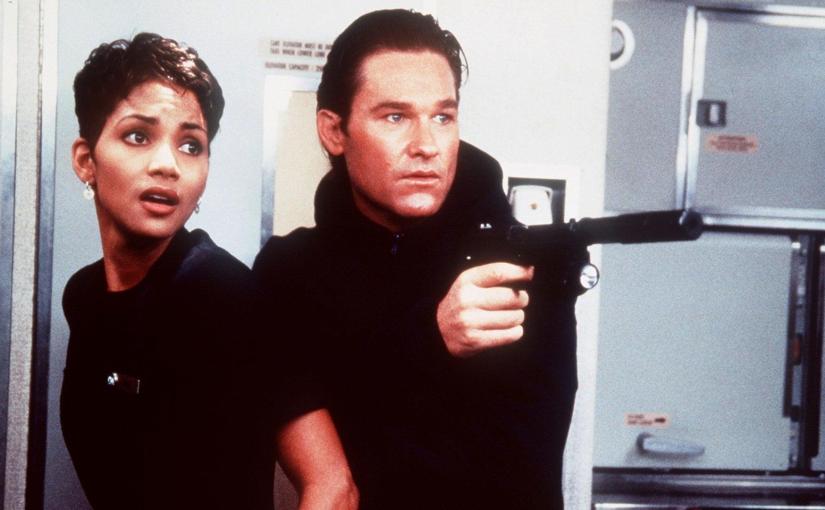
Baird invests a lot of moments with the commandos (led by John Leguizamo) sneaking around, and drilling small holes in the ceiling and floorboards of the plane to insert tiny cameras and get a look at the activity going on.  Every so often the terrorists threaten or give scary looks and we hope they don’t look down that hallway or in the elevator shaft.  The bomb also has to be deactivated but it’s never as easy as knowing to cut the blue or red wire, and there’s a “sleeper” passenger who can detonate the bomb by remote.  Where on the plane is that guy, though?  As well, the government debates with shooting down the plane of 400 passengers before it reaches America.  So, there’s a lot going on here.  Kurt Russell is especially good as a “work the problem” kind of leader who manages to earn the assistance of a flight attendant (Halle Berry).  We may know how this standard story will end up.  However, that doesn’t mean the journey can’t keep us on pins and needles. 

Executive Decision is never boring.  It’s engaging from beginning to end, even if we’ve seen this very basic formula countless times before.  Credit has to go to Stuart Baird and his lengthy experience as a film editor (the Superman and Lethal Weapon films), as well as the cast.  Kurt Russell is always reliable with upholding the tension of a situation.  Like Harrison Ford, he’s really good at playing the everyman caught up in a jarring, nerve-wracking situation.  Look at his film Breakdown for further evidence. 

Beyond Seagal’s early demise, the most amusing part of Executive Decision is watching Marla Maples Trump as another flight attendant emoting the worst panicked expressions for Halle Berry to act off.  Marla never delivers a single word of dialogue.  Even in 1996, long before the Trump name became regarded for many other reasons I need not discuss here, this likely unintended joke generated so much amusement for me, personally.  It must be seen to be believed.

That being said. Don’t watch Executive Decision just for Marla Maples Trump and Steven Seagal.  Watch it for the taut, suspenseful story it is, with a fantastic lead role performance from Kurt Russell, a solid supporting cast and a gripping assembly of tension from Stuart Baird.

BREAKDOWN

By Marc S. Sanders

The southwest region of the United States can be brutal.  The desert landscape is scorchingly hot and the end of the world seems like an eternity away…no matter how fast you drive or how far you go.  Worse yet could be the truckers and locals who could care less about who you are, where you came from or where you’re going.  So, you better be sure your well equipped Jeep Cherokee has enough gas in the tank and your oil dipstick comes up black.  For Jeff and Amy Taylor, though, nothing they do will matter.  Their car is destined to break down anyway.

Jonathan Mostow wrote and directed a taut thriller called Breakdown that builds on a Hitchcockian formula for a road picture.  When Jeff and Amy’s (Kurt Russell, Kathleen Quinlan) car breaks down on a long, lonesome highway in the middle of the desert, a friendly trucker stops by (JT Walsh) to lend a hand.  He offers to take them to the next stop where they can call a tow truck.  Jeff agrees to stay with the car.  Amy hitches a ride to call for the tow.  Shortly after, Jeff realizes that Amy has mysteriously disappeared.  When Jeff catches up with the trucker, the situation gets even stranger because this guy claims to have never met Jeff before or even know who his wife is.  It gets even weirder and more frightening from there.

Kurt Russell is very good in a relatively simple, but effective story that only needs its ninety minutes to get your heart racing.  As Jeff learns of the conspiracy playing against him, the panic builds in Russell’s performance.  A really effective moment occurs when Jeff is forced to go to a local bank and withdraw ransom money.  While the banker is executing the money transaction, Jeff enters the restroom.  In this short moment, Mostow keeps a good close up on a very sweaty, beaten and nervous Kurt Russell.  Jeff is looking for something to use as a weapon.  Now, we’ve seen this many times before.  What kept me absorbed in the suspense of the film is how Kurt Russell evokes his thought process without having anyone to talk to.  In this bathroom, he involuntarily walks in circles, seemingly asking himself “what am I going to do?”.  Mostow never breaks the shot, allowing his lead’s performance to send home the paranoia.  I was right there with this poor guy.  What is Jeff going to do?

JT Walsh was an under the radar character actor; one of those guys that you recognize from dozens of films (Good Morning, Vietnam, A Few Good Men), but you just never knew his name.  He passed away too soon.  I’d wager eventually he’d get some kind of awards recognition.  This is a magnificent villain in Breakdown.  A good antagonist is one you can trust at first.  So that when the veil is lifted, your jaw drops a little.  Walsh accomplishes that here.  He turns on the good guy and he betrays the viewer.  He really plays a guy with two masks on.  Friendly and helpful at first.  Later, a toothless scowl is across his face as he terrorizes Jeff.  The big rig truck that Walsh drives becomes reminiscent of what Steven Spielberg accomplished with his first film, Duel.

While a Jeff Taylor character may have appeared in an Alfred Hitchcock film, as the common man caught up in an outrageous plot he was never looking for, Jonathan Mostow has modernized the method with well edited action scenes.  This is a road picture but there really are not car chases to behold.  Instead, there are moments where like any of us, we will increase our speed on long stretches of road.  When we take our eyes off the highway for a split second, we never expect what will pop out and startle us.  As well, when we try to pass ahead by cutting into the opposite lane, a head on collision may come our way.  The film goes for those pressure points first before another overly used car chase.  This is where the environment fights back against the protagonist.  

The location shoots of Breakdown are superb.  An old diner, in the middle of nowhere, has some locals who could care less about a polite out of towner, clearly concerned about his missing wife.  They just look straight ahead while nursing their beers.  The bartender has also had enough of this guy to the point of threatening him with a gun to get out of the joint.  A passing by police officer (Rex Linn of Better Call Saul, another great character actor) devotes no more than five minutes of his time to poor Jeff’s concern, and then he moves on.  The desert and the people who occupy the area serve only apathy to a helpless stranger.  The setting of Breakdown is a villain all its own.

This thriller works simply because a scenario like this could happen to any of us.  It was released in 1997, just ahead of the cell phone age, and there’s acknowledgement of that time.  Jump to today and this situation could still happen.  Technology is not always going to help us, no matter how many bells and whistles we have on a car or how many bars show on our handheld devices.  In the desert, any one of us can be a victim unto ourselves.  In the middle of nowhere, a bad guy can use an opportunity to his advantage at the expense of any persons leaving themselves unguarded.

Breakdown shows that our worst nightmare could be to drive into an endless daylight void, where any one of us can get stuck, only to later get caught.  It’s scary as a desert hell, and it’s a fantastic nail biter right until its bang-up conclusion.

HOUSE OF GAMES

By Marc S. Sanders

David Mamet is one of the most renowned writers of the last fifty years.  The first film he directed was for his script, House Of Games, with his wife at the time, Lindsay Crouse, and Joe Mantegna.  It’s also important to point out that he recruited well known con artist and card trick player Ricky Jay to consult on the film and join the cast.  When you are constructing a film about the confidence game, a guy like Ricky Jay, who is widely known for his slight of hand and scam artistry, is important to ensure your story remains solid and airtight. (Note: seek out videos of Ricky performing eye popping card tricks and magic on You Tube.  He’ll make you believe that you’ve never seen a card trick before because not many come close to his mastery with a deck in hand.)

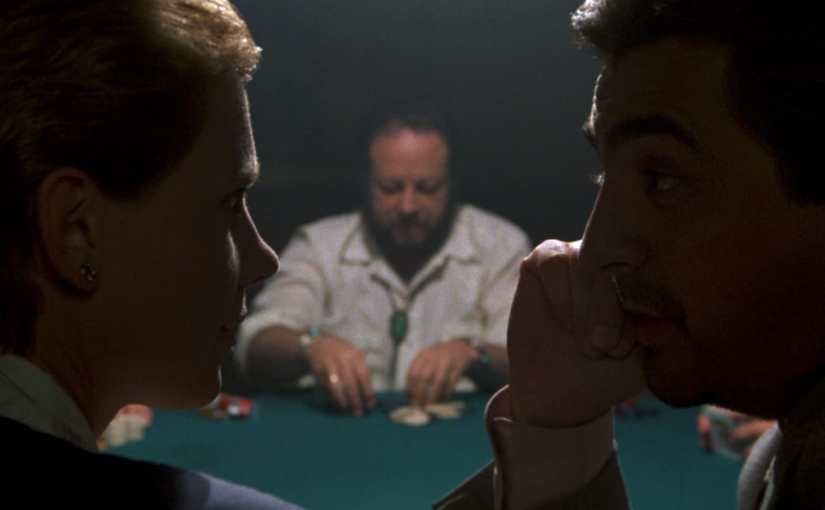
House Of Games plays like an instructional or “how to” video demonstrating how to be a successful con artist.  Crouse portrays a psychiatrist with a best-selling book titled “Driven” that focuses on obsessive behaviors.  One of her clients reveals that his compulsive gambling habits have put him $25,000 in debt with a card shark.  Crouse takes it upon herself to confront the card shark (Mantegna) on behalf of her frightened client.  Shortly thereafter, he’s got her acting as his wife to determine if the guy at the other end of a poker table is bluffing.  Then he’s introducing her to his con artist buddies, and she is becoming enamored, not only with him, but with the art of the con and the steal.  Her mundane life gives her the urge to see more.

The other Unpaid Critic, Miguel, recently reviewed this picture.  At the time of this writing, I have not read his review, but he forewarned me that the performances are stripped down to nothing.  Mantegna and Crouse are left bare to just delivering Mamet’s dialogue.  Miguel hadn’t liked this film the first time he saw it many years ago.  On my first viewing, this past week, I was engrossed.  However, I could foresee the ending as quickly as the film began.  I dunno.  Maybe it’s because I’ve seen several con artist films before like The Grifters and the granddaddy of them all, The Sting.  Films that focus on the best liars seem to always move towards a twist where even the viewer is scammed.  It’s fun to participate in the activity.

With House Of Games, the sequence of events move step by step.  Following the two characters’ introductions to each other, Mantegna is caught in the middle of doing another con but now he’s reluctantly forced to include Crouse in on the game.  This time it is seemingly much more complex and grander than the first time they worked together at the poker table.  It also gets all the more confusing when an unexpected murder is involved.  This con spells out a long night for the couple who are also falling for one another. 

Miguel is right.  The performances are most definitely stripped down and often the dialogue is wooden.  Crouse and Mantegna are deliberately flat.  I don’t even think they laugh or smile if I remember correctly.  It is likely because Mamet wants the viewers to follow along and pick up on how a successful con job is meticulous in its methods.  A con artist is not going to make waves with loud, angry monologues or passionate seductions and outrageous silliness.  What’s important is that everything that plays out seems convincing with no distractions that lead to doubt.  So, when the only African American in the cast (extras included) leaves a key on a hotel counter, you notice it.  It happened for a reason.  Later, when the characters come upon a BRIGHT RED Cadillac convertible, you are going to remember it.  A Swiss army knife with tropical artwork on the handle.  A gun metal briefcase with a large amount of cash.  A gun.  A murder.  Props and scenarios guide Mamet’s picture. Not the characters. 

Fortunately, the film remains very engaging.  As well, while I could figure out what was being played here during the entire course of the picture, as a viewer I had no choice but to feel proud of myself for uncovering the puzzles and riddles at play.  For me, watching House Of Games was like answering “Final Jeopardy” correctly when none of the contestants on screen had a clue. At least I was smiling by the end.

HOUSE OF GAMES (1987)

by Miguel E. Rodriguez

Director: David Mamet
Cast: Lindsay Crouse, Joe Mantegna, J.T. Walsh, Ricky Jay
My Rating: 8/10
Rotten Tomatometer: 96%

PLOT: A psychiatrist is led by a smooth-talking grifter into the shadowy but compelling world of stings, scams, and con men.


I’m sitting here trying to figure out how to summarize the story of David Mamet’s House of Games without giving away plot points, and it’s virtually impossible.  Mamet’s screenplay is composed almost entirely of double-crosses, triple-crosses, short cons, long cons, and the kinds of surprises that are greatly diminished in their description.  Remove one surprise, and the whole thing collapses like a house of cards.

A distinguished psychiatrist, Margaret Ford (Lindsay Crouse) pays a visit to a handsome con artist, Mike (Joe Mantegna), on behalf of one of her clients, who is distraught because of how much money he owes to Mike.  Dr. Ford is unexpectedly intrigued by Mike’s business methods, Mike senses this, and takes her to a back room where he and some other gentlemen are playing poker.

(These men don’t talk much, but when they do, it’s almost exclusively in poker patter.  “A man with style is a man who can smile.”  “Damn cards are as cold as ice.”  “The man says you gotta give action to get action.”  “Everybody stays, everybody pays.”  It’s like they learned how to talk from watching endless episodes of the World Series of Poker on ESPN2.)

Mike makes a deal with Margaret: if she helps him beat the hot player (Ricky Jay) at the table, he’ll tear up her patient’s marker.  The hot player has a tell when he’s bluffing.  Mike will go to the restroom.  If the hot player shows the tell, Margaret will tell Mike, and Mike will beat him because he’ll know he’s bluffing.  Mike goes to the bathroom, the hot player reveals his tell, and Margaret tells Mike when he comes back.  The hot player raises the pot, but Mike can’t cover it.  Margaret comes to the rescue: she’ll stake Mike with her own money.  But, uh oh, turns out the hot player wasn’t bluffing…and now Margaret owes $6,000 to a total stranger.

And that’s where I have to stop. If you think I’ve given too much away, you’ve got to trust me – I haven’t.  That’s barely the preface.  What follows is a character study of a woman who suddenly realizes that, after a lifetime of helping patients, she needs some kind of release, a change in routine.  Mike can provide this much-needed change.  The fact that it involves conning innocent people out of their hard-earned money is incidental.

Her fascination lies in Mike’s method.  For a great con to work, you can’t take someone’s money.  They have to give it to you.  They have to trust you to do the right thing.  The trick is working out how to gain the other person’s confidence without them realizing what’s happening.  We are shown two or three examples, and they’re all brilliantly sneaky.  At one point, Mike tells Margaret the cardinal rule of the con: “Don’t trust nobody.”  After watching this movie, I can’t say I agree 100% with this credo, but a healthy dose of skepticism never hurt anybody.

So how does Margaret square that credo, or anything about Mike’s lifestyle, with her profession?  She helps people for a living.  Her livelihood depends on getting strangers to trust her, but not to take their money…although let’s not forget she is well paid for her services.  Is her fascination with Mike an acknowledgement of the similarities between the two of them?

The screenplay doesn’t provide easy answers.  When we get to the final shot of the film, we can clearly see the choices Margaret has made, but it’s still unclear as to why she made them.  This is one of those movies where the complexities only really come alive during lively discussions afterwards.

Before watching it for this review, the last time I had seen House of Games was over thirty years ago.  At the time, I was unimpressed.  I originally gave it a 2 out of 10 on the IMDb website.  It was slow, the actors looked like they were giving bad performances, and nobody talked like real people talked.

Since then, I’ve had the opportunity to see not one, but three films by a French director named Robert Bresson.  (Bear with me here, I do have a point.)  Bresson, who was active mainly in the ‘50s and ‘60s, was famous for his method of shooting scenes over and over again, take after take, until all emotions had been drained from the actor.  His philosophy, in a nutshell, was that, in a film, the story isn’t everything, it’s the only thing.  If a screenplay couldn’t carry an emotional impact just by virtue of the story alone, if he had to rely on someone’s specific performance to make the movie work, he wasn’t interested.  The results are films that are curiously compelling, despite their utter lack of anything modern audiences might recognize as a typical acting performance.  His films are routinely included on the most prestigious lists of greatest films ever made; seven of them made it onto the 2012 critics’ poll by Sight & Sound magazine, a feat unequaled by any other director.

Sitting down to watch House of Games for the first time in three decades, after having seen Bresson’s films for the first time, I think I see what David Mamet was going for, in this, his directorial debut.  The actors aren’t quite dead-panning the entire time, but their performances (with one or two necessary exceptions) are pared down to the bare minimum of emotion.  Vocally, they’re angry, curious, flirtatious, what have you.  Facially, they’re ciphers.  Which, if you’re a good con man, that’s exactly what you want to be: a blank slate for the unlucky mark to interact with, then forget immediately.

I think back to those poker players and their mournful aphorisms, always said in nearly monotone.  And then I think to the film’s finale when Margaret believes she might be able to turn the tables on Mike (long story), and as the frantic words come out of her mouth, there’s not a smidgen of emotion on her face.  Like…a poker player.  Neat.

A FEW GOOD MEN

By Marc S. Sanders

A Few Good Men really does hold up.

Anyone with even minimal movie going experience can predict how it is going to end almost as soon as it starts, but that doesn’t take away from Aaron Sorkin’s first screenplay based on his original stage play.

It is well cast. For the film, no one else could ever play the intimidating and terrifying Colonel Nathan R Jessup other than Jack Nicholson. It’s not that it is just him in the role. It’s really Nicholson’s whole career legacy against the arguably still ripening careers of Demi Moore, Kiefer Sutherland, Kevin Bacon, Kevin Pollack and Tom Cruise. Nicholson’s timed grandstanding is necessary for the role to work.

Cruise on the other hand left me feeling a little too overplayed. The role calls for cockiness, yes, but is Cruise too cocky? Some of the gags he does work. Some don’t, like impersonating Nicholson momentarily (leave that for the guys on SNL, Tom), or when he’s poking fun at Moore’s character to his own delight. It’s a little too much. Still, his courtroom scenes are like watching the best in live theatre. Those scenes play like great sport, notably thanks to Tom Cruise.

Major props go to JT Walsh as a conflicted witness. When I say conflicted, I mean he authenticates a seriously valid and personal dilemma beautifully. Had it not been for Jack Nicholson, Walsh might have had an Oscar nomination. A shame he didn’t come close to such recognition while he was alive. He was such a great character actor.

Recognition also goes out to Kevin Bacon as a well versed prosecutor/Marine. His timing exudes the experience his character has, despite his youthful appearance.

Demi Moore might be caught trying too hard, I think. Kevin Pollack is the wise mentor sitting quietly waiting for his great moments. Kiefer Sutherland is great in almost anything he does. He doesn’t ever steal the spotlight like Cruise, Nicholson or Moore but he makes a great presence; conniving and bold.

The direction is nothing special really. Rob Reiner does fine but honestly Sorkin’s script sells itself.

Yeah, yeah. “You can’t handle the truth.” Great line, but I got news for you. I’d argue there’s even better lines in this 1992 film. It’s worth revisiting.