TAPAWINGO

By Marc S. Sanders

It’s amusing to say that Jon Heder (Napolean Dynamite) becomes a bodyguard in Tapawingo.  He plays a weirdo who headlines a cast of familiar faces, who also portray weirdos.  Yet, come what may, he is in fact a bodyguard named Nate Skoog (a weirdo with a weirdo’s name) who lives with his mom (Amanda Bearse) and her boyfriend (John Ratzenberger).  By day, he works in the mailroom for Amalgamated Insurance.  Nate has not hit the ranks of earning a shirt that bears the company name.  His boss gives him hope though as he assigns Nate the lofty responsibility of picking up his nerdy son, Oswalt (Sawyer Williams), from school.  Nate uses his dune buggy to handle the task.

The city of Tapawingo is notorious for its family of bullies known as the Tarwaters.  Nate is given a warning.  He’s to stop giving Oswalt rides to his tutoring sessions for their sister Gretchen (Kim Matula).  Let me be clear.  Young teen Oswalt tutors Gretchen, a twenty-something tough chick, dressed in black who moves with an attitude and a strut.  When Nate witnesses two Tarwater heavies beating up on Oswalt, he runs into action with his own technique of martial arts. Suddenly, he becomes protective of the kid.  It doesn’t help that Nate’s dune buggy runs over Gretchen’s Doberman.  Well, the Tarwaters move up the food chain and bring in their bruiser brother Stoney (Billy Zane) to make sure their policy stays in line.

Tapawingo is proudly oddball, strange, stupid, silly, slapsticky and really, really, out there.  Following the surprise response of the cult hit Napolean Dynamite Jon Heder moved into more mainstream fair and became a marquee name of sorts.  It’s fortunate he returns to his roots.  He’s on a very short list of comedians who could pull off this material.  Tapawingo is funny.  Very funny at times.  The blessing is that it does not overstay its welcome because of the stupidity of it all; how the actors portray the characters, how writer/director Dylan K Narang shoots his setups and close ups and how the absurdity of the script never stops to think.  Comedy like this only has so much fuel to drive a certain distance.  This gonzo kind of writing that lacks any kind of insight or symbolism operates like another kind of Abbott & Costello routine.  Eventually, you’ll want to move on.  In the moment, it’s a lot of fun though.

Jon Heder invents his own kind of character brand with a stoned kind of look on his face.  Nate Skoog doesn’t so much move.  Rather, the world around this nincompoop circulates around him.  With his buddy Will Luna (Jay Pichardo, playing a different flavor of weird with a Rambo wardrobe on his bearded scrawny physique) these dorks spend their time answering ads to serve as hired mercenaries.  They are marksmen at launching firework sparklers from a distance. Believe me when I say though that Nate and Will are the poster boys for gun prevention.  Maybe even butter knife prevention if there is such a thing.  Otherwise, they are playing bingo at the rec center or maybe wrestling by way of whatever they think wrestling should be.  A pair of overweight, goateed twins (George and Paul Psarras) demonstrate what the contact sport should look like in the foreground. 

Even Gina Gershon invests herself by hiding her signature glamour.  Caked in colorful makeup with a hairsprayed zig zag formation of dirty blond locks, I did not even recognize the actress who made big splashes in movies like Bound, Face/Off and Showgirls.  Her character’s name is Dot and I’d love to know if she took inspiration from Pee Wee Herman’s girlfriend, Dottie, in Pee Wee’s Big Adventure.  Dot resides in the background of Nate’s meandering life.  She’s seductive…I guess.  It’s another oddball within Nate’s world where stimuli is not so much a priority.  Nevertheless, Gershon is hysterical in a clownish, buffoon like role.

Billy Zane is the villain of this silly picture.  Bald, clean shaven, husky and dressed in black, I don’t think the guy has more than ten lines.  It’s his presence that says it all as he sits behind the wheel of an emerald, green Mustang.  I’m glad he’s here.  He headlined Waltzing With Brando (which I loved), while Heder played the supporting role.  Now the pair switch positions.  Newman and Redford, Lemmon and Matthau, Zane and Heder.  It works.  By appearance, method, and physique, these guys are so unlikely to work together, and yet that generates inventive comedy.

Tapawingo operates like one of those B-movie 1980s comedies (Better Off Dead, Real Genius) that you’d rent when The Goonies or Gremlins was checked out at the video store.  It carries no charm.  No sensitivity.  No romance.  The adventure is pratfallish and deliberately lethargic.  It’s strength comes from its characters that leap out of a comic book or a Saturday morning cartoon.  Jon Heder’s approach to live action animation is a winner.  He’ll make you bust a gut.  He doesn’t have to say a word.  Simply a close up of him staring into a void will generate the laughs. 

The brains lie in the bravery to do something as zany as Tapawingo.  Go into it with an open mind.  Better yet, take your thinking cap off and just observe.  It’s a lot of fun.

Oh yeah.  The soundtrack is killer with the help of Pat Benatar and Quiet Riot.

TWILIGHT’S LAST GLEAMING (1977)

by Miguel E. Rodriguez

DIRECTOR: Robert Aldrich
CAST: Burt Lancaster, Charles Durning, Richard Widmark, Paul Winfield, Burt Young, Melvyn Douglas, Joseph Cotten, Richard Jaeckel, John Ratzenberger
MY RATING: 7/10
ROTTEN TOMATOMETER: 80% Fresh

PLOT: A renegade USAF general takes over an ICBM silo and threatens to provoke World War III unless the President reveals details of a secret meeting held just after the start of the Vietnam War.


Twilight’s Last Gleaming, one of Robert Aldrich’s last films, is a cleverly constructed Cold War thriller whose pointed message about the Vietnam War nearly torpedoes the suspense.  The political message is hammered home in a scene that goes on for a bit too long with people speaking dialogue that feels hammy and trite.  But the movie surrounding this one scene is good enough that I would still recommend it to anyone in the market for something off the beaten track.

The movie is set in 1981, four years after it was released, so no one could draw any real-life parallels between the characters and people in real life.  In an opening sequence that feels reminiscent of Die Hard (1988), General Lawrence Dell (Burt Lancaster) and his team of military ex-cons manage to infiltrate and take command of a US ICBM missile silo in Montana.  While I highly doubt it would be as easy as portrayed in the film, Aldrich films the sequence so that I got caught up in the suspense of the narrative instead of worrying about pesky details.  (If there’s a drawback to these and other sequences featuring military hardware and installations, it’s the overall low-budget feel to the sets and props; everything looks like it was shot on a TV soundstage instead of a big-budget film set.)

Once inside, Dell makes his demands: $20 million for each of his remaining team (Burt Young and Paul Winfield), the President must read the transcript of a secret meeting held just after the Vietnam war started, and the President must hand himself over as a hostage to secure their escape.  Otherwise, he’ll launch nine Titan ICBMs at their targets.

This creates a little tension among the would-be terrorists.  Winfield and Young couldn’t care less about the secret meeting, but Dell is adamant.  Meanwhile, General MacKenzie (Richard Widmark) formulates a plan to eliminate Dell and his crew using a “tiny” nuclear device, the President (Charles Durning) agonizes over the secret transcript, and his best friend and aide uses some “tough love” to get him to make a decision.

Despite the fakeness of the surroundings, I was absorbed by the thriller elements in Twilight’s Last Gleaming.  I would compare them to the best parts of WarGames (1983) and The China Syndrome (1979).  There is some impressively impenetrable technobabble about booby traps and inhibitor cables and fail-safe systems that I just rolled with.  The plan involving that “tiny” nuclear device leads up to a sequence that I would compare favorably with any contemporary thriller you can name.

One of the ways Aldrich achieves this effect is through the use of split-screens…LOTS of split-screens.  It starts at the beginning of the film with two screens.  Then there are moments with three split screens, two on top and one in the bottom section.  Then, during the most intense sequence of the film, we get four splits in each corner of the screen.  At first, I found it disorienting, but it absolutely works when it most needs to.  (I’m trying not to give away too many plot details, so excuse the vagueness.)  I don’t know that I would want to watch an entire movie like this (Timecode, 2000), but in small doses, it’s very effective.

Where the movie bogs down is the middle section of the film when the President expresses his disapproval of the contents of the secret transcript Dell wants publicized.  It’s a bit theatrical to believe a sitting American President would be this vocal about his feelings in the middle of a dire crisis.  I think the scene would have played just as well if we had gotten a general idea of the transcript, or even if the contents had NEVER been revealed to the audience.  It would have been a perfect Macguffin, leaving viewers free to imagine anything they want.  The truth about Kennedy’s assassination?  Area 51?  Pearl Harbor was an inside job?  The Super Bowl really IS fixed?  Who knows?

Instead, the President insists on reading a portion of it out loud to his Cabinet members, enlisting them to read certain lines.  While I admire Aldrich’s intent (to send a cinematic protest to the architects of the Vietnam war), the scene nearly brought the movie to a stop, which is deadly when dealing with a suspense thriller.

But, like I said, the rest of the movie is so good, I am compelled to let it slide.  Later, we get surprise attacks, snipers, helicopters, a crafty fake-out involving torture, and an ending that is as cynical as they come, but which felt like the best way out of the situation for everyone involved…except for the American people, but that’s another story.  Twilight’s Last Gleaming feels virtually forgotten, and that’s a shame.  Aldrich directs this movie with a lot of passion for the material and milks every ounce of suspense he can with the tools at hand.  If you’re prepared to overlook that middle section, you’ll get a kick out of this movie.

P.S. Look fast for an unexpected appearance by William Hootkins, aka “Porkins” from Star Wars (1977).

WALL·E

By Marc S. Sanders

There are some movies that seem to accurately predict what we can expect of our planet’s future.  Paddy Chayefsky was one such prophet with his script for Network and the rampant consumption of television influence and addiction.  Author Phillip K Dick might have also been a Nostrodomus of sorts when his writings were adapted into such films as Total Recall, Minority Report and Blade Runner which offered convincing convenience to lifestyles and evolved productivity.  Perhaps the imagineers behind PIXAR are also on to something because their adorable, futuristic WALL·E does not seem so farfetched.  

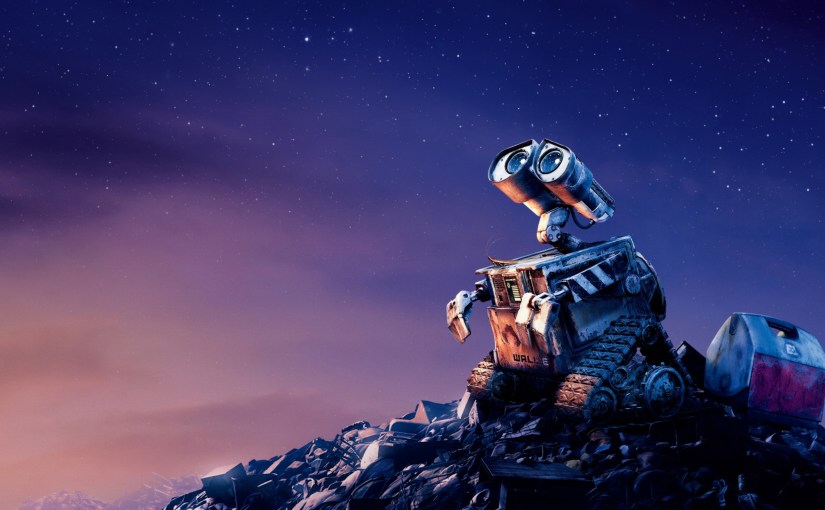
The robot title character is a trash collector on an abandoned planet Earth seven hundred years into the future.  A Wal-Mart/Sam’s Club amalgamation known as the fictional Buy N Large appeared to have become the main resource for any immediate need of the human population that once existed; what the coming of Amazon is turning into. This monopolized interpretation of absolute capitalism was run by a CEO and maybe Commander In Chief of the free world, played by Fred Willard, the one major flesh and blood actor to appear in this picture. 

WALL·E, along with a faithful cockroach, roams the wastelands.  The puppy dog, bug eyed robot wheels around on his tractor legs collecting the endless amounts of leftover trash and compacting it into neat, stackable boxes.  Piled on top of each other, these boxes get as high as skyscrapers.  These are the remnants from what Buy N Large left for the planet.

One day a rocket ship arrives and drops off a highly sophisticated and glossy white droid that we come to know as EVE.  For WALL·E, it’s almost love at first sight even though EVE has a treacherous laser cannon for an arm and intimidating blue cyborg eyes.

Eventually, the two bots hitch a ride into space when the rocket returns to pick up EVE.  They arrive on a galaxy cruise liner that’s floating through the solar system.  While the two get into a bunch of Looney Tunes shenanigans running through the corridors and piping of the ship, the audience bears witness to what exactly happened to planet Earth, and who has survived to carry on.  At this point a prophecy seems to be declared by writers Andrew Stanton, Pete Docter and Jim Reardon (all PIXAR regulars at the time).

Humans aboard this liner have become oversized, lazy blobs with no neck, fat arms, fingers and legs, and reclined to permanent seats while robotics cater to their hungers and comforts.  These people are cheerful but happily lazy and unproductive.  Remember when your mother would tell you to clean your room?  Well, the wasteland universe of WALL·E bears justification for mom’s aggravation and constant pestering.

The computerized animation of this PIXAR romantic adventure is dazzling in details and character expression.  There’s an unattractive sand like and earth tone mood to anyplace we explore on Earth.  Yet, the industrial sheen of the cruise liner appears to have all the comforts imaginable.  You can practically taste the colors and feel the balmy air conditioning within this ginormous vehicular city in space. Yet, the telling story of WALL·E has no problem convincing me that this is not right.  This is not a future I’d want to be a part of.

Disney and PIXAR follow that mentality of ensuring a soul of emotion drives their characters of fantasy and it’s easy to fall in love with the clunky lead robot.  You want WALL·E to be safe from sandstorms, while also keeping his only friend, the cockroach, by his side for companionship in an entirely lonely world.  His only other source of cheerfulness comes from watching the musical Hello, Dolly! on an old TV. Even playing ATARI’s Pong is not stimulating enough for this little guy.

Sound Effects Wizard Ben Burtt, who pioneered staple sci fi elements with the Star Wars films, performs the vocal expressions of chirps and beeps for WALL·E’s innocence.  There’s a language to the little fella and it’ll leave a lump in your throat when he calls for EVE.  Elissa Knight brings a more experienced, technologically up to date personality to EVE.  We worry when an organized entity like EVE robotically screams for WALL·E when she thinks he’s in danger.  She’s only supposed to follow a program, but the manufactured mind lends to a side effect of genuine emotion.  As the two get acquainted with each other, there’s a touching chemistry to them both.  A floating dance through space is as much silly as it is adorably romantic.  You cannot help but smile because by this point you are invested in this relationship as much you’d buy Rick and Ilsa’s affections towards one another, or Harry and Sally’s.

I really embrace the childlike love story connecting these two non-living beings.  Set against what appears like an apocalyptic wasteland, there are layered dynamics to this animated film, one of PIXAR’s best.  

I have to also salute the film’s nods to classic science fiction that also offer not so unrealistic possibilities.  An antagonist comes in the form of a robot similar in appearance to HAL-9000 from Kubrick’s 2001: A Space Odyssey.  He’s a nasty bugger with an all too familiar blood-red eye. It’s also a delight to recognize Sigourney Weaver’s voice as the cruise liner’s computer, a sort of slap in the face to monochromatic computers that would countdown a certain doom for the actress’s most famous role of Ellen Ripley in the Alien films.  PIXAR has always been brilliant with their wink and nod delights.

The film was released in 2008, a near generation ago maybe, when iPhones and Androids were not even as entirely sophisticated as today.  Yet PIXAR could telegraph what was to come.  The environments on Earth and on the cruiser tell us just how overly reliable we’ve become on technological conveniences for socializing or even one stop shopping.  

We are getting to a point where we might not even procreate with one another.  It’s a sad irony that it will take two self-thinking, yet designed for programing, robotic appliances to remind us how valuable the human touch is and what a purpose to life really serves ourselves and those we have to interactively live with.  

You might be embracing that cell phone tight in the palm of your hand, but will that device ever hold your hand in return?