SEPTEMBER 5 (Germany, 2024)

by Miguel E. Rodriguez

DIRECTOR: Tim Fehlbaum
CAST: Peter Sarsgaard, John Magaro, Ben Chaplin, Leonie Benesch
MY RATING: 10/10
ROTTEN TOMATOMETER: 93% Certified Fresh

PLOT: During the 1972 Summer Olympics in Munich, Germany, the ABC Sports broadcasting team must adapt to providing live coverage of Israeli athletes being held hostage by a terrorist group.


Two of my absolute favorite true-life movies (United 93 [2006], Bloody Sunday [2002]) happen to be from the same director, Paul Greengrass.  Watching Tim Fehlbaum’s film September 5 felt at times like I was watching a Paul Greengrass film, and I can offer no higher compliment than that.  From the moment the first gunshots are heard coming from the Olympic village in Munich in the wee morning hours of September 5, 1972, this movie never lets up on the tension.  Over the next 24 hours, we will follow the ABC Sports broadcasting team as the managers and crew work through a tangle of journalistic ethics and operational logistics to report on the biggest news story of their lives while maintaining objectivity and their obligation to the truth, and ALSO keeping the safety of the victims and their families in mind.

The four major characters are legendary ABC Sports executive Roone Arledge (Peter Sarsgaard); a then-unknown control-room functionary, Geoffrey Mason (John Magaro), who was in the right place at the wrong time; ABC Sports producer Marvin Bader (Ben Chaplin); and German-to-English translator Marianne Gebhardt (Leonie Benesch), who is probably an amalgam of several different people who were most likely present during the actual events of the film.

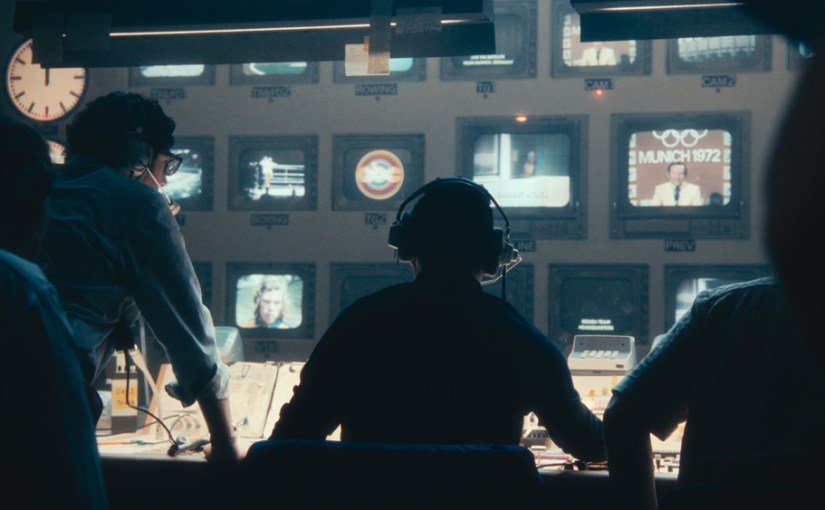
One of the masterstrokes of September 5 is how it rachets up the tension by staying inside the claustrophobic control room and connected offices for the entire film, minus the opening and closing shots showing Geoff arriving for work and leaving the next morning.  Anything showing us the outside world is only visible on the banks of television monitors in front of them, which leads to much confusion towards the end of the film as reports of the Israeli hostages being freed begin circulating, but no one can actually see what the hell is going on.  This is one of the ways the film reminded me of some of the best scenes in United 93 when the people responsible for making the most crucial decisions of their lives were limited by what they could see and hear on the news.

I have never worked in a TV studio, but this movie carries a palpable authenticity that made me believe everything I was seeing.  I never knew, for example, that chyrons (those small captions on the bottom of a TV screen during the news) were analog back in 1972.  Whenever a new development occurs, the control room has to call up a woman in a completely separate room/mini-studio so she can manually place individual letters onto a physical message board, then get behind a camera and shoot the image so it can be superimposed back in the main control room.  Exhausting!

Peter Jennings is reporting remotely across the street from the Israeli apartments, but he cannot be heard live from his radio into the audio feed for the TV signal.  So, some random dude takes a phone handset, unscrews it, solders some wires, clamps it all together in front of a microphone, and presto, now Jennings is live.  The whole operation is put together with spit and baling wire.  It feels like it’s a miracle that anything was televised at all.

The other conflicts presented to us are no less important.  Marianne, a German woman, is drafted into helping with the translation, but first she must endure some brief accusations from Marvin.  The fact these Olympics are being held in Munich less than thirty years after the end of World War II is something many people are still coming to terms with.  He asks her if her parents knew about the concentration camps.  She stares for a second and gives the best answer possible: “But I am not them.”  After that, she earns the complete trust of the entire staff.

The subtext of the German guilt over World War II is bubbling just beneath the surface for the entire film.  A German maintenance worker won’t release replacement cables to a French tech until Marianne talks him into it.  It is theorized at one point that German military forces could possibly end the hostage situation within minutes, but the German military is constitutionally forbidden to operate within the Olympic village, for obvious reasons.  Roone Arledge watches Mark Spitz win yet another gold medal, and instead of going to a closeup of Spitz, he instructs the cameraman to cut to the face of the German swimmer who lost.  Someone asks him, “Do you really want to bring politics into this?”  And he replies, “It’s not about politics, it’s about emotions.”

Which brings in the other major point of retelling this story in this way.  There is a point where ABC’s cameras have great shots of the building, the balcony, and the entire complex, and they are broadcasting live (the first time the Olympics had been broadcast live, by the way).  Someone spots German policemen – non-military – getting into position with sniper rifles.  Marianne hears chatter on the police band about an operation getting the green light.  The press is ordered out of the area, but ABC’s cameras continue to broadcast live.  Someone notices that a TV appears to be on inside the apartment where the hostages are being held.  Geoff suddenly asks a reasonable question: “Are the terrorists seeing this?”  Minutes later, German police storm the ABC control room and demand the cameras be turned off, pointing a gun at the crew at one point.  The cameras get turned off and a furious Arledge kicks the Germans out of the building, but the point is made.  Minutes later, the operation is called off. 

“They should’ve cut the electricity to the apartment, it’s not up to us to double-check on them,” says Marv.  But Geoff makes a point: “Marv, it’s not okay if we made it worse.”  The fine line between the freedom of the press and general public safety could not be more elegantly portrayed than it is here.  Earlier in the film, just as the cameras have been set up with shots of the balcony of the apartment, someone asks, “Black September [the terrorist group responsible], they know the whole world is watching, right? …if they shoot someone on live television, whose story is that?  Is it ours, or is it theirs?”

It seems like an easy question to answer: “Public safety comes first.”  But who gets to decide what’s in the public’s best interest?  Those policemen who burst into the control room and shut the cameras off at gunpoint?  Perhaps it should be left to each newsperson’s individual conscience, but can that always be trusted?  These are questions I am not qualified to answer, but I appreciate films like September 5 because they have enough faith in the viewer to pose those questions and then refrain from providing a tidy answer.  It’s one of those rare thrillers that tells a crackling good story and also asks some big, relevant questions that you may not even think about until you’re driving to work the next day.

One of the last things we hear is Marianne talking to Geoff, who had sent her to the German airport where the hostages were supposed to have been flown out of Germany.  “I was there with hundreds of people, we stared into the night.  We were waiting for something to happen because we wanted to take a picture of it.”  While that’s a rather bleak way of describing a profession that has given us some compelling images that have swayed the world’s opinion on vitally important matters, perhaps it’s also a way to caution those who would exploit situations, like the paparazzi who chased Princess Di into that tunnel.

SEPTEMBER 5

By Marc S. Sanders

September 5 is a sweeping account of how breaking news used to be assembled.  You had to be in the right place at the right time.  If you weren’t, then perhaps the sports department of your media conglomerate is, and they will get the story. 

The very first televised terrorist attack was broadcast at a sadly appropriate time.  The 1972 Olympics were being covered by the ABC television network.  For the first time, homes all across the world would be able to watch the games in color, from a satellite feed shared among the big three networks.  ABC had the broadcasting rights to the games though.  The setting is especially interesting to this story.  The Olympics are being hosted by Germany, primarily out of Munich.  This is an opportunity for the country to finally redeem itself, only twenty-seven years after World War II had come to an end and their country’s Nazi regime had been overthrown.  Germany had a lot to make up for.

The Sports Division of ABC news turn over in the wee hours of the morning of September 5.  Geoffrey Mason (John Magaro) slumps into the studio and relieves Roone Arlege (Peter Sarsgaard) following long hours of editing and covering competitions in swimming, volleyball, boxing, track and so on.  There’s minimal staff on shift as the athletes and coaches are asleep for the night, but then Geoffrey and crew believe they hear machine gun fire out of the direction of Olympic Park, and suddenly everyone is awakened and scrambling to put together the story fast. 

No other broadcasts are reporting on this alarming incident.  This is a story that comes at ABC Sports in their own time.  Had this happened today, amid an age of worldwide shrinkage with the existence of the internet, these guys would have been way behind.  In 1972 however, they can rely on Mariane Gebhardt (Leonie Benesch) a female German flunky of the sports division to translate the various radio communications between the terrorists and the German negotiators, and what plans are being put in place.  Nine Israeli athletes have been taken hostage in their hotel rooms with two believed to have already been killed.  The terrorists (believed to be a Palestinian militia group called Black September) demand that Israel release two hundred of their prisoners or they will kill a hostage every hour beginning at noon.

Forgive the cliché terminology, but September 5 is a taut, nail biting, documentary style thriller told only through the perspective of the ABC Sports division.  While the developments of the hostage situation feel urgent, for these unshaven guys in glasses and wrinkled shirts who are operating on little sleep and a lot of coffee, it is about getting the news out quickly and accurately, and just as importantly, first.  Geoffrey and Roone are constantly on the phones trying to learn whatever they can from Peter Jennings, the eventual famed ABC reporter, who is nearby the incident and at times hiding from the German police who are desperately trying to clear the area of the press.  The guys even send in a staff member with a smuggled camera and reels of film taped to his belly while he poses as an Olympic weightlifter.  The Germans forbid the press from trespassing but insist the games carry on.  So, the athletes and coaches are the only ones who can enter the area to prepare for competitions of the day.  Even Howard Cosell happens to be in a hotel staircase nearby and can provide feedback. 

In the news control room, the guys are literally putting walkie talkies next to microphones that broadcast live on air with Jim McKay who is behind the desk, talking to the world.  This is bare bones news broadcasting with unsophisticated technology to aid them in this short window of time.  The director of this film, Tim Fehlbaum, brilliantly captures the desperate inconveniences of reporting this way. 

Roone and Geoffrey also have to contend within their own ranks.  This is not a sports story.  This is a news story and so Roone must insist on keeping the story.  They are the only ones there.  How much more effective would a news division located on the other side of the world fare?  Therefore, Roone’s team are the only ones qualified to cover this developing story.  ABC News will not have access to this. 

Roone also has to improvise how the satellite feed is shared with their competitor, CBS Sports.  It’s a pain in the ass inconvenience and yet the resourcefulness and quick thinking of the control room staff find a way to uphold their claim on this story.

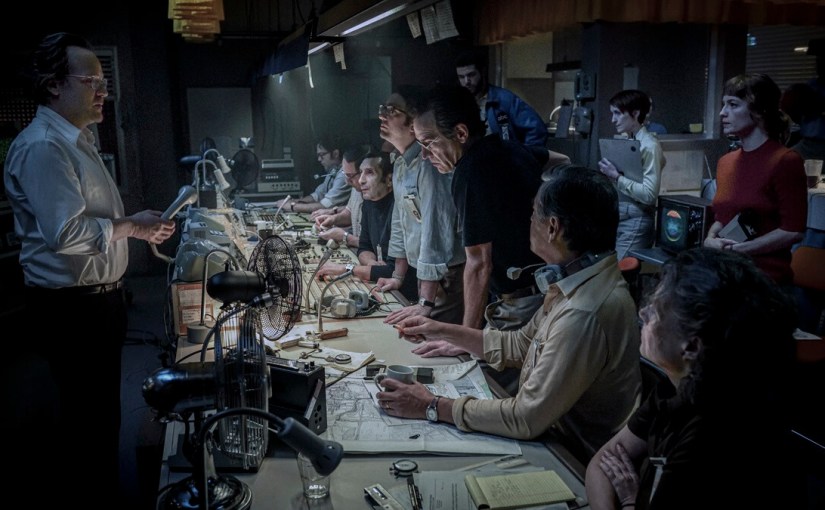
While watching this account, it matters little if we know the outcome of the September 5, 1972, Munich attack.  This film’s purpose is covering how the first few who knew about the situation responded. By the time the ninety-five-minute film is over a lot has been shared.  Tim Fehlbaum, with an Oscar nominated screenplay written by him along with Moritz Binder cover quite a bit.  The pace moves as fast as these people in the control had to move on that terrible day.  So, the information comes quick.  With real life archived ABC footage spliced within the film, you feel as if you are standing in the corner of this dark room with various tv screens, microphones, and telephones. 

You watch John Magaro feed information to Jim McKay, and then the picture cuts to real life footage of McKay at the desk.  It’s quite inventive how the script is accommodated to work in line with what Jennings, Cosell, McKay and others literally said as the crisis was being reported.

Having seen all ten Best Picture nominees for 2024, it is disappointing that September 5 did not make the cut.  Tim Fehlbaum’s picture certainly deserves more recognition and a slot over other contenders this year.  Still, the screenplay is a well-deserved accolade.  To interweave a fresh script that hinges on what was literally said on television screens around the world at that time is a marvelous strategy. 

September 5 is a crackling thriller of a terribly sad day.

PAST LIVES (2023)

By Marc S. Sanders

Facebook is a blessing and a curse for me.  It sustains a social media addiction that’s been hard to crack.  Fortunately, I never signed up for X (or Twitter), Instagram, My Space, or Snap Chat.  So, I can’t necessarily be as bad as other peers I know who are bringing on early arthritis by grasping their androids and iPhones to keep up with twenty different apps all at the same time.  The best thing to come out of Facebook, though, is access to reach across the planet and catch up with people of my past, from elementary school to high school, to college and past occupations.  Regularly, I speak to Israel, Australia, Canada, England, France and South America, as well as about thirty to thirty-five states.  Celine Song is a new writer/director who springs off the social media craze to cover a twenty-four-year span between a South Korean girl and boy.  

At age 12, Nora (Greta Lee) chooses to emigrate to Canada, and once she reaches her early twenties, she’s a budding playwright in New York City.  Hae Sung (Teo Yoo) is sad to see his friend go off to begin a new life while he remains in Seoul, eventually enlisting in the army followed by becoming an engineer.

After twelve years apart, they curiously find one another on Facebook and get hooked on Face Timing each other during every waking opportunity. It’s no matter that the time difference doesn’t ideally accommodate both of them.  They are happy to forgo sleep to keep up.  The problem is their future ambitions and lack of funds prevent them from seeing one another personally. Alas, there’s only so much substance to their rekindled romance that began as affectionate puppy love in middle school so many years ago.  Nora announces she’s ending the activity as it is time to move on.

Another twelve years pass.  Nora is married to Arthur (John Magaro, so memorable in The Big Short).  Hae Sung has just broken up with a girlfriend and opts to meet up with Nora for a visit to The Big Apple.

I know reader.  It appears as if I’ve recounted the entire film, but honestly I have not.  The magic of Past Lives does not thrive off the next story development.  Its strength falls within the various conversations that occur between the three characters.  Three quarters of this film is spoken in Korean, and an emotional tug latches on to you.  

My father and I were once waiting in the terminal of LaGuardia Airport, and we could not help but observe and conjure up made up backgrounds of the different walks of life who passed us by.  Celine Song wisely seats these three characters at a bar – two South Koreans and just off to the side is the melancholy Jewish guy.  Voiceovers begin to hypothesize what’s the story behind these individuals.  Initially, I was not even sure if there was a connection.  Maybe one of the three is an extra.  Then, the film opts to show us who is who and what is really happening here.  Who is talking, who is listening and what could the topic of conversation actually be.

I could never do justice by describing the near poetic and yet genuine dialogue that Nora, Hae Sung and Arthur deliver.  Sometimes it consists of what if scenarios.  There’s time to allegorically consider a Korean legend that comes from degrees of different generational connections.  

The best caption of the piece is when Celine Song aims her cameras at a fork within the pathways of Seoul, South Korea.  On the right, one character takes a flight of stairs.  On the left is a walkway going slightly west.  The two children will likely never see or speak to one another again once they say goodbye and follow down a separate route.  It’s heartbreaking, and this is only in the first ten minutes of the movie.  

Separation will alter relationships as well.  Nora learns to speak English.  Hae Sung relies on his Korean.  For him to even respond to Arthur is near impossible as much as they respect the value each man has in Nora’s life.  It will always be awkward among these three.  Nora can have a conversation with either man out loud, but any given moment one of the men will never comprehend the context of the discussions.

There’s an impossible outcome for Nora,  Arthur and Hae Sung, and what is so relatable is that I believe a situation like this affects many of us.  We all go on different trajectories in life that require us to shed portions of our past.  We can reminisce and reflect.  We can collect updates of those who have long been gone.  Yet, we can never get back what we once treasured, and I believe that is the sad, but true point of Past Lives.  We can only find comfort in memories while fantasizing over what could have been if I didn’t move away or I chose not to become an engineer, or I opted to marry or not marry.

Celine Song’s debut film succeeds with a very sensitive script built on genuine emotions of love, fear, loss and inner conflict.  It’s a special gift that she cast her piece with three actors who treat the dialogue with kid gloves.  Sometimes, before anyone speaks or says another word, there’s a silence, and you’ll find that you can still hear what Greta Lee, Teo Yoo and John Magaro are saying to themselves.  Past Lives is one of those films that asks you to read between the lines.  Fortunately, Celine Song doesn’t make the challenge that difficult because the filmmaker reins you in as quickly as her story begins.  When it ends, though, it’s much harder to let go.

THE BIG SHORT

By Marc S. Sanders

Ever since Adam McKay’s The Big Short was released in 2015, it has remained a favorite film of mine. I watch it at least once every year. McKay’s script with Charles Randolph, adapted from the book by Michael Lewis, is enormously funny but also realistically frightening.

The film shows how America’s housing market crashed in the first decade of the 21st Century. Mortgage backed securities never failed in history until now, and no one anywhere, especially the banks, ever believed a crash would occur, but it did. Only a select few people like Dr. Michael Burry (Christian Bale) and Jared Vennet (Ryan Gosling) foresaw what no one else could imagine, and thus they took advantage of it by making enormous betting transactions against the housing market. To say you need a strong stomach for this kind of investment is a serious understatement.

Burry is the first one to realize that the country as a whole will default on their mortgages once their interest rates go up in 2007. He represents Scion Capital and invests billions of dollars against the mortgage backed investments. Now he watches for the next two years while the capital at Scion declines into negative digits and drowns out the frustration with death metal music. Bale is fascinating as Burry who has a brilliant mind, but he lacks social skills.

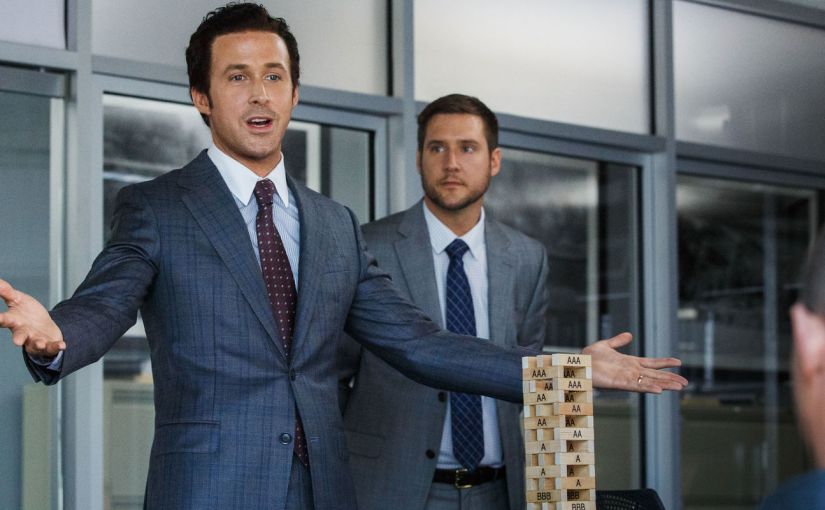
Vennet gets wind of Burry’s discovery and sells the idea to Mark Baum (Steve Carell) and his team of representatives. Vennett narrates how it all played out in the market; how ratings agencies gave triple A rankings to bonds made up of worthless backed securities. McKay wisely has Vennett introduce celebrities like Margot Robbie, Anthony Bourdain and Selena Gomez to break down the vast complexities of everything. Robbie in a bathtub. Gomez playing black jack. It’s hilarious and relatable. Gosling is great. A great scene is his selling presentation which includes a metaphoric prop of a Jenga tower. Vennet has no qualms about collecting premiums as the rest of the country is going down. He’s profiting, and why not? Big banks have been doing it for years.

Carell is spectacular as well as Mark Baum. He has a heart, but he’s an angry individual. It sickens him to make money off this short buy, but it’s the responsible action to take for the benefit of his own clients. Mark also suffers from his brother’s suicide. McKay allows just enough time for this to draw out the misery of this character. Carell should have gotten an Oscar nomination at least. Baum is a guy with no filter as he confronts authoritarian parties throughout the film. He’s a hero really, but he’s not a guy I’d ever want to be left in a room with either.

An additional story arc comes from two young guys (Finn Wittrock & John Magaro) who also uncover this opportunity. They enlist Brad Pitt as a recluse who get them into the arena of big traders. These kids who started their investment company in a garage are great as well. Another party who came out of nowhere to uncover what no one else saw.

McKay assembled a magnificent blend of actors for these unusual characters who always hid behind their computer monitors. He directs with a lighthearted approach having his characters breaking the 4th wall at times to explain what all of this means in the simplest terms.

As simple as McKay makes it with his humor, this was a terrible, terrible tragedy putting millions of people out of work and owners losing their homes. Even renters lost their homes. Pay your rent but it means nothing if your landlord isn’t paying his mortgage. McKay tragically shows this outcome.

It’s terrible to imagine, but it’s a major downfall of the American economy. When the country, is doing well, while paying short term low interest rates, no one concerns themselves with what could all go away in an instant. It’s a vicious cycle, and the only funny thing about it all is that the supposedly most brilliant investors will naively allow this to happen over and over again.

The Big Short is one of the best films made in the last 20 years.