
by Miguel E. Rodriguez
DIRECTOR: Orson Welles
CAST: Orson Welles, Jeanne Moreau, Margaret Rutherford, John Gielgud, Keith Baxter, Fernando Rey (!), Ralph Richardson
MY RATING: 8/10
ROTTEN TOMATOMETER: 96% Certified Fresh
PLOT: King Henry IV’s heir, the Prince of Wales, is befriended by Sir John Falstaff, an old, overweight, fun-loving habitual liar. Through Falstaff’s eyes we see the reign of King Henry IV and eventual ascendancy of Henry V.
[This review contains mild spoilers.]
There are so many layers to Orson Welles’s Chimes at Midnight that I had trouble figuring out how to start this review.
For starters, putting aside the significance of this film’s subject matter and where it falls in its legendary director’s body of work, it’s Shakespeare, and I have a spotty record when it comes to enjoying films of Shakespeare’s plays. The only ones I’ve every been truly entertained by were the semi-recent The Tragedy of Macbeth (2021) starring Denzel Washington and Frances McDormand, and – God help me – Baz Luhrmann’s Romeo + Juliet (1996). With the Macbeth film, I was transfixed by the performances from two of the best actors of their generation, and with Luhrmann’s film, what can I say? The deliriously over-the-top visual style frames the over-the-top performances perfectly.
With every other Shakespeare film I’ve seen, the language has very nearly put me to sleep, not because it was delivered poorly, but because it has always been difficult for me wrap my brain around the Bard’s syntax, occasionally so tortured and roundabout that even Yoda would ask, “Say what did he?” Such is the case with quite a bit of Chimes at Midnight. Watching Welles and Gielgud act are the highlights of the film, but after about 15-20 minutes, I had to put on the subtitles so I could pick up on the nuances of the language.
Can you follow the plot of the film without subtitles? Yes, to a degree, but it was difficult for me to keep track of the numerous side characters: Hotspur, Northumberland, Westmoreland, Worcester, Percy (who is also Hotspur, didn’t put that together until late in the film), etc. But I concede that, yes, without understanding every single word, it is possible to follow the broad strokes of the story, much like you might be able to follow E.T. with the sound off. Don’t know why that’s the comparison my mind jumped to, but I’m sticking to it.
So, as pure entertainment, Chimes at Midnight suffers, through no fault of its own, from a lack of comprehension on my part, except for the extensive battle scene at about midpoint and the emotionally shattering finale, which I’ll get to in a minute.
Now. If we set aside the pure entertainment value and look at Chimes at Midnight a little more analytically, there is a gold mine of information here, especially for dedicated Wellesians like my good friend, Anthony…hope you’re reading, bro.
First, there’s the production itself. Chimes was the last non-documentary film Welles completed in his lifetime. On the Blu-ray Criterion disc, Simon Callow, himself a Welles fan and biographer, makes the observation that, prior to Citizen Kane, Welles had nothing but a string of great good luck, and nothing but atrociously bad luck afterwards, almost as if Welles had struck some kind of Faustian bargain to get Kane made. The lost footage and criminal re-editing of The Magnificent Ambersons, studio interference with Touch of Evil…the list goes on. To get funding for this film, which had been a passion project of his for years, he had to go to Spain, and even then, he had to pinch pennies. (The film is officially a Franco-Swiss production and never received a full American release due to the film’s ownership that was bought and sold, or something like that…watch the interviews on the Blu-ray for the whole story.)
But even on such a limited budget, Chimes at Midnight looks like a million bucks. There’s nothing overly flashy about the camerawork, and there is a low-budget vibe to some of the scenes that reminded me of Kevin Smith’s Clerks, which I mean as a compliment to both films. I specifically noticed scenes shot with Gielgud as King Henry IV in his castle, with cathedral ceilings and high windows casting shafts of sunlight into the vast space like an Ansel Adams photograph. The battle at the center of the film looks and feels like something out of Kurosawa, but even more chaotic, which was Welles’s intention. He specifically wanted a non-glamourous battle to evoke the passing of English history from an age of gentility to one of barbarism.
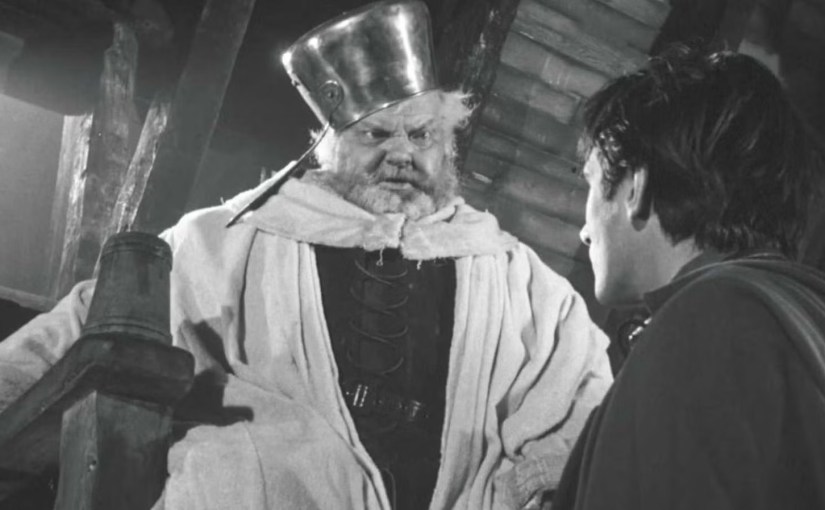
It’s the towering performance by Welles as Falstaff, though, that elevates this film past my issues with its entertainment value. I know relatively little of Shakespeare’s plays, but I knew the name of Falstaff before going in. I knew that he was a larger-than-life figure…I always pictured Brian Blessed or Robbie Coltrane when I pictured him in my head. After seeing Chimes at Midnight, I will only see Welles’s version. Wearing a fat suit to give him even more girth, until he looks like a caricature, Welles brings a sense of nobility to Falstaff’s shenanigans. He is utterly devoted to young Prince Hal (Keith Baxter), whom he knows will one day be king. He spins tall tales, sometimes it seems just to give Hal pleasure in catching him out in a lie. There is a charming scene where they do a little playacting: Falstaff pretends to be Hal’s father, sitting on a makeshift throne and using a cooking pot as a crown. He makes solemn proclamations with a sour face and a twinkling eye, like a soused Santa Claus indulging his elves at the North Pole.
But it’s the film’s climactic scene at Hal’s coronation that really makes my quibbles with the language seem superfluous. Up till now, Hal has spent virtually all of the preceding film carousing with Falstaff and his cronies, faking robberies, wooing women, thumbing his nose at his father, and so on. But by this time, Hal has stood at his father’s side as he watched him die, and the awesome responsibilities of the kingdom have settled on his shoulders, willing or not, and he has become a changed man.
So, when aged, corpulent Falstaff more or less crashes the coronation and cries out, “My king! My Jove! I speak to thee my heart!”…and Hal, now King Henry V, faces away from his former mentor and says, “I know thee not, old man.” … I mean, I was devastated. And watch Falstaff’s face, as Welles displays a succession of emotions, each individually definable, each one lasting for just a second or two: surprise, disbelief, shame, puzzlement, and finally realization. I won’t lay out the rest of Hal’s rebuke to Falstaff here, but it contains some of the most cutting language that Shakespeare ever wrote.
Added to all this is the fact that Welles was in the last phase of his career, that he perhaps realized it, and he was playing a character who, towards the end of his life, was being shut out by a man who once loved him like an uncle, perhaps even a father. Much like the Hollywood industry, after giving him his big break, had essentially shut Welles out after Kane? That might be an oversimplification, but it feels accurate.
Welles was always full of ideas, always experimenting. What if…we made a movie about the life of a media mogul, told backwards, then forwards, then backwards again, with a mysterious code word that the characters never solve? What if…we open this crime thriller with a long uncut take following a car bomb through a Mexican border town? What if…we adapted Shakespeare to follow just Falstaff through all the different plays he appears in?
Welles was never content with the conventional. Chimes at Midnight may feel conventional at first – and if you’re not a fan of Shakespeare to begin with, it might even seem a little boring. But there is treasure to be found here for those willing to take a chance on it.
 2 UNPAID MOVIE CRITICS!!!!