JFK – DIRECTOR’S CUT

By Marc S. Sanders

Oliver Stone’s JFK is told through perspective, not necessarily history.  It’s not a biography and I do not believe Stone would ever claim it to be so.  It’s a thinking person’s picture that gives viewers entitlement to question what occurred, how it occurred and why it occurred.  It might guide you not to trust what anyone says, sees or hears, but let’s face it.  Probably the day Kennedy was shot, November 22, 1963, could we ever completely trust anyone ever again? 

(Forgive my cynicism.  I must backtrack a little.  I still trust my wife and daughter.)

Oliver Stone works through the eyes of New Orleans Prosecutor Jim Garrison (Kevin Costner, in what may have been his most challenging role to date at the time).  Garrison sees a little too easily that there are circumstances out of place, or maybe too neatly in place to satisfy the ultimate resolution that a known American defector to the Soviet Union, like Lee Harvey Oswald (Gary Oldman), acted alone in the assassination of the President.  Stone wrote the script for JFK with Jim Marrs and used Garrison’s input from his own novel. Nearly every scene builds into another possibility of how that fateful day came to be.  Stone even questions if a famous photo of Oswald on the cover of Life Magazine is real.   Too many cover ups with a building list of body count witnesses and too many coincidences keep Garrison up at night.  So, he assembles a crack team of investigators and fellow attorneys to reopen the case and question the official Earl Warren Commission.

Firstly, JFK is magnificent entertainment with a hair raising and unusual original score from famed film composer John Williams.  His notes on percussion with dings and harpsichord strings cue in at just the right moments when Stone introduces another one of many scenes that point out what seems cagy and suspect. The music of JFK works as a narrator.  This narrative keeps you alert.  Maybe you should look in each corner of the screen at times for some subtle clues.

It was also wise of Stone to go with a well-known cast of actors.  The Oscar winning editing from Joe Hutshing and Pietro Scalia moves at a breakneck pace.  Yet, because I recognize fine performers like Ed Asner, Jack Lemmon, Kevin Bacon, Tommy Lee Jones, Brian Doyle-Murray (Bill’s brother), John Candy and Joe Pesci it is easy to piece together who is playing who and what significance they lend to the many theories Garrison and Stone question next.  

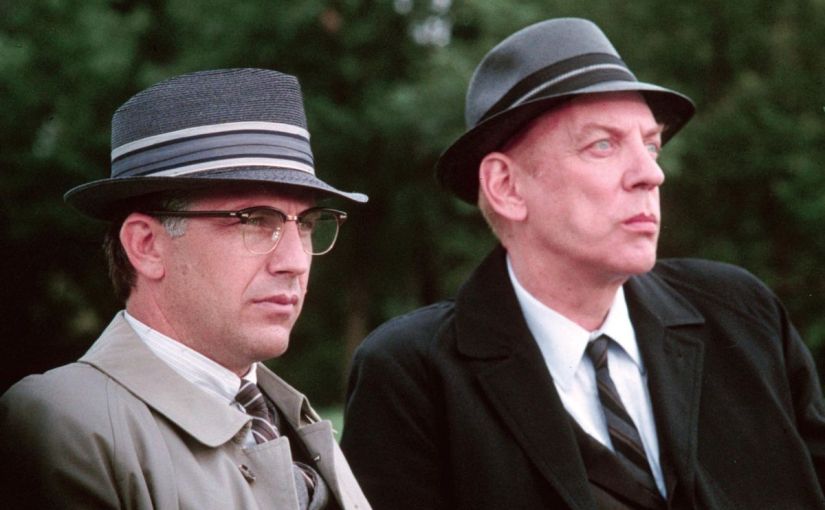
My admiration for the casting continues with the Garrison team that performs with Costner – Michael Rooker, Laurie Metcalf (especially impressive), Wayne Knight, and Jay O. Sanders.  There’s also a clandestine trench coat guy named X portrayed by Donald Sutherland.  Who even knows if this guy ever existed?  He’s more secretive than Deep Throat, but Mr. X has a hell of a lot of information to justify Jim Garrison’s suspicions.  That is an especially marvelous sequence between two men strolling through Washington D.C., eventually concluding a disturbing realization on a park bench.

Sissy Spacek brings out another dimension to the Jim Garrison character.  She’s his wife and the mother of five who suffers the loss of her husband’s attention which is entirely focused on this compounding investigation.  I like Costner’s take on the Garrison character.  Early on he politely asks one of his associates to stop cursing.  He does not like that kind of talk.  Later, it is Garrison who is dropping a number of eff bombs in front of his wife and young children.  This conundrum of a case, a very puzzling detective story, is unraveling the investigator. 

JFK was instrumental for further Congressional consideration following its release.  Files were reopened.  Additional research was executed, and soon many of those secret documents pertaining to the assassination will be revealed in 2029.  Back in 1991, of course that appeared to be a lifetime away.  It’s time we know everything, though.  Arguably, most of who were involved in this incident are dead by now.  Let us know our history.  Still, Garrison was bold enough to point skepticism at not just the adversarial relationship Kennedy may have had with Castro, the Cubans and their Communist allies, but also the people within the CIA and the FBI.  Lyndon Johnson is not even free from scrutiny after he’s sworn in.  Some on Garrison’s team went so far as to factor in culpability from the mafia.  Garrison was not so keen on that theory, actually. 

The construction of Oliver Stone’s film is unparalleled.  I think it’s his best film to date and I can find few others that even compare to how he assembled the picture.  It begins with the voiceover of Martin Sheen laying out many news cycles that were occurring ahead of Kennedy’s murder such as the Bay Of Pigs and the President’s supposed efforts to withdraw from Vietnam.  Sheen’s narrative comes at you very fast with Stone incorporating real life home movies of Kennedy along with his brother Bobby, as well as Castro, and television news footage from Vietnam and anywhere else events were happening.  By the end of the roughly five-minute opening, your head might be spinning. 

Thereafter, though, Stone goes through Garrison’s day on November 22, 1963, watching the outcome following the momentous event and the writer/director works his way into the drama beginning with Asner and Lemmon as two drunk old guys walking through the rain and getting into an argument. 

Three years pass by and so begins Jim Garrison’s motivations to follow multiple trails of breadcrumbs that lead to a lot of different places, all unlike what Earl Warren surmised. 

The scenes work quickly from that point on, and cuts of theoretical reenactments occur.  Who knows if any of these scenes are factual?  Stone and Garrison want you to at least consider their reasonable likelihood.  Moments happen where Joe Pesci and Tommy Lee Jones’ characters appear to be lying about even knowing one another while Stone will depict a sexual role play encounter between them which also includes Kevin Bacon as someone with no more reason to lie. 

Episodes are deeply focused on Lee Harvey Oswald depicted as an infamous and suspected patsy in association with others who may have a reason to want Kennedy dead.  Gary Oldman hides so well in the role.  Oliver Stone even lends focus to how different witnesses describe Oswald.  In some scenes it is Oldman, but then there are other times where a shorter, more overweight man may have been the real Oswald. Later, there’s an Oswald who is taller and more slender. 

A few years ago, I was visiting Dallas, and I was able to spend a some time walking around the crossroads where Kennedy was shot in the convertible while seated next to his wife Jackie.  Watching JFK again lent more clarity to all of the locales such as where Oswald was supposedly shooting from the top floor of the corner book depository.  Kevin Costner and Jay O. Sanders go through the motions of Oswald firing the three shots from his rifle in the short amount of time span.  The script also questions why Kennedy was taken out by Oswald after the turn off the corner of Elm and Houston. There appears to be a better wide-open clear shot long before the turn with the car only going ten miles per hour.  The men question if it was Oswald, then why didn’t he take advantage of the clearer shot.

I know.  I could go on and on.  I have to stop myself.  There’s a ton – A TON – of information in JFK.  It becomes addicting to watch.  You don’t even want to pause the long film for a bathroom break.  I watched the extended Director’s Cut by the way. 

Many common critiques of JFK lean towards how many of these scenes did not even happen.  People are happy to point out there’s no evidence to truly say any of Oliver Stone’s enactments occurred.  I agree, but that’s not the point of this director’s piece.  This is primarily told through the eyes of Jim Garrison.  Kevin Costner is great as the listener, the observer and especially at the conclusion, the describer.  Watch him physically respond to anyone he shares a scene with.  There’s a memorable twitch he offers while at the scene of the assassination that works perfectly with a jarring echo of a gunshot edited into the film.  He’s also great at turning his head down as the thinker while Mr. X lays out an enormous amount of information that comes from several different directions.  Because the film comes from Garrison’s perspective, it does not have to be true.  It only has to be what the investigating prosecutor reasonably believes, and what he absorbs from suspects, witnesses, and his devoted team. 

A final speech of Garrison’s is told at the trial of suspect Clay Bertram, aka Clay Shaw (Tommy Lee Jones), who was the only man tried by Garrison for Kennedy’s murder.  First, it’s important to note that during this fifteen-minute sequence, when Stone cuts back to Garrison in the courtroom, Costner is wearing different suits.  So, while it is assembled as an ongoing rundown, it is not meant to all be in one instance.  Garrison lays claim to an endless amount of possibilities and circumstances that at times have no correlation with each other but could possibly all merge together towards November 22, 1963.  Critics argued this speech of Garrison’s never took place.  That’s correct.  However, this is a movie and for the efficiency of information to come out, a funnel must be opened up to learn what is being pursued and what has been uncovered.  This is the strategy that the script for JFK adopts and it works, leaving you thinking and rightfully doubting what our governing bodies and history books have told us.  Most famous of all of these nonsensical happenings delivered by Garrison is the “Magic Bullet Theory” made extra famous by Jerry Seinfeld with Wayne Knight on the comedian’s sitcom.  It’s silly but it is also a response to the impact that came from JFK.

JFK has a very glossy appearance from the Oscar winning cinematography.  Reflections and natural glares come off of Jim Garrison’s glasses.  The exasperation, along with the shiny persperation of John Candy’s sleazy lawyer character is undeniably noticed as his integrity is being questioned.  Staged reenactments are shown in black and white, clear color or grainy distressed output (such as recreations of the known Zapruder Film).  Nothing is clear about what led to Kennedy’s murder.  So, Oliver Stone’s filmmaking team will ensure that nothing should look consistent.  There are no straight answers; only endless amounts of reasons to ask another question after another.

Oliver Stone does not make JFK as complex as some will have you believe.  It’s quite easy to piece together who represents what in this story.  Many theories are offered at lightning speed, but they hardly ever intersect with each other until a probability is completely laid out on the table and then the film moves on to the next one.

JFK may have a long running time and a large cast with a lot to say and ask, but it’s an exhilarating thrill to behold.  Who knows what is true?  The importance of Oliver Stone’s masterpiece demonstrates that much of what we were told as truth may not consist of the entirety of facts. 

Again, question your governing bodies and ask the hows and whys and whos.  Oliver Stone reminds us that we have that right as the citizens of America. 

What really happened to our President, and who was really responsible?

STRIPES

By Marc S. Sanders

A trifecta of talent was widely received when Bill Murray, Harold Ramis and Ivan Reitman came on the Hollywood scene. With films like Meatballs and Animal House, they were toeing the line of B movie T&A material. Audiences, however, responded to the wisdom in the comedic potential of disregarding the authoritative party. That is especially true in their R rated army romp from 1981, Stripes.

Stripes is arguably not their most memorable film of any of their careers, but for me it is probably my favorite; more than Caddyshack or Ghostbusters. The comedy was spot on, and the timing was perfect. When John Winger and Russell Zisky (Murray & Ramis) decide to enlist in the army on a spur of the moment, their basic training experience is actually believable. It could happen. I could relate. If I was as big a guy as John Candy, playing the lovable “Ox,” and I was running the obstacle course, yeah…I might run off course uncontrollably into the outer woods. All these guys are completely out of shape. There’s no way we were ever gonna see Rambo here.

Bill Murray might be the leader of this rag tag gang of miscreants, but his own material is just very, very funny. Few comedies have such a hilarious opening scene as he does while he escorts a snobby woman to the airport in his cab. He has enough of her, and so everything is put out on the table. The Three Stooges would have smacked a pie in this woman’s face. John Winger decides to terrify her with some action photos while he drives. To date, no one has ever come close to duplicating this scene.

Winger continues with his rebellion against his Drill Sargent played by Warren Oates who is terrific in his own right. Oates convincingly comes off as straight army material amid all of these nitwits. He can give a facial expression that says a thousand words.

John Candy is a huge highlight in perhaps his breakthrough cinematic performance. Ramis and Reitman wrote a great character in Ox. I think it’s hilarious that a fat guy thinks the most ideal way to lose weight is to join the army because it’s free with a six to eight week work program. We all love to see that it eventually occurs to Ox that basic training in the Army is not exactly a weight watchers program. A major highlight is when Winger rushes Ox into a mud wrestling ring at an adult club. Pure slapstick fun. You can’t help but laugh.

I’m surprised to see that many took issue with the film’s second half. I loved it as the platoon has to pursue Winger and Ziskey who have a special puke green colored RV that the army has engineered with more weaponry than a James Bond car. Eventually, this leads to a ridiculous rescue within a Russian occupied Czechoslovakian outpost. It’s a great blend of action and comedy that holds up nearly 40 years later. What’s not to like?

I’ll be honest. I saw Stripes when I was 10 or 11, and it actually gave me an education on the current life of what it’s like to be in the Army. Having never enlisted, I’m nevertheless convinced that Warren Oates was an accurate interpretation of what a hard driven Drill Sargeant was like. Because it seemed so genuine. It seemed only fitting that a great comedy could be drawn from resisting that kind of authority. The material in Stripes didn’t come off silly or Looney Tunes like. It all seemed natural. The jokes just came alive amid the challenges of entering the Army life.

Stripes remains a favorite comedy of mine.

1941

By Marc S. Sanders

Steven Spielberg’s first critical and box office flop, 1941, is a splattered mess of slapstick hysteria set a week after the Japanese attack on Pearl Harbor.  Residents of the California coast line prepare to be the next target.  Ahem!!!!!  Well, that’s it for the story…Goodnight.  Tip your waiters.

Just a year ahead of the Zucker brothers with Abrams comedy team that’ll deliver Airplane!, Spielberg opted to direct a spoof script penned by Robert Zemeckis and Bob Gale (Back To The Future).  1941 is full of gags galore beginning with a reference to the director’s most successful film to date, Jaws.  For me, seeing actress Susan Backline on screen again for another ocean skinny dip only to be intruded upon by a rising Japanese submarine was the second best joke of the film.  Once that was over, I had two hours left to go.  A long two hours. 

I’ve noted before that satire or spoofs are the riskiest genres to produce.  They can succeed with a picture like Dr. Strangelove…, or Network or Airplane!  Satire can be divisive too though, and thus only one half of your audience will appreciate the poke and prod.  Even worse, satire can just be unfunny across the board no matter which side of the aisle you lean on.  That’s 1941.  It plays too much like a Three Stooges series of slapstick violence.  Reader, even Steven Spielberg cannot capture the magic of the Three Stooges.

Zemeckis and Gale opt to poke a little fun at the Puerto Rican zoot suit riots vs the Enlisted men ahead of America’s entry into World War II.  So, when army soldier Treat Williams gets jealous of one handsome zoot suit dancer flirting with his girl, a fight breaks out which eventually populates two thirds of the film as it escalates all the way over to Hollywood Boulevard. Now thousands of stooge wannabe extras are walloping each other from one side of the street to the next. 

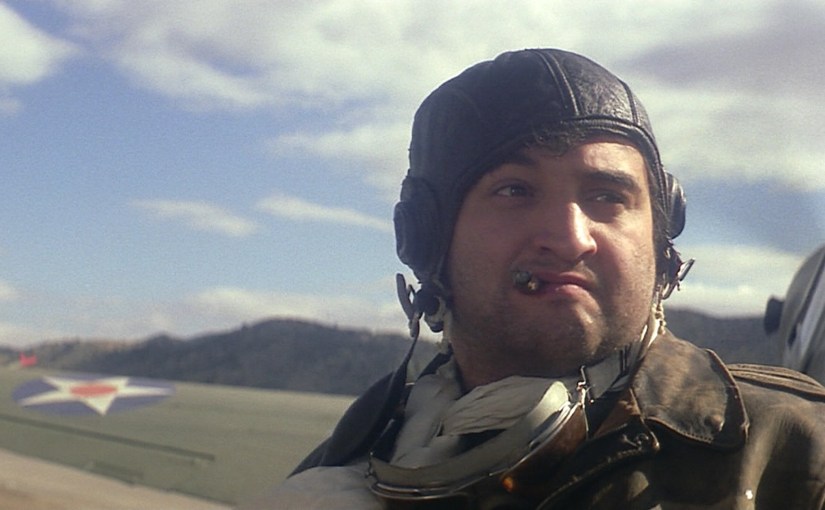
To allow a breather from this, the writers sidetrack over to Tim Matheson and Nancy Allen getting frisky in an out of control bi-plane while being mistaken for the enemy by John Belushi doing a very poor resurrection of his Bluto character from Animal House.  As Captain Wild Bill Kelso, Belushi’s pursuit fires upon everything else in sight, especially Hollywood Boulevard, but misses the plane occupied by Matheson and Allen.

The third point of this rectangle concerns Dan Aykroyd with John Candy and a whole platoon opting to set up a military cannon along the ocean view property belonging to Ned Beatty and Lorraine Gary in anticipation of the Japanese invasion.  Ned Beatty is the best stooge of the entire cast as the nerdy resident determined to protect his home while exercising his patriotic duty.  Gary’s response to Beatty’s ineptitude cracked me up as well.  The house wreckage of The Money Pit has nothing on what occurs in 1941.

The fourth storyline focuses on the enemy with a German speaking Nazi portrayed by Christopher Lee debating with the captain of a Japanese submarine (Toshiro Mifune) plotting to bomb Hollywood.  Somehow, each foil understands the other’s language.  These guys are just here to scream at one another.  There’s nothing funny about them.

Oh yeah.  Robert Stack is the Army General who watches Dumbo in the movie theatre while Hollywood Boulevard gets demolished outside.  Ho! Ho!

Often, I compliment Spielberg for his reliance on the sets he provides.  Everything you see on the screen serves a purpose to his films.  It happened as recently as with his remake of West Side Story in 2021, and it’s effectively used in Close Encounters…  He uses the same approach with 1941.  In this film though, there’s no pulse or significance to the props and pieces that are used.  The house is demolished.  So is the storage shed.  So is the movie theatre.  So is the Ferris wheel.  Yes.  What you’ve already seen in endless Looney Toons cartoons occurs here with a miniature model.  The Ferris wheel comes off its hinge and rolls across the beach side dock into the water along with Murray Hamilton and Eddie Deezen in tow.  When it happens, you’ll tell yourself I was waiting for that to happen.  What you expect to happen, happens, but you’re not laughing at it.

None of what you see in 1941 are terrible gags.  If you watch one scene out of context on a four minute You Tube channel, you may chuckle.  The problem is that every scene is treated like throwing spaghetti at a wall and seeing what will stick.  Mashing all of this together is not appetizing.  I like ice cream and I like steak.  I don’t like my ice cream on my steak.  Any idea of development is completely ignored.  The film can’t even work like a collection of skits.  Even Airplane! had a romantic storyline trajectory to perform with.  Here, two jealous guys have a fist fight and it more or less stretches that fight for an entire two hours.  The Three Stooges knew when to eventually quit.  Spielberg, Zemeckis and Gale didn’t. 

As soon as I saw Belushi on screen, I laughed.  It’s Bluto again.  Yet, the appearance wears off very quickly.  He has little dialogue and is limited to chomping on a cigar while grunting and groaning as the fighter plane he occupies wobbles around shooting at everything in sight.  When he eventually crash lands, Belushi continues to chomp on the cigar and grunt and groan.  Only now, he pratfalls as well…badly.

Ned Beatty is the real star here.  The ultimate nerd is also limited in dialogue. Still, to watch his body language with his glasses and bow tie and pear-shaped physique, accompanied with Lorraine Gary’s helpless gasping wife responding to the damage he commits with the cannon is hilarious.  Absolutely hilarious.  Tape all of their scenes together and make it a short to present ahead of the main attraction in a movie house. The audience will have a great time.

Otherwise, the only other fun I got out of 1941 was spotting the stars that were relevant at the time of its release.  Candy, Aykroyd, Frank McRae, Slim Pickens, Christopher Lee, Robert Stack, the cute blonde daughter from Eight Is Enough.  Even Penny Marshall has a quick blink and you miss it moment.  Oh, and look, there’s Lenny and Squiggy!

I think Zemeckis and Gale were on to a real smart idea here.  They maybe should have consulted with Harold Ramis and his National Lampoon’s crew however, because that’s the direction Spielberg’s film was aiming for.  What sets a film like Animal House apart from a 1941 though is in the set up.  Dialogue also helps.  1941 lacks set up.  1941 lacks dialogue.  It’s all visual and noise and more noise and more noise. 

1941 begins at letter A, and stops at letter A, never making it to B, and definitely never reaching Z.  An idea with potential was put down on paper.  The problem is these guys stopped writing after the first sentence.

PLANES, TRAINS AND AUTOMOBILES

By Marc S. Sanders

The Tuesday Before Thanksgiving Tradition blazes on for another year as Steve Martin and John Candy travel from New York City to Wichita, Kansas and then who knows where all while trying to reach their final destination of Chicago, Illinois in time for Thanksgiving dinner.

Despite the fact that Planes, Trains & Automobiles was made in 1987 before the age of cell phones, personal navigation systems, Priceline .com and Ubers, it remains a timeless classic of inadvertent comedy. Travel is still as frustrating, maybe more so now, and family kinship is still treasured.

Martin plays Marketing Executive Neil Page, forced to succumb to the unwanted company of Shower Curtain Ring Salesman Del Griffeth (Candy). One inconvenience after another delays Neil from getting home to his family for the holiday. Del wants to be helpful, yet he is anything but.

The roles are perfectly cast. One of the best on screen couples of all time. I imagine had John Candy not passed away so young, he would have been paired up with Steve Martin at least one more time.

Writer/Director John Hughes is a master at taking simple circumstances (detention on a Saturday, skipping school, traveling) and blossoming it into episodes of relatability amplified in both comedy and drama. His knack for dialogue is a huge factor in his scenes. Consider the best scene in the film between Martin and favorite character actor Edie McClurg where 19 F- bombs are tossed over the mix up of a rental car. It happens all the time to any one of us, and Hughes took advantage of the frustration and built comedy that comes from it. Its not funny when you are in the moment. It’s funny when you recall the moment later on. It’s a brilliant scene.

Nut grabbing, taxi races, ride hitching in 1 degree weather, bed sharing with what you think are pillows, burning cars, wrong way driving, encounters with death and the devil, “The Canadian Mounted,” and a perfect excuse to use Ray Charles’ rockin’ “Mess Around” all point to a reason for a climax that arguably (on the first time any of us saw the film) we never expected or considered. If you don’t choke up, you have no soul.

Hughes was all too familiar with the meaning of Thanksgiving when he wrote Planes, Trains & Automobiles. I like to think those that see the film are even better for having watched it.

It’s a very funny movie, but it’s very special movie as well. Give thanks, offer what you can, when you can, and Happy Thanksgiving.