WICKED FOR GOOD

By Marc S. Sanders

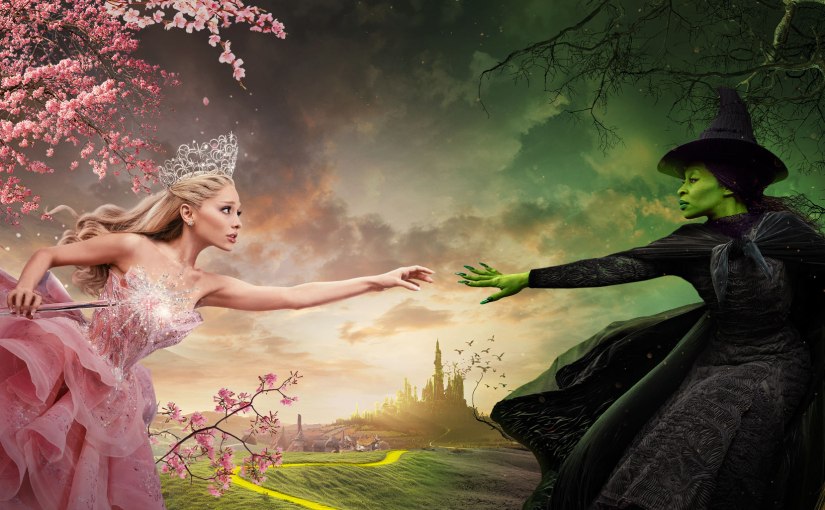
Wicked For Good is a crowning achievement in fantasy and musical wonder.  It soars across a wide expanse of never-ending settings within the wonderful world of Oz and delivers a series of messages to walk away with.  Try not to think about Wicked the next time you turn on CNN or FOX News.

Jon M Chu directs again after Wicked Part One.  Both films were actually shot as one large project but then divided.  I was suspect when I heard this was how the Broadway musical was going to be done for film.  Was there that much material, interesting enough for two full-length movies?  With a pair of new numbers drafted by original composition writer Stephen Schwartz, the answer is a profound yes.  This may be Act II of the musical but it does operate as a sequel. The new film leaps in time from when our host of characters were young students at Shiz Academy.  All are adults now with respective responsibilities and therefore they’ve grown and changed.  Sadly, but wisely, the film moves in directions that are parallel to many current events happening today. 

The wise animals of Oz are being oppressed.  The first film hinted that animals should be seen not heard.  The second part of the story executes that mantra all too realistically as they lose their power of speech and are destined not to be free but rather caged like in internment camps.  Those that have not been taken are performing mass exodus under the newly constructed yellow brick road. 

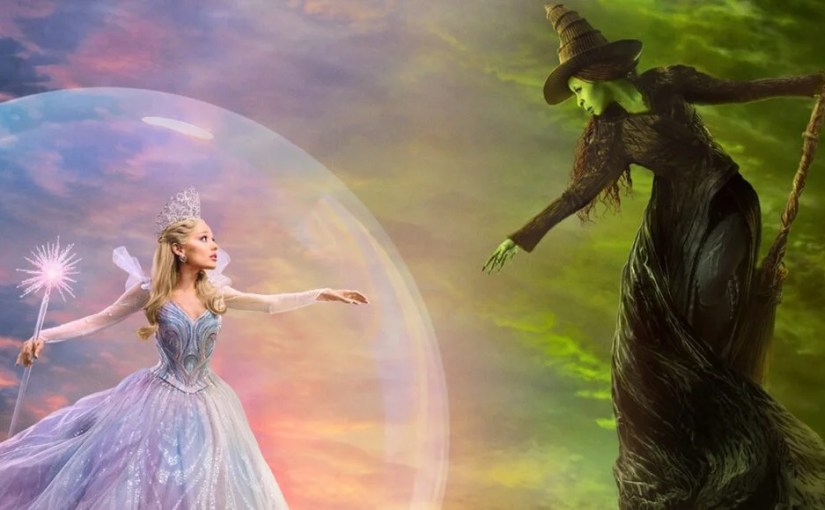
Untrue propaganda sweeps through Oz as Madame Morrible (Michelle Yeoh) uses the false influence of The Wizard (Jeff Goldblum) to unite the kingdom into believing the empathetic green skinned Elphaba (Cynthia Erivo) is the Wicked Witch of The West, on mission of terror.  Citizens of Munchkinland and the Emerald City believe the lies and live in fear of her presence.  Glinda (Ariana Grande), decked in beautiful pinks with a sparkly wand and a convenient flying bubble craft, serves as a poster girl for hope with the illusion of having enchanting powers to protect.  Elphaba’s sister Nessarose (Marissa Bode) succeeds as the governor of Oz following the death of the girls’ father.  Nessarose has grown coldhearted, particularly to her one true love Bok (Ethan Slater), who by decree must remain held captive under her authority.  He’s literally forbidden to immigrate by train. These are not the students of Shiz that we grew up with. 

I hate to use Wicked For Good as a metaphor for political purposes, but that’s exactly where my mind went to, and I’m grateful for it.  I believe there is much wrong occurring each day in the United States and throughout the world. I’m at least thankful that artistry like cinema and stage prevents us from burying our heads in the sand.  Conveniently, there’s a triggering and emotionally engaging storyline to hold on to.

Wicked was spawned off of L Frank Baum’s classic fairy tales. Part of the fun is seeing how these new stories are threaded towards his classic story of a girl from Kansas who arrives in Oz and befriends three unusual charmers while on her journey to meet The Wizard.  I’d argue that more people are familiar with the classic Warner Brothers film from 1939 than Baum’s series of books, and this Universal picture seems to adhere to the original production especially.  Elpheba delivers a new song called “There’s No Place Like Home” that’s woven beautifully into the picture.  Glinda sings about “The Girl In The Bubble” to emulate her personal conflict with how she is meant to serve.  Classic lines like “I’m off to see The Wizard” are provided.  Hints at a lion (voiced by Coleman Domingo) being fearful, along with a character’s heart becoming too small are referenced with weighty importance.  Another character is asked if he’s lost his mind.  It’s satisfying how original the Wicked properties are while being comfortably familiar.

The cast is sensational.  Cynthia Erivo is a wonderful performer who hides in her role with an American accent and her Broadway voice to belt.  She performs so convincingly that it becomes easy to look past the green skin and watch the woman who is challenged.  Michelle Yeoh and Jeff Goldblum have those unusual appearances and distinct personalities that serve a fantasy world like Oz.  Marissa Bode demonstrates tremendous strength as the disabled character who probably traverses through the biggest change of the whole cast.  Ariana Grande is a terrific actor and a lovely singer.  As I noted about the prior film, her Glinda is not my favorite, though.  The three others I saw on stage performed with a bubblier delivery and did not rely so much on Grande’s hair flip.  Jonathan Bailey is a dashing and charming hero, carved out for the prince of fantasy.  Ethan Slater’s Bok suffers through unwinnable oppression, and thus his character is more tragic this time.  It’s crushing to see, but his performance is completely relatable.

I watched the first film as a refresher ahead of seeing For Good and it occurs to me how triumphant these films are.  This whole story could have been contained in a ninety-minute Disney blueprint.  Yet, Jon M Chu, along with Stephen Schwartz want to entertain the audience through the narrative. So, it will stop where we are reading the movie, allowing us ample time to witness the world around us and what these characters of fantasy endure.  It’s odd sometimes to see the street toughs of West Side Story break into song as they are trying to knife one another in the streets.  In Wicked, it is never strange to see a witch or a munchkin or a prince break out into harmony to express their happiness, anger, sadness or wickedness.  The music and vocalizing build the vivid textures of the sets into grander designs. 

I can be told what happens next in the further adventures of Elphaba and Glinda and just move to the next chapter until they live happily ever after.  It’s better if the characters take their time to share as many thoughts and emotions as they can through song, dance, visual effects and action.  That’s what sets musicals apart from other fares of drama and comedy.

The Wicked films, and more importantly the musical, will remain timeless as much as Star Wars, Star Trek and Harry Potter.  They will never be dated.  They will only capture the hearts, laughs, tears and harmony of further generations to come decked in their favorite shades of green and pink.
WICKED PART ONE

By Marc S Sanders

The blessing of film is that it provides a channel to forms of entertainment that not everyone necessarily has access to.  I was never fascinated with the Tony Awards so much (even though I attended three live ceremonies) because the nominees were exclusive to what was performed in the last year on Broadway in New York City.  How can I or the rest of the country get enamored with the best of the best when we hardly have access to see any of the performances?  With movies, well you just go to the movies!

Wicked is one of the few musicals in the last twenty years that has taken on a worldwide fascination.  It was a very long novel before it became the touring stage production following a massive debut on Broadway. Perhaps because the story returns to a familiar setting, the fantastical land of Oz, the book and show carried a strong appeal.  Wicked arrived with an established brand.  Who doesn’t know The Wizard Of Oz?  Nevertheless, Wicked never needed magical ruby slippers (or rather silver as author L Frank Baum intended) to find its footing.  It’s always been worthy of its accolades apart from any other properties.  The new film, directed by John M Chu, will become a timeless classic all by itself.  Despite some technical issues, this cinematic adaptation is wondrous.

Elphaba (Cynthia Erivo) is the green skinned awkward teen, who was rejected by her father and only served a purpose to tend to her wheelchair bound sister Nessarose (Marissa Bode).  She accompanies them to drop her sister off at the esteemed magical school known as Shiz.  However, the headmistress of the institution, Madame Morrible (Michelle Yeoh), requests that Elphaba stay on as a student that she will personally teach as well.  Elphaba is roomed with the self-absorbed Galinda (Ariana Grande), where their relationship is frictional at first and later adoringly empathetic.  Eventually, we come to realize the destinies of these young ladies will develop into what is all too familiar in L Frank Baum’s eternal The Wizard Of Oz – Elphaba becomes The Wicked Witch Of The West while Galinda is recognized as Glinda, the pinkishly tender Good Witch Of The North. 

This Part One iteration of Wicked is very faithful to the stage production.  Every recognizable number is included from the operatic “No One Mourns The Wicked” to the giddily cheerful “Popular” to the climaxing, fist pumping, take charge “Defying Gravity” that closes out Act One.  The latter number is arguably one of the most well recognized and beloved theatrical songs of the twenty-first century thus far.  The edits and choreography of every number is magnificent, full of energy, and the harmonies work like natural dialogue as opposed to something like West Side Story where it’s not crazy to ask exactly why rival street gangs suddenly break out into song while trying to knife one another. 

John M Chu makes sure that his cast use every prop and set piece available.  You can’t help but grin while Ariana Grande does a circular swan flight from a chandelier while making a case for why it’s best to be popular.  “One Short Day” is a massive declaration within narrow school courtyards and corridors that berth out toward wide open endless fields into a vast blue sky for Elphaba to declare what she yearns for.  Cynthia Erivo has that knack to sing and perform personally to her character’s own subconscious when she’s in these intimate, private moments.  She then bursts out with confident volume to show that as repulsive as she might appear to everyone around her, the soul inside is what is beautiful.  In order to cast Elphaba, you really need one of the most beautiful singing voices in the world because the character is most stunning when she is expressing herself vocally. 

Ariana Grande is good. Though I still prefer the two iterations of the character that I saw on stage prior to this film.  Her performance is a different interpretation than what is traditionally in a live production.  I especially noticed that change when her character attempts to explain how to properly pronounce her name of Galinda.  The stage version of this memorable moment induced the laughs from me more.  As beautiful as Grande is in her characterization and singing, she’s not so humorous as the live stage performances.  So, the humor of Galinda, the self-entitled spoiled rich girl with everything, is not as strong.  As well, at the top of the film, I had an issue with understanding precisely what Ariana Grande was singing at first.  Was she harmonizing or was she singing dialogue?  Perhaps, that is not so much a fault of the actress as it is the recording.  Yet, the issue does not last long, and soon you are treated to Galinda laying it all out there.  She might not be as funny this time, but she’s incredibly charming and loved by her surrounding entourage of student followers, especially from Bowen Yang (Saturday Night Live) and Bronwyn James. 

The sets are spectacular and I learned afterwards that they are mostly physically constructed.  So, there is a texture to the schoolgrounds of Shiz with bridges and babbling brooks as well as regal castle-like architecture.  This is a Universal picture and many may presume that Disney would have produced something like this musical fantasy.  However, in Disney’s hands, much of this film would have been polished in a grandiose, yet artificial, CGI.  John M Chu and his crew went the smart route and diminished the cartoon sheen that comes with CGI.

My issue though is in the cinematography.  Regrettably, I could not see Wicked in a Dolby cinema.  So, we settled for a traditional theatre at AMC which was fine.  Yet, I was wondering at first if there was something wrong with the projector.  A lot of the scenes taking place in the daytime seemed washed out, especially with close ups on Ariana Grande and her complexion.  Then I concluded that John M Chu’s cinematographer relied on a lot of blaring sunlight for many of the scenes.  I imagine it was used to contrast the dark green complexion of Elphaba, emphasizing how much she doesn’t belong in this environment and amping up what an eyesore the character must feel like within the world of Shiz.  When Elphaba dominates a scene or a caption or when the film arrives at the Emerald City, the photography is just right.  Elsewhere at Shiz, it’s very oversaturated with a fuzzy kind of look to it.  Was I wearing the wrong spectacles?  Wait, I don’t wear glasses or contacts!  I could not get past this for much of the film. There was just too much white light, and it didn’t compliment the pinks and pales that accompany Galinda and some of the environments and extras.

My wife and I agreed we are going to see it in theatres at least one more time within a Dolby surround sound.  You should too.  We missed the surround sound of the winning music blaring through the entire theatre.  In a traditional theatre, the sound feels as if it is only coming from the front, or behind the screen.  Dolby or IMAX enhance the audible as if your mind is right at the center of an orb with the most gorgeous, pitch perfect sounds accompanying you.  Dolby and IMAX will also enrich the colors, and Wicked is most certainly vibrant.  Every scene looks like a completed coloring book, despite my one noted imperfection.  A year after Barbie, and pink is still in.  Greens and blacks are just as impactful.

Wicked is magnificent entertainment, worth seeing again.  The music is enchanting and easy to catch on to.  It’s fun and dramatic and every lyric works to shape the characters.  The story is magnificent as well with eye opening twists while allegorically adopting a message demonstrating the harm of prejudice.  There’s also opportunity to show where life can be a disappointment at times when you encounter false idols and learn truths about yourself and those you have grown close to.  I speak in vague terms on these accounts so as not to spoil what this powerful story delivers.

The film is smart in invention as well.  There are good, solid moments that were never staged in the live performances, but thanks to the art of filmmaking new ideas seem totally appropriate where the classic 1939 film, The Wizard Of Oz, are referenced.  Though, I have yet to see Part Two, I can confidently say Wicked works as a solid prequel.

I was one of the skeptics who believed breaking this film into two parts was a shameless studio cash grab.  It certainly seems that way and maybe it is, but considering how good this new musical film adaptation is, I am eager for another installment.  So, I will happily fork over more admission money a year from now and I am confident that I’ll wholeheartedly enjoy Wicked Part Two.  This is a brilliantly creative story with a strong cast, sensational music and eye-popping invention.  I may know what becomes of the characters and how this story ends, but I can’t wait to see it reenacted for its latter half, and I am eager to see what new creations present themselves in its next chapter. 

Wicked is one of the best films of the year.  A triumphing soar through the skies on a magical broomstick.

DEATH WISH (1974)

By Marc S. Sanders

I never saw the original Death Wish before.  Never felt I needed to having already watched Death Wish II and Death Wish 3.  Yes!  The inconsistency in the numbers (Roman vs numeral) is how the “saga’s” films are titled.  Sometimes self-described writers and studio marketers do not pay attention to the minute details.  If you’re gonna be stupid with your five film franchise, then be sure to strive for a complete lack of intellect.

Now before I get back to discussing the original film which I finally watched last week, I offer you this confession.  In 1985, there were two films I saw five times each in theaters.  Oh God, You Devil and Death Wish 3.  I guess Out Of Africa and Prizzi’s Honor did not appeal to my twelve-year-old mentality.  Death Wish 3, however, had a hideously violent gang making social progress because they consisted of whites, blacks and Hispanics.  A couple of punk girls too.   A welcome melting pot of deranged animals operating under an equal opportunity philosophy.  They were all pals and they pillaged, robbed, vandalized, murdered and raped the helpless neighbors of the destitute projects in New York.  Happy times.  More importantly, have you ever seen that shootout that occupies the last thirty minutes of Death Wish 3?  It is one for the ages and worth your time to watch on repeat.  Dare I say it’s as good as anything in a Stallone, Schwarzenegger or Eastwood actioner.  

Here’s where my endorsement stops with this article, though.  Skip the first two trashy Death Wish films. Unless you want to see Laurence Fishburn try to shield himself from a Charles Bronson bullet by covering his face with a boom box and then drooling blood and radio parts out of his mouth before collapsing dead on the pavement.  That glorious moment occurs midway through the second installment.

Stay with me, now.

Having experienced the happy bloodshed of the third of five films in the Charles Bronson franchise, I am surprised to learn his city architect character Paul Kersey begins the original film as a “bleeding heart liberal” who would prefer to stay away from guns.  What a departure for Bronson’s most famous role.  All that being said, director Michael Winner likely started filming this piece with a need for a message about justifiable homicide or vigilantism, but unfortunately it very quickly drowns in repulsive ugliness.

I’ll say this for Michael Winner.  He’s keen enough to show Paul and his wife (Hope Lange) vacationing in beautiful Hawaii.  Then as they return home, an overhead shot of a bloody sun-soaked New York City appears on screen with the title of the picture DEATH WISH in big block letters, accompanied by some sinister sounding music.  Hawaii is heaven.  Home is hell.  John Milton was never this poetic.

Paul Kersey’s wife and adult daughter are attacked in their home.  Interesting tidbit! One of the slimeballs is Jeff Goldblum in his first film role.  Though there’s nothing for him to be proud of here.

Kersey’s wife dies.  The daughter is brutally raped, and I mean brutally.  It’s a disgusting scene that offers no sense of sadness or fear or awareness.  It also looks as if Winner and his crew and cast never even rehearsed the scene.  The poor girl’s clothes are ripped off of her, she’s pulled against one of them from behind by her throat, and then the attackers spray paint the center of her bare anus in orange as a “target” for where to penetrate.  Another thug paints a swastika on the wall. What is that supposed to tell me? Then we are treated to seeing Goldblum and company baring themselves and mounting the actress who was awarded this unfortunate role.  Reader, I’ve seen just about everything there is to see in films.  When I consider the point of delivery that Jodie Foster offered in her Oscar winning role in The Accused, what is smeared across Death Wish is exploitative garbage. Any shred of cinematic artistry is entirely devoid in this picture.  In this case it was not just another movie.  It’s just truly sickening.

Anyway, Bronson has never been a great actor.  Nor has he been charismatic.  Yet, there’s a tough guy and dark presence to what the camera found in him.  A client gifts Paul a modern-day Colt handgun and considering the high level of violence that occurs within the streets of New York, he takes it upon himself to seek out or bait would be muggers and criminals.  He never catches up to the hooligans that tormented his family, but he takes on the mission of cleaning up the streets while a useless police force amounts to little results.

After Paul’s first shooting, he comes home to vomit.  I can only guess the liberal cannot stomach what he’s committed.  This is about the only dimension we get out of this guy.  Paul has boring conversations with his son in law.  Poorly acted scenes with actor Steven Keats; poorly acted, poorly directed, poorly written, poorly filmed.  Paul hardly ever shares a scene with his traumatized daughter who goes in and out of catatonic states when she appears in the film.

As the body count piles up, a detective played by Vincent Gardenia starts the investigation around town and wrangles up his police force posse to be on alert. Hey, look who is giving a run down on a progress report.  It’s Gardenia’s Moonstruck wife, Olympia Dukakis.  Pretty neat to see this. Still, Death Wish is not recommended for your Vincent Gardenia/Olympia Dukakis movie marathon.

Death Wish is tone deaf.  I’d be interested to see how a liberal, who shutters at violence, transitions into a vigilante.  That’s a story with an eccentric transformation. However, Michael Winner and his writers are not even aware or interested in talking to you about that.  I only know Paul Kersey starts out as a liberal because his co-worker mockingly calls him one, and again he vomits after his first shooting.  How humane of Paul.

I won’t disclose the entire ending, but I’ll share this with you.  Paul relocates to Chicago and upon arrival, Michael Winner freeze frames on a grinning Charles Bronson pointing a finger gun at a couple of harassing punks who are tormenting some citizens in a train station.  What do I gather from this hint of subtly?  I guess Paul Kersey registered with a different political party when he became an Illinois citizen.  Quite the message!

ASTEROID CITY (2023)

by Miguel E. Rodriguez

DIRECTOR: Wes Anderson
CAST: More Actors Than You Can Shake a Stick At
MY RATING: 5/10
ROTTEN TOMATOMETER: 76% Certified Fresh

PLOT: In the mid-1950s, a roadside motel in a fictional mid-Western flyspeck plays host to a junior stargazing event that unexpectedly escalates, changing everyone’s world view forever.  …sort of.


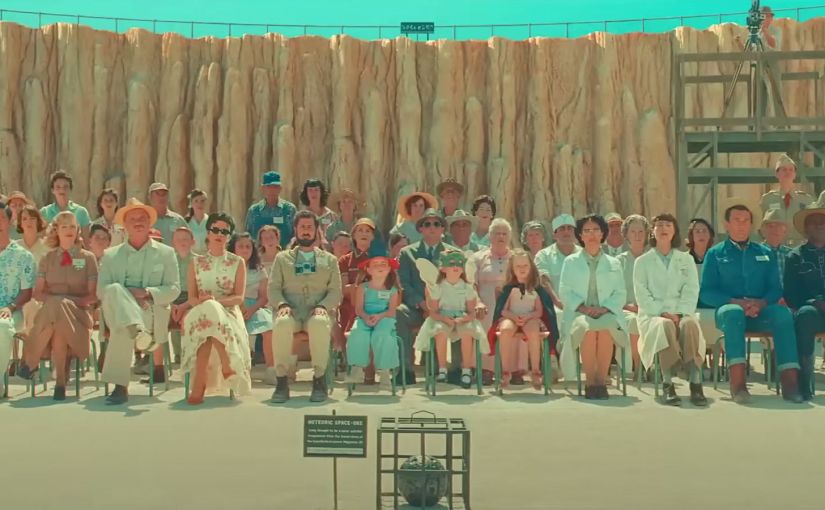
Asteroid City, Wes Anderson’s latest film, feels like a collector’s edition box of Cracker Jack with no prize inside.  Or a cake that has prize-winning decorations, but it’s hollow inside.  It looks phenomenal; one of my fellow cinephiles, Anthony, predicts it will be nominated for cinematography and production design, and I agree with him.  But where the heart of the film should be is simply a crater like the one around which the fictional town of Asteroid City was built.  This is yet another star-studded cast for Wes Anderson, but Anderson has given them very little to do other than wear colorful costumes, look solemnly into the camera, and speak in very precise phrases.

This strategy has served him very well…no…EXTREMELY well in the past.  Moonrise Kingdom (2012) and Grand Budapest Hotel (2014) spring immediately to mind.  But some crucial piece of machinery is missing from Asteroid City.  The characters are colorful and quirky, but at the end of the day, I simply didn’t care about what they did or said.  (Well…except when actress Midge Campbell [Scarlett Johansson] decides to rehearse her nude scene for her next-door neighbor…I did care about that.)

The film opens with a pillarboxed segment in black-and-white.  Our host (Bryan Cranston) explains that we’re about to watch a staged presentation of the newest play from author Conrad Earp (Edward Norton), who proceeds to lay out the “set” for us.  “Upstage right is the crater…upstage left are the motel cabins”, etc.  Then the screen expands to full letterbox and we are treated to eye-popping Kodachrome desert landscapes as we follow a 165-car freight train as it passes by Asteroid City.  Well, “City” should be in quotes…the population is officially listed at eighty-seven.

This is some wacky city.  It’s as if Wes Anderson watched every Coen Brothers film set in the Midwest, from Raising Arizona to No Country for Old Men, and filtered them through a Looney Tunes cartoon written by Charlie Kaufman.  Vending machines on the porch of the rental office sell everything from snacks and drinks to martinis and parcels of local real estate.  (Cost for the real estate parcels: forty quarters…they’re not big parcels.)  An abandoned highway overpass lurks on the outskirts.  Periodically, a police chase roars down the otherwise empty highway, guns firing and sirens blaring.  The residents say nothing about this phenomenon.  And every now and then, the town shakes from nuclear testing being done hundreds of miles away, but close enough that the mushroom clouds are visible.

Man, I love this kind of thing.  The stage is set for one of the all-time great satires, or maybe just a flat-out fairy tale.  We meet the cast of characters who have congregated here to honor young geniuses who have invented everything from rocket packs to particle guns to a projector strong enough to project an image on the moon.  A full rundown of all these characters would wind up being a novella, but if you’re acquainted with Anderson’s work, they will all be familiar to you in one way or another.  (Not least because many of them have worked on Anderson’s other films.)  They have also gathered to witness a rare astronomical event: a solar ellipse.  Not an eclipse.  An ellipse.  The mechanism required to view an ellipse without damaging your retinas looks like something out of Brazil.

Again, I normally love this kind of stuff, really, I do.  But…okay, look, first of all, the film intermittently takes a break from the movie itself to yank us out of the story and show us an event in the playwright’s life that led to the casting of Augie Steenbeck.  Or to show us a rehearsal where an acting coach (Willem Dafoe) encourages the actors – that we’ve already been watching perform in the movie/play – to improvise what it’s like to wake up by first falling asleep.  There’s even a moment where the host shows up where he really shouldn’t be.  And when one of the actors has a moment of existential crisis concerning the character he’s playing, he simply walks off the set, goes backstage and asks the director (Adrien Brody) why he’s doing what he’s doing.

…I mean…what IS this?  Conceptually, I get it, even if it’s a little heavy-handed.  (“What’s my motivation?”  “You’ll have to figure it out as you go along.”  “That’s too hard!”  “Well, that’s life.”)  But…why is it here?  Anderson worked with non-linear structure before in Grand Budapest Hotel, and it worked marvelously.  Here, it feels indulgent.  In fact, many of the scenes in the movie feel that way.  There’s a moment where an army general (Jeffrey Wright) announces he’s going to deliver a speech he’s prepared for the occasion of the “ellipse.”  But this is no ordinary speech.  It’s practically beat poetry, delivered with the kind of conviction that only Jeffrey Wright’s magnificent voice can provide, but…but…why is it here?  Even in this weird, cotton-candy, retro-fever-dream of a movie, this “speech” felt out of place and just plain goofy.  In fact, quite a lot of the scenes between characters felt less like story and more like the kind of dialogues you find in source books for actors.  (101 Scenes for Two and Three Actors…that kind of thing.)

I will provide full disclosure and say the movie did deliver some decent laughs and chuckles.  There is an event that occurs during the ellipse (I’ll have to tread carefully here) that may not be entirely unexpected, but it’s executed and timed so well that I laughed pretty much through the whole scene.  It’s the kind of thing I imagine Buster Keaton and Charlie Chaplin would have thoroughly enjoyed, if I may be so bold.  There is also the problem of the disposition of a Tupperware container holding a valuable, ah, keepsake.  Oh, and that roadrunner was awesome.

But by the time Asteroid City rolled credits, I didn’t feel like I had seen one of Wes Anderson’s best films.  (The Royal Tenenbaums remains his best film, in my opinion.)  This almost felt like a movie made on a whim, kinda like, “Hell, I don’t know if this’ll work, but if I get enough star power behind it, this may turn out to be something.”  Alas, it did not.

THE LOST WORLD: JURASSIC PARK

By Marc S. Sanders

The Lost World: Jurassic Park contains a batch of characters making a lot of stupid decisions all in the name of being stupid for stupidity’s stake.  That doesn’t make it a bad movie though.  Just somewhat…unsophisticated…and stupid.

In the sequel to the monster smash adaptation from Michael Crichton, Steven Spielberg reunites with Jeff Goldblum, now at the top of the credits list, as smarmy mathematician Dr. Ian Malcolm.  It really doesn’t matter if the guy is a doctor of any kind of specialty though.  Malcolm doesn’t utter one scientific fact or theory or observation this time around.  Whatever shred of debate regarding the resurrection of dinosaurs that existed in the first film is completely abandoned this time around.  Carnage, mayhem and outrageous ridiculousness take center stage, stage left, stage right, downstage, upstage, off stage, and over a high cliff.

In an early scene, Malcolm is summoned by wealthy entrepreneur John Hammond (Richard Attenborough, in a welcome cameo).  Hammond tells Malcolm that his paleontologist girlfriend (isn’t that a coinkidink), Sarah (Julianne Moore) is on a nearby island to the original one from the first film, and studying the behaviors of the dinosaurs that were developed there.  She will soon be meeting up with a photographer (Vince Vaughn) and another associate (Richard Schiff; I don’t recall the script explaining his specialty).  So, Malcolm sees no choice but to go after Sarah and rescue her from the island.  This is one Daring Mathematician.

One point of order, because this is a Spielberg adventure, a kid has to be involved.  Malcolm’s pre-teen daughter and gymnast extraordinaire Kelly (Vanessa Chester) stows herself away on the excursion. Thank god she’s gymnast.  That may come in handy.

At the same time, Hammond’s greedy nephew, Peter Ludlow (Arliss Howard) is leading a large expedition crew on the island to recover representatives of each breed of animal to bring back to the mainland in San Diego for show and tell.  The leader of this pack is also the best character in the whole film.  He’s a game hunter named Roland Tembo (Pete Postlethwaite).  Tembo’s price is to hunt down one Tyrannosaurus-Rex for his own game pleasure.  Aaaaand that’s where the story stops. 

I just ticked off a lot of actor names, didn’t I?  Well, this is a sequel and in a monster movie sequel there’s a demand for more casualties of course.  If that’s what you are looking for, you won’t be disappointed. 

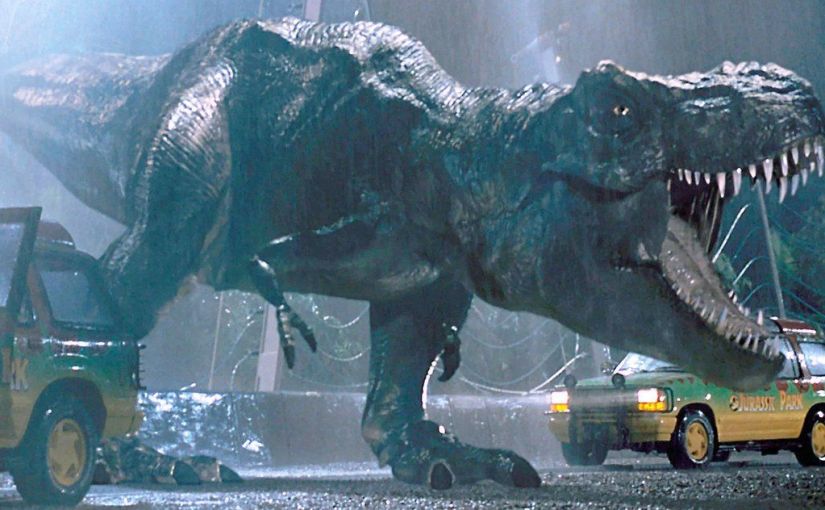
You also won’t be disappointed in the assortment of dinosaurs on hand.  This time there are two T-Rex’s and they are used beautifully in a very daring, albeit long for the sake of maximum suspense, scene that involves our heroes dangling within a double RV trailer that has been pushed off a cliff.  When Sarah lands face first on the back windowpane of glass, try your best not to bite your nails.

Another exceptional scene is when the expedition runs into a tall grass raptor nest.  This is like Jaws on land.  With the help of much CGI, but also puppetry from Stan Winston’s imagination factory, Spielberg gets great overhead shots of fast forming black lines that quickly cut through the meadow taking out one poor soul after another where beast overcomes man. These moments occur in the large second act of the film where it’s nothing but action done with Spielberg’s skill to oversee. 

The third act is questionable, but I found a nostalgic admiration for it.  Spielberg goes for the salute to King Kong, the grand daddy of all monster movies.  Ludlow’s hubris and what remains of his expedition team trap and bring back the male T-Rex to San Diego aboard a large freighter.  In the dead of night, garbed in his finest suit, he’s ready to give a speech to a press junket that must work a graveyard shift introducing the marvelous attraction.  Naturally, we know things will not go as planned.  Now, we know this is not New York City and the Empire State Building is not nearby, but this T-Rex will naturally run amok anyway and settle for destroying a suburban dog house, about a dozen cars and a 76-gas station.  No, it is not King Kong, but the salute is appreciated nonetheless.  There’s even a wink and nod to Godzilla.  I laughed.

Pretty stupid of Ludlow to do this, right?  Well, he’s the villain.  So, let’s give him a pass.  On the other hand, the heroes are dumb as rocks.  Sarah takes a baby T-Rex away from its quarters. Ian gets up into a high area platform with his daughter as an escape to safety…but then he comes down again!!!!!  The hunters simply think they are hunting kittens no matter the stature of any of the game they are pursuing.  The telephone doesn’t get answered when it really, really should.  You’ll find yourself shaking your head and outstretching your arms at the screen (palms up) as if to say “WHY????????”. 

It really doesn’t matter.  The first Jurassic Park film never had a fully developed brain.  This installment, unabashedly, never even stops to think.  It’s as if a collection of characters in a shoebox raised their hand for volunteer slaughter. 

My wife watched this with me recently, and at times she would ask “Why are you doing this or why not just call such and such?”  I’d have to remind her it’s not that simple.  Cuz if it were that simple, then they would have picked up the phone.  We all have a destiny in life.  I truly believe that.  The destiny of the cast of The Lost World: Jurassic Park was to run and maybe or maybe not get chomped on and eaten.  This is what they were groomed for their whole lives. So, let’s not interfere with the laws of nature.

JURASSIC PARK

By Marc S. Sanders

Michael Crichton’s best-selling novel, Jurassic Park, is my favorite book of all time.  I recall reading it in one Friday night a week before the Steven Spielberg adaptation was released in theaters.  It was the easiest book to breeze through and I never stopped thinking about Crichton’s approach to a what if scenario where dinosaurs are resurrected in the name of scientific discovery and profitability.  Ideas related to chaos theory and DNA experimentation were considered against the mayhem of people running for their lives in an amusement park attraction.  Amid the action, there was opportunity to think and consider.  Spielberg’s film doesn’t offer enough time for ponderance.  It starts out that way, but it doesn’t finish its thought.  That’s always been a hinderance for me.

There’s no question regarding the immense thrills the film brings, even thirty years later.  Effects and puppeteer wiz Stan Winston (how I wish he hadn’t passed away so soon) outdid himself following memorable recreations from films like Aliens and Predator.  The centerpiece of the blockbuster is of course the T-Rex.  Spielberg follows his age-old approach of not showing the monster right away, though high publicity and massive merchandising of the early 1990s never kept this cat in the bag anyway.  Oh well!  Yet, when the humungous, twenty-ton dinosaur puppet makes its grand entrance midway through the film, it still holds as a spectacular scene, especially because two fine child actors (Ariana Richards, Joseph Mazzello) with high pitched screams heighten the terror.  Look, you should know by now.  If Steven Spielberg is aiming for the rafters of box office thrills, he’s gonna put the kids in danger first and foremost.

Velociraptors are the other big stars of this creature feature and the behavior of these CGI animals is magnificent as we observe them communicate with one another.  Like the T-Rex, we don’t get an immediate first glance of them either, but their squeals and screeches as they leap in for a monster mash smorgasbord get us to jump in our seats.  When the veil is lifted on these guys, Spielberg and his effects crew go further by granting them with quick agility.  Before all this, we are told by the science experts of how they are strategic pack hunters with cheetah like speed and how they tear away at flesh as they pounce on live prey.  You wince as you imagine.  They are also smart too.  These dogs can open doors! 

Again, all good stuff here.

The best character is the sarcastic mathematician, Ian Malcolm (Jeff Goldblum), who insists resurrecting dinosaurs is a terrible idea for the modern age.  Goldblum is so good with the script written by David Koepp that my favorite scene in the picture is when the main characters sit around the dinner table to discuss what has surprisingly been thrust upon them.  I yearned for more scenes like this.  Ian Malcolm offers up a new iteration of “Matt Hooper” (Richard Dreyfuss in Jaws) that I just didn’t get enough of.  Only the surface is scratched on the argument of intelligence versus stupidity.  In Jaws, we got nearly a full hour of this welcome back and forth.

What lacks is what Jaws provided over a decade earlier.  The debates of how to live (or die) with dangerous animals begins, but doesn’t finish in Jurassic Park.  It merely gets started, and then the argument gets abandoned to allow for unending carnage.  Don’t get me wrong.  I love carnage in my movies.  However, Crichton illustrated an even amount of attention to chaos blended with intelligence (or ignorant lack thereof) when he wrote his book.  I got a textbook education from Michael Crichton.  From Steven Spielberg and David Koepp, I just got a thin dog eared comic book.

Goldblum is third in line in the cast credits behind Sam Neill and Laura Dern as Alan Grant, a paleontologist, and Ellie Satler, a paleobotanist.  They, along with Malcolm, are cordially invited by billionaire entrepreneur John Hammond (Richard Attenborough) to visit his private island that is soon to be converted into Jurassic Park, a zoo/amusement park consisting of live dinosaur attractions.  The dinner sets up the debate of Hammond versus the three scientists.  Is anyone being responsible with the potential to act upon breakthrough discoveries?

Granted, if Hollywood was going to make a dinosaur movie, then it was going to be catered to children age 10 and up.  Kids and families of four or more sell tickets.  The novel doesn’t aim towards that demographic, however.  It is darker and the Hammond character is more sinister and greedier.  He’s not a fleshed-out villain in the film.  He’s lovable.  The film simplifies itself too much as it devolves into a run and chase and chew and chomp adventure of screams and outstanding John Williams music.

I watch the film over and over again because visually it remains magnificent, but I still remind myself that it is not enough.  Steven Spielberg’s film is admired and so well regarded and perhaps it is deserving of its legacy, thirty years, five sequel films and a couple of Universal Studios attractions later.  On the other hand, I wish it allowed its brain to develop a little bit more. 

Steven Spielberg’s interpretation of Jurassic Park could’ve been as smart as a velociraptor.

THOR: RAGNORöK

By Marc S. Sanders

Thor’s third adventure in the Marvel Cinematic Universe, subtitled Ragnarök, is altogether fun, silly and primarily very campy. Sure, Cate Blanchett looks wickedly theatric as Thor’s evil older sibling Hera, but even she is not taking any of this too seriously.

There’s not much to evaluate within this film. Chris Hemsworth and Tom Hiddleston return as brothers at odds, Thor & Loki, and get sidetracked on a gladiator battle planet where they encounter a lighter, more tender and funnier Hulk care of Mark Ruffalo. The camp also comes to the forefront by way of Jeff Goldblum as the Gamemaster, a role obviously engineered to cater to his dialect idiosyncrasies.

The film is lots of neon colors of CGI and set piece junk helmed by director Taika Waititi. I commend Marvel Studios for recruiting these (at the time) unheard of directors with insightful visions. While most every Marvel film to date has its own unique appearance, Thor: Ragnarök is a balance of the prior Thor films, banking on the humorous success of the Guardians Of The Galaxy films.

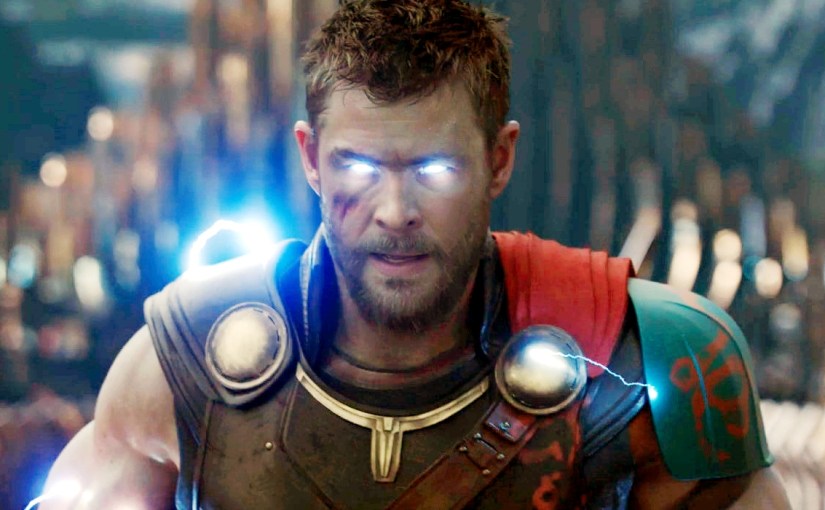
The gem this film offers is combining Led Zeppelin’s “Immigrant Song” with a fierce lightening powered one eyed Thor to fend off a few baddies. Compliments also to a bad ass, and sometimes drunk, Tessa Thompson as the Asgardian known as Valkyrie.

A favorite moment is an encounter with Benedict Cumberbatch as Dr. Strange. Good editing and direction offer an inspired Three Stooges routine where Thor is unexpectedly thrust about down a staircase or through a room. Plays like a great cartoon short.

Ragnarök has some shocking moments in its ending, but the weight of drama or story is none too burdensome.

It’s nothing special of a film, but it is amusing and gleeful, especially when Thor is forced to a chair while Willy Wonka’s “Pure Imagination” plays like annoying elevator music. That is sure to make the God Of Thunder irritable, and we the audience only gain from it.

Thor: Ragnarök is really a fun family movie of adventure, good character design and laughs.

THE PRINCE OF EGYPT (1998)

by Miguel E. Rodriguez

Directors: Brenda Chapman, Steve Hickner, Simon Wells
Cast: Val Kilmer, Ralph Fiennes, Michelle Pfeiffer, Sandra Bullock, Jeff Goldblum, Danny Glover, Patrick Stewart, Helen Mirren, Steve Martin, Martin Short (whew!)
My Rating: 10/10
Rotten Tomatometer: 80% Certified Fresh

PLOT: Egyptian Prince Moses learns of his identity as a Hebrew and, somewhat reluctantly, realizes his destiny to become the chosen deliverer of his people.


I sat down to watch The Prince of Egypt for the umpteenth time today, ostensibly in honor of Passover, but really it’s just an excuse to watch it again.  In the 24 years since its release, it’s become one of my favorite animated films.  I started out thinking it was a gimmicky cash grab.  Then I realized how majestic the score and songs were (by Hans Zimmer and Stephen Schwartz, respectively).  Then I came to appreciate how effectively it humanizes the Exodus story, so it becomes something more than just an excuse for some crazy visual effects.  Then I looked more closely at those visual effects and realized how magnificent they are, too.

So now it’s a treat when I watch it.  But something rare and unexpected happened to me when I watched it today.  Before I get into that, though, for anyone who may still be unfamiliar with this marvelous film…

Moses (Val Kilmer), a prince of Egypt, younger brother to Rameses (Ralph Fiennes) and son to the great Seti (Patrick Stewart), is comfortable with his place in the world.  One day, he comes across Miriam (Sandra Bullock), a Hebrew slave who boldly informs him he is not Egyptian.  He is, in fact, the son of a Hebrew slave woman who set him adrift on the Nile River to spare him from the bloody purges ordered by Seti, the man he calls father.  Disturbed and conflicted, Moses unthinkingly kills an Egyptian slave driver in a heated moment and leaves behind the only family he’s ever known to face his fate in the desert.

There he meets Tzipporah (Michelle Pfeiffer), a Midianite girl on whom he showed mercy earlier, and her family.  Embracing his new Hebrew identity, he marries Tzipporah and becomes a shepherd.  Time passes.  One day, Moses is searching for a lost sheep when he is confronted with a strange sight: a bush that appears to be, not burning, but covered in cold white flames, nevertheless.  To his shock, a voice speaks from the bush.  It is the God of his ancestors, and He is displeased with how His people are being treated in Egypt.  He commands Moses to go to Egypt and tell the pharaoh to let His people go…

Need I go on?  The staff, the plagues, the blood, the angel of death, the pillar of fire…it’s all presented here in spectacular fashion.

When DreamWorks first announced plans to make what basically amounts to a musical version of The Ten Commandments, I was skeptical to say the least.  I even remember what theatre I saw it in: the Ybor Centro movie theater in 1998.  I sat through the movie, and I allowed my skepticism to color my entire viewing experience, right up until the sensational Red Sea parting, which even now is one of the great animated sequences of all time.  But aside from that, I felt The Prince of Egypt was all flash and no substance, a way for an upstart movie studio to get people into theaters with an overabundance of star power and little else going for it.  But after watching it on home video repeatedly…I mean, REPEATEDLY…I started to analyze it a little more.

The first thing that really renewed my interest and appreciation for the film was the humanization of the main characters, particularly the relationship between Moses and Rameses.  Moses is no movie idol in this film.  He’s just a man.  Kind of a scrawny man, too, not classically handsome like his brother, Rameses.  Where Moses looks a little spindly and frail, Rameses looks like he lifts weights, or whatever folks did back then on “arm day.”  I also like how the movie allows these two men to behave and relate to each other like real brothers might.  They race chariots down city streets, needle each other, call each other names, play pranks on the high priests, the whole nine yards.  It’s a dynamic the two men surely must have shared as brothers growing up, but it never gets addressed in other interpretations of the story.  Because we get to see how much they love each other, the scene where Moses reluctantly turns his back on Rameses carries so much more weight than we might be accustomed to seeing.

This dynamic comes full circle when Moses returns to demand freedom for the Hebrew slaves.  Rameses is now pharaoh, and laughs at Moses’ demands, wondering what his “angle” is.  And then, when the plagues are visited upon Egypt and the city has nearly crumbled, the two men share a scene of astonishing power.  Rameses sees his city in ruins, but ruefully remembers how Moses used to get him out of trouble when they were younger.  It’s a wonderfully human moment.

The second element of the film that sparked my renewed interest was the music.  At the end of the opening number, which is itself emotionally powerful on several levels, a solo female voice sings out, “Deliver us!” right at the end of the song.  I can no longer remember a time when that moment didn’t give me goosebumps.  The score by Hans Zimmer is magnificent.  There is one particular motif of a choir of voices that we hear whenever we are in the presence of something holy or mystical, and even that gives me goosebumps.  Another moment that deservers recognition is during the big number, “When You Believe,” as the Hebrews are flowing out of Egypt.  At one point, the song is replaced by a Hebrew folk song, “Ashira L’Adonai,” sung by a little girl.  Her voice is joined by several others, and then a few more, and then a whole choir, and then the whole orchestra comes in for a reprise of the chorus, and if you don’t get goosebumps at that moment, you need a vacation.

The third element that keeps me coming back to this movie is the visuals.  True, the CGI visuals are relatively primitive compared to what was going on at Pixar around the same time.  The chariot race between Moses and Rameses features CG chariots which you may notice have wheels that don’t always turn while the chariot is moving.  This was an aspect of the film that led to my early dismissal of it.  But then came the Angel of Death scene, with a hole literally torn in the sky and sinister tendrils pouring out of it and into the village streets.  And then came the eye-popping Red Sea sequence.  More so than any other version I’ve seen, The Prince of Egypt made me feel in my bones that, yes, THIS is what it would have looked like if uncountable tons of water were parted down the middle, clearing a path large enough for the entire Hebrew nation to walk across.  (Depending on who you ask, that number could have been up to two million people, so we’re talking about a WIDE path.)  As they walk between the two massive walls of water on either side, lightning flashes illuminate sea life swimming alongside them, including some really large fish.  Now THERE’S something you don’t see every day.

So, yeah, the movie is amazing.  People may quibble about its historical inaccuracy, or the liberties it may take with certain religious beliefs.  But that does not diminish its power in the slightest bit.

Which brings me back to what I mentioned in the opening paragraph:

I sat down to watch the movie today, and for reasons I can’t explain, the opening scenes were bringing a lump to my throat.  That solo female voice singing “Deliver us!” nearly brought a tear to my eye.  And it nearly happened again after a wedding song.  And again, when Moses is leading the Hebrews out of Egypt to the strains of “When You Believe.”  And when Moses slams his staff into the shallow waters on the banks of the Red Sea, and those waters shot up into the air and kept going and going…my God, man, I nearly lost it.  I was one thread of self-control away from going full-on blubber-fest.  I mean, I grabbed my chest like a Victorian lady reading a Jane Austen novel.  In the middle of my emotional experience, I kept asking myself, “What is WRONG with me?!”

The answer is, of course, nothing is wrong with me.  I was just in exactly the right frame of mind to have a borderline religious experience while watching a movie.  It’s the same when I watch the finale of Fantasia 2000, when the sprite erupts from the ground in a gesture of pure joy.  Or when Riley learns the importance of experiencing sadness at the end of Inside Out.  Or any number of other transcendent films that can put me right in the middle of the story emotionally.  The Prince of Egypt does exactly that through a well-managed mixture of story, visuals, and music.  It may not be perfect from a technical standpoint, but it gets me where it counts, and that’s all that matters.