THE PURPLE ROSE OF CAIRO (1985)

by Miguel E. Rodriguez

DIRECTOR: Woody Allen
CAST: Mia Farrow, Jeff Daniels, Danny Aiello, Dianne Wiest, and…Jeff Daniels
MY RATING: 10/10
ROTTEN TOMATOMETER: 93% Fresh

PLOT: In 1935 New Jersey, a movie character walks off the screen and into the real-world life of a lonely, unhappily married woman.


I can imagine that it would be absurdly easy to poke holes in The Purple Rose of Cairo.  The premise is outlandish, taking place in the real world but firmly in the realm of fantasy.  It stretches the suspension of disbelief to the breaking point, then goes a little further.  It asks the audience member to forget cynicism and snark for eighty-two minutes and give in to the kind of hopeless romanticism that exists only on the movie screen.  And then, amid all that glorious make-believe, it abruptly confronts you with the knowledge that, yes, this kind of thing really does only happen in the movies, and the real world can be messy and unforgiving and sad.  Yes…but at our lowest points, we can always turn to Fred and Ginger, and Bogey and Bacall, and Luke and Leia, and Gene Kelly, and Hogwarts and the Emerald City.  The Purple Rose of Cairo reminds us that the movies allow us to escape reality for an hour or three.  Sign me up.

This movie’s plot is the embodiment of the “high-concept pitch.”  What if a movie character walked off the movie screen and tried to live in the real world?  I don’t have any statistics to support this, but I’m pretty sure there are at least 18,337 other films with variations of this fish-out-of-water scenario, most memorably Splash, Last Action Hero, and Who Framed Roger Rabbit.

In this version, Mia Farrow plays Cecilia, a semi-depressed housewife in 1935 New Jersey, living in a small town still in the grips of the Great Depression.  Her husband, Monk (Danny Aiello), claims he’s looking for work, but we only ever see him pitching pennies with his buddies or making life miserable for Cecilia at home.  Her wages from her waitressing job go directly to rent and groceries, and anything left over goes to Monk.  Amid this bleakness, Cecilia goes to see the new film opening at the local theater, The Purple Rose of Cairo, starring a dashingly handsome actor named Gil Shepherd in the supporting role of archaeologist Tom Baxter (both roles played by a young Jeff Daniels).  She is swept away by the glitter, glamour, and romance of the film.

Imagine her surprise when, during one of the many screenings she attends, Tom Baxter abruptly stops mid-sentence, breaks the fourth wall, and speaks directly to Cecilia from up on the screen.  “My God, you must really love this picture…I gotta speak to you.”  And he simply walks off the screen, much to the consternation of the movie audience, and walks out of the theater, arm in arm with Cecilia.  The wit with which Woody Allen handles the reactions of the audience AND the movie characters Tom leaves behind is priceless.  The characters and the real people react with perfect logic, so the effect is not one of slapstick (I can see an Adam Sandler version of this movie beating the joke to death), but one of a strange mixture of high and low comedy.  To relate the scenes here word for word would ruin the magic.  (An African-American maid steals every scene she’s in.)  Tom and Cecilia go off together, and the rest of the film is, from a plot perspective, fairly predictable.

What makes this movie unique is how it tells the story.  Tom knows what an amusement park is, but he has no clue what popcorn tastes like.  (“Been watching people eat it for all those performances.  When they rattle those bags, though, that’s annoying.”)  He has fallen instantly in love with Cecilia…love at first sight.  Tom hides in the city, and Cecilia lies to Monk to go back and see Tom the next night.  A nice touch comes when calls start coming in to RKO that the Tom Baxter character in prints being shown in other cities is also trying to escape his gilded silver-screen cage.  (“He almost made it in Detroit.”)  There’s the inevitable showdown between Tom and Monk.  Tom only knows the moves he uses on film, but Monk fights dirty.  However, the fight still doesn’t end quite as I expected…another nice touch.

The real crisis occurs when the studio calls in Gil Shepherd, the actor who PLAYS Tom Baxter, to New Jersey so he can try to wrangle his creation back into the movie where he belongs.  There is the expected confusion when Cecilia bumps into Gil, mistaking him for Tom.  The plot thickens even more when Gil starts falling in love with Cecilia herself, and she finds herself in a pickle.  She tells Gil, “I just met a wonderful new man.  He’s fictional, but you can’t have everything.”

The commentary being made here regarding our fascination with movie characters (and the movies themselves) as opposed to the actors who play them seems simple, but in trying to analyze it like a “real” critic, I feel helpless in the face of the ingenuity of the situation.  My words aren’t doing justice to the almost poetic elegance on display.  The more you love movies, the more you’ll appreciate what I’m desperately trying to convey.

There are two moments/sequences that elevate The Purple Rose of Cairo from a dramatic exercise into the realm of genuine movie magic.  One is when Tom wants to show Cecilia a night on the town, but they have no money (Cecilia is broke, and all of Tom’s movie money is fake).  But he remembers that, in the “fake” Purple Rose movie, the scene coming up after the one he abandoned takes all the characters to the Copacabana.  It’s here that the viewer simply must suspend what little disbelief remains and give in to the simple but grand gesture of watching Cecilia herself appear on the black-and-white screen with all of the people she’s been watching night after night.  They go to the Copa, and after watching the singer who’s supposed to be Tom Baxter’s love interest, Tom and Cecilia head out for a night on the town, as only 1930’s movies could provide.  (The maître d’ provides one of the movies biggest laughs when he suddenly realizes he can do whatever he wants…and does.)

But the greatest moment is the very ending, which I will try desperately not to spoil here.  It’s here where we get to the heart of what Woody Allen is really trying to say: The movies are here and real life is there, and never the twain shall meet.  Is this a depressing point of view?  Well, I mean…yeah, a little.  But it’s also indisputably true.  If we walked around like we were actually in a movie, we’d never lock our doors behind us when we walked into our apartment.  Everyone’s phone numbers would begin with “555”.  We’d turn on the light when answering the phone at night (who does that, really?).  But in the real world, none of that is true.  In the real world, hearts get broken, sometimes for good.  We get fired.  People die.  WE die.  Love the movies, Allen is saying, but never forget that you’re flesh and bone, and that actions have consequences.  I’m reminded of a good line from Ready Player One: “As terrifying and painful as reality can be, it’s also the only place that you can get a decent meal.”

The final shot of the movie, of Cecilia smiling through her tears, moved me like I’ve rarely been moved before.  It reminded me, perversely, of some of the worst times in my life because it was at those dark times that the movies came to my aid.  I went through a fair episode of depression in my twenties; a friend showed me Harold and Maude, and it literally changed my life.  During the Covid lockdown, I was furloughed, and the maddening Florida unemployment website sapped my will to live, figuratively speaking; my best friend, out of the blue, bought me a copy of Star Wars: The Rise of Skywalker just to cheer me up…and it did.  During that same period, several different films were in constant rotation in my movie room, all of which provided spectacular ways of escaping real life: Blade Runner 2049, Prometheus, The Martian, Interstellar, Gravity, and Sunshine [2007].  Not all laugh riots, to be sure, but they were excellent tonics against the constant worry of unemployment and disease.

And in 2017, Hurricane Irma threatened Florida.  For the first time, I was genuinely frightened that we would finally see real danger from a hurricane.  Miraculously, a local multiplex chose to stay open until almost the eleventh hour, and to get our minds off the approaching storm, I took my girlfriend to see the new remake of Stephen King’s It.  For two hours, we got scared out of our wits in the best way possible.  We escaped reality, and collectively we had our real-world fears literally exorcised.  I cannot tell you how grateful we were to have that brief respite from our troubles.

Those are the memories that came back to me in the final sequence of The Purple Rose of Cairo.  Yes, the real world is still the only place to get a decent meal, and it remains imperfect and sometimes painful.  But the movies are as close as a button click or a car ride.  They’re implausible and sometimes unrealistic and not always perfectly written.  But The Purple Rose of Cairo just wants to remind us of their power to cheer us up and transport us.
SPEED

By Marc S. Sanders

Jan de Bont’s Speed is one of the best action thrillers ever made. It moves at a breakneck pace with huge suspense, big laughs and never-ending excitement. It’s also really smart with its crazy storyline.

A mad bomber (Dennis Hopper) manages to terrorize the city of Los Angeles by rigging a high-rise elevator with a bomb. Thirteen hostages need to be rescued and for an opening scene of a movie it does not get better than this. The heights and cramped space of the elevator and shaft are tightly claustrophobic, leaving you biting your nails. Small explosions come unexpectedly. This is what Hitchcock is always talking about. Putting a bomb under a table is suspense. The moment you detonate the bomb, the fear is over. De Bont blows up some bombs, but he leaves you hanging for when he’s going to set off the biggest bomb of all – the one that’ll put a hole in the world.

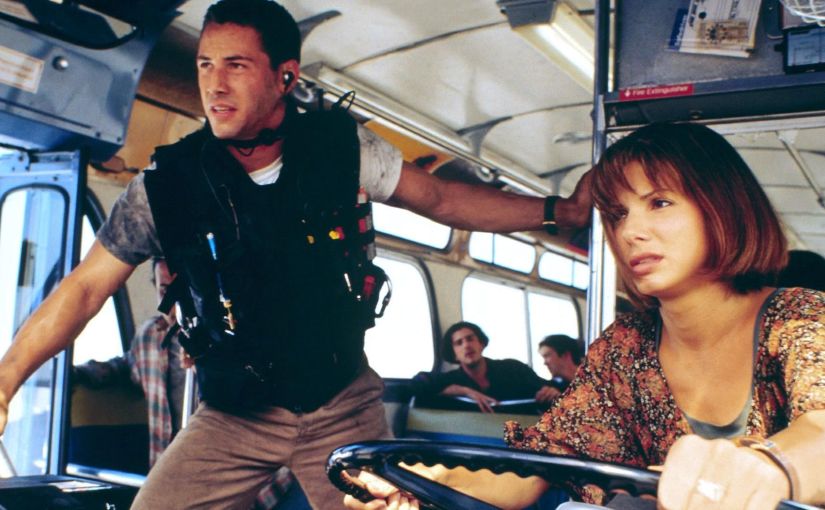
Later, the bomber does the same to a city wide transit bus traveling the freeway routes of rush hour traffic in the city. If the bus’ speed drops below 50 MPH, it’ll explode. Imagine pulling two tricks of Hitchcock all in one film. Imagine trying to never slow down a bus. This bad guy is destroying the city without even setting the big bomb off yet. This is great writing from Graham Yost. The whole scenario is tension at a maximum level.

The cop trying to stop the bomber is Jack Traven (at the time of release, an unlikely Keanu Reeves). Reeves is a perfect hero in this film. He allows the film to stand apart from being just another Die Hard rip-off by avoiding the Bruce Willis smart aleck stance. He’s a smart guy who keeps focus on just the situation at hand. He’ll get the bad guy later.

Sandra Bullock plays an adorable character named Annie who consequently has to drive the bus. This was Bullock’s breakthrough performance and I truly think it still holds as one her best. She’s funny, but she has some good dramatic moments as the tensions build up where Hopper’s crazed bomber makes things more difficult for Jack and the passengers. Bullock is good at crying on film, but she also knows how to deliver a line too.

De Bont does a great job at poking fun at the mundane trappings of traffic and intercity daily activity. As the bus careens through the city, pedestrian crossings are at risk, tow truck cars are problematic, cop cars are bashed up, and Annie is mindful enough to turn her blinker on as she careens around the corners. That last gag kills me every time. De Bont does what I always insist works in most films. He makes the setting of his film the character as well. This bomb rigged bus is stressing out the city of Los Angeles, for sure.

Seeing Speed holds a special memory for me. I saw it on its opening Friday night with some college buddies. Two days later, I insisted on taking dad to see it. Dad could not stop laughing through the absurdity of it all as street signs crash down, cars get totaled, and the fast editing blended with Annie’s laughable panic. Most especially, he loved a hapless driver (a scene stealing cameo from Glenn Plummer) in his gorgeous Jaguar convertible known as “Tuneman” by his license plate. Jack desperately hijacks his car as a means to catch up to the bus. As Tuneman’s car gets more and more wrecked, Dad could not get over it. He was in stitches. This is why movies can be so vital in our lives. I’ll never forget Dad’s nonstop laughing. I carry it with me forever, and I heard it again last night as I caught up with Speed. He’s gone now, but these are the moments I miss most about Dad.

A third act of the film is just as thrilling. Let’s see. We’ve done an elevator and a bus. How about a subway train? It’s a briefer sequence for the climax of the film, but it keeps the thrills ongoing.

Speed works on so many levels with a brilliant cast of B actors (at the time of 1994) that also include Joe Morton, Alan Ruck and a great Jeff Daniels as Jack’s partner with bomb experience. The action sequences cannot be complimented enough, and the Oscar nominated editing from John Wright with De Bont’s direction pair perfectly in timing.

Speed is an absolute thrill ride and a rocking great time at the movies.

THE SQUID AND THE WHALE (2005)

by Miguel E. Rodriguez

Director: Noah Baumbach
Cast: Jeff Daniels, Laura Linney, Jesse Eisenberg, Anna Paquin
My Rating: 9/10
Rotten Tomatometer: 92% Certified Fresh

PLOT: Two young brothers deal with the divorce of their parents in 1986 Brooklyn, specifically the Park Slope neighborhood.


I started writing this as a “conventional” review, and I found myself unable to make it more than a simple summary of the plot.  I have rarely seen a movie that has left me more inarticulate than this one.  I can tell you the movie works, and works extremely well, but I am unable to explain exactly why.

It’s a simple story of a husband and wife going through divorce, deciding on joint custody of their two sons, and the complications that ensue.  The husband, Bernard (Jeff Daniels), is a literature professor and a published novelist, but who hasn’t had anything published for some time.  The wife, Joan (Laura Linney), is in the final stages of getting her own first novel published.  This fact may or may not be one of the causes of the divorce, but Bernard is pretty sure it is.  Their sons, Walt (high school senior, played by Jesse Eisenberg) and Frank (maybe 12 years old), deal with this news in a predictable manner: initial numb acceptance, then some acting out a little later.

Bernard, whose well-educated narcissism is impossible to miss, almost cheerfully informs the sons that he and Joan will share joint custody evenly during the week.  One of the sons asks, “How can you share us evenly?”

“I’ll have you every other Thursday,” Bernard explains helpfully.  This answers the question without making anything better.

Walt starts a relationship with a classmate whom he coldly describes as “cute, but not gorgeous.”  Bernard casually invites a female student to live in a vacant room in his new house.  Joan and Bernard fiercely protect their “days” with their sons.  Frank starts drinking beer and masturbating in public places (this is handled with much more discretion than that description would have you believe).

But the story itself is not what makes this movie such a pleasure.  It’s the movie’s style and editing that create a unique experience.  The movie clocks in at an unthinkable 81 minutes, WITH credits.  I learn from the bonus features on the Blu-Ray that it was shot on Super-16 film stock with a mostly hand-held camera, lending the film a low-budget, documentary look that enhances its “reality”.  Scenes last only long enough for us to get the point before a jump cut takes us to the next plot point.  Normally, this creates in me a sense of nervousness or anxiety, but for some reason it didn’t work that way.  I never felt cheated or short-changed.  It all just felt “right.”  It gave me the same sensation I get when I’m reading a really good short story with sharply-drawn characters and impeccable dialogue.

That may sound like more details than I had promised at the beginning, but it’s really just a clinical description.  Words can’t express how the film’s brevity, atmosphere, dialogue, and characters all combined to produce one of the most touching films about family and/or divorce that I’ve ever seen.

(No, I HAVEN’T seen Marriage Story by this same director, Noah Baumbach, but I will get around to it one day.  Today is not that day, though.)

QUICK TAKE: Good Night, and Good Luck. (2005)

By Miguel E. Rodriguez

Director: George Clooney
Cast: David Strathairn, Patricia Clarkson, George Clooney, Jeff Daniels, Robert Downey Jr., Frank Langella
My Rating: 8/10
Rotten Tomatometer: 93% Certified Fresh

PLOT: In the early 1950s, broadcast journalist Edward R. Murrow (Strathairn) looks to bring down Senator Joseph McCarthy.


I feel eminently unqualified to discuss the historical merits of Good Night, and Good Luck.  I am no history scholar.  What I know about the Hollywood blacklist and the HUAC hearings can be traced to sources such as movie reviews, the movies themselves, documentaries, and The Manchurian Candidate.  (The original, not the remake.)

As such, all I can report is that this movie is solidly well-made, photographed in gorgeous black and white, and is an immensely satisfying experience, because a bully gets what’s coming to him, on national television.  If there are times when it lags a little, well, civics lessons can’t be fireworks all the time.

David Strathairn is not quite a dead ringer for legendary newsman Edward R. Murrow, but he’s close enough, and he’s never less than convincing, especially when delivering Murrow’s broadcasts in that inimitable deadpan that somehow sounds more informed than the average reporter.

I especially enjoyed the segment where McCarthy appears on Murrow’s program to defend himself against charges made by Murrow on a previous show.  Shortly thereafter, Murrow goes over McCarthy’s rebuttal line by line, identifying each falsehood and inaccuracy.  That took guts back then, but Murrow stood for truth, as corny as that sounds, and he wasn’t about to let McCarthy’s lies slide.

All in all, Good Night, and Good Luck is a great film, maybe even an IMPORTANT film, because of our ever-shifting political climate.  You never know if another McCarthy will rise up, and you wonder if anyone will be around, like Murrow, to put them in their place.

[TRIVIA NOTE: look fast for Simon Helberg (Wolowitz on “The Big Bang Theory”) in what amounts to approximately five seconds total screen time.]

TERMS OF ENDEARMENT

By Marc S. Sanders

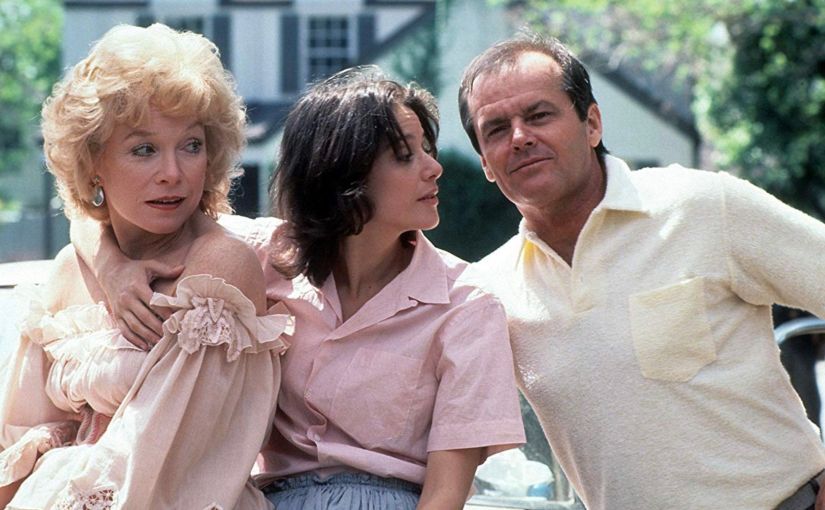
Acclaimed television writer James L Brooks’ first feature film was the 1983 Best Picture Winner Terms of Endearment.  The movie succeeds in more ways than one because of its varied relationships among the characters.  You have Aurora Greenway (Shirley MacLaine) and her daughter Emma Greenway-Horton (Debra Winger).  There’s Emma and her husband Flap Horton (Jeff Daniels).  There’s Aurora and Flap, and then there is Aurora and her neighbor Garrett Breedlove (Jack Nicholson).  Sounds like a lot to take in for a two hour picture, and yet Brooks manages to adapt a script from Larry McMurtry’s novel that smoothly covers realistic depth and dimension among these characters, and how they connect with one another.  Brooks is at least an incredibly efficient writer/director.  Honestly, I’m not complimenting him nearly enough.

Shirley MacLaine provides one of the best female performances to ever grace the silver screen.  She doesn’t have to utter a word of dialogue to say so much about how Aurora feels.  One of her greatest facial expressions is when she is addressed by her grandson as “Grandma!”  This moment is so utterly hilarious that the studio selected it to close out the original theatrical trailer.  If anything is going to get you in the seat at the theatre it’s this moment.  Aurora is a widow who can be difficult to please, judgmental and always conscious of her part in the world-even while she is hosting multiple gentlemen suitors in her Houston, Texas home.  This character is so powerful that it is hard to understand why Hollywood really never followed suit with presenting more films focused on the middle age woman or man.  There are still interesting things to be found in being a widow and dealing with ageism, motherhood and a resurrection of sexuality.  Think about The Golden Girls which dominated television sets on Saturday nights for most of the decade.

Aurora disapproves of Emma marrying Flap.  Flap has no imagination or drive and is as devoid of affection as his name suggests.  Best he can do for Emma and their three children is find whatever college professor job he can muster and uproot his family from one mid-western state to another.  Emma knows of her mother’s disdain for Flap, and can’t disagree with her.  She knows Flap is a loser, but if it means aggravating her mother then it is worth it at least to marry him.  Early in the film it amuses Emma to frustrate her mother a little more and a little more.  Contrary to Aurora’s instincts, Emma is naively unaware that life settles in soon enough and the happy nuptials fade away.

Still, Aurora and Emma have a strong mother/daughter relationship where numerous phone calls each day happen between them.  These conversations consist of Emma reluctantly telling her mother that she may be pregnant, yet again, or that Aurora is proud to let her guard down and approach the boorish, drinking next door neighbor astronaut, Garrett, played with a devil may care seductiveness from Jack Nicholson.  Aurora’s serene peacefulness in her beautiful backyard garden and home is always disrupted by Garrett’s loud bellow before diving into his swimming pool.  Still, she can’t help but be attracted to him while putting on a façade of disapproval in his presence.  The first lunch date that Aurora and Garrett share must be one of the best dates ever depicted on film.  The scene might have been written and staged by Brooks, but it is thankfully hijacked by Nicholson and MacLaine.  One of the funniest moments to ever come out of 1980s cinema for sure.  There’s much reason that MacLaine won Best Actress and Nicholson won Best Supporting Actor.  These actors easily stage a scene of realistic comedic chemistry while later expressing deep rooted drama and affection with one another.  Not easy to do all in one film.

Brooks masterfully writes these characters with such authenticity that you find yourself legitimately laughing at a scene or a piece of dialogue, while the person sitting next to you might embrace the dramatic element of the very same moment.  Both responses to random moments in Terms Of Endearment allow varied reactions like that.  When Emma suspects Flap of committing adultery, pay attention to the dialogue and the performance from Winger and Daniels.  Emma allows Flap to dodge a lie he’s about to tell by warning him that he may have just lost his senses, but if he continues down a wrong path, then he will end up worth less than he already is.  He doesn’t fight her on that observation.  Hard to explain here but listen to the vocabulary Brooks applies to Emma’s dialogue and watch how Winger traps Daniels.  You may nod with a smirk, or you may feel frightened for Emma and her marriage. 

I always say Terms Of Endearment is a comedy first and a drama second.  The film steers towards a frightening fate for the Aurora and Emma.  However, before that third act sequence there is so much to treasure, love and laugh at in the film.  When a cloud of imminent loss feels like it may approach, that is when the dramatic elements step forward.  To truly feel loss, you had to treasure wonderful moments with a loved one or a friend.  You had to value something important in your heart and soul to feel so terribly frightened and mad and hysterical when days might seemingly appear numbered.  James L Brooks and Larry McMurtry remind us of that.  Every person on the planet is destined for this feeling at one point or another.  What happens when the inevitable arrives is what sustains Terms Of Endearment to it’s satisfying end.  A character may appear on a hotel staircase to reconnect with support.  A hug goes a little longer than expected, and for the first time the one who normally lets go first actually tries to keep the moment frozen in time.  A gift from long ago is recovered to touch someone emotionally.  Brooks includes all of these moments in his film and that’s what I embrace most importantly.  Cinematically speaking, these points in the film are heightened by a memorable soundtrack of quirkiness and passage of life from composer Michael Gore.  His music is so effective that it has been used countless times over to enhance trailers for other films marketed at audiences that this picture was catered for.

Yes, after numerous viewings, Terms Of Endearment never fails to me put me in tears.  Like ugly crying!  I prefer to watch it alone actually, because I connect with the characters differently than most people I know, including my wife.  It’s a very personal film for me.  It reminds me of loss that I have felt and experienced.  More importantly though, it reminds me of all I’ve had, and all I continue to hold on to.  Terms Of Endearment is one of my favorite films.