SOMETHING WICKED THIS WAY COMES (1983)

by Miguel E. Rodriguez

DIRECTOR: Jack Clayton
CAST: Jason Robards, Jonathan Pryce, Vidal Peterson, Shawn Carson, Royal Dano, Diane Ladd, Pam Grier(!)
MY RATING: 5/10
ROTTEN TOMATOMETER: 62%

PLOT: In a small American town, a diabolical circus and its demonic proprietor grant wishes to the townsfolk…for a price.


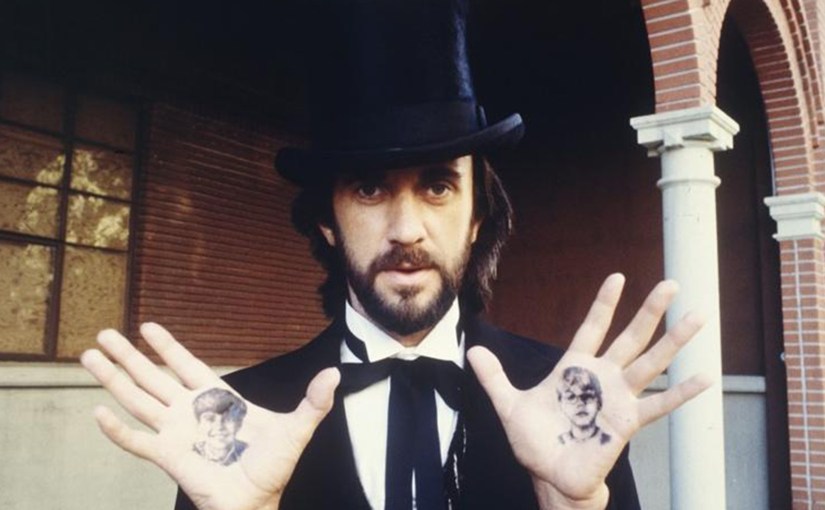
Something Wicked This Way Comes answers the question: What would the Disney version of Needful Things (1993) look like?  Instead of the Devil opening a curio shop in the middle of town, we get a malevolent carnival impresario, Mr. Dark, and his devilish carnival that promises delights beyond your wildest dreams.  But beware, for the price of having your wish granted comes straight out of The Twilight Zone.

And no wonder, the screenplay was written by Ray Bradbury, based on his novel.  Too bad the movie fell victim to studio interference, resulting in jarring tonal shifts, some awkward edits, and two re-shot scenes where the two child stars are clearly a year older and a year taller than they appear elsewhere in the film.

The movie starts out as feel-good Americana, right out of Normal Rockwell: a small midwestern town in what looks like the late 19-teens or early ‘20s, complete with a town square, a general store with the obligatory cigar-store Indian out front, and a friendly bartender with one arm and one leg.  We are introduced to Will and Jim, our two child protagonists, and Will’s father, Charles (Jason Robards), who looked to old to have an 11-year-old son in 1968, let alone 1983, but whatever.

So, there’s that part of the movie, where it looks like it’s going to be a gentle fantasy like Field of Dreams (1989) or something, with the background score to match…but then really weird things start happening.  A local eccentric vanishes after seeing a ghostly woman inside a funeral parlor.  Mister Dark’s Pandemonium Carnival opens just outside of town.  We watch as the local miser takes a ride on the Ferris Wheel with a beautiful woman…but she’s the only one who gets off the ride at the end.  The disabled bartender sees a marvelous reflection in the House of Mirrors and walks in…but never comes out.  Our two heroes, Will and Jim, witness something incredible when they peek under the big top at a broken-down carousel that only runs in reverse…

And so on.  I’ve seen umpteen versions of this story, and so have you.  It can be done well, but it takes a singular vision.  Watching this movie felt like someone spliced two films together and hoped no one would notice.  First of all, who in their right minds casts Pam Grier as a non-speaking character called The Dust Witch?  Granted, she’s a looker, but you don’t cast Pam Grier in a movie just because she’s beautiful.  You gotta give her something to do besides seduce men and stare menacingly, which, granted, she does better than most, but what a waste!  I wanted to hear her vow to bring the powers of darkness down upon your village in a fiery rage, or something, I dunno, anything.

But that’s a side point compared to the horrors awaiting our heroes.  In a scene right out of your nightmares, our two heroes are faced with an army of tarantulas in their bedrooms in the middle of the night.  So many tarantulas, in fact, that in one horrifying moment, you can see the bedsheets moving from the sheer numbers of arachnids under the covers.  (This was one of those re-shot scenes where the kids are a year older.)  Much later in the film, Mr. Dark grips someone’s hand so hard that we see the victim’s hand literally splitting open – in a VERY brief shot, mind you, but there is no question of what has happened, as the victim wears a bandage on that hand for the rest of the movie.

What is this horrific material doing in a Disney movie, for crying out loud?  Something Wicked This Way Comes arrived during a transitional period for Disney, when they were testing the waters with more adult-themed fare – The Watcher in the Woods had been released a few years earlier, and Touchstone Pictures was on the brink of breaking out with Splash (1984).  But when it came to this weird hybrid family/horror movie, they got a little gun shy.

According to the invaluable IMDb, after a poorly-received test screening, Disney execs delayed the film’s release for a year so the film could be re-edited, an opening narration could be added, additional scenes could be shot and old ones replaced, and an entirely new score could be composed by maestro James Horner.  In their attempts to make the movie more family-friendly, they were the embodiment of the axiom “too many cooks in the kitchen.”  On an early laserdisc commentary, Ray Bradbury stated that much of his original intention for the film was destroyed as a result of these after-market edits.

There is a really, REALLY good movie trapped inside the existing version of Something Wicked This Way Comes.  Watch the movie, and you can see that really good version peeking through here and there (it feels like there was a LOT more that could’ve been done with Jonathan Pryce’s rendition of Mr. Dark).  As it is now, the movie is little more than an object lesson on why so many directors dream of getting “final cut” in their contract…so something like THIS doesn’t happen.

CRIMSON TIDE

By Marc S. Sanders

A little over a year ago, having just seen Christopher Nolan’s Oppenheimer, I shared with friends how it is sadly surprising that a nuclear weapon has not been launched by a super power country since the bombs were dropped on Hiroshima and Nagasaki.  Those two bombs certainly served their purpose in response to the Pearl Harbor attack of 1941.  I deem it sad that any of us consider this a possibility that can easily be repeated. With all of the threats that continue worldwide with weapons testing, technological advancements and arms trading, it’s frightening to wonder what can ever be expected. Is it easier to execute a command like that again, now that it has been done?  It’s got to be a little surprising that the United States did not respond that way following the 9/11 attacks.  Tony Scott’s Crimson Tide comes close to providing an answer by weighing sound vs unsound reasoning. 

This is not only my favorite of Tony Scott’s films, but the movie also offers maybe my favorite performances from Denzel Washington and Gene Hackman.  The two actors of different generations are equal in measure as they debate what should be done, along with how the submarine they command, the U.S.S Alabama, should respond while in the midst of a revolutionary conflict stemming out of Russia.  

Washington is Commander Hunter, recruited at the last minute to serve as the Executive Officer aboard the Alabama.  Hackman is Captain Ramsey who proudly leads the charge of the sub with an intimidating welcome to Hunter.  Before any kind of real conflict comes their way, Ramsey puts Hunter to the test.  An uncomfortable dinner conversation, wisely written by Robert Towne (Chinatown), has the Captain question Hunter’s stance on using nuclear force to deliver a harsh defeat to the enemy.  Hunter’s position though is the real enemy is war itself.  Ramsey and his commanding staff have no reply to the new member’s observation.

Another moment occurs when Ramsey orders a missile launch drill while Hunter is assisting with containing an on-board fire in the galley.  The Captain has his reasons that Hunter cannot truly debate. Besides, Ramsey precisely tells his XO to “bite (his) fucking tongue,” even if he doesn’t agree with him.

The centerpiece of the officers’ conflict arrives when they receive a fractured message from command.  Ramsey’s instinct is to launch missiles at Russia based on the presumption that the Soviet rebels have overtaken the country’s arms.  Though Hunter cannot deny the concern, he will not agree to a missile launch until they receive the entirety of the broken order.  This occupies the second half of the film, and it becomes a back-and-forth mutiny of power.  The Captain is relieved of command but then retains control and the crew is divided between the leaderships of these two characters.

Having recently seen and reviewed the submarine classic Das Boot, it’s fair to say that film feels much more authentic and maybe it should be much more tense than any other movie of its kind.  Crimson Tide is glossier with outstanding interior cinematography on a studio constructed set designed to tilt like a maritime vessel should.  The dashboards and colored lighting are fancier.  The cast is good looking as Tony Scott obtains close up shots of them beaded in glistening perspiration with no facial hair.  Crimson Tide is definitely a Hollywood picture.  However, the screenplay from Michael Schiffer is razor sharp with not one wasted piece of dialogue.  In addition to Robert Towne’s contribution, Quentin Tarantino also script doctored a portion of the piece as well which includes a well-placed Star Trek allegory. 

There’s a jolt of energy to Crimson Tide that Das Boot has at times, but because of the latter’s three hour plus running time it also slumbers like life should while living on a submarine.  It is the theatrics of Crimson Tide that hold my attention on many repeat viewings.  I’d never want to question a guy like Captain Ramsey, but I’d be grateful that someone like Commander Hunter is around to stand in protest.  

I wish Gene Hackman and Denzel Washington had done another film together.  Their conflicted chemistry is second to none.  You like them both equally in the scenes they share together, or individually.  The timing of their tempos is perfect.  They find just the right moments to be alarming in a quiet way and save other opportunities for shocking outbursts.  The best actors practice their scripts this way and avoid any traps of overdramatizing.

Tony Scott made this film before his penchant for chaotic angles and grainy captions took over much of his other films to come hereafter.  Crimson Tide is cut perfectly from one scene to another with outstanding colors of blue, red and green lights that illuminate the cast while they stand at their posts.  Washington, Hackman as well as a sensational supporting cast (Viggo Mortensen, James Gandolfini, George Dzundza, Steve Zahn, Matt Craven, Lillo Brancato) do fine work and respond beautifully to the director’s camera positions. 

It’s impossible not to feel the tension accompanied with the progression of this film.  It serves as a motivation to wonder if we act on what we know or don’t act on what we don’t know.  As taut and dramatic as Crimson Tide is, you find yourself considering if those with access to the real-life red button consider all that could come of their decisions.  

Crimson Tide may tidy itself up after two hours, but the movie still makes me ponder if this planet’s military forces are thinking each and every day about if we are preventing nuclear war or if we are on the cusp of waging a nuclear holocaust.

This is one of my most favorite films. 

MAX DUGAN RETURNS

By Marc S. Sanders

Max Dugan Returns is one of those delightful films where the smile never leaves your face.  It’s a cozy, rainy Saturday afternoon with your favorite pillow and throw blanket.  The characters are whimsical, and they simply feel like good, good friends you would love to have in your life.

Nora McPhee (Marsha Mason) is an overworked, underpaid high school English teacher who is drowning in debt with a broken refrigerator and a car that is as ugly as it sounds on the road.  Her fifteen-year-old son Michael (Matthew Broderick, in a sensational on-screen debut performance) is a good kid, but she’s worried he’s getting too involved with the drug dealers that roam his school.

After her jalopy of a car gets stolen, the only positive that comes upon her is in the form of Donald Sutherland as a cop named Brian.  After he lends her his motorcycle to get around, there’s an immediate attraction, but it could not happen at a worse time.

Nora’s father, Max Dugan (Jason Robards), who abandoned her at age 9 arrives on her doorstep in the middle of a rainy night with a business proposition.  Now that his doctors have informed him he has six months to live, he would like to provide Nora and Michael with the six hundred thousand dollars he’s towed with him in an attaché case.  In exchange, he only wants to spend time with his grandson.  Beyond the animosity she’s held for Max, what alarms Nora is that her father stole this money from a Vegas casino.  He claims the mob stole the money from him first.  She doesn’t want the money; not with Brian the police officer in her life and she does not want to be affiliated with Max’ criminal past or associations.  Not to mention there would no way to explain this sudden windfall based on her minimal teacher’s salary.  Max won’t go away so easily, though.

Thus, the theme of Max Dugan Returns is one scene after another where a hoard of luxurious items arrive on the McPhee’s doorstep.  New appliances, new jewelry, new furnishings, fresh groceries, electronics for Michael, a Mercedes, and a thoroughbred dog named Pluto – I’m sorry.  Plato!

It’s impossible not to love this movie.  It is one of the few films that Neil Simon wrote directly for the screen.  It is so much fun though, that I think it would work marvelously as a stage play.  The story may not be grounded in reality, but Simon’s dialogue is so quick and sharp and a better cast could not be found to deliver Neil Simon’s wit.

Mason, Robards, Broderick and Sutherland have pitch perfect chemistry with one another.  These actors are so absorbed in their characters, and it makes sense.  Matthew Broderick was personally selected by Neil Simon to do his biographical play, Brighton Beach Memoirs.  Marsha Mason did five of Simon’s adapted films while she was married to him.  (They divorced shortly after the release of this picture in 1983.)  Jason Robards has an affectionate gravel to his voice – one of the best voices in film next to James Earl Jones. Robards is just so appealing as he playfully conflicts with Mason on screen while connecting with Broderick’s character under a different identity.  It’s important Max maintains a low profile.  Donald Sutherland is the straightest character in the picture.  He has a relaxed manner to him that’s found often in Neil Simon’s scripts (unless you’re a Nora McPhee or a Felix Unger).  In another actor’s hands, this would be just a walk on role, but with Sutherland on screen, you are satisfied to watch another winning performance from this actor with a relaxed stature and a genteel way about him, as his detective suits and ties hang loose on his shoulders.

Max Dugan Returns is an enchanting fantasy without the overt fantasy.  It never needed unicorns or lovable elves to deliver its magic and whimsy.  I did notice a collection of rainbows –  easter eggs hiding in plain sight, however.  Are pots of gold to be uncovered? The film asks what would happen if your long-lost father showed up on your doorstep with a suitcase full of money and a treasure trove of gifts to bestow upon you. 

Hey, it could only happen in the movies.

PARENTHOOD

By Marc S. Sanders

Once you’re a parent, you’re always a parent.  You’re also always a child to someone.  No matter if you are close with your mom and dad, or estranged and not on speaking terms, or your parents have passed on, you are always a child to someone.  Parenthood from 1989 demonstrates that you never clock out from being a parent or a child.

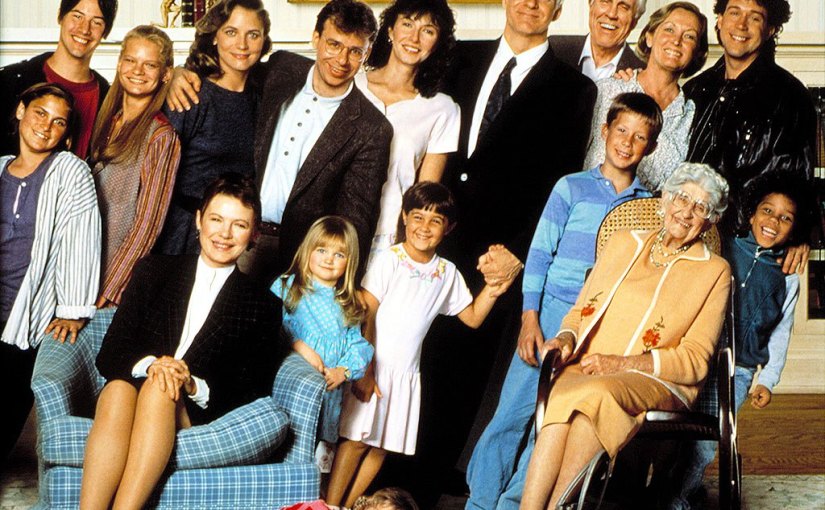
The Buckmans consist of four adult children portrayed by Steve Martin, Dianne Weist, Harley Kozak and Tom Hulce. They all got little ones to tend to with respective partners (Martin with Mary Steenburgen, Kozak with Rick Moranis and the other two are currently on the single status).  Their parents are portrayed by Jason Robards and Eileen Ryan and even the generation before them is represented by Helen Shaw.

With a cast of characters this large, there are various storylines and dynamics of raising and supporting children to go around.  Each child, or in other words, each parent has daily struggles to deal with.  The nuclear family of Steve Martin and Mary Steenburgen’s is given the most attention when it is uncovered that their eldest child of three is struggling with anxiety.  Elsewhere, Robards finds himself trying to rescue his immature, lying twenty-seven-year-old son, Hulce, from gambling addiction and debt.  Weist is doing her best to survive a sexless life after her letch of an ex-husband has left her to deal with a daughter (Martha Plimpton) pregnant and married to a stock-car racing airhead (Keanu Reeves) and a quiet, distant teenage son (Leaf, later known as Joaquin, Phoenix).  Kozak’s storyline really belongs to Rick Moranis as her genius, nerdy husband determined to raise their three-year-old daughter as a virtuoso prodigy.  Kafka is a bedtime story.

Wow, that’s a lot of baggage to unload in two hours’ time.  Yet, it works so efficiently in a film directed by Ron Howard.  I’ve used this compliment before, but it bears repeating.  You can write a full-length screenplay about any one of these characters.  I guess that is the goal you strive for when you produce a film featuring an all star cast filling the slots of a large collection of characters.  A film like Boogie Nights and Love, Actually accomplishes this feat so well.  Parenthood just the same.

Favorite moments for me occur with Jason Robards’ character.  It is evident that he was not the best father, particularly to Martin’s character, and his admiration is likely misdirected towards the kid who hasn’t made the best choices in life, played by an aloof Tom Hulce.  I really like the story arc of Robards and Hulce’s relationship when the truth rests like an ugly slime on the surface that just can’t be filtered away.  Suddenly, a man prepared for retirement and rest, has to acknowledge that his adult son needs help but is he worthy of support and love any longer?  This movie is arguably not even the highlight of Jason Robards career, but you can not deny what a gifted actor he was.  His timing and delivery are so recognizable as a hard-edged retiree parent.

Dianne Weist, the only cast member to be nominated for an Oscar for this film, has a couple of good storylines as well.  Much of her performance stems from all too common drama where a spouse leaves her and abandons any relationship he had with their children.  It’s so unfair for the child.  It’s hard on the mother who has to maintain a career while raising teenagers who are entering a new phase with regards to love and sex.  Plimpton gets into an argument with Reeves, her boyfriend, and Weist starts to swat him away.  Then Plimpton unexpectedly announces they just  got married and Weist turns to swatting Plimpton.  Weist is funny while the material holds dramatically.  It’s a real nice balance.  

Steve Martin has a good storyline as well.  He’s a hard working white collar executive who wants to prioritize attention for his son though it kills him to lose out on a promotion he knows he’s entitled to.  At the same time, he battles with how his own father (Robards) treated him at a young age.  He makes sure that his son’s birthday party is the best.  He encourages the boy to play second base on the little league team.  He attempts to do everything denied of his own childhood for his son, now.  Still, it’s not enough.  Parenthood can often feel like a winless battle. 

Martin also has good scenes with Steenburgen, and they remind me of my relationship with my wife.  She’s the sensible one.  I’m the one who gets trapped in insecurity and anxiety and low self esteem as a worker, a friend, a husband, and especially as a parent to our teenage daughter.  I excel at taking care of the bills though. 

Why am I making this personal all of the sudden?  Well, perhaps it is to call out the true nature of family and marriage that exists within the script for Parenthood, written by Babaloo Mandell, Lowell Ganz and Ron Howard.  There are some moments where Martin’s character daydreams of scenarios for his son.  One time the boy becomes a valedictorian with a speech offering complete recognition towards his father.  In another moment, he’s a rooftop sniper blaming dad for making him play second base and missing the game winning out.  When I get trapped listening to the thoughts in my head, I envision what could be.  More often than not I’m predicting dread, which almost never arrives.  Yet, I believe parents yearn to raise the perfect child that they never were.  It’s an impossible stretch.  I write that here and now, and still, I’ll try and try.  So what, though! While I’m working for perfection and absolute happiness for my daughter, I must remind myself that my efforts are contributing towards a successful path for her full of fulfillment and happiness.  More importantly, while at least half of my efforts could lead in failure on my part, my intentions are always done with absolute love and care for her.  That’s what I see in the here and now.  I’m blessed. My whole family is blessed.  So many families have it so much worse and I wish them well.  I have to remind myself not to take what I have for granted.

Ron Howard’s film is not entirely perfect.  I could have done without some of Steve Martin’s recognizable schtick from his stand-up routines.  I always like his material.  I just think some of it doesn’t belong here, the same way Robin Williams would let his known antics creep into some of his films.  Some scenes are also spliced into the film jarringly, like when a dentist’s office is suddenly vandalized.  Thematically, these break away moments should have remained on the editing floor.  Fortunately, the movie isn’t anchored by these plot points for too long.

There’s much to relate to with Parenthood.  Kids who gleefully sing about diarrhea, to parents mired in regret and doubt.  Teenagers who think they have found love to the absence of father figures.  Grown-ups who just haven’t grown up and parents who are just getting a little too ambitious in their child’s upbringing.  This is not a film, necessarily about the love a parent has for a son or daughter.  Rather, I appreciate how it questions the role these characters serve towards their fathers, mothers and children. 

Love is only one dynamic in fatherhood, motherhood, and childhood.  Parenthood focuses on everything else.

MAGNOLIA

By Marc S. Sanders

Ernie Anderson was the cool voiceover for the ABC television network that would introduce upcoming programs for years. He was a staple of the television industry from the 1970s through the ‘90s. I promise that you or your parents know his sharp, recognizable tempo. So, it makes sense that his son Paul Thomas Anderson would center his multiple story crossover film Magnolia around the television industry, within a 10-block radius in the Hollywood Area. Magnolia presents the off-chance coincidences that somehow happen and the unusual phenomena that can occur when never expected.

Anderson’s three hour epic offers storylines centered around former and present day game show quiz kids (Jeremy Blackmon, William H Macy), the game show host stricken with cancer (Phillip Baker Hall), the drug addicted daughter he’s estranged from (Melora Walters), the dying game show producer (Jason Robards), the producer’s son who is a motivational speaker for men to sexually conquer women (Tom Cruise), and the producer’s gold digging wife (Julianne Moore).

Because the narrative of the film has a biblical theme specifically referencing Exodus 8:2, there are also two good natured guardian angels involved. John C Reilly as a sweet but clumsy police officer proud of his work, and a sentimental hospice nurse played beautifully with bedside sympathy by Phillip Seymour Hoffman.

Anderson’s film opens with three stories of random coincidence that resulted in the deaths of three different men. More than likely most people would say these tall tales of legend could only occur in a movie. Yet, the voiceover narrator , Ricky Jay, says they did not, and thus begins one specific day with torrential downpours of rain, where all of these random characters will come in contact with a personal experience of monumental impact that will change their individual lives forever. Oddly enough, all these people are somehow connected to one another and are within blocks of each other located near Magnolia Blvd in the Hollywood Hills.

Like Boogie Nights, Paul Thomas Anderson directs a film of very weighty emotions that thematically focuses on the sins of fathers that carried over to the futures of their children. The game show is titled “What Do Kids Know?” which likely symbolizes what they didn’t know while at the behest of their parents during their youth. What they know now about their fathers is a burden to bear in insecurities, drug abuse and outright cruelty for the opposite sex. Every character represents some aspect of this ongoing theme during Magnolia. It’s a lot, a whole of information, but fortunately it moves at a very swift pace with an energetic steady cam and dramatic notes of instrumental soundtracks.

Anderson consistently shows different references to Exodus 8:2 by either using the numbers in clocks or decks of cards or temperature readings of the weather or on marquee signs. It’s almost like a scavenger hunt when seeing the film on a multiple viewings.

MAYBE A SPOILER ALERT:

“But if you refuse to let them go, behold, I will plague all your country with frogs.”

Sure. Most recognize the Bible verse as Moses’ decree to Pharaoh to release the Jews from Egypt. I like to think Anderson used Magnolia to release his beloved, but damaged, characters from their own sins or the sins of their fathers. Set them free even if it could be by means of confession, judgment, offering and begging for forgiveness, or journeying towards a personal salvation.

The smart device that Anderson uses is the angelic music of Aimee Mann. Often I talk about how I love when film characters would spontaneously dance. In Magnolia, the cast surprisingly breaks into song with Mann’s confessional number entitled “Wise Up.” It more or less summarizes each individual plight that all the various characters must endure. Magnolia is only an even better film because of Mann’s music.

Magnolia is a beautiful film that I draw many personal parallels from, especially having now lost both of my parents and being by my father’s bedside during his difficult final days of illness.

It is very touching, sometimes funny, and sometimes a difficult film to watch with a belief in random coincidence that is only stronger after watching it.

Like the film insists “we may be through with the past, but the past ain’t through with us.” After Magnolia finishes, you won’t be through with Paul Thomas Anderson’s film. It’s a film that will stay with you.

ALL THE PRESIDENT’S MEN

By Marc S. Sanders

People talk too much.

Ten minutes into Alan J Pakula’s film, that’s all I can think about. William Goldman’s dialogue heavy script pounds away at depicting Washington Post reporters Carl Bernstein and Bob Woodward’s uncovering of the Watergate break in, and it shows that simply, people talk too much. So much so that just a stutter or a name in passing conversation will dig the hole deeper and deeper towards self-incrimination, and that of other accomplices. Once a source trips up, then a good reporter can pounce.

Names, dates, slamming doors, rotary phones, typewriters and papers fly fast and furiously during Pakula’s film and that’s what upholds the breakneck pace of the investigative journalism. In a film like this, a crime is depicted and investigated, only the words are the real weapons.

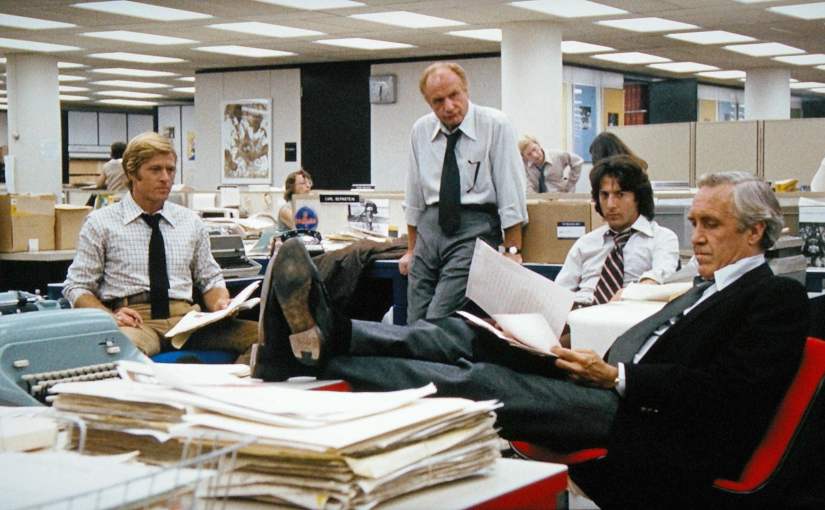
I don’t find All The President’s Men to be a history lesson in the corruption of Nixon’s administration. Rather, I only see what was necessary for Woodward & Bernstein to truthfully prove the corruption took place. The reporters, played by Robert Redford and Dustin Hoffman, seem to run on endless adrenaline of coffee, cigarettes and fast food effectively showing their drive while donning loose ties, wrinkled shirts, and crumpled notepads amid unkept desks and apartments. It’s visually convincing. A story like this doesn’t sleep, nor does it take a vacation. A story like this makes a viewer feel like he/she is still up at 2am, catching a cab to meet a shadowy source in a haunting parking garage; thanks Hal Holbrook for Deep Throat (“Follow the money.”).

Redford has a great scene where Pakula never stops running the camera on close up for over six minutes. All that Redford is doing is dialing, and talking on the phone while maintaining two different conversations. I don’t know if this moment happened in real life but I imagine the best reporters in a pre internet phase had to hold out for opportune times like this to fall into their laps. The cut does not end and Pakula was instinctively wise to do that. The scene itself serves that harrowing pace. Less is more in a moment like this. Props to Redford for maintaining the statuesque momentum.

Equally so, Hoffman has a couple of good moments with Jane Alexander (his eventual costar in Kramer vs Kramer.). She beautifully depicts a victim of intimidating threat, and Hoffman must tread carefully with his questions by strategically letting himself into her home, puffing on a cigarette, sipping cold coffee, speaking softly and eventually getting out his notepad as she gradually breaks down her shell. Alexander doesn’t make it easy and so their scenes work so well in taut suspense of low whispers.

Nixon’s cohorts really are not the antagonists here. In essence, Goldman’s script (based on the reporters’ published book) welcomes the challenge of acquiring factual reporting as the overall conflict. This is best represented by Jason Robards’ portrayal of Post Editor Ben Bradlee. Robards won an Oscar, and he so deserved it. He wouldn’t give “Woodstein” a break until the truth willed itself out by the proper means that are necessary. He’s intimidating in the role but he’s open minded enough to not ignore the young reporters’ instincts. I love watching his scenes; the way he commands an office from a chair with his feet up or fidgets and writes with his red pen. When his boys finally get a solid piece, Bradlee’s character breaks for one moment to knock on a desk and clap his hands as he walks away from his men. They got it. He didn’t relent, and they finally got it. I love that moment. Simply marvelous.

All The President’s Men remains a favorite film of mine. The dialogue moves so fast that after seeing it a number of times I still haven’t connected all the dots, and yet that’s what I appreciate about it. I see something new every time.

PHILADELPHIA

By Marc S. Sanders

Tom Hanks most certainly deserved the first of his two Oscars for his portrayal of Andrew Beckett, one of the first protagonists to be an AIDS victim on screen in Jonathan Demme’s 1993 film, Philadelphia. Its a good film but not a great film.

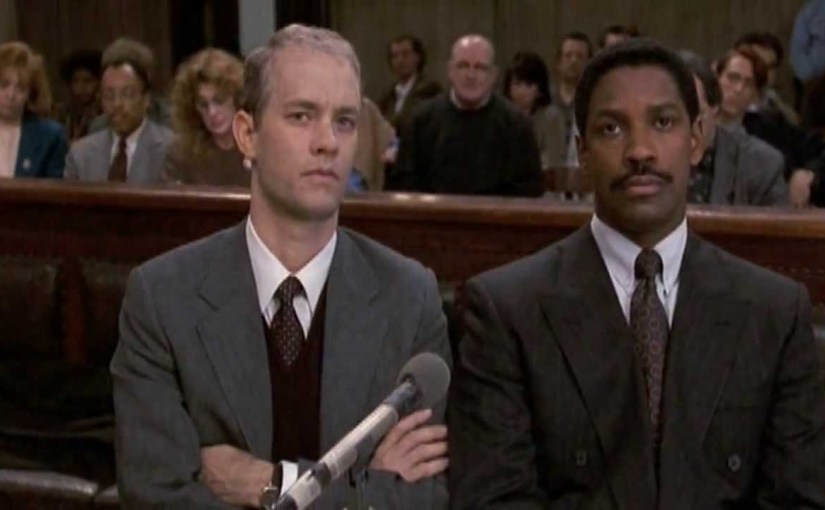
I recall seeing Philadelphia when it was originally released. Seeing it today, my opinion hasn’t changed. I don’t believe the film takes enough risks and the script from Ron Nyswaner is too cookie cutter and simple. Beckett hires Joe Miller (Denzel Washington) to represent him when he proceeds to sue the law firm who wrongfully fired him for having AIDS, and most likely being gay as well. The argument hinges on proving that having AIDS is a handicap that never interfered with Andrew’s work performance. Andrew is clearly made out to be the firm’s best of the young attorneys when he’s assigned their biggest client. Nine days later he’s sabotaged, and soon after he’s fired for an attitude problem and carelessness. Eventually, Andrew and Joe assemble, despite Joe’s prejudices against homosexuals.

The trial, Andrew’s struggle of living with AIDS, and Joe’s own inner debate with associating and defending a homosexual, AIDS victim are the three main storylines.

The first storyline is the best. Demme does a masterful job of showing the evolution of the disease. Andrew could be looking at papers on a desk and when he turns his head, a lesion appears on his neck. Makeup artists Carl Fullerton and Alan D’Angerio deservedly were Oscar nominated as Hanks’ appearance seems to change from one scene to another and another. He’s thinner in one moment with very fine ash gray hair. In another scene, he’s got a full head of hair with an energetic way about him. I cried for Andrew’s deterioration. Hanks and Demme carry that aspect very, very well. The actor does great work of changing his voice when he’s fighting a cold with a terrible cough or evoking massive weakness. As the film progresses and Andrew gets sicker, he’s incredibly pale with a droopy eye. The makeup artists tell the story with Hanks’ performance and Demme’s direction.

The 2nd and 3rd storylines don’t offer much of a challenge. The law firm primarily represented by head partner Jason Robards is too easily “evil.” There’s no subtlety here. Robards gets right in the face of the film – “Andrew brought AIDS into our office.” A better script would wait for the bad guys’ momentous third act Freudian Slip. This case was unchallenging really. It was too easy to win. Especially true considering this great and powerful law firm hires Mary Steenburgen as defense counsel. Steenburgen plays her part very mousy and unaggressive though. This case is too lopsided and uneven and I just couldn’t get past that.

Joe’s own reservations are too apparent as well. He’s meant to represent those that simply never understood the mentality of gay love, nor the scientific evidence of the AIDS virus. He rushes to his doctor following an initial meeting with Andrew. Demme does an extreme close up of this doctor to teach the audience the basics of AIDS. This guy is right in your face with his dialogue. I didn’t care for moments like this. Too patronizing.

A side story attempts to show the intimate relationship of Andrew with his boyfriend Miguel (Antonio Banderas). I still feel the same about this part. The script holds back. Hanks and Banderas give each other “bro hugs” and kisses are done on the bottom cheek. Back in’93, filmmakers were not prepared to go all the way with depicting the true nature of homosexuality. I found it insulting. You finally want to make a film that shows AIDS and homosexuals at the forefront but you stop short at the finish line.

Ironically, Joe has a repetitive line “Explain this to me like I’m a 4 year old…” Demme adopts that method throughout the film with major “in your face” close ups to glaringly make the beliefs of what any character values or has to say as obvious as possible. I felt as an audience member that Demme didn’t have to take it this far. I get it. You don’t have to be THAT FORTHRIGHT.

Washington is a great actor as always. He’s likable even if he’s tripped by the fault of misunderstanding. His “TV GUY” ambulance chasing lawyer is comic relief at times within a film of very heavy subject matter.

Demme’s filmmaking does make some wise choices despite some of my issues. The opening credits offers a lot of footage of the city with people carrying on their daily lives while waving to the camera, selling fish at the market, street dancing, etc, all accompanied by Bruce Springsteen’s sweet, yet haunting theme “Streets Of Philadelphia.” I like this opening as it shows what we see on the surface of the people we live with does not necessarily reveal the struggle any one of us might be enduring. This is a moment where the script is not so easy to grasp. There’s a challenge to accepting Demme’s footage blended with Springsteen’s overture.

Jonathan Demme is a good director, who is sadly no longer with us. I appreciate Philadelphia for showing the illness but not much else. It’s a film that should be seen. I’d argue most would embrace more of the movie than I did. I just felt the envelope could have been, actually should’ve been, pushed further. It was too careful with its subject matter.

A great observation though was recognizing the many faces that appear in the film from Demme’s other film, The Silence Of The Lambs. As well as naming Joe’s baby daughter “Clarice.” I also recognized an identical tracking shot that Demme offers. When Joe goes to visit Andrew in the hospital, it is a shot for shot remake of the tracking movement when Clarice goes to visit Jack Crawford in his office, at the beginning of Lambs. This might not be original, but I had fun recognizing it, nonetheless.