NIGHT MOVES

By Marc S. Sanders

As soon as composer Michael Small’s easy listening disco themes kick in and you see Gene Hackman make a u-turn in his green Ford Mustang convertible, I had vibes that Night Moves was going to operate like an episode of The Rockford Files.  I was alert and energized.  I liked where this was going.  A new, undiscovered gritty 70s movie to sink my teeth in.

Gene Hackman is Harry Moseby, a perfect name for a private detective.  Arthur Penn is the director in his second of three collaborations with the actor.  The film starts off well for Harry.  He’s giddily promiscuous and happily married to Ellen (Susan Clark), and he’s ready to take on a new case. 

A Hollywood has been actress needs Harry to find and bring back her sixteen year old, runaway daughter named Delly (Melanie Griffith, in her debut role).  Through a lead in the form of a young, punk kid (James Woods, in an early role), Harry flies out to the Florida Keys where Delly might have taken up with her step father.  

Seems easy enough, but before he departs Harry does some personal investigating on the side and discovers that Ellen is having an affair with a guy named Marty (Harris Yulin).  Harry’s carefree exterior is shattered.  Quickly, he becomes bitter towards all he cared about, from his wife and his profession which serves a purpose of lifting the veil on sins and secrets.  

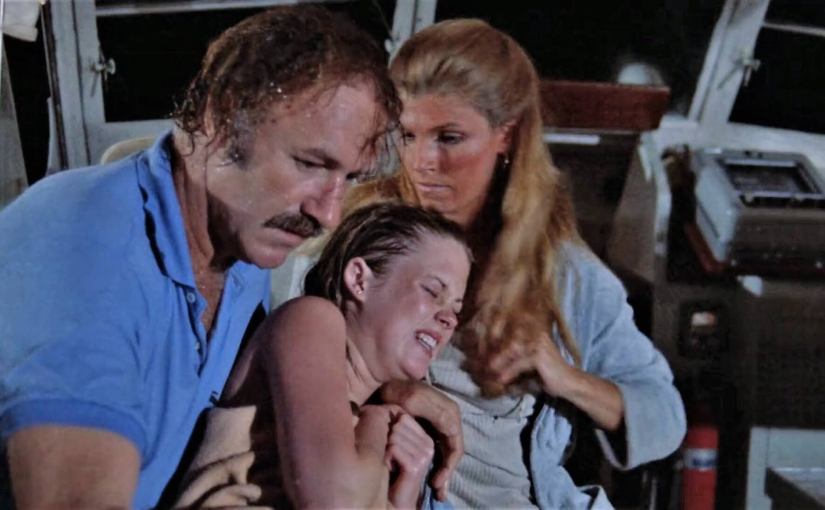
Night Moves performs with unpredictable directions and tempos.  When Harry finds Delly with her step father Tom (John Crawford) and his younger girlfriend Paula (Jennifer Warren), the rundown boat dock where they reside seems relaxing and tranquil.  Paula tends to a dolphin pen.  There’s a plane that Tom uses for shipment trips.  Drugs?  Harry is not all that concerned.  He’s only here to pick up Delly.  A boat is there for fishing and swimming off of too.  Delly feels welcome and independent here.  Though as a teen she’s resistant to Harry’s obligation to return her to her mother in Los Angeles.  

It’s only after he wraps up the case that unexpected twists occur and now he’s got to backtrack to find out what is really going among the ranks of these folks.  In parallel succession, Harry and Ellen have to wade through their own sordid conflicts.  

Watching the Criterion issue of Night Moves was really interesting.  After seeing the film, I watched two different interviews with director Arthur Penn.  There are lots of discoveries to find in the film all the way down the very last frame of the picture.  However, the revelations of the mysteries are not told but rather shown.  Dialogue hardly spells out this story.  It’s what Arthur Penn allows you to see.  He described it as explaining through a lens or view from a window, for example.  As Penn speaks, Criterion edits in quick moments where mirrors and windows that were woven into the final cut of the film provide new information and answers.  It’s a very clever strategy.

The sinister happenings of Night Moves are undetectable until Harry gets wise.  It made me think of what Jake Gittes experiences in Chinatown.  The new assignment seems so easy.  An open and shut case until the complexities surface from under water or even high above.  

What separates Night Moves from the Mickey Spillane gumshoe stories or Chinatown and The Maltese Falcon for example, is that Harry Moseby’s personal hell interferes with an occupation where he’s meant to serve from outside of all of the sordidness.  Harry won’t slack on his case, but he still has to grapple with a sudden broken marriage that he is so capable of uncovering from his wife and her bumbling lover.  He’s not a loner like Sam Spade, Jake Gittes or Mike Hammer.  He’s opted to open his own private practice and dig into others personal conflicts and misgivings.  On the side, he wants a happy home life.  Problem is he is just too damn good at what he does.  So, he’ll get hurt.  It’s the cost of his talents.

This is a great performance from Gene Hackman.  He seems like a put together Jim Rockford in the form of James Garner.  Yet, when the film steers into the tsunami of its conflicts, this character splinters apart.  Hackman has always been good at evoking strength and confidence in the romances and adventures his characters get into as well as with their various occupations.  He’s also a dynamo at showing how his characters crack and become undone (Crimson Tide, The Conversation, The French Connection).  

The supporting cast of lesser known but familiar character actors are collectively stellar as well.  Sharing scenes with Hackman only makes them look more engaging and natural in either their privileged Hollywood, California habitats or the earthy locales of Florida islands.  Arthur Penn assembles this whole cast in great footage and sequences.

Whether it’s a trip to Florida or back to California, a late night personal stake out and break-in at an ocean beach house, a visit to a film set, or a moonlit boating venture in the Keys, Alan Sharp’s script never foreshadows what’s too come.  Thus, Night Moves offers a verity of the sinister and complex.  Just when you think you don’t need to carry much thought with the picture, it suddenly begins to challenge you.

Night Moves will have you believe it gets its title from how Harry plays the strategies of two celebrated chess champions against one another.  He explains to Paula, that while it may seem that the players are three moves ahead of each other, they’re really not.  Instead, there’s play going on beyond a standard trap of check or checkmate.  When everything is laid out to the very last second, it all makes sense even if Harry never had the instinct to think of any likely scenario before.  

Was I a little vague with you just now?  

Good.  

That’s how Night Moves serves its audience best. A stunning, unpredictable thriller.
TRUE BELIEVER (1989)

by Miguel E. Rodriguez

DIRECTOR: Joseph Ruben
CAST: James Woods, Robert Downey Jr., Margaret Colin, Yuji Okumoto, Kurtwood Smith
MY RATING: 7/10
ROTTEN TOMATOMETER: 96% Fresh

PLOT: A cynical former civil liberties attorney, now reduced to “specializing” in defending drug dealers, becomes transformed by an eight-year-old murder case.


I don’t know if True Believer counts as a “forgotten” film in today’s world, but it’s certainly not a movie that I hear mentioned anymore.  Directed by genre-hopping journeyman Joseph Ruben, whose films are more recognizable than he is (Dreamscape, The Stepfather, Sleeping with the Enemy), and anchored by James Woods and Robert Downey Jr., True Believer is a solid entry in the crime/courtroom drama/thriller arena, at least in broad strokes.  However, there are momentary lapses of logic that strain credulity, and despite the momentum of everything around them, they were enough to affect my opinion/impression of the movie.

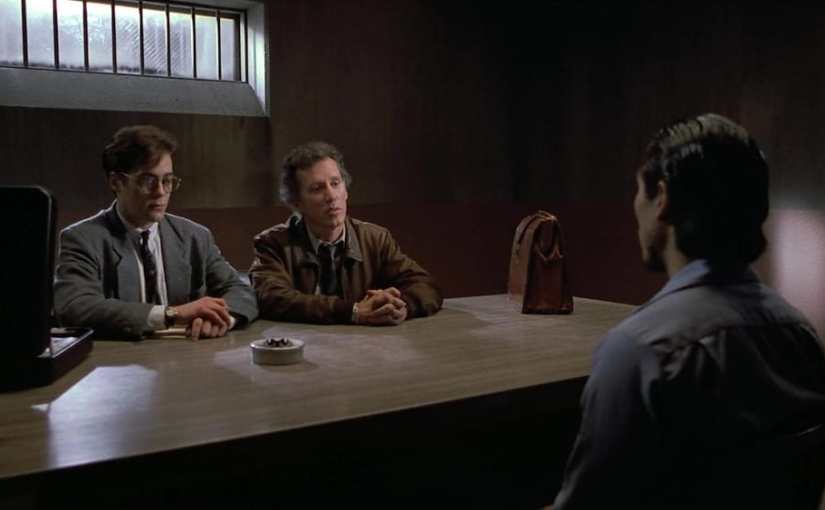
After a flashback and prologue that introduces us to his future client, we meet Eddie Dodd (James Woods), a fiery former civil liberties attorney who once defended Black Panthers and other social revolutionaries in the 1960s.  Now, at the tail end of the ‘80s, in the waning days of the “Me Generation”, he specializes in defending drug dealers and/or distributors under the guise of painting the government’s use of wiretaps and undercover agents as invasions of privacy…a shabby attempt at investing his sleazy client list with some sort of social nobility.  Into his life comes an aspiring attorney, Roger Baron (future Oscar-winner Robert Downey Jr., looking fresh and innocent during what must have been one of his infamous rough patches).  Roger idolizes the old Eddie Dodd, the idealist, and is severely disillusioned by the current Eddie, the opportunist.

Things change, though, when a Korean mother and daughter track Eddie down and ask him to defend their son and brother, Shu Kai Kim (Yuji Okumoto, The Karate Kid Part II, Better Off Dead), who is eight years into a prison term for a murder they say he didn’t commit.  The daughter says she tracked him down by going to all the courthouses: “They all speak of you, and they all say the same thing…you do cases cheap.”  He dismisses them with a vague promise to “review the material,” but after some predictable prodding from Roger, his new conscience incarnate, he takes the case.

What follows is a well-directed, well-paced mystery-slash-courtroom thriller.  It’s not fancy or especially slick, but it held my interest, which is all I ask of a mystery where I’m expected to keep track of a lot of information.  And there is a lot of information to keep track of.  Eddie and Roger, with the assistance of their P.I., Kitty (the invaluable Margaret Colin), uncover inconsistencies in witness accounts, inconsistencies from their own client, the involvement of the Aryan Army, a bona fide conspiracy theorist who believes the phone company killed Kennedy, and a possible link to an 8-year-old drug bust.  (That’s about all I can say about the plot without ruining the surprises of the evidence chain.)

As I said before, the movie is solid, but they made one major misstep: casting the talented Kurtwood Smith as opposing counsel, D.A. Robert Reynard.  From his first scene, no matter how nicely he smiles or how friendly he seems, he is obviously the bad guy, because it’s Kurtwood Smith.  Because of his mere presence, you know he’s not to be trusted and must be brought low, no matter how logical his courtroom arguments are.  He is clearly the villain, even if he’s not doing anything truly wrong.  So right away, any possible objectivity about who’s right and who’s wrong is skewed.  It would have been more interesting if the ostensible bad guy had been cast by someone who is at least a little ambiguous.  Just my two cents.

There are other issues.  As the investigation progresses, there is an anguished speech from Eddie to Shu Kai Kim that spells out exactly where the title of the movie comes from and ends with some tortured dialogue that must have looked good on the page, but just doesn’t feel right coming out of James Woods’s mouth.   In another scene, Eddie walks away from two armed men who have every reason to shoot him in the back but inexplicably choose not to, presumably due to a sudden attack of conscience.  Given what these two men had done just previously, this inaction seemed wildly improbable.  Then the D.A., whom we have seen is highly intelligent, allows himself to get cornered in the courtroom when he absolutely should not have.  Not the actions of a smart man…but certainly the actions of the clear villain, because it’s Kurtwood Smith.

Because of these inconsistencies, True Believer will probably never be mentioned in the same breath with Jagged Edge or The Verdict or any other great courtroom thriller.  But the performances from the leads are more than adequate (despite James Woods’s incongruous ponytail), and the mystery is fun to unravel, and Joseph Ruben’s direction is competent if not splashy.  In other words, it’s your slightly above-average ‘80s genre movie.  (And I am sometimes a sucker for ‘80s nostalgia, so…there you go.)

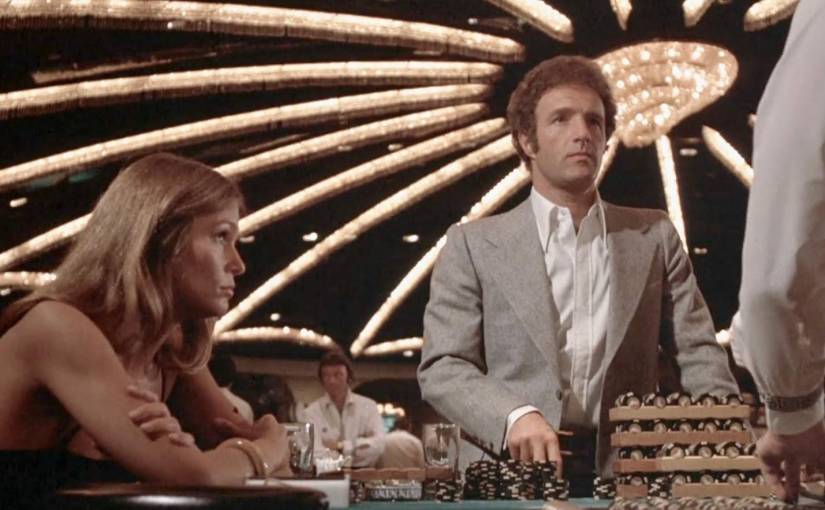
THE GAMBLER (1974)

By Marc S. Sanders

James Caan is Axel Freed, The Gambler, and when the film starts it shows the main character figuratively at the bottom of a very deep hole.  From this point on, he’s always looking at its great endless height above; a depth so low or a height so high, that there’s no crawling out of this trap.  No matter the opportunities that rescue Axel from a $44,000 debt to some bookies, he’ll never allow himself to be saved.

The autobiographical inspiration of James Toback’s first screenplay is hardly entertaining, but it held my attention all the way through.  Axel is a well-educated literature professor and an expert on Dostoyevsky but he’s entirely foolhardy.  A parallel inspiration comes from the author’s novella The Gambler.

I dunno.  Whether it’s 1974 or 2024, if I’m told I owe forty-four grand to someone who will otherwise break my legs and then who knows what else, I’d be terrified with fear.  Axel Freed seems to brush off his dilemma as he cruises through the city in his Mustang convertible.  To him, this is just the current setback of the week.  Nothing big.  He’s been in worse situations.  At least that’s what he tells himself. Axel swallows some pride and asks his mother (Jacqueline Brooks) for a loan, and she has to go through her own hoops to scrounge up the funds.  Look for an early appearance from James Woods as an unsympathetic banker.  Once mother’s monies are in hand though, Axel opts for a different route than to wipe his debt clean. Therein lies the anchoring burden of gambling addiction.

Toback’s script, directed by Karel Reisz, is not so much about a story as it is about living with overwhelming compulsion.  He writes good dialogue performed with apathy by Caan.  It’s not about winning.  It’s about the thrill of possibly losing the money he’s got in hand. 

Once Axel obtains money, he ventures off to Vegas feeling sure that he will double what he’s got and still manage to pay off this huge debt.  The brilliance of the film is that it had me tricked as Axel marathons through victory at every table while also feeling confident on three college basketball games that seem to be moving in his favor.  I was not sure if I was looking at a hero or a despairing loser during this sequence.  Reisz convinces me that it can go either way for Axel with his girlfriend, Billie (Lauren Hutton) in tow.

As many films, books, and programs that I’ve encountered focusing on gambling and the addiction it musters, I feel confident I know the outcome of the piece.  What sets The Gambler apart though is the realistic nature of what this kind of craving does to a person.  It depicts the victim as in denial, rejoicing when he dodges bullets, thinking he’s invincible.  The film demonstrates how those close to Axel Freed respond to his mounting dilemmas, but also how they are affected.  It’s inclusive not only of his Billie, his mother, his self-made millionaire grandfather, or even his main bookie (Paul Sorvino), but an admiring student of his as well. 

There are scenes that I could see how they are going to play out as soon as they begin.  I’m sorry but when I see tough guy character actors like Burt Young and Vic Tayback enter a story like this, I know something, or someone, is about to endure some damage and walk away feeling terribly threatened.  Still, I’d be complaining if Toback excised moments like this from his screenplay.

The ending left me feeling a little perplexed as to if it really belongs here.  It’s not a happy ending but seemed to come out of nowhere and I questioned its relevance against everything else that was seen before. 

The strength of The Gambler lies in the honesty of James Toback’s script and the performance of James Caan.  The film belongs exclusively to Caan and his character, with the others entering the frame when they are called upon for a cause and effect of Axel’s actions and decisions.  There’s nothing to celebrate in a hard drama like this, but I applaud the film’s will to uphold a genuine truth of how gambling addiction leaves behind a crippling life for those caught in continuing temptation.

CASINO

By Marc S. Sanders

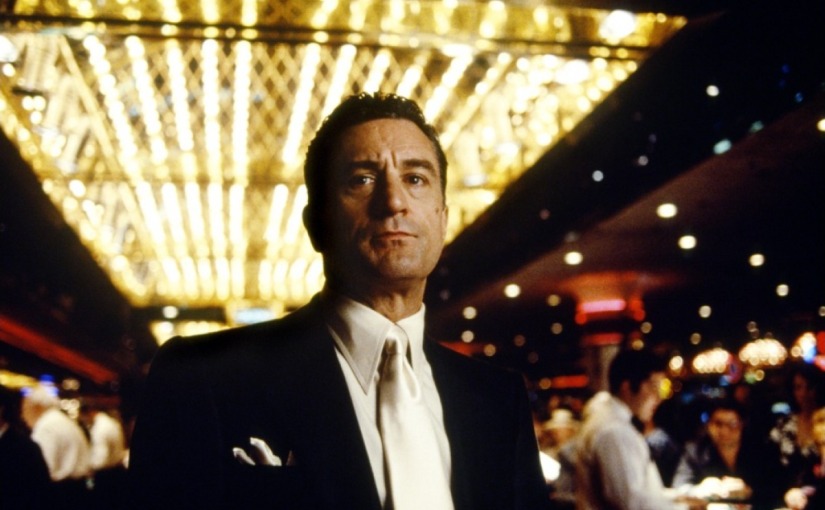
When a movie is set in Las Vegas, doesn’t it feel like it should be overly exaggerated, maybe a little loud, and quite bombastic?  That’s how I feel about Martin Scorsese’s three-hour opus, Casino.  The film opens with a car bomb exploding our primary narrator, Sam “Ace” Rothstein into the skies where he then makes his descent into the expansive signs that light up sin city in the desert.

Ace (Robert DeNiro) runs The Tangiers Casino.  He was especially picked by the mid-west Mafia back home (St. Louis, Mo.) to oversee everything that happens at the casino.  He’s looking for cheaters.  He’s making sure blueberry muffins live up to their name.  He’s dodging the FBI and their hidden bugs.  Most importantly, he’s making sure hefty suitcases are walked out of the casino and delivered on a monthly basis to the wise guys he has to answer to, and those deliveries better not come up light.  These guys treasure Ace because he never loses a bet.  Not one.  He can predict the outcome of any sports contest.  He can beat the odds on any table.  Ace is the best at his job because he also works eighteen hours out of every day, and he makes a lot of money for his superiors.

Everything should go smoothly.  However, the mob has also allowed Ace’s childhood friend, Nicky Santoro (Joe Pesci) to move out to Vegas.  Nicky is a heavy.  It’s not wise to upset or anger Nicky, because it’ll likely be the last time you ever do.  He’ll kick you when you’re down on the ground, but he’ll also stab you with a pen an endless number of times.  Don’t get your head caught in a vice when you are around Nicky.  This bull might have been sent out as a toughie to protect Ace and his work, but he’s not subtle about his methods.  When law enforcement gets involved, it only causes interference for Nicky and his crew to get back in the casinos or even in to Vegas.  Because Nicky won’t settle for that, it’s only going to make things harder, and especially challenging for Ace.

Ace’s other problem focuses on the one bet he did lose in life, and that was marrying Ginger (Sharon Stone in an Oscar nominated performance).  She’s a high-class hooker that Ace quickly becomes infatuated with, and the worst mistake he could have ever made was that he trusted her.  He trusted Ginger way too much.  Ginger may have quickly had a child and married Ace, but she never gave up on her loyalty to her scuzzy pimp, Lester (James Woods), and just wait until she starts carelessly confiding in Nicky.  Early on, everyone in the room, like even those in the comfort of their own homes, scream out loud why Ace would entrust a safe deposit box containing millions in cash with only Ginger’s name.  Ace can’t even get into the box if he wanted to.  He arranged it so that only Ginger could have access.  Keep the cash out of his name and the Feds can’t make a case.  As well, is Ace hiding his own interests from his own people?  Yet, that’s what he did.  He trusted his hooker wife way too much, way too often.

I’ve seen Casino a few times and I always leave it with the exact same problem.  I don’t think the film lives up to its title enough.  The first half of the film, while a similar blueprint to Goodfellas and later The Wolf Of Wall Street, is incredibly sweeping with Scorsese’s signature steady cams and voiceover work from DeNiro and Pesci.  You can travel from one end of the gambling hall, and then through clandestine back rooms and into secure areas all within sixty seconds.  Scorsese with a script from Nicholas Pileggi gives you a very fast education on how Ace operates a tight ship and keeps his mob superiors invested. 

Later, however, the film loses its way with an abundance of material on the Ginger character and how she is undoing Ace.  Stone gives an incredible performance as a constant drug and alcohol fueled spoiled brat of a trophy wife/former hooker.  She has wild outbursts that continuously threaten Ace and who he works for and with.  Minutes later, the film cuts to where the drugs have worn off and she comes back to her husband with her chinchilla coat draped over her shoulders.  The energy that Stone puts into this role must have exhausted her.  As a viewer, I get wiped out just watching her.  Yet, as engrossed the actress is in the part, what does it really have to do with life in a mob run casino? 

It’s not crazy to say that Las Vegas is city of at least 8 million stories.  It’s not called sin city for nothing.  In three hours’ time, much attention is given to how Ace’s casino funnels out monies to the mob.  Focus is also given to how they deceive the gaming commission and how Ace dodges the need to have a gaming license if he is to work at the casino.  There’s a great scene where he demonstrates what happens to cheaters who rip off the joint.  He also has to contend with the governing good ol’ boys who staked their claim in Nevada long before it became the gaming capital of the world.  If a dumb nephew is fired for not properly handling the slot machines, Ace is going to have to answer to someone with a big shot title.  Pileggi’s script is best in scenarios like this.  So, I can’t understand why he diverts his story into a domestic squabble of screaming and shoving between a husband and wife. 

The Ace/Ginger storyline populates over one third of the movie and then not much is talked about with the casino.  There are broken glasses and screaming and crying and drug fueled rages and opportunities to beat up Lester and now the film has become a personal picture, rather than Las Vegas mob cycle we were invited to observe.

Ironically, what I always hoped to gain from Casino is only a tease at the end, when Ace narrates how Las Vegas segued from mob rule and sold out to corporate America, even comparing it to Disney Land.  A wise shot is provided showing the senior citizens entering the doors of the casinos en masse, dressed in their sweat pants and polyester outfits ready to take a chance on the slots, not the more sophisticated gaming tables where the fat cats would lay down ten grand a hand.  Why couldn’t Nicholas Pileggi and Martin Scorsese devote time to this transition?  This seems like the bigger bet that Ace wouldn’t win out on.  Tons of married couples lose out and get married for the wrong reasons.  We’ve seen that kind of material before.  The real undoing of Ace Rothstein was likely the blue-chip organizations who pounced on what the mafia pioneered.  Hardly any of that is shown, only left to be implied.  I’m sorry, but Casino concludes on a missed opportunity.

BEST SELLER

By Marc S. Sanders

It’s kind of sad when two very good actors are provided with really subpar material.  The writing can naturally make the performers look bad.  Two things can happen.  The actors might try too hard or they may not try hard enough.  A perfect example of that is John Flynn’s crime drama Best Seller with James Woods and Brian Dennehy.  Woods tries too hard.  Dennehy isn’t trying at all.

Brian Dennehy is Dennis, a Los Angeles undercover cop.  Following a department robbery in 1972, he writes about the experience and then he is on his way to also being a best-selling crime novelist.  Fifteen years go by.  He’s still working the streets and chasing bad guys while also writing.  Though now he’s got writer’s block. 

James Woods is Cleve, a professional hitman, who enters Dennis’ life and convinces him to write a book about Cleve’s experiences.  Cleve’s motivation for this is to expose a crooked politician that he used to do jobs for and at the same time, the book will become a best-selling true crime novel for Dennis. So, Cleve escorts Dennis around various parts of the country from California to New York then back west to Oregon.  Cleve shows Dennis a bedroom in New York where he successfully executed a man with details about where the victim fell to how he did it, step by step.  There’s not a shred of dialogue or discovery in this scene.  A real estate agent giving a tour of an empty model home is more eye opening.  Cleve also brings Dennis to his parents home for a sleepover where he can gain some background material on Cleve’s upbringing.  Having just seen the ninety minute film, I can not recall one thing that was discussed at the dinner table with mom and dad.  Dennis never looks interested.  Dennis doesn’t even have a tape recorder or a pad to write on.  Dennis isn’t even necessarily convinced that Cleve is the hitman he says he is.  I was convinced, however.  Ten minutes into the film, Cleve saves Dennis’ life by shooting a criminal that was about to kill Dennis and he had pretty good aim with his silencer hand gun.  What more do you need to know?  If Dennis is such a good cop, why can’t he realize what is in front of him?  Was that the dilemma of Best Seller?  To see if Dennis believes Cleve is an expert hitman? 

The story is utterly ridiculous.  It doesn’t help however that James Woods carries himself like a nut job when Flynn directs him in cool postures adorned with stylish Ray Bans and knitted 1980’s suits.  He gets hyper in front of people he’s threatening and prefers unusual sexual positions with women he just met.

Brian Dennehy hardly looks like he’s in character.  His dramatic moments have no impact.  He seems undisturbed by this weird guy he’s travelling the country with.  Wouldn’t a seasoned cop even keep his guard up while with this likely hitman?  Not even a couple of near misses on killing them both seem to faze his Dennis character.  The men make a quick escape from a bomb laced taxi cab and they hardly discuss or consider who is behind the attempt on their lives. 

I’m not sure what was to be accomplished with this film.  It doesn’t explore anything remotely interesting. It’s mostly as boring as Brian Dennehy seems in his role.  Both of these actors have had better material to work with in their careers and they work best as supporting character actors like Woods in Casino and Hercules, or Dennehy in First Blood and Presumed InnocentBest Seller was not a box office hit or even a sleeper hit.  It’s not hard to see why.