THE RIVER

By Marc S. Sanders

A film like Mark Rydell’s The River only thrives on witnessing the misery of people living with the misery of others.  That’s not to say this is not how ordinary people are often forced to live.  There’s too much suffering in the world.  I can never deny that.  A homeless shelter or a prison are settings of great misfortune, hardship and sadness.  Yet for a movie, sometimes you must ask what the point is, especially when it is apparent that the heroes are destined to lose against the forces of nature while the villain is entirely correct in his own cause.  Sometimes in a no-win situation it is honorable to just give up.  I wish Tom Garvey, the corn farmer, would have just quit being a farmer and sought a better life for his wife Mae and their two young children.

Tom and Mae are played by Mel Gibson and Sissy Spacek.  He is the current generation who owns the Tennessee corn crop farm that his family lineage has passed down.  The first twenty minutes of The River depict the harshness of terrible rainstorms that flood the nearby river and wash away the family’s prized crops and land.  Tom, Mae and the children do everything in their power to recede the water as the rain continues to come down in buckets.  Mae fills up sacks of mud and water with their daughter Beth.  Their son Lewis works with Tom on the beat-up tractor against a never-ending battle of plowing the flood waters away from the land.  There’s no way to overcome this terrible plague of weather that comes at least twice every year.  As I watch the sopping wet struggle that opens the picture in the middle of a stormy night, shot very well by Rydell and his crew, I already ask myself what’s the point?  Get out of this situation Tom!!!!! Take up babysitting, tutor, become a fireman, go back to school.  Relocate for heaven’s sakes!!!!

What recuses the Garvey family and the farm, one more time, is when the rain finally stops.

Scott Glenn is Joe Wade.  He is a wealthy industrialist, who also grew up in these parts under a family legacy.  Joe is on the good side of the state politicians and is aggressive in buying out the farmers’ land so that he can flood the valley, build a dam and use the overabundance of water to power the utilities of the area in a more efficient and much less costly way for everyone.  And he’s the villain of the story????????

Joe makes sense.  Tom’s passion for holding on to what his family has owned does not.  I get the idea of grasping on to family heirlooms like my grandfather’s watch that he maybe kept hidden in an uncomfortable orifice while being held captive by the Nazis, or the prized jewel that survived a shipwreck generations ago.  I also understand the desire to carry the torch of the harsh labor a father and a father before endured and died for while allowing a farm to thrive.  Yet, there are children to feed and debts to pay. The ruin that comes from the acts of God do not empathize.  Therefore, I say again, sometimes the bravest and most sensible thing a person can do is actually quit.

Tom, along with most of the neighboring farmers, are adamant about not selling their land to Joe.  When auctions occur to sell off the equipment and leftover supplies of the few that do surrender, it is practically considered a gross violation of a sacred code in these parts.  I look at the stubborn folks who frown upon their peers as terribly disrespectful.  The script is expecting me to empathize with Tom and those who stand with him though. 

Midway through, The River takes a detour as Tom leaves to do hard labor elsewhere to earn much needed cash.  This is where misery does not love company.   He is one of many men selected to do factory work as an inexpensive replacement for the union workers on strike.  Tom, along with the other recruits, are threatened, called scabs, and in a glaring scene spit directly in the face.  A fellow worker is beat up in the middle of the night.  All of this is powerful footage and yet who am I supposed to empathize with?  These workers on strike are demanding better benefits and rights.  A guy like Tom, who values the survival of the Garvey farm, interferes in someone else’s just cause for his own welfare. 

I think about films like Schindler’s List and even The Lord Of The Rings fantasies and I witness the hardships and suffering of a collective people.  Those stories never expect me to value the misery of a select few over others.  I take stock in a whole populace.  In Mark Rydell’s film, however, I feel like I’m only asked to cry for Tom Garvey’s relief, the stubborn father who is defiant for an unlikely future of promise for the area he occupies while also ignoring the welfare of his family against the forces of nature.  Joe is offering Tom and Mae hundreds of thousands of dollars for their land so that he can enhance the state.  Joe’s bounty will rescue the family from insurmountable debt and the unforgiving floods that repeatedly destroy their crops.  Still, I’m supposed to believe that Joe is the asshole.

Sissy Spacek was nominated for Best Actress for her performance.  She competed against Sally Field (who won) and Jessica Lange.  Both were ironically featured in their own “farm life films” in 1984.  Spacek remains one of Hollywood’s finest actors.  However, I did not think there was much for her to do here.  A drawn-out sequence has Mae caught under a tractor with a nasty wound while the blistering heat bears down with no one around to help.  It has its moment of suspense because this film could go in many different directions of tragedy, but a development like this is more circumstantial than performance based.  If Katherine Hepburn or Laurence Olivier were under that tractor, the scene would not play out much differently.  It’s just a standard farmer accident destined to be included in a standard farmer picture.

The possibility of a love triangle is also implied during the film.  As soon as I saw the opening credits (Sissy Spacek, Mel Gibson, Scott Glenn), I hoped against all hope that the story would not go there, and yet…

Having hardly even used a rake or a shovel, I know that farming is a grueling life and still so necessary for our world consumption to survive.  The River attempts to demonstrate this message. I empathize with people like Tom.  I really do.  However, I empathize with the sacrifice they may need to take, not with their with their foolhardy stubbornness or their intrusion upon others’ challenges for gain.  If a doctor told me that no matter what efforts he performs he will not be able to save my arm or my leg, I’m going to have to believe him and accept that the limb must be amputated.  If an overflowing river and an unbearably long rainstorm affects my home, my farm, my family and my livelihood at least twice a year, eventually I’m going to come to my senses and tell myself that the bad guy is probably right. 

Contrary to the well-known slogan, sometimes money is everything.
PRINCE OF THE CITY

By Marc S. Sanders

Sidney Lumet made an outstanding career of bringing attention to corruption within the halls of police precincts, amid the offices of politics and the inside the hallows of cherrywood courtrooms with manipulating lawyers and unsympathetic judges. His films are spellbinding with difficult conundrums for his protagonists to overcome and survive.  Prince Of The City is a perfect example.

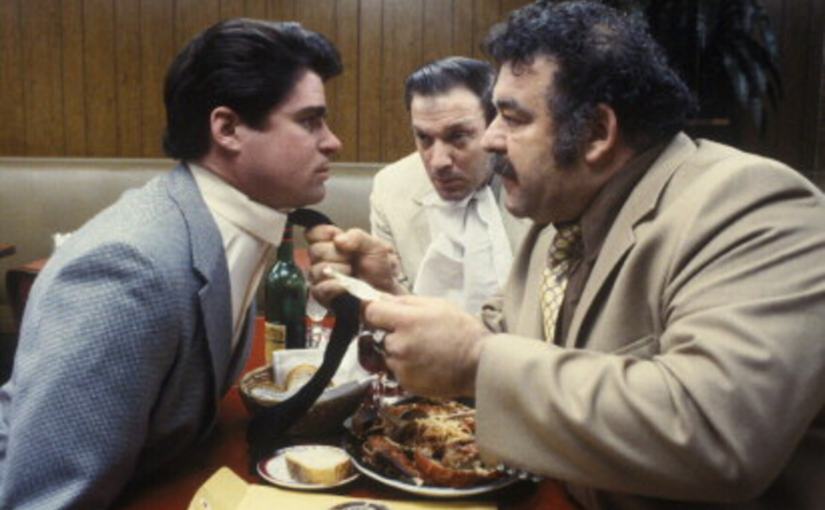
A handsomely young Treat Williams stars as Danny Ciello.  He’s a famed cop working for the New York City Special Investigative Unit.  He’s part of a squad of partners who are also his best friends.  Jerry Orbach is the standout among the gang.  They make a huge difference in the big busts they accomplish.  In fact, some of them were part of the famed French Connection cocaine takedown.  Their celebrated careers lend to their monikers.  Danny is an especially accomplished “prince of the city.”  Proudly, they march into a crowded courtroom with a packed audience to announce another huge indictment with the criminals handcuffed together in a line.  However, these officers are also immoral in their daily practice. 

A bust of illegal immigrant drug dealers is made early in the film where over ninety-two thousand dollars is uncovered, and the team agree to share half among themselves.  A little later, Danny gets a desperate call in the middle of the night from one of his informants and to appease him he rips some heroin off another street user to give to the other one.  It’s a necessary evil to ensure progress as an accomplished detective.  The snatching of the monies? Well, as his brother frustratingly points out, that’s so he and his partners can live comfortably in furnished homes with nice clothes and jewelry. Yet perhaps all of this is no longer sitting right with Danny.

None of this is unusual for Danny but considering that an internal investigator (Norman Parker) has approached him about going undercover to reveal corruption that’s rampant throughout the police force, his conscience is weighing on him.  Danny agrees to go to work on this assignment.  However, he lays out one important condition. He’ll never give up his partners, including wearing a wire in their presence.  He lives with his wife, but he loves his partners.

Prince Of The City is a long film, but its running time is necessary because there are so many facets to Williams’ character.  Also, the residual effects of Danny’s work branch off in so many directions.  More than once, Danny is warned not to perjure himself.  Legal authorities find it hard to believe that Danny only broke his ethical code just three times in eleven years.  However, Danny insists that’s all there is.  He’s warned over and over it better be.  Otherwise, those that are working with him will later work against him.

Lumet is very good at showing realistic settings.  An abandoned post office is designated as a secret locale to store evidence and wiretap records that Danny collects.  In the beginning, the joint is empty, but over a progression of five years’ time, the shelves fill up quickly and a large staff is assembled, equipped with computers, typewriters and stuffed file cabinets.

Danny catches cops on the take.  He gets a crooked lawyer on tape.  He’s also taking big risks that amplify his stress.  Lumet showed the increasing agony of a cop against a police department in Serpico with Al Pacino.  I thought the actor was a little overdone in that film.  Here, Treat Williams could not be more authentic, and the transition from cocky detective to paranoid informant, working against his colleagues, comes through much more subtly as the film carries on.  Danny gets caught in a diner sting wearing his wire.  His quick instincts save him, but only after his shirt is torn open showing the wire, and a gun comes out of nowhere.  The sloppy struggle that ensues with a broken glass door and overturned tables loaded with food and dishes is frighteningly realistic.  Lumet shoots the moment with a documentary kind of feel.  Deliberately, there’s no special effect to the camera work here.  It’s all in Williams’ performance and the actors he shares the scene with.

Treat Williams performance is so wired that I am very surprised it did not lead to more recognizable and stand out roles later in his career.  Williams was unknown at the time of this film’s release in 1981, but his lead in this picture is as welcome as Ray Liotta in Goodfellas.

Danny Ciello is a fictional character based on the real-life narcotics detective known as Robert Leuci.  Leuci had a checkered background dating back to when he became an undercover cop informant.  Neither Danny or Robert wears the white hats of pure honor and loyalty.  That is what makes these men so challenging.  Because they are somewhat impure, there is a tipping scale to how they should be regarded. 

A marvelous part occurs in the last act of the film.  Danny’s transgressions as well as what he’s accomplished have all been laid out.  The costs of his partners’ careers have been considered.  The risks and dangers that Danny and his family with two young children have encountered are given their due attention.  Now, as the film is concluding, Lumet along with his co-writer Jay Presson Allen, assemble close to twenty prosecutors and district attorneys in a dark, slightly sunlit office to debate whether Danny Ciello should be charged for violations of perjury.  One prosecutor threatens to resign if Danny is prosecuted.  Another one cannot see how a police officer can be granted pardons for violating the very laws he’s been sworn to uphold. No one is right or wrong in this argument. The collection of actors in this scene is amazing. 

The Oscar nominated script from Lumet and Allen do not provide a straight answer as to whether Danny is a hero or a criminal.  Prince Of The City is never spoon fed to its audience.  Different perspectives and receptions have likely been generated from the picture.  I’d love to hear other people’s viewpoints.

Once again, I commend the running time of Lumet’s film.  Danny Ciello is a complicated man who sacrifices so much that the cost of everything needs to be acknowledged.  The rampant corruption that is uncovered among his colleagues is so extensive that the turnaround response must be depicted.  Some men committed suicide for their crimes.  Some swear they’ll never give themselves up or even Danny.  Danny is expected to do the same in return.  Danny lost friendships and trust over the assignments he accepted. His children and his wife (an excellent Lindsay Crouse) were undeservedly forced to live in fear for their lives, and upend their household, ironically feeling obligated to accommodate those assigned to protect them.  At one time, Danny is relying on men who are heading the investigation, promising to abide by his conditions and guarantee his safety.  Later, these men accept promotions that pull them away to other departments, leaving Danny to deal with people he cannot count on going forward, and who may work against him or refuse to honor original promises.

It’s quite unfair for Danny as he continues to make headway.  An uncaring portrayal by Bob Balaban (really good in everything he does) as a federal prosecutor forces Danny into uncompromising positions where he’s squeezed into offering up everything with little to no options.  Because Danny is no longer the conceited prince that he once considered himself to be, these authorities keep him beholden to his commitments, no matter the cost of his career, his partnerships or how it affects the lifestyle of himself and his family.

Prince Of The City is a very heavy film with much to address.  If this were to be remade, without the guidance of Lumet’s expertise, it could only work as a miniseries.  Though I doubt it would ever compare to Treat Williams’ performance or Sidney Lumet’s specialty in covering the complexities that organically stem from police corruption.  This is a fascinating film that I’m looking forward to watching again.  Because the weight of the material is so thick, I’m certain I’ll discover something new in a repeat viewing.  This is one of Sidney Lumet’s best films.

TOP GUN

By Marc S. Sanders

For a movie that focuses a lot on showers, men’s locker rooms and bare chested sweaty and chiseled volleyball players, it’s a wonder that it is called Top Gun.  Maybe the title has another indirect meaning to it, other than a moniker for a Navy fighter pilot school of the elite.  Maybe these guys are elite for a different reason.

The Tony Scott film that is supposedly about the top one percent, the best of the best, American fighter pilots in the Navy is arguably the most important film in Tom Cruise’s career.  It launched the actor into a superstar sensation that has hardly faltered since the movie’s release all the way back in 1986.  But is it a good movie?  Well, yes and no.

I’ve always loved Tony Scott’s filmmaking technique.  Sure, his sun-soaked film shots are constantly repeated.  He always relishes in enhancing the beaded glow of sweat drenching his actor’s faces, arms and chests.  It’s seen in nearly every moment of Top Gun, as well as other celebrated pictures like Crimson Tide, Beverly Hills Cop II and True Romance.  Orange sunlight blankets palm trees and beach lined streets.  Bar saloons and military headquarters are lit in sexy blues and greens.  It may lack originality after seeing a few of his films, but it just makes the movie all the more sexy. 

Tony Scott is also a well-versed director in action sequences.  He’ll get your pulse racing and Top Gun is the best example.  The fighter jet sequences in this film are masterful in editing, sound and speed.  It’s fantastic to see how the planes will twirl around and then shoot themselves straight up into a vertical trajectory in the sky and finally cut in on actors Tom Cruise, Anthony Edwards and Val Kilmer for a “WOO!” moment in the cockpit.  This stuff still holds up.

Yet, unlike other modern-day films that focus on cadets or students in our armed forces, Top Gun doesn’t concern itself with the discipline of what it takes to serve in the Navy.  This is the informal, class clown version of An Officer And A Gentleman.  You only need look as far as Tom Cruise’s character’s pilot call name, Maverick.  The name itself is a one-word thematic description of what you are watching.  So, the kid who learned to say “what the fuck” in Risky Business, went on to do daredevil flybys while disobeying orders.

Maverick’s real name is Pete Mitchell.  He has no family except that of his co-pilot, Goose (Anthony Edwards).  The disappearance of his Navy pilot father remains a mystery…because it is sexy and cool to have a mystery for your handsome hero in a film like this.  Call it DRAMATIC HEFT!!!! 

When Maverick and Goose get the opportunity to attend “Top Gun” – a fighter school specializing in training the best pilots in the world in aerial dog fighting – they are intent on getting their names on the plaque for the best of the best of THE BEST.  Competition comes in the other prettiest of the pretty boys with Iceman (Val Kilmer).  These are all great likable characters.  Yet, even when I saw this film at sleepaway camp at age 13, I couldn’t help but notice how distracted it gets with the abundance of erotic machoism on display here.  What would serve as dramatic dialogue in another film is presented in a steam room area allowing opportunity to see the male cast wrapped in towels around their waists with wet spiky blond and black hair.  It truly doesn’t matter what they are talking about in this scene.  When you are watching it, all that you are hearing is the sound of Charlie Brown’s unseen and indecipherable school teacher.  “Waa waa.  Waa waa waa waa!”

That’s not enough though.  The infamous volleyball scene keeps you awake.  I don’t care if you are hetero or homo or bi or pan or plus, the beach volleyball scene keeps you alert as one of Kenny Loggins’ many movie songs plays in accordance.  Tony Scott doesn’t just go for tossing the ball around.  Slow mo captions are offered of each guy just posing with their chiseled arms and chests.  You may not take your eyes off of it, but oh my…what does this have to do with the discipline of attending Navy fighter pilot school training?????

The romance is second to none.  Truly!  These days, people talk about Jack and Rose in Titanic or Ross and Rachel on Friends.  For me, it’s Maverick and Charlie (Kelly McGillis).  Cruise and McGillis really light up their scenes together.  It’s an absolute perfect pairing of sex appeal and it is really when Top Gun performs at its smartest level.  The dialogue is strongest during their scenes.  The romance isn’t rushed but nicely flirted with, and when tragedy strikes within the thin storyline of the overall film, the relationship goes in another supportive and appreciated direction.  When I was a kid, with hormones being discovered for the first time, my buddies and I would elbow each other during the midnight blue sex scene between McGillis and Cruise with the Oscar winning song “Take My Breath Away” from Berlin playing.  I look at this scene now and it is modern romance at a beautiful best.  A fantastic scene from Tony Scott. 

Charlie is the unexpected, well-versed contractor for the Navy giving counsel to the pilot students on how best to operate the jets.  In the 1980s, action blockbusters normally held the women as the barely dressed damsels to be rescued, and nothing more.  The female characters didn’t have brains and the only brawn to go around was saved for Princess Leia or Marion Ravenwood (Raiders).  Charlie is an exception though.  McGillis plays the character as someone who is aware that these testosterone-filled guys will regard her as a piece of meat, until they realize otherwise.  The irony of Top Gun is that the nearly all male cast, Cruise included, are the pieces of meat.  The one main female role is actually the brains of the whole operation.  McGillis was a marvelous actress back in the day.  Go look at Witness and The Accused to see what I mean.  With her help, Cruise elevates above the hokey dialogue of the Top Gun script. Kelly McGillis really could act well in almost anything.  I wish her career went further, honestly. 

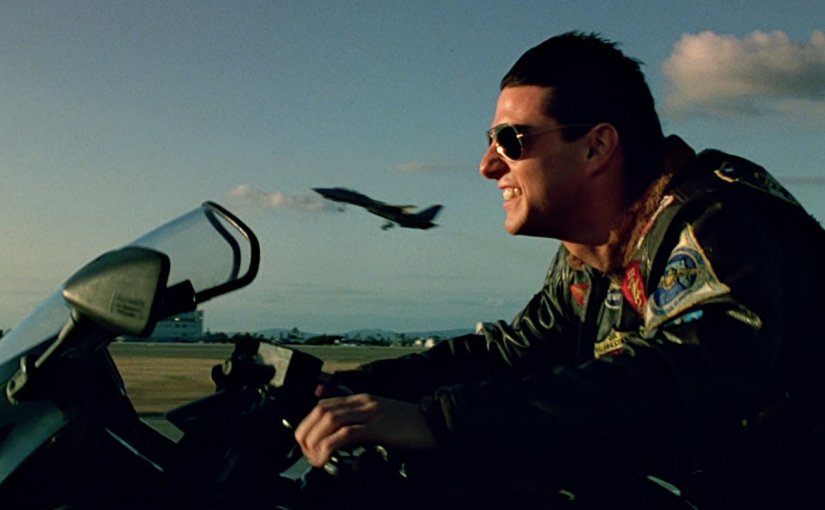
Top Gun remains a mainstay in 1980s pop culture.  If the VH1 channel is doing a documentary on the decade of Madonna, Michael Jackson, parachute pants and neon pastels, Top Gun is also brought up in the mix with a close up of Tom Cruise’s toothy grin and his aviator sunglasses.  We were never watching Oscar winning material here, but somehow the film that introduced all of us to Tom Cruise still feels like a day at the beach with the twenty something boy toy in his tight jeans and leather bomber jacket riding his Kawasaki Ninja motorcycle at top speed or breaking the sound barrier in his fighter jet with his shiny navy-blue helmet on his head.  Top Gun and Tom Cruise demonstrated that it’s a party to serve in the Navy.  Why not?  Vietnam was behind us and the decade was not embroiled in war.  Join the Navy!!!!  It’s fun and you get to shower with the best-looking guys in the world.  You’ll even get to play volleyball with them and date your sexy flight instructor.

A lot of the dialogue and the storyline may sound like an adult, military interpretation of Saved By The Bell, but you can’t break away from the sexy allure of what Tony Scott with Cruise, Kilmer, McGillis and Edwards put on the screen.  It’s always been there and somehow a sequel was never made. 

Wait a second!  WHAT??????

BACK TO THE FUTURE PART III

By Marc S. Sanders

I think Bob Gale and director Robert Zemeckis forgot one thing about Back To The Future Part III. It was supposed to be a time travel movie. Sure, Marty McFly (Michael J Fox) travels back to the Hill Valley of the Old West in the year 1885, but once he gets there, there is not a lot of material for the beloved DeLorean.

The film picks up immediately where the last film cliff hanged. Marty is left trapped in 1955, and he receives a letter sent to him 70 years earlier from his present day Doc Brown companion (Christopher Lloyd) originally from 1985. You still with me? When Marty realizes that Doc gets shot in the back by Mad Dog Tannen (character actor great, Thomas F Wilson), he arranges with the 1955 Doc to send him back to the Old West and prevent that from ever happening.

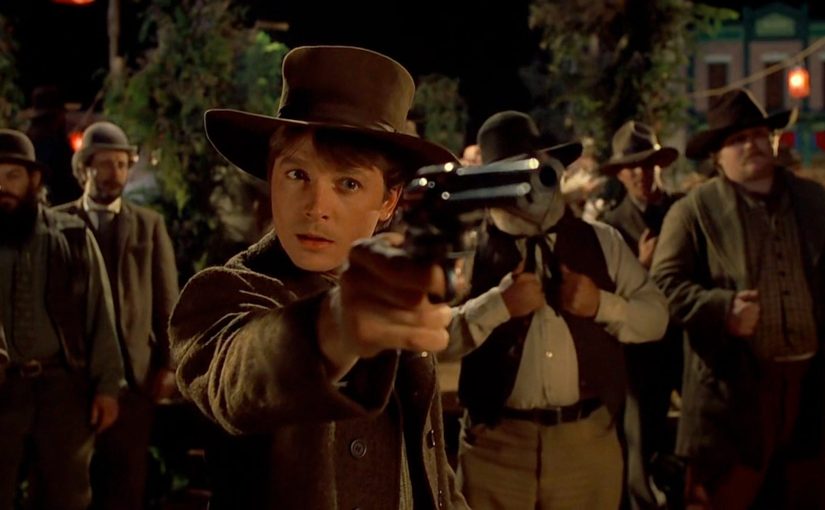
From there, the film turns into a staple Western. There’s the calvary, Indians on horseback, quick draw duels in the street, a saloon, stage coach and wagons. Most importantly, there’s a steam engine to push the DeLorean to the necessary 88 miles per hour to send our heroes back to the future. That dilemma is solved quickly and early on. They now just have to wait for the train to arrive.

So the film calms down to allow a charming Mary Steenburgen as Clara Clayton, a schoolteacher, to capture the affection of the good ol’ Doc. When the romance seems impossible though, we get a depressed Doc. A depressed Doc Brown is never good for a movie. Consider this. It’d be so easy to just wait for the moment to travel back in time. However, obstacles get in the way, right? In the fantastic first film, Marty has to play guitar at the school dance to get the necessary first kiss between his parents thereby solidifying his existence. That’s fun…and then he kills it while performing “Johnnie B. Goode.” Here, the moment to time travel is approaching, but it can’t happen because Doc is depressed. What’s so fun about that?

Like Part II, Part III is watchable. It’s not terrible by any means. It’s just a little stale. The best gag, however, is Marty taking on the name of “Clint Eastwood” to build his status in the town. This allows a lot of inside jokes. What would’ve sent this film into the stratosphere is if they got the legend himself to make at least a cameo. Alas…. I can dream and wonder.

Back To Future Part III ends the film on a sweet message similar to what you get from other fantasies like The Wizard Of Oz or Willy Wonka & The Chocolate Factory. It reminds me that despite its shortcomings, the entire Future trilogy is great to share with the whole family. No doubt, there’s always something to look at and focus on.

Still, some movies that require focus specifically, takes work. The first film allowed me to wonder. Wonder if all of this could be true one day. Wonder how they thought all this up. Wonder how Marty is actually going to get back to the future.

If I have to choose, I’d rather not focus. I’d rather just wonder.

BACK TO THE FUTURE PART II

By Marc S. Sanders

Back To The Future Part II is a paint by numbers or recipe film more than just a film. This has to be done, so that that can be done, cook on high for just over two hours and all will be wrapped up. Because it is so focused on covering all bases it forgets the wonder and fun of the original film, and just gets down to business. Watching this film makes you feel like dad just won’t throw the football around with you in the front yard. He’s got work to do.

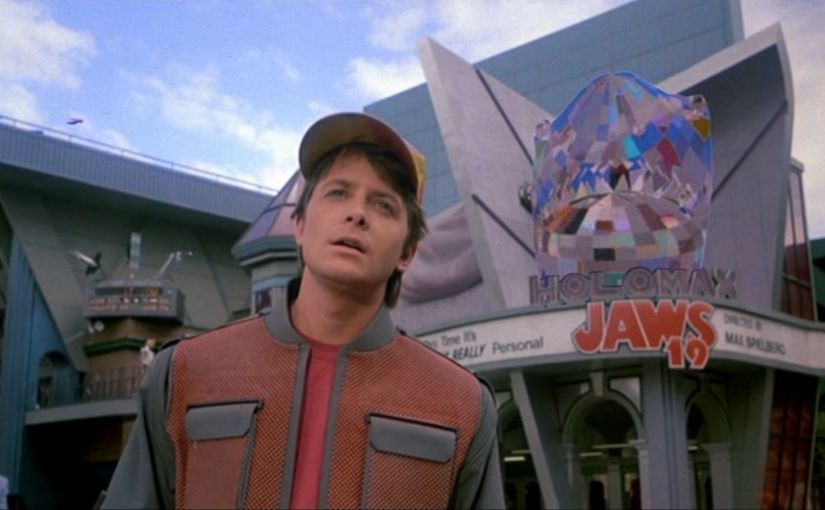
The sequel picks up immediately where the first film ended with Doc Brown (Christopher Lloyd) taking Marty McFly (Michael J Fox) and his girlfriend Jennifer (Elisabeth Shue) to a very zany looking future in the year 2015, complete with flying cars, Jaws 19, the abolition of lawyers, and opportunities to get a redesign of your body complete with a replacement of your spleen and colon just like Doc explains. When an elderly Biff Tannen gets a hold of a sports encyclopedia, he travels back in time to 1955 to tell his younger self to make bets he can’t lose. Now the future is entirely changed, riddled with crime, and Biff in absolute power. Worst of all, the brute is married to Lorraine, Marty’s mom (Lea Thompson, regrettably not given much to do this time around). So, Doc and Marty need to travel to 1955 to set things right all over again.

Look, if you were gonna make a sequel to Back To The Future, this is likely what the script was going to spit out. It’s a watchable film. However, it’s lost the soul of the original installment. It feels like an office project. The comedy is absent. A long sequence shows a middle age Marty in 2015 talking on video phone remotely with his bullying boss, and getting fired, with fax machines all over the house spitting out the message as well. This is supposed to leave me in awe? This is funny?

The second half of the film in 1955 has Marty pursuing Biff the bully while trying to get the sports book back. Biff, played by Thomas F Wilson, is more or less doing the same thing as the first film. Only he’s not the dumb buffoon we laughed at the first time. He doesn’t have George to bully around this time. You realize Biff and George made a perfect comedic pair. That’s missing here. So he bullies some little kids and with extreme harshness and tries to kill Marty on several occasions. It’s not so funny this time. It’s cruel.

A fun motif (that also carries forward in Part III) is that the actors are playing their characters at different ages 30-60 years apart from one another. Fox, Wilson and Shue also play their kids or grandkids. A nerdy Marty Jr is nerdy, but not quite funny. Fox is not doing the fantastic humor that Crispin Glover did as George in the first film. He’s just wearing an oversize jacket with his jeans inside out and squeaking his voice. Meh…not funny, just there.

Robert Zemeckis’ sequel is just okay. It’s disappointing because he and his collaborator Bob Gale worked so inventively on the first film. The construction is solid. I still love the various transformations of Hill Valley, California. If the film were made today that’d all be done with CGI. I appreciate the texture in the construction of the town’s past, present and future. Each time period allows me to look around and see what’s replaced what and so on. So, I’m truly grateful for that.

All and all though, Zemeckis and Gale had all the right ideas. They just didn’t have the best execution in mind.

BACK TO THE FUTURE

By Marc S. Sanders

One of the best fantasy films of all time is Robert Zemeckis’ Back To The Future. No matter how many times I see it I’m astounded by the imagination and attention to detail that is invested in its script penned by Zemeckis and Bob Gale.

First, there is the set that stands in for the town of Hill Valley, California. To set up the film which took place in the film’s present shooting period of 1985, everything appears modern from Pepsi Free soda to Huey Lewis and the News and Marty McFly’s (Michael J Fox) parka vest.

Through a set of circumstances, when Marty travels back in time to November 5, 1955, suddenly the hit song is “Mr. Sandman” and his vest is mistaken as a life preserver. But look at Hill Valley!!!! Twin Pines Mall is now Twin Pines Ranch belonging to a farmer. A exercise workout locale is the corner diner where the future mayor is a waiter, and Marty’s domestic subdivision isn’t even built yet. Zemeckis and his crew are religiously faithful to observing the “science” of time travel.

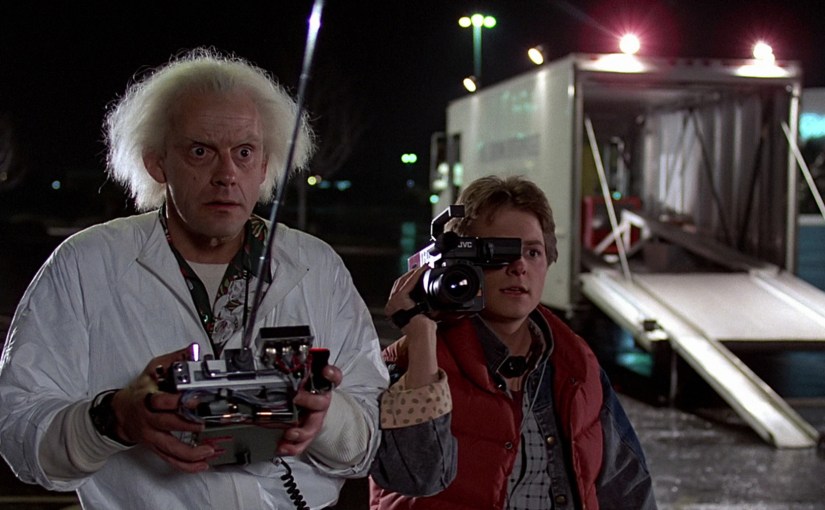
His minister so to speak is Doctor Emmett Brown (a should have been Oscar nominated Christopher Lloyd; absolutely brilliant in his bug eyed, crazy hair, fun loving role). Doc’s time machine comes by means of a DeLorean automobile – perfectly sci fi like. Marty recruits the younger version of Doc to get him back to his present day, or Doc’s future.

Complications occur when Marty interferes with how his parents originally met thereby causing his mother, (Lea Thompson also superb and maybe should’ve been nominated as well) a teen at the time, into falling in love with Marty. Now Marty is at risk of being erased from existence, while his mother has the hots for him.

Complications are compounded endlessly in Back To The Future, and it’s easy to learn all that is at stake. That’s only the skeleton of the nominated screenplay. The dialogue works beautifully as well. Imagine telling someone living in 1955 that Ronald Reagan is President in 1985, and see how he’ll respond. The conservative culture of 1955 vs the free liberal lifestyle 1985 clash so well in the film’s comedy.

Outstanding performances make up one of the greatest casts of all time. It’s difficult to believe that Eric Stoltz was originally cast as Marty. Michael J Fox is so perfectly natural in his hysteria and cool, yet panicky, swagger. Crispin Glover is hilarious as Marty’s ultra-nerd dad, George McFly, and Thomas F Wilson is one of the top ten on- screen bullies of all times as the towering buffoon Biff Tannen.

Without question, Back To The Future is one of the most imaginative films ever made. It has wonder, comedy, suspense, song (yes…we even learn how Chuck Berry came to play “Johnny B Goode”), and brilliant characterizations. It is wholly original in its creativity. It’s fast moving, and it’s great fun.

Credit also goes to Alan Silvestri’s catchy orchestral soundtrack. It is magnificent in accompanying the adventure and misunderstandings that occur. You see the film once, and you never forget Silvestri’s music.

Back To The Future is a magnificent film that every kid should eventually see.