WINCHESTER ‘73 (1950)

by Miguel E. Rodriguez

DIRECTOR: Anthony Mann
CAST: James Stewart, Shelley Winters, Dan Duryea, Stephen McNally, Millard Mitchell, Rock Hudson, Tony Curtis
MY RATING: 9/10
ROTTEN TOMATOMETER: 100% Fresh

PLOT: A cowboy’s obsession with retrieving his stolen rifle leads to a violent odyssey through the American West.


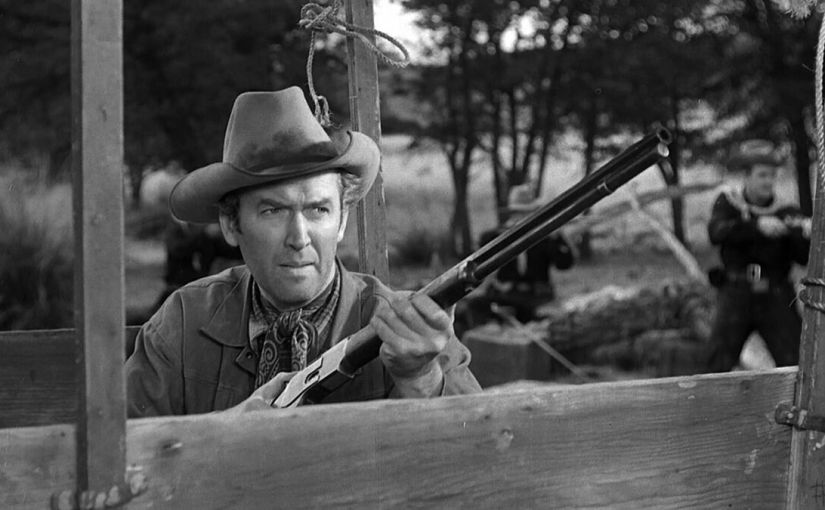
Even without knowing the full history of how the film impacted contemporary audiences, Anthony Mann’s Winchester ’73 still packs a punch.  Using an ingenious story structure, courtesy of a very Western MacGuffin, the film follows the path of a rare, expensive Winchester rifle from hand to hand for ninety taut minutes.  James Stewart is top billed, but he is on screen for less time than you’d think.  That’s actually a good thing in this case, as Mann’s focus is not on star power, but on metaphor and mythology.  (Although Stewart’s star power certainly doesn’t hurt, as he demonstrates in several key moments.)

The movie plops us right into the action with nary a flashback nor an expositional monologue in sight.  The legendary town of Dodge City is holding a shooting contest to celebrate Independence Day, 1876.  Sheriff Wyatt Earp (!) is officiating, and the prize will be a rare model of the Winchester ’73 repeating rifle.  Arriving in town that day is Lin McAdam (Stewart) with his partner, High-Spade Frankie Wilson (Millard Mitchell).

(Around this part of his career, Stewart’s trajectory was on the decline, as he was getting too old to play the aw-shucks-y kind of roles that were his bread and butter in the ‘30s and ‘40s.  Winchester ’73 was an opportunity to showcase his range, and he delivered.  Lin McAdam is not the villain, but neither is he the kind of character Stewart had ever played before.  It’s been written that, when audiences of the day saw Stewart get violent and pin a man to a saloon bar, there were gasps.)

Lin is none too friendly towards another man in town, Dutch Henry Brown (Stephen McNally), who reciprocates in spades.  There is clearly some kind of history, but what that history entails would take too long to explain, so the movie wisely doesn’t try.  They’re enemies, and that’s enough.  Somewhat predictably, they both enter the contest for the prize Winchester, but in the first of many twists, the contest doesn’t play out exactly as you would expect.  Then the rifle is stolen, Dutch and his pals skip town, and Lin and his partner give chase.

From there, the movie gets episodic.  There’s the Indian trader, the Indian himself, Young Bull (Rock Hudson in a fake nose and braids!!!), the obligatory feisty lady, Lola (a luminous young Shelley Winters) and her beau who behaves in a most unmanly manner, a run-in with some cavalrymen (featuring an unknown young actor billed as “Anthony Curtis”), and winding up with a real sleazeball, Waco Johnny Dean (Dan Duryea).  How the rifle makes its way from place to place I will not reveal, but it’s all perfectly feasible.

(I will leave it to wiser minds than I to discuss the racist portrayal of Indigenous Americans, including using Rock Hudson in “red-face” to play a tribal chief.  Yes, it’s shameful and unfortunate, but it happened, and I use the term “Indian” earlier because that’s how they’re referred to in the film, for better or worse.)

If I had to explain what this movie is actually about, beyond its brilliant plotting, I’m not sure I could do it.  I can report that it was engaging and crisp and surprising and almost demands a rewatch after the end credits, but aside from just being a darn good entry in the Western genre, it’s hard for me to pin down its message.  Is it a screed against the violence in the real West?  How some men searched for violence because it was in their nature, or because they felt it was their duty?  I mean…yeah, I guess, but that feels like just scratching the surface.  What were Mann and Stewart trying to say?

Maybe it’s one of those movies where the message depends on the viewer.  If you look at it as an anti-violence film with a bittersweet ending filled with moral ambiguity, it’s there.  If you look at it as just a travelogue or tapestry of the old West, made by a director who loves the genre and an actor sinking his teeth into a great role, that’s there, too.  (Mann and Stewart would go on to make seven more films together, five of them Westerns.)  There’s even melodrama and a hint of romance along the way, but never too much to drown everything else out.  For me, Winchester ‘73 is much harder to unpack than Unforgiven (1992), whose message is crystal clear from beginning to end.  Both movies are equally entertaining, though, don’t misunderstand me.

If any active readers have made it this far, feel free to let me know what the “true meaning” of Winchester ’73 is.  Whether I find out or not will truly not matter, because the movie is still hugely entertaining with or without an explanation.  I might have a tiny bone to pick with the final battle, with its foregone conclusion, but it comes with the territory, so I have to forgive it.  This is a great entry in the genre, featuring a star pushing his boundaries and a director who knew how to harness that energy.

IT’S A WONDERFUL LIFE

By Marc S. Sanders

I have finally righted a serious wrong and watched Frank Capra’s It’s A Wonderful Life, and what a pleasurable experience it has been.  Reader, if this movie lover who gets hopped up on science fiction gobbley gook with laser swords and spaceships can watch an old black and white movie feeling sorrow for its main characters, and elation when the film finishes, then it’s easy to understand how timeless and impressionable Capra’s classic film truly is.

I recall when I had finally seen It Happened One Night, originally released in 1934 and arguably the pioneer of the romantic comedy genre.  I could not help but connect certain moments and pieces of dialogue to the films released while I was growing up, like When Harry Met Sally… and Bull Durham.  Those films took inspiration from Capra’s comedy with Clark Gable and Claudette Colbert.  Capra pioneered storytelling once again with It’s A Wonderful Life.  As my wife and I watched the movie late last night until nearly two in the morning, I said to her this is like Back To The Future.  My wife said A Christmas Carol.  Both true statements.  So perhaps while Capra was revolutionary with his own storytelling, he might have been adopting some inspiration from what came before as well.  Regardless, I applaud his approach.  Frank Capra is a tremendous gift to the cinematic medium.  If there was a Mount Rushmore for filmmakers, Capra would most certainly be sculpted alongside the likes of Hitchcock, Chaplin and Disney.

George Bailey (James Stewart) has big dreams of leaving his sleepy little town of Bedford Falls and building grand designs of skyscrapers while also exploring the world, beginning with Europe and Alaska and whatever else needs discovering.  Like any of us, our yearning for adventure and the destinies we wish for get interrupted. Before you know it, we ask ourselves if life has passed us by.  It takes a guardian angel named Clarence (Henry Travers) to remind George that life has been with him all along; maybe not the life he envisaged, but certainly a life of purpose and significance beyond just himself.

George watches as his high school chums go on to grand accomplishments that pay off in enormous amounts of wealth.  His younger brother Harry (Todd Karns) goes to college, gets married and becomes a celebrated war hero.  However, George remains in Bedford Falls offering loans to his fellow townsfolk that he can’t afford to honor with a business he inherited from his father.  To lend and support comes involuntary to George.  He’s just a good man. 

On the other end of the spectrum is the mean, wealthy miser Mr. Potter (Lionel Barrymore).  Barrymore plays Potter like one of the worst villains in the history of cinema.  An unforgiving, jealous wretch of a man.  His cruelty is long and unmatched, even if he is relegated to a wheelchair.  He knows how destitute George is, despite his unending generosity, but Potter won’t tolerate the admiration George receives.  To squash George’s stature, he’ll buy out his business.  He’ll make every effort to silence George Bailey’s influence.  Potter will even try to take George under his wing where he can maintain complete authority as a big fish in the small pond of Bedford Falls.  Yet, Potter’s never-ending wealth cannot crush the love for George’s humbleness and giving nature.

A favorite device of mine in movies is when the filmmaker can turn the story’s setting into a character all its own.  Examples of this are shown in pieces like Spielberg’s Schindler’s List where the use of thousands of extras and piles of rubble bring testimony to the atrocities of the Holocaust.  In James Cameron’s Avatar (which I just watched as a refresher for the just released sequel), an imaginary neon glowing planet awakens our senses, and we learn that its inhabitants form a symbiont circle with the plant life and animals that dwell there.  In many films, the time and place speak to the viewer.  Bedford Falls is a main character to the story.  Capra makes wonderful use of the Main Street where each business building quickly becomes very familiar as if we have walked into these small town structures a hundred times.  It hearkened me back to my time in Fair Lawn, New Jersey where I would accompany my grandmother on her daily errands to the bank, the kosher deli and the Woolworth’s.  Wherever she went, everyone knew Helen.  In Bedford Falls, the pharmacy with the soda jerk doesn’t look new to me.  It appears like I’d seen it a hundred times before.  Martini’s, the bar, felt like I knew every hob knobber in the joint.  I could smell the ink and feel the creak of the wooden floors in Bailey Building and Loan. 

The townsfolk are also assembled wisely by Capra.  An old man sitting on his porch at night takes in the flirtations that George and soon to be wife Mary (Donna Reed) exchange with one another.  This man represents Bedford Falls taking stock in what’s to come next for our protagonist.  The people in this town have a rhythm to their gatherings.  Capra offers a magnificent shot where the camera is overhead behind George, wearing his overcoat and hat, and the townspeople are facing him at the other end of the sidewalk.  They expect of George, but does George have anything left to give?  I can only see the back of Jimmy Stewart, but I know all too well the expression he’s sending to the people opposite him.  Look at the scene where they march over to George Bailey’s business demanding their monies back.  How one delivers a line followed by another is perfectly timed to James Stewart’s despair.  The ending is beautifully cut as these same folks come into George’s home to offer their sense of giving during a desperate hour of need for George. 

I always knew the story of It’s A Wonderful Life.   Years ago, I saw a stage production where Miguel portrayed George opposite his girlfriend in the role of Mary.  Yet, I was not familiar enough with the surprises that Capra’s film offers.  I just didn’t realize how much fantasy is embedded in the movie as Clarence is meant to be a naïve angel who has yet to earn his wings.  Seems a little too childlike for me on the surface.  I’ll admit I didn’t take to the angels represented as blinking stars early in the picture.  That’s hokey!  However, when Clarence is personified in the latter half of the film, Henry Travers brings a sense of clarity to the purpose of life when he forces George and maybe anyone watching the movie to imagine what things would be like had they never been born.  Reader, I think I’ve seen story adaptations like this on episodes of Family Ties and The Golden Girls.  In this movie, it becomes frightening as we realize the actions we take carry impacts with them.  Had George not rescued his brother Harry from a skating accident, what would have happened to a squadron of soldiers during the war?  Had George not had the nerve to dance with Mary at his high school dance, what would have happened to her?  Had George not existed, then he wouldn’t be available to lend monies to people and what would have happened to a beautiful collection of new homes that would never be erected?  These questions are incorporated into roughly a thirty-minute last act that remind you to appreciate all that you saw earlier in the film.  I want to say its cheesy, but Travers and Stewart really don’t make it that way.  The sequence comes through with forthright honesty from Travers, never going big or outlandish, and genuine anguish from Stewart who convincingly appears like he’s lost everything when earlier he felt like he had nothing. 

I read that Jimmy Stewart did this film shortly after returning from serving in World War II.  He was suffering from PTSD and much of the torment and agony that George exhibits was coming through naturally on film.  This has to be one of the all-time greatest performances on screen.  Jimmy Stewart’s timing in practically every scene of the picture is perfection.  He’s a wide eyed optimist with big enthusiasm to get his life going.  Then he transcends into a teasing flirt with the girl he was not expected to hook up with.  When George tells Mary he wants to throw a lasso around the moon and give it to her, I really believe he could do it.  We have Jimmy Stewart to thank for that.  Later, he’s unexpectedly frightening as he is on the verge of being charged with fraud and penniless.  Stewart is uncompromising in front of Donna Reed and the young actors playing his children.  When he kicks over the table with the train set and gifts, on Christmas Eve, it’s terribly shocking.  Sadly, it’s relatable.  A film from 1946 presents personal problems and struggles that exist today.  That is why It’s A Wonderful Life is such an important piece.  We struggle to live with our struggles.

Frank Capra’s film is necessary to remind each of us to never give up, no matter how hard it gets.  We have value.  We have importance to ourselves and to others.  We are loved.  Yes, it’s only a movie and it conveniently solves itself in its made-up fantasy.  However, those that enrich and occupy space in our daily lives are real and they are folks who depend on us for their fulfillment and happiness.  We are necessary to making their lives better and sustainable.  Reciprocally speaking, they are just as important to mine and your satisfactions.  It might be drippy to claim that Frank Capra’s film is a “feel good movie,” but I prefer to believe that the writer/director, along with Stewart, Reed, Travers and the rest of the company served a higher purpose. They demonstrate that we have all been blessed with an enormous gift filled with the riches of love and friendship that life absorbs and treasures. 

Happy Holidays!!

VERTIGO

By Marc S. Sanders

Never would I think Alfred Hitchcock would enter the world of the supernatural.  At least of all that I’ve read about him and the films I’ve seen to date, I do not recall tales of ghosts and ghouls from the master of suspense.  Yet, as I’m watching his classic, psychological film, Vertigo, I’m questioning the territory that Hitch has entered.

James Stewart returned to work with Hitchcock in 1958.  He plays Police Detective John “Scotty” Ferguson who opts to retire following a frightening encounter involving a foot chase over the rooftops of San Francisco.  When he succumbs to his debilitating fear of heights, a police man loses his life in the process.  Scotty just can’t go on.

He is recruited by his wealthy industrialist friend Gavin Elster (Tom Helmore) to shadow his wife, Madeleine (Kim Novack).  Gavin is concerned that Madeleine may be suicidal, because it is becoming not too unreasonable to consider that perhaps a woman from the past has taken possession of her.  Scotty is reluctant of course, and it all sounds like a bunch of nonsense.  Yet, he accepts the assignment.

Vertigo may be a classic film, known by millions worldwide, but I won’t dare utter any hint of what’s to come.  Scotty’s pursuit of Madeleine continues to spiral into new inventive twists like Alfred Hitchcock always took advantage of.  The film could have ended on several different notes, and its running time could have been shorter.  However, Hitch lay insistent on peeling back more of the onion.

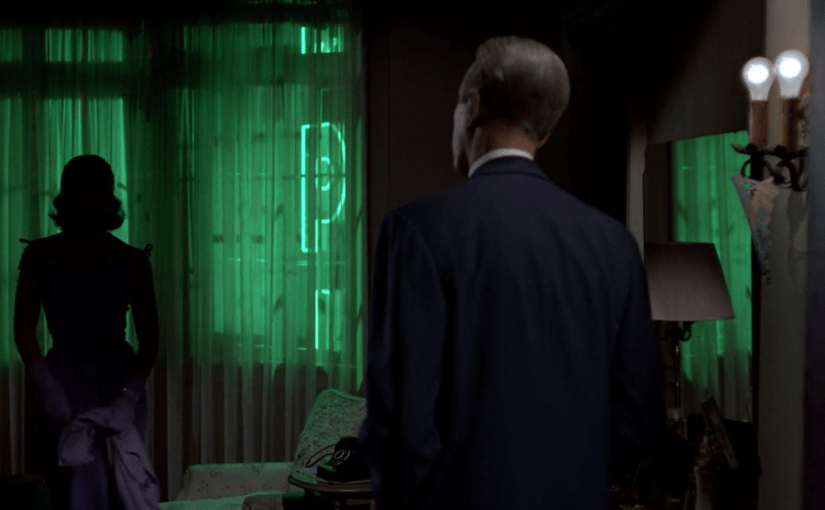
I was fortunate to see the movie following a painstaking restoration after the film was uncovered to be in terrible shape.  Now, it is preserved on 4K disc, and Vertigo is tantamount to the necessity of 4K.  Firstly, as Scotty continues to oversee where Madeline goes and what she does, Hitchcock keeps much of her activity bathed in a rich emerald green.  Green almost works like breadcrumbs for Scotty.  She drives a green car.  Many of her elegant dresses have green in them.  Hitchcock lights many of her scenes in green.  Oddly enough though, while green is so apparent from Scotty’s perspective, Madeleine’s overall purpose and intent is such an enigma.  So, film historians proudly recall how the most popular outfit for the bleach blond Novack to wear in the film is a plain, simple grey suit which tells us nothing.  Grey is melancholy, seeming to express no kind of emotion.  Not fear, or anger or love, or happiness or sadness.  The suit even becomes a significant plot point later in the picture.  The woman is there plain as day, at times shining in the emerald car, or beneath a green light, but why is she there? 

As well, Scotty’s continued pursuit and eventual love affair with Madeleine overcomes him and he spirals into a madness highlighted in reds and blues and oranges with spiral lines turning into bottomless pits.  Hitchcock even imposes haunting animation to show how Scotty’s mind is splintering and falling away from any depth of reality.

I have seen clips of the original film and the colors are so faded out.  It takes you out of the picture.  The color is so pertinent to the narrative of Vertigo that there was no question.  The movie had to be restored.  Watch this movie on 4K.  You won’t regret it.

Have you looked at the well-known marquee poster for Vertigo lately?  It is definitely one that’s consistent to dizzying turns and descents to overtake the movie.

Furthermore, the opening credits of the film zoom into the pupil of a woman’s eye and then spiral sketches start to turn and spin.  It’s easy to connect this to the side effects of Scotty’s acrophobia.  He gets dizzy.  His visual perspective draws him out of measured reality.  As the film progresses, though, it goes further than that.  Hitchcock turns Scotty into a man crippled with obsession. 

I heard my Cinephile colleagues discuss this film recently, implying that Vertigo is not their favorite.  They didn’t like James Stewart’s character.  For one thing he falls in love with Madeleine, his friend’s wife. The Cad!!!  Later, he invokes unequivocal dominance over a new woman he meets in the second half of the picture.  (I won’t say much more, here.)  He insists the woman dress like Madeleine and do her hair and makeup like Madeleine.  She also needs to walk like her too.  Stewart and Hitchcock really put this protagonist through the ringer.  He’s first crippled with a fear of heights.  However, dominant obsession interferes with him as well.  Is it the acrophobia that is so debilitating, or is it a sick obsession that comes into play?

San Francisco is an ironic setting for a film where the main character has a fear of heights.  It’s made up of steep hills that descend from high tops, or ascend into the sky.  Try climbing the staircases that stand upon these hills and now you are even closer to the heavens and further away from the ground.  How could a guy like Scotty Ferguson live in such a city?  Yet, here it is.  Maybe it was a sick, subtle joke of Hitchcock.  I think it’s a nice touch to amplify the suspense.

James Stewart is just as good here as he was in Rear Window.  The likable fellow who serves as a sponge to what’s laid out before him.  If he absorbs too much though it could defeat him altogether.  Much of the suspense Hitchcock is known for, stems from this thread line.  Stewart’s Hitchcockian characters get drunk on needing to know more, and delve even further.  The audience can’t help but get intoxicated with him.

Kim Novack is radiant.  She gives an especially incredible acting performance.  Through the first half of the picture, she’s quiet and reserved laying credence to what Gavin suggests to Scotty.  Is she being possessed by a young woman with odd resemblances too her, who killed herself back in the 1800s?  Is it something else?  Her turn in the second half of the picture leaves you questioning if you are even watching the Kim Novack.  An amazing double performance from her that lends to one of the twists that Vertigo offers.

Pictures like Vertigo and Rear Window are so important for people to see.  These films laid the groundwork for much of the horror, macabre and disturbingly mysterious stories shown today.  They are pioneering films that only invent what needs to be shown.  In other words, they don’t get diverted in overcompensating with action and gore.  Many films that derived from Vertigo desperately turn to blood and over the top stunts and visual effects.  Alfred Hitchcock thought about how the actors, the settings and wardrobe, along with his cameras, would capture the terror and embrace the unknown.  Filmmakers need to continue learning from a craftsman like him.

REAR WINDOW

By Marc S. Sanders

Alfred Hitchcock’s beloved classic Rear Window remains absolutely relatable today.  Before the age of the internet and reality TV, people already had a voyeuristic instinct about them.  Heck, movies are voyeuristic!  The audience watches the behaviors and actions of people on a large screen.  Snooping into the activities within your neighbor’s private apartments is not much different.  Though likely less ethical.

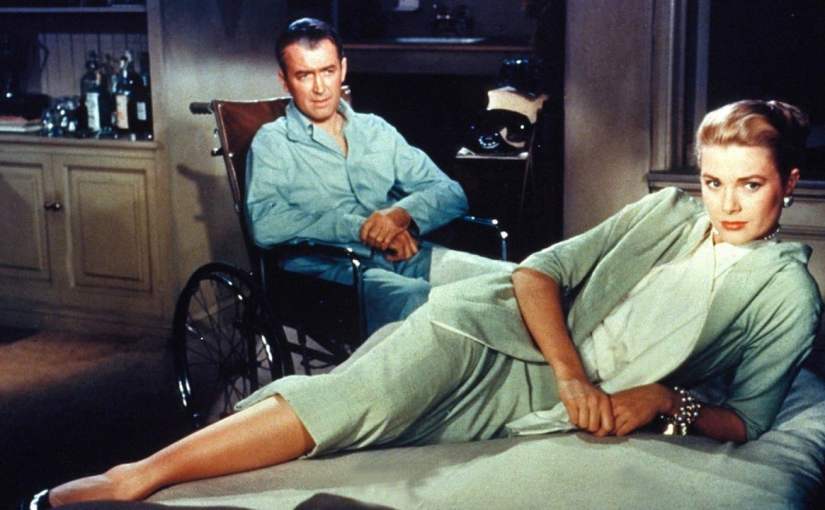
When photographer L.B. Jeffries, aka “Jeff,” (James Stewart, in one of his most famous roles) is bound up in a wheelchair with his broken leg wrapped in a waist high cast, there’s not much adventure like his traveling career demands.  So, he gets caught up in looking at the goings on of his Greenwich Village apartment neighbors like a beautiful hourglass figure dancer he dubs “Miss Torso,” or the newlywed couple and their never-ending sexual escapades.  There’s also an elderly couple who find comfort in sleeping at night on their outdoor balcony next to one another.  He can also take pleasure in a struggling musician trying to write his next piano tune while also entertaining a collection black tie guests.  Another woman he dubs “Miss Lonely Hearts,” for her desperate attempts at entertaining herself with imaginary escorts she’s “invited” for dinner, also leaves him curious to keep up with.

The most inquisitive occupants in this building are a husband (Raymond Burr) and his seemingly ill and often irritating and nagging wife.  Over one rainy night, Jeff takes notice of the husband leaving his apartment with a suitcase at three different times and the wife is nowhere in sight ever again thereafter.  Later glimpses of the husband handling a carving knife, a saw and some rope tied around a storage trunk are also eye opening.  Jeff recounts this sequence of events to his desperate love interest, Lisa (Grace Kelly, with a gorgeous on-screen entrance in one of costumer Edith Head’s legendary dresses) and his nurse caretaker Stella (a smart allecky and perfectly cast Thelma Ritter).  When the likelihood of murder has probably occurred, Jeff also lets his detective friend Tom Doyle in on what’s seen.  All seem skeptical at first. 

Now the action of murder is never seen by Jeff, nor by the audience, mind you.  For the most part, Hitchcock limits the viewer only to what Jeff sees with his own eyes or with the help of his binoculars and his long lens camera.  Midway through the film, the director allows Jeff to doze and gives us a glimpse of something the husband does.  Now, we the audience, have a slight edge of knowledge that our hero doesn’t.  This plays with Hitchcock’s approach to suspense.  We know there’s a “bomb” under the table.  The people sitting there don’t however.  It pains us to wonder if our protagonists will discover the bomb before it goes off.

I’m a big fan of Alfred Hitchcock movies because they never get too complex.  The stories he chose to direct normally place an everyman in a scenario he/she never expected to find themselves in, much less be invited to.  With a screenplay from John Michael Hayes, Hitchcock puts out only a few pieces of a puzzle.  Then, it’s up to his handicapped hero and the audience to solve it.

The voyeurism for Jeff seems like a harmless vice while his time at home slowly passes painstakingly by.  Hitchcock and Stewart do very well in assembling this film.  A close up of Stewart will have him turn his eyes to his right and then we will see what the newlywed couple are doing.  Then we will cut back to Stewart and see his reaction with a smirk.  A look down will cut to the dog, curiously digging away in a flower bed.  Then once again back to Stewart for a close up that maybe has him wondering if the dog is getting at something pertaining to this husband and his now missing wife.  The smirk leaves Stewart’s face.  Now, it’s an expression of puzzlement.

I noted earlier that Rear Window can easily be related to what drives people’s obsessions today.  We are people driven by internet surfing and television streaming and social media.  The known statistic that half of marriages end in divorce is still prominent.  (Maybe that percentage is even higher by now.) Stewart’s character of Jeff becomes so obsessed with keeping up with these people’s stories, that he hardly finds time or enthusiasm to accept the romantic gestures of Lisa.  It’d be fair to argue that technological devices of today serve as an equal distraction in relationships.

Grace Kelly is well cast here.  Arguably one of the most beautiful women to ever appear on screen, dressed in some of the most artistic and fascinating costumes provided by Edith Head, and even she can not divert Stewart’s attention away from the activities of others that Jeff doesn’t even have an intimate knowledge of.  Kelly begins her performance in the film with an approaching close up followed by a sensual kiss upon a sleeping Jeff.  She arranges a catered dinner, delivered by the renowned New York restaurant, Twenty-One.  It just doesn’t completely sway Jeff away from what he becomes obsessed with.  Much like people are with social media, Jeff has been addicted to his vice.  When Lisa tries to implore with Jeff to take their relationship further, James Stewart raises his voice to tell her to shut up and insists that her beautiful hairstyles, wardrobes and high heel shoes could never keep up with him on his travels to far off deserts, jungles and war-torn areas that he photographs.  Yes, Jimmy Stewart tells Grace Kelly to shut up.  It’s shocking.  However, maybe the film will eventually demonstrate that Jeff really doesn’t know anything about Lisa.  The everyman of cinema at that time has been corrupted by what he’s focused on, and in an Alfred Hitchcock film, it is bound to get him into more trouble than he ever expected.  More importantly, the one who cares for him may open his eyes to what he really can’t see as this mystery proceeds.  Broken leg or not, Jeff has never truly seen the real Lisa.

I recall visiting Universal Studios in Orlando, Florida when there was an Alfred Hitchcock attraction there.  I miss it.  It was taken over by a Shrek ride and soon it will be another Minions adventure.  Before ever having seen Rear Window, the attraction featured a look at the Greenwich Village courtyard setting of the film.  It was fascinating.  It was four floors of apartments directly across a courtyard that had a flower bed, folding chairs and the like.  There was also an alley that presumably led to a bustling New York City street.  Naturally, you couldn’t see much of the street.  Just a sliver.  Hitchcock arranged with Paramount Pictures to build the set this way.  Audiences would have wide open views of activities within the window frames of these apartments, the hallways beyond the front door of each dwelling and that one slim alleyway.  The viewer is as limited in what can be seen as Jeff.  This mysterious husband may be going somewhere at odd hours of the night, but once he passes that alleyway, there’s no way of knowing where he went.  Today, we might call something like this one of those “Escape Rooms.”  Solve the mystery, but only with what you can see and only from your one stationary position.  If something takes an unexpected direction, you could find yourself in danger without any means of escape.  That’s how Hitchcock sets up the limitations for Jeff.

As the film progresses, Lisa proves that she can be adventurous like Jeff claims that she isn’t.  In her beautiful gown, heeled shoes and coifed hairdo, she climbs into the apartment of the likely murder suspect looking for clues.  Jeff, however, can’t do anything but watch.  There’s not much he can do either even when the suspect returns while Lisa is still there.  He’s helpless to help her or even himself.  This assembly of direction again falls in line with the “bomb under the table” idea.  It’s one of many devices Hitchcock uses to keep Rear Window as suspensefully entertaining as it was for audiences in the 1950s.

Few directors still can’t keep audiences on the edge of their seat like Alfred Hitchcock.  He had such an intuition for knowing what would keep viewers engaged and wanting to know more.  Unlike other films from him, there’s not much of a twist to Rear Window.  The resolution falls in lifting the veils.  Jeff must reveal himself to this mysterious husband.  (When they come face to face finally, Hitch is smart to position Jeff as a silhouette in darkness.)  Lisa must show Jeff a side to her that he refuses to acknowledge in order to save their relationship. Most importantly, a mystery has to be confirmed.  You find yourself more and more breathless as the film moves on, and then more facts are revealed implying that Jeff is truly on to something.  When the picture finally ends, if you got caught in Hitchcock’s web of suspense, you’ll likely let out a satisfying sigh of relief.