SILKWOOD

By Marc S. Sanders

As the 1980s were setting its stride, Silkwood might have been one of the earliest in a line of films to focus on the union worker who fights back at the billion-dollar corporation.  Some might unfairly regard the movie as The China Syndrome, Part II. Other well-known pictures of this mold are even more familiar to me like Michael Mann’s The Insider.  However, director Mike Nichols, working with a first screenwriting effort from Nora Ephron who partnered with Alice Arlen, showcases the aggravation on not just Karen Silkwood, the real life potential whistleblower, but also her friends and co-workers in a one factory town just outside of Oklahoma City.

Karen (Meryl Streep) lives with her boyfriend Drew (Kurt Russell) and her best friend Dolly (Cher) in a run-down house in the middle of nowhere.  They ride to work together at the local plutonium manufacturing plant where they dress in scrubs and gloves. Punch in, punch out kind of days, and often they are expected to work double shifts and weekends.  Karen works an assembly line where she places her hands in rubber gloves and assembles dangerous combinations of chemicals in an enclosed box.  It’s also routine that before you leave your station you wave your hands over a sensor to ensure you have not been exposed to radiation.  There’s even sensors you walk through as you enter and leave the plant.  When those sensors go off, a calm kind of film seemingly turns into a horror movie.  The last thing anyone could ever want is to get “cooked.”

Karen does not live a perfect life.  Her three kids reside with their uncompromising father in Texas.  Money is not ideal.  Dolly is a slob and has also invited her girlfriend to live with them.  Karen can manage with all of this, but when she observes some unconventional activities around the factory she gets up the nerve to head the union for better protection and working conditions.  However, the further she goes looking at files and photos, jotting down notes of what people say and do, plus taking trips to Washington DC, and getting phone calls from attorneys at night, she becomes more and more isolated from Dolly and Drew, along with the rest of her close-knit workers.  Karen is not just risking her job, but everyone else’s jobs and worse her own life.

The attorneys lay it out to the townsfolk and the union of the horrifying statistics that go along with radiation exposure.  The tiniest fraction of a miniscule of exposure to the smallest crumb of chemicals could increase a human’s bearable limit towards radiation and cancer.  The sad irony is that the more that is learned, the more the people of this area smoke and smoke some more.  Granted, this story takes place in the early 1970s, though.    

The company is primarily represented by an intimidating Bruce McGill.  He’s great in everything he does and is worthy of an Oscar nomination somewhere.  M Emmet Walsh has no lines but his presence is enough to shake you; the slimy guy you easily recognize from every other movie you have seen.  While the company’s overbearing intrusion is shown plenty, the script for Silkwood focuses more on how these working people get by.  They are treated unfairly and in dangerous working conditions, but they also know this is the only place that offers steady income in the area.  Without this factory, the whole town would be left in dire straits.  Karen is repeatedly told or implied to leave well enough alone.

Meryl Streep notches another harrowing performance on her resume and bears such a departure from more sophisticated characters found in Sophie’s Choice and Kramer Vs Kramer.  Karen Silkwood is not educated and she bears an unmistakable white trash dialect but she’s also not stupid and the more progress she makes at exposing the plant’s shortcomings the more unfairly she is treated with department transfers and workplace shake ups that she is indirectly blamed for.  Potential threats on her life begin to build, but she only upholds a bravery.  You really observe the strength of Meryl Streep.  She’s at the top of an elite class of actresses at this time that also included Sally Field, Jessica Lange and Glenn Close.

Cher plays Dolly in her first on screen role.  The variety act performer probably subjected herself to a bigger departure than Streep.  She was not a professionally trained actress at the time.  Mike Nichols insisted on no makeup along with her hair unkept and flat, while dressed in green chino pants and baggy sweatshirts.  The new actress carries herself so well without the usual glitz that accompanies her.  Her scenes with Streep are workshops in acting technique. 

Kurt Russell delivers another understated performance.  One of the best actors out there who has never been enough of a critical darling.  Drew is likable and Kurt Russell plays him as a settled in match for Streep’s portrayal of Karen.  Watch how they tangle up in each other’s arms in bed or when he snaps at her as she carries on her crusade while he’d rather things be left alone.  His timing is perfect for the script.

Mike Nichols keeps his film calm, except when the go by the numbers narrative must be disturbed.  A radiation cleanse with high pressure hoses will make you wince.  The factory alarms will terrify you.  Meryl Streep accepts the physical taxations necessary for this setting.  Nichols gets in close with his camera to show how cleansers dressed in scrubs and masks rub Streep down until her skin is a burning red.  I distinctly remember how her right ear appears in this scene, getting flushed by something just short of a fire hose, and the aftermath of her sitting in a chair is so discomforting while a company doctor assures her that there’s not much to worry about as long she brings in her urine samples daily.  In fact, soon all of the employees are tasked with delivering their urine samples.  What kind of place is this?

While Silkwood is based on a true story with a burning question left behind, I do not want to reveal too much.  Many have seen Silkwood since it was released over forty years ago, but as the third act begins, the fallout only becomes more disturbing and Mike Nichols directs a horrifying sequence built primarily on the pealing of old wallpaper.  That’s all I want to suggest. 

Karen Silkwood was a very unlikely crusader.  She probably never envisioned what she would become and what she would fight for.  Yet, she uncovered horrible truths that should not have been occurring under the eye of billion-dollar corporate America.  After watching Silkwood, I can only imagine what else was there to turn over.

NOTE: Another good reason to watch Silkwood is to discover early performances from some amazing character actors who were either just starting their careers or continuing to hide in the crowd. 

Scavenger hunt for Anthony Heald, James Rebhorn, David Strathairn, Ron Silver, Fred Ward, Diana Scarwid, Bill Cobbs, M Emmet Walsh, Craig T Nelson, Tess Harper, Will Patton, Richard Hamilton and Josef Sommer.

SILKWOOD (1983)

by Miguel E. Rodriguez

DIRECTOR: Mike Nichols
CAST: Meryl Streep, Kurt Russell, Cher, Craig T. Nelson, Fred Ward, Ron Silver, Bruce McGill, David Strathairn, M. Emmet Walsh, James Rebhorn
MY RATING: 8/10
ROTTEN TOMATOMETER: 77% Fresh

PLOT: On November 13, 1974, Karen Silkwood, an employee of a nuclear facility, left to meet with a reporter from the New York Times. She never got there.


The tagline for Silkwood (quoted above) almost feels like it gives the game away, but it doesn’t really.  Even if Karen Silkwood’s name isn’t exactly part of the cultural zeitgeist anymore, I am willing to bet that a lot of people know what her name signifies in one way or another.  So, it’s not like the movie’s poster or trailers are spoiling what happens at the end of the film because most of us know.

In any event, Mike Nichols’ film isn’t a nuclear-based thriller, like The Day After (1983) or WarGames (1984), that depends on an unexpected resolution.  Silkwood isn’t about theatrical heroics or bombastic personalities.  It’s a quietly intense character study of an everywoman with an untidy personal life who experiences a seismic shift in her perception and decides she simply can’t stand by and do nothing.  This isn’t a crowd-pleaser like Erin Brockovich (2000), but this film’s story and central character are no less important.

The film goes to great pains to show us how ordinary and messy Karen Silkwood is.  The incidents at the Oklahoma nuclear facility where she works (along with her live-in boyfriend, Drew, and her roommate, Dolly) are almost secondary to the plot, at least for the first half of the film.  Karen has kids that live with her ex-husband and his girlfriend in Texas.  Her relationship with Drew isn’t stormy, but it’s not perfect.  Dolly seems tolerable as a roommate, but is not shy about speaking her mind.  Dolly brings a girlfriend home one night, and there is a slyly amusing conversation between Karen and Drew about Dolly’s sexual preferences.  (“I can handle it.”  “Me, too.”  “…so why are we talking about it?”)

I don’t want to go into too many details about the true-life incidents that occurred at the facility where Karen worked because, if you’re not intimately familiar with the facts of the story, they should be as surprising to you as they were to me.  Plutonium is involved, but probably not in the way you’re thinking.  Karen learns enough to know she should be more involved in the factory’s union…a LOT more.  One plot thread almost feels like it’s ripped off from The China Syndrome (1979), until you realize Syndrome was released four years after the events of Silkwood, so if anything, Syndrome was probably inspired by Karen’s discoveries.

I also have to mention Cher as the roommate, Dolly.  Of course, Meryl Streep is amazing and convincing as an everyday, average divorced mom, but Cher more than holds her own in every scene.  There is absolutely no hint of the pop music megastar of the ‘70s in this film.  Director Mike Nichols insisted she wear little or no makeup in her scenes, which went against every fiber of her instinct as a performer.  She understood the assignment: she never upstages anyone.  This is not a grandstanding kind of supporting role, like Tommy Lee Jones in The Fugitive (1993) or Cate Blanchett in The Aviator (2004).  It required subtlety and understatement, and Cher delivered.  I tried to spot her “acting,” and I never could.  She was unbelievably natural and, at times, heartbreaking.  The movie is almost worth searching out just to see her performance.  It’s a clinic in how to own a small role and make it stand out by doing less than you might expect.

Silkwood may not feel as thrilling as some of the other thrillers I’ve already mentioned, but it is just as compelling, specifically because we’re watching an ordinary person under extraordinary circumstances.  We’re not watching a hero triumphantly rise to the occasion.  We’re watching a struggling divorcee who’s trying to do the right thing after years of inaction, even if it means losing the trust of her co-workers or sacrificing her other personal relationships.  I identified more with Karen Silkwood and her situation than I did with Jane Fonda in The China Syndrome or Julia Roberts in Erin Brockovich

The ambiguous nature of the film’s ending mirrors what happened in real life, and when the credits rolled, I felt a surge of empathy for the people left behind and the unanswered questions they live with to this day.  That doesn’t happen to me very often.

MEET THE PARENTS

By Marc S. Sanders

Am I the only one who used to get tired of feeling sorry for Ben Stiller?  The go to formulas of his earlier comedies made him the unfortunate stooge.  The best of that batch was The Farrelly Brothers’ hilarious There’s Something About Mary.  Every gag, every cast member, every storyline was straight up side splitting.  Late last year, during the hurricane chaos in Florida I got around to watching Along Came Polly.  Poor Ben had to play basketball defense against a bare chested wookie hairball of a guy and his close up of misfortune carried the advertising campaign for that movie. 

Back in the year 2000, Stiller suffered through a terrible weekend with an intimidating Robert DeNiro frowning on his every move in Meet The Parents, also known as the first of a “Fockers Trilogy.”  Yeah, Meet The Parents is funny.  You shake your head at the absurd comedy that befalls Stiller’s character, Greg Focker. Though that isn’t even his real name at birthright.  Still, I can’t recall feeling so guilty for one guy’s misfortune that he can hardly ever help to avoid.  This guy is destined to never win, to never overcome, to never live without self-consciousness.

Greg Focker is ready to propose to his loving girlfriend Pam Burns (Teri Polo). First, he has to survive a weekend at her parents’ house where the other daughter is getting married.  Not so easy because first the airline loses his luggage and poor Greg has no clothes to wear, other than what Pam’s pot head brother can provide. Baggy jeans and baggy sweatshirt on a short and svelte Ben Stiller is one sight gag of many.  The guy also has to nonchalantly dismiss his uninviting surname and the fact that Pam’s father Jack (DeNiro) is unimpressed with his occupation.  Greg is not a nurse.  Greg is “a male nurse,” who opted not to go all the way for the MD, even after taking the exams. 

Jack and his wife Dina (Blythe Danner) are less than impressed with Greg’s housewarming gift.  Jack’s precious cat Mr. Jinx is a bit of a problem because Pam can’t keep her mouth shut that Greg is not fond of cats.  Doesn’t make him a bad guy, but does her cat loving father need to know this interesting tid bit, right away?  Pam’s ex-boyfriend Kevin (a hilarious Owen Wilson against Stiller’s pitiful expressions) can do absolutely no wrong – like nothing at all.  The biggest challenge for Greg though is Jack.  Whether it’s Taxi Driver or Meet The Parents or Rocky & Bullwinkle, Robert DeNiro is the embodiment of intimidation. 

Meet The Parents is funny, and it serves no purpose to surrender the many sight gags or one liners that are offered in the film.  I laugh.  I laugh hard when I watch this movie, but I hardly ever feel good about myself.  Poor Greg never catches a break.  He’s in a no-win situation and I’m just uneasy about the whole thing.  The guy chooses not to go swimming because he has no swimsuit. Then Kevin offers one and well…yeah…I’m on Greg’s side and it’s not funny for Greg.  If I was a guest in someone’s home only to wake up late when the whole family is dressed and finishing breakfast, and I’m wearing my girlfriend’s dad’s PJs, of course I’m going to feel insecure.  For the sake of the comedy in Meet The Parents, the set ups are simply awkward situations to laugh at that one guy in the room.  Poor Greg.  Poor, poor Greg. 

In fact, the real villain of Meet The Parents is not even DeNiro’s Jack Burns who has some secrets to hide.  Actually, the unsympathizing bad guy is Teri Polo’s character.  Pam never makes it easy for her boyfriend.  Greg rightfully asks why didn’t she wake him up or why didn’t she tell him her dad is not a florist, or why this and why that, and Pam is naïve to Greg’s justified concern, never empathizing with his position.  In fact, when he tries to explain his feelings, she’s nothing but insensitively dismissive. 

Yes.  It’s a comedy, but I was begging and begging and BEGGING Greg to just leave.  Leave this place.  LEAVE PAM FOR GOOD AND GET OUT OF THIS HOUSE.  You know, like we would tell the counselors in a Friday The 13th flick?  It’s not so much the father as it is his girlfriend who quickly nosedives Greg’s comfort into an inescapable hell.  You know how people love to say Jenny is the villain of Forrest Gump?  Well, I got one better.  Pam Burns is an unthoughtful, uncaring, spoiled brat of a daddy’s girl with nary a shred of consideration for others. 

I despise you Pam Burns – daughter of Jack and Dina Burns, rotten and heartless girlfriend to Greg Focker!!!!! 

MY COUSIN VINNY

By Marc S. Sanders

The American Bar Association’s publication, The ABA Journal, ranked My Cousin Vinny #3 on its list of the “25 Greatest Legal Movies.”  Surprised?  You really shouldn’t be.  

This “fish out of water” film follows a goodfella who did not pass the bar exam until his sixth try.  Now he’s defending his cousin and another UCLA college kid in an Alabama courtroom.  It’s Vinny’s first murder trial.  So he’s gotta learn the ropes of how to dress properly for court all the way up to discrediting material witnesses and demonstrating reasonable doubt to get his clients exonerated.  It’s a great courtroom picture because within the dense slapstick comedy there are authentic lessons to learn about being a member of the Bar and having confidence in yourself.

Bill and Stan (Ralph Macchio, Mitchell Whitfield) are roadtripping through southern America, en route to UCLA, when they get pulled over and framed for the murder of a convenience store clerk.  With no money or hope of retaining a reliable public defender, the young men turn to Bill’s cousin Vinny.  

Straight out of the five boroughs of New York wearing a black leather jacket, black boots and a slick pompadour, Vinny Mancini arrives in small town Alabama.  You know something?  If I didn’t know any better I’d say he looks and acts a lot like Joe Pesci.  With him is his long time fiancée, Mona Lisa Vito (Marisa Tomei, in her very well remembered Oscar winning role). Mona Lisa Vito!  I love when there’s some thought put into a character’s name.

The future looks grim for the accused as Vinny doesn’t know where to begin.  The iron horse Judge Chamberlain Haller (Fred Gwynne) habitually holds the guy in contempt because Vinny can’t shed his New York ways either in wardrobe or proper decorum. The prosecutor played by Lane Smith really doesn’t have to try hard at all.  Though he deliberately gets all Southern showy each time he faces the jury, made up of friendly locals.  In an unexpected and tender moment, the tough guy, Vinny, admits to Lisa that he’s “a-scared.”

I never cared for My Cousin Vinny since I had seen it in theaters.  However, there’s much I appreciated on only my second viewing of this film directed by Jonathan Lynn, an actual law scholar.  Lynn is always striving for an authenticity within the courtroom.  His protagonist might not know anything about being a litigator, but the director ensures that a genuine regiment of customary courtroom behavior, procedure, and theatrics will be upheld even if this is only a silly, little comedy flick.  

Outside the courtroom, there’s primarily an updated George and Gracie situational comedy at play.  Marisa Tomei is of cinema’s great scene stealers.  Mona Lisa Vito might look like an overly familiar character, but the actress’ performance is entirely unique.  She never plays Lisa as a dumb side character to her boyfriend who will not commit to marriage.  Lisa comes off generous, always offering to assist Vinny despite his rejections.  She’s also positively smart as a whip with her extensive knowledge of automotive repairs, and she’s a quick study of Alabama law.  When she gets put on the witness stand it hardly matters what she’s saying.  Marisa Tomei owns the expertise and defiance of Lisa.  Turn the scene on mute to watch her doing some of her best work would be equally effective.

Go look at Silver Linings Playbook when Jennifer Lawrence rhythmically dictates numeric football statistics at Robert DeNiro.  Both actresses won Oscars for these respective roles.  These performances stand apart from so many other second, third and fourth billed actresses because they are written with immense intelligence.  That’s what Tomei and Lawrence normally embrace first, ahead of costume and makeup.  The confidence from these actors is uncanny.  More women need to be cast in roles like these.  

Joe Pesci is doing his reliable, familiar schtick from Goodfellas, Raging Bull and Easy Money.  He’s in a what if scenario though.  What if there’s a movie with Jersey Boy Joe Pesci, but he’s put in Alabama country with roosters crowing and trains chugging into town at five in the morning? There can even be a communication gap between the Judge and Vinny for some padded laughs.  “What is a yoot?”

I was bored with this movie the first time I saw it.  I just didn’t think the humor was funny even if I recognized the attempts.  Over thirty years later, what I appreciate is the heart that feels much more apparent.  The hero feels weak and at a loss.  Only when he is given strength and support from a wisecracking, sexually frustrated girlfriend does he get the drive to behave like a lawyer he’s licensed to become.  I like Vinny.  I like Lisa.  Therefore, now I can laugh at their unfortunate dilemmas as they work towards an end goal – getting him to do his best at becoming a courtroom lawyer and hopefully reaching a not guilty verdict. 

I gotta give a shout out to the supporting cast.  Bruce McGill plays a familiar sheriff that we’ve seen before, but so what.  It’s the way he carries himself that I’m always welcome to see him in a movie.  Same goes for Lane Smith.  These guys are sophisticated Dukes Of Hazzard.  Fred Gwynne, most famously known as Herman Munster, was always a brilliant character actor.  He has the ability to be goofy and intimidating all in the same scene.  To place his towering stature against little Joe Pesci? Who needs dialogue? Watch Fred Gwynne’s moments in My Cousin Vinny.  He could’ve been Oscar nominated, and I would not have complained.  While Ralph Macchio is doing his typical routines (same things we saw in The Karate Kid, The Outsiders and so on), it’s Mitchell Whitfield playing his buddy who really stands out.  This is a nothing role but it’s as if this guy fell out of a Woody Allen or Neil Simon picture to claim his own territory among an outstanding cast.

My Cousin Vinny is one of those comfort films to put on when the stress is becoming too much in real life.  Everyone is so likable here.  There isn’t a villain to dual against.  Instead, it’s a conflict of cultures who must work together to uncover truths within a murder trial while also learning about what any one of us is actually capable of accomplishing. 

Vinny from da Bronx is a lawya???? 

FUGGETABOUTIT!!!!!

SCENT OF A WOMAN

By Marc S. Sanders

When it comes to Thanksgiving films, majority turn to that John Hughes road picture.  However, there’s another film that is just as meaningful to the spirit of the holiday and that is Martin Brest’s Scent Of A Woman which features Al Pacino’s Oscar winning Best Actor performance; at last!!!!

Before Chris O’Donnell became Robin in some tired Batman movies or a tough guy on NCIS, he was the staple prep school achiever (see also School Ties).  Here he plays Charlie, a student attending a prestigious boarding school in New Hampshire.  He does not have the wealthy background of his classmates and without the funds to go home for Thanksgiving, he opts to accept a weekend job tending to retired Lt. Col. Frank Slade, U.S. Army (Pacino).  Frank is a frightening lost soul with Pacino’s signature outbursts.  What’s even more challenging is that Frank has been plagued with blindness following a reckless accident with a hand grenade.  Unbeknownst to Charlie, Frank assumes control once his niece’s family leaves town for the weekend and sends himself with Charlie in tow to New York City.  Frank plans to enjoy a pleasant stay at the famed Waldorf Astoria, have a nice meal, crash his older brother’s holiday dinner, get a new tailored suit, bed a beautiful girl and drive a Ferrari.  Afterwards, he’s going to blow his brains out in full dress uniform.

This is not a problem Charlie needs to be dealing with right now.  The pressure is on the young man to identify the students of a prank that occurred just before the holiday break.  The Dean of Students (James Rebhorn) has given Charlie and another student, the privileged George Jr. (Phillip Seymour Hoffman, in a very early role) the weekend to ponder how they should respond.  Charlie, however, seems to face expulsion and likely an opportunity to miss out on admittance to Harvard.  George Sr., a former student and benefactor, will likely save his son.  Frank has predicted this outcome, and Charlie can’t deny that it is likely the truth.  Charlie’s dilemma is in his own morals as a man.  He’s not a snitch who will sell out his future to satisfy the esteemed integrity of the prep school and the ego of the Dean.

I miss the director, Martin Brest.  He has some magnificent films on his resume (Beverly Hills Cop, Midnight Run & Scent Of A Woman).  His other two popular films are broader in action comedy.  Here he is much more sensitive, and he uses the legacy of Pacino’s craft to the highest level.  He allows Al Pacino the freedom to be intimidating and frightening and intrusive.  A most uncomfortable Thanksgiving dinner at Frank’s brother’s house begins with awkwardness and ends in terrifying fear for Frank and all at the dinner table. 

Brest also lives up to the title of the picture.  There’s really not a main female character in the picture.  However, the camera captures a woman entering the frame at random times for Frank’s heightened senses to kick in.  If Frank is going to end his life soon, then he will at least absorb the finest things the world has to offer and that is a beautiful woman.  Charlie doesn’t realize this yet, having spent most of his days at an all-boys private school.  Martin Brest does such good work.  He’ll position his close up on Pacino doing his work and then a brown-haired young lady will enter from behind.  The scene will shift gears from morose to eye opening. Simple, yet great technique at play here.

Pacino may have won the Oscar, where some debate this was not his finest material and that it was a more likely a long-time coming career award at this point.  The portrayal has also become spoofed so many times over since the release of the film (Seinfeld) and “Hoo Ahh!”.  Still, look at the individual scenes on display here.  There are so many different angles to this guy.  Frank Slade is a lonely man who doesn’t directly identify his sorrow, but rather masks it with drill sergeant persona.  Yet, Frank is also a charming man who graciously does a sensual tango in the middle of a dining room with a beautiful young girl (Gabrielle Anwar).  Reader, if you are a regular subscriber to my write ups, then you know I adore a dance scene that occurs within a non-musical.  Scent Of A Woman may feature the number one ranked scene in that category.  Try not to grin or smile during this marvelous centerpiece.  How fortunate for Anwar – the one woman who got to do a tango on film with the great Al Pacino.  I’m thankful it is cemented in my consciousness for eternity.  It’s an amazing scene; one that can be taken out of context from the film and adored on You Tube, many times over.

Pacino and O’Donnell have brilliant chemistry together and it makes sense that the story takes place during the Thanksgiving weekend.  These are two men from very different backgrounds and neither realizes how much they need to be rescued by one another.  Charlie will have to literally save Frank’s life, no matter how intimidating he appears.  Frank will have to save Charlie’s future against an established school that’s offered up some of the country’s most brilliant minds.  Poor Charlie from Oregon, without the coat tails of a legacy to ride upon doesn’t fit the mold for the next President or championship football coach.  Both issues have insurmountable odds of being overcome, and yet these two are the only ones who plow through the challenges.

Scent Of A Woman has delightful moments to simply watch, such as a blind Frank driving a Ferrari through So Ho district and of course that tango scene, but this is an actor’s piece for sure.  The climax confirms that distinction.  The holiday weekend has come to an end and Charlie must face his peers and the Dean and confirm what he will do, but Frank will make sure to attend this makeshift trial. Then the opportunity is given for an outstanding monologue performance that only confirms one simple notion.  Al Pacino is one of the greatest film actors in history. I imagine the dialogue for this wrap up scene is quite something to read on a page.  However, to watch Pacino bring it to life is something else entirely. 

Therefore, on this Thanksgiving, I’m thankful for Al Pacino and Chris O’Donnell and Martin Brest, along with the tango, and I’m especially thankful for Scent Of A Woman.

THE GAME

By Marc S. Sanders

David Fincher is a director always focused on playing tricks with the viewer’s mind. His earliest films from Alien 3 (a poor installment in a celebrated franchise) to Se7en (an unrealistic yet frighteningly suspenseful serial killer story) to his third motion picture The Game, a movie that throws you off from the beginning of each scene to the end of each scene are best examples of this technique. It’s a little jarring, and I’m happy to watch it that way.

This film only works if you mask what’s really happening by showing you what’s fake instead. I know I sound vague but those that have seen The Game would probably agree that is the point. It’s based off a screenplay (by John Brancato & Michael Faris) that strategizes itself like a Dungeon Master setting up a Friday night in the basement with some buddies to play some role playing games with a 20 sided die.

Michael Douglas is really the only guy who could play Nicholas Van Orton, a millionaire with everything but really has nothing; no friends, no spouse (any longer), no one to care about. Beyond his fortune, all he has are a weirdly estranged brother, played by Sean Penn, and his attorney only there to ask Nicky “Should I be worried?” The film takes place during Nick’s 48th birthday. Normally, the song would go “Happy Birthday Nicky.” However, for Douglas’ cold protagonist, the lyrics are “Happy Birthday Mr. Van Orton.” A man with everything, who really has nothing.

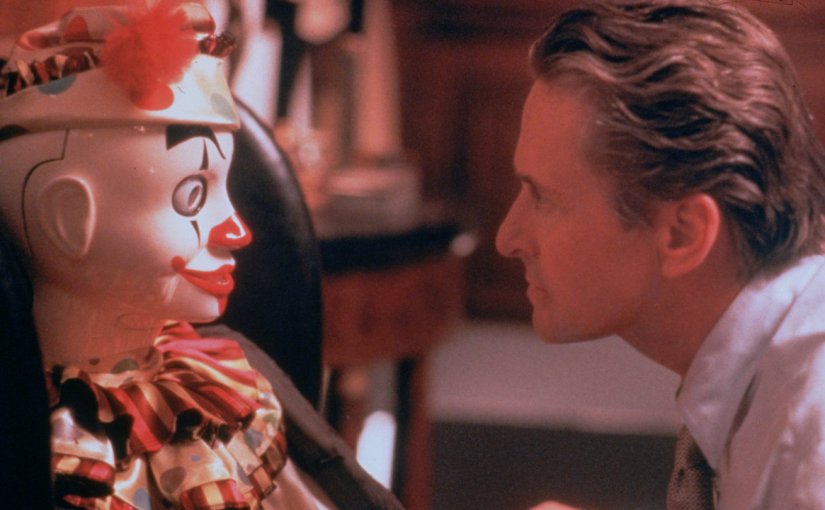
Penn gives him a card with a number to call. This is his birthday present to Nicky. Then the paranoia presents itself little by little; a wooden clown doll, a tv that talks to Nick, a leaky pen, spilled drinks, and soon Nicky’s life is threatened.

Why are these things happening? What’s with the keys? What’s with the waitress who keeps turning up, played by Debra Kara Unger so effectively that she arguably carries the riddles most convincingly? Unger is brilliant at twisting the story over and over. Another great player is well recognized character actor, the late James Rebhorn (also known from Scent of a Woman) who gets the ball rolling and then wraps up the answers later on.

Fincher plays with the mind quietly but never at a slow pace. There’s a consistent tinkling of piano keys that seem to work as puzzle pieces being matched up. It’s much more disturbing to go this route than with grand horns and bass.

When I saw The Game initially in 1997, I started to piece together how to write multi dimensional characters. There’s a past that gnaws at Nick’s psyche sprinkled with glimpses of his father committing suicide. Fincher offers up a background to Nick by means of grainy home movie footage. It all seems quick and taken for granted but it’s necessary to understand Douglas’ cold demeanor and it circles back beautifully towards the film’s unexpected ending. It works so well as a motivator for Nick that I often circle back to its presentation when I write my own scripts.

There’s a great, short scene that sets up the 3rd act. Probably Michael Douglas’ best scene ever in a film, in my opinion. Nick walks into a diner in a dirty suit with scratches on his face. He asks for everyone’s attention and offers up his last $18 to anyone who can offer him a ride. The character is humbled and changed. An arc is completing itself on the other end. It’s a scene that maybe doesn’t belong here until you realize it does. In another director’s hands, a scene like this would be cut or never shot. Fincher took advantage of Douglas’ technique for substituting intimidating power with humble gratitude to simply be able to just ask for a favor. A new character is born in a most efficient 90 seconds of film. It’s a great moment.

See The Game whether you haven’t seen it yet or to watch it again to remind yourself how all the pieces come together.

You might argue that this can’t be realistic but suspend your disbelief because that is what David Fincher always strives for. You’ll be glad you did. Trust me, or maybe…don’t trust anyone?!?!?!?