
By Marc S. Sanders
The China Syndrome explores the inherent risk that comes with a reliance on nuclear energy. It also touches upon the moral choices within the field of journalism. Most importantly though, it’s a hell of a thriller.
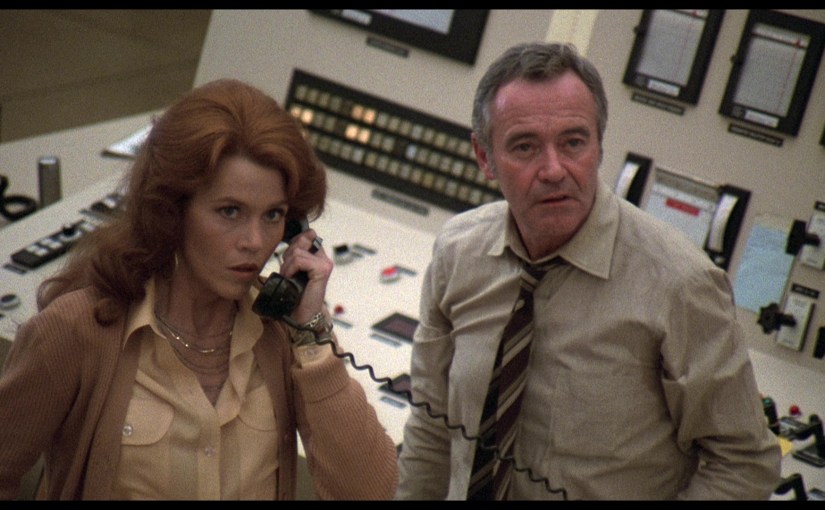
Kimberly Wells (Jane Fonda) is an on the scene reporter doing light fare topics for the evening news, like the novelty of singing telegrams for example. With her subcontractor cameraman, Richard Adams (Michael Douglas, also one of the film’s producers), they cover a story on how a nuclear power plant operates. During their tour, a very frightening accident stops short at only being a threat. While the top brass at the company downplays the incident, Richard manages to record the panic-stricken activity happening among the operators in their soundproof control room. As Kimberly and Richard gather information about what really happened, they are told they only were so close to what can be described as a China Syndrome – the underground nuclear rods could have overheated, imploded and the blast would have ruptured through the core of the earth where even China could feel it on the other side of the world.
The corporate elites (led by Richard Herd) are the villains of this picture. The could be hero is Jack Godell (Jack Lemmon), a could be whistleblower. Jack oversees the whole operation and following that frightening scene begins to do his own kind of investigation. What happened only makes sense because due diligence was not upheld, and inconsistencies are being neglected. Problems are only expected to get worse because they are not contained. There would be an enormous monetary expense that will put the company at a loss. Initially, Jack wants to remain quiet, but the idea of what he’s certain will eventually happen is conflicting him. As well, Kimberly and Richard’s pursuit of what truths he holds is gnawing at him.
Jack Lemmon is a frazzled, yet sensible, marvel in this film. I love the unspoken subtleties of this guy. Best I could see is that Jack Godell is unmarried and has no children, nor friends beyond the faint connections he shares with his work colleagues, particularly one played by Wilford Brimley. This only enhances Godell’s isolation in a them-against-him matchup. Lemmon is great at emoting a sorrow and regret to his character. He tells the journalists that he loves that plant. It’s all he has in life and now it spells a certain, eventful doom if the faults in operation are not exposed. Like Michael Mann’s The Insider, which was released over two decades later, the unlimited resources of this company will do everything in their power to silence this liable peon who works for them.
The other side of The China Syndrome focuses on Fonda’s character. When this film was released in 1979, it was the norm to not take a woman reporter seriously. They were best used as attractive figureheads with beautiful hairstyles and well applied makeup to shift the seriousness of the news over to stories about dogs who can do tricks or hot air balloon happenings. This film could have made more of a campaign to embrace the female journalists with heavier topics. Instead, Jane Fonda’s character is not a fighter so much for deserved recognition in a male dominated world. She’s actually just trying to circumvent around the unspoken chauvinism of her industry and get to the heart of this story that she witnesses firsthand. The news station would rather her efforts be focused elsewhere.
Richard, the cameraman, is not embraced by Kimberly’s news station and therein lies the debate of airing what appears to be a story of urgency for the benefit of the public. Yet, the station does not want to face a lawsuit. What do the principles of journalism mandate even when there’s a monetary and reputational risk to their institution?
Plenty of films with these kinds of dilemmas have come out following The China Syndrome. What’s remarkable is the authentic feel of this fictionalized account. Ahead of the release, the real-life companies that were developing a need for nuclear power were lambasting this film, insisting there was no validity to this story. They were adamant that the production and maintenance of nuclear power was completely safe and well monitored. Twelve days after this film hit theaters in March 1979, the Three Mile Island accident occurred in Harrisburg, Pennsylvania when a partial nuclear meltdown of a reactor occurred. Traces of harmful gases and iodine were released into the atmosphere, and the incident was rated a Level 5, an “Accident with Wider Consequences.” I do not believe Michael Douglas and his co-producers/filmmakers necessarily set out to make a statement. Though there are protesting movements peppered throughout the film. It’s a frightening irony, however, when life imitated fiction.
Jane Fonda and Jack Lemmon put the suspense of The China Syndrome into play. There’s an awareness to what could happen with technological advances in nuclear energy especially if they are not carefully observed and addressed.
Over forty years later, do we really know what’s going on and even if we did, what could any of us do about it?
 2 UNPAID MOVIE CRITICS!!!!