
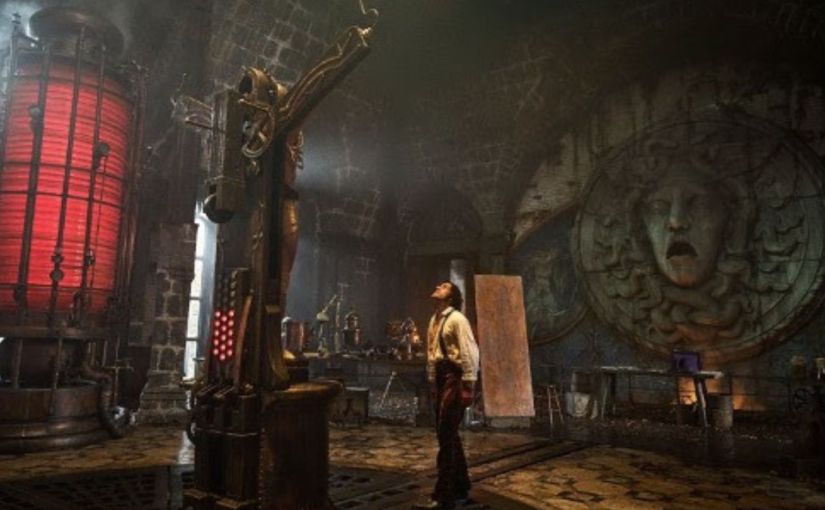
FRANKENSTEIN (2025)

by Miguel E. Rodriguez

DIRECTOR: Guillermo del Toro
CAST: Oscar Isaac, Jacob Elordi, Christoph Waltz, Mia Goth, Charles Dance, David Bradley
MY RATING: 8/10
ROTTEN TOMATOMETER: 86% Certified Fresh

PLOT: A brilliant but egotistical scientist brings a creature to life in a monstrous experiment that threatens to undo both the creator and his tragic creation.


Having never read the original novel by Mary Shelley, I have no idea if Guillermo del Toro’s rendition of Frankenstein is any more or less faithful to the source material.  What’s interesting about this version is that it feels like it is.  There are long passages of dialogue and even some monologuing on the nature of life, death, and the creator’s responsibility to their creation.  del Toro is smart enough to balance these cerebral discussions with enough gothic (and gory) horror to satisfy any fan of the genre.  Call it a good example of a thinking man’s horror film.

Oscar Isaac’s performance as Victor Frankenstein puts a new spin on the stereotypical mad scientist.  He’s no less obsessed than previous versions, but del Toro and Isaac went for a slightly different vibe in his personal appearance.  Rather than a cackling lunatic with a god complex, Isaac’s doctor looks and sometimes behaves more like a self-absorbed rock star…with a god complex.  (I learn on IMDb that this was by design; del Toro wanted Victor to evoke David Bowie, Mick Jagger, and Prince…mission accomplished.)

Jacob Elordi as The Creature does an admirable job of generating sympathy and empathy for perhaps the greatest misunderstood monster of all time.  The unique makeup (which took up to 10 hours to apply!) allows Elordi to emote and lend humanity to the Creature in the second half of the film, especially during his encounter with the blind man.  There is a subtle but ingenious effect where one of his eyes will sometimes glow orange with reflected light as a reminder that, when push comes to shove, this Creature is not to be trifled with.

Mia Goth is a welcome presence as Elizabeth, who is not Victor’s love interest this time around, but fiancé to Victor’s younger brother, William.  I supposed I could quibble that the screenplay does not give Elizabeth much to do.  She comes across as the intellectual equal of Victor in a few well-written scenes, but her encounter with the chained Creature felt a little trope-y, and her character’s payoff left me wanting more.

The visual style of the film is crammed with del Toro’s signature fingerprints: huge gothic structures, elaborate costume designs (loved Victor’s mother’s red outfits near the start of the film), startling dream sequences, and lots of practical effects…well, more than there were in Pacific Rim (2013) and Crimson Peak (2015), anyway.  One image that really struck me was the unique design of two coffins seen in the film.  They looked more like futuristic cryogenic chambers than Victorian-era caskets.  Watch the movie and you’ll see what I mean.

Other things I loved:

  1. Victor’s early presentation of his theories to a disciplinary board, in which we get an echo of that creepy dead guy resurrected by Ron Perlman in del Toro’s Hellboy (2004).
  2. The towering set for Frankenstein’s laboratory.  What it lacks in the whirring, crackling machinery we normally associate with his lab, it makes up for in scale, including a yawning pit several feet across that really should have had a guardrail.
  3. Being able to get inside the Creature’s head this time around.  There have no doubt been other variations where the Creature speaks, but I haven’t seen one where he is this eloquent, expressing his pain and anguish over his unwanted existence and apparent immortality (his wounds are self-healing).  This is another factor that makes this movie feel more faithful to Shelley’s novel, even if it isn’t.
  4. The no-holds-barred aspect to the violence and gore, which can be quease-inducing, but which never feels overdone or exploitative.  In fact, the moment that scared me the most in the film had nothing to do with the gore or violence at all, but with one of the doctor’s early experiments that comes to life in a most surprising manner.

Above all, there’s the tragic nature of the poor Creature’s existence, the misunderstood monster that has been so often satirized or spoofed, and the deeper questions the story raises about our own lives.  It might be tempting to listen to the closing passages of the film and dismiss them as trite and sentimental, but Frankenstein earns those moments, in my opinion.  More than any other Frankenstein movie I’ve seen, this one made me think, and jump a little, in equal measures.  Tricky stuff.

SALTBURN (2023)

by Miguel E. Rodriguez

DIRECTOR: Emerald Fennell
CAST: Barry Keoghan, Jacob Elordi, Rosamund Pike, Richard E. Grant
MY RATING: 9/10
ROTTEN TOMATOMETER: 71%

PLOT: A scholarship student at Oxford finds himself drawn into the world of a charming and aristocratic classmate, who invites him to his eccentric family’s sprawling estate for a summer never to be forgotten.


What is Saltburn?

I sit in front of my keyboard and try to figure out a way to write a review of Saltburn that doesn’t spoil its surprises in any way.  I ponder.  I rack my brain.  As of this writing (January 2024), the film has already been released theatrically and in the public eye for almost three weeks.  Any avid filmgoer who hasn’t seen it has heard rumblings about some kind of dark undertones and risqué material in writer-director Emerald Fennell’s follow-up to her astounding debut film Promising Young Woman.  The trailers reveal nothing except a plot that seems almost too similar to another film released over a month ago, The Holdovers.

Having just watched it last night, I can say that Saltburn is a pure thriller, masquerading as a dark comedy about class warfare, heavily influenced by The Talented Mr. Ripley and, say, Howards End, but that’s just plotting.  With this movie, it’s all about style and delivery, both verbally and visually.

First, a plot summary.  Young Oliver Quick (nice Dickensian name), played by Barry Keoghan, is a scholarship freshman at Oxford University in the long-ago year of 2006.  Virtually friendless except for an antisocial math whiz, he notices the strikingly handsome Felix Catton (Jacob Elordi, unknown to me), a very rich…what, junior?  Senior?  Probably a senior.  People of all genders are attracted to him like bees to honey.  Oliver is instantly attracted to him, but that doesn’t stop him from making out with one of Felix’s paramours given the opportunity.  He is nothing if not opportunistic.

After a meet-cute involving a flat bicycle tire, Felix gradually folds Oliver into his flock of hangers-on, much to the dismay of Felix’s cousin, Farleigh (who is brown-skinned…that will be important later), and to Oliver’s math friend, who cryptically tells Oliver, “He’ll get tired of you.”  One thing leads to another, and Felix winds up inviting Oliver to stay at his – there’s no other word for it – palatial manor house, Saltburn.  There, Oliver meets Felix’s aristocratic, idiosyncratic family: Felix’s mother, Elspeth (Rosamund Pike); his father, Sir James (Richard E. Grant); his sister, Venetia (newcomer Alison Oliver); a “friend of the family”, Pamela (Carey Mulligan); and the creepiest butler since that guy in the men’s room with Jack Nicholson in The Shining.

Here at Saltburn, and at Oxford, Fennell proves to be a master at creating a certain kind of mood.  There is an air of…something in the offing.  You know how some animals supposedly know when an earthquake or a tornado is coming?  That’s what the movie feels like during its first half.  I kept expecting a gruesome murder to occur, or for Oliver to discover a literal skeleton in a forgotten closet, or an explosion, I dunno, something.  I don’t know how much of that is due to my expectations after Promising Young Woman and how much to the carefully modulated camerawork and editing, but either way, the mood was there, permeating the screen with a sense of foreboding.

Oliver revels in his proximity to Felix, and I remembered with some chagrin my own formative years as a geeky teenager.  Trust me, I recognize hero worship when I see it.  At Saltburn, they sleep in separate rooms with a common bathroom, but there’s no shower, just an old-fashioned bathtub in the middle of the room.  At one point, Oliver hears…noises…coming from the bathroom and takes a peek inside, where he sees Felix lying back in the filled bathtub and – well, I’m given to understand that in Catholic schools, it was called “interfering with yourself.”

And it’s here I must stop with any kind of summarizing.  It’s here where Saltburn abandons its masquerade as a comedy of manners and becomes something else entirely.  It’s still comic, in my opinion, but it becomes less about manners and more about Machiavelli.  Oliver may present a meek façade, but he reveals the ability to do some very quick thinking indeed, especially in a moonlit scene involving Felix’s sister, Venetia, and during a karaoke party when Farleigh suggests a song for Oliver to sing that hits a little too close to home.

I admired how the movie turned my expectations on their head…twice.  There were a couple of times when, I must admit, my conspiratorial thinking led me to a couple of conclusions that turned out to be right in the end, which is something I don’t really like to do.  I don’t like to be that guy who goes to see The Sixth Sense and thinks, “You know, I don’t see how Bruce Willis could have survived that gunshot…”  I want to revel in the mystery, to live in the moment of the film and let its surprises work organically.  When a movie does its job well, I don’t even have to think about it.

What’s cool about THIS movie is that I managed to pick up on little “clues” about what was happening, or about to happen, but as the movie progressed, other things occurred (especially Felix’s little field trip with Oliver), and I found myself thinking, “Nah, never mind.”  And that is pretty ingenious, I think.  To lead the viewer down the garden path, make a left turn, get back to what looks like the main road so you think you know where it’s headed, then to pull a sudden U-turn into something else entirely?  That’s masterful misdirection.  I dunno, I fell for it hook, line, and sinker.  Call me crazy.

I haven’t even really touched on what will no doubt be the most famous elements of this movie.  That would be the scenes involving the bathtub, the cycle of the moon, a surprise midnight visit, a freshly dug grave, and Oliver’s, er, choreographic inclinations.  With the exception of that last one, which occurs too late to mean anything to the plot except as a wonderful ribbon to tie it up with, these scenes were, yes, shocking, but not in a hostile way.  Or even a Hostel way, if you take my meaning.  They were not intended to disgust or horrify the audience.  Or perhaps they ARE meant to horrify, but not in the kind of way that a serious horror movie disgusts people, like The Thing or Hellraiser.  It’s very tongue-in-cheek.  I’d like to believe there was a certain kind of glee in Emerald Fennell’s face when she watched her actors performing those scenes, knowing the material might completely turn some people off to the film without hesitation.  I found them to be yet another example of misdirection.  The off-putting nature of those scenes sort of lulled me into thinking one thing was happening and that the movie would then follow that thread into a more predictable conclusion.  But it didn’t.

I know, I’m being maddeningly vague.  The movie is new enough that I don’t want to risk spoiling anything.  There are supposedly some moths that, once touched by human hands, can never fly again.  Or is that butterflies?  Either way, I don’t want to deprive this movie of flying high in the eyes of a first-time viewer.  It’s refreshing to see a movie that seems to be following all the mile markers towards one thing, when it was really leading you somewhere else.  Saltburn is a treasure.