YOUNG GUNS

By Marc S. Sanders

In the late 1980s a novel idea hit the screens.  An MTV interpretation of the Old West with a rock anthem soundtrack of electric guitars and drums. A far separation from Ennio Morricone’s unbeatable spaghetti western approach.  

The film was Young Guns, featuring handsome stars like Emilio Estevez, Kiefer Sutherland, and Lou Diamond Phillips.  They were each different kind of gunslingers in their own right while delivering stand out personalities.  The film has some problems in editing, and some sequences do not work.  Yet, it remains stylish with impressive set designs, props, costume wear, and an especially appealing array of performances from the whole cast.  

Billy The Kid aka William H Bonney is one of the most notorious outlaws in American history.  Emilio Estevez brilliantly turns the gunslinger into a quick draw joker with an addictive cackle and an adorable smile.  William is taken in by the mentoring John Tunstall (Terence Stamp) who already oversees a collection of orphaned young men.  He’s teaching them to bear responsibility on his farm while they learn proper manners at the dinner table and how to read.

A neighboring industrial enemy, L.G. Murphy (Jack Palance) commissions his men to gun down Tunstall.  Billy and the rest of the gang are then deputized by the local Sheriff to issue warrants for the arrest of the killers.  However, Billy repeatedly exercises his own form of justice by killing one guy after another with his pair of six shooters.  Soon after, the boys are on the run by horseback while creating a whole bunch of mayhem.

I never considered Young Guns to be a perfect film, but I like it a whole heck of a lot.

There are moments that serve no purpose, like when the men get high on peyote, introduced by the Navajo, Chavez Y Chavez (Lou Diamond Phillips).  It’s not amusing.  It’s not quotable and the scene runs too long as we watch the cast walk and talk while in daze.  Frankly, most movie scenes of just watching people get high are boring.  Often, they go nowhere and I’m not sure how to respond. It’s like I’m the designated driver fiddling with my car keys at a drunken binge fest. This is no different.

As well, there seem to be gaps within the body of the story. I know it is inspired by the Lincoln County War, but it’s never entirely clear why Tunstall and Murphy are at odds with each other.  We just have to accept that the two elderly men of equal proportions are against one another.  Still, Palance versus Stamp is a very inviting conflict to look at. (Supposedly, the real John Tunstall was only in his mid-20s.)

Young Guns has a very cool polish.  These cowboys are downright attractive, sexy like Hollywood movies tend to offer, and I love how they handle each other, their horses and their pistols.  Every time a six shooter whips out of a holster and clicks, the movie becomes more alive.  The guys look well-worn within this environment, close to the Mexican border of the 1870s.  The image is just as effective as Clint Eastwood appears in his various assortment of westerns.  

Billy The Kid, over this film and its sequel, is Emilio Estevez’ best role of his career.  The actor has such a cocky, nervy way about him and his over-the-top laugh is impossible to forget.  A favorite scene in all of movies emerges when Billy toys with a bounty hunter in a saloon.  Estevez delivers much fun before gunning the guy down. I never tire of watching that moment.

Kiefer Sutherland is second in line with a graceful sensitivity as the educated and poetically romantic Doc Scurlock.  You worry about him and his courting affair with a young Chinese concubine that is owned by Murphy.  Lou Diamond Phillips specializes in knife throwing as Chavez, the token Navajo.  His presence belongs here as an unpredictable sidekick.  

The best surprise is delivered by Casey Siemaszko as the virginal, boyish illiterate Charlie.  Some gunslingers were afraid to ever become outlaws.  Charlie is ugly and dirty, bumbling and sweet, reminiscent of Fredo in The Godfather films.  Siemaszko never became as established as the others in the cast, but he’s a good performer who delivers panicked fear and brings the glamour of Young Guns down to a semblance of reality.  

Young Guns is a style over substance product.  It has potential for a stronger storyline, but the dialogue works and the cast is stellar, which also includes Dermot Mulroney, Terry O’Quinn and Charlie Sheen.  The sequel is actually better as it commits closer to the intrigue of Billy The Kid.  

Not perfect, but this is a fun escapist western experience.
SHANE (1953)

by Miguel E. Rodriguez

DIRECTOR: George Stevens
CAST: Alan Ladd, Jean Arthur, Van Heflin, Brandon De Wilde, Jack Palance
MY RATING: 8/10
ROTTEN TOMATOMETER: 97% Fresh

PLOT: A drifter (who may or may not be a retired gunfighter) comes to the assistance of a homestead family terrorized by a wealthy cattleman and his hired gun.


Shane affords me the opportunity to use a word I never get to use in daily conversation: archetypal.  John Ford’s Stagecoach [1939] may be the granddaddy of the modern Western, but Shane taps into something even more primal.

Alan Ladd as Shane is the archetype of the mysterious stranger riding out of the mountains, either coming to the aid of a community who has lost hope (Pale Rider, 1985) or wreaking havoc as an avenging angel (High Plains Drifter, 1973), and then disappearing into the sunset or riding back into the distant mountains.  This formula was probably already old when Shane was made, and the film does little to dress it up or add any kind of pretentious spin to the story.  But by sticking to the formula and really nailing it home, director George Stevens achieved a weird kind of clarity that elevates Shane into a mythical realm.  If it’s not terribly realistic, well…who wants realism mixed in with their magic?  Not me.

Shane is set in the high plains of Wyoming in 1889.  (I don’t remember the exact year being mentioned in the film – I pulled it off IMDb – but we can tell it’s after the war because a running gag involves a harmonica player who always starts playing a Union song whenever a homesteader called Stonewall, who fought for the South, walks into a meeting.  It’s a mark of faith in the intelligence of the average viewer that the screenplay never comes out and explains that’s what’s happening; we just see it and have to put two and two together.  Nice.)

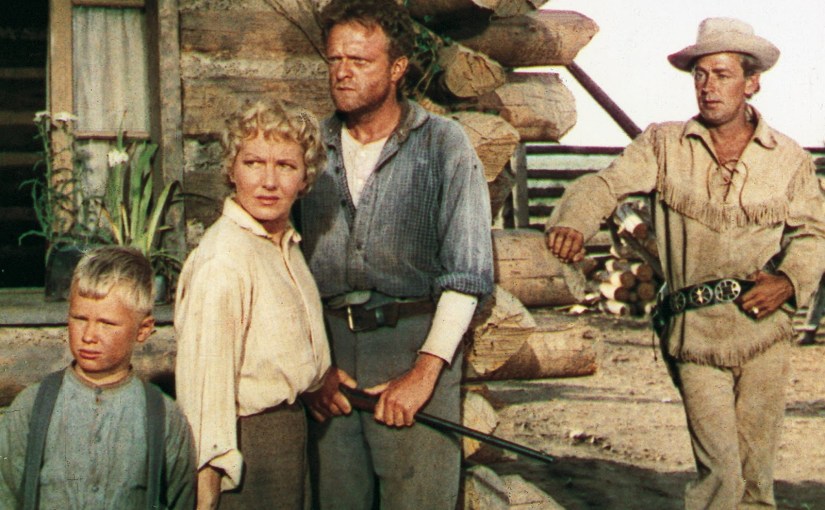
ANYWAY…it’s 1889, and a land baron named Rufus Ryker is trying to run homesteaders off some land that they rightfully own, but which is preventing Ryker from expanding his cattle ranch.  Among these homesteaders is Joe Starrett (Van Heflin); his wife, Marian (Jean Arthur); and his little boy, Joey (Brandon De Wilde, who earned an Oscar nomination for Best Supporting Actor, but don’t ask my opinion of his performance…just don’t).

One day, true to mythical form, a lone figure rides out of the mountains and up to Starrett’s patch of land.  He is improbably good looking, wears a fringed buckskin jacket, two ivory-handled revolvers, and identifies himself only as Shane.  After earning Starrett’s trust, he agrees to stay on as a hired hand and possibly help with the struggle against Ryker…

…and if you’ve been watching movies as long as I have, you could practically write your own screenplay for the rest of the film, because you’ve seen it before, many times.  The stranger proves his worth, defends his new friends, makes friends with the wife (but not TOO friendly), gets hero-worshipped by the little boy, and eventually runs them cattle barons plumb out of business.  But I’ve never seen it done quite like Shane.

For example, there’s a bar fight that ought to be in the Bar Fight Hall of Fame.  Shane, in what HAS to be a deliberate move to goad the bad guys into action, walks into a saloon filled with Ryker’s men to return a soda-pop bottle for the deposit.  A fight predictably breaks out, first one-on-one, then 1-on-2, then 3, then 4.  (Who does this guy think he is?  John Wick?)  The fight gets to a point when it’s winding down…then it picks right up again.  Then they get Shane on the ropes and start waling on him…until Starrett sees what’s happening, grabs an axe handle, and cracks it over someone’s head.  That may not sound like much in writing, but it’s pretty impressive visually, especially from a 1953 Western that feels at times like a Disney product.

(It almost feels like what Tarantino did with the fight between the Bride and the Crazy 88 in Kill Bill, Vol. 1 (2003).  George Stevens said, “Okay, these people want a bar fight?  I’ll give you a damn bar fight.”)

But while I was watching it, I started to analyze it a little bit.  Bar fights…seen one, seen a thousand.  But Shane felt to me like it was embracing the cliché, making friends with a trope, and in so doing the fight became a myth of a bar fight, a fever dream of itself.  It’s not just a bar fight.  It’s THE bar fight.

A lot of Shane works that way.  Shane isn’t just a mysterious stranger, he’s THE mysterious stranger.  An argument could be made for Eastwood’s “Man with No Name” as the archetype of this character, at least in the Western genre, but it’s clear that Eastwood took a lot of cues from Shane when writing and directing his own films.  I’m not suggesting that Eastwood plagiarized Shane.  I’m suggesting that Eastwood’s creations are infused with Shane’s DNA in all the best ways.  (I wouldn’t presume to speculate how much of Shane is in Sergio Leone’s spaghetti westerns starring Eastwood, though I would say those have more of Kurosawa in them than George Stevens.)

There are just two items that bugged me while watching Shane.  One, the editing was occasionally erratic, using a lot of fades or cuts to virtually empty frames in the middle of the action.  I don’t normally pick that kind of thing apart in a review, but it was glaringly apparent in a lot of places.

Two…the tragic waste of talent by casting Jean Arthur as Mrs. Starrett.  Jean Arthur is the fast-talking, quick-thinking actress who appeared in such classics as Mr. Deeds Goes to Town [1936], Mr. Smith Goes to Washington, and Only Angels Have Wings [both 1939].  She goes (or OUGHT to go) on the list of intelligent female actors like Katharine Hepburn and Rosalind Russell.  By 1953, she was semi-retired and only appeared in Shane as a favor to her friend, director George Stevens.  When I saw her name in the credits, I had visions of her delivering fiery speeches, shaming and out-thinking the menfolk, declaring her admiration for Shane without exactly laying out her TRUE feelings for him, and so on.  Instead, she is reduced to spending the majority of her screen time fretting over her husband’s safety, casting loaded glances at Shane while her husband isn’t around, baking pies, and reading bedtime stories to Joey.  I know I just got done writing about how the movie embraces clichés and becomes mythological, and there’s nothing more clichéd than the “little woman” supporting her husband, etc., but something about her role just rubbed me the wrong way.  After this film, Arthur retired from film completely, and although Shane was a massive popular and critical hit, I can’t help but wish she had been given more to do in her last film.

By the time Shane reaches its famous finale (“Shaaane!  Come baaack!”), justice has been meted out and the little guys have won…all is right with the world.  Echoes of Shane still linger today, because who doesn’t like a good old-fashioned bad-guy beatdown, administered by the archetypal mysterious stranger?  This may not be my favorite Western of all time, but from now on, whenever I do watch my favorite Westerns, I’ll keep an eye out for Shane’s shadow, looming large over all who came after it.

MONTE WALSH (1970)

by Miguel E. Rodriguez

DIRECTOR: William A. Fraker
CAST: Lee Marvin, Jeanne Moreau, Jack Palance, Mitchell Ryan
MY RATING: 7/10
ROTTEN TOMATOMETER: 89% Fresh

PLOT: An aging cowboy realizes that the West he knew and loved will soon be no more – and that there will be no room for him, either.


Based on this film, Monte Walsh, and the other two films he directed, A Reflection of Fear [1972] and The Legend of the Lone Ranger [1981], I think it would be charitable to say that William A. Fraker’s best films are the ones where he served instead as director of photography, such as Bullitt [1968], WarGames [1983], and Tombstone [1993], among many other notable movies.  Am I saying Monte Walsh is a bad film?  No, but it’s certainly not as bad as Gene Siskel’s 1-star rating, nor is it as stellar as Roger Ebert’s 4-star rating.  I give it a 7-out-of-10 on my scale because of the way the second half of the film builds and builds so that the outbursts of violence feel earned and motivated instead of cliched.

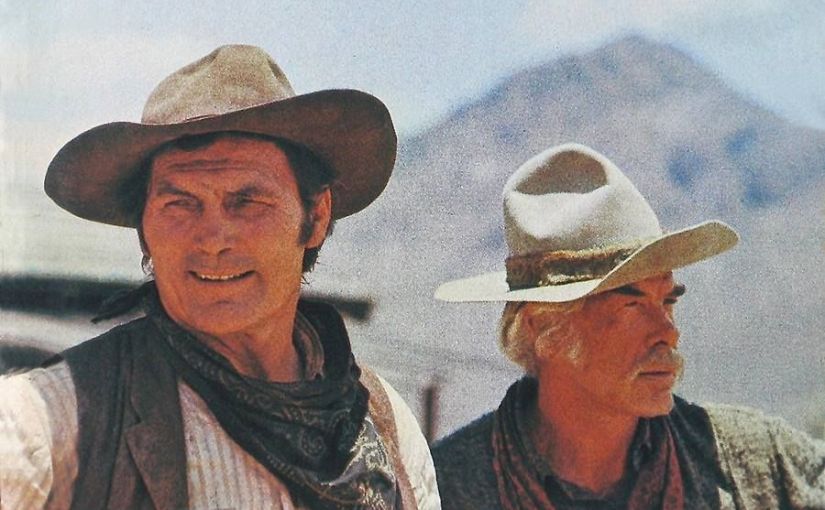
Monte Walsh (Lee Marvin, grizzled as ever, even with a handlebar moustache) and his friend and partner, Chet (Jack Palance in a rare non-villainous role), come down off a mountainside after a rough winter keeping watch on Mr. Brennan’s herd of cattle, only to get news that Brennan’s ranch has been purchased by a corporate entity, Consolidated Cattle.  Brennan offers them a steady job, which they reluctantly take, but deep inside they know this means their prairie-roaming way of life is coming to an end.  Chet is prepared to accept this, but Monte chafes at the idea.  “I ain’t doing nothing I can’t do from a horse,” he warns Brennan.

We get entertaining glimpses of the ranch hand life, complete with the saloon fights and the stinky cook.  Monte dallies with a French madame, Martine (played by the exotic Jeanne Moreau).  At one point, Monte and Chet ride out and meet a weathered old ranch hand who is “riding fence,” or inspecting every foot of fence around the ranch for repairs…the only work he’s cut out for anymore.  “Looks like his life is over with,” they say, and you can tell they’re looking into their own future.

The thrust of the film is one I’ve seen in many other westerns before this one: “The old West is changing, and there’s no place in it for people like us anymore, so we’d better evolve or die.”  This theme is present in Once Upon a Time in the West [1968], Butch Cassidy and the Sundance Kid [1969], and especially The Wild Bunch [also 1969]…seemed to be a trend for westerns at the turn of the decade, for some reason.  Monte Walsh handles it in an episodic format, kind of like another Lee Marvin film, The Big Red One [1980].  It doesn’t quite tell a straightforward plot with a pre-determined story arc.  It skips around a little bit, painting a picture without telling a conventional story.

There can be a sense of freedom in this kind of storytelling.  Unshackled by traditional story beats – at least for the first half – the movie is laid back, asking the viewer for a little patience as it slowly lays down building blocks for the finale.  However, I must report that I found this section of the movie a little slow.  I grew impatient.  I felt I was being set up for something, but pretty soon I just wanted the movie to get on with it.  Butch Cassidy sort of works that way, but you had two of the most photogenic stars who ever lived as the two leads.  I struggled to care the same way for Jack Palance as I did for Paul Newman.

But then an unexpected scene of violence occurs, setting into motion a series of events that culminate in a tragic series of deaths that, I must admit, had me glued to the screen as they unfolded.  Because of the gangbusters nature of this section, I am inclined to forgive the film’s shortcomings in its first half.  Here, we see, yes, Monte must evolve or die, and even if it’s never in any real doubt what he will choose, it’s entertaining to watch him make that choice.

If not for the second half of the picture, I might not even be writing about Monte Walsh.  I didn’t care for the opening song (even if it WAS sung by Mama Cass), some of the movie felt ripped off from several other westerns, and I was borderline bored for the first half.  But if you stick with Monte Walsh until the end, I think you’ll agree it’s worth a look.

BATMAN (1989)

By Marc S. Sanders

If Warner Bros was to abandon the campy familiarity of the Adam West TV series, Tim Burton was the best candidate to deliver The Dark Knight into the macabre gloominess of a bustling crime ridden Gotham City.  Burton is proud of his grotesque weirdness which is what this famed comic book character demands.  

Despite a story that always teetered on flimsy to me, this close-out picture of the decadent 1980s, has so many elements that work. It begins with the marquee cast to the richly deserved Oscar winning hell on Earth art designs from Anton Furst to silly pop/funk samples from Prince and the orchestral score from Danny Elfman.  This is truly the film that put Elfman on the map.

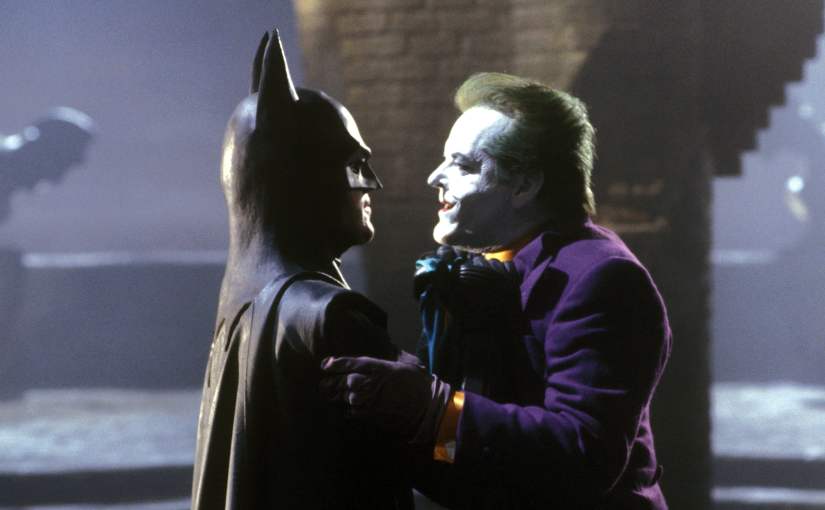
Jack Nicholson collected buckets and buckets of cash to bring Batman’s arch nemesis Joker to life.  He earned every penny.  There’s been copycat attempts (Hello Jim “Mr. Shameless” Carrey) to a handful of other interpretations of the psychotic clown, and still no one has overshadowed what Nicholson brought to the role.  His performance seems like a combined amalgamation of previous celebrated career roles from Easy Rider to …Cukoo’s Nest.  Prince served as his cheerleading entourage to compliment the purple and green color schemes.  This Joker is a perfect antithesis to the famed title character superhero.

Batman is portrayed by Michael Keaton.  Let the record show that when news broke of Mr. Mom occupying the part, I was not a skeptic.  I had seen the dark and dramatic side of the former standup comic a year prior (Clean And Sober, my review is on this site).  I knew he could pull it off.  His quiet pondering as either billionaire Bruce Wayne, whose parents were gunned down in front of him as a child, to the Batman under the cape and mask work on the opposite spectrum to Nicholson’s uncompromising insanity and hyperactivity.  

Keaton against Nicholson are a defined Yin and Yang.

The supporting cast have good moments too including the loyalty of Bruce’s butler, Alfred.  Michael Gough brings Wayne Manor alive and Burton, with a script from Sam Hamm, welcomes several spotlights from the expected council of the trusty character.  Kim Basinger is photojournalist Vicki Vale, Bruce’s love interest.  Frankly she has better scenes to share with Robert Wuhl as Gotham’s reporter.  The Batman fan in me stops short at Pat Hingle as Commissioner Gordon.  It’s not the actor’s fault however that the film offers little for him to do on screen.    Hingle never had much material to play with in the four films he occupied.  That’s regrettable.

The best supporting character is the setting of Gotham City.  With Burton’s penchant for a Vincent Price characterization, he relies on Anton Furst to bring the towering midnight blue steel, skyscraper pillars to enormous heights, reaching into the blackness of heaven.  Every street, alleyway, balcony, puddle, garbage can or mugger, policeman and cabbie that circumvent this city lend life to this hopeless, criminal world.  It’s astonishing how well constructed this Gotham is.  Designs go just as far with Wayne Manor, the underground Bat Cave and a chemical plant designed in hot steam,  with enormous barrels of rainbow, acidic liquids and rickety platforms. Even Vicki Vale’s apartment is gorgeous to look at as both Bruce Wayne and the Joker compliment it as having “lots of space.” Tim Burton and Anton Furst make certain the people who roam these environments are entirely aware of what they occupy.

Sam Hamm’s script doesn’t appear as solid as everything else on screen.  There’s never a cohesive beginning to end trajectory and a lot of the film feels like short story episodes.  Joker takes over the localized mob.  There’s that story.  Joker somehow concocts a chemical poisoning amid the various hygiene products.  Yet it only spreads to the local newscasters.  Gordon, Alfred, Vicki Vale, and certainly not Bruce Wayne ever gets exposed.  Once that storyline begins, it’s quickly disposed.  A little attention focuses on Batman’s beginnings.

The irony of Batman is that unlike other superhero films, this one does not hinge on an origin story for the good guy dressed in black.  That angle is devoted mostly towards Joker, and Nicholson makes the most of his large amount of screen time.  A favorite, sinister scene that maybe Edgar Allen Poe might have approved of is Burton’s invention for Joker to gradually reveal himself beneath the darkness.  He’s depicted sitting in a dirty office basement with an underground cosmetic doctor who witnesses a transformation in the gangster turned madman.  I just like it.  It’s hair raising.  The moment plays like Poe writing a new version of The Mask Of The Red Death.

For me, this is likely Tim Burton’s best film, just below his passion for detail in Ed Wood.  Batman offers up a lot of variety ranging from the darkness of the character to the disruptions revealed in the antagonistic, loudly dressed, Joker.  

There’s no denying how visually memorable the film remains and how quotable it is as well.  In 1989, when superhero movies were not the event release commodities they are today, the endless hype only enhanced the experience of finally seeing the movie on the big screen.  Over a year ahead of release, t- shirts, caps, action figures and costumes were of the highest demand among kids, teenagers and adults.  I actually miss the marketing blitz that overtook the finished film product.  Everyone you encountered was embracing Batman and Joker.  These might be pop culture phenomena, but they created a commonality among the masses of the world.  Batman was worthy of all its swag and endless mania.  It was a celebration of movies for people of all ages to take seriously.

Fortunately, the first half of the 1989 promotional partnerships were never squandered on a decidedly terrible movie.  The end product was immensely satisfying.

Tim Burton upheld his dedication while still a young director in a cutthroat and competitive industry.  As the later films, from a careless Joel Schumacher, demonstrated, it takes an endearing kind of passion to pull these eccentrics off on a silver screen.  Fanboys will happily toss that Bat logoed t-shirt away if they feel betrayed by the movie, they couldn’t wait to sink their teeth into.

An enormous sigh of relief came across the entire pre-internet world.  Keaton is great.  Nicholson of course.  Check out the Batmobile and Bat Jet as well!!! Prince’s music videos served as free commercialization to see the movie over and over again.  A separate record was released to highlight Danny Elfman’s work.

Rightly so!

The grand scheme of delivering Batman and Joker to audiences, was worth every second of the wait.

An astounding achievement of near perfect filmmaking, this Batman film was never overshadowed even with a better, leaner Dark Knight interpretation to arrive nearly two decades later.

Right this way Mr.  Nolan.  Your table is ready for you.