STAR WARS EPISODE III: REVENGE OF THE SITH

By Marc S. Sanders

Star Wars Episode III: Revenge Of The Sith is the best installment in George Lucas’ prequel trilogy of his epic space opera saga. However, that is where the line is drawn.

It carries a heightened drama thanks primarily to Ian McDiarmid as the eventual Emperor Palpatine. Shakespeare might have been proud of the character and performer. Much like Alec Guinness received an Oscar nomination for his portrayal of Ben Kenobi, so should McDiarmid have been honored playing an antithetical influence (of Kenobi) on the student and Jedi in Training, Anakin Skywalker (Hayden Christensen in a much more improved performance).

War within the galaxy is rampant and there’s no end in sight. The Jedi Order is overwhelmed. Anakin is used as a pawn to spy on his new mentor Palpatine who in turn insists that the young Jedi occupy a chair in the Jedi Council to spy on them. In addition, it’s hard for Anakin to come to grips with his secret wife Padme (Natalie Portman) dying from childbirth as his nightmares continue to remind him. A deal with the devil himself in Palpatine is offered as an option. Can a manipulation in the Force rescue Padme from death?

There’s a lot of weight on Anakin here. Sith departs from the politics discussed in the prior entries as it focuses primarily on Anakin’s personal struggles. The film really needed to take this direction. After all, it’s time to witness Anakin’s transformation into Darth Vader. Everyone has been dying to see that.

George Lucas’ scene set ups work on occasion. A great performance of dialogue occurs in an alien opera box between Palpatine and Anakin. This is where McDiarmid really comes through. He’s subtle and deliberate in his influence. Fortunately, Christensen just needs to listen mostly.

Later however, a scene works only so much when Samuel L Jackson as Jedi Master Mace Windu duels with Palpatine, having just revealed his secretly evil Sith side. Through all three of these films, Mace Windu has been one of Jackson’s least exciting roles. He’s bland and never doing much. Christensen comes upon this scene and doesn’t give me the genuine anguish I was hoping for. McDiarmid, again, is hitting home runs in surprise and development. This turning point scene is not as strong as it should have been thanks to Lucas’ stilted direction and writing, along with Jackson and Christensen lacking any true depth.

Episode III also has a handful of so what moments that continually frustrate me in this trilogy. We have to watch Yoda and Obi Wan watch a video of what Anakin has done. Why? We’ve seen this already. Bail Organa (Jimmy Smits; I wish he had a larger role) needs to be informed of an upcoming meeting. Honestly, I don’t need an update on a character’s calendar. Just make sure he arrives on time. Moments like these don’t drive towards anything.

Natalie Portman is not served well as a pregnant Padme. Her dialogue is worse than ever, and it hinders her performance. Padme is torn between her affection for Anakin and her passions for democracy. We see next to none of the latter. How does an intelligent woman like Padme suddenly become so unaware? Ironically, opportunity for her political nature was filmed but remains only as deleted DVD features. These scenes would have enhanced the movie as they imply the foreshadowing of the upcoming Rebellion, while a petition attempt is mounted to usurp the Emperor’s administration. Here, Padme is trying to be instrumental in Luke & Leia’s (her own children) future. Really good material here. Nevertheless, George Lucas opted to leave it all on the cutting room floor. Oh well! I’m still holding out hope for a “special edition” cut one day, inclusive of this storyline.

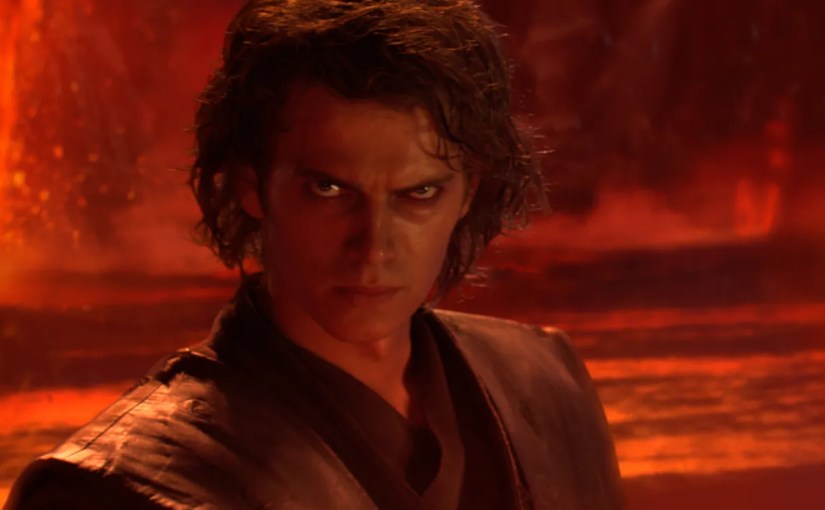
Lucas’ lava planet, Mustafar, is quite grand as the arena for the much-anticipated dual between evil Anakin and noble Obi Wan. Still, again, it could have been better. There’s too much CGI and flashing lightsabers that hide the acting among the swordsmen. Compare this to the duals in Empire and Jedi and you see what I mean.

I know my commentary on the prequels is quite pessimistic, but I do have an (maybe a biased diehard fan) appreciation for the films. The stories work. The execution falls short however in dialogue, performances and visual artificialness.

George Lucas had all the right make up for a trilogy as epic as his original films that began in 1977. Maybe because he didn’t have the monies and technology at that time, his imagination had to work overtime back then. In these later films, however, his hubris got in the way of his craft. So, we have to settle for his next great technological discovery in CGI efficiency. Therefore, we get cartoons with no depth like Jar Jar Binks, General Grievous, and lame, clicking battle droids.

Lucas always defended the position of his writing by insisting these films are aimed for kids. No. I don’t accept that. Star Wars was aimed for kids and the kids that remain in all of us as we continue to grow into adulthood. George Lucas needed to write with that in mind.

STAR WARS EPISODE II: ATTACK OF THE CLONES

By Marc S. Sanders

Star Wars Episode II: Attack Of The Clones is a vast improvement on the prior installment of George Lucas’ prequel trilogy from a galaxy far, far away. Lucas made an attempt to bring his characters out of their shell a little bit. I mean at least they laugh among each another. You need that if you are to believe that Jedi In Training Anakin Skywalker and Padme Amidala (Hayden Christensen and Natalie Portman) are to fall madly in love. So at least have them romp around in a Naboo meadow.

There’s some curious political intrigue in Clones; delving deeper than what Episode I only began to imply. As stilted as some of the dialogue may be, there are ingredients here that allow to me correlate with real life government powers and to date current events. That’s a compliment, but it’s also a shortcoming.

Ian McDiarmid remains the MVP of this trilogy as Chancellor Palpatine, the puppet master with a faux innocent exterior. Anytime he’s on screen you sit up in your chair with a little more focus. He’s brilliant as the manipulator who keeps a short distance on Anakin, the supposed chosen one, while also pushing Padme away from government interference, and yet still managing to prevent the Jedi Order from detecting his true nature. It takes a heck of an actor to pull this off.

At the same time though, the politics take up a large amount of the entire trilogy. While it holds my interest, I still question if this is what a Star Wars film should be comprised of. Where’s the force, and where’s a more defined explanation of what “the chosen one” is to offer, or what the “balance of the force” really means? Some heavy vocabulary in this terminology, maybe, but is there any dimension to any of this? Regrettably, the answer is no.

New characters and planets are introduced. Jango Fett (Temura Morrison), an armored bounty hunter, is the initial antagonist who is part of an assassination attempt on Padme, followed by a revelation that he is the source of a new discovered clone army on a secret water planet known as Kamino. (As a diehard franchise fan, I have a lot of issues with Jango and his pre-teen son Boba, but that is for another discussion.)

Eventually, the antagonism shifts to Christopher Lee as the former Jedi Count Dooku, found to be keeping conference on another secret planet known as Geonosis, where life size dragonflies reside. Lee was legendary by the time this film was released in 2002, but he’s not exactly aggressive enough for me. He was an old man with little convincing agility to be engaged in a lightsaber fight with a very bouncy Master Yoda. In Lord Of The Rings, he commanded from the perch of his tower. Here, Lee is in the mix of the action and he’s a far cry from Ray Park’s appearance as Darth Maul.

Yoda is another issue. Now friends will be quick to remind and tease me over how excited I got when I saw Yoda engage in a climactic lightsaber dual for the first time. My tune has changed though. As The Empire Strikes Back showed way back in 1980, Yoda was convincingly powerful without ever having to prove how powerful he ever was. Here, it comes off gimmicky to me as an excuse to draw a crowd or make a new kind of toy to sell. Just Yoda’s appearance alone should be enough. Now, he’s just like the rest of them. Yoda’s greatest feature was his philosophy, never his combat skills.

I don’t take much issue with the romantic dialogue between Anakin and Padmé. An actor like Leonardo DiCaprio or Billy Zane would sell the “sand monologue” into the stratosphere. Remember, those guys performed James Cameron’s hammy Titanic script. Hayden Christensen could not do that though. His temper, which Anakin is regarded for at this age, is never convincing. It’s terribly overacted. He screeches his dialogue. Darth Vader never had to yell or scream or screech. So why is Anakin? This is also partly Lucas’ fault. Where’s the misuse of the force with Anakin? At one moment, Anakin is upset and throws an object? Why throw an object? Why not “force throw” an object? Anakin demands answers from a captive bounty hunter by screaming at her? Why only scream? Why not “force choke her” or mentally torment her? Don’t you think these ideas, these familiarities we’ve seen with Vader would have held much more dramatic weight and depth?

Lucas stretched himself further than he did on The Phantom Menace. Still, he just didn’t take his second episode far enough. It’s as if he opted not to apply too much effort. There are no twists to Attack Of The Clones. No surprises. We easily have a general idea of where all of this is going long before the opening crawl even begins. So, like its predecessor, Episode II lacks a wow factor that placed the original three films into the greatness they still hold.

There still needed to be more in these films. I’m not gonna even talk about CGI. I’m talking about story, and what makes a saga a Saga. So… WHERE’S THE SAGA?????

STAR WARS EPISODE I: THE PHANTOM MENACE

By Marc S. Sanders

22 years after the first Star Wars film made a ginormous cultural impact on the world, George Lucas finally returned to the franchise to make the first film of a new prequel trilogy with Star Wars Episode I: The Phantom Menace. It was hyped beyond measure, and it sold gazillions in ticket sales but was nevertheless a letdown for diehard fans and pretty much everyone else. I don’t think it’s a terrible movie. I just don’t understand how necessary the film is.

There’s a lot of irrelevant moments here. Early on two Jedi step off a ship, and a droid introduces herself to them and says “this way please,” and the three figures literally walk out of frame. This takes up time that I don’t understand. Why couldn’t the three just end up in the room they were supposed to be in? There are a lot of “so what?” moments in The Phantom Menace, and it all weighs the film down, hindering a story.

Listening to an audio commentary a number of years ago, one of the visual effects makers pats himself on the back of a shot midway through the film that consists primarily of CGI characters and sets. That was when I realized the conception of The Phantom Menace was completed with a short-sighted intent. Sure the scene might have been a technical breakthrough in 1999, but where’s the story? Fact is, there is no story and little regard for the celebrated franchise in Episode I. Lucas and his team were more concerned with shooting new CGI discoveries blended with human interaction. They offered next to no regard for intelligent plot and storytelling. The film suffers because of Lucasfilm’s hubris.

Consider the pod race. There’s a moment where young Anakin’s (Jake Lloyd) racer falls apart at high speed and he’s gotta get it back together. He uses a magnetic tool to get a cable plugged back in. If this child is “the chosen one” and potentially “dangerous,” why not show the child potentially use the force to bring the cable back in place? Why not show moments where unexplainable power emits from Anakin, to what would imply the inevitablity we are aware will eventually happen?

Lucas is also all over the place in his storytelling and characters. From the Shakespearean manipulator, Senator Palpatine, to the immature cartoon like Jar Jar Binks. I think they all serve a purpose to entertain. Yet while adults and die hard fans will relish the return of Ian McDiarmid (a terrific actor) they’ll be bored to death with actor Ahmed Best in the Jar Jar role. This I expect happens in vice versa with 8 year olds seeing their toy figures come to life. There is a silly charm to Jar Jar, but what 8 year old wants to pay attention or even comprehend debates among galactic senators over taxation and trade? It’s as if Bugs Bunny entered the halls of Congress, or Othello walked in on a pie throwing melee among the Three Stooges. At almost every point in The Phantom Menace something doesn’t belong or seems out of place.

The film moves far away from the tradition of the original trilogy. For the first time the human characters are enormously flat. Liam Neeson, Natalie Portman, Ewan McGregor…all flat, all bland. There’s no snarkiness to them. No sarcasm. Before The Phantom Menace when was it ever said that the Jedi order was so formal in their ways? It doesn’t feel very fun to be a Jedi, like it did for Alec Guinness and Mark Hamill before.

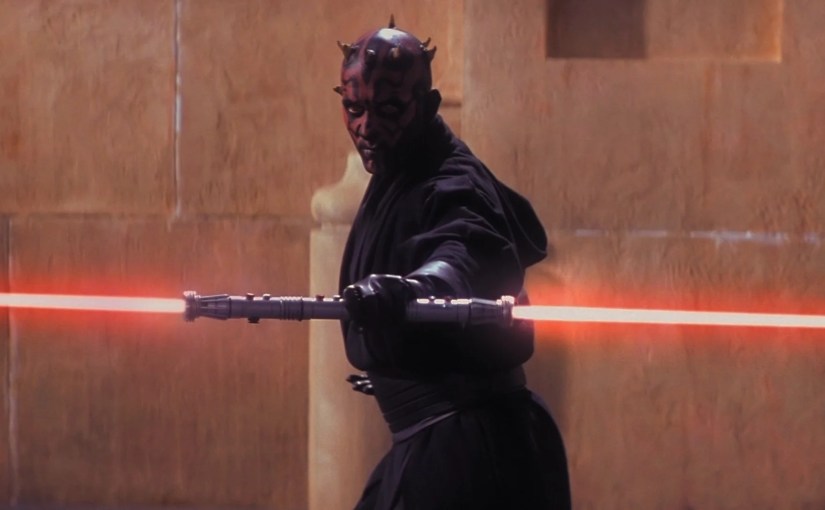
The two redeeming qualities of this film belong to the pod race which is thrillingly edited in sound and visuals. There’s some fun shots of each racer, the pit droids, the crowds in the stands and even Jabba The Hutt. The film really comes alive here much like the memorable cantina scene from the original Star Wars. The other best feature is the villain, the apprentice to the phantom menace, the red and black tattooed Darth Maul played by the agile martial artist Ray Park.

Lucas didn’t use Park enough in the film. With his double bladed lightsaber, the two on one dual Park has with the Jedi characters towards the end is one of the greatest sword fights in film. I would’ve welcomed an additional five minutes of this scene. Shamefully, this would be Ray Park’s only appearance in the film franchise, as well as Darth Maul. This was a great blend of actor and character. Lucas abandoned a good thing too soon.

Yes! I have much to complain about The Phantom Menace. Yet it is not all bad as a whole. I love the political trickery that McDiarmid displays and the senate meeting among the delegates is a nice foreshadowing for what we know will come of it. Visually, it’s a treat as well. (Again, though, what kids are going to be entertained by all of that?) The pod race and lightsaber dueling are masterful as well. There’s some good material here. There just could’ve been a whole lot more….and a whole lot less overall.

RETURN OF THE JEDI

By Marc S. Sanders

There’s a moment in Return Of The Jedi where Luke Skywalker (Mark Hamill) is about to be forced into Jabba The Hutt’s monstrous Sarlaac pit. R2D2 launches the Jedi Knight’s lightsaber in the air. Luke catches the hilt of the saber and just before he ignites it, the hero gives a smile. The Star Wars saga is not just fun for audiences. The players in the film are enjoying themselves just as much.

Following the mind-blowing cliffhangers of The Empire Strikes Back from 1980, the third film in the original trilogy picks up to tie off all those loose ends. The result is nothing but giddy, refreshingly inventive, swashbuckling adventure. I always admired the sets of the original trilogy. No two locations looked the same. Prior films have introduced desert, snow, swamp and cloudy locales. Jedi takes us to a forest moon known as Endor. It’s no surprise that a forest moon will not offer much technology even in science fiction/fantasy. So, we are treated to a welcoming and ironic final battle to overthrow Darth Vader’s evil Empire. Ewoks, cuddly looking teddy bears, known for the means of survival with primitive devices like rocks, sticks and logs will face up against armored Stormtroopers and gigantic, zippy little speeder bikes, and steel chicken walkers armed with powerful blasters. The battle scenes are fun, and they work. Just before the heroes break into an Empire bunker, Han Solo outstretches his arms and gives a smirk at the Imperial troops. Even Harrison Ford is having a good time. There’s much opportunity for the audience to clap along.

The main story involves Luke making an effort to defeat Darth Vader once and for all after he’s urged by Yoda and Ben Kenobi (Frank Oz and Alec Guinness) to confront the dark lord as a means to complete his training to be a Jedi. It will not be easy as it also means that Luke must resist the evil Emperor Palpatine’s seductive nature to join the dark side.

Ian McDiarmid is the Emperor and I always say this guy never got enough recognition. He’s as masterful with the role as Margaret Hamilton was with The Wicked Witch of the West. He chews the scenery and like the good guy actors, he’s also having fun in the part.

Jabba The Hutt is also a terrific surprise that’s finally revealed (if you had been following the more preferred original cuts of the trilogy). This large, slug like puppet character is an amalgamation of Marlon Brando in The Godfather and a very bulky Orson Welles. The infamously controlling gangster on Luke’s home planet of Tatooine gleefully displays a captive Han Solo still frozen in carbonite. The sets within his palace are magnificently detailed in creature extras and sleazy decor, much like a seedy strip club.

I think the appeal of Star Wars comes partly from the nature of human beings and the planet Earth where we reside. All looks familiar in a way the first time we see something and it’s easy to make presumptions of this galaxy’s inhabitants and what they are respectfully capable of. We can recognize that Ewoks might be as constructive as the Swiss Family Robinson with their tree like village. At the same time, a giant slug with a green skinned, dancing concubine chained to him commands over a peasantry. Elders in black robes carry an instinct to almost gaslight a weaker opponent for personal gain.

George Lucas sourced from prior films of all different categories used before. He only made it his own original work with some modifications. So you get sword fights, only in this world the swords are beams of light. You get a strip club bar, but it’s science fiction polish allows it to be a little more PG rated.

Return Of The Jedi serves as a great time to watch a movie. It’s swashbuckling and even well-acted, especially with Mark Hamill in the lead. His character changes from one film to the next. He’s no longer a child here. He’s now an absolute leader walking into the depths of hell aboard a new and more powerful Death Star, ready to sacrifice himself to fulfill a likely prophecy, as well as to save the Rebellion he commands.

It may not be the best film of the original trilogy, but Return Of The Jedi was one of the most satisfying movie going experiences from the decade of the 1980s.

STAR WARS: THE RISE OF SKYWALKER

By Marc S. Sanders

Star Wars: The Rise Of Skywalker is a well packaged thrilling adventure of spectacle, emotion, thrill and salutations to a film saga that’s lasted nearly a half century. JJ Abrams, with backing from the franchise’s new owner Disney, invents a storyline that bears consistency with the episodes that have been seen before. There’s just so much to appreciate.

To get the story rolling, it appears the villainous Emperor Palpatine (Ian McDiarmid in a role that has never garnered enough deserving praise) returns from the dead, intent on recruiting the confused Kylo Ren to kill Rey. From there, it becomes a race for Rey and her allies (Finn, Poe, Chewbacca C3PO & BB8) to find “wayfinders” (like directional compasses) that will lead to Palpatine’s location. Naturally they get sidetracked with some unexpected encounters like flying Stormtroopers (“They fly now!”) and Lando Calrissean (a very welcome and delayed return for Billy Dee Williams). As well, Rey gradually learns more of her back story and there are some quite surprising moments to see.

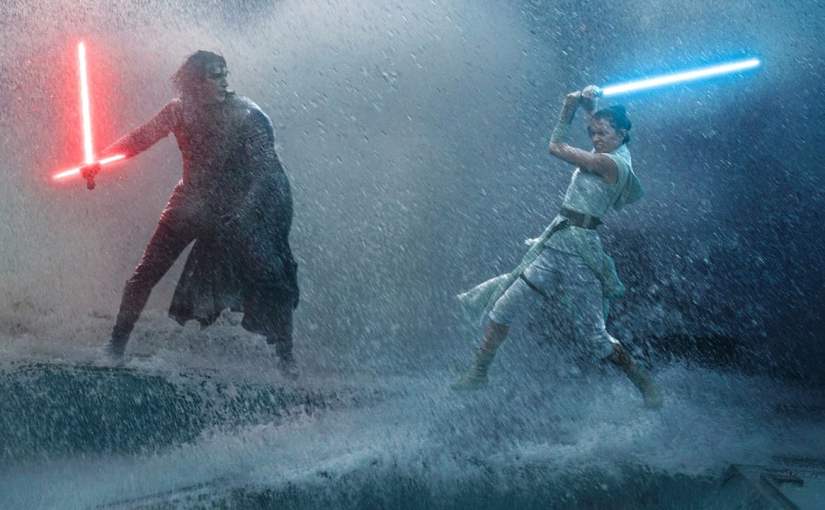
ROS is really a beautifully shot piece of cinematography. Abrams still loves the occasional lens flare but it’s never distracting. Outer space flights and battles have a clear exactness to them. The moments between Rey and Kylo Ren are well edited conversations and lightsaber duals that occur at two different parts of the galaxy as background settings seamlessly change at times. This is an element from the prior often sour Episode VIII known as Rian Johnson’s The Last Jedi that still works for these new characters.

Abrams and company really get everything right here by neglecting wasteful narratives from Johnson’s installment to allow reflections on the other films in the series with fan loved cameos of characters and ships from before.

Episode IX is bound to displease some fans who carry their own vision that challenge them to accept something satisfying. I dare not consider what those thousands of possibilities could be.

All that I know is that the newest chapter is never boring, often surprising and in the most capable hands possible with the Mouse House engineers.

Major applause for the Daisy Ridley giving her best performance to date followed by John Boyega & Oscar Isaac offering terrific buddy chemistry with fun, wry dialogue and major kudos to Anthony Daniels who is given much material that reminds the audience that the Skywalker saga is quickly approaching closure. Daniels has always offered a quite humane performance to a character that can show one expression but still carries dimensions of fear, wisdom and humor. An actor limited in expression who only provides a vastness of emotion.

The Rise of Skywalker delivers a lot of story and some new, albeit unnecessary characters (except for new merchandising to sell), but everything is a visual treat.

Abrams’ contributions offer opportunities of laughter and tears and messages of redemption and sacrifice for a greater good.

There’s much to this to consider and appreciate. I absolutely loved Star Wars: The Rise of Skywalker.