THE PLEDGE

By Marc S. Sanders

The Pledge is a moody and bleak crime drama that follows a retired detective’s descent into obsessive madness.

Director Sean Penn opens his film with the gruesome discovery of a murdered nine year old girl found amid the snow covered woods outside a small Nevada town.  She happens to be discovered on the evening of veteran detective Jerry Black’s (Jack Nicholson) retirement party.  Upon receiving word of the crime, Jerry leaves his celebration to explore the scene that is carelessly compromised by the local sheriffs.  His protege partner Stan (Aaron Eckhart) rushes through a possible suspect’s (Benicio Del Toro) interrogation that draws a quick conclusion along with an unnecessary and bloody outcome.

Jerry surrenders his position with the police department, but he’s not entirely convinced the crime has been solved.  He obligates himself to uphold a devout promise he gave to the victim’s parents (Patricia Clarkson, Michael O’Keefe) that he will catch their daughter’s killer.

Time passes and rather than retire into a quiet life of fishing, Jerry purchases an old gas station located within the vicinity of the crime scene as well as nearby where two other murders with similar circumstances occurred.  Jerry is going to wait out the next attempt committed by “The Wizard” or “The Racoon Killer,” and catch him in the act.

The Pledge is a brooding and lonely film.  Sean Penn’s piece offers an impressive list of who’s who actors that appear in small roles to shape out the detective’s progress.  Amidst all of these familiar names in the cast, Jack Nicholson has never appeared so isolated or despondent before.  His character is limited on dialogue.  A thin mustache and a wrinkled complexion with a smoking habit hide any humor or joy.  Jerry Black knows he’s the last capable police detective in this area.  It pains him to abandon his post to the halfwits he leaves behind.

A promise is a dangerous gesture.  If you adhere to it, all obstacles become nonexistent.  Anything will be done to uphold a pledge and conclude your wild theories, even if proof is not conveniently supplemented.   Nothing stands in the way of pledge.  

The second half of The Pledge moves at a slower pace when Jerry welcomes an abused mother (Robin Wright Penn) and her daughter into his home.  A new life seems destined for these three people but at what cost?  Is the hero of this film at least as dangerous as the psychopath that supposedly remains at large?

Would you go to the great lengths that Jerry puts himself through?  Is the expense of his own sanity, and the safety of an innocent woman and her daughter worth this pursuit?

Sean Penn’s film does not operate on suspense. What action there is only fuels Jerry’s chase at a long-shot truth.  It’s a slow burn crime drama that makes the central murder a far second priority to how the initial discovery overtakes the main character.  Again, this kind of mania is a different breed from Jack Nicholson’s other crazed portrayals found in One Flew Over The Cuckoo’s Nest, Five Easy Pieces, or The Shining.  Nicholson is not as vocal or expressive in this role.  Yet, we all know what drives this guy with what few words he uses.

Robin Wright Penn and Nicholson share some effective scenes together. Their motive to be with one another stems from a misery loves company ideal. Good casting here, and throughout the film with small appearances from Helen Mirren, Harry Dean Stanton, Sam Shepard, Vanessa Redgrave, Mickey Rourke, Tom Noonan, Clarkson, O’Keefe, Del Toro and Eckhart.

Sean Penn is very good at creating visual moods to his film. The image of Nicholson standing within the pen of a crowded turkey farm with the anguished parents of the victim is truly haunting. Animals of all kinds seem to emote a cold harshness as well. The first image to appear consists of a swarm of large, winged birds soaring above this backwoods area where the biggest thing to happen is a town parade. Otherwise, as one girl tells Jerry there’s nothing else to do here. This remote Nevada area is unprotected from greater powers, and its only guardian is forced to accept retirement, leaving his community vulnerable. This formerly decorated Marine is now a formerly decorated cop, and the unseen animals-or monsters-still roam.

I won’t spoil the ending which I commend, but there is one moment that Sean Penn includes in the final cut that is objectionable.  For the first time in the picture since Jerry Black accepted the case, one moment near the end of the movie tells the audience everything they need to know while leaving Jerry in the dark.  I think it was a poor choice to go this way.  The audience is going along with Jerry’s pursuit until they are spoon fed a resolution they didn’t earn because Jerry never arrives at this conclusion.  A better route would be to leave the audience in the same dizzying haze that Jerry must live with.  Some hanging threads should be left untied. The Pledge is a pot boiling, well-made and disturbing film, but with minutes to go before the end credits roll, a less is more approach should have been adopted.
FAREWELL, MY LOVELY (1975)

DIRECTOR: Dick Richards
CAST: Robert Mitchum, Charlotte Rampling, John Ireland, Sylvia Miles, Anthony Zerbe, Harry Dean Stanton, Jack O’Halloran, Joe Spinell, Sylvester Stallone
MY RATING: 9/10
ROTTEN TOMATOMETER: 71% Fresh

PLOT: When a giant ex-con fresh from prison asks Philip Marlowe to find his missing sweetheart, Marlowe winds up entangled in multiple murders, prostitutes, and a sultry trophy wife.


Because it was released only a year after Chinatown (1974), it is tempting to compare Farewell, My Lovely to that landmark film noir, but although they are in the same genre, the two films are apples and oranges…or at least apples and pears.  Both feature hard-nosed private eyes accepting cases that turn out to be more complicated and far-reaching than they appear, both feature multiple unexpected deaths, and both feature curvy, smoky-eyed dames with dangerous secrets and aging husbands.  All true to the genre.  But Chinatown breaks (successfully) with film noir in several key areas, while Farewell, My Lovely achieves its lofty heights while still remaining faithful to the bedrock tropes of vintage film noir, right down to the tired voice-over narration from the hero.  I have no idea how faithful it is to the Raymond Chandler novel by the same name, but if the book is half as entertaining as the movie, I may have to track it down and give it a read.

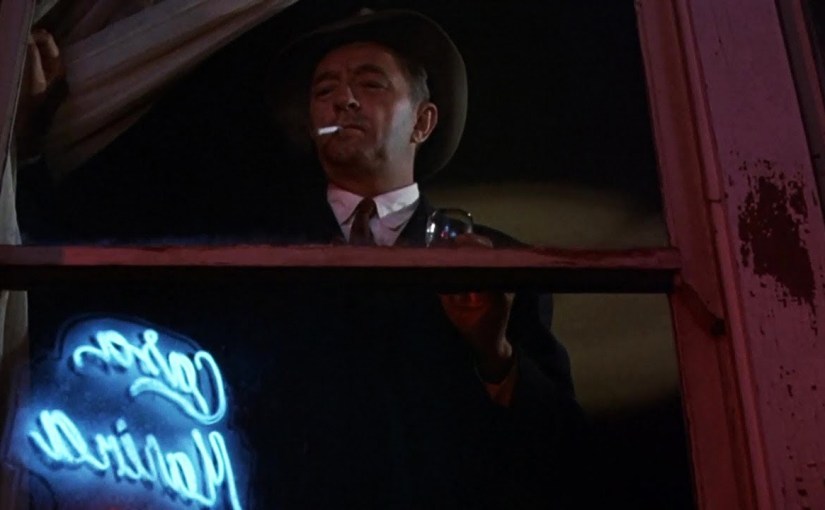
Robert Mitchum plays legendary gumshoe Philip Marlowe, the third version of the character I’ve ever seen after Humphrey Bogart (The Big Sleep, 1946) and Elliott Gould (The Long Goodbye, 1973).  Compared to the other two, Mitchum is by far the most shambling version, but I mean that in a good way.  We first see him staring out of a rundown hotel room in downtown Los Angeles, some time in 1941.  We know the timeframe because of a calendar here and there, and because Marlowe is obsessively following Joe DiMaggio’s progress, as he is on the verge of breaking the record for hits in consecutive games.  That’s a nice touch.  Marlowe’s world-weary narration plays over Mitchum’s sagging face and drooping cigarette, and the spell is complete: we are in the hands of one of the great genre pictures, from a story by one of the greatest mystery writers of his generation.

Marlowe’s story starts as a flashback, a story he’s relating to similarly-weary Lieutenant Nulty (John Ireland).  See, it all began when Marlowe was tracking down a rich family’s runaway daughter.  Soon thereafter, “this guy the size of the Statue of Liberty walks up to me.”  This is Moose Malloy, an ex-con fresh out of the slammer after serving seven years for armed robbery and making off with $80,000, which was never recovered.  Moose is played by Jack O’Halloran, whom cinephiles will recognize immediately as the overly large/tall man who played Non, the mute superpowered henchman in 1980’s Superman II.  To see this man actually string words together into sentences was a strange experience, but I eventually got used to it.

Moose wants Marlowe to find his sweetheart, Velma, who hasn’t written to him the last six years of his stretch.  Next thing you know, someone takes a potshot at Moose on the street, Moose winds up killing a guy in a bar, and Marlowe follows Velma’s trail to an insane asylum, and that’s still just the tip of the damn iceberg, because now there’s this guy who wants Marlowe to help deliver $15,000 in ransom to some other guys who stole a jade necklace…and we STILL haven’t seen the rich trophy wife yet.

And round and round it goes.  I have seen other films that attempted to combine this many plot threads and they wound up a jumbled mess.  Not this movie.  Farewell, My Lovely skillfully walked that tightrope and held my interest all the way through.  I was never lost, never confused…except for a couple of places where the soundtrack obscured a word or two, but I don’t know if that’s the soundtrack’s fault or the actors for mumbling too much.  Plus, this movie contains one of the single greatest interrogation sequences I’ve ever seen, starring Marlowe, two thugs, and the madame of a whorehouse.  It starts semi-normal, escalates with a shocker, then tops the first shocker with something I didn’t think even a hardcase like Philip Marlowe would do.  But the more I watched this movie, the more I got the sense (whether it’s true or not, I don’t know) that this Mitchum version of Marlowe is truer to the literary Marlowe than we ever got previously, in terms of Marlowe’s principles.

I should also mention the dialogue, which contains some of the best one-liners and comebacks I’ve ever had the pleasure of listening to.  For example:

  • Marlowe describing a large house he’s driving up to: “The house wasn’t much.  It was smaller than Buckingham Palace and probably had fewer windows than the Chrysler Building.”
  • Marlowe on his billing practices: “I don’t accept tips for finding kids.  Pets, yes…five dollars for dogs, ten dollars for elephants.”
  • Marlowe describing the obligatory femme fatale (Charlotte Rampling): “She had a full set of curves which nobody had been able to improve on.  She was giving me the kinda look I could feel in my hip pocket.”
  • Marlowe when the femme fatale asks him to sit next to her: “I’ve been thinking about that for some time.  Ever since you first crossed your legs, to be exact.”

Dialogue and lines like this are dangerous because they have been the targets of so many parodies for so long that modern audiences may have forgotten how to take them at face value.  But in Farewell, My Lovely, it comes off perfectly as a tribute to the classic noirs of the 1940s and ‘50s, a tip of the hat to the giants of the past.

Conversely, this movie also reminded me of many of the best eighties thrillers I remember watching, which is ironic considering it was released in 1975.  Movies like Body Heat and Jagged Edge and Silverado, whose purpose for existing seemed to be just to tell a freaking awesome story, unburdened with subtextual layering but laden with style and wit and intelligence, paying homage to their cinematic ancestors by emulating them without plagiarizing them.  There are no doubt film historians who could analyze this film scene by scene and explain exactly what the filmmakers were really trying to tell us underneath the ingenious dialogue and intricate plotting.  But even if I knew or understood all of that, I maintain the best reason for seeking out and watching Farewell, My Lovely will always because it’s just a damn good movie.

(…if for no other reason because of that interrogation scene…I had to rewind it a couple of times just to get my shocked laughter out of my system…)

KELLY’S HEROES

By Marc S. Sanders

There’s gold in them thar Nazi castle.  Hence the plot is set in motion for a World War II romp called Kelly’s Heroes.  It’s easy to get acclimated to the lightheartedness of this comedic war picture from director Brian G Hutton (Where Eagles Dare). 

The movie opens during a dark and rainy evening within a German occupied France. The on-screen credits pop up revealing an all-star cast of tough guy actors who are also quite funny.  Clint Eastwood is the title character who sits behind the wheel of a jeep. When the Nazis take notice, he hits the gas, makes a sharp left through the muddy road, and zooms away while avoiding shell fragments coming down on him. The film’s catchy theme song marches in – “Burning Bridges” performed by the Mike Curb Congregation.  The chorus of singers speak as a soldier who does not even care about authority or the rules of war.  The lyrics are rather simple to understand, and you want to just join in on the revolutionary merriment.  The song enters the film again and again over the next two and a half hours, reminding you to just enjoy the ride against this tragic capsule of time from the first half of twentieth century history.  Hawkeye Pierce couldn’t have said it better.

In his capture, Kelly has brought back a Nazi commandant and when he sees a fourteen-karat gold bar in the German’s possession, it’s easy to surmise that there must be more where this came from.  Turns out there is a stash worth roughly sixteen million dollars crated in a bank vault in the center of a stopover town, located across enemy lines in war torn France.  Kelly and his squad, led by Big Joe (Telly Savalas), are under heavy fire and forced to retreat for safety, but that isn’t going to stop him from making a snatch and grab.

Joe has been given orders to get the unit to safety and allow them a three-day reprieve of R & R.  However, he’s just as enticed as Kelly and gradually a small team of men assemble to pull off the heist.  First, they’ll need tanks to fight off the nearly indestructible Nazi Panzer machines they expect to encounter.  Fortunately, Crapgame (a scene stealing Don Rickles) and Kelly come across the hippie loving Oddball (another scene stealer – Donald Sutherland) who can supply the tanks they need and fend off what stands in the unit’s way.  What’s also important is Oddball find a bridge for the squad to cross before the allies destroy it.  That’s not so easy.  Sutherland is somewhat of a spaz; maybe an ancestor of Cosmo Kramer.

Meanwhile, a blood and guts two-star General Colt (Carroll O’Connor) is screaming for results from his subordinates.  When he intercepts the guys’ communications, he can’t help but be impressed with their progress and strategies of attack.  He’s ready to go into the field with a handful of medals for every American soldier that’s giving a damn. 

The looniness of Kelly’s Heroes is hilarious. Eastwood carries his signature quietness about him.  So, he’s the straight man leaving the loudmouth material for Savalas, Rickles, and a bevy of supporting actors.  Plus, there’s O’Connor in his own side story.  Sutherland is another kind of comedy – the free spirit who appears to have taken one too many shells to the noggin. 

It’s not a slapstick kind of movie.  It operates like the doctors from M*A*S*H.  These draftees have no loyalty to a cause.  They look out for each other.  They know how to survive the battles and they know that some will not make it.  Brian Hutton does not forget the frightening impact of war.  A memorable scene occurs when the unit realizes they are dead center in a mine field, offering up the life and death factor blended in both the comedy and drama that comes with a heroic war picture. 

There are some inconsistencies to Kelly’s Heroes.  Often, it feels like some scenes that would connect certain dots must have been edited out of the final print.  As the men come close to the to the bank where the gold is stashed, two of the soldiers are already in the overlooking bird’s nest tower giving a low down of the area to Kelly and Big Joe.  Yet, how did those guys ever get up there?  It’s not a terrible violation.  There are sequences like this that make the movie feel a little uneven. Clint Eastwood even went on record expressing his disappointment with the film as there were excised moments that drew more out of Rickles and Sutherland’s characters, and a few of the other supporting characters played by Gavin MacLeod (The Love Boat, The Mary Tyler Moore Show), Stuart Margolin (a very underrated character actor who had memorable episodes on the M*A*S*H tv series) and a young Harry Dean Stanton (here credited only as Dean Stanton). 

This film was shot in Yugoslavia simply because the country still had possession of many tanks and vehicles from the story’s time period.  The art design and battlegrounds are very impressive.  Before CGI, Brian G Hutton and his team were reenacting a lot of these loud, bombastic battle scenes complete with big fireballs of explosions along with the aftermath wreckage left behind of rubble and blasted out walls and craters.  Hutton positions his cameras either on top or right behind the cannons and guns mounted on the tanks.  So, you are actually getting a first person view of these massive war machines driving across the plains while shooting off their firepower.  The filmmakers did not hold back on making World War II look authentic in its battle wear.  I’ll be bold enough to say the settings are comparable to what Spielberg accomplished with Saving Private Ryan, and what Eastwood depicted in Letters From Iwo Jima.  The lens is just not as serious as those films.

The cast is a magnificent fraternity of brazenly funny tough guys, in the same vain as The Dirty Dozen, though much more lighthearted.  They’re a motley sort who all stand out among their similar appearances in green army fatigues and netted helmets. 

Kelly’s Heroes is a lighthearted comedic adventure where the heist is what you come to see against a historical backdrop when nothing was ever sensationalized fun.  History offers up a cruel world of pain and suffering, but who says we can’t enjoy ourselves through all the blood, guts and misery as our heroes ride off into a ravishing orange sunset?

Go for the gold and catch up with Kelly’s Heroes.

ALIEN

By Marc S. Sanders

To be lost and alone is my absolute greatest fear.  I don’t know what to do when I find myself in situations like that.  I feel palpitations and terrible anxiety.  The only argument my wife and I had on our honeymoon was when we got lost in the Louvre in Paris.  She was relaxed.  I definitely was not.  I didn’t know in which direction to walk through the massive museum, located in a country that I’m not at all familiar with, inhabited by a majority of people who speak a language that I’m terribly limited at using for conversation.

When a person is completely, physically isolated, the only thing to depend on is his/her own wits and sensibilities.  That’s step one in constructing a scene of terror.  Step two is to lock that person away with an entity that is unpredictable, unrecognizable, smart and grotesquely frightening.  In a film, each time that entity comes into the play, the scene should not look like the last time the protagonist or the audience encountered this creature.  Whatever I learned a few minutes ago is not going to offer much help the next time around. 

I’ve just described the spine of the story that makes a horror film like Ridley Scott’s Alien so successful.

Science Fiction always works best when it can be convincing enough to lend authenticity to the fiction of its, well, science.  With Alien, a variation of biology and evolution lends to the terror of the picture and you don’t even realize it until the movie is half over. The title character is introduced in different characterizations with every scene it is called for.  First, it’s an egg, then a tentacled creature wrapped around the face of an unfortunate victim.  Later, at dinner time, it reveals itself in an unforgiving and memorable scene as a phallic shaped organism with a snake like tail and steel teeth.  Lastly, you just can’t even describe what it is except to say it is huge and its even worse than the monsters you imagined as a kid hiding in your closet or under your bed.  Credit has to go to the creature designs from H.R. Giger.  Every limb or shape of the monster seems to serve a purpose.  If that’s not enough, the animal bleeds acid that’ll burn through the hull of an enormous spaceship.  The alien in this 1979 film, later deemed a “xenomorph,” is one of the scariest and most unforgettable monsters in movie history.

A crew of seven are piloting a large ship back to the planet Earth.  Their cargo is carrying mineral ore (whatever that is).  This crew is not military of any kind.  There’s a science officer, but by and large, I’d characterize these people as truckers in outer space working on behalf of a company, by hauling a load across the galaxy.  During the long journey, they rest in a cryo-like sleep.  As the film opens, they are awakened by their transmission computer, known as “Mother,” to respond to a distress call.  Their ship has been diverted from Earth to investigate an unexplored planet.  As the piece continues, the crew brings back a plus one. They have no idea what to expect or how to handle its presence, and then they are hunted across the maze of the large ship, dispatched one by one.

The byline for Alien is marketing brilliance.  In Space, No One Can Hear You Scream.  It only scratches the surface of the terror you encounter when watching this terrifying film.  Ridley Scott uses art direction set up with long, dark hallways and warehouse size rooms that make the cast appear infantile.  His labyrinth of a spaceship offers up practically any place for a killer creature to hide and strike at an opportune time. 

It’s important to point out that Alien lends to the argument for the value of 4K resolution.  This latest print to honor the film’s 40th anniversary offers much clarity within the dark settings of the picture.  Having seen Alien countless times, I still examine each frame carefully because Giger’s designs allow the monster to blend in properly with engineering architecture of long and large pipes and cables, and immense darkness.  Chains hang from the ceilings and water drips down for no reason to be explained.  It’s just how the spaceship lives, apparently.  The atmosphere rattles you, however, when you realize there’s a dangerous bug crawling around somewhere.  Did I just catch a glimpse of the alien’s head there????  Was that his tail????  Is that a limb, like an arm or a hand????  I know all of the highlights of the picture by now, but to this day I still look for when and where the silent terror is looming, thinking I missed it from the last time I watched.  Would you believe on this last viewing, I found a caption of the alien I don’t recall ever seeing before?

Once the monster is established and we see our heroes within inescapable danger, then paranoia and mistrust can lend to their erratic nature.  The screenplay from Alien co-creator Dan O’Bannon establishes how the “grunts” of the seven (Yaphet Kotto, Harry Dean Stanton) debate what is and isn’t their responsibility and what monies they truly are entitled to on this mission.  Early on, before the threat is even considered, a divide exists within the band.  They are not always going to get along.  Later, the debate on whether to quarantine the crew members who investigated the distress signal on the strange, unknown planet comes into play.  It would be easy to simply make Alien all about blood, guts and sci fi laser pistols in a post Star Wars/Star Trek era, but it is even more effective to create disagreements and seeds of unreliability among the group.  One or two of them could end up operating in a different and unexpected direction that won’t help their cause.  Maybe it’s not just the alien we should be afraid of.

The seven members (5 men, 2 women) all have different personalities.  They like one another well enough, but they all have uncommon values and motives.  Sigourney Weaver portrays Ripley, the third in command, behind two men.  However, in outer space, does it really matter where she falls in the line?  The science officer, Ash (Ian Holm), seems to drift into his own way of thinking, separate from the rest.  Captain Dallas (Tom Skerritt) moves along the straight and narrow, only doing what’s assigned simply to move on and get things over with.  The other woman Lambert (Veronica Cartwright) does not have much dialogue to work with, but her expressions seem to be questioning why she even took this job.  Was this woman desperate for work and this is the best she could find?  She’s definitely the most unrelaxed and fearful of the crew.

Like Steven Spielberg’s Jaws, Alien does not operate on the movie monster alone.  There are other factors at play.  A popular Hollywood story is that Spielberg didn’t show the shark for a long period of time simply because the thing would not work, mechanically speaking.  Ridley Scott, however, demonstrates that he can present the animal one way and then show it in a completely different form later.  When it has reached what we can only believe is full evolution, we still don’t get a clear physical picture of the creature’s design from head to toe.  Scott will show us teeth, or maybe a shoulder blade or a tail that whips or moves at a slow and cautious pace.  The alien functions with a combination of real-life predators’ behaviors.  It hatches.  It sheds its skin.  It bites.  It runs.  It hunts a prey.  It grows and evolves…and seemingly very quickly.

Alien has been duplicated many times following its release, including a few shameless sequels.  Mind you, some of the franchise follow ups remain exceptional in their own right.  What misgivings Ridley Scott’s movie have later inspired cannot be helped.  Mr. Scott should consider it an honor, at best, that various craftspeople have attempted to top what he accomplished, I guess.  Those copycats don’t follow the recipe of Alien though.  There’s either too much of an ingredient included like blood and guts or there’s a lacking in its script, such as the eerie haunts of a dangerous setting or the overeager intelligence of its characters.  Whatever the case may be, the achievements in horror work so well in Alien, because it moves with dread, uncertainty, helplessness, a lack of knowledge, and then with only a few touches of gore and violence that are mostly left to our worst imaginations. 

Alien is not only one of the best science fiction films ever made.  It is also one of the best horror films ever made.

PRETTY IN PINK

By Marc S. Sanders

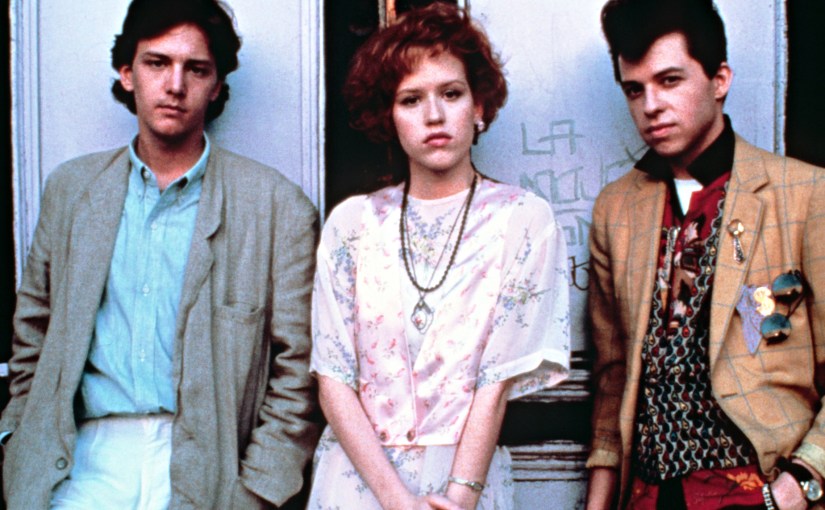
Director Howard Deutch directs John Hughes script, Pretty In Pink, by adhering to the familiar themes quickly recognized as Hughes’ signature touch from prior films. Deutch and Hughes maintain a vibe of alternative rock music amid a Chicago public high school community that could never be possible. Did I have this much independence in high school like Molly Ringwald as Andie, her adoring rich boy crush Blaine (Andrew McCarthy), or weirdly annoying (and lovable at the same time) Duckie played by Jon Cryer? And, oh yeah, a high school senior asshole named Steph played by asshole character perfectionist James Spader with his long cigarettes, Italian suits and barely buttoned shirts would never exist in an institution of education. So, there’s that too.

The kids at this school are divided among two different sides of a track-poor (Andie & Duckie) and rich (Blaine & Steph). Never meant to socialize or get along, the conflict of the film occurs when Andie and Blaine fall for one another.

This is Molly Ringwald’s 3rd Hughes film and looking back maybe it was a mistake for her career as she was outgrowing the roles she was getting pigeonholed for. Still, who else could you envision in the role of the aspiring dress designer who is responsible for her schlub of a father she lives with (Harry Dean Stanton), and friends with a weirdly eccentric, 80s punk/alt dressed co-worker played by Annie Potts?

Hughes’ is quite serious here, though the setup is not acceptably realistic, even back in 1986. These characters are competitive with one another for status in a high school setting. What other environment could the outline for Pretty In Pink take place in, though? Prom is on the minds of these “adults.”

Pretty In Pink was never a perfect movie. It has a perfect soundtrack, and I like the cast a lot as well as Hughes’ characterizations. Its glaring imperfection, however, is that these characters fit like a circle in the square setting of high school. The elements clash big time.

Still, I’ve always had an unusual affection for the film. I guess it is because I look past its inaccuracies and accept a playing field and the positions that Hughes and Deutch defiantly assign to the four characters. How does the intrusion of background and status overcome an affection between two people, and can this ever be happily resolved?

The ending was supposed to be different, very different. Yes. I should agree with the original conclusion because the math of the story adds up to that point. However, Reader…I am as defiant a viewer as Hughes and Deutch were as filmmakers. It’s wrong!!!! Nevertheless, I loved the ending that was eventually tacked on. So don’t judge me.

MARVEL’S THE AVENGERS

By Marc S. Sanders

Phase One of the Marvel Cinematic Universe concludes with Marvel’s The Avengers. This is a real treat and a feast for the eyes. It’s not my favorite of all the Marvel films because it gets a little too Saturday morning cartoon like at times, but it’s enjoyable to watch for good escapist popcorn fun.

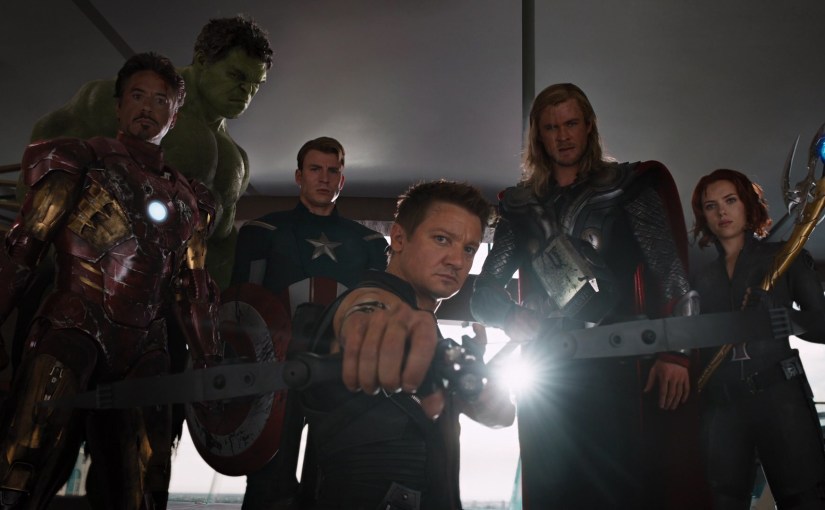
Movie goers were salivating for the year 2012 to arrive which would finally assemble Thor, Iron Man, Captain America and the Hulk on screen. Thanks to writer/director Joss Whedon that wish had finally come true and Whedon does not try to reinvent the wheel. When you assemble a team of heroes, you pit them against a large army and watch every variation imaginable of how the Hulk can smash, or what Iron Man’s armored suit can launch.

By now, you all know how I feel about the actors portraying their respective roles. Best to just say the chemistry works among them. They find reasons to squabble and Whedon provides moments for them to use their given talents against one another. So you get to see what happens when Thor smashes his hammer against Cap’s shield.

The actor who finally gets his moment in the sun is Samuel L. Jackson as Nick Fury, the orchestrator behind this team up. Jackson is more subdued than his other well known characters from the Tarentino films or Snakes On A (Mother effing) Plane. He does get to say “stupid ass idea” at one point and there’s the Samuel L. Jackson we all know and love! In comics, the Nick Fury character was reinvented before any of the films to harbor the appearance of Jackson. This film proves why the writers went that route. He’s great. He’s fun to watch. He makes for a great leader of the secret agency SHIELD. In tow with him is Clark Gregg as Agent Phil Coulson, a welcome cameo guy before this film, Gregg gets in a few scenes that show his endearment, and offer some dramatic weight as well. The guy could be waiting on hold while Black Widow takes out a couple of thugs, and you are cracking up at Gregg as Coulson, not necessarily Black Widow. He’s so likable that well…heck…he should get his own Marvel TV show….wait….nevermind….I digress.

Again, however, the women of the MCU are not drawn well for the screen. Scarlett Johansson makes her second appearance as Black Widow. She’s got a great, funny early fight scene while tied to a chair in a sleek black dress, but that’s all for show. She hints at a checkered past but this film does not offer much to expound on that. I understand. There’s a lot going on here. So there’s not much here for her to do. It’s time she got a film of her own, however. I’ll sign the petition. Wait! Nevermind! Colbie Smolders is a waste as Agent Maria Hill. She is nowhere convincing as a bad ass agent. Her line delivery seems forced. Her role seems unnecessary. Her scenes should have been on the deleted floor. It would have allowed more time for Johannson to play up her character. How is Maria Hill different from Black Widow in this film, anyway? She’s not. Therefore, cut out Maria Hill.

Jeremy Renner is given nothing to do but shoot arrows as Hawkeye, and work against the Avengers while under a spell from Loki.

Speaking of Loki, the great Tom Hiddleston is back. Hiddleston just elevates the Marvel films to more than just a comic book movie. His glee as the God of Mischief is different than say any version of the Joker’s. Pay attention Syndrome (from The Incredibles)!!! When Hiddleston monologues, you want to listen, unless you are the Hulk.

Whedon does an awesome job with the action scenes as he gradually destroys an aircraft carrier when chaos takes hold among the various heroes, and then later he destroys New York City in a fun amusement park like battle through the streets, subways and skyscrapers. It’s a little reminiscent of Richard Donner’s (or Richard Lester’s) Superman II, and Ivan Reitman’s Ghostbusters. It’s fun to watch the Hulk run through a building only to come out the other side and leap upon the head of a gigantic, flying centipede to bring it down on to the top of a building. Who cares how this all gets cleaned up? The greatest city in the world always figures out a way.

Whedon sealed the pop culture significance of superheroes in the early 21st Century. He’s done what guys like Michael Bay beg to do with other toy/comic book franchises. Marvel’s The Avengers stands out as an important impact in cinematic filmmaking. It’s not best picture worthy, but it is nonetheless important to how blockbuster films are conceived and created. Sadly, some people still don’t get it right, all these years later.

THE GODFATHER PART II

By Marc S. Sanders

The first film to use the number 2 (or Roman numeral II, in this case), in its title and the first sequel to win Best Picture is Francis Ford Coppola’s continuous adaptation of Mario Puzo’s Corleone family legacy in The Godfather Part II. It is worthy of all of the accolades it collected as an individual film. Yet, it does not best the first film.

Unlike the 1972 classic, Part II does not provide much character arc for anyone. We’ve already seen Michael (Al Pacino, silently ferocious here) change from good college boy and war hero to the evil puppet master Mafioso he eventually became. This film shows him exercising his threateningly murderous deeds as he works in conjunction with a sly Nevada Senator, a Jewish Miami mob boss (an excellent performance from Lee Strasberg) from the time of his father’s reign, and another mob guy from New York (Michael V Gazzo). We get a whiff of all these guys early on during a commencement celebration for Michael’s son. Coppola keeps this a running theme of grand openings in all three films. It’s a great method of introductions each time.

Following the party, an assassination attempt is brought against Michael. But who did it? Problem is this is where the foundation of the film is not so strong. It’s never really made clear who betrayed Michael. That’s a little bothersome.

Coppola depicts another storyline altogether with the early 20th century origin of Vito Corleone flawlessly played by Robert DeNiro who hardly speaks any English while communicating in a Sicilian variant of Italian. Young Vito immigrates to America following an escape from the Sicilian Don that murdered his family. In New York we witness his rise to power. Famed Cinematographer Gordon Willis washes out these flashback images to enhance a pictorial history accompanied by Angelo P. Graham’s art direction of early brick and mortar architecture and the muddy streets of early Little Italy, New York. It’s a time travel back to a historical age. It’s magnificent.

Back in the 1950s, Puzo and Coppola bring authentic fiction to real life history as Michael considers a go at a business enterprise in Cuba. However, will the rebellion uprising interfere with his plans, and what will it cost him? As well, there’s a great sequence where he has to testify before a congressional hearing in response to suspicion of criminal activities. Coppola used the infamous McCarthy hearing footage as inspiration for this predecessor to what C-Span would eventually look like.

Yet, there’s another story to become involved with as Michael must contend with his dim witted older brother Fredo. John Cazale is superb as the guy who wanted more but was limited by the influence of competing factions and his loyalty to his brother. Pacino and Cazale always had great chemistry together. A great conversation moment occurs in the third act following a terribly surprising twist. One of the best scenes in the film occurs on the porch of the Corleone compound.

More story elements come into play as Michael attempts to balance his married life with Kay (Diane Keaton). She’s pregnant again. Yet, what will that mean for the future of the family?

The sequel to The Godfather assembles another stellar cast. So good, that the film garnered three Oscar nominations in the Supporting Actor category alone (DeNiro, Gazzo, Strasberg) as well as a nomination for Pacino as Best Actor and Talia Shire (Supporting Actress) as Connie, Michael’s sister. That nom left me a little dubious only because there’s not much material for Shire to play with here.

Coppola’s detail is at the top of his game again. The film, like the first, feels like a true life biography.

Puzo offers heartbreaking moments, most especially in the film’s shocking end which leads to a flashback assembly of characters from the first film. That scene alone plays as a great reminder of what Michael once was before becoming the hideous monster that closes the story. Puzo’s whole Godfather franchise hinges on well defined, crushing tragedy.

The Godfather Part II is nothing short of mesmerizing and wholly engaging. You can watch it over and over again. It’s layered in rich storytelling and narratives that provide endless amounts of material for a family meant to be mired in secrets, deliberately hidden in the dimly lit rooms that Willis photographed.

It’s a treat to be the fly on the wall wherever Michael and his family move to next.