UNCOMMON VALOR

By Marc S. Sanders

In the decade following the Vietnam War a common denial (or ignorance, maybe) went towards American soldiers who were missing in action.  Many men were theorized to be prisoners of war long after the armed forces left the country, ending a losing battle with record numbers of casualties.  A handful of films of the 1980s brought focus to this topic, as a means for adventurous entertainment.  Chuck Norris had a series of Missing In Action films.  Even light action fare TV shows like The A-Team and Magnum PI brought attention to this issue.  Most predominantly, the possibilities of POWs were ingrained within Sylvester Stallone’s box office bonanza of Rambo pictures.  In 1982, Ted Kotcheff directed the initial entry of that series, First Blood, and he zeroed in much more precisely the following year, with Uncommon Valor.  

Gene Hackman is retired Marine Colonel Jason Rhodes who begins a decade long campaign convincing the U.S. government to seek out those who were left behind and are likely being held as prisoners of war.  His motivation stems from his belief that his son Frank is likely being held captive in a camp located in northern Laos.  

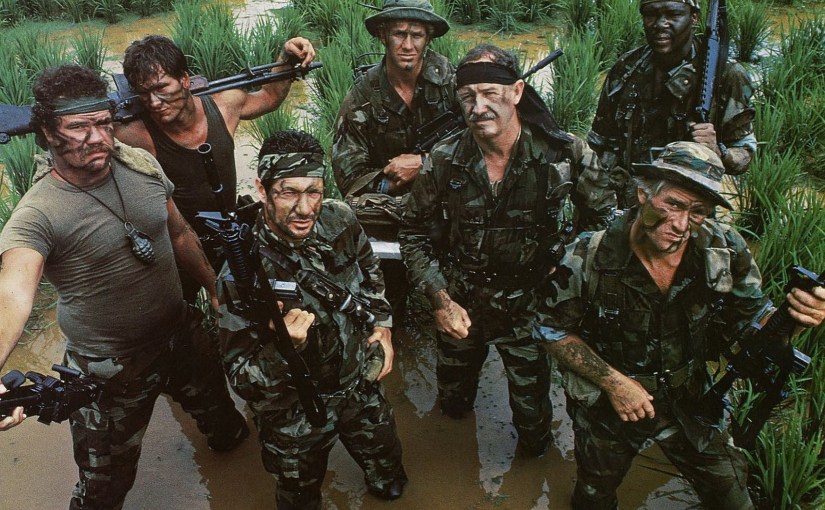
By the time 1983 arrives no action of recovery or rescue is taken.  The Colonel is committed to bearing the responsibility.  He appreciatively accepts financing of his own mission from an oil tycoon (Robert Stack) whose son might be with Frank.  The Colonel also recruits members of Frank’s unit who made it home (Fred Ward, Reb Brown, Randall “Tex” Cobb, Harold Sylvester, and Tim Thomerson). Patrick Swayze is a young guy named Scott who never served in the conflict but is an expert combat and weapons specialist who will get these men retrained for the upcoming rescue.  He also has his own reasons for partaking of this mission. 

Uncommon Valor is sporadic on humor and focused on the adventure and resourcefulness.  The first half provides footage of how the squad gets reacquainted with each other and the jungle elements they left behind in Vietnam.  They practice routines outlined by the Colonel with ground patrols, detonators, hand to hand combat, artillery, sabotage, and chopper rescue.  The second half follows them back into the Asian country where they have to obtain weapons and supplies, while making connections with locals who will escort them through the dense jungle area towards the camp.  

This is a rare occasion where Gene Hackman is not applying much of his acting craft. He is primarily going through motions of Kotcheff’s film direction with a script rumored to be co-written by Wings Hauser (also a producer on the film).  The trauma of the war is primarily carried by Fred Ward who struggles with PTSD long before it became so widely attributed to service men and women after returning from combat.  In First Blood, Stallone offered a much more substantial and convincing demonstration.  Yet, Ward does a serviceable job with a script that never goes terribly deep.

Uncommon Valor is better described as a present-day adventure picture.  It’s never boring.  There are fireball explosions and machine gun shootouts. The action set pieces still hold up with good art designs staged off the Hawaiian Islands in place of a sweltering Vietnam.  The prisoners who are recovered, supposedly held for over a decade, are chilling to look at with obvious malnourishment and dead-blank expressions.

Randall “Tex” Cobb and Reb Brown (the TV movie Captain America) are mostly doing wacky A-Team material here.  Gene Hackman, Fred Ward and Harold Sylvester are the straight characters.  

It’s not as grand as a Rambo film, but Uncommon Valor never lampoons or minimizes what was a horrifying experience for those enlisted soldiers who never came home, while their next of kin never obtained closure.  

For the 1980s, which feels like it had just passed yesterday, it’s fair to say that all those missing in action during that terrible and bloody war are no longer alive over fifty years later.  The opportunity to search and negotiate for their freedom has long expired by now.  While movies like Missing In Action, Rambo and Uncommon Valor focused on fictional triumphs that were never factually replicated, at least these films can serve as reminders for the sacrifices these people served at the behest of their country.  I’m not writing to ease lifelong pains.  All I can do is recognize, remind and be forever grateful.  These movies still serve a purpose beyond the pulpy Saturday afternoon adventures. 
NIGHT MOVES

By Marc S. Sanders

As soon as composer Michael Small’s easy listening disco themes kick in and you see Gene Hackman make a u-turn in his green Ford Mustang convertible, I had vibes that Night Moves was going to operate like an episode of The Rockford Files.  I was alert and energized.  I liked where this was going.  A new, undiscovered gritty 70s movie to sink my teeth in.

Gene Hackman is Harry Moseby, a perfect name for a private detective.  Arthur Penn is the director in his second of three collaborations with the actor.  The film starts off well for Harry.  He’s giddily promiscuous and happily married to Ellen (Susan Clark), and he’s ready to take on a new case. 

A Hollywood has been actress needs Harry to find and bring back her sixteen year old, runaway daughter named Delly (Melanie Griffith, in her debut role).  Through a lead in the form of a young, punk kid (James Woods, in an early role), Harry flies out to the Florida Keys where Delly might have taken up with her step father.  

Seems easy enough, but before he departs Harry does some personal investigating on the side and discovers that Ellen is having an affair with a guy named Marty (Harris Yulin).  Harry’s carefree exterior is shattered.  Quickly, he becomes bitter towards all he cared about, from his wife and his profession which serves a purpose of lifting the veil on sins and secrets.  

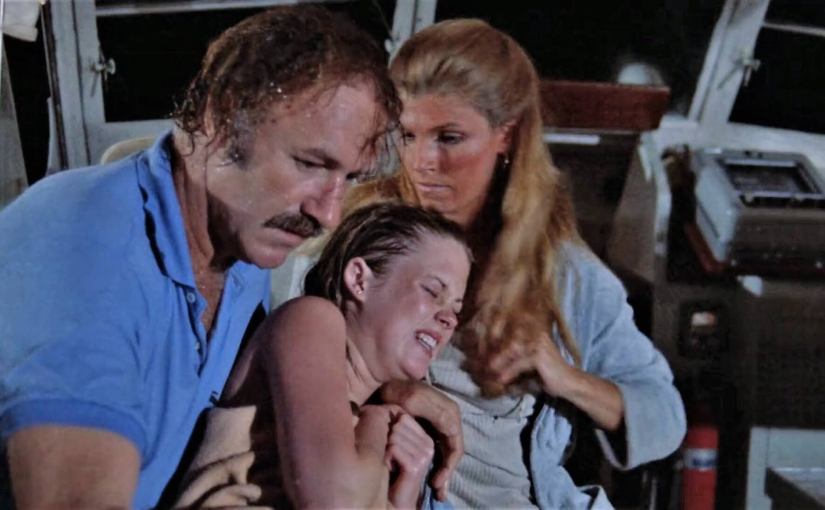
Night Moves performs with unpredictable directions and tempos.  When Harry finds Delly with her step father Tom (John Crawford) and his younger girlfriend Paula (Jennifer Warren), the rundown boat dock where they reside seems relaxing and tranquil.  Paula tends to a dolphin pen.  There’s a plane that Tom uses for shipment trips.  Drugs?  Harry is not all that concerned.  He’s only here to pick up Delly.  A boat is there for fishing and swimming off of too.  Delly feels welcome and independent here.  Though as a teen she’s resistant to Harry’s obligation to return her to her mother in Los Angeles.  

It’s only after he wraps up the case that unexpected twists occur and now he’s got to backtrack to find out what is really going among the ranks of these folks.  In parallel succession, Harry and Ellen have to wade through their own sordid conflicts.  

Watching the Criterion issue of Night Moves was really interesting.  After seeing the film, I watched two different interviews with director Arthur Penn.  There are lots of discoveries to find in the film all the way down the very last frame of the picture.  However, the revelations of the mysteries are not told but rather shown.  Dialogue hardly spells out this story.  It’s what Arthur Penn allows you to see.  He described it as explaining through a lens or view from a window, for example.  As Penn speaks, Criterion edits in quick moments where mirrors and windows that were woven into the final cut of the film provide new information and answers.  It’s a very clever strategy.

The sinister happenings of Night Moves are undetectable until Harry gets wise.  It made me think of what Jake Gittes experiences in Chinatown.  The new assignment seems so easy.  An open and shut case until the complexities surface from under water or even high above.  

What separates Night Moves from the Mickey Spillane gumshoe stories or Chinatown and The Maltese Falcon for example, is that Harry Moseby’s personal hell interferes with an occupation where he’s meant to serve from outside of all of the sordidness.  Harry won’t slack on his case, but he still has to grapple with a sudden broken marriage that he is so capable of uncovering from his wife and her bumbling lover.  He’s not a loner like Sam Spade, Jake Gittes or Mike Hammer.  He’s opted to open his own private practice and dig into others personal conflicts and misgivings.  On the side, he wants a happy home life.  Problem is he is just too damn good at what he does.  So, he’ll get hurt.  It’s the cost of his talents.

This is a great performance from Gene Hackman.  He seems like a put together Jim Rockford in the form of James Garner.  Yet, when the film steers into the tsunami of its conflicts, this character splinters apart.  Hackman has always been good at evoking strength and confidence in the romances and adventures his characters get into as well as with their various occupations.  He’s also a dynamo at showing how his characters crack and become undone (Crimson Tide, The Conversation, The French Connection).  

The supporting cast of lesser known but familiar character actors are collectively stellar as well.  Sharing scenes with Hackman only makes them look more engaging and natural in either their privileged Hollywood, California habitats or the earthy locales of Florida islands.  Arthur Penn assembles this whole cast in great footage and sequences.

Whether it’s a trip to Florida or back to California, a late night personal stake out and break-in at an ocean beach house, a visit to a film set, or a moonlit boating venture in the Keys, Alan Sharp’s script never foreshadows what’s too come.  Thus, Night Moves offers a verity of the sinister and complex.  Just when you think you don’t need to carry much thought with the picture, it suddenly begins to challenge you.

Night Moves will have you believe it gets its title from how Harry plays the strategies of two celebrated chess champions against one another.  He explains to Paula, that while it may seem that the players are three moves ahead of each other, they’re really not.  Instead, there’s play going on beyond a standard trap of check or checkmate.  When everything is laid out to the very last second, it all makes sense even if Harry never had the instinct to think of any likely scenario before.  

Was I a little vague with you just now?  

Good.  

That’s how Night Moves serves its audience best. A stunning, unpredictable thriller.

THE CHAMBER

By Marc S. Sanders

Having recently read John Grisham’s fifth novel, The Chamber, I opted to watch the film adaptation directed by James Foley. 

First, allow me to say that Grisham’s novel is primarily stale and boring.  That’s only because his nearly five-hundred-page best seller is occupied with a lot of legal procedurals and tactics necessary to get a convicted, racist murderer off of death row before his scheduled date of execution.  Grisham permits moments where his characters can bond, become forgiven or get even more revolting with each other.  In between though are efforts of appeal after appeal.  It’s likely how it works.  A motion is carried out.  It’s rejected.  On to the next in line.  In fiction though, this is terribly redundant. 

James Foley’s film does not work that way, however.  In fact, it’s a much worse experience.

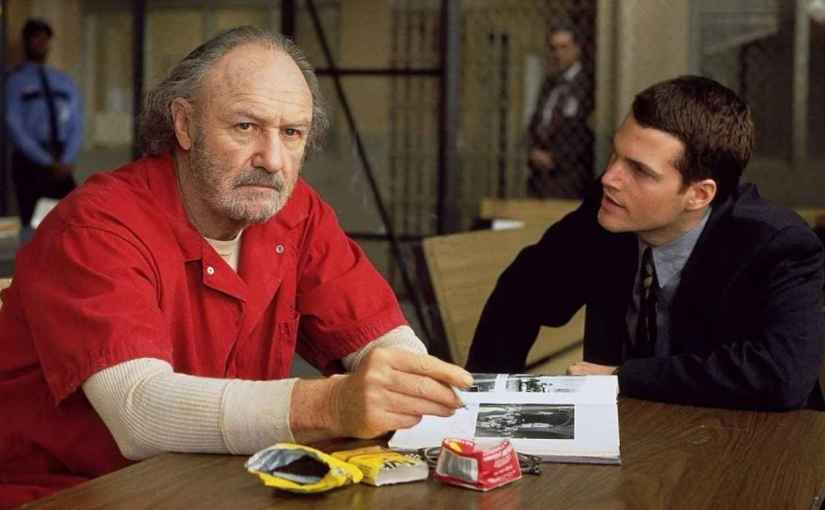
A grey bearded Gene Hackman with oily, stringy hair and tobacco-stained teeth is Sam Cayhall.  He’s a former member of the Ku Klux Klan who is sentenced to the gas chamber for the murder of two young Jewish boys who accompanied their father, a Mississippi civil rights attorney in 1967.  The father lost both legs and years later he took his own life.  Sam is considered solely responsible for bombing the lawyer’s office building. 

Chris O’Donnell plays Adam Hall, a twenty-six-year-old attorney eager to take on Sam’s case and get him off death row.  Sam will finally meet his grandson but he won’t be very welcoming.  Adam is adamantly against capital punishment and he’s repulsed by his grandfather’s past, but that is not enough to send the old man to the chamber.

IMDb trivia documents that screenwriter William Goldman (Butch Cassidy And The Sundance Kid, The Princess Bride) walked away from the film after six drafts.  Another credited screenwriter used a pseudonym to keep his name disassociated with this picture.  John Grisham considers The Chamber the least favorite of his film adaptations thus far.  I can imagine the suffering with trying to assemble something compelling on film.  Frankly, I don’t think it could ever be accomplished.  This stuff is either boring or ugly or both.  Try and project it on a screen and it will not deliver a message like Schindler’s List or Do The Right Thing.

Gene Hackman suffers the most from this film.  His character is clearly there, but the script and directing and even his primary scene partner, Chris O’Donnell, are not up to par.  Hackman puts in the energy with an old man white trash dialect.  He has the expected hateful outbursts of a Klansman.  His appearance is convincing too.  However, nothing he has to say is important.  He’s actually not hateful enough, even if he’s freely uttering the N-word or being derogatory towards the Jewish people who run the legal firm that Adam works for.  As well, the script does not offer empathy for him or enough remorse of his past sins. 

Chris O’Donnell is supposed to be the idealized grandson in the mid-1990s who feels shame for his family’s history of Klan participations and crimes going all the way back to his great, great grandfather.  Hardly any opportunity is offered for the young actor to feel this way.  He barely gets angry or empathetic when he shares scenes with Hackman.  Instead, his moments are wasted with a young staff member of the Governor, played by Lela Rochon. She has too large a role, especially when Gene Hackman could be doing more. The two prattle on about topics that result in no consequence. 

Faye Dunaway plays Hackman’s daughter, now a wife to a Southern aristocratic banker.  She’s a recovering alcoholic, which is assumed to be a residual cost of her father’s misdeeds.  Dunaway, this once great actress, has no connection to either Gene Hackman or Chris O’Donnell.  It’s as if she is not listening or properly responding to either of them when she appears.  Then again, O’Donnell is not lending his best towards Hackman either.  He’s very flat, very plain.  His character from Scent Of A Woman went on to legally represent his racist grandfather.  His Robin, the acrobatic DC superhero, has more personality and drive than this guy.

Thematically, John Grisham builds his thrillers off of what southern American law mandates.  Precedents become obstacles for his protagonists to overcome, or the characters have to learn to embrace what’s at their disposal.  However, it’s tempting to hinge on racial divides to serve as antagonism.  That’s tricky because if you emulate the hate and racism too much, then it looks glamourized. 

James Foley provides many exterior shots of uniformed modern-day Nazis and Klansmen marching outside of Sam’s penitentiary.  Others are there to applaud the death penalty for the old coot.  These are just visuals though.  They say nothing except enhance the image and platforms these sects stand for.  If a film is to bring prejudice to the forefront, then the screenplay or book better have something important to say.  Let’s study the science of hate and where it stems from.  Let’s focus on those who fight against such cruelty.  The Chamber just marches itself towards an inevitable conclusion with nothing gained in the process.

Fortunately, the author’s novel uses its five hundred pages to span the last four weeks before Sam Cayhall is to be executed, and in that time his grandson learns more of what transpired in the convict’s past.  Then the author delves into how Adam grapples with what he learns.  James Foley’s film only flashes back to one very ugly incident.  From there, it’s hardly discussed and it is definitely not focused on enough.  Foley stages the murderous events but his film has nothing to say about any of these things afterwards.  Adam hardly ever gets disgusted or even a little angry.  Sam never regrets or even champions what he’s responsible for.  These are just scenes from a book reenacted for a Hollywood film, and devoid of any emotional weight.  Do something guys!!!!!  Shock me!!!!

I have to credit what Gene Siskel and Roger Ebert observed about the film.  The racist, former Klan member, Sam Cayhall, steps out of his cell and walks down the hallway. A series of hands belonging to African American prisoners shake Sam’s hand through the bars, and they pump their fists in allegiance for their fellow prisoner.  In what world would this happen where the black occupants applaud the cellmate racist buddy?  Forgive the term, but I’d expect they would lynch this guy for what he did before entering this prison.  This kind of staging is an insult to the intelligence of what hate stands for in this country, where it was back in 1996, or nearly thirty years after the movie was released.  Why is The Chamber whitewashing what really happens? 

I was not fond of either the novel (a boring drag of a read) or the film (an insult lacking insight or sensitivity), but at least John Grisham did his homework. Racism is not to be sugar coated for what is genuinely ugly in this world.

ABSOLUTE POWER

By Marc S. Sanders

As Clint Eastwood’s Absolute Power was unfolding I started to think this plays like one of those hardcover bestseller political thrillers from the 90s that my dad would scoop up off of the neatly designed stack at the front of Barnes & Noble.  You know with the glossy book jacket that has the blood stain and a dead girl’s nail polished hand next to a bloody letter opener.  The graphics are elevated to feel the crime scene with your fingertips.  The intrigue is summed up on the inside tab.  You turn to the back of the book to see the picture of the author.  Then you buy it with your membership card.  Go figure!  William Goldman adapted the screenplay from a novel by renowned author David Baldacci. Absolute Power has an engaging set up, a who’s who of a cast, it’s directed, produced and starring Eastwood. Still, it evolves into utter eye-rolling preposterousness.

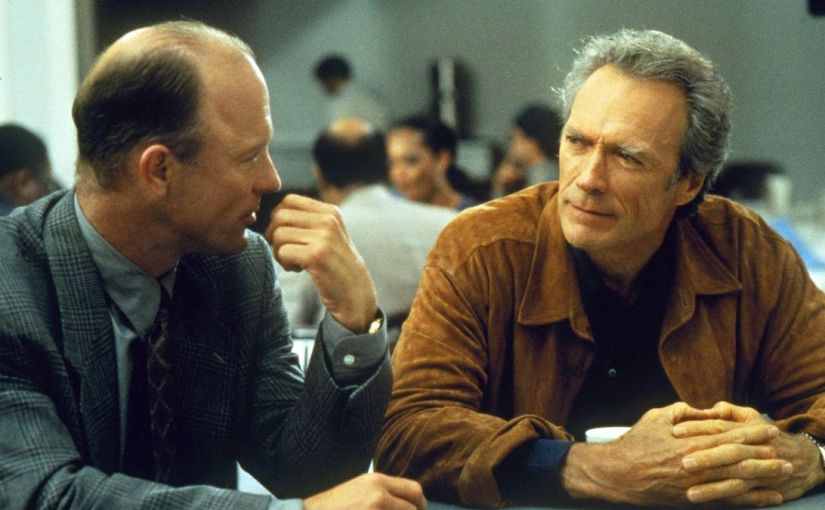
Eastwood directs his own portrayal Luther Whitney, an expert jewel thief.  He might be getting up there in age but he scopes out the mansion of a billionaire tycoon (E.G Marshall, in his final on-screen role) and locates the vault hidden behind a large two-way mirror.  Everything is going to plan as Luther bags up the valuables and a lot of cash but then a drunken couple enter with Luther hidden behind the mirror to watch their tryst turn deadly.  The President of the United States (Gene Hackman) avoids being stabbed to death by the young lady (Melora Hardin) when his secret service detail (Scott Gleen and Dennis Haysbert) enter to shoot the girl dead.  The President’s Chief of Staff (Judy Davis) arrives soon after.  Luther observes the four as they rush the Commander In Chief out of the house and alter the crime scene.  They get careless and just as Luther makes a quick exit, he retrieves evidence that will hopefully work to his advantage.  Now he’s in danger of the President and the other three as they work to permanently contain the situation.

Elsewhere is Ed Harris as the detective out to solve the murder and uncover everything we already know.  When he realizes a thief must have been at the scene of the crime, he actually approaches Luther for some guidance as to who could have been there.  Later, he will use Laura Linney, playing Luther’s daughter, for assistance as her father seems to be the prime suspect. 

The tycoon, the President’s biggest supporter, also wants to resolve his personal vendetta by hiring his own sniper (Richard Jenkins) to take out Luther. 

Absolute Power has all of these players, with recognizable actors in the roles, and yet cannot work the magic necessary to fix this outrageous conundrum.  I can believe that a President could get in more trouble than he needs with a one-night stand and a dead girl on the floor.  I can believe members of his staff will work to tie off all the loose ends, even if it means more murder and mayhem must occur. 

What is hard to swallow is how neatly the story wraps up literally within one afternoon leading into an evening.  It’s fortunate that window washers are present to throw off a couple of snipers with an inconvenient glare at the most inopportune time.  Otherwise, there will be no more movie.  It helps that a character with remorse happens to take his own life, thus exposing the conspiracy, just as Eastwood’s character is steering his own way to exoneration.  All in the same night!!!!

To ramp up the suspense, the bad guys go after Linney’s character, the one person Luther cares for the most.  She ends up in a hospital.  Message has been sent.  Luther better surrender himself along with what he knows to the President’s squad.  Yet, they try one more time to permanently eliminate her and I asked why.  What purpose does that serve to kill her now?  If you kill her, then Luther has nothing to protect or care about anymore.  He can just reveal the entire breakdown of what really happened complete with evidence and so on.

A few years earlier, Eastwood starred in In The Line Of Fire where John Malkovich played a master of disguise assassin.  Luther is also a craftsman at hiding in plain sight.  However, there’s no way I can believe that.  We are looking at Clint Eastwood here.  He’s got his own unique and very tall and square stature.  Put a white mustache and a pair of glasses on the guy, and it is still Clint Eastwood.  Put a hat and beard on him and it is still Clint Eastwood.  Wrap him up in a trench coat and have him walk the city streets in broad daylight where fifty cops are awaiting his arrival and you’ll be able to see the one and only Clint Eastwood.  It just can’t work.  James Bond can hide in disguise.  John Malkovich can hide in disguise.  Go anywhere in the world and Shaquille O’Neal and Clint Eastwood would never be hidden in plain sight. 

William Goldman (The Princess Bride, Butch Cassidy And The Sundance Kid) is one of Hollywood’s most celebrated screenwriters.  He did not think this story all the way through.  You may believe Gene Hackman (second billing behind Eastwood) would have had more of a presence in this picture but oddly enough he’s hardly there. The real bad guy roles belong to Judy Davis and Scott Glenn who are not nearly as exciting as what Hackman could have delivered.

There was a potential for a good conspiracy thriller. The problem is the audience knows too much following the first fifteen minutes of the film.  We know everything that happened and therefore I could care less about the progress that Ed Harris’ detective makes.  Absolute Power likely would have performed better had it opened after the crime had occurred.  Run the opening credits over the dead girl in the room and open the two-way mirror for Luther to enter the frame.  He makes a run for it and then the film can gradually reveal what precisely happened.  A mystery for the characters and the audiences who are watching them only works if the questions are offered before the answers are revealed.

Absolute Power offered a lot of promise with a lot of talent but it’s devoid of both.

HOOSIERS

By Marc S. Sanders

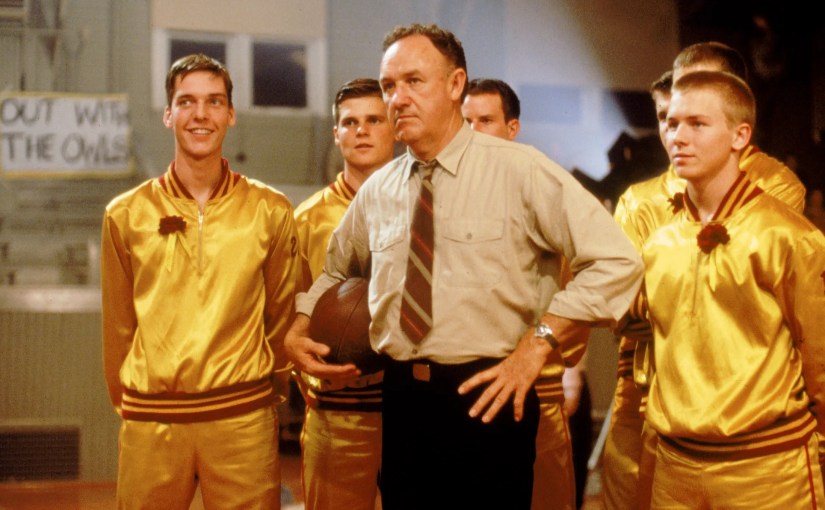
Hoosiers is a sports film offering nothing truly new or inventive.  What sets it apart though is that this high school basketball picture has Gene Hackman as the coach, Norman Dale.

Like so many films, this one occupies its opening credits with the cross country drive of the outsider arriving in small town USA with Jerry Goldsmith’s orchestral horns conducting the journey.  Welcome to the sweeping farmlands of Hickory, Indiana, 1951.  

Coach Dale has been hired by the local high school to lead the team of seven boys for the upcoming season.  Everything typical happens from there.  The potential love interest gives the guy the cold shoulder.  The town, who take such pride in the boys basketball team, find the coach unfit and work the first half of the story trying to vote him out. There’s the one kid who makes every shot and is stand offish, but just won’t play.    There’s a player who has strife with his father, the town drunk called Shooter (Dennis Hopper).  Coach gets kicked out of the games too.  Even Hackman’s recognizable short fits are here to stir it up with the referees.

Yet, is this team gonna get in shape and take it all the way to the championship?  I’ll let you decide if that’s rhetorical question.  

I dunno.  Maybe it’s because I’ve never been wild about basketball that Hoosiers just didn’t do much for me.  A film like Hoop Dreams or even the actor/players shown here impress me with their abilities to make one jump shot after another, while their capabilities to dribble appear like artistic forms of dancing.  The game however has never done much for me.  A team scores and then they go to other side the court where the other team scores.  For me, only the last few seconds of a basketball game seem important.  Otherwise, it’s a back-and-forth scrimmage to me.  Hoop Dreams lends more of a story within its tragic documentary footage than Hoosiers provides.

When I observe the team making plays on the court, there’s not much to open my eyes wider.  David Anspaugh was a new director when this movie was released. Much of the cuts within his footage are the players jumping and passing and Hackman’s sideline expressions where he slaps his play sheet before another cut to the cheering or booing crowd.  This is nothing but action takes. Where are the shortcomings and triumphs that come with cinematic athleticism?

Even the final game does not work like a story.  It’s all just a collection of basketball players making shots.  It never worked for me because I hardly know any of the kids.  The star player, Jimmy, literally has three lines in the film.  I could never pick out which young man was Hopper’s son because most of the team members are given such little attention.  It’s only when a scene or two finally presents itself for the father and son that I connect the dots, but that’s resigned for a quick last act.  The one I could always pick out was the short guy who is not very good and mostly sits on the bench.  The kid who prays too long?  Good gag, but when he’s not on one knee I don’t recall who he is among the crowd.  The players are not given distinct personalities. They are scarcely shown in close up and so I don’t know one from the other.  

Watch Teen Wolf with Michael J Fox.  Beyond the lead who is a werewolf, there are two or three others on the team that triumph, as well as faithful members of the school student body. Thus, that movie ending game becomes something entirely special and touching.

Gene Hackman is always an attraction even if some of the traits he lends to his characters are the same.  I love his grin and his quiet, sometimes sarcastic, cackle. When he throws a temper it’s not one that can be duplicated.  I’ve never seen someone who can do an exact impersonation of Gene Hackman.  He’s simply one of a kind. He’ll always be favorite actor of mine, no matter the material.

Dennis Hopper is very good as well.  He’s not just a drunk, but Shooter is a likable guy who looks worthy of a second chance.  Hopper’s body language defines all of that.  It’s not just the booze or the drying out moments that lend to the performance.  The celebrated actor is given scenes where the character is lost and helpless while trying to contribute moments of value to the basketball team.  Even the unpressed, oversized suit and greasy combover he wears tell a story.

Barbara Hershey seems underutilized.  For most of the film she proceeds with a scowl on her face, and I was never certain of her disdain for the Coach or the school where she teaches.  I could never confound exactly what her problem was anyway. At best, she’s here for an eventual on-screen kiss with the lead, but then the relationship doesn’t progress.  I read that much material went on the cutting room floor, and I can’t deny there’s an absence to her storyline.

Hoosiers is serviceable, but nothing it offers moved me and grabbed my attention.  This is a step by step sports film with every standard cliche included.  I didn’t stand up and cheer when that final shot swished through the basket in slow motion because I did that at the end of Rocky and The Karate Kid, and Teen Wolf too.  When The Bad News Bears ended I did a hard clap because those tykes had balls.  At the close of Slapshot, I couldn’t contain my laughter.  I couldn’t stop thinking about Hoop Dreams for good, long week. Other pictures focusing on athletics always possessed a way of making their stories special.  Hoosiers looks like it stole its play by play from those wunderkinds. 

TRIVIA: Look for Sheb Wooley, who portrays Hackman’s first assistant coach. He is the origin of the famous Wilhelm Scream uttered by Indiana Jones, several Stormtroopers and during the demise of various superhero villains.

CRIMSON TIDE

By Marc S. Sanders

A little over a year ago, having just seen Christopher Nolan’s Oppenheimer, I shared with friends how it is sadly surprising that a nuclear weapon has not been launched by a super power country since the bombs were dropped on Hiroshima and Nagasaki.  Those two bombs certainly served their purpose in response to the Pearl Harbor attack of 1941.  I deem it sad that any of us consider this a possibility that can easily be repeated. With all of the threats that continue worldwide with weapons testing, technological advancements and arms trading, it’s frightening to wonder what can ever be expected. Is it easier to execute a command like that again, now that it has been done?  It’s got to be a little surprising that the United States did not respond that way following the 9/11 attacks.  Tony Scott’s Crimson Tide comes close to providing an answer by weighing sound vs unsound reasoning. 

This is not only my favorite of Tony Scott’s films, but the movie also offers maybe my favorite performances from Denzel Washington and Gene Hackman.  The two actors of different generations are equal in measure as they debate what should be done, along with how the submarine they command, the U.S.S Alabama, should respond while in the midst of a revolutionary conflict stemming out of Russia.  

Washington is Commander Hunter, recruited at the last minute to serve as the Executive Officer aboard the Alabama.  Hackman is Captain Ramsey who proudly leads the charge of the sub with an intimidating welcome to Hunter.  Before any kind of real conflict comes their way, Ramsey puts Hunter to the test.  An uncomfortable dinner conversation, wisely written by Robert Towne (Chinatown), has the Captain question Hunter’s stance on using nuclear force to deliver a harsh defeat to the enemy.  Hunter’s position though is the real enemy is war itself.  Ramsey and his commanding staff have no reply to the new member’s observation.

Another moment occurs when Ramsey orders a missile launch drill while Hunter is assisting with containing an on-board fire in the galley.  The Captain has his reasons that Hunter cannot truly debate. Besides, Ramsey precisely tells his XO to “bite (his) fucking tongue,” even if he doesn’t agree with him.

The centerpiece of the officers’ conflict arrives when they receive a fractured message from command.  Ramsey’s instinct is to launch missiles at Russia based on the presumption that the Soviet rebels have overtaken the country’s arms.  Though Hunter cannot deny the concern, he will not agree to a missile launch until they receive the entirety of the broken order.  This occupies the second half of the film, and it becomes a back-and-forth mutiny of power.  The Captain is relieved of command but then retains control and the crew is divided between the leaderships of these two characters.

Having recently seen and reviewed the submarine classic Das Boot, it’s fair to say that film feels much more authentic and maybe it should be much more tense than any other movie of its kind.  Crimson Tide is glossier with outstanding interior cinematography on a studio constructed set designed to tilt like a maritime vessel should.  The dashboards and colored lighting are fancier.  The cast is good looking as Tony Scott obtains close up shots of them beaded in glistening perspiration with no facial hair.  Crimson Tide is definitely a Hollywood picture.  However, the screenplay from Michael Schiffer is razor sharp with not one wasted piece of dialogue.  In addition to Robert Towne’s contribution, Quentin Tarantino also script doctored a portion of the piece as well which includes a well-placed Star Trek allegory. 

There’s a jolt of energy to Crimson Tide that Das Boot has at times, but because of the latter’s three hour plus running time it also slumbers like life should while living on a submarine.  It is the theatrics of Crimson Tide that hold my attention on many repeat viewings.  I’d never want to question a guy like Captain Ramsey, but I’d be grateful that someone like Commander Hunter is around to stand in protest.  

I wish Gene Hackman and Denzel Washington had done another film together.  Their conflicted chemistry is second to none.  You like them both equally in the scenes they share together, or individually.  The timing of their tempos is perfect.  They find just the right moments to be alarming in a quiet way and save other opportunities for shocking outbursts.  The best actors practice their scripts this way and avoid any traps of overdramatizing.

Tony Scott made this film before his penchant for chaotic angles and grainy captions took over much of his other films to come hereafter.  Crimson Tide is cut perfectly from one scene to another with outstanding colors of blue, red and green lights that illuminate the cast while they stand at their posts.  Washington, Hackman as well as a sensational supporting cast (Viggo Mortensen, James Gandolfini, George Dzundza, Steve Zahn, Matt Craven, Lillo Brancato) do fine work and respond beautifully to the director’s camera positions. 

It’s impossible not to feel the tension accompanied with the progression of this film.  It serves as a motivation to wonder if we act on what we know or don’t act on what we don’t know.  As taut and dramatic as Crimson Tide is, you find yourself considering if those with access to the real-life red button consider all that could come of their decisions.  

Crimson Tide may tidy itself up after two hours, but the movie still makes me ponder if this planet’s military forces are thinking each and every day about if we are preventing nuclear war or if we are on the cusp of waging a nuclear holocaust.

This is one of my most favorite films. 

THE QUICK AND THE DEAD

By Marc S. Sanders

The Quick And The Dead is a gritty, stylish western that boasts a who’s who of great actors.  Some of which went on to magnificent careers.  I wish the story was a strong as the cast list though.  It’s watchable.  It’s intriguing. It’s also too repetitious.

Sharon Stone is Elle.  Otherwise known in these parts as The Lady.  Two minutes into the picture and my suspension of disbelief is withering away.  Not because this gunslinger cowboy is a cowgirl, but because Stone does not look like she fits in the Old West.  Her blond locks are shampooed and conditioned.  Her complexion perfectly made up without a hint of grime or dirt or sunburn.  Stone looks like she took one step off the Oscars red carpet and onto this set. Her costume with a scarf, leather pants, black rimmed hat, and spurred boots looks like its attempting its own kind of Clint Eastwood stranger.  Frankly, it appears to have leaped off the pages of an Old Navy catalogue.

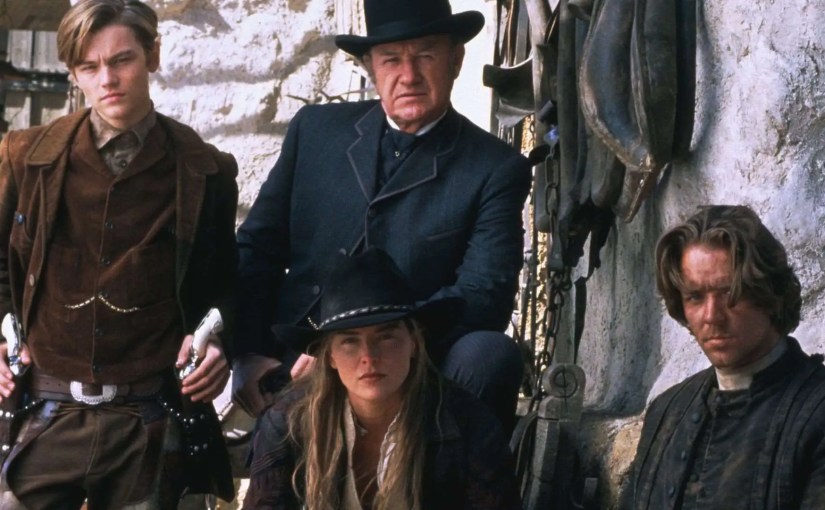
Below Stone on the credit lineup is a much more redeemable list of characters.  Gene Hackman is Mayor Herod who has amped up his level of sinister from his Oscar winning performance in Unforgiven.  There’s also Ace Hanlon played by Lance Henrickson with a rare on-screen giddy grin, whose personal deck of cards consists of aces of spades for every man he’s killed. Sgt Cantrell is the flamboyant personality with the handlebar mustache, deep voice and toothy grin that actor Keith David proudly bears.  A kid named Leonardo DiCaprio plays up the youthful cockiness of an outlaw named The Kid.  All these folks are gunslingers participating in the sport of gunslinging.  Last one left standing is the winner.  Midway through though, Herod will up the ante and deem that the last one left alive is the winner.  Each one challenges another until a final winner is recognized.  One reluctant participant is played by a very youthful looking Russell Crowe.  Cort is a former fast draw, who is now a remorseful preacher for all of the killings he’s committed.  Herod is not entirely convinced and will antagonize Cort to throw his hand in the game.

Sam Raimi directs and Sharon Stone produces this slick small town modern day High Noon.  The problem though is that Raimi and screenwriter Simon Moore choose to only send up the climax of that classic Gary Cooper western over and over.  Time and again, two opponents line up at opposite ends of the street.  The townsfolk observe with close up tension shots.  The hands twitch their fingers next to the holsters and when the clock strikes twelve, the guns go off.  Raimi often gives you the impression that the one expected to live is the one who is going to topple over dead and then an edit shows the match went exactly like you thought it would. 

This whole supporting cast has enough presence and charisma to keep my attention, but the set ups are the same over the course of the film.  Cut in between are discussions within the saloon or the hotel rooms where Herod or the Lady rest.  Cort remains chained in the town square.  When the movie breaks away it goes to flashbacks of Stone’s character as a child when she once crossed paths with the devilish Herod. 

I like the polish that Sam Raimi brought to The Quick And The Dead.  Before Quentin Tarantino was glamourizing his pulp fiction to his own two dimensional westerns and war movies, Raimi was daring enough to let us look through literal bullet holes from the front to the back of his victims.  Holes through the hand, the chest and the head.  It’s fun.  There are also countless closeups of haunting music from Alan Silvestri as a new stranger enters a saloon to click his spurs on the wooden floor.  Quick draw action is how these pistols perform too.  Hangings are a part of any day as well.  All of this is familiar and standard to the B movies brought to us by Sergio Leone’s spaghetti westerns during the mid twentieth century, but now we have a modern day cast and some glossy cinematography.

I was ready for a worthy salute.  It just comes up short due to a lack of any depth in story.  Gunslinging quick draws are not as dynamic as a gunfight at the OK corral.  How much different is one dual draw going to be from the last one we watched five minutes ago?  Raimi’s camera points from behind each challenger.  The music builds louder and louder.  Zoom in shots of townsfolk cut in.  The minute hand on the clock tower moves closer and closer to the roman numeral twelve, and then…BANG BANG!!! (I’ve said this before, haven’t I?  Well, so does the movie.)

The Quick And The Dead is worth seeing especially for another scenery chewing villain from the great Gene Hackman.  I’ll never tire of watching him.  To see the beginnings of Russell Crowe and Leonardo DiCaprio’s potential is a real treat as well.  They all certainly have some acting moments that I loved digging up from this time capsule.  Character actors Keith David and Lance Henrickson break from the standard personas you’ll find on the rest of their resumes.  I just needed more of a variety to this town setting they got play in.  The déjà vu is too overdone.

Sharon Stone usually looks like she’s giving a so so community theatre audition.  It’s hard to take her seriously, the same way I would had Uma Thurman, Susan Sarandon or Geena Davis been cast as The Lady.  Those actresses work for their appearance to be appropriate for the setting of their films.  Look at Sharon Stone here in the dusty Old West.  Then look back to what Sarandon and Davis did in Thelma & Louise.  You’ll see right away, practically anyone else would have been more suitable for the lead of The Quick And The Dead.

SUPERMAN II

By Marc S. Sanders

It’s time for the man in the red cape and blue tights to fall in love with Lois Lane, but wouldn’t you know it?  Three Krytonian criminals possessing the same powers as our hero have arrived on Earth with a means to dominate the planet and exact revenge on the son of their jailer.  Superman II picks up where Richard Donner’s original 1978 smash left off.  It remains a fantastically fun and breathless sequel.

Richard Lester (A Hard Day’s Night) gets the directing credit on this film following one of Hollywood’s most infamous behind-the-scenes stories.  While I’m a big admirer of Donner’s body of work, I think it was a blessing that Lester finished the job.  I’ve seen what Donner was intending to do on a special Blu Ray cut, and it just does not work. The characters make odd choices that seem inconsistent with how they were perceived in the first film.  That’s all I need to say about that comparison right now, though. 

In the original theatrical release, the story expands on the relationship between Superman & Lois (Christopher Reeve, Margot Kidder) as well as Clark Kent and Lois.  Eventually, both relationships intersect with one another, and Lois realizes the man she’s been admiring and the one she hardly takes notice of are one and the same.  The problem for Superman, known by his krypton name Kal-El, son of Jor-El, is if it is acceptable to be intimate with an earthling. 

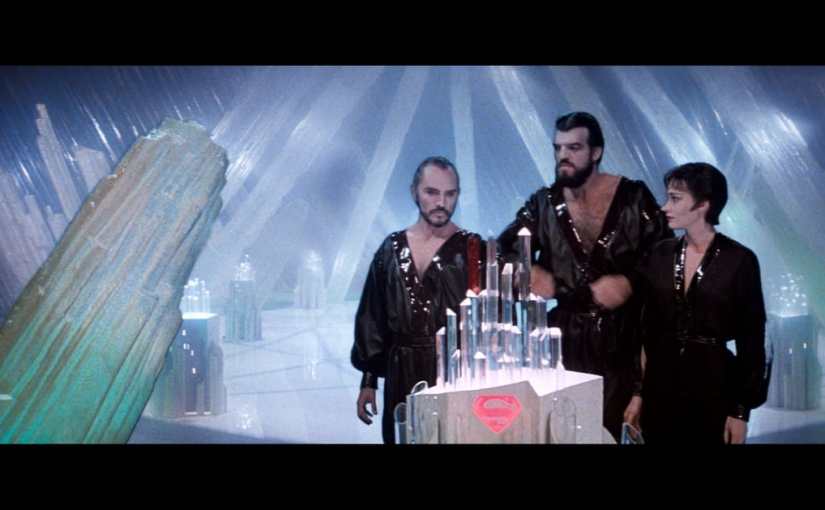
Meanwhile, Lex Luthor (Gene Hackman) has escaped prison to entice three villains from Krypton into a partnership that will allow them to take over the Earth and destroy Superman.  The trio is led by General Zod (Terence Stamp) with the wicked Ursa (Sarah Douglas) and the mindless and mute Non (Jack O’Halloran).  Following their attack on Houston, or as they call it the “Planet Huuston,” and the White House, it is on to Metropolis in search of Kal-El.

I’ve offered up quite a bit of what Superman II provides and I am not even close to sharing all it’s adventurous features and character dynamics.  This is a solid picture all the way through, and it begins with the casting.

I’ll be bold by declaring that Christopher Reeve as Clark Kent/Superman is one of the best casting decisions in film history.  Think about this for a moment.  As good as Henry Cavill was in Zach Snyder’s films, thirty years later, and how well some of the WB iterations have been, the contrary point that most people make is that none of them are Christopher Reeve.  From the smile, his handsome face, clear voice with perfect enunciation and even the signature hair curl over the forehead, no one has looked as good as a superhero come to life better than Mr. Reeve.  When he’s flying, even with outdated visual effect backgrounds, you are still convinced that Christopher Reeve knows exactly how to fly.

Following the director shake up on this picture, it is said Gene Hackman refused to shoot some scenes or do follow up edits.  You can tell when there is a double in place for him and you can hear the different vocal sound bites from Lex Luthor.  Nevertheless, what survived from Hackman’s participation is silly and twisted like you would expect from a modern-day, dastardly villain or as he declares himself to be “the greatest criminal mind of our age.” Some of these lines look hokey on paper, but Hackman invests his showmanship once again in the character.  I love it.  On all of those top ten lists, Gene Hackman as Lex Luthor is the one that everyone is regrettably forgetting about.

Margot Kidder is just as committed.  Lois Lane is best when she is the go-getter and Kidder is thoroughly convincing at not just being seen in the stunts and action but actually performing through Lois’ fears, sense of daring, and adoration for the love of her life.  Near the beginning of the film, there’s a great close up of Kidder looking up into the heights of the Eiffel Tower as Superman flies a hydrogen bomb out of danger.  No dialogue, but you can read it all over Margot Kidder’s face.  There goes my hero.  Watch him as he goes.  Few love interests in superhero films have ever matched what Margot Kidder accomplished in these pictures.

The action scenes are great set ups.  I get a chill down my spine every time I watch the showdown in Metropolis between the three baddies against the man in blue and red.  However, Richard Lester never neglects the acting throughout the whole two hours, particularly by the leads, as well as the Shakespearean maniacal performances from Stamp and Douglas.  Furthermore, the extras throughout Metropolis, Houston and even in Niagara Falls are performing very well and therefore turning the various settings into characters themselves.  Just as the fight over Metropolis is to begin, a cabbie declares “Man, this is gonna be good!”  Isn’t that guy speaking for the audience?  I remember the room applauding in the theater at that line.  When Superman rescues a child in Niagara Falls, a woman utters “What a nice man!” Clifton James, from a couple of James Bond movies, resurrects that redneck persona and it works better here as the guy who clashes with the imposing new visitors.  All of these walk on characters further shape the purpose of the visitors from space.  None of it depends on B-movie tripe like declaring “Peace!”  The personality of the folks meet the strangers from a strange land.  Sometimes it is done for means of slapstick, but it is always very entertaining.

Superman II is a perfect complement to the original film thanks especially to the cast.  Reeve gives multiple performances of Clark and Kal-El that could not be more different.  Kidder takes her character in new directions upon learning the surprises the script has in store for Lois.  Hackman is doing the same routine, but fortunately it’s welcome because I can not get enough of his antics.

This sequel really set the bar high and the next installments for Reeve came nowhere close. Though I actually have an affection for Superman III with that internal struggle depicted in the junk yard scene; one for the ages. 

The first two movies are legendary and Warner Bros/DC films realize they still have not superseded what was done over forty years ago.  The studios are not trying hard enough. However, more to the point, the filmmakers back then got it absolutely perfect, and you cannot beat Superman, nor can you beat perfection.

CLASS ACTION

By Marc S. Sanders

Two sharp San Francisco attorneys go against one another in Michael Apted’s Class Action.  The hitch is that it is father vs daughter and the two were adversarial with each other long before this trial ever began.

Gene Hackman is Jed Ward, the small-time lawyer who grandstands big theatrics in a courtroom while fighting for the little man who’s repeatedly suffered at the negligence of Goliath corporations.  His daughter is Margaret Ward played by Mary Elizabeth Mastrantonio.  She’s vying to be partner for the giant law firm that represents an automobile manufacturer getting sued for faulty explosive gas tanks on their cars.  

Jed is bullish and cocky.  Margaret is trying to prove her dominance over a father who repeatedly cheated on mom and was hardly the devoted dad as he pursued one landmark case or bed partner after another.

I saw Class Action in college while taking a law studies class.  The case at hand was inspired by a well-known trial focused on Ford Pintos.  Ford was found to deliberately ignore a faulty car part because the cost to replace the item on all of their automobiles would far outweigh the cost to settle with all of the victims of the class action lawsuit.  That’s a neat connection showing what was real being weaved into a fictitious story.  

The problem with Apted’s film is the amount of melodramatic scenes devoted to its father and daughter main characters.  It’s hammered into our consciousness over and over, and like most arguments they run in circles, getting nowhere.  We get it already.  You’ve got animosity towards each other.  Move along!

The olive branch is eventually extended as the film is approaching its standard third act, conveniently thanks to the giant law firm’s indiscretions to conceal evidence for the sake of victory.  

I’m really not spoiling much here.  This is a paint by numbers, cookie cutter outline.  You can see where everything will fall as soon as the 20th Century Fox logo appears at the beginning.

These are two good actors, but Gene Hackman is far better.  Most would agree. Mary Elizabeth Mastrantonio is not a good enough contender against him.  Hackman comes off fierce.  Mastrantonio comes off hokey like something out of a day time soap opera. She’s been much more impactful in other films like The Color Of Money and even Robin Hood: Prince Of Thieves.

I argue though that she would have been much more effective if James Horner’s instrumental music wasn’t used so much. I can feel the emotions with just the two playing out their scenes of dialogue and tempers flaring.  I shouldn’t need help to get there from a swooning saxophone that intrudes and plays over, of all people, the great Gene Hackman.  

Too much is focused on the family melodrama that also includes the mom/wife (Joanna Merlin) caught right in the middle.  I got tired of it.

I’m a sucker for courtroom drama.  I know.  In most movies, you know the beats of a cinematic trial.  You can easily predict which witness is going to be undone on the witness stand.  You likely will predict who will win the trial.  Yet, I get a thrill out of the rapid-fire pace of the questioning and the calls for objections with the barking rulings heaped on by the judge.  It’s all standard, but I gobble it up like potato chips.  The two leads are marvelous in the courtroom, despite the spoon fed ease the script allows.

When the two are screaming at each other about their past transgressions, I had no interest.  The film angles itself as a courtroom thriller with a twist on the litigators when it’s barely that way at all.  

It’s right in front of you guys!  An astounding case of deliberate negligence by one of the country’s biggest industrialists.  Why couldn’t we uncover more of the underhandedness that occurred there? Regrettably, the trial takes second banana to the trite family squabbles with a cheesy late ‘80s soundtrack. 

Hard and Fast Rule: Don’t ever play off the great Gene Hackman.

A BRIDGE TOO FAR (1977)

by Miguel E. Rodriguez

DIRECTOR: Richard Attenborough
CAST: Sean Connery, Ryan O’Neal, Gene Hackman, Michael Caine, Anthony Hopkins, James Caan, Maximilian Schell, Elliott Gould, Denholm Elliott, Laurence Olivier, Robert Redford, and MANY others
MY RATING: 7/10
ROTTEN TOMATOMETER: 63% Fresh
Everyone’s a Critic Category: “A Movie Set During an Historic War”

PLOT: A detailed account of an overly ambitious Allied forces operation intended to end the war by Christmas of 1944.


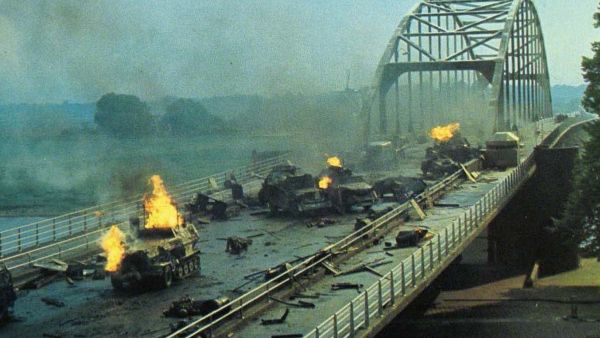
In September of 1944, in an attempt to land a finishing blow to Germany following D-Day, Allied forces launched Operation Market Garden, a bold offensive that would drop over 30,000 soldiers behind enemy lines.  The objective was to capture and hold three strategic bridges in the Netherlands, over which a massive column of British tanks would then roll straight into the Ruhr, the heart of Germany’s industrial complex.  Neutralize the Ruhr, and taking Berlin would be inevitable.  However, as with so many other simple plans in history, multiple factors led to the operation getting bogged down at the third bridge, and after massive Allied casualties, the offensive was abandoned.

Based on a bestselling novel by Cornelius Ryan (who also wrote the novel The Longest Day), the movie of A Bridge Too Far resembles the actual Operation Market Garden, not just in appearances, but also in its ambition, scope, and ultimate failure to achieve its goal.  However, as a pure combat movie, I give it credit where it’s due.

First off, look at this cast.  There had not been an assemblage of so many of Hollywood’s leading men since 1962’s The Longest Day (“42 International Stars”, that movie’s posters proclaimed).  Naturally, most of the actors are pitch perfect in their roles, with one glaring exception.  Whoever thought Gene Hackman was just the right guy to play a Polish general was either desperate or foolhardy, or both.  Hackman is a talented actor, without question, but his attempt at a Polish accent is a MAJOR distraction from whatever he’s saying.  Every once in a while, it even pulls a disappearing act, not that it matters.

ANYHOO.  The all-star cast.  To offset the lengthy running time, the story is told in semi-episodic fashion, which makes me wonder if someone hasn’t thought about rebooting this movie as a Netflix/HBO/streaming miniseries.  I’d watch it.  Within each of these episodes, it helps if we remember right away that Michael Caine is the leader of the tank column, Sean Connery is heading up one of the ground units, Anthony Hopkins is holding the bridge at Arnhem, and Elliot Gould is the cigar-chewing American trying to get a temporary bridge put together, and so on.  It’s a rather brilliant way of using visual shorthand to keep the audience oriented during its nearly three-hour running time (including an intermission at some screenings).

There is one “episode” featuring James Caan that has literally – LITERALLY – nothing to do with the plot.  He plays an Army grunt who has promised his young captain not to let him die.  After a grueling ground battle, Caan finds his captain’s lifeless body and, after improbably running a German blockade, holds an Army medic at gunpoint, forcing him to examine his dead captain for signs of life.  I read that, unlikely thought it may seem, this incident really did happen as presented in the film (more or less).  All well and good.  But what does it have to do with capturing bridges?  I’m sure the story is in the novel, but the movie takes a good 10-to-15-minute detour from the plot to follow this bizarre story.  Did director Richard Attenborough think we needed comic relief or something?  I remember liking that story as a kid, but watching it now…is it necessary?  Discuss amongst yourselves, I’ll expect a summary of your answer at tomorrow’s class.

I want to mention the combat scenes in A Bridge Too Far.  First off, I never served in the armed forces.  Well, never in combat.  I was in the Air Force for about a week.  (Well, Air Force boot camp in Oklahoma for about a week…LONG story.)  So, my observations of the combat scenes are less about historical accuracy and more about how they compare to other films.  While some of the combat portrayed is rightfully horrific in its own way – the river crossing in those ridiculous canvas boats, the slaughter of the paratroopers, the seemingly endless holdout at Arnhem – a lot of the combat, particularly the tank shelling and the skirmishes at Arnhem, is…I have to say, it’s kind of fun to watch.  There’s something, I don’t know, charming about it all.  It reminded me of how I used to play with my army men and Star Wars figures, or how I used to run around with neighborhood friends wearing plastic helmets and pretending we were “good-guys-and-bad-guys” while throwing dirt clods at each other and making fake explosion noises.  It was movies like A Bridge Too Far that shaped my young impressions of what wartime combat was like, and whether it was realistic or not was irrelevant.

Anyway, enough nostalgia.  Here’s the sad truth: A Bridge Too Far, despite its thrilling combat and all-star cast, falls short of delivering a truly meaningful war film.  There are half-hearted attempts to drum up some dramatic impact with scenes in a makeshift field hospital and a speech in Dutch from Liv Ullman wearing her best “isn’t-war-awful” expression, but for some reason those scenes fall flat.  (I did like the “war-is-futile” scene with that one soldier who runs out to retrieve the air-dropped canister, only to discover…well, I won’t spoil it, but it’s a good scene.)

After writing almost 1,000 words, I’m no closer to explaining why A Bridge Too Far falls short.  It’s still an entertaining watch, but I’ve really got to be in the mood for it.  It’s rather like reading a historical novel that isn’t particularly thrilling like a Crichton or a Clancy, but it does deliver some eyebrow-raising information.  It doesn’t hit me in the heart, but it does feed my brain.  Maybe that’s not such a bad thing in the long run, but if movies are about stirring emotions, I must say: A Bridge Too Far is no Saving Private Ryan.

(Sure, I probably could have just said that instead of writing this long-ass review, but where’s the fun in that?)


QUESTIONS FROM EVERYONE’S A CRITIC

Best line or memorable quote:
“Remember what the general said: we’re the cavalry. It would be bad form to arrive in advance of schedule. In the nick of time would do nicely.”

Would you recommend this film?  Why or why not?
Ultimately, I would recommend it to film buffs who have not yet seen it.  If nothing else, it’s an interesting time capsule movie.  This would be the last time for a VERY long time that anyone would attempt to make an epic film with a truly all-star cast.  …come to think of it, I can’t think of a major, epic drama since A Bridge Too Far with an actual A-list cast.  Can you?