
THE QUICK AND THE DEAD

By Marc S. Sanders

The Quick And The Dead is a gritty, stylish western that boasts a who’s who of great actors.  Some of which went on to magnificent careers.  I wish the story was a strong as the cast list though.  It’s watchable.  It’s intriguing. It’s also too repetitious.

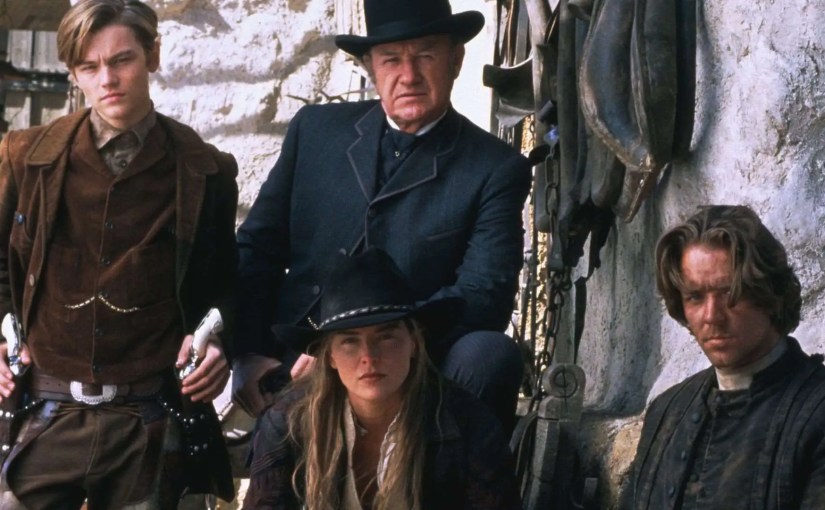
Sharon Stone is Elle.  Otherwise known in these parts as The Lady.  Two minutes into the picture and my suspension of disbelief is withering away.  Not because this gunslinger cowboy is a cowgirl, but because Stone does not look like she fits in the Old West.  Her blond locks are shampooed and conditioned.  Her complexion perfectly made up without a hint of grime or dirt or sunburn.  Stone looks like she took one step off the Oscars red carpet and onto this set. Her costume with a scarf, leather pants, black rimmed hat, and spurred boots looks like its attempting its own kind of Clint Eastwood stranger.  Frankly, it appears to have leaped off the pages of an Old Navy catalogue.

Below Stone on the credit lineup is a much more redeemable list of characters.  Gene Hackman is Mayor Herod who has amped up his level of sinister from his Oscar winning performance in Unforgiven.  There’s also Ace Hanlon played by Lance Henrickson with a rare on-screen giddy grin, whose personal deck of cards consists of aces of spades for every man he’s killed. Sgt Cantrell is the flamboyant personality with the handlebar mustache, deep voice and toothy grin that actor Keith David proudly bears.  A kid named Leonardo DiCaprio plays up the youthful cockiness of an outlaw named The Kid.  All these folks are gunslingers participating in the sport of gunslinging.  Last one left standing is the winner.  Midway through though, Herod will up the ante and deem that the last one left alive is the winner.  Each one challenges another until a final winner is recognized.  One reluctant participant is played by a very youthful looking Russell Crowe.  Cort is a former fast draw, who is now a remorseful preacher for all of the killings he’s committed.  Herod is not entirely convinced and will antagonize Cort to throw his hand in the game.

Sam Raimi directs and Sharon Stone produces this slick small town modern day High Noon.  The problem though is that Raimi and screenwriter Simon Moore choose to only send up the climax of that classic Gary Cooper western over and over.  Time and again, two opponents line up at opposite ends of the street.  The townsfolk observe with close up tension shots.  The hands twitch their fingers next to the holsters and when the clock strikes twelve, the guns go off.  Raimi often gives you the impression that the one expected to live is the one who is going to topple over dead and then an edit shows the match went exactly like you thought it would. 

This whole supporting cast has enough presence and charisma to keep my attention, but the set ups are the same over the course of the film.  Cut in between are discussions within the saloon or the hotel rooms where Herod or the Lady rest.  Cort remains chained in the town square.  When the movie breaks away it goes to flashbacks of Stone’s character as a child when she once crossed paths with the devilish Herod. 

I like the polish that Sam Raimi brought to The Quick And The Dead.  Before Quentin Tarantino was glamourizing his pulp fiction to his own two dimensional westerns and war movies, Raimi was daring enough to let us look through literal bullet holes from the front to the back of his victims.  Holes through the hand, the chest and the head.  It’s fun.  There are also countless closeups of haunting music from Alan Silvestri as a new stranger enters a saloon to click his spurs on the wooden floor.  Quick draw action is how these pistols perform too.  Hangings are a part of any day as well.  All of this is familiar and standard to the B movies brought to us by Sergio Leone’s spaghetti westerns during the mid twentieth century, but now we have a modern day cast and some glossy cinematography.

I was ready for a worthy salute.  It just comes up short due to a lack of any depth in story.  Gunslinging quick draws are not as dynamic as a gunfight at the OK corral.  How much different is one dual draw going to be from the last one we watched five minutes ago?  Raimi’s camera points from behind each challenger.  The music builds louder and louder.  Zoom in shots of townsfolk cut in.  The minute hand on the clock tower moves closer and closer to the roman numeral twelve, and then…BANG BANG!!! (I’ve said this before, haven’t I?  Well, so does the movie.)

The Quick And The Dead is worth seeing especially for another scenery chewing villain from the great Gene Hackman.  I’ll never tire of watching him.  To see the beginnings of Russell Crowe and Leonardo DiCaprio’s potential is a real treat as well.  They all certainly have some acting moments that I loved digging up from this time capsule.  Character actors Keith David and Lance Henrickson break from the standard personas you’ll find on the rest of their resumes.  I just needed more of a variety to this town setting they got play in.  The déjà vu is too overdone.

Sharon Stone usually looks like she’s giving a so so community theatre audition.  It’s hard to take her seriously, the same way I would had Uma Thurman, Susan Sarandon or Geena Davis been cast as The Lady.  Those actresses work for their appearance to be appropriate for the setting of their films.  Look at Sharon Stone here in the dusty Old West.  Then look back to what Sarandon and Davis did in Thelma & Louise.  You’ll see right away, practically anyone else would have been more suitable for the lead of The Quick And The Dead.

APOLLO 13

By Marc S. Sanders

What’s fascinating about Ron Howard’s film Apollo 13 is that I can hardly understand what anyone is talking about.  I don’t know how they identify the problems of the doomed spacecraft.  I don’t know how any of the folks at NASA resolved the issue to get the three astronauts, Jim Lovell, Fred Haise or Jack Swigert (Tom Hanks, Bill Paxton, and Kevin Bacon), back to Earth.  What I do know is that William Broyles’ script, based upon the novel from Lovell with Jeffrey Kluger, allows for an ease of comprehension to know where one thing has started, where it leaves off and where it needs to go with each passing scene.

Forgive me, but when I watch NASA documentaries, I honestly get bored.  It’s amazing what has been accomplished during the history of our space program.  So much has been discovered but it’s only a fraction of what’s still left to be uncovered beyond our planet.  The films and literature that account for the engineering of space craft and what is required to travel in space lose me though.  Ron Howard puts everything in place with Apollo 13, however.  It’s the emotions that stem from the actors.  All I need to understand are the efforts each character serves to the ending that we all know.  It’s not about telling us what these guys are educated with or what science mandates.  Rather, it is about how these people respond to an unexpected and unfamiliar crisis.

On the ground in Houston, Texas Ed Harris portrays Gene Krantz.  He’s a pretty quiet kind of character, but upon his entry into the film, just ahead of the anticipated launch of Apollo 13, he is gifted a pure white vest.  Krantz wears this as his armor, prepared to take on any challenge including navigating a crew of three astronauts towards the moon.  He is surrounded by a school of nerdy looking engineers and scientists, in their short sleeve shirts, skinny ties and black rimmed eyeglasses.  They are all disbursed among an assortment of different departments.  I think one specified simply in human waste disposal aboard the ship.  Yeah, there’s a guy there making sure the urine is dispensed properly.  Again, I couldn’t tell what specialty each man is designed for, but they’re the experts.  Harris simply tells his men what needs to be done by drawing two circles on a chalkboard; one is the moon, the other is Earth.  When a frightening malfunction occurs aboard the rocket, Harris explains that his men now need to get the ship back to Earth by drawing a line between the solar locales.  He doesn’t know how it can be done, but like a football coach he demands his team find a way.

On board Apollo 13, the three astronauts are crammed in what is left of their ship, marooned to float through space. The interior gets extremely cold, exhaustion gradually overtakes them, and they are left with no choice but to power down whatever sources they have left as a means of preservation. 

A third angle comes from the wives and families of the three men.  More precisely, focus is drawn towards Marilyn Lovell (Kathleen Quinlan) with her family, including the children and Jim’s elderly mother watching the television with anticipation for ongoing developments while the media waits outside their doorstep.  The first act of the picture offers the anxiety that Jim’s wife has with this upcoming mission.  There is the standard nightmare scene.  Acknowledgement of the unlucky number thirteen.  Marilyn loses her wedding ring down the shower drain (something that actually happened). Ironically, the Lovells’ eldest daughter seems to carry the same kind of apathy for her dad’s upcoming trip like the rest of the country.  Jim may finally be having his dreams come true, to walk on the moon.  However, the rest of the world is more concerned with the possibility of the Beatles breaking up or what else is on TV.

A side story is delivered by Ken Mattingly (Gary Sinise).  The poor guy was originally a part of Lovell’s three man crew, only to be sidelined at the last minute because of a suspected case of measles.  When things go wrong for Apollo 13, he enters the flight simulator to diagnose the issue and find a resolution.  He’s offered a flashlight but rejects it because the guys in space don’t have that tool.  He specifically tells his men not to give him anything that they don’t have up there, and he refuses to take a break either.  If they don’t get a chance to rest, then neither does he.  This mantra carries over to the other guys working diligently to keep the astronauts alive and get them home. 

Apollo 13 is not a how to picture.  Rather, it is a film that focuses on response. 

Ron Howard offers amazing shots of the rocket and footage in space.  The launch is extremely exciting as shrapnel sheds off the craft during its fiery liftoff. Then other parts disengage after it leaves the Earth’s atmosphere.  The interior looks extremely claustrophobic, but the actors look comfortable within the floating zero gravity confines. Hanks, Paxton and Bacon have great chemistry together whether they are kidding one another about vomiting in space or bickering with each other while caught up in the problem at hand. 

The base of NASA is alive with hustle and bustle.  Not one extra looks like they are sitting around.  They all know what monitor to look at or which teammate to lean over as they desperately discuss what needs to be accounted for.  There’s a great moment that is explained to the audience as if they are a four year old.  A man in charge throws a pile of junk onto a boardroom table and says they need to build something with nothing but what’s on this table to absolve the problem the astronauts are having with carbon dioxide poisoning.  A few scenes later, we see the junky device that’s been rudimentarily assembled.  Who knows what it does?  All I need to know is that it works. 

I did take one issue with Apollo 13.  To heighten the dramatics, sound is provided as the ship comes apart. Even I know that sound does not travel through space.  I forgive it when I’m watching fantasies like Star Wars or Superman.  However, this film recaps a real-life event and during those moments, as startling as they may be, I could not help but think about the dramatic clanging and crashing penetrating my sound system.  Apollo 13 draws from a well-known case, but it still resorts to cinematic tropes to hold my attention.  I wonder if the picture would have worked had it remained faithful to basic scientific fact through and through.  It’s not a terrible offense.  It’s forgivable.  Though it got me thinking. Heck, it obviously never bothered the masses because the film was awarded the Oscar for Best Sound Design.

Ron Howard’s film is a magnificent experience, full of outstanding footage.  It relies on actors who depend on the emotions of the scenario to narrate the story.  Recently, I watched the film Tár with Cate Blanchett.  In that film, the mechanics of orchestral music and conducting are endlessly discussed.  It’s like listening to a foreign language at times while trying to keep up.  Howard’s film could have taken that approach and bored me to tears with a lot of technical jargon from engineers and scientists.  Instead, Apollo 13 succeeds by only presenting the basics of the issues at hand.  I couldn’t name one specific part on the engine of my car, but I know it powers the vehicle, allowing it to go from point A to point B.  The army of NASA folks declare this thing has never done that before or it must be crazy to consider because that has never been attempted.  I can count on the players of Apollo 13 to know what they’re doing.  They are aware of the risks that need to be taken and know what’s at stake.  I don’t need to see their diplomas to trust their concern or computations.

Like other films where known historical events are depicted, Apollo 13 maintains its suspense even if you already know the ending.  The aborted mission to the moon became known as “The Successful Failure.”  It’s refreshing to see how this proud moment all played out. For fleeting window in time America, actually most of the world, seemed to hold a unified care for three men trying to outlast a doomed, desperate and impossible situation. 

Apollo 13 is a triumph.

FORREST GUMP

By Marc S. Sanders

There’s not much that I can say to further praise the merits of Robert Zemekis’ Forrest Gump. It’s a film of legend though it’s a sore spot for die-hard fans of Pulp Fiction, which competed for Best Picture in 1994. Guess which film won. Tom Hanks won the Oscar for the second year in a row, following his outstanding turn in Jonathan Demme’s Philadelphia. Zemekis won Best Director. Eric Roth’s screenplay won as well.

What holds a lasting impression for me about Forrest Gump is the sweeping travel through time of a man with limited intelligence but unlimited willingness to explore and participate, whether it be as a Ping Pong Champion, a Medal of Honor recipient for heroism during the Vietnam War, a millionaire entrepreneur of a shrimping boat business, or a man who just felt like running from one corner to the next of the North American continent. Forrest Gump never knew to compromise a belief he had, probably because he was never aware of the capability to compromise in the first place.

An interesting theme occurs throughout Roth’s screenplay (adapted from the novel by Winston Groom). The people that Forrest encounters are always shouting their ideals and agendas. Yet no one seems to listen. Not just Forrest though. No one at all listens to each other. Lieutenant Dan (Oscar nominee, Gary Sinese) shouts for an immediate evacuation of a hostile territory under attack and no one on the other end of the line, appears to be listening to him. He orders Gump to leave him there, but Forrest does not listen. Forrest only focuses on rescuing his friends, Lt. Dan and Bubba (Mykelti Williamson). What exactly were Americans like the Hippie movements, the War Veterans, the Black Panther party, even the men in the burlesque nightclubs, as well as the various assassinations attempting to accomplish really? Did they accomplish anything? Did any of these parties make an impactful change, or did they just like to hear themselves talk? Did they just want the recognition for only themselves and no one else? When Forrest meets up with his love Jenny (Robin Wright), in a gorgeous caption in front of the Washington Monument (often shown during Oscar film compilations), he has just shared his thoughts over a loudspeaker, unaware that not one of the thousands of war protestors could hear him because the microphone had been unplugged. Later that day, a Black Panther participant only cares to wave his finger and shout his agenda in Forrest’s face. Is Forrest interested? Is he even listening? Is the Jenny, the hippie and her protestor boyfriend listening? Like many Americans, Forrest was only concerned with what was most important to him; Jenny. When Forrest develops a following during his cross country run, everyone is looking for his purpose and his message, and Forrest is unaware that he needed to offer one. Americans are always looking for the next best following. When Forrest passes the Grand Canyon and stops running, the parade of lost souls behind him shouts, “Now what are we supposed to do?” Forrest doesn’t listen. He just walks away and declares he’s tired. America during the mid twentieth century was lost. Forrest was not. Forrest just went in the direction in front of him.

Zemekis pulls an interesting trick of contrasting Forrest against other regulars. The nurse who sits on the bench next to Forrest is more interested in reading a mundane two dimensional issue of “People Magazine.” A man listening to Forrest’s tale of rescue in Vietnam was only concerned with the bullet that struck Forrest in the butt, not the men he saved or the loss of his dear friend Bubba. The old codgers who hang around the local barber shop in Greenbough, Alabama just watch the exploits of Forrest as the years go by. Their hair gets grayer and their skin gets more wrinkled, and life just passes them by while Forrest passes life by. It’s a subtle, yet effective, device that I appreciate on repeat viewings.

Sally Field contributes to the disregard Forrest has for menial issues. If Forrest is going to be denied going to a regular school because his intelligence level falls a few points below average, she will make certain that does not interfere even if it means pleasuring the principal. Mama Gump has the wit and intelligence. Forrest does not. However, their commonality shows in their disregard for what keeps us from living life to the fullest. Without Mama as his influence, Forrest would never have met the President again, and again, and again.

Mama reminds Forrest that “Life is like a box of chocolates…” You know the rest! It doesn’t matter what we get, as long as we get what we pursue.