
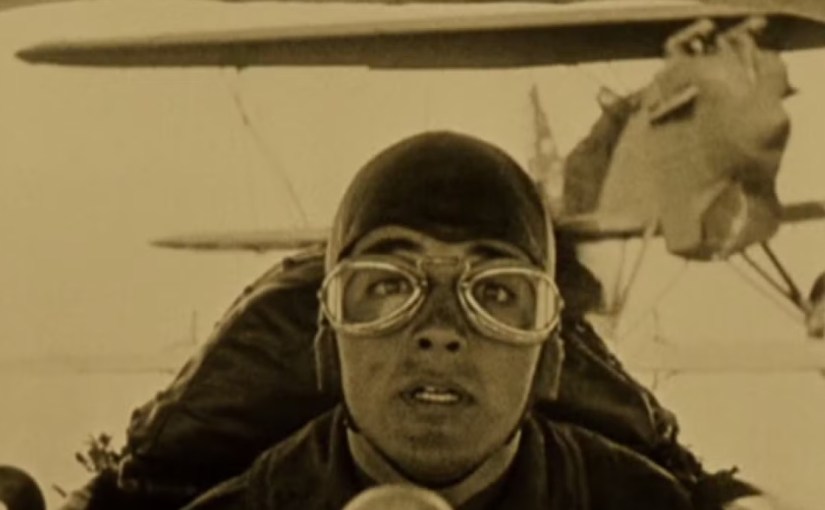
WINGS (1927)

by Miguel E. Rodriguez

DIRECTOR: William A. Wellman
CAST: Clara Bow, Charles ‘Buddy’ Rogers, Richard Arlen, Gary Cooper
MY RATING: 10/10
ROTTEN TOMATOMETER: 94% Certified Fresh

PLOT: Two young men, one rich, one middle class, who are in love with the same woman, become fighter pilots in World War I.


Not long ago, I purchased a copy of the 1927 classic Wings, based mostly on the favorable review by my friend and colleague, Marc Sanders.  I was more or less aware of its place in cinema history: the very first winner of the Best Picture Oscar, essentially the birthplace of Gary Cooper’s career (despite appearing in the film for just over 2 minutes), legendary aerial footage, and so on.  But I never felt compelled to seek it out.

Having finally watched it, I am very glad I did, and you should, too.  Wings is pure entertainment from start to finish.  Unexpectedly engrossing, captivating, thrilling, the whole enchilada.  High melodrama, comedy (borderline slapstick, what are you gonna do, it was 1927), romance, comic misunderstandings – and some not-so-comic – and eye-popping aerial footage, true to its reputation.  A neat camera move gliding over several cabaret tables even showcases director William A. Wellman’s desire to push the boundaries of what was possible with the massive cameras of his day.  I once wrote that Sunrise (1927) was my favorite silent film of all time.  If I ever make another 100-Favorite-Films list, Wings and Sunrise are going to have to duke it out…

Wings sets a surprisingly modern tone from the start.  In the very first sequences of the film, Jack Powell (Charles ‘Buddy’ Rogers) does not “ham it up” like some of the more typical Hollywood actors of that era.  Obviously, his mannerisms are exaggerated, but there is a restraint to his face and body that seems at odds (in a good way) with nearly everyone else in the film…except Gary Cooper, who, if he underplayed his role any further, would have become a still painting.  That restraint is also evident in Jack’s foil/nemesis, David Armstrong (Richard Arlen), the rich aristocrat to contrast Jack’s more humble background.  This moderation lends a very contemporary feel to a movie that’s nearly a century old – quite a feat.

In sharp contrast to the two male leads, the fabled Clara Bow plays her role, Mary Preston, with complete abandon.  She never truly overacts, exactly, but she throws herself into her supporting role with abandon.  Mary is hopelessly infatuated with Jack, who is actually in love with the debonair Sylvia Lewis (Jobyna Ralston), who is already involved with David, though they haven’t made anything official.  (If Facebook had been a thing back then, their relationship status would have been “It’s Complicated”.)  So, when Jack makes eyes at Sylvia, poor Mary is in the background as her hopeful smile deteriorates into sobs.  She may not be subtle, but Clara Bow makes sure you know EXACTLY what is on Mary’s mind at any given moment.

In the middle of this would-be soap opera, World War I intervenes.  Jack and David both enlist to become aviators.  A crucial scene shows Jack asking for Sylvia’s picture to keep as a good luck charm, a picture that has already been signed over to David.  Then, as he says his farewells to the lovelorn Mary, she offers him her picture.  How this scene plays out, and how it comes to bear much later, is one of the high points of the film’s ground-based drama.

But the real marquee attraction Wings comes during the aerial training and combat scenes.  Watching this movie, you understand why modern filmmakers today strive for realism as much as possible.  Ron Howard wanted to show weightless environments for Apollo 13, so sets were constructed inside a military jet tanker that flew parabolic arcs to simulate weightlessness…for real.  The makers of Top Gun: Maverick wanted to draw audiences into the film, so they had their actors train for weeks and months so they could be filmed inside the actual cockpits of F-18 fighters as they performed simulated combat maneuvers…for real.  Those filmmakers knew what had already been demonstrated decades earlier by Wings: nothing beats reality.

(Almost nothing…Ready Player One was pretty damn cool…BUT I DIGRESS…)

For Wings, director Wellman, a combat pilot himself during the war, knew that the best way to grab the audience by the lapels would be to get his actors up in the air for real.  To put it very briefly, he got his two lead actors to become certified pilots, got them into the air with small cameras strapped to the front of their planes, and had them act, fly their own planes, and be their own camera operators, all at the same time, while other stunt pilots flew around them, sometimes in VERY close quarters, simulating aerial combat.

The results are staggering.  There is a visceral mojo to these scenes that cannot be overstated.  Sure, it looks “old” because it’s black and white and grainy, but it is also undeniably real, and when you see long shots of a biplane going into a death spiral after being shot out of the sky, your intellect tells you there’s a real pilot flying a real plane hurtling at high speed towards the real ground, and you either sit back in awe or you lean forward with excitement.  There are a few scenes where real planes crash to the ground in various ways; one of them crashes into the side of a freaking HOUSE…for REAL.  IMDb mentions one staged crash where the plane didn’t do exactly what it was SUPPOSED to do, and the stunt pilot literally broke his neck…but survived and returned to his job six weeks later.  And it was all done in camera with no trickery or fake dummies in the cockpit.  It is literally mindboggling.

However, it should be noted that these accomplishments by themselves would mean very little if they weren’t hitched to a compelling story.  The love story among Jack, David, and Mary is a constant thread through the whole film.  Mary, having volunteered as an ambulance driver in the Army, miraculously finds herself stationed overseas…right next to Jack and David’s unit, wouldn’t you know it!  Contrivances aside, Wings expertly balances the exciting elements with the melodramatic flourishes.  The melodrama comes to a head when Mary finds herself alone in a hotel room with Jack, who is so drunk on champagne he doesn’t recognize her.  (She is dressed as a cabaret dancer, but that’s a long story…)  This movie truly contains the best of both worlds, genre-wise.

This might be crass of me to mention, but I’m going to anyway…Wings is also notable for some of the earliest on-screen nudity (in an AMERICAN film, anyway) that I can recall seeing.  There is a scene in a recruitment office where a line of bare male bums are lined up in the background, awaiting health inspection.  Then later, we see a woman’s bare breasts…just a brief glimpse, but it’s there.  Not only THAT, but during a fancy camera move in a French cabaret, we see a woman caressing another woman’s face…are they a couple?  Scandalous!  Who needs the Hays Code?  Not this guy!

(I could also mention the homo-erotic overtones during a pivotal scene towards the end of the film, but they pretty much speak for themselves [like the volleyball scene in Top Gun], so I’m just gonna move on…)

To sum up: Wings ranks as one of the greatest pure entertainments that Hollywood has ever served up.  Marc mentioned that it perhaps doesn’t get the love it deserves.  He’s probably right.  I’m sure it’s revered among cinephiles, but it is certainly not in the general public consciousness when it comes to silent films.  Regardless, it is exceptionally well-made and uncommonly effective.  If ever an old film deserved to be rediscovered by the general public, Wings is it.
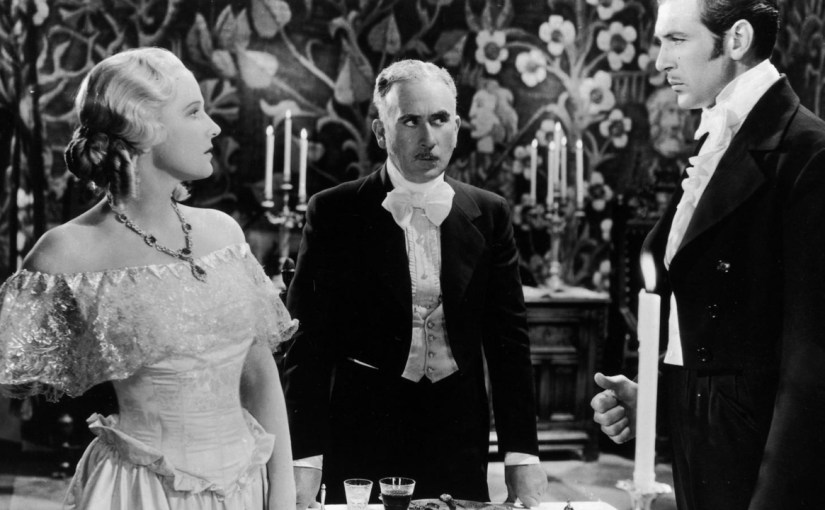
PETER IBBETSON (1935)

by Miguel E. Rodriguez

Director: Henry Hathaway
Cast: Gary Cooper, Ann Harding, Ida Lupino
My Rating: 9/10
Rotten Tomatometer: No rating

PLOT: A successful architect who longs for the love of his childhood friend is delighted to discover that the Duchess who just hired him is in fact his long-lost beloved.  This being melodrama, there is of course much more to the story.


[SPOILERS FOLLOW]

Peter Ibbetson plays like a long-lost Dickens novel, full of melodramatic flourishes and convenient plot contrivances designed to play the audience like a grand piano.  Is it shameless?  Yes.  Is it maudlin?  Yes.  Do I normally like movies like this?  No.  But there is something about this film and its story that got around my defenses and into my heart and soul.  I’ll try to elaborate on that as much as I can, but I don’t know how well I’m going to do.  Good luck.

The story opens, as the title card helpfully explains, in the middle of the last century, which would make it somewhere around the 1850s.  Somewhere in a well-heeled French countryside, two children from neighboring British families play and quarrel with each other, Mimsey and Gogo.  (I am not making that up, though why parents felt the need to inflict those names on their children is utterly beyond me.)  Gogo, the boy, cruelly teases the girl, Mimsey, who nevertheless gives as good as she gets.  Unfortunately, Gogo’s mother dies after a long illness, and when a distant uncle arrives to take Gogo back to England, he realizes he doesn’t want to leave his precious Mimsey.  Together they try to run away and hide, but it’s no use.  The sight of poor Mimsey weeping in the branches of a tree as Gogo is finally taken away was one of the scenes that started to chip away at my armor of cynicism.

Time passes, and Gogo changes his name to Peter and takes his mother’s last name, Ibbetson.  He becomes a successful architect and a valuable asset for his employer.  (In a very Dickensian touch, Peter’s employer is blind…wholly unnecessary to the plot, but that specificity makes it feel even more realistic amid all the other melodrama.)  Peter is successful, yes, but he is unhappy.  He is a bachelor, and when a very pretty girl more or less hits on him at a museum back in France, he takes her for a drink as a matter of courtesy, not out of any real attraction.  His heart still belongs to the lost love of his childhood, you see.  Mimsey is the touchstone of his past, his Rosebud, his green light at the end of the pier, and she will not be easily eradicated.

Initially, I was unsympathetic to the adult Peter.  How can anyone get on with their life if they’re stuck in the past?  It didn’t work for Kane or Gatsby.  If there’s anything the last thirty or so years of my life has taught me, it’s that the past will only weigh you down if you let it.  I’m not suggesting one should literally forget history, but had I been one of Peter’s associates in the film, I would have been constantly reminding him about being grateful for the present rather than bemoaning the mistakes or regrets of the past.  That way lies madness.

Before I get into more story details, I should mention the style of the film and the acting, which is so mannered and stylized that it feels as if it were a silent film that had a soundtrack added as an afterthought.  Gary Cooper may be a legend, but in this film…let’s be blunt, he is no Cary Grant.  Every sentence feels as if it’s been dragged out of him by way of torture.  His charisma is based solely on his imposing height and his dashing good looks, NOT his speech.  (Sorry, I calls ‘em like I sees ‘em.)  The women are not much better acting-wise, though the Duchess of Towers does have some interesting moments.  However, one of the movie’s highlights are the cinematography and subtle visual effects, especially in the late stages of the film.  Look at that scene involving the peculiar qualities in the bars of the jail cell and explain to me 100% how that was accomplished.  It’s so understated and effective that it took me completely by surprise.  I believe it would raise eyebrows with TODAY’S audiences.

I mention all of this about the style and my mindset because I believe that it all contributes to the reaction I had to the film, at which I’m still perplexed.

One day, Peter is contracted to rebuild the stables of an aristocratic family, the Duke and Duchess of Towers.  When Peter first meets Mary, the Duchess, he experiences an unexplainable connection.  His contract requires him to live in the Towers house for several months.  One day they share a conversation and discover that they shared a dream.  This isn’t a case of two people dreaming about the same thing coincidentally.  They actually shared a dream, Inception style, but without the machinery.  How can this be?

By now, any breathing audience member has already deduced that the Duchess is Mimsey and they are destined for each other.  Alas, Peter and Mary are not as quick on the uptake as we are, and their moment of recognition is delayed until after the peevish Duke confronts them at the dinner table, in a conversation laden with Hays-Code-era double-speak.  “Well, Mr. Ibbetson, are you to be congratulated again?” the Duke asks.  Later, during a second confrontation, the Duke points a gun at Peter and Mary and explains that they will not make love behind his back.  He raises his gun and says, “Get into your lover’s arms.”  Whoa.  Daring stuff for 1935.  It’s during this second confrontation that something goes horribly wrong, and Peter is sent to jail for life.

MORE melodrama?  Hasn’t this movie already had more than its fair share?  Children tearfully separated?  An equally tearful reunion?  Outrageous coincidences?  Shared dreams, for crying out loud?  Oh, you ain’t seen nothing yet.

It’s in the film’s third act, when our hero is in prison, that Peter Ibbetson really started to get to me at some primal level.  Peter and Mary, after being reunited against all odds, are now separated even more cruelly than before.  Peter is so distraught he goes on a hunger strike, chained to his “bed,” which is little more than a wide wooden beam.  (Look at it from a certain angle and he might almost appear to be on a cross, but don’t worry, it’s not that kind of movie.)  When one of his fellow prisoners makes a joke at Mary’s expense, Peter goes a little crazy and starts to throttle him.  Miles away, at the same time, Mary suddenly senses something is wrong.  In the jail, guards use force that’s a tad too excessive to restrain Peter, and at the same exact moment Mary screams.  The two are connected in a mystical way that transcends walls or distance.  They continue to share dreams in which they laugh and walk and talk as if nothing bad had ever happened.  In one dream, he points to a castle in the distance that he has built for his beloved.  I was reminded instantly of the scenes in Inception where Cobb and his wife Mal build entire cities for themselves in their own shared dream.

I’ve already given away too much, far too much than I usually care to.  As much as I want to, I can’t describe the one scene that got me to literally yell, “NO!” at the TV screen.

What fate eventually befalls Peter and Mary, I leave for you to discover.  What remains for me is to try once again to summarize how I felt after the movie was over.  Intellectually, I can see its shortcomings.  The acting is wooden, despite some pretty sharp dialogue.  The music is overwhelmingly romantic and dramatic, commenting on a lot of action unnecessarily, as was the custom back then.  There are one or two odd cuts.  But on an emotional level, the experience of watching Peter Ibbetson was like watching one of Shakespeare’s tragedies.  The only other movies that ever made feel these precise emotions, although not to the exact same degree, are The Remains of the Day and Atonement.  If you know those movies, you know what I’m talking about.

The movie’s final shot is as shamelessly manipulative as these things get.  It’s unabashed romanticism at its best AND its worst.  But you know what?  This movie earns it, and it works.