
SAVING PRIVATE RYAN

By Marc S. Sanders

How much blood needs to be spilled to change the color of an ocean red?  The battle of Normandy during World War II showed quite a bit, and Steven Spielberg more than convincingly duplicates that terrible episode in world history with his war picture Saving Private Ryan

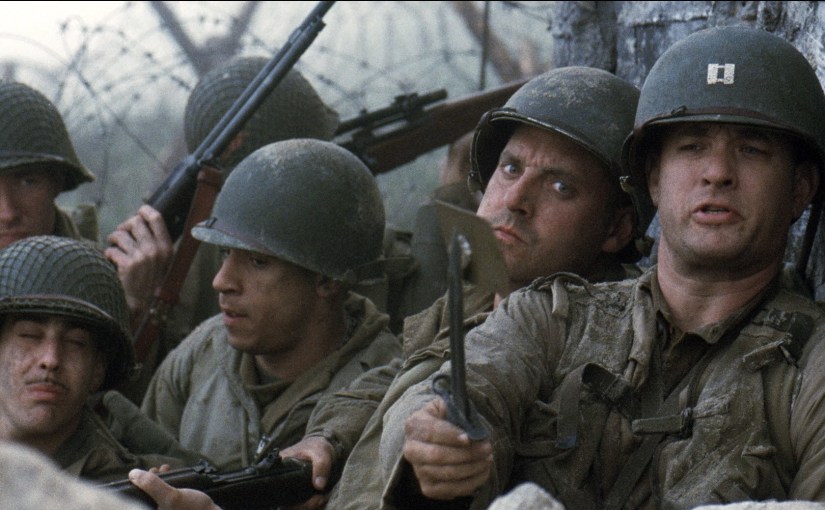
Spielberg earned his second Oscar for direction with this film from 1998.  It’s not only a technical marvel, but it’s a story that tests the nature of humanity when a squad of American soldiers ask themselves if saving the life of one man is worth sacrificing themselves.  Tom Hanks leads the team of recruits.

Saving Private Ryan begins on June 6, 1944 when thousands of American soldiers were inevitable sitting ducks as they washed ashore on Normandy Beach to engage in battle with German forces.  Spielberg’s footage is astonishing.  First of note is the cinematography is wisely washed out of color.  The sky is grey.  The ocean water and sand feel frigidly cold.  The most dominant color is blood red.  The fear displayed on the thousands of extras portraying soldiers, who never look mentally ready for battle, is palpable. 

The shots in this roughly thirty-minute opening do not compromise.  A soldier is seen walking around looking for his arm that has been shredded from below his elbow.  Other soldiers will turn over one way out of camera, but when they roll back into frame there’s a smoking hole where their face used to be.  Deadly head shots come out of nowhere.  Army medics have their hands soaked in bright red blood while trying to use scissors and thread to sew up wounds caked in wet sand. 

The action slows down at one point to focus on Hanks.  We haven’t even gotten to know his character yet, but we realize he is exhausted of this violence.  His hearing seems to deafen for a moment while he watches the horror quickly unfold as he puts his helmet back on only to have blood-stained water shower down over his head.  War is not meant for heroics and glamorization.  War only serves chaos and brutal death. 

Following this incredible opening sequence, one of the most impressive ever to start a film, Captain John Miller (Hanks) receives orders to locate the titled character, a paratrooper named Private James Francis Ryan (Matt Damon).  The army insists on sending the young private home to his grief-stricken mother, who has recently lost her other three sons in the conflict.  So, Miller recruits a handful of men consisting of fantastic actors like Tom Sizemore, Edward Burns, Vin Diesel, Adam Goldberg, Barry Pepper, Giovanni Ribisi and Jeremy Davies to make the trek across war torn Europe and rescue Private Ryan before he perishes as well.  How is that really fair though?

Any one of these men are sons to a worried mother back home.  The script for Saving Private Ryan by Robert Rodat has the men question why should they risk their own lives to find this one kid?  What makes him more special than any one of them?  Is the United States Army being fair?  Are they using this special mission as a means of propaganda?  Questions like this are irrelevant to the war department.  Just get him the hell out of there.

The journey of Miller’s squad is not just a simple hike.  At any given moment, they will come across a bombed-out town or another regimen who has just experienced their own kind of hell.  Further questions are asked when Miller recognizes an opportunity to take out an enemy battalion.  His own men suggest circumventing around this potential battle.  Miller won’t hear of it.  He’s a soldier.  Yet, after it is done, there is loss of life.  Should he have listened to their warnings or was he right to engage the enemy to avoid another team of allies suffering a terrible fate? 

Other dilemmas also come into play.  Should they escort a family and their young children who have lost their home?  The brutal dialogue of the script says that’s not their job.  Their goal is to take out the enemy and eventually rescue this one man.  Should an unarmed German prisoner be forced to dig his own grave and later be executed for the atrocities he’s committed?

War tests the ultimate limits of man.  What has to be done to allow us to finally, ultimately and justifiably shed ourselves of our humanity?  A correct answer is never provided in Saving Private Ryan.

Amid a series of astonishing battle scenes and images, two parts of the film stand out for me.  Following the loss of one of their comrades, there is disorder within the ranks.  This is where Tom Hanks takes control of a chaotic scene.  John Miller knows his soldiers have placed bets on what he does for a living back home.  Considering the strategist that Miller shows himself to be, its quite startling to find out what his occupation is.  It’s so surprising that Hanks as Miller uses it to temper his men which segues nicely into why Miller honors the mission assigned to him, even if it means risking his own life.  It’s not the best answer to why one man is more valuable than any other, but it’s the only one we are going to get. 

An even more powerful image comes to mind in the third act.  Jeremy Davies plays a Corporal assigned to the team to be a German and French interpreter.  He’s a soldier in this war, but he’s the last one you would want in combat.  As the American forces await the inevitable arrival of a German tank and a large number of troops to arrive, the men assign Davies to hold on to the long chains of ammunition and artillery.  He is draped in bullets around his neck and shoulders.  As the battle engages, shots are fired in all directions, men are quickly dispatched and Spielberg wisely has his cameras follow a helpless, weeping Davies do nothing but run from one end of the street to the other and up the stairs of a blown-out building.  He has all of the power in the world but he lacks the muster to kill and destroy which is what the nature of war demands.  He can even hear a man slowly die by stabbing in the floor above him. Yet, the Corporal can’t even rush to rescue his friend, and slaughter the enemy.  War destroys, but it also paralyzes man to act beyond an intrinsic nature of peace.  Each time I watch this scene, I can’t get past what this poor young man is truly capable of while being utterly helpless at the same time. 

I found Spielbergian techniques in Saving Private Ryan that hearken back to other celebrated moments in his film repertoire.  Tom Sizemore engages an enemy, only for both of them to run out of ammunition.  So, they wind up clumsily throwing their helmets at each other.  Indiana Jones might have done something like this for the sake of some form of slapstick.  Spielberg applies desperation to this scenario however.

The German tank at the center of the third act is somewhat reminiscent of the shark from Jaws.  Before we get an opportunity to see it, a focused Barry Pepper in a sniper’s bird’s nest gives a visual description of how big it really is and what accompanies it.  Later, Miller and Ryan have taken cover in a trench of rubble only to be overtaken by this beast as it careens over them.  The mouth of its cannon seems to come alive just before it blasts out a tower.  It’s just as scary and shocking as even Spielberg’s pictures of fantasy and adventure came before the release of this picture.  Every shot Steven Spielberg provides in any one of his films build towards an intrinsic and organic response from his viewers.  He always works with that goal in mind.  The tank is the tool used here.

The art direction is fascinating in this film as well.  A knocked over chair is picked up before a soldier stands it up as sturdy as he can on top of splintered wood and crumbled stone.  Sand on the beach is blasted up and out, sometimes splattering the lens of the camera.  Ocean water too.  Pockets of afterburn flames will be seen in the distance of a war-torn area.  The tangibility of these set pieces works cohesively with the distressed colors of a weathered and battle-stricken Europe. 

As chaotic as Spielberg demonstrates war to be, the editing is also commendable.  A war movie like this is not an action picture for the sake of escapism.  We don’t need to see the gun that fired the bullet that pierces the skull of a person.  We just need to see the person get a bullet that penetrates his helmet only to blow his head off to understand the unforgiving nature of war.  A man might be dialing up headquarters requesting air support, but he suddenly will not finish the conversation.  Editing allows the unexpected to become all too common in the midst of battle.

Saving Private Ryan is one of the best films ever directed by Steven Spielberg.  He had already shown real brutality not embedded in fantasy with films like The Color Purple, Empire Of The Sun and especially Schindler’s List.  Yet, with this picture, small factions of men, seeking world conquest, might have started this terrible conflict, but the movie does not concern itself with those instigators.  Instead, we witness the pawns at the disposal of war.  We see the collateral damage that suffer and die at the hands of unseen powers that be.  With Robert Rodat’s script, Steven Spielberg questions the value of one man versus a collection of men, and how any man, who may physically endure this terrible period in time, can also mentally survive long after it is all over. 
CODE OF SILENCE

By Marc S. Sanders

I must admit I have not watched many Chuck Norris movies. Just a handful here or there like The Delta Force, but on my radar to catch was always the cop thriller from 1985, Code Of Silence. I always intended to watch it someday as the film is highly endorsed by Siskel & Ebert. As well, it’s directed by Andrew Davis, the skilled filmmaker who would go on to direct The Fugitive and Under Siege.

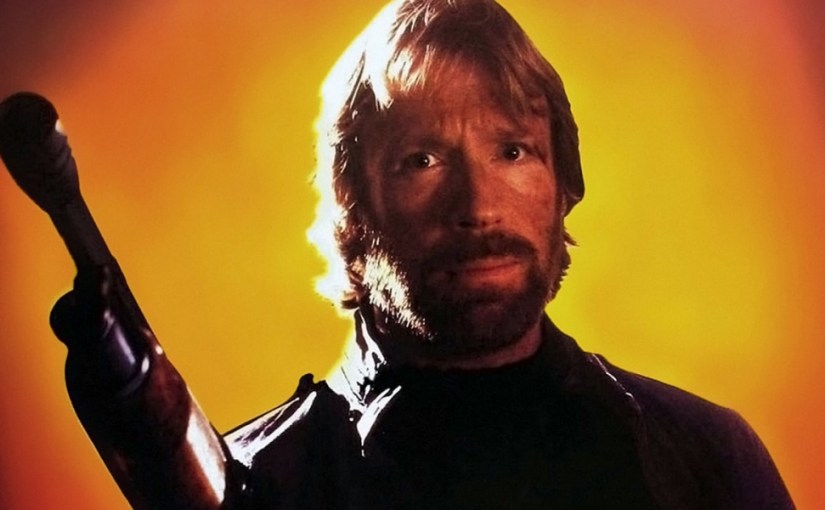
Code Of Silence works in two ways; two stories that live up to the title. Norris is a Chicago cop named Eddie Cusack who heads a squad of under covers within the city. The film opens with what is supposed to be a well-planned drug bust that goes wrong when the one mob faction is overrun by another mob. Cusack’s informant as well as others turn up dead just before his band were to move in with arrests. Nearby, two of Cusack’s men come upon a young, unarmed man. The rookie officer witnesses the elder officer accidentally shoot the kid, and afterwards he plants a pistol in his hand to make it look like self-defense.

Now Cusack has to contend with a mob war in the streets where a boss’ daughter (Molly Kagan) is the only survivor of an attack and he must protect her. While at the same time he has to deal with his squad turning on him because he knows what the elder cop really did. The code of silence motif is expected to be honored in both camps. Personal vendettas and violations of police policy need to remain quieted.

The film belongs to Norris exclusively. Andrew Davis allows some of the action star’s kickboxing skills to work their way into the movie, and it all becomes a sidestep dance routine really. It always amuses me in these action pictures where the star will take on twenty guys at once yet he fights one or only two of them at a time. The other eighteen or nineteen thugs wait their turn. Why not just have all of them tackle Norris all together? No. Then we wouldn’t get his outstretched 360-degree roundhouse kicks in the air.

There’s also an unnecessary cop robot contraption that Norris pilots for the climactic action packed ending. This thing looks a rejected auditioner for the role of Johnny 5 in Short Circuit. The robot must have been too tall for the part and rather clunky. It has no relevance to either storyline and was obviously inserted for fun, campy violence of fireballs and explosions in the necessary old, abandoned warehouse where all of these actioners have to take place.

Fortunately, Code Of Silence has good story material to work with, and some thrilling stunt work including Chuck Norris pursuing a bad guy on top of a moving elevated train that makes its way with an eventual leap into the river. From what I could tell, that was really Mr. Norris himself in that whole scene. Good footage here.

Andrew Davis relies on what would become regular side characters that appear in many of his other films including Ron Dean and Joseph Kosala. They always make for good cop antagonists within the Chicago settings of his films. Norris is also good in a quiet Clint Eastwood kind of manner as he holds his own beliefs against the rest of his department who support the elder cop.

I like the conflicts that happen on both sides of the law in Code Of Silence. Sure, it’s got some silliness to it with the kickboxing and the gigantic, cop robot that shamelessly waddles along, but the two stories hold up by keeping me engaged of their outcomes.

Code Of Silence is a pretty effective thriller.

OUT OF SIGHT

By Marc S. Sanders

In 1998, Elmore Leonard’s best-selling novel, Out Of Sight, was adapted by director Steven Soderbergh, where Federal Marshall Karen Sisco (Jennifer Lopez) falls in lust with Bank Robber Jack Foley (George Clooney), which leads to ridiculous, albeit logical set ups as a high stakes diamond heist is planned along the way.

I know years after Steven Soderbergh’s film was released an ABC tv series based on the Sisco character was produced. That was a misfire. Simply because the beautiful, sexy and most importantly under appreciated and intuitive portrayal that Lopez mastered was a role that could have led to another great film franchise of sequels to come. Carla Gugino played author Leonard’s heroine in the tv show. If you are saying “Carla who?” then ‘Nuff said. Sisco belongs to Jennifer Lopez.

Lopez and Clooney have great chemistry amid gorgeous cinematography on location in sun filled Miami and snow blanketed Detroit. Soderbergh shoots a great scene midway through where the two characters, on opposite sides of the law, throw caution out the door as they seduce each other in front of a hotel window view boasting beautiful midnight blue sprinkled with falling snow. It is one cool and very hot scene.

Sisco is always a step ahead of Foley. Her problem arises when after being held hostage by him in the trunk of her car following his escape from prison…well, she just can’t resist him.

My apologies. Out Of Sight is a far better film than I could describe here thanks also to a boastful cast featuring Dennis Farina, Ving Rhames, Don Cheadle (how many films has he done with Clooney?), Steve Zahn, Albert Brooks (simply great as a hairpiece wearing white collar criminal), Michael Keaton (two Batmans in a film for the price of one) and finally a master of cameos reserved for a smirk inducing final scene. Make an educated guess of who I could be talking about.

Lopez and Clooney should have done more films together over the years. They are as classic a couple as Tracey & Hepburn, Beatty & Dunaway, Hanks & Ryan or Gere & Roberts.

This was a gem of a movie I mistakenly found boring when I saw it in theatres. What was I thinking? On a second viewing, 20 years later, I laughed, smiled and just couldn’t take my eyes off it. It’s just great fun.

Without Out Of Sight, Soderbergh, Clooney and Company would probably never have made an Ocean’s 11. Check out what became before their more successful collaborations to come.

MIDNIGHT RUN

By Marc S. Sanders

Martin Brest’s Midnight Run is a perfect blend of comedy, action and sweet tenderness. Different facets of what two guys could potentially experience together, especially if they are on an unexpected cross country road trip, pop up unexpectedly. It’s a well-acted film with great exchanges in dialogue that surge with broad comedy and high-octane car chases and shootouts. Yet, there’s even some special quiet moments to appreciate as well. It’s another favorite film of mine.

Robert DeNiro is Jack Walsh, a disgraced former Chicago cop now turned bounty hunter who spends his days wrangling up criminals who skip out on their bail. When Eddie the bondsman (a great Joe Pantoliano) asks Jack to bring back Jonathan “The Duke” Mardukas (Charles Grodin) who skipped out on a $450,000 bond, something as simple as a “midnight run” turns into an excruciating journey from New York to California. The Duke doesn’t make it easy for Jack. He never shuts up and right from the start it doesn’t help that he’s afraid to fly. Well, there’s always the train, right? Plus there’s plenty of time because Jack has five days to get The Duke back into custody.

Not so fast. The mob, led by a silky smooth and threatening Dennis Farina, wants The Duke dead as revenge for embezzling millions of dollars from them, plus avoiding the risk of him testifying against them. The Duke unknowingly served as their accountant. The Feds, led by a just as awesome Yaphet Kotto, want The Duke as their material witness against the mob. On top of all that, Jack has to compete with Marvin (John Ashton), another bounty hunter who wants to bring in the The Duke.

There’s great action in Midnight Run and you can’t get enough of it, but it’s the comedic layers of complications the cast of characters bring on to themselves that serve the film best. Danny Elfman’s music accompaniment primarily on horns with guitar and piano bring out the fun in the best way possible. Great chases with a helicopter and various stolen vehicles while Jack and The Duke outrun endless squad cars are magnificent. Martin Brest (Beverly Hills Cop) is just an entertaining director.

Still, the action is not even the highlight for me. First, the chemistry among all the actors is fantastic. They have such brilliant exchanges of cursing each other out, getting on each other’s nerves, and especially listening to one another as well. It doesn’t matter if it’s a screaming match phone call between DeNiro and Pantoliano, or a one on one with Kotto getting frustrated DeNiro. It all works.

Most especially is the pairing of DeNiro and Grodin. They hate each other and then seconds later they’re laughing with each other. Grodin as The Duke, as pesky as he is, plays an unwelcome therapist at times to DeNiro’s Jack as the history of his failed marriage resurfaces and his fall from grace with the Chicago police department comes back to bother him. Jack doesn’t give in so easy to The Duke’s desire to share his feelings. He’d rather endlessly smoke, eat unhealthy food and tell The Duke to “shut the fuck up!” Nevertheless, a bond between the two forms and continues to reshape itself during the course of the film. A great moment occurs when they need to scam a barkeep out of some twenty-dollar bills. You’ll never forget “the litmus configuration” after you see Midnight Run.

I also want to call attention to one of my favorite of so many DeNiro moments in his long career. Midway through the film, Jack reunites with his ex wife and teen daughter that he hasn’t seen in nine years. Like many divorced couples, an argument breaks out among the parents only to be quickly silenced by the quiet intrusion of Jack’s daughter Denise (Danielle DuClos). As Jack waits for his wife to bring him money to help, Brest allows DeNiro to do some of his best acting with this young actress. They can hardly speak to one another. DuClos simply stares in disbelief that her estranged father came home. DeNiro can’t, in good conscience, make eye contact, knowing he’s been the absent parent. It’s too difficult. It is such a humane moment that it grabs me every time. It reminds me that dialogue is not always necessary for a great acting piece. Martin Brest really trusts his actors in this moment. It’s likely my favorite scene of the film and of DeNiro’s career. You can take this scene out of the context of the entire film and still be just as moved by it.

The best action films succeed when the filmmakers care about the characters. When the characters are given depth, then we worry about them. We hope they don’t get killed or taken or arrested, and simply make it home. Midnight Run is that kind of action piece. Had we not cared for Jack and The Duke, movie lovers never would have cared for Martin Brest’s film, now going on 34 years later. It’s a perfect film.