MATEWAN (1987)

by Miguel E. Rodriguez

Director: John Sayles
Cast: Chris Cooper, Mary McDonnell, David Strathairn, James Earl Jones
My Rating: 9/10
Rotten Tomatometer: 94%

PLOT: The (mostly) true story of a West Virginia coal town where the local miners’ struggle to form a union rose to the pitch of all-out war in 1920.


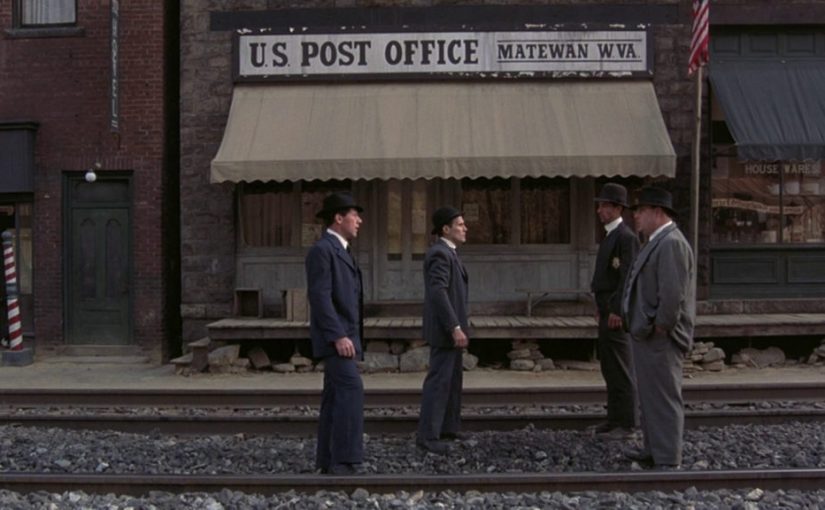
A few nights ago, I watched Matewan for the first time.  I haven’t seen many of director John Sayles’ films, but I’d venture to say it’s one of his best.  With loving authenticity and a keen ear for dialogue and music, Matewan depicts a nearly forgotten chapter of American history when coal miners in 1920 West Virginia attempted to unionize, the big corporation that owned the mine attempted to suppress and intimidate the workers, and everything came to a head one fateful day on the train tracks leading in and out of town.

I can’t pin down exactly why, but I haven’t been able to stop thinking about this movie.  When I was watching it, I tried to stop so I could go to bed and finish it in the morning.  But when I tried to sleep, my mind wouldn’t stop racing, thinking about the film, its message, its look, the SOUND of it.  I had to get back out of bed and finish it to the end before I was finally able to sleep.

The plot is nothing new, at least in broad strokes.  Small town locals take on corporate America and show them what for.  Seen it once, seen it a hundred times.  But for some reason, when this film showed scenes of company men evicting miners from their homes, or humiliating dinner guests at the boarding house where they’re staying, or spreading lies about union organizers, even employing a spy…I got mad.  I wasn’t just upset at the bad guys in a knee-jerk way, like disliking Nazis in a World War II film.  I was genuinely angry.  And I stayed angry for days whenever I thought about the movie.

Maybe it’s the thought of this particular kind of injustice depicted in Matewan that fueled my anger.  Here are people, poor people, desperate people, who lost their land, their homes, their dignity, and their lives so other men hundreds or thousands of miles away could report a six percent increase in profits at the next stockholder’s meeting.

There’s a powerful but terrible scene when the mining boss is introducing a group of new employees to the mine and its rules.  They are presented with tools…but they’re loans from the company, and their cost will be deducted from their first paycheck.  Miners can sharpen the tools with the company’s tool sharpeners…for a monthly fee.  The company provides a doctor…for a monthly fee.  The train ride to the mine was provided by the company…cost to be deducted.  The men are paid in company “script”, redeemable only at the company store.  Purchase any items available at the company store from an outside merchant…and you’re fired.

I remember thinking, this is literally slave labor.  How could anyone live like that, day after day, going down into a hole in the earth where the very real possibility of death, sudden or protracted, loomed over you every moment you’re down there?  And then to hear that the company could make conditions safer, but it’s just too expensive?  No WONDER they wanted to unionize.

Anyway.  Like I said.  It stuck with me.

Leaving aside the story, the film is extremely well made, especially considering the filmmakers were working within an extremely limited budget.  They employed the services of Haskell Wexler, one of the gods of movie cinematography, whose credits include Who’s Afraid of Virginia Woolf? (1966), In the Heat of the Night (1967), and One Flew Over the Cuckoo’s Nest (1975).  He employed a lot of low-light and natural-light photography, and as a result, even though Matewan was released in 1987, the movie looks and feels like a classic ‘70s movie.  It’s so precisely of a particular time and place that it’s a little jarring to see contemporary actors like Chris Cooper and Mary McDonnell in scenes that look like something out of Barry Lyndon or McCabe & Mrs. Miller.

The music choices are also out of this world, especially in a scene where musicians from three separate ethnic communities start riffing on each other’s music.  It’s an eloquent symbol of the kind of community and camaraderie that was needed for the miners to succeed in their task.

The story moves onward.  The miners first rally around Joe Kenehan (Chris Cooper), who came to town with the specific goal of unionizing the mine.  Then things go sour when company enforcers arrive.  The local sheriff (David Strathairn) makes a bad first impression, but later reveals his true nature in immensely satisfying style.  Guns are fired.  Lives are lost.  A spy is discovered.  And everything leads to a final showdown between powerful men with the might of corporate America backing them up and a few desperate miners who just want to be treated like men instead of so much dry goods.

If you’re anything like me, Matewan will stay with you long after it’s over.  Maybe not for the same reasons, but its memory will definitely linger.

QUICK TAKE: Good Night, and Good Luck. (2005)

By Miguel E. Rodriguez

Director: George Clooney
Cast: David Strathairn, Patricia Clarkson, George Clooney, Jeff Daniels, Robert Downey Jr., Frank Langella
My Rating: 8/10
Rotten Tomatometer: 93% Certified Fresh

PLOT: In the early 1950s, broadcast journalist Edward R. Murrow (Strathairn) looks to bring down Senator Joseph McCarthy.


I feel eminently unqualified to discuss the historical merits of Good Night, and Good Luck.  I am no history scholar.  What I know about the Hollywood blacklist and the HUAC hearings can be traced to sources such as movie reviews, the movies themselves, documentaries, and The Manchurian Candidate.  (The original, not the remake.)

As such, all I can report is that this movie is solidly well-made, photographed in gorgeous black and white, and is an immensely satisfying experience, because a bully gets what’s coming to him, on national television.  If there are times when it lags a little, well, civics lessons can’t be fireworks all the time.

David Strathairn is not quite a dead ringer for legendary newsman Edward R. Murrow, but he’s close enough, and he’s never less than convincing, especially when delivering Murrow’s broadcasts in that inimitable deadpan that somehow sounds more informed than the average reporter.

I especially enjoyed the segment where McCarthy appears on Murrow’s program to defend himself against charges made by Murrow on a previous show.  Shortly thereafter, Murrow goes over McCarthy’s rebuttal line by line, identifying each falsehood and inaccuracy.  That took guts back then, but Murrow stood for truth, as corny as that sounds, and he wasn’t about to let McCarthy’s lies slide.

All in all, Good Night, and Good Luck is a great film, maybe even an IMPORTANT film, because of our ever-shifting political climate.  You never know if another McCarthy will rise up, and you wonder if anyone will be around, like Murrow, to put them in their place.

[TRIVIA NOTE: look fast for Simon Helberg (Wolowitz on “The Big Bang Theory”) in what amounts to approximately five seconds total screen time.]

NOMADLAND

By Marc S. Sanders

amazon ( n.) a large strong and aggressive woman; Synonyms: virago. amazon ( n.) mainly green tropical American parrots; 2. Amazon ( n.) (Greek mythology) one of a nation of women warriors of Scythia (who burned off the right breast in order to use a bow and arrow more effectively);

As I reflect on watching the 2020 Best Picture Oscar winning film, Nomadland, I considered the literal translation of the word “amazon.”  To many of us, I would think the word has an entirely different meaning.  Director, writer and editor Chloe Zhao probably considers both the literal definition of the first noun (noted above), as well as the brand name that seemingly runs the world these days.

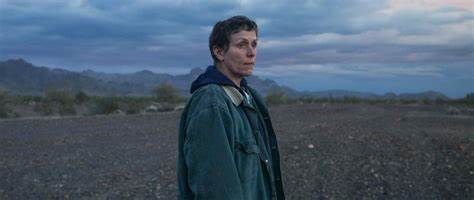
Fern, played without compromise by Frances McDormand, is likely a strong and aggressive woman, though only subconsciously large.  I’d argue you would have to be in order to survive as a nomad within a pre-Trump era mid-western America with a beat up van as your mobile residence and a deep plastic bucket for a toilet that isn’t hard on your knees when used.  Fern is a former resident of Empire, Nevada.  Empire and its postal zip code no longer exist as of 2011 when the sheetrock factory that sustained the town closed up after 88 years, thus forcing all its residents to give up their homes and relocate elsewhere.  Now that Fern is widowed, she does not see any other way to live other than in the van she calls “Vanguard.”  She lives paycheck to paycheck with seasonal jobs that are hopefully available.  The first of these jobs includes a packing facility for Amazon.  Once the holidays are over, it’s up in the air as to what she’ll come across next.

Zhao is an observational director.  To depict a film about a lonely, uncertain post middle age nomadic widow will require shots of the country like frost on the ground, deep snow, endless roads, hot deserts and moonlit campfires with other nomads who come by Fern’s way.  These people (many of which are real life nomads in the film) might travel individually but they are a community as well.  They teach one another in ways of being resourceful with auto repair or what’s the best bucket for a toilet.  They provide people like Fern with temporary job opportunities.  They also counsel one another with how to deal with grief and share their own health challenges like the various forms of cancer and illnesses they endure and how they plan to live out the remainder of their limited time on earth.  One woman with an inoperable brain tumor is determined to make it back to Alaska.  What drives these people is not necessarily a will to survive.  More importantly, it’s the knowledge that they will cross paths with one another again.  An experienced nomad who lost a son to suicide never considers saying goodbye to anyone he encounters.  Rather, he is staunch in telling others that he’ll “see them down the road,” at another time and place.  He reminds Fern that to live this life is to never close the book or end a chapter, and memories of those we have lost can only stay alive if Fern and others stay alive.

I appreciate a film like Nomadland simply because I’ve never been the brave traveler.  One of my greatest fears is being lost and alone.  It has always terrified me.  I still don’t trust the navigation apps on my cell phone.  I have to see the destination in front of me.  Luckily, my wife keeps me in check.  Yet, Nomadland is a film that gives me an opportunity to explore places I might never arrive at, while I sit safely in front of my flat screen.  Chloe Zhao shoots with wide lenses to take in gorgeous landscapes.  How fortunate for Fern that she can encounter all of this beauty in person.  How fortunate, as a viewer, a film like this allows me to witness what’s out there.  How sad though as well that sometimes this way of life seems treacherous and nonsensical.  Whatever entity created the earth allowed no sympathy for a flat tire or a broken-down engine, when you have no means of paying for replacement parts.  As well, mother nature is not always going to be that companion that holds your hand during lonely times.  Corporate America certainly won’t do that either, but it is a necessary evil.  Thank you, Amazon!

Frances McDormand is perfect for this role as she carries no inhibitions about herself.  She will truly show herself sans makeup or coiffed hairstyles, floating nude in a stream, or go so far as to literally defecate on screen in that practical bucket to demonstrate how truly unglamourous and unforgiving the life of a nomad is. 

Nomadland is not a favorite film of mine, but I can’t help but appreciate its honesty thanks to Zhao, McDormand and the numerous real-life nomads that inhabit the picture.  It’s a sad story; not a triumphant one, but it is also a film that tries to emulate the comfort of being “houseless…not homeless” as Fern describes with absolute certainty.  It might not be the life for many of us, but it is definitely a life meant for Fern.

GODZILLA: KING OF THE MONTSTERS

By Marc S. Sanders

Godzilla: King Of The Monsters

Imagine our reaction upon learning that the cast of this epic features the following:

Academy Award Nominee: David Strathairn

Academy Award Nominee: Ken Wantanabe

Academy Award Nominee: Vera Farmiga

Academy Award Nominee: Sally Hawkins

The FBI Guy from The Wolf Of Wall Street: Kyle Chandler

Emmy Nominee: Millie Bobbie Brown

Emmy Nominee: Charles Dance

…and the guy from Speed and Terminator 2: Judgement Day and most importantly the 2nd episode of What’s Happenning!!!: Joe Morton

Here is a film where scientist Vera Farmiga justifies waking up 10 million ton monsters on earth because it will “SAVE THE EARTH FROM POLLUTION DUE TO OVER POPULATION.” (Ahem, couldn’t she have just called Thanos?”)

Here is a film where scientists reason that the only way to communicate with Gorjira (a bad ass looking three headed Hydra) is by humpback whale frequency. (Ahem…one more thing…couldn’t Spock simply travel back to the mid 1980s and pick up George & Gracie?)

Here is a film where Boston is brought down to rubble save one street conveniently available for a Hummer to race down so that Kyle Chandler and Vera Farmiga can race back to their house to find daughter Millie Bobbie Brown safely taking refuge.

Despair not though my friends.

Boston survived!!!

There was one sole remaining functioning traffic light still standing following the mass destruction. That’s all I need for self assurance.

Let me tell you something though. You get your money’s worth out of this mashed potatoes of a film. One of the best comedies of the year!!!

It was a lot of fun.