SILKWOOD

By Marc S. Sanders

As the 1980s were setting its stride, Silkwood might have been one of the earliest in a line of films to focus on the union worker who fights back at the billion-dollar corporation.  Some might unfairly regard the movie as The China Syndrome, Part II. Other well-known pictures of this mold are even more familiar to me like Michael Mann’s The Insider.  However, director Mike Nichols, working with a first screenwriting effort from Nora Ephron who partnered with Alice Arlen, showcases the aggravation on not just Karen Silkwood, the real life potential whistleblower, but also her friends and co-workers in a one factory town just outside of Oklahoma City.

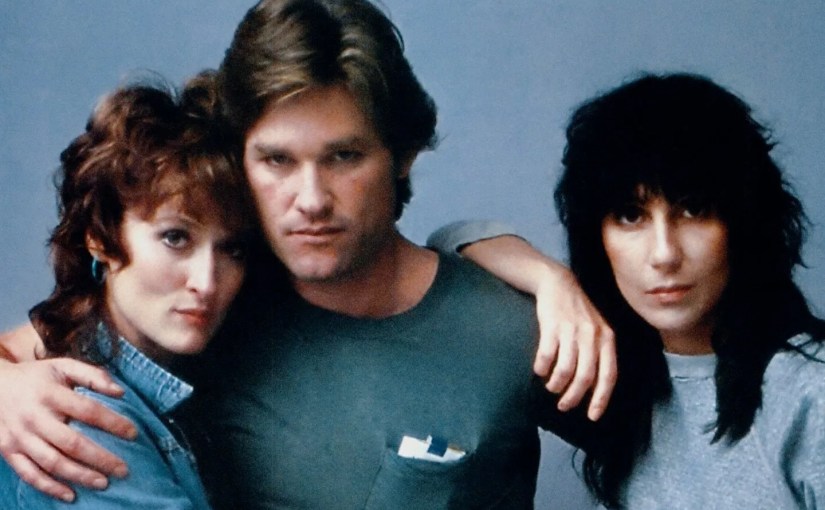
Karen (Meryl Streep) lives with her boyfriend Drew (Kurt Russell) and her best friend Dolly (Cher) in a run-down house in the middle of nowhere.  They ride to work together at the local plutonium manufacturing plant where they dress in scrubs and gloves. Punch in, punch out kind of days, and often they are expected to work double shifts and weekends.  Karen works an assembly line where she places her hands in rubber gloves and assembles dangerous combinations of chemicals in an enclosed box.  It’s also routine that before you leave your station you wave your hands over a sensor to ensure you have not been exposed to radiation.  There’s even sensors you walk through as you enter and leave the plant.  When those sensors go off, a calm kind of film seemingly turns into a horror movie.  The last thing anyone could ever want is to get “cooked.”

Karen does not live a perfect life.  Her three kids reside with their uncompromising father in Texas.  Money is not ideal.  Dolly is a slob and has also invited her girlfriend to live with them.  Karen can manage with all of this, but when she observes some unconventional activities around the factory she gets up the nerve to head the union for better protection and working conditions.  However, the further she goes looking at files and photos, jotting down notes of what people say and do, plus taking trips to Washington DC, and getting phone calls from attorneys at night, she becomes more and more isolated from Dolly and Drew, along with the rest of her close-knit workers.  Karen is not just risking her job, but everyone else’s jobs and worse her own life.

The attorneys lay it out to the townsfolk and the union of the horrifying statistics that go along with radiation exposure.  The tiniest fraction of a miniscule of exposure to the smallest crumb of chemicals could increase a human’s bearable limit towards radiation and cancer.  The sad irony is that the more that is learned, the more the people of this area smoke and smoke some more.  Granted, this story takes place in the early 1970s, though.    

The company is primarily represented by an intimidating Bruce McGill.  He’s great in everything he does and is worthy of an Oscar nomination somewhere.  M Emmet Walsh has no lines but his presence is enough to shake you; the slimy guy you easily recognize from every other movie you have seen.  While the company’s overbearing intrusion is shown plenty, the script for Silkwood focuses more on how these working people get by.  They are treated unfairly and in dangerous working conditions, but they also know this is the only place that offers steady income in the area.  Without this factory, the whole town would be left in dire straits.  Karen is repeatedly told or implied to leave well enough alone.

Meryl Streep notches another harrowing performance on her resume and bears such a departure from more sophisticated characters found in Sophie’s Choice and Kramer Vs Kramer.  Karen Silkwood is not educated and she bears an unmistakable white trash dialect but she’s also not stupid and the more progress she makes at exposing the plant’s shortcomings the more unfairly she is treated with department transfers and workplace shake ups that she is indirectly blamed for.  Potential threats on her life begin to build, but she only upholds a bravery.  You really observe the strength of Meryl Streep.  She’s at the top of an elite class of actresses at this time that also included Sally Field, Jessica Lange and Glenn Close.

Cher plays Dolly in her first on screen role.  The variety act performer probably subjected herself to a bigger departure than Streep.  She was not a professionally trained actress at the time.  Mike Nichols insisted on no makeup along with her hair unkept and flat, while dressed in green chino pants and baggy sweatshirts.  The new actress carries herself so well without the usual glitz that accompanies her.  Her scenes with Streep are workshops in acting technique. 

Kurt Russell delivers another understated performance.  One of the best actors out there who has never been enough of a critical darling.  Drew is likable and Kurt Russell plays him as a settled in match for Streep’s portrayal of Karen.  Watch how they tangle up in each other’s arms in bed or when he snaps at her as she carries on her crusade while he’d rather things be left alone.  His timing is perfect for the script.

Mike Nichols keeps his film calm, except when the go by the numbers narrative must be disturbed.  A radiation cleanse with high pressure hoses will make you wince.  The factory alarms will terrify you.  Meryl Streep accepts the physical taxations necessary for this setting.  Nichols gets in close with his camera to show how cleansers dressed in scrubs and masks rub Streep down until her skin is a burning red.  I distinctly remember how her right ear appears in this scene, getting flushed by something just short of a fire hose, and the aftermath of her sitting in a chair is so discomforting while a company doctor assures her that there’s not much to worry about as long she brings in her urine samples daily.  In fact, soon all of the employees are tasked with delivering their urine samples.  What kind of place is this?

While Silkwood is based on a true story with a burning question left behind, I do not want to reveal too much.  Many have seen Silkwood since it was released over forty years ago, but as the third act begins, the fallout only becomes more disturbing and Mike Nichols directs a horrifying sequence built primarily on the pealing of old wallpaper.  That’s all I want to suggest. 

Karen Silkwood was a very unlikely crusader.  She probably never envisioned what she would become and what she would fight for.  Yet, she uncovered horrible truths that should not have been occurring under the eye of billion-dollar corporate America.  After watching Silkwood, I can only imagine what else was there to turn over.

NOTE: Another good reason to watch Silkwood is to discover early performances from some amazing character actors who were either just starting their careers or continuing to hide in the crowd. 

Scavenger hunt for Anthony Heald, James Rebhorn, David Strathairn, Ron Silver, Fred Ward, Diana Scarwid, Bill Cobbs, M Emmet Walsh, Craig T Nelson, Tess Harper, Will Patton, Richard Hamilton and Josef Sommer.
SILKWOOD (1983)

by Miguel E. Rodriguez

DIRECTOR: Mike Nichols
CAST: Meryl Streep, Kurt Russell, Cher, Craig T. Nelson, Fred Ward, Ron Silver, Bruce McGill, David Strathairn, M. Emmet Walsh, James Rebhorn
MY RATING: 8/10
ROTTEN TOMATOMETER: 77% Fresh

PLOT: On November 13, 1974, Karen Silkwood, an employee of a nuclear facility, left to meet with a reporter from the New York Times. She never got there.


The tagline for Silkwood (quoted above) almost feels like it gives the game away, but it doesn’t really.  Even if Karen Silkwood’s name isn’t exactly part of the cultural zeitgeist anymore, I am willing to bet that a lot of people know what her name signifies in one way or another.  So, it’s not like the movie’s poster or trailers are spoiling what happens at the end of the film because most of us know.

In any event, Mike Nichols’ film isn’t a nuclear-based thriller, like The Day After (1983) or WarGames (1984), that depends on an unexpected resolution.  Silkwood isn’t about theatrical heroics or bombastic personalities.  It’s a quietly intense character study of an everywoman with an untidy personal life who experiences a seismic shift in her perception and decides she simply can’t stand by and do nothing.  This isn’t a crowd-pleaser like Erin Brockovich (2000), but this film’s story and central character are no less important.

The film goes to great pains to show us how ordinary and messy Karen Silkwood is.  The incidents at the Oklahoma nuclear facility where she works (along with her live-in boyfriend, Drew, and her roommate, Dolly) are almost secondary to the plot, at least for the first half of the film.  Karen has kids that live with her ex-husband and his girlfriend in Texas.  Her relationship with Drew isn’t stormy, but it’s not perfect.  Dolly seems tolerable as a roommate, but is not shy about speaking her mind.  Dolly brings a girlfriend home one night, and there is a slyly amusing conversation between Karen and Drew about Dolly’s sexual preferences.  (“I can handle it.”  “Me, too.”  “…so why are we talking about it?”)

I don’t want to go into too many details about the true-life incidents that occurred at the facility where Karen worked because, if you’re not intimately familiar with the facts of the story, they should be as surprising to you as they were to me.  Plutonium is involved, but probably not in the way you’re thinking.  Karen learns enough to know she should be more involved in the factory’s union…a LOT more.  One plot thread almost feels like it’s ripped off from The China Syndrome (1979), until you realize Syndrome was released four years after the events of Silkwood, so if anything, Syndrome was probably inspired by Karen’s discoveries.

I also have to mention Cher as the roommate, Dolly.  Of course, Meryl Streep is amazing and convincing as an everyday, average divorced mom, but Cher more than holds her own in every scene.  There is absolutely no hint of the pop music megastar of the ‘70s in this film.  Director Mike Nichols insisted she wear little or no makeup in her scenes, which went against every fiber of her instinct as a performer.  She understood the assignment: she never upstages anyone.  This is not a grandstanding kind of supporting role, like Tommy Lee Jones in The Fugitive (1993) or Cate Blanchett in The Aviator (2004).  It required subtlety and understatement, and Cher delivered.  I tried to spot her “acting,” and I never could.  She was unbelievably natural and, at times, heartbreaking.  The movie is almost worth searching out just to see her performance.  It’s a clinic in how to own a small role and make it stand out by doing less than you might expect.

Silkwood may not feel as thrilling as some of the other thrillers I’ve already mentioned, but it is just as compelling, specifically because we’re watching an ordinary person under extraordinary circumstances.  We’re not watching a hero triumphantly rise to the occasion.  We’re watching a struggling divorcee who’s trying to do the right thing after years of inaction, even if it means losing the trust of her co-workers or sacrificing her other personal relationships.  I identified more with Karen Silkwood and her situation than I did with Jane Fonda in The China Syndrome or Julia Roberts in Erin Brockovich

The ambiguous nature of the film’s ending mirrors what happened in real life, and when the credits rolled, I felt a surge of empathy for the people left behind and the unanswered questions they live with to this day.  That doesn’t happen to me very often.

FRACTURE

By Marc S. Sanders

When director Gregory Hoblit was shooting this film, did he ever wonder how preposterous this courtroom mystery is?  

This ridiculous effort featuring a tired Anthony Hopkins as a suspect representing himself, and a very green Ryan Gosling as the prosecuting attorney proudly boasts a centerpiece storyline of simply finding a gun used in an attempted murder.  That’s it really.  No nuances.  No subtle riddles.  Just a “what happened to the gun?” plot line.  

It’s any wonder that I had never heard of this movie until I found it on Netflix.

Take my advice.  Find something else on Netflix.

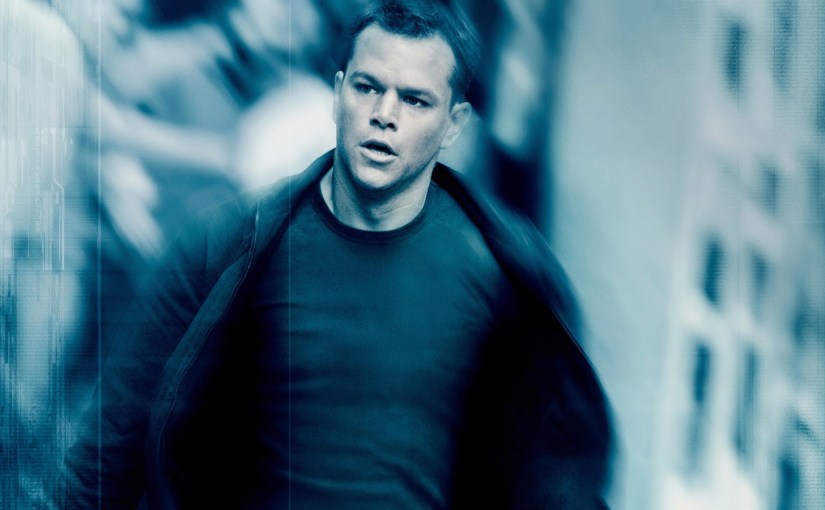
THE BOURNE SUPREMACY, THE BOURNE ULTIMATUM, THE BOURNE LEGACY, JASON BOURNE

By Marc S. Sanders

Sometimes the same old thing is all we want, right?  It’s like comfort food.  That’s what the Jason Bourne films offer.  The first time (The Bourne Identity) it is original.  The second time (The Bourne Supremacy) it is familiar.  The third time (The Bourne Ultimatum) it is what we expect.  When you get to the fourth and fifth time (The Bourne Legacy and Jason Bourne), well then perhaps you’ve overstayed your welcome.

The second and third films in the Matt Damon action series function as one long four-hour film.  They are absolutely gripping in high octane, fast cut editing, pulse pounding music from James Newton Howard, and taut direction from Paul Greengrass.  They work because at least two thirds of the material is shown through the eyes of the former assassin Jason Bourne who is trying to learn of his past and who he worked for and why.  Plus, though he may hide deep undercover on the other side of the world in places like populated India, he only resurfaces when he discovers someone is trying to kill him.

The other third of these two pictures function on the other side of the coin with clandestine departments within the CIA who only consider Bourne being alive as a threat to the integrity of their black operations.  He must be eliminated.  There are great acting scenes with Joan Allen first up against an intimidating Brian Cox, and later she’s going toe to toe with David Strathairn.  If you are not part of the chase for Bourne, then you are engrossed in the cause these three supporting players offer with government politics and debate.  With each passing film, it’s an old, grey haired white gentleman in a suit who is insistent on eliminating Bourne and anyone who he associates with.  This started with Chris Cooper in the first film followed by Brian Cox (my favorite) over to David Strathairn.  The baton is then passed to Albert Finney.  A new film moves over to Edward Norton and then Tommy Lee Jones.  Scott Glenn and Stacy Keach are in the recipe too, but they are not as prominent.  All these guys start to look alike and when you watch the films in succession, one after the other, like I recently did, you start to question when this actor and this actor entered the fold.  Best way to describe it is that it is a ladder climb.  There was one guy in charge, then another above him and so on.

The appreciation for the Bourne series comes mostly from its action and the absolute cleverness of its hero.  Jason Bourne functions with ease about staying one step ahead of those trying to kill him.  They think they have a lead on him, but in reality, he has the lead on them.  Do you know how satisfying it is when he calls these people to talk to them and they play dumb? Jason will simply say “If you were in your office right now, then we would be having this conversation face to face.”  Moments like this are what gets an audience to clap and cheer.  The old white guy has been duped.

The action works because, once again I lay claim to the lack of CGI.  So, the overabundance of car chases seems nerve wracking like they are supposed to.  That door on that car is actually getting bashed in.  That taxi cab is really getting t-boned and turning into a 360 tailspin.  Jason can grab a seatbelt, lie down on his side and when the car careens over the barrier onto the landing fifty below, upside down, I’ll believe he gets out with only just a slight limp and a dribble of blood on his brow.  Only Jason Bourne can drag a wrecked rear bumper on a stolen police car through a busy Times Square and bash an SUV into a concrete barrier.

Fight scenes are not just fight scenes in the Bourne films.  It’s not just fists and punches and karate kicks.  Creatively speaking, the films construct their fight scenes to have the hero arm himself with a ball point pen or a magazine that’s wrapped up ready to wallop an opponent in the nose.  I’ll never forget when my colleague Miguel and I saw Ultimatum in the theatres and witnessed Jason punching a book into the face of a dangerous bad guy.  How many times have you seen a guy get punched in the face?  How many times have a seen a guy punch a book into the face of another guy?  There’s a difference. 

Matt Damon has been quoted as saying he believes the Bourne films carried the least amount of dialogue for him to memorize.  Yeah.  That’s likely true.  These films are visual feasts.  They rely on watching Damon move.  They are paced by how he walks, drives a car or tinkers with props.  Even how he listens and observes move with a kinetic progress. 

The locales are spectacular, spanning the globe from India, to Russia, to London, to Morocco, to the Philippines, and on to New York City and Las Vegas.  Following the first film, Paul Greengrass directed three of the next four.  (Writer Tony Gilroy directed the fourth film, The Bourne Legacy with Jeremy Renner taking the lead while Damon’s character was only talked about.) Each film takes every advantage of the atmosphere, using the overpopulated extras as obstacles and means to hide and weave away from the antogonists while on foot, behind a steering wheel or saddled upon a motorcycle.  Greengrass practically invents the concept of putting the viewer so much within the environment, you can almost smell the diesel or the food trucks within the area.  Zoom in overhead shots offer quick glances of the playground and traffic we are engrossed in.  Approximately twenty-five minutes within the center of The Bourne Ultimatum go by with no dialogue as Jason Bourne pursues a bad guy through a labyrinth of apartment tenements and rooftops, while the bad guy pursues actor Julia Stiles.  Finally, when all three catch up to one another, with a leap through a window, do you let out the deep breath you never realized you were holding on to. 

The first three films in the series (Identity, Supremacy and Ultimatum) work as a tight trilogy.  Each film ends with hanging threads to consider and lend to the next film.  By the time Ultimatum concludes, you feel as if all that needed to be told has been covered.  The next two (Legacy and Jason Bourne) function as cash grabs for the studio.  Legacy is entertaining and it boasts a good cast with Jeremy Renner and Rachel Weisz trying to outrun the government adversaries.  It hinges on operating as parallel material that occurs in the prior Damon installment.  While Jason Bourne is being pursued, this is happening over here.  It’s not unwatchable, but it is also truly unnecessary as it doesn’t advance the universe of the series at all.  A thrilling motorcycle chase closes out the film, but it’s a retread of what we’ve seen before.  It gets old quickly.  The film demonstrates that guys like Jason are trained to become dependent on drug enhancements for their highly trained arts of warfare and instinct.  Renner’s character is just another kind of Jason Bourne.  I was more impressed when I thought Jason was just a highly skilled fast learner to all that he’s capable of.  If you tell me blue and green pills lend to what he’s capable of, well then, he’s not much of a superhero in my eyes anymore.

With the final film, Jason Bourne, Greengrass returned to the director’s chair and Damon agreed to come back (paycheck had to be right, I’m sure), though he was significantly greyer and older than his prior films.  It was a weak return.  Just when we think Bourne has learned everything he needed to know and he could now live comfortably underground as a street brawler for bucks, he is informed that his deceased father knew and did some things for these secret agencies that put Jason on this path of special operations.  It doesn’t hold much weight and the payoff is nothing special.  Another car chase occurs in Vegas that appears nearly shot for shot similar to what we already saw in Damon’s prior installments. 

I wrote in an earlier review of The Bourne Identity, that Matt Damon works so well in the role because he’s such an unexpected surprise.  He’s not the muscle guy like Stallone or Schwarzenegger.  He comes off common.  In the first three films, he’s simply a kid.  When you place him in action or see how he gets the drop on a bad guy who is surveilling him, it is so satisfying.  The Bourne films work best with the locales they choose to shoot from.  Bourne will spy on his pursuers from a rooftop building across the street from where they are.  This is inventive filmmaking not just found in the pages of the script.  Paul Greengrass strategically shoots his players.  Director Doug Liman planted the seeds for this series’ potential (The Bourne Identity), very loosely based on the Robert Ludlum novels with creative adaptations from Tony Gilroy, primarily.   Greengrass enhanced the characters and their motivations by use of scenic locales, skillful shaky cameras to make it look like the audience is running at the same pace of Bourne and his adversaries, and quick cut, real time editing.  He applied this approach to his 9/11 film United 93.  The last two films are good even if they seemingly peter out the series, but overall, the four sequels hold up very well. 

If you’re asking, the best of the series is The Bourne Ultimatum, followed very closely by The Bourne Supremacy.  Either way, no matter which film you’re watching, you’re in for a good time when Jason Bourne shows up on the grid.

NOMADLAND (2020)

by Miguel E. Rodriguez

Director: Chloé Zhao
Cast: Frances McDormand, David Strathairn, and a cast of non-professionals/actual “nomads”
My Rating: 8/10
Rotten Tomatometer: 93% Certified Fresh

PLOT: A woman in her sixties, after losing everything in the Great Recession, embarks on a journey through the American West, living as a van-dwelling modern-day nomad.


Nomadland is one of the most visually beautiful films I’ve seen recently.  It mostly reminded me of Brokeback Mountain (2005) with its sprawling vistas of distant mountains, lonely country roads against a looming sky, and desert badlands illuminated by that elusive light that appears only during the “magic hour” so coveted by cinematographers and photographers alike.  It’s beautiful and well-made.  As a message film that won the Academy Award for Best Picture of 2020…I mean…it’s good and admirable, but it didn’t quite get to me like it was clearly trying to.

As a piece of propaganda (intentional or not), I can see Nomadland being effective for anyone who has been disillusioned of the American Dream by financial troubles.  Set in 2011, the film follows Fern (McDormand) as she hits the road in a van after the gypsum mining company her deceased husband worked for folded, displacing an entire town, Empire.  Even the town’s zip code was discontinued.  Fern literally lives out of her van, which doubles as living quarters, bedroom, dining room, and (revealed in a shot that I was stunned to learn was real) bathroom.  She works seasonal jobs throughout the American West at various parks, restaurants, and even an Amazon warehouse during the holidays.

On her travels, she encounters a large community of fellow nomads.  Periodically (I think annually), they gather at a location in the middle of the desert to trade goods, share stories and nomadic tips, and basically support each other for a week or a month or whatever…it’s not made clear exactly how long everyone stays before they go their separate ways once more.  On this occasion, she meets a fellow traveler named Dave (Strathairn) who trades her for a can opener.  Over the course of the film, Fern’s and Dave’s paths will intersect again and again.  I thought we were getting the kernel of a corny love story, but not quite.  The purpose of their relationship is pragmatic, not romantic.

Another traveler Fern meets is Swankie, a lively woman in her seventies who hangs a skull-and-crossbones flag from her van when she wants no visitors.  Honestly, it made me wish I had a similar flag to hang from my neck to communicate the same thing in public.  Anyway, Swankie reinforces Fern’s commitment to this way of living by describing trips to Alaska, a visit to a large community of swallows nesting on a cliff while on a canoe trip, and by revealing one of the real reasons Swankie has adopted this lifestyle in the first place.  All with no bills to pay, other than gas, food, and vehicular upkeep.

The movie follows Fern from one place to another over the course of a little over a year.  We see her working, driving, talking with people she meets, cooking on her tiny gas stove inside her van, dealing with the cold in the winter, reminiscing over old photos and slides.  There are two interesting side trips when she can’t avoid reaching out to…well, I guess “civilization” is the right word.  One occurs because her beloved van breaks down and she has to get to her sister’s to ask her for repair money.  Another occurs when she takes Dave up on an offer to…no, won’t spoil it.

At times, I found myself comparing Nomadland to Cast Away, Robert Zemeckis’ 2000 film where Chuck Noland (Tom Hanks) finds himself stranded on a desert island after a plane crash.  In both situations, the heroes find themselves isolated from civilization.  They must both learn to deal with an alternate way of life, and there is no alternative.  Adapt or die.  (When Swankie learns Fern doesn’t even know how to change a tire, she reprimands her.  “You can die out here.  You’re out in the wilderness, far away from anybody.  You can die out here.  Don’t you understand that?  You have to take it seriously.  You have to have a way to get help.  You have to be able to change your own tire!”  It’s a sobering reminder that, even though she has a cell phone (how she pays the bill is a mystery to me), Fern must be self-sufficient in order to survive.)

Furthering the similarities to Cast Away, there’s even a moment where Fern has an opportunity to sleep in a real bed.  We see her crawl underneath the covers…but in the middle of the night, she creeps back out to her faithful van to get a real night’s sleep, just like Chuck Noland sleeping on the floor of his hotel room.

But what does it all mean?  What is Nomadland trying to say?  I couldn’t shake the idea that Zhao’s film, based on a book of the same name, was an attempt, like Into the Wild (2007), to romanticize the concept of shedding our material needs, stripping ourselves down to the necessities, and getting back in touch with nature.  I have no doubt this notion appeals to many people.  Well, that much is clear because nearly everyone in the film besides McDormand and Strathairn are non-actors who are playing themselves, and they’re all nomads, too.  But is the movie simply showing me how and why a person makes this decision?  Or is it trying to convince me that I should do the same thing?  Is this one of Ebert’s “empathy machines” that allows me to live in someone else’s shoes for 107 minutes and experience life through their eyes, or, like Into the Wild, is it making the case that folks who haven’t made this decision themselves are slaves to a corporate system?

At one point, a gentleman named Bob, who is a real person and is one of the main coordinators of the community that meets once a year in the desert, makes a speech to the nomads who have gathered:

I think of an analogy as a work horse. The work horse that is willing to work itself to death, and then be put out to pasture. And that’s what happens to so many of us. If society was throwing us away and sending us as the work horse out to the pasture, we work horses have to gather together and take care of each other. And that’s what this is all about. The way I see it is that the Titanic is sinking, and economic times are changing. And so my goal is to get the lifeboats out and get as many people into the lifeboats as I can.

I’d be lying if I said his notion wasn’t appealing.  Who wouldn’t want to live a life of seeing the country, parts of which many of us may never see in our lifetimes?  Never being tied down to a job, to familial obligations, bills, taxes, the eternal quest for the almighty Dollar?  I get it.  But…if I didn’t have a job, didn’t earn a living, didn’t pay my bills, and have enough left over to buy a home entertainment system including the Blu-ray of Nomadland…I would never have seen this lovely film in the first place.

So, no, the concept of living as a nomad is not something I would seriously embrace…yet.  Life is good.  I have a job.  I have family.  I have friends who are as good as family.  I have the woman I love beside me.  I’ve seen Alaska, England, Greece, New York, Miami, and Key West.  Nomadland argues that, if any of that would ever change, there is an alternative to depression and slaving away and eking out a living in my retirement years in a 1-bedroom apartment.  Perhaps, on that day, I might re-evaluate my opinion of nomadic living.

But that day is not today.

Tomorrow is not looking good, either.

AT CLOSE RANGE

By Marc S. Sanders

Sean Penn has been a gifted actor from the very beginning of his career.  Whoever thought the kid who played surfer dude Jeff Spicoli in Fast Times At Ridgemont High would go on to evoke such intensity in future roles afterwards?  Other actors who did that kind of sophomoric material went on to be in Police Academy movies.  Penn would never shake that surfer image, but he would at least equally receive accolades for his dramatic turns. In James Foley’s At Close Range the high stakes drama could not be more apparent. 

Penn portrays Brad Whitefore, Jr. in this film based on a true story taking place in a small, rural Pennsylvania town in 1978.  Brad Jr.  is going nowhere and that’s fine with him.  He’d rather be an intimidating, fearless kid who will defy his step father so he and his brother (Chris Penn, Sean’s real-life sibling) can get drunk and high.  When Brad opts to go live at his father’s, Brad Sr., house, he hopes that he will learn the ropes of becoming a career criminal like his dad.  Brad Sr. (Christopher Walken) specializes in ripping off tractors, farm equipment, cars, wealthy property owners, and safes carrying large amounts of cash.  He happily welcomes his son into his home with his misfit gang and his new young wife.  Dad will also express love to his son by giving him a car and support, while also welcoming in Jr’s new girlfriend Terry (Mary Stuart Masterson). 

There is a code among these criminals however, and it stretches to flesh and blood as well.  No one is to talk about what they do or how they do it.  Shortly after dad allows his son join in on a job, Brad Jr. learns of the consequences if anyone talks about their handiwork, especially if you are seen chatting with local law enforcement.

At Close Range came out in 1986.  Even by then, I don’t think it would be challenging to forecast where the story is heading.  What’s most interesting about the film are the cast performances from Penn, Walken, and Masterson.  James Foley sets up good scenes where loving trust works at one point, but when that is shattered, what is the detritus left over afterwards?  Christopher Walken plays a guy with no limits to upholding his code, and as I reflect on that motivation, I can’t help but think how relevant Madonna’s eerie ballad Live To Tell (from her True Blue album) is so very important to the picture.  The song should have received an Oscar nomination based on its significance alone.  I’ve only now just seen the movie for the first time.  Yet, I’ve been familiar with the song for nearly forty years.  It carries much more meaning now.

James Foley’s film could’ve been better, however.  The first hour is incredibly slow moving and doesn’t seem to offer much direction or exposition for what the film is truly going to be about.  At some points it is a boy meets girl storyline with Penn and Masterson.  They have good scenes together, but were they all necessary?  Couldn’t some of this material ended up on the cutting room floor?  Then in other areas it is a father/son coming of age piece where pals from both of their respective backgrounds get drunk together on any given night.  Brad Sr. is emulated for his leadership, the gun he carries, the money he flashes and the high-end muscle cars he steals, even gifting one to his son.  Brad Jr. is looked upon as the cool rebel (maybe a more aggressive modern James Dean) for not surrendering to intimidation from anybody. 

The movie also ends kind of abruptly.  It’s clearly understood what’s going to come of the father and son’s relationship.  Sean Penn and Christopher Walken stage a nail biting, very intense showdown in the kitchen.  However, what happens to them individually?  The final scene actually ends right in the middle of what could have been some good dramatic work, but it all goes to black.  Had I been in a movie theatre, I might have thought the projector broke down.  Business must have interfered behind the scenes.  A producer must have stepped in and pulled the plug.  It’s the best excuse I can think of, because the end credits intruded way too soon.  If the film was being edited for length, then there was much material to chop out of the first hour.  The filmmakers basically cut off the wrong leg.

At Close Range is not a steady trajectory of a movie.  It moves in too many sideways directions to stay focused on what it wants to be considered.  Is it a more genuine Rebel Without A Cause?  Is it a rural, backwoods interpretation with inspiration from Mean Streets?  Thankfully, what saved me from turning it off or falling asleep are the assembled cast performances.  At the very least, it got me interested to read up on the real story the film is based on.

THE RIVER WILD

By Marc S. Sanders

Meryl Streep can do anything. Comedy, drama, accents, age defiance, make unbearable choices, even play opposite Roseanne; anything! She can even go white water rafting. She’s a real life James Bond.

In The River Wild, Streep takes a while to outsmart bad guys Kevin Bacon and John C Reilly, but she always maintains the raft through dangerous rapids while protecting her husband and son (David Strathairn and Joseph Mazzello).

See, according to Curtis Hanson’s adventure film, the best way to outrun the law following committing a robbery is to go white water rafting, even if you have no experience with the sport. That becomes a downer for Meryl Streep’s family getaway where tensions are high in her marriage to her workaholic husband. Fortunately, this setback might get them on the right track and Strathairn will find an appreciation for the dog that has come along. Reader, I won’t give it away but like I said, Meryl Streep can do anything. So, the odds on the family pet making it out of this alive are pretty favorable. Too bad Mazzello and the dog won’t listen to dad when it’s necessary.

The plot of The River Wild is very simplistic. Hanson quickly gets to the river following some exposition of familial discourse at home. However, just because he gets to the river so soon, doesn’t mean that the thrills begin right away. There’s a lot of beautiful nature footage here and everyone is happily getting along. Bacon connects with Mazzello much to Strathairn’s chagrin, and he flirts charmingly with Streep. Then lo and behold, oh my stars, Kevin Bacon is a bad guy??? What? The Footloose guy?????? Why he’s six degrees of any one of us!!!!!

Hanson gets some good action moments on the rapids. There close up shots against the rocks, and right into the water and down the impossible falls. The suspense is lacking though. Strathairn makes an escape in the woods. He’s got a good head start, and the best option he can come up is to climb a steep rock wall in plain sight with no coverage whatsoever. Kevin Bacon, what are you doing? Shoot the guy!!!! Mr. Hanson, you just brought your stride to a screeching halt.

That’s the problem with The River Wild. There’s a lack of thrill to it all. This is not a film brave enough to really endanger the dog, nor the kid, nor Streep. The worst that’s really done is a couple of punches to Strathairn and a cut above his eye.

Mazzello made it as the screamer kid star in his adolescent years in film (see Jurassic Park). Bacon seems like he wanted to get a little crazier in the villain role, but he held back. I wanted him to cross the line a little more, a lot more actually. He wasn’t dangerous enough for me. Reilly was just a bumbling, worried accomplice in tow.

Hanson has done way better than this with his supreme effort like L.A. Confidential and even Eminem’s 8 Mile. Thank goodness I can still respect the man’s career beyond this doused misfire.

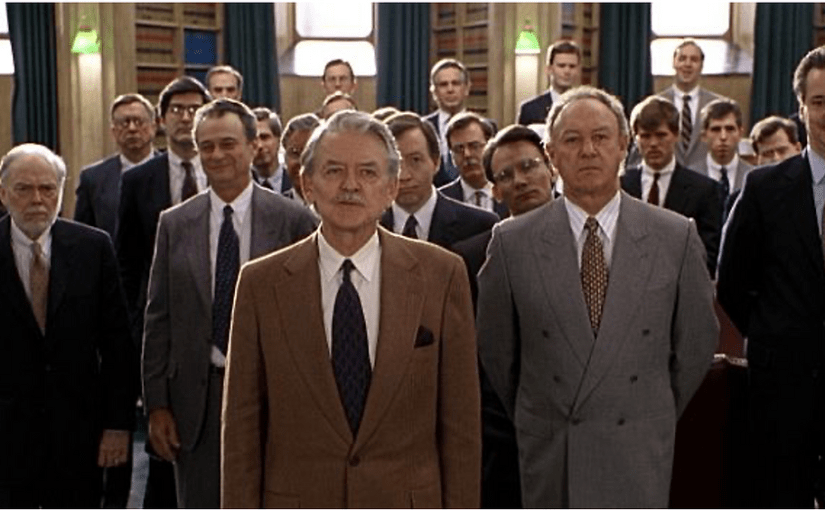
THE FIRM

By Marc S. Sanders

Sydney Pollack was the first director to take a crack at adapting one of John Grisham’s best-selling books, namely the still most popular novel, The Firm. Wisely, and with a measure of risk, Pollack took the script from David Rabe, Robert Towne and David Rayfiel and maintained a true adaptation for the first hour of the film while inventing a new kind of second half that I think improves upon Grisham’s story.

Mitchell McDeere (a well cast Tom Cruise) is the most sought after Harvard law graduate in the country. A small Tennessee firm makes an offer to him that outbids any of the big leaguers. Considering that Mitch comes from a poor broken home with a brother (David Strathairn) currently in jail for manslaughter, the offer and treatment given to Mitch and his school teacher wife Abby (Jeanne Tripplehorn) could not be more enticing. A house, a car, school loan payoffs, and a near six figure salary in the first year is not something anyone would walk away from.

Once the happy, young couple are comfortable though, a curious FBI man (Ed Harris, an MVP of this stellar cast) inquires if Mitch finds it odd that this firm has four of its lawyers dead within the last ten years. The two most recent casualties perished in a boat accident.

The sharp minded Avery Tolar (another welcome performance from Gene Hackman) is assigned to make sure Mitch follows the path the firm expects of him. Avery also has his sights set on Abby. For a guy who has never been regarded as good looking, Hackman plays a pretty effective flirt.

The firm, led by a seasoned Hal Holbrook with a charming Mark Twain like bow tie, and a perfect henchman villain played by Wilford Brimley (definitely on my top list of best bad guys) are involved with the Mafia and their shady dealings of money laundering, racketeering, murder and embezzlement. Now Mitch is stuck.

The FBI want to use him to uncover the firm’s activities but that risks blowing his career and maybe his and Abby’s life. If he doesn’t cooperate, then the Feds will run him in with the rest of the gang.

A second hour focuses on a complicated way for Mitch to get out of this ordeal. It means a lot of white collar work and contrived timing in the script. Fortunately though, Pollack builds suspense with foot chases and some allies on Mitch’s side, including Holly Hunter as an hourglass figured, bombshell secretary to a private investigator (Gary Busey) that Mitch went to see. His plan involves traveling to and from the Cayman Islands, and making copies of legal documents to build evidence of mail fraud against the firm.

Mail fraud???? That’s right mail fraud. It’s not a sexy crime, but the script with Pollack’s direction and a hard pounding piano soundtrack from Dave Grusin manage to keep the suspense up and alert.

Pollack directs Cruise to sprint across downtown Nashville for some great sights and hideouts in broad daylight. Your adrenaline moves with the film even if you can’t connect all the dots of Mitch’s complex plan.

In fact, it’s best to just give up on following every little step Mitch and his team take to stay ahead of the firm. What works best is the seemingly no win scenario for Mitch and Abby. Pollack follows a Hitchcock trajectory. He leaves the bomb on the table but doesn’t detonate it right away. Thus the suspense holds steady.

So, the best kind of counsel I can give is to just enjoy The Firm as it runs through its paces. It’s a solid white-collar thriller.

NIGHTMARE ALLEY (2021)

By Marc S. Sanders

Guillermo del Toro’s Nightmare Alley is a visual feast of the macabre set in a Depression era western America.  Every caption caught on film is unbelievable to look at, and while I know del Toro released his picture in black and white to enhance its film noir theme, I was truly delighted with the color version of the film.  With del Toro’s direction and photography designed by Dan Lausten, every dimension and sparkle of color from a sunset to a dreary cloud in the sky to the lights on a Ferris wheel spinning in an open field from the distance is absolutely jaw dropping.  Nightmare Alley is a modern technical masterpiece.  It makes me want to go back and watch the original 1947 version, as well as explore other productions in the film noir category.

Bradley Cooper portrays Stanton Carlisle, a murderous drifter who ends up accompanying a traveling carnival of garish figures who entertain their quirky qualities for townsfolk to be marveled and amazed.  There’s the flexible snakeman, the world’s strongest man (del Toro regular, Ron Perlman), the smallest man alive, the electrical woman, the psychic and the terrorizing, caged “geek” who will eat the head off a live chicken in front of your very eyes.  At first Stanton serves as a heavy meant to carry loads and set up and strike the tents and stages as the show moves from town to town.  He connects though with the psychic (Toni Collette) and the architect behind her façade (David Strathairn).  Soon, Stanton is adopting their techniques of using code words and hand gestures to “read the minds” of the various audience participants. 

He goes even further by redesigning the electrical woman’s presentation. Before she was using teslas to demonstrate her will to generate electrical currents.  Now she can be zapped in an electric chair.  The woman is Molly (Rooney Mara), and a relationship begins that sends her and Stanton on a successful tour away from the carnival where they entertain more sophisticated and wealthier nightclub guests with his psychic abilities.  One attendee, however, is on to Stanton’s devices, a beautifully alluring psychiatrist named Lilith (Cate Blanchett).  She maneuvers Stanton into using his manipulative talents into conning her clients.  She has recorded her sessions and will share confidential information with Stanton. Then, he will use that towards his ongoing psychic advantage as a means to swindle them of their fortunes.  Lilith and Stanton will split the rewards.  The play seems convincing enough for the likes of a wealthy industrialist named Ezra, played by Richard Jenkins yearning to reconnect with his deceased wife at a cost of thousands of dollars for Stanton’s services.

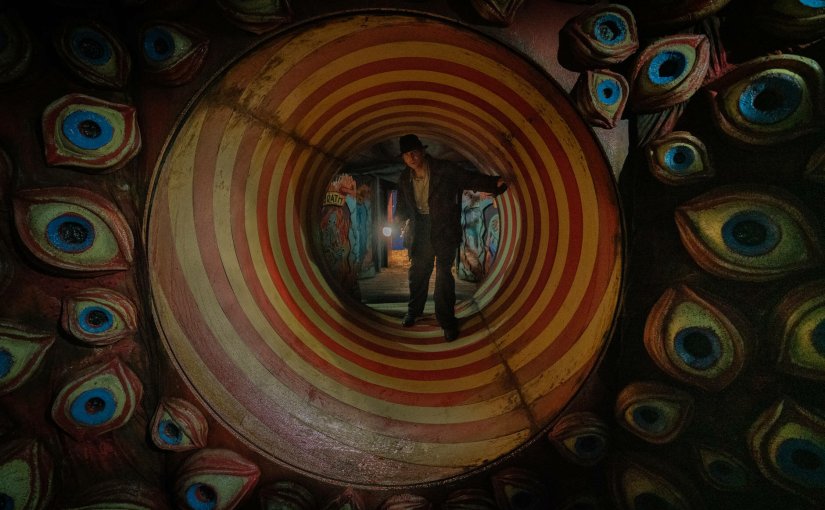
The narrative of Nightmare Alley is so absorbing.  Everything is beautifully staged.  A fun house hall of mirrors has a décor of disturbing imagery.  Stanton enters this place symbolically at the beginning of the film in search of the runaway “geek.”  The surroundings display the seven deadly sins around a large skull and other haunted house imagery.  del Toro demonstrates what Stanton is about to enter, which occupies the remainder of the film.  Stanton performs on the motivations of greed and lust and vanity.  Maybe, pride as well.  At least those are the first couple of sins that come to my mind.  How will his actions reflect back on him later on, though?

The film is also performed by a magnificent cast.  Cooper is doing some of his best work here.  While I feel like I’ve seen Blanchett’s deceitful character before, I don’t mind.  I can’t think of anyone else to play the role.  Curiously, del Toro has Mara, with her snow-white complexion, dressed in red quite often amid a cast of characters and extras wearing blacks and dark greys.  She’s meant to stand out as the innocent.  Molly questions Stanton’s decisions while also trying to convince him to end his charades.  Yet, she only serves as a disturbing pawn in the shyster’s tricks.  Will Stanton corrupt Molly though?  It’s one thing to put on a magic show for a couple of hours each night.  It’s another when you are swindling the massive fortunes of others and toying with their despair. 

Other surprise performers that appear include Willem Dafoe as the showman for the “geek,” and a late appearance by Tim Blake Nelson to close out the film and deliver what’s to come of Stanton. 

Nightmare Alley deliberately moves at a slow pace, but that only allows you to take in its various environments.  From the carnival tents to the nightclubs to the alleyways, to Ezra’s snow covered never-ending garden, and even Lillith’s gold embossed office of cabinetry and furniture are so hypnotic and dark in its intended film noir way.  Again, while I’m sure there’s some striking qualities to the black and white interpretation of the film, I really fell in love with the colors provided by Lausten’s photography.

I won’t call this a favorite film of mine, but I loved the journey of it all.  I appreciated the script by del Toro and Kim Morgan, adapted from the novel by Lindsay Gresham, that depicts a sinful man like Stanton devolve into more sin, until he’s only undone by a smarter sinner than he; a sinner masked within beauty and wealth with a noble and educated profession.  Bradley Cooper and Cate Blanchett perform beautifully with one another.  They make a terrific pair.  I only hope they’ll do another film together.

NIGHTMARE ALLEY (2021)

by Miguel E. Rodriguez

Director: Guillermo del Toro
Cast: Bradley Cooper, Cate Blanchett, Toni Collette, Willem Dafoe, Rooney Mara, David Strathairn
My Rating: 6/10
Rotten Tomatometer: 80% Certified Fresh

PLOT: An ambitious carny with a talent for manipulating people with a few well-chosen words hooks up with a female psychiatrist who is even more dangerous than he is.


No good movie is too long; no bad movie is short enough. – Roger Ebert

Nightmare Alley is director Guillermo del Toro’s longest film to date at exactly two-and-a-half hours.  Going by Ebert’s dictum above, I have to say that it was too long by maybe a half hour or more, but that doesn’t make it a “bad” film.  Just a poorly edited one.

The story revolves around a Depression-era drifter with a troubled past who becomes a carny with the kind of flea-bitten traveling circus that tours all the urban hotspots of Iowa and Kansas, and which is almost all sideshows: a psychic (Toni Collette), a giant (played by del Toro regular Ron Perlman), a rubber man, a girl impervious to electrical currents (Rooney Mara), and a geek show, among other things.  What’s a geek show, you ask?  Why, that’s where people pay two bits to watch a man bite the head off a live chicken.  We are shown one such performance in the opening minutes of the film.  It’s hard for me to believe people were entertained by this, no matter how long ago it was.  I mean, the geek did not look like he was having much fun…although he did seem to be having more fun than the chicken.

Anyway, to make a long story short, the carny, named Stanton (Bradley Cooper), befriends the psychic and her husband (David Strathairn) and reveals that he has always been a student of human behavior, and with a few quick observations, he can make factual statements about someone that boggle the mind.  One thing leads to another, and eventually he leaves the carny behind, with the electrical-current girl, Molly, in tow.  Soon he is headlining nightclubs and posh bars with his mind-reading act, with Molly as his assistant.  One night a beautiful psychiatrist with a level-headed gaze (Cate Blanchett) sees one of his performances and suggests a con: she will provide detailed information about her rich and powerful patients on the sly, and he will do command performances for these elites, making them both rich.  What happens next, I leave for you to discover.

(I must be honest: this is not the kind of film I was expecting from del Toro.  A character study of tragic greed and hubris?  Where are the monsters?  The supernatural nightmares of the title?  But I’m always telling people to criticize the movie the filmmakers made, and not the movie you wish they had made.  I press on.)

I’m finding it hard to summarize my thoughts here.  The movie looked great.  I mean, it looked amazing.  At one point, Stanton runs into the carnival’s funhouse looking for someone, and it’s filled with the kind of over-the-top prop demons and fake ghosts that made me hope we would get a later sequence where these things came alive in some horrifying way.  But no, it’s just intended as throwaway scenery, glimpsed once and never seen again.

There is an extended sequence where Stanton tries to revamp Molly’s act as the “Electric Girl”, coming up with new costumes, new props, new patter (patter is important with sideshows), and it’s a relatively lengthy sequence which felt like it was setting something up.  And, yeah, there’s kind of a payoff, but not the kind I felt it was building towards.

The movie left me with a vague sense of frustration throughout.  We are fed gobs of information about the tricks used by sideshow psychics, the sad ploy used to hire the geeks, the psychic’s husband looms large in the story and then abruptly becomes a non-factor, and it just went on and on and on.  Then in the “riches” part of the rags-to-riches story, Stanton has become insufferable, a believer of his own press releases, willing to put his livelihood (and his life) in jeopardy for that one last big job.

This is all very intriguing stuff, on paper.  But as executed and written, there seemed to be unnecessarily long scenes with loads of information being dumped on us with nothing moving the action forward.  I would pay money to watch Cate Blanchett read a Denny’s menu, but even her extended “therapy” sessions with Bradley Cooper felt interminable.  I felt like those random crowds in Monty Python and the Holy Grail periodically yelling, “GET ON WITH IT!”

To be fair, the Stanton character does eventually get his comeuppance, in literally the final ten minutes of the film.  Full disclosure, I will say without spoilers that it is very gratifying, it had me and some random dude behind me exclaiming loudly in the movie theater, and it features some of the best acting Bradley Cooper has ever done.  But…it came long after I had started shifting in my seat and wondering if I would miss anything important if I ran to get some more candy.

I give Nightmare Alley a 6 out of 10, mainly because it looks so damn good.  del Toro has yet to make a movie that doesn’t look masterful (yes, even Blade II is a beauty to behold).  Also, the acting all around is top notch.  There’s talk Cooper may get an Oscar nod, which wouldn’t surprise me.  But it boils down to a very, VERY long drive for an all-too-short day at Denouement Beach.  A ninety-minute movie crammed into 150 minutes.  Alas.