THUNDERBOLTS*

By Marc S. Sanders

Thunderbolts* is the next Marvel movie out of the assembly line, the second of 2025 (after Captain America: Brave New World).  A new team is haphazardly assembled and the witty lines come through that poke fun at their idiosyncrasies and their origins.  Yelena (Florence Pugh) is the Russian assassin with a daredevil streak.  John Walker (Wyatt Russell) is the wannabe Captain America known formally as U.S. Agent.  There’s Ghost (Hannah John-Kamen) who can teleport in and out of places, and Red Guardian (David Harbour), the Soviet equivalent of Captain America with a shaggy beard, a beer belly and an adorably estranged father/daughter relationship with Yelena.  Bucky, The Winter Soldier (Sebastian Stan) is back too.  We’ve talked enough about him though.

Marvel and Disney are advertising this cast as the anti-heroes, or anti-Avengers and the film lives up to that mantra.  However, it still has the witty banter of those other superhero team up pictures.  What sets this one apart though is that eventually the characters and the story use their brain and a little welcome psychosis for a thrilling final act that leaves you alarmed while welcoming you to empathize. 

The strongest actor and most dimensional character portrayal belongs to Florence Pugh.  No doubt that she carries the film as she leads us into an unexpected underground trap where the other members of this cast are all trying to kill each other at the assigned behest of Valentina Allegra de Fontaine (Julia Louis-Dreyfus).  Yelena quickly figures out Valentina’s deceit while overlooking an innocent looking Frankenstein’s monster of a young man named Bob (Lewis Pullman).  The others are there to just exercise their skills for some cool action scene edits, and tag along with Yelena and Bob.  An escape out of the underground structure might overstay its welcome, but fortunately the characters are fun.

Once the escape is complete, the action gets better from there with explosions and fire power and such.  Cars and a limo go boom.  Bullets deflect everywhere.

Naturally, disaster eventually has to arrive in New York City and it is up to these Thunderbolts* to save the city.  Honestly, as the citizens kept on disappearing into blackness, I kept asking myself why Dr. Strange or Spider-Man didn’t show up.  That’s the become the unwelcome problem with the Marvel films and their ongoing connections to each other.  Why would I expect a teleporter and a group of acrobatic fighters who carry shields and handguns to stop a godlike entity that is destroying New York City?  Last I recall, Stephen Strange was not dead.  I had to look past the obvious though because there’s interesting material that harbors itself during this third act. 

Florence Pugh and Lewis Pullman steer the reins to triumph, and it is more so done with an underlying, bordering hokey message that these two capable actors balance quite well.  There’s punching and running and screaming and superpower stuff, yes.  However, the win works on an emotional level too, setting itself apart from the various Avengers movies.  There’s good editing to be found here as the characters jump from one room to another as personal demons are confronted.  The room jumps make you feel like you are in that inflatable wonder wheel you would walk on in the swimming pool. It certainly keeps you alert. All the while, Yelena, the skilled martial arts assassin, uses her brains and instinct to rescue her teammates and especially Bob.

The debate rages on the oversaturation of superhero movies and how they might be destroying cinema.  I’ve never been so quick to surrender to that argument.  The box office of these films keep jobs in place for a large multi-billion dollar industry and the profits to be made allow for small more arthouse like films to be produced.  Also, they are still so fun and entertaining if you allow yourself not to be such a film snob. So, stop complaining so much. 

As for the material of these pictures, Thunderbolts* is a good, up to date example of not simply relying on special effects and city destruction with another villain of the week.  It has a Ghostbusters/Men In Black humorous vibe to it while still catering to intrinsic insecurities and personal baggage that all of us carry through life.  Sometimes, when we want to escape to the movies, it helps to uncover someone telling a story that gets me, gets you…gets all of us. 
THE EQUALIZER

By Marc S. Sanders

I guess Liam Neeson and Gerard Butler were unavailable when Antoine Fuqua and Denzel Washington collaborated to make the first installment of The Equalizer trilogy, based on the CBS television series that starred Edward Woodward.  This film is nothing special with a nothing special kind of script, a nothing special hero and a nothing special collection of Russian Mafia villains.  The kills are nothing special either.  The action is nothing special.  The explosions are nothing special, even when they are started by a trip wired microwave.

Robert McCall (Washington) lives a quiet life by himself, while working at a jumbo home improvement store (think Home Depot or Lowes – big places for lots of not so special action to take place at the conclusion of a not so special movie).  Turns out McCall, who also lives with OCD, is a retired special ops commando.  Robert uses his down time to read one of a hundred books that should be read before you die, while sitting quietly in a coffee shop each night.  He also volunteers his assistance with getting people to improve their lives.  A plump co-worker named Ralphie (the go to name for fat guys) played by Johnny Skortis is on Robert’s strict diet regimen to lose enough weight so that he can be promoted to the store’s security guard position.  Skortis occupies the best and most interesting character in The Equalizer.  During the final action sequence, it’s what Ralphie does that earned my one cheer during the course of the picture.

Robert also becomes acquainted with a young lady named Teri (Chloë Grace Moretz) who has aspirations of becoming a singer but is weighed down by her call girl commitments to members of the Russian mob.  When Robert sees that Teri has been beaten and is in serious trouble, he doesn’t wait to be asked for help.  He just does what is necessary to even the score.

That about does it for The Equalizer

No.  Seriously.  That’s all there is to it.  And so I’m very disappointed. 

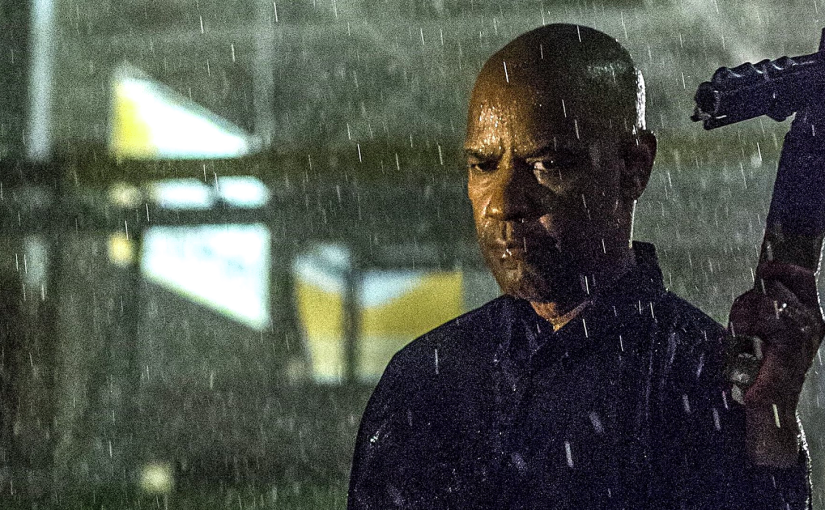
First, Denzel Washington does not even look like he’s trying.  His demeanor to this character is no different than what he did in the lousy Man On Fire, directed by Tony Scott.  The script to this film is not challenging in the slightest.  Like Man On Fire, The Equalizer is simply a series of scenes where Robert torments his villains.  David Harbor is a corrupt Boston cop who gets trapped in his own car, while Robert runs a garden hose from the exhaust pipe to the inside with the engine running.  Where is the entertainment in this?  Washington sits in a chair while he mechanically opens and closes the car window and Harbor gasps for breath.  McCall is inventive with his methods but it does not lend to any story progression or character depth.  I guess Robert McCall is an artiste – one who specializes in torment, torture and death.

The climactic showdown, within the store, is a great set up for some tête-à-tête methodology to happen, but all of it is executed with little interest.  Here’s where I asked myself a question.  McCall nabs a guy in a makeshift kind of bear trap down aisle 10 (I guess).  The thug gets his neck caught in a barb wire noose and up he goes to the second level of pallet platforms for McCall to stare the guy down while the blood squirts out from his throat.  There’s four or five heavily armed other guys roaming the store, but McCall can take a break to stare this guy down for his last breaths.  If this trap works so well with this one guy, then why not set up six or seven more of these MacGyver contraptions and let each machine gun toting baddie go through the same routine?  I know.  I know.  Miguel would respond, “because then there would be no movie!”  Yet, what does that say about The Equalizer that my mind drifts to this idea?

Later in the sequence, McCall easily walks up to another thug from behind and delivers a power drill to the back of his head.  Then he puts the drill back on the shelf.  Again, if this worked so efficiently and covertly, why not just do it again? And what is so exciting about a power drill anyway if Jason Vorhees isn’t using it?

A nail gun is used a few minutes later and Fuqua opts to just have Washington shoot one nail after another into his opponent.  Bang – Nail – Cock! Bang – Nail – Cock!  There’s no pun or one liner.  There’s just a bad guy who falls to one knee, then an arm goes down.  The machine gun lets off a few rounds and drops to the floor. There goes the other knee and then he’s dead.  Washington just observes the guy die while the sprinkler system drenches him stylistically in slow motion. 

I look at The Equalizer and I think back to the ‘80s actioners from Schwarzenegger, Van Damme, Stallone (some of them), Jackie Chan and even Seagal.  The Rock had fun with a few of these action pieces too.  Go check out The Rundown.  There was a pizzaz to the hero’s methodologies back then.  It wasn’t just a brutal killing and bloodletting.  A one liner accompanied the kills.  It made you cheer and applaud.  Those pictures worked like symphonies of dialogue and ultra cool action that John Wayne never accomplished.  Robert McCall is boring.  Just boring.  An absolute bore.

The villain of this effortless piece is also boring.  Marton Csokas did not advance his career with the lack of anything beyond his Russian dialect and three-piece suits used in this picture. 

Antoine Fuqua has yet to wow me.  Though I know he’s an accomplished director, Training Day always feels like it comes up short with the three or four times I’ve watched it looking for its merits. The critically poor procedural of The Equalizer only lessens his promise for growth and potential.

Denzel Washington has resorted to uninspired characters a few times now. He still earns accolades with pictures like the recent The Tragedy Of Macbeth (a Best Actor nomination) and on stage (I was in the third-row orchestra when I saw him do a forty five minute monologue in The Iceman Cometh on Broadway.  Amazing!).  Still, he just recently completed the third installment of the Equalizer series. Ugh!  Why?  Why Denzel?  Why are you trying to be another past his prime, tired Liam Neeson in these cheapo action pictures?

What I wouldn’t give for another Crimson Tide kind of thriller.

BLACK MASS

By Marc S. Sanders

Black Mass tells the story of an FBI agent, and his two childhood friends who are brothers.  One brother is Billy Bulger, a Massachusetts state senator.  The other is notorious Boston gangster James “Whitey” Bulger.  The script has a lot of elements to make for a great crime drama, but I wonder what Johnny Depp is doing here made up to perform like a crazed ghoul.

The FBI agent is John Connolly (Joel Edgerton) who turns to Whitey (Depp), a fearful leader of the Irish mob in South Boston during the nineteen seventies through eighties to work as an informant, providing intel on the competing Italian Mafia.  It’s no secret about Whitey Bulger’s dealings or what territory he covers.  Agent Connolly does his best to protect his friend, so long as he collects pertinent information that leads to arrests.  However, what’s the limit to Bulger’s activities, and how does this reflect on a public figure like Whitey’s politician brother, Billy (Benedict Cumberbatch)?

Much of Black Mass reenacts recorded testimonies after everything has shaken out.  Guys who survived Whitey’s violent crew (Jesse Plemmons, Rory Cochrane) offer information on the gangster’s activities and what he compelled his captains to carry out.  Mixed in with these voiceovers are how Connolly responds to the progress of his operations.  Time and again, his superiors (first played by Kevin Bacon and later by Corey Stoll) question Connolly about how beneficial Bulger can be if the crook always has his finger on the trigger, killing those that might rat him out.  Black Mass is told from an assortment of different perspectives and sometimes that muddies the water.

The most interesting storyline is how Connolly uses and protects his criminal friend, while also stepping away from getting blood on his hands.  Joel Edgerton gives the best performance of the film as an FBI guy who turns a blind eye to Whitey’s crimes. Connolly thinks he can continue his own corruption while Whitey cooperates and leads him to big, heroic indictments of the Italian mob.  As long as the arrangement upholds, the corrupt agent will always have an answer for his actions and stay ahead of the ethical lines he knows he’s crossing.  More importantly, even if his wife protests, Connolly is getting prestigious promotions and collecting substantial paychecks for his progress.  Scott Cooper directs Edgerton with conflicts of overwhelming complications.

One problem is that Whitey Bulger is a loose cannon who is never intimidated, not even by the Feds, especially not by his childhood friend.  His brother Billy looks away to maintain a clean political image.  Therefore, it is quite easy for Whitey to gun down a rat associate in broad daylight in the middle of a wide-open parking lot, shotgun and all.  The killer doesn’t even need to run away from the scene of the crime.  This is Whitey Bulger.

Johnny Depp is great in the role, but does his portrayal belong in this film?  Depp’s career is widely celebrated for the quirky, makeup clad parts he plays such as Jack Sparrow and Edward Scissorhands.  Even Ed Wood is delightfully weird.  In Black Mass, the actor dons steel grey eye contacts, white slicked back hair making him appear almost bald, and skeletal teeth beneath a near albino complexion.  He looks like Skeletor without the hood.  Throw in a brooding, deep Bostonian accent and you have the ghoul I referred to earlier.  Is this Whitey Bulger?  Online photos of the real guy do not seem consistent with the film’s appearance.  Depp’s delivery of dialogue and even his wicked Freddy Krueger laugh seem too far beyond the realm of this crime drama.  The actor is working on another plane than everyone else in the cast who wear hairpieces, three-piece cotton suits and cheesy off-the-rack polyesters and denims to populate this time period from forty years ago. 

A scene showing Bulger dining on steaks with Connolly and his FBI partner (David Harbor) was famously used in preview showings ahead of the film’s release.  Take this scene out of context like the trailer did and Depp looks scary good as he terrifies Harbor for doing something as simple as revealing a long-time secret family recipe.  Afterwards, Whitey goes upstairs to harass Connolly’s wife (Julianne Nicholson) at the bedroom door.  The dinner scene sold me on getting a ticket for the movie as soon as it was released.  However, put it back into the framework of the script and I feel like Black Mass is diverting itself from a complex crime drama to a vampire in a Member’s Only jacket.  As good as Depp is with his makeup and his vocal inflections and pace, it just doesn’t seem to belong in this particular film.  Marlon Brando as Don Corleone with the shoe polish in the hair and the cotton in the mouth? That works.  Johnny Depp as Count Dracula in Sergio Valente skinny jeans is not as effective.

Because the script changes hands from one perspective to another and then another, I found the reenactments of Connolly and Bulger’s reign of crimes to be a little inconsistent.  I found much potential for Benedict Cumberbatch’s purpose as Whitey’s brother, but there is too much diverted away from that character because the picture is trafficked with what everyone else is doing and seeing on top of giving Johnny Depp a lot of scenery to chew.

Black Mass pursued the potential for a very interesting gangster picture like Goodfellas or Donnie Brasco, but it wants to capitalize too much on the latest Johnny Depp routine.  I think James “Whitey” Bulger is an interesting twentieth century bad guy with a violently daring and checkered background.  He had associates within his family and gang to color in a movie that’ll grab you.  The tainted lawmen who were involved are also intriguing.  Scott Cooper and the screenwriters knew this, but often they opt to go in different directions.  

Now that a loose interpretation of Bulger has been played by Jack Nicholson in Martin Scorsese’s Oscar winning The Departed and again here, it’s time to tell the cold-blooded killer’s story once more.  Just go simpler without all the clownish theatrics.

WAR OF THE WORLDS (2005)

By Marc S. Sanders

There’s a harsh reality to science fiction in the 21st century.  When the aliens arrive on Earth, a little girl will ask her dad “What is it?  Is it terrorists?”  Steven Spielberg’s interpretation of H.G. Wells’ War Of The Worlds covered that territory when it was released four brisk years after 9/11.  All these years later and there’s still some legitimacy to that sadly reasonable question.  I find it interesting that one of the most pioneering novels in sci fi was published just ahead of the twentieth century paving the way for endless approaches to alien arrivals and attacks on Earth.  When Spielberg approaches it on his third try, the trope may have been done to death, but now the reality of the response is updated and all too real, and brutally disturbing.

Tom Cruise is the lead in this adaptation, and he is arguably in the most vulnerable role of his career.  He plays a storage bin dock loader, only regarded as a half caring deadbeat and divorced dad to his teenage son (Justin Chatwin) and 10-year-old daughter (Dakota Fanning). After his ex-wife (Miranda Otto) drops the kids off for the weekend, there’s an uncomfortable game of catch in the backyard followed by the beginning of the mayhem.  What appears like a lightning storm evolves into dead batteries and no electricity along with odd wind currents and hammering echoes.  When the people all around the main characters in their New York neighborhood get vaporized, then naturally their first instinct is to think it’s terrorists.  In today’s science fiction, terrorists are real and aliens are not.

Later, once the extra terrestrials (not the friendly kind who consume Reece’s pieces) have viciously introduced themselves, Spielberg’s film resorts to demonstrating mass exodus of the people of Earth.  Military units advise folks to “keep movin’.”  When the attacks happen, people scatter in different directions.  When a ferry is leaving the mainland, helpless folks rush for the dock, desperately climbing over the gates and leaving loved ones behind.  Spielberg hasn’t forgotten about the unlawful occupations from world history.  He simply applies it to a Tom Cruise action piece.

Tim Robbins shows up as a crazed man hiding in a farmhouse basement with a shotgun ready to begin a one-man revolution.  Cruise tries to contain the hysteria.  A scene like this could have had Nazis or aliens circumventing on the floor above, as the central characters remain as quiet as the Jews used to do in the basement below.  The parallels are eerily the same. 

Still, I respect the reality of the piece.  For one thing, much of the film, scripted by Josh Friedman and David Koepp is pulled right from H.G. Wells’ pages, including the nice and tidy ending that eventually arrives.  Don’t knock it.  That’ how Wells wrote the story to begin with.  Spielberg and crew don’t invent their own new image of the invaders.  They are still the tall three-legged tripods towering over the people of Earth and blasting them with their “heat rays.”  My favorite touch of this film is using Morgan Freeman’s vocals as the bookended narrator reciting Wells’ novel text, nearly word for word.  It’s a welcome salute to the memorable radio show that Orson Welles lent to the story decades before. 

I consider this adaptation of War Of The Worlds to be an observational picture or a reactionary film.  Cruise is not super skilled with fighting techniques and weapons handling.  All he can do is watch and react.  He’s an everyman here, which is actually quite unusual for him when you gloss over his resume.  This is not Maverick or Ethan Hunt: Superspy.  His purpose is to watch and return his kids to their mother in Boston, assuming she is still alive.  The success of the mission here only depends on getting the kids back to mom. 

Dakota Fanning and Justin Chatwin go against the grain of so many other Spielberg kid characters.  They are not intuitive or inventive.  Especially for Fanning’s character, she is just a scared little girl.  Not a Goonie and not like Gertie, who is scared for the sake of humor with precocious one liners.  If aliens were attacking the Earth, this is how my kid would react. 

Once it is established that this movie is a Spielberg running man film, then you may be grateful for the realistic mentality of the story’s community.  You’ll also appreciate the amazing set pieces accompanied by John Williams’ original score that plays like a drive-in monster movie or a Twilight Zone episode.  The aftermath of a plane crash on a Jersey suburban neighborhood is very convincing.  A runaway train set ablaze intrudes upon the cast with great surprise.  A cracked piece of concrete that gets swallowed up below only to immediately vomit a tripod in the air for instant attack is eye popping. 

War Of The Worlds is a well-crafted film, and the thought was definitely invested in its approach ahead of making it.  Yet, I won’t say it’s fun escapism.  It’s a reminder of the unrelenting realities we live in now.  Sadly, it’s not reaching to say that maybe we live in a time where it is in fact every person for themselves.  Even Cruise’s son insists on going off on his own, abandoning both him and his sister with nary a care at all.  Unlike Close Encounters or E.T., there’s not much to laugh or grin at in this Spielberg alien film.

The 2005 adaptation of War Of The Worlds is certainly loyal to H.G. Wells.  It may be realistic in the human nature of its science fiction, but in the end, it is also a very bleak film.  There’s much to marvel at, but once the movie is over, as my colleague Miguel and I often recommend to one another, it’ll likely be best that you get outside and bathe in the warm sun under a blue sky, roll around in the grass with your dog, and taste an apple for the first time all over again.  It’s about all we have left to embrace what little is left of our sanity.

QUANTUM OF SOLACE

By Marc S. Sanders

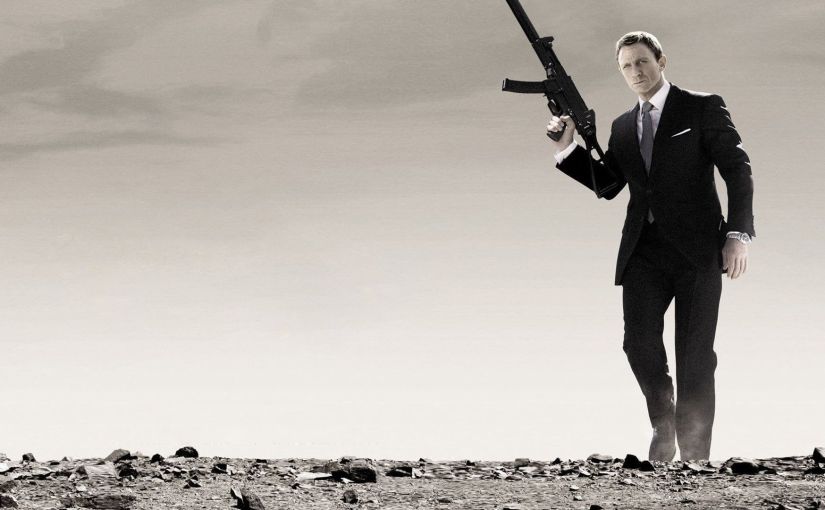
A writer’s strike never bodes well for a film. So the 22nd installment in the James Bond franchise, Quantum Of Solace, suffered because of it. Daniel Craig returns in his second film as Bond which begins as a direct sequel to my favorite film in the series, Casino Royale. Marc Forster (Finding Neverland) directs, but not very well.

Much of the action scenes are very shaky and choppy. Forster seems to have adopted Paul Greengrass’ technique that works so effectively in the Jason Bourne films and United 93. However, Forster does not make clear what is occurring. You can’t recreate Picasso with crayons.

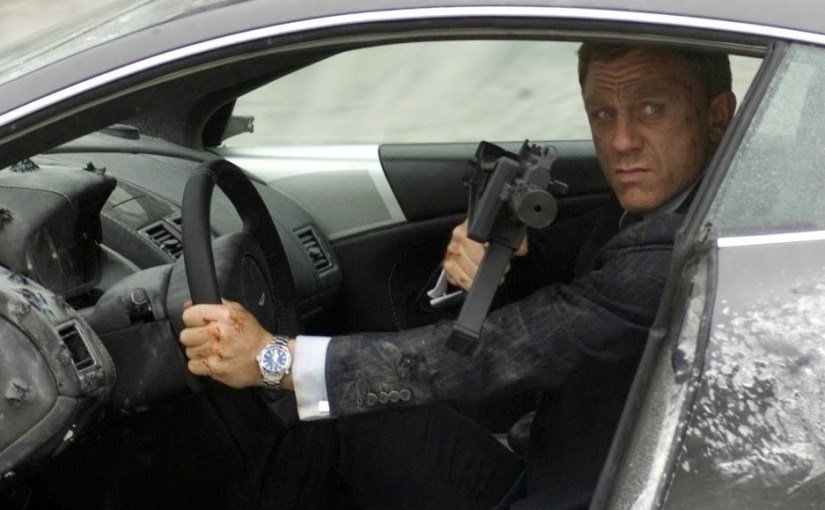
The opening is a rush job of a car chase as Bond races away from enemies in his Aston Martin. Machine guns and heavy traffic and construction sites make way for his car to gradually fall apart but it’s hard to really see how the car becomes damaged in the first place. Just when exactly did the driver’s side door come off? There’s lots of spinning out of control and dirt flying with bombastic gun fire and engine revving. It’s all sensory overload to hide the preciseness in the high speed chase.

Later, Bond is attempting to rescue the girl Camille (boring name, boring girl) played by Olga Kurylenko when she’s held captive on a boat. He jumps into a motor boat and the chase is on. Bond fends off the bad guy by tossing a rope with a hook on it. Just tossing it up. Suddenly the bad guy’s boat flips over. What exactly happened here? How did the rope take out that boat? I didn’t see the connection. Film is visual. So show me the fundamentals from A to Z, please.

The story involves Dominic Greene (Mathieu Almaric) who appears to be an environmentalist with interest in a pipeline in Bolivia. (Bolivia????) At first Bond is under the impression this pipeline must be for oil. Later, it’s realized that Greene intends to charge the country enormous prices as he takes over the water supply. (Roman Polanski’s Chinatown did this all much, much better.). In exchange, Greene will assist a tyrannical Bolivian General in becoming President. This General raped and murdered Camille’s family. Naturally, she wants revenge. As Bond pursues Greene, he comes to learn that Greene is a member of a secret organization called Quantum. Hence the strange title.

Bond follows through with this assignment while trying to determine why his past love (Vesper Lynd from Casino Royale) was murdered, and after MI6 is infiltrated.

The story is kind of all over the place. It has a lot of interesting threads like Bond’s need for revenge, Camille’s need for revenge and a secret organization that MI6, nor the CIA, were ever aware of. Threads remain hanging as threads though if a writer’s strike interferes.

The story for Quantum Of Solace hardly gets fleshed out. We learn nothing of the organization, Quantum. When Bond finishes his mission with Camille, she just gets out of the car and walks away into the middle of nowhere. Where is she going exactly? The climactic battle takes place in a luxury hotel located in the middle of the desert. Unless this is Las Vegas, who goes to a hotel in the middle of the desert? I mean like ever?????

The film is a tremendous disappointment after the creatively artistic success of Casino Royale. Often sequels do not live up to their predecessors, but Quantum really goes off the rails. This film was a make-up as you go.

Craig is fine in the role of Bond; consistent with his first film. Almaric is okay as the villain, but never given much to do. A second woman comes into play, named Fields played by Gemma Arterton, assigned by M to bring Bond out of service. She seems to have a personality that the Camille character lacks, but she’s hardly given much screen time, save for a nightcap with Bond and later an image that harkens back to Goldfinger.

Jeffrey Wright (a great Felix Leighter, that I have not talked about yet) is belabored to share scenes with an obnoxious CIA partner played David Harbour. These two guys seem to be acting in a different movie.

Marc Forster was given a toolbox but didn’t know which end of the hammer to hold with Quantum Of Solace. There are too many things wrong with this film to justify any merits it may have.

Maybe the most interesting moment happens in the epilogue scene as we learn more about Vesper’s past. The scene has next to no relevance with much of the main story beforehand. Still, why couldn’t this film simply stay on this trajectory from the beginning? This is a thread worth pulling on and then tying off.

In other words, Vesper Lynd is far more interesting than the water supply in…ahem…Bolivia. 

QUANTUM OF SOLACE (2008)

by Miguel E. Rodriguez

Director: Marc Forster
Cast: Daniel Craig, Olga Kurylenko, Mathieu Amalric, Judy Dench, Gemma Arterton, Jeffrey Wright, David Harbour
My Rating: 5/10
Rotten Tomatometer: 65%

PLOT: Super-spy James Bond investigates a mysterious organization that seems intent on cornering Bolivia’s water supply.  Yes, you read that right.


The trivia on IMDb for Quantum of Solace (Bond #22, for those keeping track) contains this revealing nugget:  “Editing this movie was so stressful that co-editor Richard Pearson was brought in to assist Matt Chesse, to speed up editing. Director Marc Forster only had five weeks to edit the entire movie. In his previous movies, Forster would take an average of fourteen weeks to edit.”

Right there.  That’s the biggest problem with Quantum of Solace, the reason it’s ranked among my least favorite Bond films.  The stunts are there, the wordplay is there, the Bond girls are there…I was going to add “good villain” to the list, but more on him later.

Anyway, most of the important elements are there, but the movie never really makes us CARE about what’s going on.  We do get the barest bones of a connection to Casino Royale from two years earlier, but that’s still not enough to bring this up to the level I’ve grown accustomed to with Bond films.  This film feels more like one of Vin Diesel’s old XxX movies.

One of the biggest problems is the aforementioned editing issue.  In Casino Royale, the fight scenes were clearly defined and visually exciting.  (Remember that fight in the stairwell?  BRILLIANT.)  In Quantum of Solace, the fight scenes are cut so rapidly I’d swear they were from a Michael Bay movie.  Rather than make the scenes more exciting, this had the effect of making the scenes feel like the trailer for the movie, rather than the movie itself.  It was distracting, and lessened the tension for me.

Another problem that kept me from caring what happened is the plot.  Dominic Greene (Mathieu Amalric) is the villain this time around, and I’m sorry, but he does not exactly come across as a dangerous fellow.  He’s a little on the shorter side, he doesn’t dress impeccably (except when attending the opera), and his hair looks…greasy.  This is not a villain; this is a sidekick looking for a villain.

And his evil plot?  Using an environmental advocate organization as a front to…corner the Bolivian water supply.

The water.  In Bolivia.  After decades of James Bond stopping villains who wanted to do everything from steal nuclear submarines to kill literally every human on Earth, it seems to me this particular mission could have been left to the varsity squad.

There are other elements that were distracting.  David Harbour makes an appearance as a CIA agent whose character serves no real purpose other than to be the stereotypically obnoxious American.  One scene takes place during a beautifully staged outdoor production of Tosca that looked so amazing, I almost wished I could have left the movie just to finish watching the opera.  Gemma Arterton plays Agent Fields (first name Strawberry…get it?), another in a very long line of female characters in Bond films whose sole purpose is to sleep with Bond and/or get killed…or both.  Usually both.  (In an interesting first for the franchise, Bond actually does NOT sleep with the main Bond girl…go figure.)

The movie’s showdown takes place in a location that looked very real, but was ALSO distracting.  What is a four-star hotel doing in the very middle of the Bolivian desert?  We get a clumsy exposition line about the hotel running on “fuel cells” that are apparently poorly protected indeed, given the building’s incendiary tendencies during the climax.

I’m making the movie sound like a BAD movie.  It’s not truly BAD, but it just feels so slipshod in comparison to its predecessor, Casino Royale.

So what happened here?  Well, another tidbit on IMDb quotes Daniel Craig as saying this is the last time he’d work on a Bond movie without a finished script.  I guess THAT’S what happened here.  Shooting a movie without a finished script can sometimes end well, but not usually.  It’s like building a 30-story skyscraper using plans that only go up to the 15th floor, with couriers bringing new blueprints for the floors already under construction as well as the unbuilt floors.

But…BUT.  There is one overwhelmingly bright spot in the film: the THEME SONG.  Performed by Jack White and Alicia Keys, it marked the first (and, so far, only) Bond song to be performed by a duet.  It’s called “Another Way to Die”, and it is a SCORCHER.  Words fail me.  It’s down, dirty, mean, and growling, complete with the occasional staccato brass flourishes so evocative of John Barry’s score from earlier Bond films.

Too bad the rest of the movie is unable to live up to the promise of its title song.  Alas.

EXTRACTION

By Marc S. Sanders

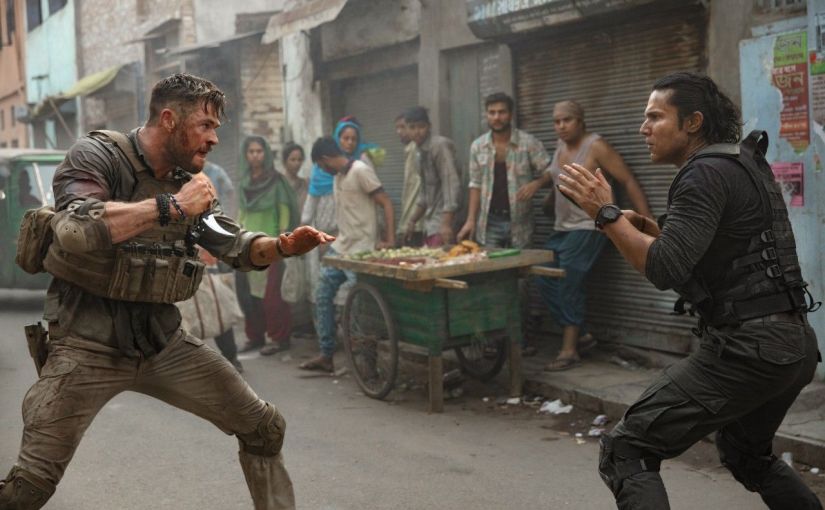
Why do some filmmakers find it to be of such “impactful dramatic narration” to show a snippet of the end of the story or film within the first two minutes of its beginning? That’s what disappointed me in the latest Netflix release Extraction featuring Chris Hemsworth as a skilled Australian mercenary hired to rescue an Indian drug lord’s son that has been kidnapped by a competing drug lord.

Hemsworth plays Tyler Rake, action hero name!!! He’s an alcoholic that manages to maintain his buff physique. I’d like to know the secret to these big action brutes, and how they stay so fit while downing bottles upon bottles of liquor and pills. Tyler has two days to get Ovi Mahajan Jr (Rudhraksh Jaiswal) out of an area of Bangladesh that is completely controlled by Amir Asif (Priyanshu Painyuli) the most powerful drug lord in Dharma, Bangladesh. Ovi Sr is another drug lord trapped in prison. Cops, civilians, street kids, practically everyone in the area operates under the command of Amir.

The rescue happens early with Tyler taking out over a half dozen guys that are holding Ovi in a run down apartment. He kills them every which imaginable. Fist, gun, knife, rake (in a top floor apartment?), you name it. From there, the bulk of the film focuses on how Tyler and Ovi are going to get safely out of the area.

Extraction is directed by Sam Hargrave and produced by Hemsworth’s Marvel super hero producer pal, Joe Russo. It is based on a graphic novel and it’s easy to recognize that. The violence is fast and gory and unforgiving. A major player gets a head shot assassination while standing at a urinal. Hargrave freezes the scene for a moment like a comic book panel. Dialogue throughout the film is somewhat limited to what could only fit in one of those speaking bubbles you find in comics.

Hargrave had me going with a number of long steady cam moments. One in particular has Tyler driving a Mercedes down a busy street while getting shot at, crashed into and rocket launched. The camera goes in and out of the car from the back seat to the front seat to the hood and the trunk and around the bad guys surrounding them. It reminded me of that celebrated sequence from Children Of Men directed by Alfonso Cuaron. Only thing is, Hargrave is not as seamless as Cuaron. I give an ‘A’ for effort, though you easily catch the breaks in the flow.

Tyler gets some assistance from David Harbour, who plays another sleazy kind of cut up, just like in Quantum Of Solace. Can this guy do anything else? (I know…Stranger Things. How about something even more that that though?). He just didn’t do anything for me here.

Tyler also gets some welcome assistance from a female mercenary named Nik Khan (Golshifteh Farahani). She’s completely bad ass, and her character really comes alive in the last 30 minutes.

Extraction is decent entertainment. Honestly, I was getting a little bored as the killings went on and on. How many different ways can a guy be shot in the head? I guess that’s why Tyler swings a dead body like a baseball bat to take out another guy or mashes a guy’s head into a car door window. You know, to mix it up a little bit.

Hargrave’s film does go beyond the normal conventions of action films at times. There are a few twists that got my attention but it’s mostly a film narrated in body count and bullets.

However, because of these mild surprises, again I ask why show me obvious material from the story’s ending as a quick pre title sequence? It would have been a much more satisfying surprise for me as a viewer had I not known what was to eventually come into play.