
By Marc S. Sanders
I grew up watching the television show M*A*S*H with my mother and brother. Don’t hate me but I have yet to see the Robert Altman film. Perhaps that is because I was afraid of major disappointment. The formula for many of the episodes and seasons of the TV show work so well at blending tidbits of comedy within a setting that is nothing else but bloody turmoil. For those characters to survive required all of them to laugh and lampoon into the face of an uncontrollable situation where their lives could end at any time while they live in misery.
These thoughts came back to me as I watched an unsung and forgotten film from 1984, Teachers directed by Arthur Hiller. John F Kennedy High School is only going in one direction which is very far south beyond the gates of hell. A gym teacher is getting students pregnant, a kid shows up at the principal’s office with a stab wound in the arm, and the school psychologist has just lost her marbles because the old fart tenured teacher hogs the ditto copy machine (Remember those? You could get high off the ink on the paper.). A mental patient has managed to worm his way into a comfortably welcome substitute teacher position. The driver’s ed car has been stolen and one student terrorizes another teacher in an assortment of ways beginning with biting and then moving on to theft.
Alex Jurel (Nick Nolte) is the admired social studies teacher who has lost his passion for the profession. It’s not so much that the student body or the teaching staff is out of control. The whole administration has taken to a new mentality of profit over proficiency. The merits that come with an education are all but dismissed. The assistant principal (Judd Hirsch) used to care as well. Now, his job is to maintain a façade for the school and churn out one student body after another year after year. The principal only knows to answer any questions with a genuine “I don’t know.” reply. Bottom line is no student should ever be flunked from John F Kennedy High School. If they can read enough, then it’s enough to get the diploma.
A former student of the school is Lisa Hammond (JoBeth Williams), now an attorney and representing a graduated student who is suing the school claiming he is an illiterate who cannot find a job or begin a future due to the negligence of the school. Lisa is a crusader. She’s not here for the money to be earned from the case. She’s here to make a change and her lynchpin deposition will come from Alex who will testify about the truth that’s occurring. Hopefully, he will also recruit other teachers in tow to back up the claim. Naturally, as his former student with the nice ass, Lisa becomes involved with Alex on the side. Like most movies, this one also does not question the conflict-of-interest circumstance. We just have to roll with it.
I really take to the dilemma of the school and I understand both sides of the argument. Now, more than ever, over forty years after the release of this film, I think our educational system is in dire straights with minimal funding, lack of support and respect for a teaching staff, parents who exonerate themselves of being responsible for their children’s lack of progress and behavior, and then of course there is the very real epidemic of school shootings and on campus violence.
However, school is a necessary element to our society and its where all of us begin. To uphold a reputation will involve both losses and wins. Not every student will make it. Not every student will miss out either. As Judd Hirsch’s character insists, half of these students will not graduate with a proper education but half of them will.
Okay. Enough arguing! How about Arthur Hiller’s movie? Teachers has much to stand on and I wish it had garnered more attention. It’s undoubtedly worthy of it.
Like M*A*S*H, there’s organic comedy that comes from the film and a variety of teachers and students appear like they have been cut from familiar cloths. Most of the comedy works especially well. I love the ongoing joke of the one teacher who sits at the back reading his paper and dozing off, with the students facing away from him while they complete an assignment during the period. The punchline to this joke may be predictable, but I’m still allowed to laugh as I watch it play out. It’s funny.
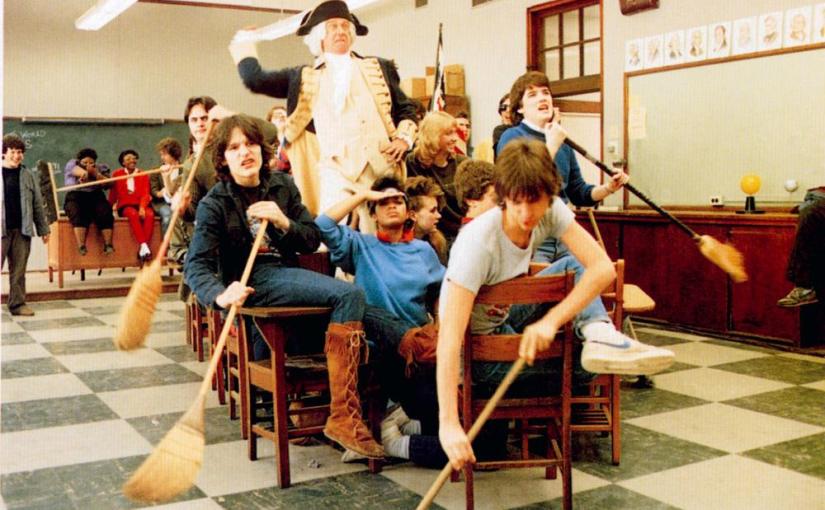
Richard Mulligan (Empty Nest) plays a mental patient that ironically engages his students when he conducts his classes dressed as famous historical figures like Lincoln and Custer. Watch him reenact George Washington’s crossing of the Delaware with his students “rowing” the boat. It’s an image I will not forget. Nor will I forget his final scene in the picture as he encounters Nolte’s character in the hallway.
Where the film falls short is in the one student that is primarily focused on, played by Ralph Macchio, shortly after coming off his first Karate Kid movie. Just like in The Outsiders, which I recently wrote about, Macchio relies on his dark complexion, stylish black hair, blue jeans and that popped up jacket collar again. There’s also that strut he always has. Forgive me for beating up on the kid, but too often I see Macchio donning the same image – that cool kid pose needed for the cover of Teen Beat Magazine. Nick Nolte shares a lot of scenes with the actor playing the troubled kid with a sixth grade reading level. However, Nolte is the only one working most of the time. Another actor in this role would have served better. It’s a necessary role as it attempts to awaken Nolte’s teacher character to try saving another kid before he gets lost. Back then, maybe Emilio Estevez or Lou Diamond Phillips would have been more suitable. Instead, we get Ralph Macchio being Ralph Macchio all over again.
Teachers is a comedy drama that mostly works. It’s easy to get caught up in the comedy and, sadly, the absurd truth of what goes on in a metropolitan public school system back in the 1980s. There’s also very dramatic and heavy elements to the film that stay with you. Before school shootings no longer became shocking (a sad and current truth), Teachers explored the trauma of school bullying and the response the comes with that issue.
Arthur Hiller’s film did not invent the wheel on troubled times within school. Heck, even The Sweat Hogs from Welcome Back, Kotter were troublemakers too. Not to mention there are other school dramas to come before, like Blackboard Jungle. However, Teachers is an very engaging film. I was completely absorbed as soon as the movie began, first in its comedy, and then later in its drama. A near final scene of the film is eye opening and much like Steel Magnolias will leave you laughing and crying all at the same time. That happens because you quickly begin to care for most of these characters and the turbulent times they live through as a teacher making next to no money while working under unfair and unreasonable scrutiny.
I think Nick Nolte is delivering one of the best performances of his career. He has great chemistry with JoBeth Williams, who is good in her role. The romantic storyline does not go overboard. It does not get schmaltzy. It is just enough, and it’s wise to include dialogue where they debate one another from two different sides of a coin.
Teachers also works as a great look back piece. A lot of well-known, eventual recognizable actors round out this cast including Morgan Freeman, Crispin Glover, Laura Dern, Allen Garfield, and Lee Grant. Anytime Nolte is on screen, he only enhances the scenes he shares one on one respectively with most of these actors. The moments between him and Macchio only work because of Nick Nolte. Call Nolte the Alan Alda/Hawkeye Pierce of this picture.
Teachers might look tame by the turmoil we see today in schools across the country but none of what is seen is untrue or exaggerated either. Well, maybe except for the mental patient who arguably turns out to be the most engaging and influential instructor of them all. That’s funny stuff, but you gotta be a little bit crazy to become a teacher nowadays.

 2 UNPAID MOVIE CRITICS!!!!